Multiply by Five Worksheets | Multiplication Facts | 5 Times Tables




- Grades
- Grades 2–3, Elementary
- File type
- Preparation
- Print ready


- Subject
- Math, Multiplication and Division, Division
- Topic
- multiplication facts, 5 times tables
- Resource types
- Worksheets & Printables, Worksheets
- Preparation
- Print ready
About this resource
What's inside this resource
Multiply by Five Worksheets | Multiplication Facts Unit | 5 Times Tables
A comprehensive teaching resource designed to aid educators in teaching the five times tables. Ideal for educators overseeing Grade 2 or Grade 3 pupils who are presently immersed in mathematics and more specifically, multiplication.
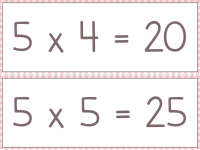
Product Components:- Bulletin board equation cards that are visually appealing and optimal for interactive learning or display purposes.
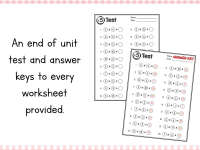
- Over 25 worksheets, activity pages and additional resources intended to strengthen your students' ability to multiply by five through diverse and engaging tasks.
- A special flashcard set dedicated to multiplying by five that could add variety to your class routines.
The materials included can be used flexibly according to classroom dynamics or individual learning methods: first, as individual work; secondly, during small group sessions (peer work can be particularly effective when understanding multiplication mechanics); lastly, as homework assignments which extend learning beyond school hours.
Main Goal:To promote deep comprehension of multiplication facts rather than simple rote memorization.
What the resource provides:- a fusion of traditional methods with creative approaches,
- dissipation of any monotony linked with repetitive exercises,
This constitutes a constructive way of evaluating student's understanding effectively while delivering immediate feedback about their progress in acquiring their multiplicands relating number five .
In summary: An all-in-one package enhancing multiplied-by-five education packed within an easily downloadable PDF format totalling 71 print-ready pages providing utmost convenience on administrative front to teachers. Definitely an easy go-to when it's time again to demystify multiplications by fives!Related resources
More resources teachers may find useful
24 related resources were found using this product's title, contributor, categories and tags.

In the classroom
Teaching tips & learning objectives

Learning objectives
Recall products in the 5 times table from zero through twelve
Represent multiplication facts through equations, matching, stories, and visual tasks
Recognize multiples of five in a mixed-number maze

Teaching tips
Introduce the zero-to-twelve fact cards before selecting mixed practice pages.
Move from direct equation pages to matching, story, search, and maze formats once the core products are familiar.
Use the corresponding checking section only after a selected activity is complete, keeping the practice and review pages paired. Compare the five-times-table patterns with what happens when students multiply by 0 and 1.

Skills covered
Five-times-table fluency — products with a factor of five recur from zero through twelve.
Fact representation — equations are matched, written, searched, sorted, and applied in stories.
Multiple recognition — the maze requires distinguishing multiples of five from other values.

No reviews yet
Downloaded this resource? Tell other teachers how it went.
Curriculum
Standards, concepts & topics
Standards
 Standards
- 3.OA.A.1 — Interpret products of whole numbers, e.g., interpret 5 × 7 as the total number of objects in 5 groups of 7 objects each. For example, describe a context in which a total number of objects can be expressed as 5 × 7.
- 3.OA.A.3 — Use multiplication and division within 100 to solve word problems in situations involving equal groups, arrays, and measurement quantities, e.g., by using drawings and equations with a symbol for the unknown number to represent the problem.1
- 3.OA.A.4 — Determine the unknown whole number in a multiplication or division equation relating three whole numbers. For example, determine the unknown number that makes the equation true in each of the equations 8 × ? = 48, 5 = � ÷ 3, 6 × 6 = ?.
- 2.OA.C.3 — Determine whether a group of objects (up to 20) has an odd or even number of members, e.g., by pairing objects or counting them by 2s; write an equation to express an even number as a sum of two equal addends.
- 2.OA.C.4 — Use addition to find the total number of objects arranged in rectangular arrays with up to 5 rows and up to 5 columns; write an equation to express the total as a sum of equal addends.
- 3.OA.B.5 — Apply properties of operations as strategies to multiply and divide.2 Examples: If 6 × 4 = 24 is known, then 4 × 6 = 24 is also known. (Commutative property of multiplication.) 3 × 5 × 2 can be found by 3 × 5 = 15, then 15 × 2 = 30, or by 5 × 2 = 10, then 3 × 10 = 30. (Associative property of multiplication.) Knowing that 8 × 5 = 40 and 8 × 2 = 16, one can find 8 × 7 as 8 × (5 + 2) = (8 × 5) + (8 × 2) = 40 + 16 = 56. (Distributive property.)
- 3.OA.B.6 — Understand division as an unknown-factor problem. For example, find 32 ÷ 8 by finding the number that makes 32 when multiplied by 8
- 3.OA.C.7 — Fluently multiply and divide within 100, using strategies such as the relationship between multiplication and division (e.g., knowing that 8 × 5 = 40, one knows 40 ÷ 5 = 8) or properties of operations. By the end of Grade 3, know from memory all products of two one-digit numbers.
Core concepts
 Core concepts
Multiplication facts
Five times table
Multiples of five
 Topics
Explore more
Categories this resource belongs to
Explore related searches
More to explore
You may also like