Multiply by Eleven Worksheets | Multiplication | 11 Times Tables

- Grades
- Grades 2–3, Elementary
- File type
- Preparation
- Print ready


- Subject
- Math, Multiplication and Division, Division
- Topic
- flash cards, multiplication unit
- Resource types
- Worksheets & Printables, Worksheets
- Preparation
- Print ready
About this resource
What's inside this resource
Are you practicing your times tables? We all know that practice and repetition are important for memorizing multiplication tables, but that can get boring! This set has a variety of worksheets, activities, flashcards, and even a test. Enjoy!
How To Use This:
Look through all the resources and decide which ones to use. Print out flashcards and cut them apart before use. Print enough worksheets for each student. Use them as individual work, small group work, or homework. There is a wide variety of games and activities mixed in with more classic worksheets in hopes that you can provide some variety as they practice their multiplication fact. A test has been provided at the end to assess how well they’ve learned their facts!
What You Get:
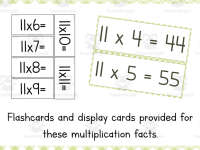
- A set of bulletin board equation cards for teaching or display
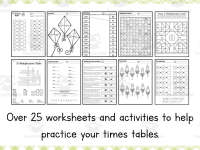
- 25+ worksheets, activity pages, and resources to help practice your x11 tables
- x11 flashcard set
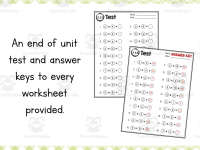
- x11 test
- Answers keys for all worksheets, activities, and tests
Want More Multiplication Resources?:
- Multiply by Zero: Multiplication Worksheets and Activities
- Multiply by Two: Multiplication Worksheets and Activities
- Multiply by Three: Multiplication Worksheets and Activities
- Multiply by Four: Multiplication Worksheets and Activities
- Multiply by Five: Multiplication Worksheets and Activities
- Multiply by Seven: Multiplication Worksheets and Activities
- Multiply by Eight: Multiplication Worksheets and Activities
- Multiply by Nine: Multiplication Worksheets and Activities
- Multiply by Ten: Multiplication Worksheets and Activities
- Multiply by Eleven: Multiplication Worksheets and Activities
- Multiply by Twelve: Multiplication Worksheets and Activities
Check out other resources from my store: Simply Schoolgirl!
I can be contacted for questions and concerns at simplyschoolgirl1@gmail.com
Related resources
More resources teachers may find useful
24 related resources were found using this product's title, contributor, categories and tags.

In the classroom
Teaching tips & learning objectives

Learning objectives
Recall products in the 11 times table from zero through twelve
Use eleven-times-table facts in equations, matches, stories, and visual puzzles
Identify multiples of eleven among mixed values

Teaching tips
Sequence the fact cards before mixed equations so products through 132 are introduced in order.
Alternate a direct fluency page with a story, search, craft, or maze format to change the required response.
Keep each selected activity beside its corresponding checking page during correction rather than exposing the full solutions section.

Skills covered
Eleven-times-table recall — products with a factor of eleven recur from zero through twelve.
Multiplication application — facts are used in stories, matches, searches, crafts, and puzzles.
Multiple recognition — the maze isolates multiples of eleven within a mixed grid.

No reviews yet
Downloaded this resource? Tell other teachers how it went.
Curriculum
Standards, concepts & topics
Standards
 Standards
- 3.OA.A.1 — Interpret products of whole numbers, e.g., interpret 5 × 7 as the total number of objects in 5 groups of 7 objects each. For example, describe a context in which a total number of objects can be expressed as 5 × 7.
- 3.OA.A.3 — Use multiplication and division within 100 to solve word problems in situations involving equal groups, arrays, and measurement quantities, e.g., by using drawings and equations with a symbol for the unknown number to represent the problem.1
- 3.OA.A.4 — Determine the unknown whole number in a multiplication or division equation relating three whole numbers. For example, determine the unknown number that makes the equation true in each of the equations 8 × ? = 48, 5 = � ÷ 3, 6 × 6 = ?.
- 3.OA.C.7 — Fluently multiply and divide within 100, using strategies such as the relationship between multiplication and division (e.g., knowing that 8 × 5 = 40, one knows 40 ÷ 5 = 8) or properties of operations. By the end of Grade 3, know from memory all products of two one-digit numbers.
- 3.OA.B.5 — Apply properties of operations as strategies to multiply and divide.2 Examples: If 6 × 4 = 24 is known, then 4 × 6 = 24 is also known. (Commutative property of multiplication.) 3 × 5 × 2 can be found by 3 × 5 = 15, then 15 × 2 = 30, or by 5 × 2 = 10, then 3 × 10 = 30. (Associative property of multiplication.) Knowing that 8 × 5 = 40 and 8 × 2 = 16, one can find 8 × 7 as 8 × (5 + 2) = (8 × 5) + (8 × 2) = 40 + 16 = 56. (Distributive property.)
Core concepts
 Core concepts
Multiplication facts
Eleven times table
Multiples of eleven
 Topics
Explore more
Categories this resource belongs to
Explore related searches
More to explore
You may also like