



The Lemonade Crime Novel Study Digital & Print Comprehension questions

- Grades
- Grades 3–6, Elementary, Middle School
- Pages
- 97
- File type
- Multiple File Types


- Subject
- ELA, Reading, Strategies
- Topic
- novel study, teacher plans
- Resource types
- Novel Studies, Worksheets & Printables
About this resource
What's inside this resource
The Lemonade Crime Novel Teacher Plans: A Comprehensive Teaching Resource
Designed specifically for students in grades 3-5, The Lemonade Crime Novel Teacher Plans provide an enjoyable and engaging learning experience. This resource comes with meticulously planned lesson plans, paving way for a smooth teaching journey. Utilize it either as a daily English Language Arts curriculum or fill-in during substitute teacher days—both approaches guarantee riveting sessions!
The Lemonade Crime novel, part of The Lemonade War series, is the perfect educational tool that introduces concepts like character traits, symbolism, comprehending circumstances and comparing/contrasting factors.
Digital Advantage
An accompanying digital version adds depth to lessons with an extra activity for each chapter. It can be printed out or shared digitally depending on convenience, giving you unrivalled flexibility!
Beyond Reading: Activities & Insightful Questions
Comprehensive comprehension questions
Intriguing activities aligned with lessons
Tailor-made resources prepared in advance saving you precious planning time!
Upcoming Resources & Updates:
We also have updates related to other books from The Lemonade War Series including The Bell Bandit, The Candy Smash, and the Magic Trap.
Addition of Exciting Reads:
If you enjoyed working with our comprehensive lesson plan structure, be sure to check out similar packages designed for other popular novels such as the impactful 'Island of the Blue Dolphins' and whimsical 'The Phantom Tollbooth' providing flawless preparatory work by us.
Digital Bonuses
Recipients of this package gain access to over 50 beautifully crafted Google slides complementing all Language Arts lessons. You'll find resources emphasizing Reading Strategies, expanding the learning structure from a mere physical book to a wholesome digital-physical hybrid experience for both teacher and students.
Related resources
More resources teachers may find useful
24 related resources were found using this product's title, contributor, categories and tags.


In the classroom
Teaching tips & learning objectives

Learning objectives
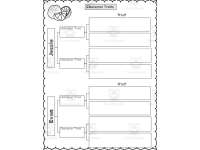
Identify character traits for Jessie and Evan and support each with proof drawn from the chapter, following the worked example about Jessie skipping third grade
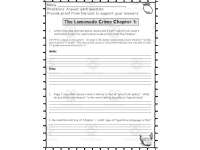
Distinguish literal from figurative meaning, starting with the mother's advice to "give Evan space" in Chapter 1
Work out an unfamiliar word from its sentence using the five SAIDE context-clue strategies and record five such words from the novel

Teaching tips
Each teacher plan names its differentiation up front - the graphic organizer for students who need to plan an answer, and an unscaffolded short response for those who do not - so the split can be decided before the lesson rather than during it
The context-clues page comes twice: the first copy carries worked examples built around the word eccentric, the second is blank for students' own five words. Show the first, then hand out the second
The APE frame appears at Chapter 13, well into the unit, so earlier written answers are a good baseline to compare against once it is introduced

Skills covered
Character analysis with textual proof - students name at least two traits each for Jessie and Evan and cite the page and detail that shows it, following a modelled example.
Literal versus figurative meaning - Chapter 1 asks whether "give Evan space" is meant literally, and later pages ask students to identify figurative language in the chapter.
Context-clue strategy - the SAIDE page teaches synonym, antonym, inference, definition and example clues with worked sentences, then asks students to classify five unknown words from the novel.
Good to know
Questions teachers ask about this resource
How is each chapter's teaching plan laid out?
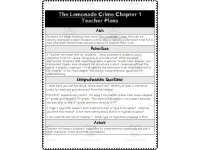
Four fixed parts. An Aim naming the skill and the question behind it, a Procedure that models the skill and gives the differentiated route, the chapter's comprehension questions with a worked example where one is useful, and an Assess line describing what to look for in the responses.
What does the culminating project actually require students to make?
A performed or filmed scene. Groups of five or six pick a scene, note its page numbers, list every character in it, build the characters from clay, play doh, construction paper or household items, make a background from a shoe box, cardboard or poster board, then reenact it and record it on an iPad as a mini movie.
What does the SAIDE page teach?
Five ways to work out an unknown word from its sentence - Synonym, Antonym, Inference, Definition and Example. The first copy demonstrates all five around the word eccentric; the second is blank so students can log five words they were unsure of from the novel under the strategy that unlocked each one.

No reviews yet
Downloaded this resource? Tell other teachers how it went.
Resource details
Concepts & topics
Core concepts
 Core concepts
Novel study
Character traits
Textual evidence
Context clues
Figurative language
Symbolism
 Topics
Explore more
Categories this resource belongs to
Explore related searches
More to explore
You may also like


