Sales Tax Worksheet: Financial Literacy, Life Skills, Percent Math



- Grades
- Grades 7–10, Middle School, High School
- Pages
- 2
- File type
- Answer key
- Included


- Subject
- Life Studies, Home Economics, Finance, Math, Percentages, Decimals, Special Resources, Life Skills
- Topic
- Sales Tax, Financial Literacy
- Resource types
- Worksheets & Printables, Worksheets
- Answer key
- Included
- Standards
- 7.RP.A.3
Product description
From the author
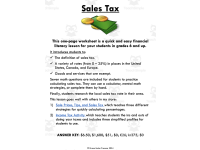
This two-page PDF includes teacher information and answers plus a one-page student worksheet. Students calculate sales tax in seven purchase scenarios using the supplied rates and exemption information, then research their local rate.
Use a calculator, mental math or decimal multiplication to solve the fixed exercises. Treat the printed rates as classroom problem data; current local rates and rules require separate checking for the research prompt.
Related resources
More resources teachers may find useful
24 related resources were found using this product's title, contributor, categories and tags.


In the classroom
Teaching tips & learning objectives

Learning objectives
Calculate sales tax on a purchase by applying a given percentage rate
Apply the worksheet’s supplied exemption information to its purchase scenarios
Research the local sales tax rate requested in the final prompt

Teaching tips
Point out item 4 (dental work in Connecticut) as a deliberate trick question — dental work is listed as sales-tax exempt earlier on the page, so the correct answer is $0, not 6.35% of $550.
Have students convert each percentage to a decimal before calculating, since the worksheet allows a calculator, mental math, or by-hand decimal multiplication.
Use the final research question (finding the local sales tax rate) as a homework or discussion extension after the seven set-location problems are checked.

Skills covered
Calculating a percentage of a dollar amount to find sales tax owed on a purchase.
Applying a real-world rule (tax-exempt categories) rather than mechanically applying a percentage to every problem.
Good to know
Questions teachers ask about this resource
Should students use the worksheet’s rates for the seven problems?
Yes. The fixed problems supply rates and exemption information for the calculations. The final research prompt separately asks students to find their local rate.

No reviews yet
Downloaded this resource? Tell other teachers how it went.
Curriculum
Standards, concepts & topics
Standards
 Standards
- 7.RP.A.3 — Use proportional relationships to solve multistep ratio and percent problems. Examples: simple interest, tax, markups and markdowns, gratuities and commissions, fees, percent increase and decrease, percent error.
Core concepts
 Core concepts
Sales tax
Percent calculation
Tax exemptions
 Topics
Explore more
Categories this resource belongs to
Explore related searches
More to explore
You may also like