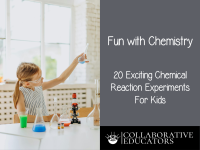
Fun with Chemistry: 20 Exciting Chemical Reaction Experiments For Kids

- Year groups
- Years 1–6 (Key Stages 1–2)
- Pages
- 24
- File type
- Preparation
- Print ready


- Subject
- Chemistry, Science
- Topic
- Chemistry, Experiment
- Resource types
- Activities
- Preparation
- Print ready
From the author
About this resource
Welcome, young scientists and teachers! This eBook is full of fun and colourful experiments that show how different substances can react to create amazing effects. You will see bubbles, colour changes, fizzing eruptions, and even “rockets” that zoom up into the air. As you explore these experiments, remember that science is all about asking questions, observing closely, and having fun learning about the world around us.
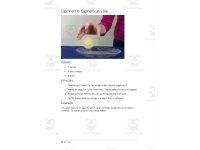
There are 20 exciting chemistry experiments included. They all involve simple chemical reactions that can be safely performed by kids. For each experiment, the materials are listed, and the step-by-step procedure. Finally, an explanation is given, so as to highlight the science behind the experiment.
Last but not least: All experiments must be conducted under strict adult supervision. Always wear safety goggles (or ask an adult to help you wear them) and use the experiments in a safe area where spills can be easily cleaned up.
Related resources
More resources teachers may find useful
More resources on the same subject and topic.


In the classroom
Teaching tips & learning objectives

Learning objectives
Students predict and observe the outcome of a simple acid-base or gas-producing chemical reaction.
Students read a plain-language explanation to connect an observed result (fizzing, colour change, inflation) to its underlying chemical cause.
Students discuss, in response to open prompts, why a specific reaction produced the result they observed.

Teaching tips
Require adult supervision and safety goggles for every experiment, as the book's own safety page instructs, and read each experiment's individual materials list in advance since a few call for items like hydrogen peroxide or a hairdryer.
Group experiments that share the same underlying reaction (baking soda + vinegar appears in the volcano, balloon, apple volcano, and popcorn experiments) to reinforce that one chemical principle explains several different demonstrations.
Use the built-in discussion prompts (for example, in the invisible-ink and fizzy-citrus experiments) as a quick verbal check for understanding before moving to the next activity.

Skills covered
Chemical reaction observation — students carry out simple acid-base and gas-producing reactions and observe the physical result.
Cause-and-effect science reasoning — students connect an observed effect (bubbles, colour change, inflation) to the chemical explanation given for each experiment.
Safety practices in hands-on science — students follow materials and step lists that build in adult supervision and protective equipment.

No reviews yet
Downloaded this resource? Tell other teachers how it went.
Resource details
Concepts & topics
Core concepts
 Core concepts
Chemical reactions
Acids and bases
Gas production
Topics
 Topics
Explore more
Categories this resource belongs to
Explore related searches


More to explore