



3,911 products added recently
Page 4 - Guided Reading Activity
Enhance your guided reading sessions with activities that support students at various reading levels. This collection provides structured resources, including question prompts, discussion guides, and comprehension exercises. By incorporating these guided reading activities into your lessons, you can facilitate deeper understanding and encourage critical thinking among your students.

 Show filters


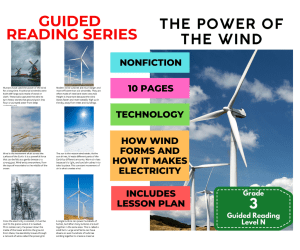
Guided Reading Level N - The Power of the Wind (with Lesson Plan)
ELA, Resources for Teachers, Reading Comprehension, Reading, Social Studies, Geography, Earth and Environmental Sciences, Science, Physics, Technology, Grade 2, 3, 4, Worksheets & Printables, Worksheets, Teacher Tools, Centers, Activities, Literacy Readers, Quizzes, Quizzes and Tests, Assessments, Lesson Plans
This Guided Reading Book - The Power of the Wind (Level N) with lesson plan includes: Guided Reading Color Label (front cover x1) This is a quick way to match the book’s demands to what students can generally handle.. The overall goal is to use the level/color to pick books for several smaller groups. To qualify for a certain level, a student is expected to read a book from that level with about 90–94% accuracy. If a student is consistently accurate and understands, move up a level. If the student is struggling at that level, drop down and add more support. Each student will improve at completely different rates, but it is generally one of the best ways to check progress across the class. DOWNLOAD THE CATALOG TO VIEW ALL GUIDED READING BOOKS AVAILABLE (SORTED LEVELS A-Z) Pre-Reading Question (x1) Teacher asks the prompt aloud, can be while showing the cover or first page. Students share what they already know, or make educated guesses from the cover. Prompt them to use the target vocabulary. Write some of their responses on the board to look back at during the reading. Vocabulary Words (x5) Introduce the five words, best doing it one at a time. Start by saying it, while students repeat and then see if anyone knows what it means before reading further. Read through the meaning and try to briefly connect each word to a picture or gesture so it’s meaningful. Ask students to flip through the book pages and point to where they see each of the vocabulary words. While reading the book pause upon coming across one of the vocab words or read the sentence twice to make sure students understand the word has appeared. Optional: Ask students to raise hands whenever they see/hear one of the new words. Guided Reading Pages (x10) Check the book snapshot (below) for: primary topic - do you need to prep extra reading or intro materials on this? what is taught best - decide on 1-2 bullets to focus on, use the prompt or words provided here for best results. learning goals - what you are checking for students to be able to do after the session, elicit answers using prompts or words provided. key vocabulary (see section above). questions overview - so you know what is coming up and if you need to prep extra materials to assist understanding. Run the lesson You may have already looked at a few of the pages together, but you can show them some of the pictures again first to set meaning. Depending on how much time you have and how familiar your students are with guided reading class, you may want to read the book aloud first with the group first. Students whisper or partner read, while you listen in. If time, do it as a group, one student reading a page each. Use the guided page’s prompts to coach: “Check the picture / does it make sense?” “Point under the words / try the first sound” “Reread the sentence smoothly”. Try to focus more on one student per session (rotating every time), so you can work out if they are ready to move up or need to move down a level. Comprehension Questions (back cover x3) This is your way to check that students didn’t just say the words, but actually understood the text. First, let students answer by pointing to the page/picture and saying a short sentence. After any answer, follow with: “Show me where you found that in the text.” In bigger groups, have partners answer first (10–20 seconds), then call on 2–3 students to share. Differentiation tips: Emerging speakers/struggling readers: oral + pointing On-level: oral in a full sentence Higher: one written sentence or draw + label Book Snapshot Title: The Power of the Wind Genre: Nonfiction (informational science text) Subject: Science (Energy/Earth Science) Primary Topic: How wind forms and how it makes electricity Estimated Guided Reading Level (A–Z): N What This Book Teaches Best Defines wind as the movement of air across Earth’s surface and describes wind as a breeze or a strong gust. Explains the cause of wind : the sun heats Earth unevenly, warm air rises, and cool air moves in to replace it. Shows how people have used wind over time, comparing traditional windmills (grinding grain, pumping water) to modern wind turbines. Describes how a wind turbine works, including blades spinning a shaft connected to a generator that makes electricity. Connects wind energy to sustainability by explaining wind farms , offshore wind farms , and wind energy as a clean, renewable resource. Learning Goals Students will explain what wind is using details from the text. Students will describe how the sun’s heating of Earth helps create wind. Students will describe how traditional windmills used wind to help people. Students will explain how wind turbines change wind’s motion into electricity. Students will describe what a wind farm is and why offshore wind farms can capture strong winds. Students will explain why wind energy is described as renewable and clean in the text. Key Vocabulary From the Text movement — going from one place to another. gust — a short, strong burst of wind. turbines — big machines with blades that spin in wind. generator — a machine that makes electricity. renewable — can be used again and won’t run out. Discussion Prompts Pre-reading question: Where have you seen wind do work, like moving something or making power? Comprehension questions: What does the text say creates wind? Comprehension questions: How did traditional windmills use wind to help people? Comprehension questions: How does a wind turbine turn wind into electricity, according to the text? Printing Tips 1. Best Printing Method (Recommended) “Booklet” Printing (Best if Available) If your printer or PDF viewer supports Booklet Printing , use this. Settings to use: Print mode: Booklet Paper size: Letter or A4 (either works) Orientation: Landscape Print on both sides: Yes Flip on: Short edge Scaling: Fit to printable area Booklet subset: First test: Front sides only Then: Back sides only This will automatically: Pair pages correctly Put the cover on the outside Align everything for folding After printing, fold in half and staple along the spine . 2. If “Booklet” Printing Is NOT Available You can still print this correctly with manual duplex printing . Step-by-step: Open the PDF. Choose Print . Set: Orientation: Landscape Pages per sheet: 1 Print on both sides: Yes Flip on: Short edge Print all pages . Because each PDF page already contains two facing book pages, the result will still fold cleanly into a book. Thousands of Cored Education products are included with your TeachSimple membership. Download links and encyclopedia index available here.
Author Cored Education
Rating
Tags Reading Comprehension, Reading Passages, Reading, Guided Reading, Guided Reading Lesson Plan, Guided Reading Activity, Pre-reading, Geography, Science Lesson Plans, Technology
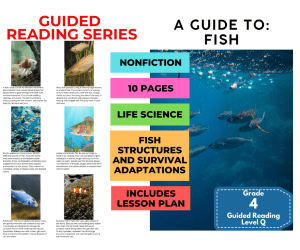
A Guide to Fish: Guided Reading Level Q with Lesson Plan
ELA, Resources for Teachers, Reading Comprehension, Reading, Science, Language Development, Life Sciences, Earth and Environmental Sciences, Pre-Reading, Vocabulary, Grade 3, 4, 5, Worksheets & Printables, Worksheets, Teacher Tools, Centers, Activities, Literacy Readers, Quizzes, Quizzes and Tests, Assessments, Lesson Plans
This A Guide to Fish (level q) guided reading book with lesson plan includes: Guided Reading Color Label (front cover x1) This is a quick way to match the book’s demands to what students can generally handle.. The overall goal is to use the level/color to pick books for several smaller groups. To qualify for a certain level, a student is expected to read a book from that level with about 90–94% accuracy. If a student is consistently accurate and understands, move up a level. If the student is struggling at that level, drop down and add more support. Each student will improve at completely different rates, but it is generally one of the best ways to check progress across the class. DOWNLOAD THE CATALOG TO VIEW ALL GUIDED READING BOOKS AVAILABLE (SORTED LEVELS A-Z) Pre-Reading Question (x1) Teacher asks the prompt aloud, can be while showing the cover or first page. Students share what they already know, or make educated guesses from the cover. Prompt them to use the target vocabulary. Write some of their responses on the board to look back at during the reading. Vocabulary Words (x5) Introduce the five words, best doing it one at a time. Start by saying it, while students repeat and then see if anyone knows what it means before reading further. Read through the meaning and try to briefly connect each word to a picture or gesture so it’s meaningful. Ask students to flip through the book pages and point to where they see each of the vocabulary words. While reading the book pause upon coming across one of the vocab words or read the sentence twice to make sure students understand the word has appeared. Optional: Ask students to raise hands whenever they see/hear one of the new words. Guided Reading Pages (x10) Check the book snapshot (below) for: primary topic - do you need to prep extra reading or intro materials on this? what is taught best - decide on 1-2 bullets to focus on, use the prompt or words provided here for best results. learning goals - what you are checking for students to be able to do after the session, elicit answers using prompts or words provided. key vocabulary (see section above). questions overview - so you know what is coming up and if you need to prep extra materials to assist understanding. Run the lesson You may have already looked at a few of the pages together, but you can show them some of the pictures again first to set meaning. Depending on how much time you have and how familiar your students are with guided reading class, you may want to read the book aloud first with the group first. Students whisper or partner read, while you listen in. If time, do it as a group, one student reading a page each. Use the guided page’s prompts to coach: “Check the picture / does it make sense?” “Point under the words / try the first sound” “Reread the sentence smoothly”. Try to focus more on one student per session (rotating every time), so you can work out if they are ready to move up or need to move down a level. Comprehension Questions (back cover x3) This is your way to check that students didn’t just say the words, but actually understood the text. First, let students answer by pointing to the page/picture and saying a short sentence. After any answer, follow with: “Show me where you found that in the text.” In bigger groups, have partners answer first (10–20 seconds), then call on 2–3 students to share. Differentiation tips: Emerging speakers/struggling readers: oral + pointing On-level: oral in a full sentence Higher: one written sentence or draw + label Book Snapshot Title: A Guide to: Fish Genre: Nonfiction (informational) Subject: Life Science Primary Topic: Fish structures and survival adaptations Estimated Guided Reading Level (A–Z): Q What This Book Teaches Best Explains how gills help fish breathe by extracting oxygen from water and releasing carbon dioxide. Describes how a fish’s streamlined shape and fins support efficient movement, stability, steering, and turning. Introduces the lateral line as a sensory system that detects vibrations and pressure changes to help fish navigate and find prey. Compares freshwater and saltwater habitats and explains how fish maintain the right internal balance of salt and water. Shows multiple survival strategies such as bioluminescence, camouflage, cartilaginous skeletons, and schooling (“safety in numbers”). Learning Goals Explain how fish breathe using gills and what happens as water passes over gill filaments. Describe how fins and a streamlined body shape help fish move, steer, and turn in water. Identify what the lateral line does and how it helps fish survive (navigation and finding prey). Compare how freshwater fish and saltwater fish manage water and salt in their bodies. Explain at least two survival adaptations described in the text (camouflage, bioluminescence, schooling). Describe what “cartilaginous fish” are and what the text says cartilage allows them to do. Key Vocabulary From the Text vertebrates — animals that have a backbone. specialized — made for a specific job or purpose. filaments — thin, threadlike parts of the gills. bioluminescence — the ability to make your own light. cartilaginous — having a skeleton made of cartilage, not hard bone. Discussion Prompts Pre-reading question: What body parts or behaviors might help fish survive in different kinds of water? Comprehension questions: What does the text explain that gills do for a fish? Comprehension questions: How does the lateral line help fish, according to the text? Comprehension questions: Why does the text say swimming in a school can help fish survive? Printing Tips 1. Best Printing Method (Recommended) “Booklet” Printing (Best if Available) If your printer or PDF viewer supports Booklet Printing , use this. Settings to use: Print mode: Booklet Paper size: Letter or A4 (either works) Orientation: Landscape Print on both sides: Yes Flip on: Short edge Scaling: Fit to printable area Booklet subset: First test: Front sides only Then: Back sides only This will automatically: Pair pages correctly Put the cover on the outside Align everything for folding After printing, fold in half and staple along the spine . 2. If “Booklet” Printing Is NOT Available You can still print this correctly with manual duplex printing . Step-by-step: Open the PDF. Choose Print . Set: Orientation: Landscape Pages per sheet: 1 Print on both sides: Yes Flip on: Short edge Print all pages . Because each PDF page already contains two facing book pages, the result will still fold cleanly into a book. Thousands of Cored Education products are included with your TeachSimple membership. Download links and encyclopedia index available here.
Author Cored Education
Rating
Tags Reading Comprehension, Reading Passages, Reading, Guided Reading, Guided Reading Lesson Plan, Guided Reading Activity, Pre-reading, Science Lesson Plans, Life Science, Earth Science

History of the Domestic Dog: Guided Reading Level R with Lesson Plan
ELA, Resources for Teachers, Reading Comprehension, Reading, Science, Language Development, Life Sciences, Vocabulary, History, Social Studies, Grade 3, 4, 5, Worksheets & Printables, Worksheets, Teacher Tools, Centers, Activities, Literacy Readers, Quizzes, Quizzes and Tests, Assessments, Lesson Plans
This History of the Domestic Dog (level r) guided reading book with lesson plan includes: Guided Reading Color Label (front cover x1) This is a quick way to match the book’s demands to what students can generally handle.. The overall goal is to use the level/color to pick books for several smaller groups. To qualify for a certain level, a student is expected to read a book from that level with about 90–94% accuracy. If a student is consistently accurate and understands, move up a level. If the student is struggling at that level, drop down and add more support. Each student will improve at completely different rates, but it is generally one of the best ways to check progress across the class. DOWNLOAD THE CATALOG TO VIEW ALL GUIDED READING BOOKS AVAILABLE (SORTED LEVELS A-Z) Pre-Reading Question (x1) Teacher asks the prompt aloud, can be while showing the cover or first page. Students share what they already know, or make educated guesses from the cover. Prompt them to use the target vocabulary. Write some of their responses on the board to look back at during the reading. Vocabulary Words (x5) Introduce the five words, best doing it one at a time. Start by saying it, while students repeat and then see if anyone knows what it means before reading further. Read through the meaning and try to briefly connect each word to a picture or gesture so it’s meaningful. Ask students to flip through the book pages and point to where they see each of the vocabulary words. While reading the book pause upon coming across one of the vocab words or read the sentence twice to make sure students understand the word has appeared. Optional: Ask students to raise hands whenever they see/hear one of the new words. Guided Reading Pages (x10) Check the book snapshot (below) for: primary topic - do you need to prep extra reading or intro materials on this? what is taught best - decide on 1-2 bullets to focus on, use the prompt or words provided here for best results. learning goals - what you are checking for students to be able to do after the session, elicit answers using prompts or words provided. key vocabulary (see section above). questions overview - so you know what is coming up and if you need to prep extra materials to assist understanding. Run the lesson You may have already looked at a few of the pages together, but you can show them some of the pictures again first to set meaning. Depending on how much time you have and how familiar your students are with guided reading class, you may want to read the book aloud first with the group first. Students whisper or partner read, while you listen in. If time, do it as a group, one student reading a page each. Use the guided page’s prompts to coach: “Check the picture / does it make sense?” “Point under the words / try the first sound” “Reread the sentence smoothly”. Try to focus more on one student per session (rotating every time), so you can work out if they are ready to move up or need to move down a level. Comprehension Questions (back cover x3) This is your way to check that students didn’t just say the words, but actually understood the text. First, let students answer by pointing to the page/picture and saying a short sentence. After any answer, follow with: “Show me where you found that in the text.” In bigger groups, have partners answer first (10–20 seconds), then call on 2–3 students to share. Differentiation tips: Emerging speakers/struggling readers: oral + pointing On-level: oral in a full sentence Higher: one written sentence or draw + label Book Snapshot Title: The Science and History of the Domestic Dog Genre: Nonfiction (informational) Subject: Life Science Primary Topic: Domestication, traits, and roles of dogs Estimated Guided Reading Level (A–Z): R What This Book Teaches Best Explains dogs’ biological connection to gray wolves , including shared DNA and instincts tied to social behavior and communication. Describes the history of domestication and how human artificial selection led to many distinct dog breeds. Uses specific evidence to show why dogs have exceptional smell and hearing (brain structures, scent receptors, and hearing frequencies). Shows how selective breeding creates specialists for different jobs (speed, herding, cold-weather survival, and service work). Teaches how to read dog communication signals (tail wag speed/height, ear position, facial muscles, back posture). Learning Goals Explain how the text connects domestic dogs to gray wolves using specific evidence (classification and DNA). Describe how domestication began and how humans’ breeding choices created many breeds over time. Identify details that show why dogs can smell better than humans (olfactory bulb and scent receptors). Identify details that show why dogs can hear better than humans (frequencies and ear muscles). Compare at least two breeds in the text by explaining how traits match their work or environment (speed, herding, cold climate, service). Describe what the text says people can look for to understand a dog’s emotional state. Key Vocabulary From the Text subspecies — a smaller group within a kind of animal. domestication — animals becoming used to living with people. olfactory — having to do with smell. frequencies — how high or low a sound is. resilient — able to handle hard conditions and keep going. Discussion Prompts Pre-reading question: What jobs or tasks have you seen dogs do for people? Comprehension questions: According to the text, how are domestic dogs connected to gray wolves? Comprehension questions: What evidence does the text give to show how powerful a dog’s sense of smell is? Comprehension questions: What signs does the text say people can look for to understand a dog’s emotional state? Printing Tips 1. Best Printing Method (Recommended) “Booklet” Printing (Best if Available) If your printer or PDF viewer supports Booklet Printing , use this. Settings to use: Print mode: Booklet Paper size: Letter or A4 (either works) Orientation: Landscape Print on both sides: Yes Flip on: Short edge Scaling: Fit to printable area Booklet subset: First test: Front sides only Then: Back sides only This will automatically: Pair pages correctly Put the cover on the outside Align everything for folding After printing, fold in half and staple along the spine . 2. If “Booklet” Printing Is NOT Available You can still print this correctly with manual duplex printing . Step-by-step: Open the PDF. Choose Print . Set: Orientation: Landscape Pages per sheet: 1 Print on both sides: Yes Flip on: Short edge Print all pages . Because each PDF page already contains two facing book pages, the result will still fold cleanly into a book. Thousands of Cored Education products are included with your TeachSimple membership. Download links and encyclopedia index available here.
Author Cored Education
Rating
Tags Reading Comprehension, Reading Passages, Reading, Guided Reading, Guided Reading Lesson Plan, Guided Reading Activity, Pre-reading, Science Lesson Plans, Life Science, History

Guided Reading Lesson Plan & Activities for Grade 6
Reading, ELA, Grade 6, Activities, Lesson Plans, Teacher Tools
In their first year of middle school, 6th graders embark on a new phase in their education, facing fresh challenges and changes. In many ways, 6th grade marks an important transition for students, as they apply the skills they have learned before to engage in more complex and self-guided learning in deeper and more demanding ways. While collaboration continues to be an important element of the curriculum, students often need to produce more detailed independent assignments, especially in writing. This requires improved independence and organizational skills, and it will probably necessitate some adjustment and practice at the beginning of the school year. The main goal of the 6th grade reading curriculum is to have students interact with increasingly difficult texts over the year, preparing them for high school, advanced studies, and future professions. Students examine a variety of texts and different genres, including fiction, drama, poetry, and non-fiction. This ebook offers a detailed lesson plan for guided reading along with activities tailored for your sixth-grade classes. Suggested replies are also provided.
Author Bright Classroom Ideas Marketplace
Tags Guided, Reading, Lesson, Plan, Grade 6, Language, Activities

Guided Reading Level H - The Story of the Wheel
ELA, Resources for Teachers, Reading Comprehension, Reading, Language Development, Vocabulary, Engineering, Technology, Science, Physics, Kindergarten, Grade 1, 2, Worksheets & Printables, Worksheets, Teacher Tools, Centers, Activities, Literacy Readers, Quizzes, Quizzes and Tests, Assessments
This Guided Reading Book - The Story of the Wheel (Level H) includes: Guided Reading Color Label (front cover x1) This is a quick way to match the book’s demands to what students can generally handle.. The overall goal is to use the level/color to pick books for several smaller groups. To qualify for a certain level, a student is expected to read a book from that level with about 90–94% accuracy. If a student is consistently accurate and understands, move up a level. If the student is struggling at that level, drop down and add more support. Each student will improve at completely different rates, but it is generally one of the best ways to check progress across the class. DOWNLOAD THE CATALOG TO VIEW ALL GUIDED READING BOOKS AVAILABLE (SORTED LEVELS A-Z) Pre-Reading Question (x1) Teacher asks the prompt aloud, can be while showing the cover or first page. Students share what they already know, or make educated guesses from the cover. Prompt them to use the target vocabulary. Write some of their responses on the board to look back at during the reading. Vocabulary Words (x5) Introduce the five words, best doing it one at a time. Start by saying it, while students repeat and then see if anyone knows what it means before reading further. Read through the meaning and try to briefly connect each word to a picture or gesture so it’s meaningful. Ask students to flip through the book pages and point to where they see each of the vocabulary words. While reading the book pause upon coming across one of the vocab words or read the sentence twice to make sure students understand the word has appeared. Optional: Ask students to raise hands whenever they see/hear one of the new words. Guided Reading Pages (x10) Check the book snapshot (below) for: primary topic - do you need to prep extra reading or intro materials on this? what is taught best - decide on 1-2 bullets to focus on, use the prompt or words provided here for best results. learning goals - what you are checking for students to be able to do after the session, elicit answers using prompts or words provided. key vocabulary (see section above). questions overview - so you know what is coming up and if you need to prep extra materials to assist understanding. Run the lesson You may have already looked at a few of the pages together, but you can show them some of the pictures again first to set meaning. Depending on how much time you have and how familiar your students are with guided reading class, you may want to read the book aloud first with the group first. Students whisper or partner read, while you listen in. If time, do it as a group, one student reading a page each. Use the guided page’s prompts to coach: “Check the picture / does it make sense?” “Point under the words / try the first sound” “Reread the sentence smoothly”. Try to focus more on one student per session (rotating every time), so you can work out if they are ready to move up or need to move down a level. Comprehension Questions (back cover x3) This is your way to check that students didn’t just say the words, but actually understood the text. First, let students answer by pointing to the page/picture and saying a short sentence. After any answer, follow with: “Show me where you found that in the text.” In bigger groups, have partners answer first (10–20 seconds), then call on 2–3 students to share. Differentiation tips: Emerging speakers/struggling readers: oral + pointing On-level: oral in a full sentence Higher: one written sentence or draw + label Book Snapshot Title: The Story of the Wheel Genre: Nonfiction (informational) Subject: Science (Engineering / Simple Machines) Primary Topic: How wheels changed over time and how they work Estimated Guided Reading Level (A–Z): H What This Book Teaches Best What wheels are and what they help people do: move heavy things with less effort. How wheels changed over time (from heavy stone/wood wheels to spoked wheels to modern rubber tires). Why different wheels are designed differently for different jobs (tractor treads for mud; thin bicycle wheels for speed; small wheels for gliding). That not all wheels are for travel—gears are wheels with teeth that help machines move. Learning Goals Students will explain what wheels are used for using a detail from the text. Students will describe how the first wheels were made long ago, according to the book. Students will explain why spoked wheels helped carts move faster using the book’s comparison. Students will describe how treads help tractor wheels move through thick, wet mud. Students will identify one way gears are different from travel wheels and tell what gears do in machines. Key Vocabulary From the Text spokes — thin parts connecting the center to the outside. oxen — strong animals that pull heavy loads. rubber — stretchy material used to make tires. treads — deep grooves that help a tire grip ground. gears — wheels with teeth that help machines move. Discussion Prompts Pre-reading question: How do you think wheels help people move things more easily? Comprehension questions: What does the book say wheels are used for? What were the very first wheels made from long ago? What are gears, and what do they help machines do? Printing Tips 1. Best Printing Method (Recommended) “Booklet” Printing (Best if Available) If your printer or PDF viewer supports Booklet Printing , use this. Settings to use: Print mode: Booklet Paper size: Letter or A4 (either works) Orientation: Landscape Print on both sides: Yes Flip on: Short edge Scaling: Fit to printable area Booklet subset: First test: Front sides only Then: Back sides only This will automatically: Pair pages correctly Put the cover on the outside Align everything for folding After printing, fold in half and staple along the spine . 2. If “Booklet” Printing Is NOT Available You can still print this correctly with manual duplex printing . Step-by-step: Open the PDF. Choose Print . Set: Orientation: Landscape Pages per sheet: 1 Print on both sides: Yes Flip on: Short edge Print all pages . Because each PDF page already contains two facing book pages, the result will still fold cleanly into a book. Thousands of Cored Education products are included with your TeachSimple membership. Download links and encyclopedia index available here.
Author Cored Education
Rating
Tags Vocabulary, Reading Comprehension, Reading Passages, Leveled Reading, Nonfiction, Reading, Guided Reading, Physics, Engineering, Technology
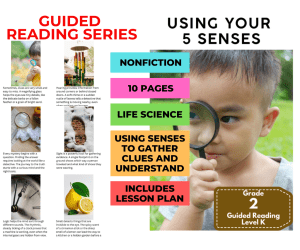
Guided Reading Level K - Using Your 5 Senses (with Lesson Plan)
ELA, Resources for Teachers, Reading Comprehension, Reading, Pre-Reading, Language Development, Human Body, Life Sciences, Science, Vocabulary, Grade 1, 2, 3, Worksheets & Printables, Worksheets, Teacher Tools, Centers, Activities, Literacy Readers, Quizzes, Quizzes and Tests, Assessments
This Guided Reading Book - Using Your 5 Senses (Level K) with lesson plan includes: Guided Reading Color Label (front cover x1) This is a quick way to match the book’s demands to what students can generally handle.. The overall goal is to use the level/color to pick books for several smaller groups. To qualify for a certain level, a student is expected to read a book from that level with about 90–94% accuracy. If a student is consistently accurate and understands, move up a level. If the student is struggling at that level, drop down and add more support. Each student will improve at completely different rates, but it is generally one of the best ways to check progress across the class. DOWNLOAD THE CATALOG TO VIEW ALL GUIDED READING BOOKS AVAILABLE (SORTED LEVELS A-Z) Pre-Reading Question (x1) Teacher asks the prompt aloud, can be while showing the cover or first page. Students share what they already know, or make educated guesses from the cover. Prompt them to use the target vocabulary. Write some of their responses on the board to look back at during the reading. Vocabulary Words (x5) Introduce the five words, best doing it one at a time. Start by saying it, while students repeat and then see if anyone knows what it means before reading further. Read through the meaning and try to briefly connect each word to a picture or gesture so it’s meaningful. Ask students to flip through the book pages and point to where they see each of the vocabulary words. While reading the book pause upon coming across one of the vocab words or read the sentence twice to make sure students understand the word has appeared. Optional: Ask students to raise hands whenever they see/hear one of the new words. Guided Reading Pages (x10) Check the book snapshot (below) for: primary topic - do you need to prep extra reading or intro materials on this? what is taught best - decide on 1-2 bullets to focus on, use the prompt or words provided here for best results. learning goals - what you are checking for students to be able to do after the session, elicit answers using prompts or words provided. key vocabulary (see section above). questions overview - so you know what is coming up and if you need to prep extra materials to assist understanding. Run the lesson You may have already looked at a few of the pages together, but you can show them some of the pictures again first to set meaning. Depending on how much time you have and how familiar your students are with guided reading class, you may want to read the book aloud first with the group first. Students whisper or partner read, while you listen in. If time, do it as a group, one student reading a page each. Use the guided page’s prompts to coach: “Check the picture / does it make sense?” “Point under the words / try the first sound” “Reread the sentence smoothly”. Try to focus more on one student per session (rotating every time), so you can work out if they are ready to move up or need to move down a level. Comprehension Questions (back cover x3) This is your way to check that students didn’t just say the words, but actually understood the text. First, let students answer by pointing to the page/picture and saying a short sentence. After any answer, follow with: “Show me where you found that in the text.” In bigger groups, have partners answer first (10–20 seconds), then call on 2–3 students to share. Differentiation tips: Emerging speakers/struggling readers: oral + pointing On-level: oral in a full sentence Higher: one written sentence or draw + label Book Snapshot Title: Using Your 5 Senses Genre: Nonfiction (informational) Subject: Science (Human Body) / Reading Primary Topic: Using senses to gather clues and understand Estimated Guided Reading Level (A–Z): K What This Book Teaches Best How to observe like a detective by starting with a question and looking for an answer. How sight can gather evidence by noticing details like footprints and tiny clues. How hearing can provide information (like movement nearby) even when you can’t see. How smell, touch, and taste each give different kinds of information about the world. How thinking and logic connect clues “like pieces of a puzzle” to understand what happened. Learning Goals Students will explain how asking questions helps begin solving a mystery. Students will identify what sight, hearing, smell, touch, and taste can tell a person, using details from the text. Students will describe how a magnifying glass helps the eyes see “tiny details.” Students will explain how hearing can give information about something moving nearby. Students will describe how logic helps connect clues to make a clear picture of what happened. Key Vocabulary From the Text detective — a person who looks for clues to solve. evidence — facts or clues that show what happened. magnifying — making something look bigger to see details. rhythmic — having a steady, repeating beat or pattern. observation — watching carefully and noticing details. Discussion Prompts Pre-reading question: How can your senses help you find clues about the world? Comprehension questions: What does the book say sight helps you learn from a single footprint? How can hearing tell a detective something is moving nearby? According to the book, why are the five senses “keys to understanding the world”? Printing Tips 1. Best Printing Method (Recommended) “Booklet” Printing (Best if Available) If your printer or PDF viewer supports Booklet Printing , use this. Settings to use: Print mode: Booklet Paper size: Letter or A4 (either works) Orientation: Landscape Print on both sides: Yes Flip on: Short edge Scaling: Fit to printable area Booklet subset: First test: Front sides only Then: Back sides only This will automatically: Pair pages correctly Put the cover on the outside Align everything for folding After printing, fold in half and staple along the spine . 2. If “Booklet” Printing Is NOT Available You can still print this correctly with manual duplex printing . Step-by-step: Open the PDF. Choose Print . Set: Orientation: Landscape Pages per sheet: 1 Print on both sides: Yes Flip on: Short edge Print all pages . Because each PDF page already contains two facing book pages, the result will still fold cleanly into a book. Thousands of Cored Education products are included with your TeachSimple membership. Download links and encyclopedia index available here.
Author Cored Education
Rating
Tags Reading Comprehension, Reading Passages, Reading, Guided Reading, Guided Reading Lesson Plan, Guided Reading Activity, Pre-reading, Vocabulary, Life Science, Human Body

Guided Reading Level Q - The Living Rainforest (with Lesson Plan)
ELA, Resources for Teachers, Reading Comprehension, Reading, Animals, Life Sciences, Science, Nature & Plants, Earth and Environmental Sciences, Physics, Grade 3, 4, 5, Worksheets & Printables, Worksheets, Teacher Tools, Centers, Activities, Literacy Readers, Quizzes, Quizzes and Tests, Assessments
This Guided Reading Book - The Living Rainforest (Level Q) with lesson plan includes: Guided Reading Color Label (front cover x1) This is a quick way to match the book’s demands to what students can generally handle.. The overall goal is to use the level/color to pick books for several smaller groups. To qualify for a certain level, a student is expected to read a book from that level with about 90–94% accuracy. If a student is consistently accurate and understands, move up a level. If the student is struggling at that level, drop down and add more support. Each student will improve at completely different rates, but it is generally one of the best ways to check progress across the class. DOWNLOAD THE CATALOG TO VIEW ALL GUIDED READING BOOKS AVAILABLE (SORTED LEVELS A-Z) Pre-Reading Question (x1) Teacher asks the prompt aloud, can be while showing the cover or first page. Students share what they already know, or make educated guesses from the cover. Prompt them to use the target vocabulary. Write some of their responses on the board to look back at during the reading. Vocabulary Words (x5) Introduce the five words, best doing it one at a time. Start by saying it, while students repeat and then see if anyone knows what it means before reading further. Read through the meaning and try to briefly connect each word to a picture or gesture so it’s meaningful. Ask students to flip through the book pages and point to where they see each of the vocabulary words. While reading the book pause upon coming across one of the vocab words or read the sentence twice to make sure students understand the word has appeared. Optional: Ask students to raise hands whenever they see/hear one of the new words. Guided Reading Pages (x10) Check the book snapshot (below) for: primary topic - do you need to prep extra reading or intro materials on this? what is taught best - decide on 1-2 bullets to focus on, use the prompt or words provided here for best results. learning goals - what you are checking for students to be able to do after the session, elicit answers using prompts or words provided. key vocabulary (see section above). questions overview - so you know what is coming up and if you need to prep extra materials to assist understanding. Run the lesson You may have already looked at a few of the pages together, but you can show them some of the pictures again first to set meaning. Depending on how much time you have and how familiar your students are with guided reading class, you may want to read the book aloud first with the group first. Students whisper or partner read, while you listen in. If time, do it as a group, one student reading a page each. Use the guided page’s prompts to coach: “Check the picture / does it make sense?” “Point under the words / try the first sound” “Reread the sentence smoothly”. Try to focus more on one student per session (rotating every time), so you can work out if they are ready to move up or need to move down a level. Comprehension Questions (back cover x3) This is your way to check that students didn’t just say the words, but actually understood the text. First, let students answer by pointing to the page/picture and saying a short sentence. After any answer, follow with: “Show me where you found that in the text.” In bigger groups, have partners answer first (10–20 seconds), then call on 2–3 students to share. Differentiation tips: Emerging speakers/struggling readers: oral + pointing On-level: oral in a full sentence Higher: one written sentence or draw + label Book Snapshot Title: The Living Rainforest Genre: Nonfiction (informational text) Subject: Life Science / Reading (Informational Text) Primary Topic: Rainforest layers, cycles, and why they matter Estimated Guided Reading Level (A–Z): Q What This Book Teaches Best Rainforest location and climate patterns: Tropical rainforests are near the equator and stay warm and rainy year-round. Structure of a rainforest ecosystem: The text explains distinct vertical layers (forest floor, understory, canopy, emergent layer) and what makes each layer different. Earth science connection (water cycle): Transpiration is described as a process that helps form clouds and rain over the forest. Biodiversity and ecosystem balance: Rainforests hold a huge variety of life, and organisms play roles that keep the ecosystem balanced. Why rainforests matter globally: The book connects rainforests to photosynthesis, oxygen/carbon dioxide exchange, carbon storage, rainfall patterns, and climate. Learning Goals Students will describe where tropical rainforests are located and what their climate is like. Students will explain how the rainforest is organized into layers and compare the conditions in at least two layers. Students will describe what happens on the forest floor when leaves, seeds, and fruits decompose. Students will explain transpiration and how it helps create rain over the rainforest. Students will summarize why rainforests are called the “lungs of the planet,” using details from the text. Students will identify reasons the text gives for preserving tropical rainforests. Key Vocabulary From the Text ecosystems — living things and their environment working together. decompose — break down and rot into smaller parts. understory — plant layer below the canopy. transpiration — plants release water vapor from leaves. biodiversity — many different living things in one place. Discussion Prompts Pre-reading question: How might the different rainforest layers change where plants and animals can live? Comprehension questions: What makes the forest floor dark and damp, according to the text? Comprehension questions: How does the text describe transpiration helping rain form over the rainforest? Comprehension questions: Why does the text call rainforests the “lungs of the planet”? Printing Tips 1. Best Printing Method (Recommended) “Booklet” Printing (Best if Available) If your printer or PDF viewer supports Booklet Printing , use this. Settings to use: Print mode: Booklet Paper size: Letter or A4 (either works) Orientation: Landscape Print on both sides: Yes Flip on: Short edge Scaling: Fit to printable area Booklet subset: First test: Front sides only Then: Back sides only This will automatically: Pair pages correctly Put the cover on the outside Align everything for folding After printing, fold in half and staple along the spine . 2. If “Booklet” Printing Is NOT Available You can still print this correctly with manual duplex printing . Step-by-step: Open the PDF. Choose Print . Set: Orientation: Landscape Pages per sheet: 1 Print on both sides: Yes Flip on: Short edge Print all pages . Because each PDF page already contains two facing book pages, the result will still fold cleanly into a book. Thousands of Cored Education products are included with your TeachSimple membership. Download links and encyclopedia index available here.
Author Cored Education
Rating
Tags Reading Comprehension, Reading Passages, Reading, Guided Reading, Guided Reading Lesson Plan, Guided Reading Activity, Pre-reading, Science Lesson Plans, Animals, Plants
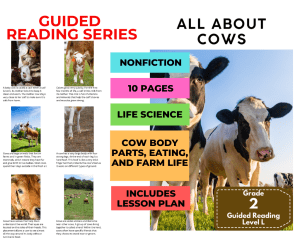
Guided Reading Level L - All About Cows (with Lesson Plan)
ELA, Resources for Teachers, Reading Comprehension, Reading, Science, Language Development, Life Sciences, Animals, Pre-Reading, Vocabulary, Grade 2, 3, 4, Worksheets & Printables, Worksheets, Teacher Tools, Centers, Activities, Literacy Readers, Quizzes, Quizzes and Tests, Assessments, Lesson Plans
This Guided Reading Book - All About Cows (Level L) with lesson plan includes: Guided Reading Color Label (front cover x1) This is a quick way to match the book’s demands to what students can generally handle.. The overall goal is to use the level/color to pick books for several smaller groups. To qualify for a certain level, a student is expected to read a book from that level with about 90–94% accuracy. If a student is consistently accurate and understands, move up a level. If the student is struggling at that level, drop down and add more support. Each student will improve at completely different rates, but it is generally one of the best ways to check progress across the class. DOWNLOAD THE CATALOG TO VIEW ALL GUIDED READING BOOKS AVAILABLE (SORTED LEVELS A-Z) Pre-Reading Question (x1) Teacher asks the prompt aloud, can be while showing the cover or first page. Students share what they already know, or make educated guesses from the cover. Prompt them to use the target vocabulary. Write some of their responses on the board to look back at during the reading. Vocabulary Words (x5) Introduce the five words, best doing it one at a time. Start by saying it, while students repeat and then see if anyone knows what it means before reading further. Read through the meaning and try to briefly connect each word to a picture or gesture so it’s meaningful. Ask students to flip through the book pages and point to where they see each of the vocabulary words. While reading the book pause upon coming across one of the vocab words or read the sentence twice to make sure students understand the word has appeared. Optional: Ask students to raise hands whenever they see/hear one of the new words. Guided Reading Pages (x10) Check the book snapshot (below) for: primary topic - do you need to prep extra reading or intro materials on this? what is taught best - decide on 1-2 bullets to focus on, use the prompt or words provided here for best results. learning goals - what you are checking for students to be able to do after the session, elicit answers using prompts or words provided. key vocabulary (see section above). questions overview - so you know what is coming up and if you need to prep extra materials to assist understanding. Run the lesson You may have already looked at a few of the pages together, but you can show them some of the pictures again first to set meaning. Depending on how much time you have and how familiar your students are with guided reading class, you may want to read the book aloud first with the group first. Students whisper or partner read, while you listen in. If time, do it as a group, one student reading a page each. Use the guided page’s prompts to coach: “Check the picture / does it make sense?” “Point under the words / try the first sound” “Reread the sentence smoothly”. Try to focus more on one student per session (rotating every time), so you can work out if they are ready to move up or need to move down a level. Comprehension Questions (back cover x3) This is your way to check that students didn’t just say the words, but actually understood the text. First, let students answer by pointing to the page/picture and saying a short sentence. After any answer, follow with: “Show me where you found that in the text.” In bigger groups, have partners answer first (10–20 seconds), then call on 2–3 students to share. Differentiation tips: Emerging speakers/struggling readers: oral + pointing On-level: oral in a full sentence Higher: one written sentence or draw + label Book Snapshot Title: All About Cows Genre: Nonfiction (informational) Subject: Life Science + Reading (Informational Text) Primary Topic: Cow body parts, eating, and farm life Estimated Guided Reading Level (A–Z): L What This Book Teaches Best Explains what cows are (large farm animals; mammals that have fur and give birth to live babies). Teaches how cow body parts help them (strong legs, hard hooves that protect feet; eyes placed on the sides for wide view). Describes what cows eat and how they eat plants (herbivores; tongue wraps around grass; plants like grass, hay, clover). Introduces a key digestion process (food goes to a large stomach; cows bring food back up to chew again—“chewing cud”). Builds understanding of cow family and social life (calf care; calves drink milk with vitamins and minerals; cows live in herds and have “friends”). Learning Goals Students will describe what the book says cows are and where they live. Students will explain how a cow’s hoof helps protect its feet while it walks. Students will identify what cows eat and describe how a cow uses its tongue to pull in grass. Students will explain what “chewing cud” means using the book’s description of digestion. Students will describe how calves are cared for and what the text says about calf milk. Students will describe how cows live together in a herd and how they rest. Key Vocabulary From the Text mammals — animals with fur that give birth to live babies. hoof — hard covering that protects a cow’s foot. herbivores — animals that eat only plants. digesting — breaking down food inside the body. herd — a group of cows living together. Discussion Prompts Pre-reading question: What do you already know about cows living on farms? Comprehension questions: How does the book describe a cow’s hoof and what it does? Comprehension questions: What happens to grass after a cow swallows it, and what is “chewing cud”? Comprehension questions: Why can a cow see almost all the way around its body without turning its head? Printing Tips 1. Best Printing Method (Recommended) “Booklet” Printing (Best if Available) If your printer or PDF viewer supports Booklet Printing , use this. Settings to use: Print mode: Booklet Paper size: Letter or A4 (either works) Orientation: Landscape Print on both sides: Yes Flip on: Short edge Scaling: Fit to printable area Booklet subset: First test: Front sides only Then: Back sides only This will automatically: Pair pages correctly Put the cover on the outside Align everything for folding After printing, fold in half and staple along the spine . 2. If “Booklet” Printing Is NOT Available You can still print this correctly with manual duplex printing . Step-by-step: Open the PDF. Choose Print . Set: Orientation: Landscape Pages per sheet: 1 Print on both sides: Yes Flip on: Short edge Print all pages . Because each PDF page already contains two facing book pages, the result will still fold cleanly into a book. Thousands of Cored Education products are included with your TeachSimple membership. Download links and encyclopedia index available here.
Author Cored Education
Rating
Tags Reading Comprehension, Reading Passages, Reading, Guided Reading, Guided Reading Lesson Plan, Guided Reading Activity, Pre-reading, Science Lesson Plans, Life Science, Animals
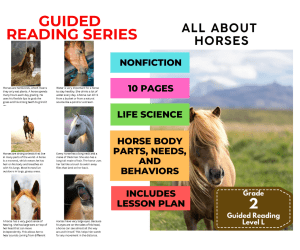
Guided Reading Level L - All About Horses (with Lesson Plan)
ELA, Resources for Teachers, Reading Comprehension, Reading, Science, Language Development, Life Sciences, Animals, Pre-Reading, Vocabulary, Grade 2, 3, 4, Worksheets & Printables, Worksheets, Teacher Tools, Centers, Activities, Literacy Readers, Quizzes, Quizzes and Tests, Assessments, Lesson Plans
This Guided Reading Book - All About Horses (Level L) with lesson plan includes: Guided Reading Color Label (front cover x1) This is a quick way to match the book’s demands to what students can generally handle.. The overall goal is to use the level/color to pick books for several smaller groups. To qualify for a certain level, a student is expected to read a book from that level with about 90–94% accuracy. If a student is consistently accurate and understands, move up a level. If the student is struggling at that level, drop down and add more support. Each student will improve at completely different rates, but it is generally one of the best ways to check progress across the class. DOWNLOAD THE CATALOG TO VIEW ALL GUIDED READING BOOKS AVAILABLE (SORTED LEVELS A-Z) Pre-Reading Question (x1) Teacher asks the prompt aloud, can be while showing the cover or first page. Students share what they already know, or make educated guesses from the cover. Prompt them to use the target vocabulary. Write some of their responses on the board to look back at during the reading. Vocabulary Words (x5) Introduce the five words, best doing it one at a time. Start by saying it, while students repeat and then see if anyone knows what it means before reading further. Read through the meaning and try to briefly connect each word to a picture or gesture so it’s meaningful. Ask students to flip through the book pages and point to where they see each of the vocabulary words. While reading the book pause upon coming across one of the vocab words or read the sentence twice to make sure students understand the word has appeared. Optional: Ask students to raise hands whenever they see/hear one of the new words. Guided Reading Pages (x10) Check the book snapshot (below) for: primary topic - do you need to prep extra reading or intro materials on this? what is taught best - decide on 1-2 bullets to focus on, use the prompt or words provided here for best results. learning goals - what you are checking for students to be able to do after the session, elicit answers using prompts or words provided. key vocabulary (see section above). questions overview - so you know what is coming up and if you need to prep extra materials to assist understanding. Run the lesson You may have already looked at a few of the pages together, but you can show them some of the pictures again first to set meaning. Depending on how much time you have and how familiar your students are with guided reading class, you may want to read the book aloud first with the group first. Students whisper or partner read, while you listen in. If time, do it as a group, one student reading a page each. Use the guided page’s prompts to coach: “Check the picture / does it make sense?” “Point under the words / try the first sound” “Reread the sentence smoothly”. Try to focus more on one student per session (rotating every time), so you can work out if they are ready to move up or need to move down a level. Comprehension Questions (back cover x3) This is your way to check that students didn’t just say the words, but actually understood the text. First, let students answer by pointing to the page/picture and saying a short sentence. After any answer, follow with: “Show me where you found that in the text.” In bigger groups, have partners answer first (10–20 seconds), then call on 2–3 students to share. Differentiation tips: Emerging speakers/struggling readers: oral + pointing On-level: oral in a full sentence Higher: one written sentence or draw + label Book Snapshot Title: All About Horses Genre: Nonfiction (informational) Subject: Life Science / Reading (Informational Text) Primary Topic: Horse body parts, needs, and behaviors Estimated Guided Reading Level (A–Z): L What This Book Teaches Best Key animal facts about horses (they are strong animals, mammals, and live outdoors in grassy areas). How horse body parts help them (mane and tail; tail swishes away flies). What horses need to stay healthy (they eat plants and drink a lot of water). How horses move (trot with “diagonal pairs,” and gallop as the fastest way to move with hooves off the ground). Special horse behaviors and life stages (sleeping while standing; a baby horse is a foal). Learning Goals Students will identify key facts about horses (habitat, body traits, and needs) from the text. Students will explain how a horse uses its tail based on details in the book. Students will describe what horses eat and how they graze using evidence from the text. Students will compare two horse movements (trot and gallop) using information from the book. Students will explain how a horse can sleep while standing without falling over. Students will describe what a foal is and what it can do soon after being born. Key Vocabulary From the Text mammal — an animal that breathes air with lungs. herbivores — animals that eat only plants. grazing — eating grass little by little over time. diagonal — slanted, from one corner to the opposite corner. hooves — the hard feet of a horse. Discussion Prompts Pre-reading question: What do you think a horse needs to stay healthy outdoors? Comprehension questions: What does the text say a horse uses its tail for? How does the text describe a trot? What is a foal, and what can it do within an hour of being born? Printing Tips 1. Best Printing Method (Recommended) “Booklet” Printing (Best if Available) If your printer or PDF viewer supports Booklet Printing , use this. Settings to use: Print mode: Booklet Paper size: Letter or A4 (either works) Orientation: Landscape Print on both sides: Yes Flip on: Short edge Scaling: Fit to printable area Booklet subset: First test: Front sides only Then: Back sides only This will automatically: Pair pages correctly Put the cover on the outside Align everything for folding After printing, fold in half and staple along the spine . 2. If “Booklet” Printing Is NOT Available You can still print this correctly with manual duplex printing . Step-by-step: Open the PDF. Choose Print . Set: Orientation: Landscape Pages per sheet: 1 Print on both sides: Yes Flip on: Short edge Print all pages . Because each PDF page already contains two facing book pages, the result will still fold cleanly into a book. Thousands of Cored Education products are included with your TeachSimple membership. Download links and encyclopedia index available here.
Author Cored Education
Rating
Tags Reading Comprehension, Reading Passages, Reading, Guided Reading, Guided Reading Lesson Plan, Guided Reading Activity, Pre-reading, Science Lesson Plans, Life Science, Animals

Guided Reading Level M - Shanghai (with Lesson Plan)
ELA, Resources for Teachers, Reading Comprehension, Reading, Science, Earth and Environmental Sciences, Economics, Social Studies, Geography, Language Development, Grade 2, 3, 4, Worksheets & Printables, Worksheets, Teacher Tools, Centers, Activities, Literacy Readers, Quizzes, Quizzes and Tests, Assessments, Lesson Plans
This Guided Reading Book - Shanghai (Level M) with lesson plan includes: Guided Reading Color Label (front cover x1) This is a quick way to match the book’s demands to what students can generally handle.. The overall goal is to use the level/color to pick books for several smaller groups. To qualify for a certain level, a student is expected to read a book from that level with about 90–94% accuracy. If a student is consistently accurate and understands, move up a level. If the student is struggling at that level, drop down and add more support. Each student will improve at completely different rates, but it is generally one of the best ways to check progress across the class. DOWNLOAD THE CATALOG TO VIEW ALL GUIDED READING BOOKS AVAILABLE (SORTED LEVELS A-Z) Pre-Reading Question (x1) Teacher asks the prompt aloud, can be while showing the cover or first page. Students share what they already know, or make educated guesses from the cover. Prompt them to use the target vocabulary. Write some of their responses on the board to look back at during the reading. Vocabulary Words (x5) Introduce the five words, best doing it one at a time. Start by saying it, while students repeat and then see if anyone knows what it means before reading further. Read through the meaning and try to briefly connect each word to a picture or gesture so it’s meaningful. Ask students to flip through the book pages and point to where they see each of the vocabulary words. While reading the book pause upon coming across one of the vocab words or read the sentence twice to make sure students understand the word has appeared. Optional: Ask students to raise hands whenever they see/hear one of the new words. Guided Reading Pages (x10) Check the book snapshot (below) for: primary topic - do you need to prep extra reading or intro materials on this? what is taught best - decide on 1-2 bullets to focus on, use the prompt or words provided here for best results. learning goals - what you are checking for students to be able to do after the session, elicit answers using prompts or words provided. key vocabulary (see section above). questions overview - so you know what is coming up and if you need to prep extra materials to assist understanding. Run the lesson You may have already looked at a few of the pages together, but you can show them some of the pictures again first to set meaning. Depending on how much time you have and how familiar your students are with guided reading class, you may want to read the book aloud first with the group first. Students whisper or partner read, while you listen in. If time, do it as a group, one student reading a page each. Use the guided page’s prompts to coach: “Check the picture / does it make sense?” “Point under the words / try the first sound” “Reread the sentence smoothly”. Try to focus more on one student per session (rotating every time), so you can work out if they are ready to move up or need to move down a level. Comprehension Questions (back cover x3) This is your way to check that students didn’t just say the words, but actually understood the text. First, let students answer by pointing to the page/picture and saying a short sentence. After any answer, follow with: “Show me where you found that in the text.” In bigger groups, have partners answer first (10–20 seconds), then call on 2–3 students to share. Differentiation tips: Emerging speakers/struggling readers: oral + pointing On-level: oral in a full sentence Higher: one written sentence or draw + label Book Snapshot Title: World Cities: Shanghai Genre: Nonfiction (informational text) Subject: Social Studies (Geography) Primary Topic: Shanghai’s location, waterways, and key city features Estimated Guided Reading Level (A–Z): M What This Book Teaches Best Explains where Shanghai is located and why its place near the Yangtze River Delta and the East China Sea matters. Describes how the Huangpu River functions as a major waterway and supports large ships year-round because the water never freezes. Compares two parts of the city along the river—Pudong’s modern skyline and Puxi’s historic area, including the Bund. Connects landforms to city development by explaining Shanghai’s flat, alluvial plain and limited land. Highlights how waterways and islands shape life and trade, including Suzhou Creek, Chongming Island habitats, and a deep-water port for global shipping. Learning Goals Identify Shanghai’s location on the eastern coast of China using details from the text. Explain why the Huangpu River is important for ships, based on the book’s description. Describe how Pudong and Puxi are different, using evidence from the text. Describe Shanghai’s landform (an alluvial plain) and tell what that means for mountains or hills in the main city area. Explain how islands and waterways support wildlife, neighborhoods, and trade in and around Shanghai. Describe Shanghai’s climate and seasons as stated in the book. Key Vocabulary From the Text vital — very important. waterway — a river or channel ships can travel on. district — a part of a city. alluvial — made from soil rivers leave behind over time. tributary — a smaller river or stream that flows into a larger river. Discussion Prompts Pre-reading question: What places in a city might be built near water, and why? Comprehension questions: Where does the text say Shanghai is located? Comprehension questions: What does the text say makes the Huangpu River important for large ships? Comprehension questions: What details does the book give about Shanghai’s climate and seasons? Printing Tips 1. Best Printing Method (Recommended) “Booklet” Printing (Best if Available) If your printer or PDF viewer supports Booklet Printing , use this. Settings to use: Print mode: Booklet Paper size: Letter or A4 (either works) Orientation: Landscape Print on both sides: Yes Flip on: Short edge Scaling: Fit to printable area Booklet subset: First test: Front sides only Then: Back sides only This will automatically: Pair pages correctly Put the cover on the outside Align everything for folding After printing, fold in half and staple along the spine . 2. If “Booklet” Printing Is NOT Available You can still print this correctly with manual duplex printing . Step-by-step: Open the PDF. Choose Print . Set: Orientation: Landscape Pages per sheet: 1 Print on both sides: Yes Flip on: Short edge Print all pages . Because each PDF page already contains two facing book pages, the result will still fold cleanly into a book. Thousands of Cored Education products are included with your TeachSimple membership. Download links and encyclopedia index available here.
Author Cored Education
Rating
Tags Reading Comprehension, Reading Passages, Reading, Guided Reading, Guided Reading Lesson Plan, Guided Reading Activity, Pre-reading, Social Studies Lesson Plans, Geography, Economics
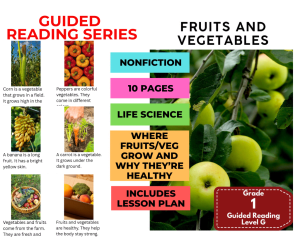
Fruits and Vegetables: Guided Reading Level G with Lesson Plan
ELA, Resources for Teachers, Reading Comprehension, Reading, Science, Language Development, Life Sciences, Health, P.E. & Health, Vocabulary, Kindergarten, Grade 1, 2, Worksheets & Printables, Worksheets, Teacher Tools, Centers, Activities, Literacy Readers, Quizzes, Quizzes and Tests, Assessments, Lesson Plans
This Fruits and Vegetables (level g) guided reading book with lesson plan includes: Guided Reading Color Label (front cover x1) This is a quick way to match the book’s demands to what students can generally handle.. The overall goal is to use the level/color to pick books for several smaller groups. To qualify for a certain level, a student is expected to read a book from that level with about 90–94% accuracy. If a student is consistently accurate and understands, move up a level. If the student is struggling at that level, drop down and add more support. Each student will improve at completely different rates, but it is generally one of the best ways to check progress across the class. DOWNLOAD THE CATALOG TO VIEW ALL GUIDED READING BOOKS AVAILABLE (SORTED LEVELS A-Z) Pre-Reading Question (x1) Teacher asks the prompt aloud, can be while showing the cover or first page. Students share what they already know, or make educated guesses from the cover. Prompt them to use the target vocabulary. Write some of their responses on the board to look back at during the reading. Vocabulary Words (x5) Introduce the five words, best doing it one at a time. Start by saying it, while students repeat and then see if anyone knows what it means before reading further. Read through the meaning and try to briefly connect each word to a picture or gesture so it’s meaningful. Ask students to flip through the book pages and point to where they see each of the vocabulary words. While reading the book pause upon coming across one of the vocab words or read the sentence twice to make sure students understand the word has appeared. Optional: Ask students to raise hands whenever they see/hear one of the new words. Guided Reading Pages (x10) Check the book snapshot (below) for: primary topic - do you need to prep extra reading or intro materials on this? what is taught best - decide on 1-2 bullets to focus on, use the prompt or words provided here for best results. learning goals - what you are checking for students to be able to do after the session, elicit answers using prompts or words provided. key vocabulary (see section above). questions overview - so you know what is coming up and if you need to prep extra materials to assist understanding. Run the lesson You may have already looked at a few of the pages together, but you can show them some of the pictures again first to set meaning. Depending on how much time you have and how familiar your students are with guided reading class, you may want to read the book aloud first with the group first. Students whisper or partner read, while you listen in. If time, do it as a group, one student reading a page each. Use the guided page’s prompts to coach: “Check the picture / does it make sense?” “Point under the words / try the first sound” “Reread the sentence smoothly”. Try to focus more on one student per session (rotating every time), so you can work out if they are ready to move up or need to move down a level. Comprehension Questions (back cover x3) This is your way to check that students didn’t just say the words, but actually understood the text. First, let students answer by pointing to the page/picture and saying a short sentence. After any answer, follow with: “Show me where you found that in the text.” In bigger groups, have partners answer first (10–20 seconds), then call on 2–3 students to share. Differentiation tips: Emerging speakers/struggling readers: oral + pointing On-level: oral in a full sentence Higher: one written sentence or draw + label Book Snapshot Title: Fruits and Vegetables Genre: Nonfiction Subject: Life Science (Plants and food) Primary Topic: Where fruits/vegetables grow and why they’re healthy Estimated Guided Reading Level (A–Z): G What This Book Teaches Best Many foods come from plants , and plants grow in the sun. Examples of fruits and where they grow (apple on a tall tree; banana with bright yellow skin). Examples of vegetables and where they grow (carrot under the ground; corn in a field; peppers in different colors; broccoli looks like a tiny tree). A simple fruit feature: most fruits have seeds inside (watermelon has many small seeds). Health connection: fruits and vegetables are healthy and help the body stay strong. Learning Goals Students will identify what the book says many foods come from. Students will describe where at least one fruit grows (example from the text). Students will describe where at least one vegetable grows (example from the text). Students will explain what the book says about seeds in fruits. Students will explain how fruits and vegetables help the body, using the book’s words. Key Vocabulary From the Text plants — living things that grow in the sun. fruit — food that can grow on a tree. vegetable — food that can grow in the ground. seeds — small parts inside fruits. healthy — good for your body. Discussion Prompts Pre-reading question: What fruits and vegetables do you already know, and where do you think they grow? Comprehension questions: What does the book say many foods come from? Comprehension questions: Where does the book say a carrot grows? Comprehension questions: How do fruits and vegetables help the body, according to the book? Printing Tips 1. Best Printing Method (Recommended) “Booklet” Printing (Best if Available) If your printer or PDF viewer supports Booklet Printing , use this. Settings to use: Print mode: Booklet Paper size: Letter or A4 (either works) Orientation: Landscape Print on both sides: Yes Flip on: Short edge Scaling: Fit to printable area Booklet subset: First test: Front sides only Then: Back sides only This will automatically: Pair pages correctly Put the cover on the outside Align everything for folding After printing, fold in half and staple along the spine . 2. If “Booklet” Printing Is NOT Available You can still print this correctly with manual duplex printing . Step-by-step: Open the PDF. Choose Print . Set: Orientation: Landscape Pages per sheet: 1 Print on both sides: Yes Flip on: Short edge Print all pages . Because each PDF page already contains two facing book pages, the result will still fold cleanly into a book. Thousands of Cored Education products are included with your TeachSimple membership. Download links and encyclopedia index available here.
Author Cored Education
Rating
Tags Reading Comprehension, Reading Passages, Reading, Guided Reading, Guided Reading Lesson Plan, Guided Reading Activity, Pre-reading, Science Lesson Plans, Life Science, Health
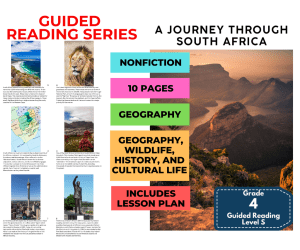
Journey Through South Africa: Guided Reading Level S with Lesson Plan
ELA, Resources for Teachers, Reading Comprehension, Reading, Science, Geography, Social Studies, History, Life Sciences, Government, Grade 3, 4, 5, Worksheets & Printables, Worksheets, Teacher Tools, Centers, Activities, Literacy Readers, Quizzes, Quizzes and Tests, Assessments, Lesson Plans
This A Journey Through South Africa (level s) guided reading book with lesson plan includes: Guided Reading Color Label (front cover x1) This is a quick way to match the book’s demands to what students can generally handle.. The overall goal is to use the level/color to pick books for several smaller groups. To qualify for a certain level, a student is expected to read a book from that level with about 90–94% accuracy. If a student is consistently accurate and understands, move up a level. If the student is struggling at that level, drop down and add more support. Each student will improve at completely different rates, but it is generally one of the best ways to check progress across the class. DOWNLOAD THE CATALOG TO VIEW ALL GUIDED READING BOOKS AVAILABLE (SORTED LEVELS A-Z) Pre-Reading Question (x1) Teacher asks the prompt aloud, can be while showing the cover or first page. Students share what they already know, or make educated guesses from the cover. Prompt them to use the target vocabulary. Write some of their responses on the board to look back at during the reading. Vocabulary Words (x5) Introduce the five words, best doing it one at a time. Start by saying it, while students repeat and then see if anyone knows what it means before reading further. Read through the meaning and try to briefly connect each word to a picture or gesture so it’s meaningful. Ask students to flip through the book pages and point to where they see each of the vocabulary words. While reading the book pause upon coming across one of the vocab words or read the sentence twice to make sure students understand the word has appeared. Optional: Ask students to raise hands whenever they see/hear one of the new words. Guided Reading Pages (x10) Check the book snapshot (below) for: primary topic - do you need to prep extra reading or intro materials on this? what is taught best - decide on 1-2 bullets to focus on, use the prompt or words provided here for best results. learning goals - what you are checking for students to be able to do after the session, elicit answers using prompts or words provided. key vocabulary (see section above). questions overview - so you know what is coming up and if you need to prep extra materials to assist understanding. Run the lesson You may have already looked at a few of the pages together, but you can show them some of the pictures again first to set meaning. Depending on how much time you have and how familiar your students are with guided reading class, you may want to read the book aloud first with the group first. Students whisper or partner read, while you listen in. If time, do it as a group, one student reading a page each. Use the guided page’s prompts to coach: “Check the picture / does it make sense?” “Point under the words / try the first sound” “Reread the sentence smoothly”. Try to focus more on one student per session (rotating every time), so you can work out if they are ready to move up or need to move down a level. Comprehension Questions (back cover x3) This is your way to check that students didn’t just say the words, but actually understood the text. First, let students answer by pointing to the page/picture and saying a short sentence. After any answer, follow with: “Show me where you found that in the text.” In bigger groups, have partners answer first (10–20 seconds), then call on 2–3 students to share. Differentiation tips: Emerging speakers/struggling readers: oral + pointing On-level: oral in a full sentence Higher: one written sentence or draw + label Book Snapshot Title: A Journey Through South Africa Genre: Nonfiction Subject: Social Studies (Geography/Culture/History) Primary Topic: South Africa’s geography, wildlife, history, and cultural life Estimated Guided Reading Level (A–Z): S What This Book Teaches Best Country overview and civics detail: South Africa’s location at Africa’s southernmost tip and its unusual system of three capital cities (Pretoria, Cape Town, Bloemfontein). Landforms and unique plant life: Table Mountain as a major landmark and part of a national park with many plant species found nowhere else. Habitats, wildlife, and conservation: Coastal habitats (including African penguins) and inland grasslands/savannas connected to the “Big Five” and protection of animals and environments. Modern cities and historical change: Johannesburg’s growth after gold discovery and South Africa’s journey from apartheid toward equality and democracy through Nelson Mandela’s leadership. Culture and identity through arts and community life: Traditions, music, and dance (Zulu and Xhosa) plus artistic expression like Ndebele painting and beadwork with special meanings. Learning Goals Students will identify South Africa’s three capital cities and explain each city’s role as described in the text. Students will describe two natural features or habitats in South Africa (for example, Table Mountain or the coastline) using details from the text. Students will explain how the text describes South Africa’s coastline and name the oceans it includes. Students will describe the inland grasslands and savannas and identify animals included in the text’s “Big Five.” Students will explain what apartheid was and describe how the text says South Africa moved toward equality and democracy. Students will describe at least two examples of South African culture or identity from the text (music/dance, art/beadwork, sports, or national symbols). Key Vocabulary From the Text southernmost — farthest to the south. administrative — related to running a government or system. savannas — wide grassy areas with some trees. apartheid — unfair system that separated people by race. resilience — strength to recover and keep going. Discussion Prompts Pre-reading question: What do you think you will learn about South Africa’s people, places, and animals? Comprehension questions: What are the three capital cities of South Africa named in the text? Comprehension questions: Which two oceans does the text say border South Africa’s coastline? Comprehension questions: What is the name of the system that separated people by race in South Africa? Printing Tips 1. Best Printing Method (Recommended) “Booklet” Printing (Best if Available) If your printer or PDF viewer supports Booklet Printing , use this. Settings to use: Print mode: Booklet Paper size: Letter or A4 (either works) Orientation: Landscape Print on both sides: Yes Flip on: Short edge Scaling: Fit to printable area Booklet subset: First test: Front sides only Then: Back sides only This will automatically: Pair pages correctly Put the cover on the outside Align everything for folding After printing, fold in half and staple along the spine . 2. If “Booklet” Printing Is NOT Available You can still print this correctly with manual duplex printing . Step-by-step: Open the PDF. Choose Print . Set: Orientation: Landscape Pages per sheet: 1 Print on both sides: Yes Flip on: Short edge Print all pages . Because each PDF page already contains two facing book pages, the result will still fold cleanly into a book. Thousands of Cored Education products are included with your TeachSimple membership. Download links and encyclopedia index available here.
Author Cored Education
Rating
Tags Reading Comprehension, Reading Passages, Reading, Guided Reading, Guided Reading Lesson Plan, Guided Reading Activity, Pre-reading, Social Studies, Geography, History
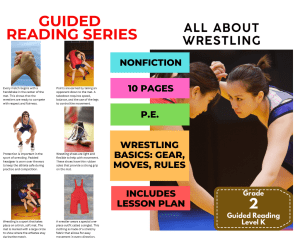
Guided Reading Level K - All About Wrestling (with Lesson Plan)
ELA, Resources for Teachers, Reading Comprehension, Reading, Health, P.E. & Health, Pre-Reading, Language Development, Sports, Physical Education, Grade 1, 2, 3, Worksheets & Printables, Worksheets, Teacher Tools, Centers, Activities, Literacy Readers, Quizzes, Quizzes and Tests, Assessments
This Guided Reading Book - All About Wrestling (Level K) with lesson plan includes: Guided Reading Color Label (front cover x1) This is a quick way to match the book’s demands to what students can generally handle.. The overall goal is to use the level/color to pick books for several smaller groups. To qualify for a certain level, a student is expected to read a book from that level with about 90–94% accuracy. If a student is consistently accurate and understands, move up a level. If the student is struggling at that level, drop down and add more support. Each student will improve at completely different rates, but it is generally one of the best ways to check progress across the class. DOWNLOAD THE CATALOG TO VIEW ALL GUIDED READING BOOKS AVAILABLE (SORTED LEVELS A-Z) Pre-Reading Question (x1) Teacher asks the prompt aloud, can be while showing the cover or first page. Students share what they already know, or make educated guesses from the cover. Prompt them to use the target vocabulary. Write some of their responses on the board to look back at during the reading. Vocabulary Words (x5) Introduce the five words, best doing it one at a time. Start by saying it, while students repeat and then see if anyone knows what it means before reading further. Read through the meaning and try to briefly connect each word to a picture or gesture so it’s meaningful. Ask students to flip through the book pages and point to where they see each of the vocabulary words. While reading the book pause upon coming across one of the vocab words or read the sentence twice to make sure students understand the word has appeared. Optional: Ask students to raise hands whenever they see/hear one of the new words. Guided Reading Pages (x10) Check the book snapshot (below) for: primary topic - do you need to prep extra reading or intro materials on this? what is taught best - decide on 1-2 bullets to focus on, use the prompt or words provided here for best results. learning goals - what you are checking for students to be able to do after the session, elicit answers using prompts or words provided. key vocabulary (see section above). questions overview - so you know what is coming up and if you need to prep extra materials to assist understanding. Run the lesson You may have already looked at a few of the pages together, but you can show them some of the pictures again first to set meaning. Depending on how much time you have and how familiar your students are with guided reading class, you may want to read the book aloud first with the group first. Students whisper or partner read, while you listen in. If time, do it as a group, one student reading a page each. Use the guided page’s prompts to coach: “Check the picture / does it make sense?” “Point under the words / try the first sound” “Reread the sentence smoothly”. Try to focus more on one student per session (rotating every time), so you can work out if they are ready to move up or need to move down a level. Comprehension Questions (back cover x3) This is your way to check that students didn’t just say the words, but actually understood the text. First, let students answer by pointing to the page/picture and saying a short sentence. After any answer, follow with: “Show me where you found that in the text.” In bigger groups, have partners answer first (10–20 seconds), then call on 2–3 students to share. Differentiation tips: Emerging speakers/struggling readers: oral + pointing On-level: oral in a full sentence Higher: one written sentence or draw + label Book Snapshot Title: All About Wrestling Genre: Nonfiction (informational) Subject: Physical Education / Health Primary Topic: Wrestling basics: gear, moves, rules, sportsmanship Estimated Guided Reading Level (A–Z): K What This Book Teaches Best Introduces where wrestling happens and how the mat is marked with a large circle. Explains what wrestlers wear for the sport (a singlet, padded headgear, wrestling shoes). Describes how points are earned and names key actions in a match (takedown, escape, pin). Highlights sportsmanship routines and expectations (handshake, respect and fairness, good sportsmanship). Shows the referee’s role in counting points and making sure rules are followed. Learning Goals Students can describe what the wrestling mat is like and what the large circle shows. Students can identify key wrestling gear from the text and explain its purpose. Students can explain how points are earned in wrestling using details from the book. Students can describe what an escape is and what it means to get back to a standing position. Students can explain what a pin is and what it does to the match. Students can describe how wrestlers show respect and fairness during a match. Key Vocabulary From the Text singlet — a one-piece outfit a wrestler wears. headgear — padded gear worn to protect the ears. opponent — the person you are competing against. takedown — a move that brings an opponent down to the mat. sportsmanship — behaving kindly and fairly during a match. Discussion Prompts Pre-reading question: What rules or routines help athletes compete safely and fairly in sports? Comprehension questions: What does the book say the large circle on the mat shows? Why do wrestlers begin each match with a handshake? What move ends the wrestling match immediately? Printing Tips 1. Best Printing Method (Recommended) “Booklet” Printing (Best if Available) If your printer or PDF viewer supports Booklet Printing , use this. Settings to use: Print mode: Booklet Paper size: Letter or A4 (either works) Orientation: Landscape Print on both sides: Yes Flip on: Short edge Scaling: Fit to printable area Booklet subset: First test: Front sides only Then: Back sides only This will automatically: Pair pages correctly Put the cover on the outside Align everything for folding After printing, fold in half and staple along the spine . 2. If “Booklet” Printing Is NOT Available You can still print this correctly with manual duplex printing . Step-by-step: Open the PDF. Choose Print . Set: Orientation: Landscape Pages per sheet: 1 Print on both sides: Yes Flip on: Short edge Print all pages . Because each PDF page already contains two facing book pages, the result will still fold cleanly into a book. Thousands of Cored Education products are included with your TeachSimple membership. Download links and encyclopedia index available here.
Author Cored Education
Rating
Tags Reading Comprehension, Reading Passages, Reading, Guided Reading, Guided Reading Lesson Plan, Guided Reading Activity, Pre-reading, Vocabulary, Health Lesson Plans, P.e. Lesson Plans
Guided Reading Level K - The World of Goats (with Lesson Plan)
ELA, Resources for Teachers, Reading Comprehension, Reading, Science, Language Development, Life Sciences, Animals, Pre-Reading, Vocabulary, Grade 2, 3, 4, Worksheets & Printables, Worksheets, Teacher Tools, Centers, Activities, Literacy Readers, Quizzes, Quizzes and Tests, Assessments, Lesson Plans
This Guided Reading Book - The World of Goats (Level K) with lesson plan includes: Guided Reading Color Label (front cover x1) This is a quick way to match the book’s demands to what students can generally handle.. The overall goal is to use the level/color to pick books for several smaller groups. To qualify for a certain level, a student is expected to read a book from that level with about 90–94% accuracy. If a student is consistently accurate and understands, move up a level. If the student is struggling at that level, drop down and add more support. Each student will improve at completely different rates, but it is generally one of the best ways to check progress across the class. DOWNLOAD THE CATALOG TO VIEW ALL GUIDED READING BOOKS AVAILABLE (SORTED LEVELS A-Z) Pre-Reading Question (x1) Teacher asks the prompt aloud, can be while showing the cover or first page. Students share what they already know, or make educated guesses from the cover. Prompt them to use the target vocabulary. Write some of their responses on the board to look back at during the reading. Vocabulary Words (x5) Introduce the five words, best doing it one at a time. Start by saying it, while students repeat and then see if anyone knows what it means before reading further. Read through the meaning and try to briefly connect each word to a picture or gesture so it’s meaningful. Ask students to flip through the book pages and point to where they see each of the vocabulary words. While reading the book pause upon coming across one of the vocab words or read the sentence twice to make sure students understand the word has appeared. Optional: Ask students to raise hands whenever they see/hear one of the new words. Guided Reading Pages (x10) Check the book snapshot (below) for: primary topic - do you need to prep extra reading or intro materials on this? what is taught best - decide on 1-2 bullets to focus on, use the prompt or words provided here for best results. learning goals - what you are checking for students to be able to do after the session, elicit answers using prompts or words provided. key vocabulary (see section above). questions overview - so you know what is coming up and if you need to prep extra materials to assist understanding. Run the lesson You may have already looked at a few of the pages together, but you can show them some of the pictures again first to set meaning. Depending on how much time you have and how familiar your students are with guided reading class, you may want to read the book aloud first with the group first. Students whisper or partner read, while you listen in. If time, do it as a group, one student reading a page each. Use the guided page’s prompts to coach: “Check the picture / does it make sense?” “Point under the words / try the first sound” “Reread the sentence smoothly”. Try to focus more on one student per session (rotating every time), so you can work out if they are ready to move up or need to move down a level. Comprehension Questions (back cover x3) This is your way to check that students didn’t just say the words, but actually understood the text. First, let students answer by pointing to the page/picture and saying a short sentence. After any answer, follow with: “Show me where you found that in the text.” In bigger groups, have partners answer first (10–20 seconds), then call on 2–3 students to share. Differentiation tips: Emerging speakers/struggling readers: oral + pointing On-level: oral in a full sentence Higher: one written sentence or draw + label Book Snapshot Title: The World of Goats Genre: Nonfiction (informational text) Subject: Life Science + Reading (Informational Text) Primary Topic: Goat traits, behaviors, and how they help Estimated Guided Reading Level (A–Z): K What This Book Teaches Best Describes goats as “smart and curious” animals that live in many places around the world. Explains body parts that help goats move and stay safe (horns, hooves, and special eyes that help them “see all around”). Teaches what goats eat by defining them as “herbivores” and naming plants they munch on (grass, leafy bushes, bark). Highlights goat abilities and behaviors (climbing steep, rocky cliffs; kids running and jumping; goats playing and gently bumping heads). Connects goats to farm life by stating they provide milk and wool. Learning Goals Students will identify key goat traits and behaviors described in the text. Students will explain how horns and hooves help goats, using details from the text. Students will describe how a goat’s special eyes help it stay safe. Students will explain what herbivores eat and list plants goats munch on from the text. Students will describe how goats communicate and what a “bleat” can help a mother goat do. Students will describe how goats can be helpful to people on a farm, according to the text. Key Vocabulary From the Text curious — wanting to learn more by exploring. hooves — hard feet that help goats walk. rectangles — shapes with four sides and four corners. herbivores — animals that eat only plants. bleat — the sound a goat makes. Discussion Prompts Pre-reading question: What features might help goats live in different places? Comprehension questions: How do a goat’s special eyes help it stay safe? Comprehension questions: What kinds of plants does the book say goats like to munch on? Comprehension questions: Why do goats gently bump their heads when they play together? Printing Tips 1. Best Printing Method (Recommended) “Booklet” Printing (Best if Available) If your printer or PDF viewer supports Booklet Printing , use this. Settings to use: Print mode: Booklet Paper size: Letter or A4 (either works) Orientation: Landscape Print on both sides: Yes Flip on: Short edge Scaling: Fit to printable area Booklet subset: First test: Front sides only Then: Back sides only This will automatically: Pair pages correctly Put the cover on the outside Align everything for folding After printing, fold in half and staple along the spine . 2. If “Booklet” Printing Is NOT Available You can still print this correctly with manual duplex printing . Step-by-step: Open the PDF. Choose Print . Set: Orientation: Landscape Pages per sheet: 1 Print on both sides: Yes Flip on: Short edge Print all pages . Because each PDF page already contains two facing book pages, the result will still fold cleanly into a book. Thousands of Cored Education products are included with your TeachSimple membership. Download links and encyclopedia index available here.
Author Cored Education
Rating
Tags Reading Comprehension, Reading Passages, Reading, Guided Reading, Guided Reading Lesson Plan, Guided Reading Activity, Pre-reading, Science Lesson Plans, Life Science, Animals

Guided Reading Activity The Chalkbox Kid Trifold Book Report
ELA, Reading, Grade 2, 3, 4, Projects, Activities, Teacher Tools, Graphic Organizers, Worksheets & Printables, Novel Studies
The Chalk Box Kid by Clyde Robert Bulla tells the story of Gregory, a boy adjusting to a new home, a new school, and a difficult family situation. Feeling out of place, Gregory discovers an abandoned chalk factory where he creates a secret garden with his drawings, allowing his creativity to flourish. Through his art, Gregory finds a sense of belonging and learns that self-expression can bring hope and healing. This trifold activity is created to help students practice reading comprehension skills while providing differentiated instruction for various reading levels. This tool can be used during guided reading, as independent seat work, or within literature circles. The included writing wrap-up allows for assessing multiple skills in one cohesive project, making it an ideal, standards-aligned resource for busy teachers. Grading opportunities for reading comprehension, reading skill work, and writing are available. What’s Included in This Resource: Each trifold is broken into chapters to allow for teacher skill guidance and manageable chunking for student comprehension. Skill Development Activities: Making Connections: Encourage students to relate the story to their own lives, other texts, and the wider world. Making Inferences: Help students combine text evidence with prior knowledge to draw logical conclusions. Using Context Clues: Teach students to deduce the meaning of unfamiliar words using hints from the text. Visualization: Support students in creating mental images of characters, events, and settings. Evaluation: Develop critical thinking by analyzing characters, themes, and the author’s message. Writing Wrap-Up: A creative assessment tool for reflection and deeper understanding. How This Resource Benefits Teachers: ✔ Provides differentiated instruction for diverse learners. ✔ Fosters deeper text engagement and critical thinking. ✔ Offers flexibility for grades, seat work, or group discussions. What Teachers Are Saying: ⭐ "This resource made my guided reading groups more organized and productive!" - Rebecca T. ⭐ "Perfect for differentiation and keeping all students engaged at their level." - Larraine C. ⭐ "My students loved the activities, and it worked seamlessly in our literature circles!" - Celia N.
Author Kel's Klass
Tags Making Inferences, Reading Strategies, Guided Reading Activity, Making Connections, Visualization, Context Clues, Evaluation, Trifold Project, Novel Study, The Chalkbox Kid

Guided Reading Lesson Plan & Activities for Grade 12
Reading, ELA, Grade 12, Activities, Lesson Plans, Teacher Tools
Guided reading allows teachers to monitor students while they read texts appropriate to their instructional reading levels. It typically includes these standard components: - Collaborating in small teams - Aligning student reading skills with text difficulty levels - Providing each individual in the group with identical text - Presenting the text - Hearing people read - Encouraging students to unify their reading strategies - Involving students in discussions regarding the text. The objective is to assist Grade 12 students in creating strategies for independent application. Work emphasizes processes essential for proficient reading, like cross-referencing print with meaning, instead of memorizing the definitions of words from a specific book. In guided reading, educators observe student reading behaviors and ensure that texts are accessible to them, enabling learners to combine their newly learned skills into a cohesive, integrated reading system. This ebook will assist you in practicing guided reading with your 12th-grade classes. It includes a complete lesson plan with activities and recommended answers that takes about 90 minutes.
Author Bright Classroom Ideas Marketplace
Tags Guided, Reading, Lesson, Plan, Activities, Grade 12, Language

Guided Reading Level L - The Arctic Fox (with Lesson Plan)
ELA, Resources for Teachers, Reading Comprehension, Reading, Pre-Reading, Language Development, Life Sciences, Science, Vocabulary, Animals, Grade 1, 2, 3, Worksheets & Printables, Worksheets, Teacher Tools, Centers, Activities, Literacy Readers, Quizzes, Quizzes and Tests, Assessments
This Guided Reading Book - The Arctic Fox (Level L) with lesson plan includes: Guided Reading Color Label (front cover x1) This is a quick way to match the book’s demands to what students can generally handle.. The overall goal is to use the level/color to pick books for several smaller groups. To qualify for a certain level, a student is expected to read a book from that level with about 90–94% accuracy. If a student is consistently accurate and understands, move up a level. If the student is struggling at that level, drop down and add more support. Each student will improve at completely different rates, but it is generally one of the best ways to check progress across the class. DOWNLOAD THE CATALOG TO VIEW ALL GUIDED READING BOOKS AVAILABLE (SORTED LEVELS A-Z) Pre-Reading Question (x1) Teacher asks the prompt aloud, can be while showing the cover or first page. Students share what they already know, or make educated guesses from the cover. Prompt them to use the target vocabulary. Write some of their responses on the board to look back at during the reading. Vocabulary Words (x5) Introduce the five words, best doing it one at a time. Start by saying it, while students repeat and then see if anyone knows what it means before reading further. Read through the meaning and try to briefly connect each word to a picture or gesture so it’s meaningful. Ask students to flip through the book pages and point to where they see each of the vocabulary words. While reading the book pause upon coming across one of the vocab words or read the sentence twice to make sure students understand the word has appeared. Optional: Ask students to raise hands whenever they see/hear one of the new words. Guided Reading Pages (x10) Check the book snapshot (below) for: primary topic - do you need to prep extra reading or intro materials on this? what is taught best - decide on 1-2 bullets to focus on, use the prompt or words provided here for best results. learning goals - what you are checking for students to be able to do after the session, elicit answers using prompts or words provided. key vocabulary (see section above). questions overview - so you know what is coming up and if you need to prep extra materials to assist understanding. Run the lesson You may have already looked at a few of the pages together, but you can show them some of the pictures again first to set meaning. Depending on how much time you have and how familiar your students are with guided reading class, you may want to read the book aloud first with the group first. Students whisper or partner read, while you listen in. If time, do it as a group, one student reading a page each. Use the guided page’s prompts to coach: “Check the picture / does it make sense?” “Point under the words / try the first sound” “Reread the sentence smoothly”. Try to focus more on one student per session (rotating every time), so you can work out if they are ready to move up or need to move down a level. Comprehension Questions (back cover x3) This is your way to check that students didn’t just say the words, but actually understood the text. First, let students answer by pointing to the page/picture and saying a short sentence. After any answer, follow with: “Show me where you found that in the text.” In bigger groups, have partners answer first (10–20 seconds), then call on 2–3 students to share. Differentiation tips: Emerging speakers/struggling readers: oral + pointing On-level: oral in a full sentence Higher: one written sentence or draw + label Book Snapshot Title: The Arctic Fox: A Winter Survivor Genre: Nonfiction (informational) Subject: Life Science Primary Topic: Arctic fox adaptations for cold-weather survival Estimated Guided Reading Level (A–Z): L What This Book Teaches Best Explains the Arctic fox’s habitat (“far north”) and names the tundra as a vast, treeless land with deep winter snow. Describes seasonal camouflage: white winter fur to hide, and brown/gray summer fur to blend with rocks and plants. Shows physical adaptations that help the fox stay warm and move safely (small rounded ears; thick fur on paws like “warm socks”). Teaches hunting behaviors using precise actions and vocabulary (hearing prey under snow; pouncing by leaping and diving head-first). Introduces animal homes and young: a den as tunnels under hills/rocks, and baby foxes called kits born in spring. Learning Goals Describe where the Arctic fox lives and what the tundra is. Explain how the Arctic fox’s fur color helps it in winter and in summer. Describe two body features that help the Arctic fox stay warm in freezing weather. Explain how the Arctic fox finds prey under the snow using its hearing. Describe what “pouncing” is and how it helps the fox catch food. Describe what a den is and what kits do as they grow. Key Vocabulary From the Text tundra — cold, treeless land in the far north. lemmings — small animals the fox can hunt. prey — an animal another animal hunts and eats. pouncing — leaping and diving quickly to catch food. den — a home or shelter where an animal lives. Discussion Prompts Pre-reading question: What body parts or behaviors might help an animal stay warm in a cold, windy place? Comprehension questions: How does the Arctic fox’s fur help it hide in winter and in summer? What does the fox do with its tail when it goes to sleep? How does pouncing help the Arctic fox catch its food? Printing Tips 1. Best Printing Method (Recommended) “Booklet” Printing (Best if Available) If your printer or PDF viewer supports Booklet Printing , use this. Settings to use: Print mode: Booklet Paper size: Letter or A4 (either works) Orientation: Landscape Print on both sides: Yes Flip on: Short edge Scaling: Fit to printable area Booklet subset: First test: Front sides only Then: Back sides only This will automatically: Pair pages correctly Put the cover on the outside Align everything for folding After printing, fold in half and staple along the spine . 2. If “Booklet” Printing Is NOT Available You can still print this correctly with manual duplex printing . Step-by-step: Open the PDF. Choose Print . Set: Orientation: Landscape Pages per sheet: 1 Print on both sides: Yes Flip on: Short edge Print all pages . Because each PDF page already contains two facing book pages, the result will still fold cleanly into a book. Thousands of Cored Education products are included with your TeachSimple membership. Download links and encyclopedia index available here.
Author Cored Education
Rating
Tags Reading Comprehension, Reading Passages, Reading, Guided Reading, Guided Reading Lesson Plan, Guided Reading Activity, Pre-reading, Vocabulary, Science Lesson Plans, Animals
Guided Reading Activities and Lesson Plan Nonfiction Set 5 Sea Animals
ELA, Reading, Reading Comprehension, Common Core, ESL, Language Development, Pre-Reading, Vocabulary, Resources for Teachers, Grade 4, 5, Worksheets & Printables, Worksheets, Lesson Plans, Teacher Tools, Activities
Guided Reading Activities with Lesson Plans Nonfiction Set 5 Note: This download DOES NOT include the passages themselves. If you have not already done so, download in a format of your choice in the "reading links" section below. Overview The perfect companion materials for Cored Education reading comprehension downloads. This collection provides structured lessons designed to enhance students' reading, comprehension, vocabulary, and creative thinking. Each lesson follows a consistent format that includes pre-reading activities to engage students, vocabulary-building exercises, comprehension checks, creative writing prompts, and discussion topics that promote critical thinking. The lessons are designed to foster active participation, encourage reflection, and develop key literacy skills through interactive and immersive learning experiences. The series is ideal for guided reading sessions, providing teachers with a comprehensive toolkit to engage students in both individual and group activities, enhancing their understanding of text and expanding their language skills. Includes Guided Reading Materials For: 1.Stingray 2.That's Electric 3.Whale Shark 4.Scared of Sharks 5.Under the Sea 6.All About Jellyfish Reading Links: This is the guided reading materials version and DOES NOT include the passages themselves. The passages related to this download are available here in GOOGLE Docs, GOOGLE Forms, GOOGLE Slides. PDF, PPT, WORD. Google Docs Google Forms Google Slides PDF PPT Word Key Features: Engaging Lesson Structure: Each lesson follows a clear and predictable format, which includes pre-reading discussions, vocabulary exercises, reading activities, and creative tasks to maintain student engagement. Vocabulary Development: Focus on introducing and applying new vocabulary in context, helping students internalize new words and use them effectively. Comprehension and Reflection: The lessons include comprehension questions and reflective prompts that encourage students to think critically about the text and its themes. Creative Writing and Discussion: Opportunities for students to express themselves through writing and group discussions, reinforcing their understanding while fostering creativity. Interactive and Student-Centered: The activities are designed to be interactive, allowing students to engage directly with the content and each other, promoting active learning. FULL CATALOG OF DOWNLOAD LINKS HERE Grade 4/5 Links Fiction Set 1 - Animals Google Docs Google Forms Google Slides PDF PPT Word Guided Reading Materials Fiction Set 2 - Family Google Docs Google Forms Google Slides PDF PPT Word Guided Reading Materials Fiction Set 3 - Friends Google Docs Google Forms Google Slides PDF PPT Word Guided Reading Materials Fiction Set 4 - School Google Docs Google Forms Google Slides PDF PPT Word Guided Reading Materials Fiction Set 5 - Sports Google Docs Google Forms Google Slides PDF PPT Word Guided Reading Materials Nonfiction Set 1 - Birds Google Docs Google Forms Google Slides PDF PPT Word Guided Reading Materials Nonfiction Set 2 - Insects Google Docs Google Forms Google Slides PDF PPT Word Guided Reading Materials Nonfiction Set 3 - Mammals Google Docs Google Forms Google Slides PDF PPT Word Guided Reading Materials Nonfiction Set 4 - Nature Google Docs Google Forms Google Slides PDF PPT Word Guided Reading Materials Nonfiction Set 5 - Sea Animals Google Docs Google Forms Google Slides PDF PPT Word Guided Reading Materials Reading Passages Overview Each passage is especially written for Grade 4-5 students, including key vocabulary required for this age group. Topics are varied and are accompanied by colorful graphics. Topics are meant to educate, yet entertain the modern student. These passages are perfect for the modern classroom. Whereas textbooks can become outdated in no time, any changes to technology or the world will result in updates to this product. Mixed Questions The mixed questions section of each lesson includes a variation of five comprehension, vocabulary and math questions. In addition, key reading strategies are frequently covered including cause & effect, summarizing, compare & contrast and making conclusions. Two or three of the questions will be MCQs and other questions will require a written response of some kind. Full answers and example responses appear at the end of the lesson. Spelling & Vocab Each reading passage contains a variety of words and phrases designed for Grade 4-5 students. Spelling and vocab activities provide the opportunity to build fluency with these words. As it can become quite mundane doing the same activities over and over, each lesson in a set will contain a different spelling and vocab activity . Activities include: spelling games, sentence match-ups, mixed-up text and decoding words from the lesson. Writing Prompts Writing prompts are designed to continue the theme or lessons learned in the story. Students are persuaded to write in a variety of ways and each prompt includes several cues to help. As with the spelling/vocab section, writing prompts will vary. This includes research pieces, reading responses, poetry and creative writing prompts. Full Answer Keys Full answer keys and sample responses are provided so no matter how busy you are, you know you're covered! Mixed question answers provide evidence from the text, math questions contain the relevant workings. Answers are designed for use by the teacher, but also suitable as a handout to the student. Just for Fun Each lesson will have a bonus extension exercise. This is something fun to extend the lesson with. You can find these at the end of each lesson, titled Just for Fun. Just for Funs are optional. Some you may like, some you may not. Either way, they are there to do with as you wish. For similar downloads and other frees, do check out Cored Group on TeachSimple.
Author Cored Education
Tags Elementary, Reading, Comprehension, Vocabulary, Answers, Ccss, Guided Reading, Guided Reading Activity, Guided Reading Lesson Plans, Guided Reading Lesson Plan
Reading Comprehension Quizzes - Coelacanth Ancient or Not?
Reading Comprehension, Reading, ELA, Life Sciences, Science, Vocabulary, Language Development, Writing, Theories, Basic Science, Grade 3, 4, 5, 6, Projects, Activities, Centers, Literacy Readers, Teacher Tools
Coelacanth is one of the most popular pieces of evidence that evolutionary scientists use to prove their theory about the age of the earth. But Coelacanth was discovered living in the early 20th century. Not only was this “extinct” fish discovered alive and well, but it was also apparently the same with no major changes compared to the original fossil discovered and dated 65 million years. So, if macroevolution is true, should the coelacanth still be used as evidence of evolution or old age. If so, why are there no apparent changes in this specific animal? These are questions to be pondered by students who read the short article and answer the questions included in the activity. This reading comprehension activity includes the link to the article discussing the discovery and what this might mean to the overall picture painted for the public regarding the evidence. This activity can be used for guided reading as well as increasing vocabulary and practice critically evaluating both sides of a controversial topic: Creation vs Evolution. The answer key is included. Teachers can easily use this as a starting point for deeper research on the subject. Total usable pages: 3 Downloadable pdf file Link to article included #Guided Reading #Reading Comprehension #Vocabulary Test
Author Homeschooling Dietitian Mom
Tags Reading Comprehension, Reading Comprehension Quizzes, Vocabulary, Vocabulary Quizzes, Guided Reading Activity, Guided Reading Lesson Plan, Biology Projects, Science Projects By Grade

Guided Reading Level F - Planets in Our Solar System
ELA, Resources for Teachers, Reading Comprehension, Reading, Language Development, Pre-Reading, Vocabulary, Science, Earth and Environmental Sciences, Space, Kindergarten, Grade 1, 2, Worksheets & Printables, Worksheets, Teacher Tools, Centers, Activities, Literacy Readers, Quizzes, Quizzes and Tests, Assessments
This Guided Reading Book - Planets in Our Solar System (Level F) includes: Guided Reading Color Label (front cover x1) This is a quick way to match the book’s demands to what students can generally handle.. The overall goal is to use the level/color to pick books for several smaller groups. To qualify for a certain level, a student is expected to read a book from that level with about 90–94% accuracy. If a student is consistently accurate and understands, move up a level. If the student is struggling at that level, drop down and add more support. Each student will improve at completely different rates, but it is generally one of the best ways to check progress across the class. DOWNLOAD THE CATALOG TO VIEW ALL GUIDED READING BOOKS AVAILABLE (SORTED LEVELS A-Z) COMPANION VIDEO NOW AVAILABLE (EMBEDDED AFTER PREVIEW PICTURES IN PRODUCT DESCRIPTION) Pre-Reading Question (x1) The teacher says the question aloud, either while showing the cover or the first page. Students share what they already know or make sensible guesses based on the cover. Encourage them to use the target vocabulary where possible. Write a few of their ideas on the board so you can return to them during or after the reading. Vocabulary Words (x5) Introduce the five words one at a time. Say each word aloud, have students repeat it, and then ask if anyone already knows what it means. Read the meaning together and briefly connect each word to a picture, action, or gesture so it feels more memorable. Ask students to flip through the book and point to any pages where they spot the vocabulary words. While reading, pause when one of the words appears, or reread the sentence so students clearly notice and understand it in context. Optional: Ask students to raise their hands whenever they see or hear one of the new words. Guided Reading Pages (x10) Check the book snapshot below for: Primary topic — decide whether students need a quick introduction or extra background first. What this lesson teaches best — choose 1–2 key points to focus on during the session. Learning goals — keep in mind what students should be able to understand or say by the end. Key vocabulary — review and reinforce these throughout the lesson. Questions overview — look ahead so you know what students will be asked and whether any extra support is needed. Run the lesson You may already have looked at a few pages together, but it can help to revisit some of the pictures first to build meaning. Depending on your time and how confident the group is with guided reading, you may want to read the whole book aloud to them first. Students can then whisper-read or partner-read while you listen in. If time allows, you can also read as a group, with each student taking a page. Use the guided reading prompts to support them, such as: “Check the picture—does it make sense?” “Point under the words.” “Try the first sound.” “Reread the sentence smoothly.” It can be helpful to focus more closely on one student each session, rotating over time, so you can better judge whether they are ready to move up or may need more support at their current level. Comprehension Questions (back cover x3) This is where you check that students understood the text, not just the words on the page. Start by letting students answer by pointing to a page or picture and saying a short sentence. After they respond, follow up with: “Show me where you found that in the text.” In larger groups, let partners discuss their answer first for 10–20 seconds, then invite 2–3 students to share. Differentiation tips Emerging speakers / struggling readers: oral response + pointing On-level: oral response in a full sentence Higher: one written sentence or a drawing with labels Book Snapshot Title: Planets in Our Solar System Genre: Nonfiction (informational) Subject: Science Primary Topic: Basic facts about the Sun, the planets, and the Moon Estimated Guided Reading Level (A–Z): F What This Book Teaches Best Introduces the Sun as a star at the center of the solar system that gives light and heat to the planets. Teaches the order of the planets, from Mercury to Neptune, with one main fact about each one. Builds science vocabulary naturally through the text, including words like craters , surface , giant , unique , and reflects . Helps students compare planets using simple details such as color, temperature, rings, winds, and clouds. Learning Goals Students will identify the Sun’s job in the solar system using details from the text. Students will name the planets in order from Mercury to Neptune as shown in the book. Students will describe at least three planets using facts from the text. Students will explain what makes one planet “unique” in the book. Students will tell what the Moon does at night, according to the text. Key Vocabulary From the Text craters — deep holes in the ground surface — the outside layer of something giant — very, very big unique — special and different from others reflects — bounces light back Discussion Prompts Pre-reading question: What do you already know about the Sun, the Moon, and the planets? Comprehension question: Which planet does the book say is the smallest? Comprehension question: What is Saturn famous for? Comprehension question: What does the Moon reflect at night? 1. Best Printing Method (Recommended) Booklet printing is the best option if your printer or PDF viewer supports it. This method usually places the pages in the correct order automatically and makes folding much easier. Settings to use: Print mode: Booklet Paper size: Letter or A4 Orientation: Landscape Print on both sides: Yes Flip on: Short edge Scaling: Fit to printable area Booklet subset: First, print front sides only Then, print back sides only This will automatically: Pair the pages correctly Place the cover on the outside Help everything line up properly for folding After printing, fold the pages in half and staple along the spine. 2. If “Booklet” Printing Is Not Available You can still print the book correctly by using manual duplex printing . Step-by-step: Open the PDF. Click Print . Use these settings: Orientation: Landscape Pages per sheet: 1 Print on both sides: Yes Flip on: Short edge Print all pages. Since each PDF page already contains two facing book pages, the pages should still fold neatly into a book. Thousands of Cored Education products are included with your TeachSimple membership. Download links and encyclopedia index available here.
Author Cored Education
Rating
Tags Vocabulary, Reading Comprehension, Reading Passages, Leveled Reading, Nonfiction, Reading, Guided Reading, Earth Science, Space, Planets
Discovering India: Guided Reading Level Q with Lesson Plan
ELA, Resources for Teachers, Reading Comprehension, Reading, Science, Geography, Social Studies, Technology, History, Life Sciences, Grade 3, 4, 5, Worksheets & Printables, Worksheets, Teacher Tools, Centers, Activities, Literacy Readers, Quizzes, Quizzes and Tests, Assessments, Lesson Plans
This Discovering India (level q) guided reading book with lesson plan includes: Guided Reading Color Label (front cover x1) This is a quick way to match the book’s demands to what students can generally handle.. The overall goal is to use the level/color to pick books for several smaller groups. To qualify for a certain level, a student is expected to read a book from that level with about 90–94% accuracy. If a student is consistently accurate and understands, move up a level. If the student is struggling at that level, drop down and add more support. Each student will improve at completely different rates, but it is generally one of the best ways to check progress across the class. DOWNLOAD THE CATALOG TO VIEW ALL GUIDED READING BOOKS AVAILABLE (SORTED LEVELS A-Z) Pre-Reading Question (x1) Teacher asks the prompt aloud, can be while showing the cover or first page. Students share what they already know, or make educated guesses from the cover. Prompt them to use the target vocabulary. Write some of their responses on the board to look back at during the reading. Vocabulary Words (x5) Introduce the five words, best doing it one at a time. Start by saying it, while students repeat and then see if anyone knows what it means before reading further. Read through the meaning and try to briefly connect each word to a picture or gesture so it’s meaningful. Ask students to flip through the book pages and point to where they see each of the vocabulary words. While reading the book pause upon coming across one of the vocab words or read the sentence twice to make sure students understand the word has appeared. Optional: Ask students to raise hands whenever they see/hear one of the new words. Guided Reading Pages (x10) Check the book snapshot (below) for: primary topic - do you need to prep extra reading or intro materials on this? what is taught best - decide on 1-2 bullets to focus on, use the prompt or words provided here for best results. learning goals - what you are checking for students to be able to do after the session, elicit answers using prompts or words provided. key vocabulary (see section above). questions overview - so you know what is coming up and if you need to prep extra materials to assist understanding. Run the lesson You may have already looked at a few of the pages together, but you can show them some of the pictures again first to set meaning. Depending on how much time you have and how familiar your students are with guided reading class, you may want to read the book aloud first with the group first. Students whisper or partner read, while you listen in. If time, do it as a group, one student reading a page each. Use the guided page’s prompts to coach: “Check the picture / does it make sense?” “Point under the words / try the first sound” “Reread the sentence smoothly”. Try to focus more on one student per session (rotating every time), so you can work out if they are ready to move up or need to move down a level. Comprehension Questions (back cover x3) This is your way to check that students didn’t just say the words, but actually understood the text. First, let students answer by pointing to the page/picture and saying a short sentence. After any answer, follow with: “Show me where you found that in the text.” In bigger groups, have partners answer first (10–20 seconds), then call on 2–3 students to share. Differentiation tips: Emerging speakers/struggling readers: oral + pointing On-level: oral in a full sentence Higher: one written sentence or draw + label Book Snapshot Title: Discovering India Genre: Nonfiction Subject: Social Studies (Geography/Culture) Primary Topic: India’s land, wildlife, traditions, and modern life Estimated Guided Reading Level (A–Z): Q What This Book Teaches Best Key geography facts about India’s location in Southern Asia, nearby borders, and surrounding waters. How landforms shape life in India, including the Himalayan Mountains and the Ganges River. Notable wildlife of India through examples like the Bengal tiger and the Indian elephant. Cultural traditions and everyday life, including spices used in meals and the celebration of Diwali. Modern India today, including transportation (auto-rickshaws) and major cities connected to technology and innovation. Learning Goals Students will describe where India is located and name details about its borders and southern waters. Students will explain how the Himalayan Mountains are described as protecting the inner plains. Students will explain why the Ganges River is important to people and farming in northern India. Students will describe key traits of the Bengal tiger and the Indian elephant using details from the text. Students will identify facts about the Taj Mahal, including where it is and features described in the book. Students will describe examples of Indian culture and modern life mentioned in the text (foods/spices, Diwali, transportation, cities). Key Vocabulary From the Text vast — very large in size. significant — very important. distinctive — easy to notice because it looks different. minarets — tall towers on a monument. diyas — small clay lamps used during Diwali. Discussion Prompts Pre-reading question: What are you hoping to learn about India as you read? Comprehension questions: What warm waters does the text say surround India to the south? Comprehension questions: According to the text, why is the Ganges River essential? Comprehension questions: What does the text say diyas symbolize during Diwali? Printing Tips 1. Best Printing Method (Recommended) “Booklet” Printing (Best if Available) If your printer or PDF viewer supports Booklet Printing , use this. Settings to use: Print mode: Booklet Paper size: Letter or A4 (either works) Orientation: Landscape Print on both sides: Yes Flip on: Short edge Scaling: Fit to printable area Booklet subset: First test: Front sides only Then: Back sides only This will automatically: Pair pages correctly Put the cover on the outside Align everything for folding After printing, fold in half and staple along the spine . 2. If “Booklet” Printing Is NOT Available You can still print this correctly with manual duplex printing . Step-by-step: Open the PDF. Choose Print . Set: Orientation: Landscape Pages per sheet: 1 Print on both sides: Yes Flip on: Short edge Print all pages . Because each PDF page already contains two facing book pages, the result will still fold cleanly into a book. Thousands of Cored Education products are included with your TeachSimple membership. Download links and encyclopedia index available here.
Author Cored Education
Rating
Tags Reading Comprehension, Reading Passages, Reading, Guided Reading, Guided Reading Lesson Plan, Guided Reading Activity, Pre-reading, Social Studies, Geography, History

Guided Reading Level B: Soccer - The World's Game
ELA, Resources for Teachers, Reading Comprehension, Reading, Language Development, Pre-Reading, Vocabulary, Sports, P.E. & Health, Physical Education, Kindergarten, Preschool, Grade 1, Worksheets & Printables, Worksheets, Teacher Tools, Centers, Activities, Literacy Readers, Quizzes, Quizzes and Tests, Assessments
This Guided Reading Book - Soccer: The World's Game (Level B) includes: Guided Reading Color Label (front cover x1) This is a quick way to match the book’s demands to what students can generally handle.. The overall goal is to use the level/color to pick books for several smaller groups. To qualify for a certain level, a student is expected to read a book from that level with about 90–94% accuracy. If a student is consistently accurate and understands, move up a level. If the student is struggling at that level, drop down and add more support. Each student will improve at completely different rates, but it is generally one of the best ways to check progress across the class. DOWNLOAD THE CATALOG TO VIEW ALL GUIDED READING BOOKS AVAILABLE (SORTED LEVELS A-Z) Pre-Reading Question (x1) Teacher asks the prompt aloud, can be while showing the cover or first page. Students share what they already know, or make educated guesses from the cover. Prompt them to use the target vocabulary. Write some of their responses on the board to look back at during the reading. Vocabulary Words (x5) Introduce the five words, best doing it one at a time. Start by saying it, while students repeat and then see if anyone knows what it means before reading further. Read through the meaning and try to briefly connect each word to a picture or gesture so it’s meaningful. Ask students to flip through the book pages and point to where they see each of the vocabulary words. While reading the book pause upon coming across one of the vocab words or read the sentence twice to make sure students understand the word has appeared. Optional: Ask students to raise hands whenever they see/hear one of the new words. Guided Reading Pages (x10) Check the book snapshot (below) for: primary topic - do you need to prep extra reading or intro materials on this? what is taught best - decide on 1-2 bullets to focus on, use the prompt or words provided here for best results. learning goals - what you are checking for students to be able to do after the session, elicit answers using prompts or words provided. key vocabulary (see section above). questions overview - so you know what is coming up and if you need to prep extra materials to assist understanding. Run the lesson You may have already looked at a few of the pages together, but you can show them some of the pictures again first to set meaning. Depending on how much time you have and how familiar your students are with guided reading class, you may want to read the book aloud first with the group first. Students whisper or partner read, while you listen in. If time, do it as a group, one student reading a page each. Use the guided page’s prompts to coach: “Check the picture / does it make sense?” “Point under the words / try the first sound” “Reread the sentence smoothly”. Try to focus more on one student per session (rotating every time), so you can work out if they are ready to move up or need to move down a level. Comprehension Questions (back cover x3) This is your way to check that students didn’t just say the words, but actually understood the text. First, let students answer by pointing to the page/picture and saying a short sentence. After any answer, follow with: “Show me where you found that in the text.” In bigger groups, have partners answer first (10–20 seconds), then call on 2–3 students to share. Differentiation tips: Emerging speakers/struggling readers: oral + pointing On-level: oral in a full sentence Higher: one written sentence or draw + label Book Snapshot Title: Soccer: The World’s Game Genre: Nonfiction (concept book) Subject: Reading / Health & PE Primary Topic: Soccer words for people, places, and gear Estimated Guided Reading Level (A–Z): B What This Book Teaches Best Builds sports vocabulary by naming soccer-related nouns (ball, field, goal, team, trophy). Introduces soccer roles and equipment with clear, repetitive labels (player, goalie, cleats, jersey, whistle). Supports early print concepts by pairing a short phrase with each picture (“The ____.”). Strengthens categorizing skills by noticing items that belong to the same topic (soccer). Learning Goals Students will identify the topic of the book as soccer. Students will name at least three soccer things the book labels. Students will identify two soccer people named in the book (player, goalie). Students will retell the book by naming the items in order from the pages. Students will match key words from the text to the correct picture (e.g., goal, jersey, trophy). Key Vocabulary From the Text cleats — shoes with bumps that help you grip. goalie — player who protects the goal. jersey — shirt a player wears. whistle — tool that makes a loud sound. trophy — prize you win. Discussion Prompts Pre-reading question: What soccer things do you think this book will name? Comprehension questions: What is the first thing named in the book? Name one person named in the book. What is the last thing named in the book? Printing Tips 1. Best Printing Method (Recommended) “Booklet” Printing (Best if Available) If your printer or PDF viewer supports Booklet Printing , use this. Settings to use: Print mode: Booklet Paper size: Letter or A4 (either works) Orientation: Landscape Print on both sides: Yes Flip on: Short edge Scaling: Fit to printable area Booklet subset: First test: Front sides only Then: Back sides only This will automatically: Pair pages correctly Put the cover on the outside Align everything for folding After printing, fold in half and staple along the spine . 2. If “Booklet” Printing Is NOT Available You can still print this correctly with manual duplex printing . Step-by-step: Open the PDF. Choose Print . Set: Orientation: Landscape Pages per sheet: 1 Print on both sides: Yes Flip on: Short edge Print all pages . Because each PDF page already contains two facing book pages, the result will still fold cleanly into a book. Thousands of Cored Education products are included with your TeachSimple membership. Download links and encyclopedia index available here.
Author Cored Education
Rating
Tags Vocabulary, Reading Comprehension, Reading Passages, Leveled Reading, Nonfiction, Reading, Guided Reading, P.E., Sports, Soccer
Guided Reading Level P - Animal Camouflage (with Lesson Plan)
ELA, Resources for Teachers, Reading Comprehension, Reading, Pre-Reading, Language Development, Animals, Life Sciences, Science, Vocabulary, Grade 2, 3, 4, Worksheets & Printables, Worksheets, Teacher Tools, Centers, Activities, Literacy Readers, Quizzes, Quizzes and Tests, Assessments
This Guided Reading Book - Animal Camouflage (Level P) with lesson plan includes: Guided Reading Color Label (front cover x1) This is a quick way to match the book’s demands to what students can generally handle.. The overall goal is to use the level/color to pick books for several smaller groups. To qualify for a certain level, a student is expected to read a book from that level with about 90–94% accuracy. If a student is consistently accurate and understands, move up a level. If the student is struggling at that level, drop down and add more support. Each student will improve at completely different rates, but it is generally one of the best ways to check progress across the class. DOWNLOAD THE CATALOG TO VIEW ALL GUIDED READING BOOKS AVAILABLE (SORTED LEVELS A-Z) Pre-Reading Question (x1) Teacher asks the prompt aloud, can be while showing the cover or first page. Students share what they already know, or make educated guesses from the cover. Prompt them to use the target vocabulary. Write some of their responses on the board to look back at during the reading. Vocabulary Words (x5) Introduce the five words, best doing it one at a time. Start by saying it, while students repeat and then see if anyone knows what it means before reading further. Read through the meaning and try to briefly connect each word to a picture or gesture so it’s meaningful. Ask students to flip through the book pages and point to where they see each of the vocabulary words. While reading the book pause upon coming across one of the vocab words or read the sentence twice to make sure students understand the word has appeared. Optional: Ask students to raise hands whenever they see/hear one of the new words. Guided Reading Pages (x10) Check the book snapshot (below) for: primary topic - do you need to prep extra reading or intro materials on this? what is taught best - decide on 1-2 bullets to focus on, use the prompt or words provided here for best results. learning goals - what you are checking for students to be able to do after the session, elicit answers using prompts or words provided. key vocabulary (see section above). questions overview - so you know what is coming up and if you need to prep extra materials to assist understanding. Run the lesson You may have already looked at a few of the pages together, but you can show them some of the pictures again first to set meaning. Depending on how much time you have and how familiar your students are with guided reading class, you may want to read the book aloud first with the group first. Students whisper or partner read, while you listen in. If time, do it as a group, one student reading a page each. Use the guided page’s prompts to coach: “Check the picture / does it make sense?” “Point under the words / try the first sound” “Reread the sentence smoothly”. Try to focus more on one student per session (rotating every time), so you can work out if they are ready to move up or need to move down a level. Comprehension Questions (back cover x3) This is your way to check that students didn’t just say the words, but actually understood the text. First, let students answer by pointing to the page/picture and saying a short sentence. After any answer, follow with: “Show me where you found that in the text.” In bigger groups, have partners answer first (10–20 seconds), then call on 2–3 students to share. Differentiation tips: Emerging speakers/struggling readers: oral + pointing On-level: oral in a full sentence Higher: one written sentence or draw + label Book Snapshot Title: A Guide to Animal Camouflage Genre: Nonfiction (informational text) Subject: Life Science / Reading (Informational Text) Primary Topic: How animals use camouflage to survive and hunt Estimated Guided Reading Level (A–Z): P What This Book Teaches Best What camouflage is and why it matters: Camouflage helps animals blend into their environment to stay safe from predators or sneak up on prey. Types of camouflage with clear examples: Background matching (toad), disruptive coloration (zebras), mimicry (stick insect), countershading (sea animals), and active camouflage (octopus). How animals change to match conditions: Seasonal changes in the Arctic fox’s coat and rapid changes in the octopus’s appearance. Camouflage for defense and hunting: The text shows camouflage protecting animals and helping hunters like the orchid mantis. Adaptations and survival: Camouflage is presented as an adaptation that helps animals survive and thrive in their homes. Learning Goals Students will explain what camouflage is and how it helps animals survive. Students will describe background matching and use the toad example from the text. Students will explain how disruptive coloration in zebra stripes can confuse a predator. Students will describe mimicry using details about the stick insect. Students will compare seasonal camouflage in the Arctic fox with countershading in sea animals. Students will describe how active camouflage works in the octopus and how the chameleon’s color-changing can help it stay hidden. Key Vocabulary From the Text camouflage — colors, patterns, or shapes that help an animal blend in. predators — animals that hunt other animals for food. texture — how a surface feels or looks. mimicry — when an animal looks like a different object. countershading — dark top and light belly that help hide in water. Discussion Prompts Pre-reading question: Why might an animal need to blend into its environment to survive? Comprehension questions: What does the text say camouflage helps animals do? Comprehension questions: How do zebra stripes make it difficult for a hunting lion to target one zebra? Comprehension questions: How does countershading help sea animals blend in from above and from below? Printing Tips 1. Best Printing Method (Recommended) “Booklet” Printing (Best if Available) If your printer or PDF viewer supports Booklet Printing , use this. Settings to use: Print mode: Booklet Paper size: Letter or A4 (either works) Orientation: Landscape Print on both sides: Yes Flip on: Short edge Scaling: Fit to printable area Booklet subset: First test: Front sides only Then: Back sides only This will automatically: Pair pages correctly Put the cover on the outside Align everything for folding After printing, fold in half and staple along the spine . 2. If “Booklet” Printing Is NOT Available You can still print this correctly with manual duplex printing . Step-by-step: Open the PDF. Choose Print . Set: Orientation: Landscape Pages per sheet: 1 Print on both sides: Yes Flip on: Short edge Print all pages . Because each PDF page already contains two facing book pages, the result will still fold cleanly into a book. Thousands of Cored Education products are included with your TeachSimple membership. Download links and encyclopedia index available here.
Author Cored Education
Rating
Tags Reading Comprehension, Reading Passages, Reading, Guided Reading, Guided Reading Lesson Plan, Guided Reading Activity, Pre-reading, Science Lesson Plans, Life Science, Animals
The Arid World - Deserts: Guided Reading Level P with Lesson Plan
ELA, Resources for Teachers, Reading Comprehension, Reading, Science, Language Development, Social Studies, Life Sciences, Geography, Earth and Environmental Sciences, Grade 2, 3, 4, Worksheets & Printables, Worksheets, Teacher Tools, Centers, Activities, Literacy Readers, Quizzes, Quizzes and Tests, Assessments, Lesson Plans
This The Arid World - Deserts (level p) guided reading book with lesson plan includes: Guided Reading Color Label (front cover x1) This is a quick way to match the book’s demands to what students can generally handle.. The overall goal is to use the level/color to pick books for several smaller groups. To qualify for a certain level, a student is expected to read a book from that level with about 90–94% accuracy. If a student is consistently accurate and understands, move up a level. If the student is struggling at that level, drop down and add more support. Each student will improve at completely different rates, but it is generally one of the best ways to check progress across the class. DOWNLOAD THE CATALOG TO VIEW ALL GUIDED READING BOOKS AVAILABLE (SORTED LEVELS A-Z) Pre-Reading Question (x1) Teacher asks the prompt aloud, can be while showing the cover or first page. Students share what they already know, or make educated guesses from the cover. Prompt them to use the target vocabulary. Write some of their responses on the board to look back at during the reading. Vocabulary Words (x5) Introduce the five words, best doing it one at a time. Start by saying it, while students repeat and then see if anyone knows what it means before reading further. Read through the meaning and try to briefly connect each word to a picture or gesture so it’s meaningful. Ask students to flip through the book pages and point to where they see each of the vocabulary words. While reading the book pause upon coming across one of the vocab words or read the sentence twice to make sure students understand the word has appeared. Optional: Ask students to raise hands whenever they see/hear one of the new words. Guided Reading Pages (x10) Check the book snapshot (below) for: primary topic - do you need to prep extra reading or intro materials on this? what is taught best - decide on 1-2 bullets to focus on, use the prompt or words provided here for best results. learning goals - what you are checking for students to be able to do after the session, elicit answers using prompts or words provided. key vocabulary (see section above). questions overview - so you know what is coming up and if you need to prep extra materials to assist understanding. Run the lesson You may have already looked at a few of the pages together, but you can show them some of the pictures again first to set meaning. Depending on how much time you have and how familiar your students are with guided reading class, you may want to read the book aloud first with the group first. Students whisper or partner read, while you listen in. If time, do it as a group, one student reading a page each. Use the guided page’s prompts to coach: “Check the picture / does it make sense?” “Point under the words / try the first sound” “Reread the sentence smoothly”. Try to focus more on one student per session (rotating every time), so you can work out if they are ready to move up or need to move down a level. Comprehension Questions (back cover x3) This is your way to check that students didn’t just say the words, but actually understood the text. First, let students answer by pointing to the page/picture and saying a short sentence. After any answer, follow with: “Show me where you found that in the text.” In bigger groups, have partners answer first (10–20 seconds), then call on 2–3 students to share. Differentiation tips: Emerging speakers/struggling readers: oral + pointing On-level: oral in a full sentence Higher: one written sentence or draw + label Book Snapshot Title: The Arid World: Deserts Genre: Nonfiction (informational) Subject: Earth Science Primary Topic: Desert climate, landforms, and survival adaptations Estimated Guided Reading Level (A–Z): P What This Book Teaches Best Defines deserts by very low precipitation and explains how scarce water shapes the environment. Explains extreme temperature changes in hot deserts from day to night and why they happen. Compares hot deserts and cold deserts , including why icy places can still be deserts. Shows how living things adapt to desert conditions , with examples from plants and animals (cactus, fennec fox, camel, sidewinder snake). Describes how wind shapes desert landforms , including how dunes form and move. Learning Goals Students can define a desert using the book’s description of precipitation and water scarcity. Students can explain why temperatures in a hot desert can drop quickly after sunset, based on the text. Students can describe how a cold desert can exist and name the example given in the book. Students can identify at least three desert adaptations and match them to the plant or animal described. Students can describe how wind forms dunes and what the text says dunes do over time. Students can explain what an oasis is and why it supports life in a desert. Key Vocabulary From the Text precipitation — water that falls from the sky, like rain. evaporation — when water turns to vapor and leaves. nocturnal — active at night and resting in daytime. oasis — a fertile desert area with freshwater reaching the surface. dunes — hills of sand formed when wind drops sand. Discussion Prompts Pre-reading question: What challenges do you think plants and animals face in a very dry place? Comprehension questions: How much rain do deserts usually get in a single year, according to the text? Comprehension questions: What does the book say helps the Saguaro cactus conserve water? Comprehension questions: What is an oasis, and where does its freshwater usually come from? Printing Tips 1. Best Printing Method (Recommended) “Booklet” Printing (Best if Available) If your printer or PDF viewer supports Booklet Printing , use this. Settings to use: Print mode: Booklet Paper size: Letter or A4 (either works) Orientation: Landscape Print on both sides: Yes Flip on: Short edge Scaling: Fit to printable area Booklet subset: First test: Front sides only Then: Back sides only This will automatically: Pair pages correctly Put the cover on the outside Align everything for folding After printing, fold in half and staple along the spine . 2. If “Booklet” Printing Is NOT Available You can still print this correctly with manual duplex printing . Step-by-step: Open the PDF. Choose Print . Set: Orientation: Landscape Pages per sheet: 1 Print on both sides: Yes Flip on: Short edge Print all pages . Because each PDF page already contains two facing book pages, the result will still fold cleanly into a book. Thousands of Cored Education products are included with your TeachSimple membership. Download links and encyclopedia index available here.
Author Cored Education
Rating
Tags Reading Comprehension, Reading Passages, Reading, Guided Reading, Guided Reading Lesson Plan, Guided Reading Activity, Pre-reading, Science Lesson Plans, Social Studies Lesson Plans, Earth Science