



2,784 products added recently
Page 763 - Newest Teaching Resources

 Show filters

Decomposing Fractions - Grade 4 Worksheets
Math, Fractions, Grade 4, 5, Worksheets & Printables, Worksheets
Decomposing fractions deals with the breaking down of a fraction or whole number into a sum of simpler parts. It provides a good foundation for addition and subtraction of fractions, converting improper fractions to mixed fractions and also makes word problems easier. These worksheets aim to develop the skills and understanding of decomposing fractions by ensuring you can choose from a sufficient number of levels of worksheets with and without visual support, and where needed repeat a level with a different set of questions as many times as is needed. There are 5 levels of worksheets with visual support which form a natural progression: Decompose fractions less than 1 to unit fractions Decompose fractions less than 1 to 2 fractions Decompose a fraction less than 1 to 3 fractions Decompose a Whole Number to 2 fractions Decompose an improper number then write as a mixed number Differentiation within each level For each of the above there are a number of options available that will enable you to choose how much information your students need to complete a worksheet e.g. you may want themto: -only to fill in the numerators for the decomposed fractions -write out the fully the fraction before and after decomposition using colored fraction bar -color in the fraction bar -find the missing numerators or denominators using the shown numbers as clues How many worksheets are there ? Lots and lots. There are 22 worksheet templates BUT at the click of a button numbers are randomised, so the questions change every time which allows you to create new worksheets at the same level for extra practice or revision throughout the year or even give groups of pupils in your class different sets of questions again all at the same level. The multiple levels of worksheets means that you can differentiate from the very start and have the freedom to set the pace of work that you think is best for each student. With these worksheets there is a simple example at the top of the page as a memory jogger Numerical Worksheets There are 2 further sets of worksheets with numerical based questions. The first covers decomposing fractions to unit fractions and 2 or more fractions. The second set has questions on decomposing improper numbers then writing them as mixed numbers. Answers can be found on the second page of every worksheet, are automatically generated when you create a new worksheet. As these NO PREP worksheets need little explanation, they are ideal if you need to leave work for a replacement teacher. Blank Templates In addition there are blank templates of each of the 5 formats above that can be used for a more open-ended activity where students can create their own worksheets on decomposing fractions. Note These resources are PDF documents and work with the official Adobe Acrobat Reader on Windows or Mac computers with the randomising buttons also working via a touchscreen (PC or Mac)or on an Interactive Whiteboard. Common Core CCSS.MATH.CONTENT.4.NF.B.3 Understand a fraction a/b with a > 1 as a sum of fractions 1/b. CCSS.MATH.CONTENT.4.NF.B.3.B Decompose a fraction into a sum of fractions with the same denominator in more than one way, recording each decomposition by an equation. Justify decompositions, e.g., by using a visual fraction model.
Author Jeff's Notebooks
Tags Math, Fractions, Decomposing Fractions, Decompsoing Fractions Less Than 1, Decomposing Fractions Greater Than One, Decomposing A Whole One, Jeff's Notebooks, Grafe 4, Fraction Worksheets, Worksheets, Decompose Fractions Worksheet, Decomposing Fractions 4th Grade Worksheet, Decomposing Fractions Worksheet Pdf, Decomposing Fractions Worksheets, Decomposing Mixed Numbers Worksheet, Decomposing A Fraction, Decomposing Fractions Worksheet 4th Grade Pdf, Decomposing Fractions Worksheet, Decomposing Mixed Numbers, Decomposing Fractions 4th Grade
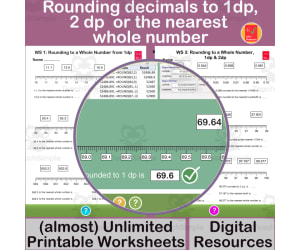
Rounding decimals to the nearest whole number, 1/10th or 1/100th
Math, Number Lines, Decimals, Place Value, Grade 5, 6, Worksheets & Printables, Worksheets
The number line is ideal for introducing rounding decimal numbers to a specific place value. Here we focus on numbers containing tenths, hundredths and thousandths and then round each of these to the nearest whole number, or numbers to 1d.p or 2 d.p. Worksheet Sets Worksheet Set 1: The focus here is on rounding numbers written to 1 d.p. to the nearest whole number. Students are encouraged firstly to find the number on the number lines provided before doing the actual rounding. Worksheet Set 2: Numbers written to 2 d.p. need to be rounded to either the nearest whole number or to 1d.p. Worksheet Set 3: Numbers written to 3 d.p. need to be rounded to either the nearest whole number, tenth or hundredth. In this worksheet the language of the questions is much more varied. How many worksheets are in each set ? Lots and lots. At the click of a button all numbers are randomised, so the questions change every time. This will allow you to create as many new worksheets you will need for practice throughout the year (classwork, homework, revision, fillers etc) or even give small groups of students in your class different sets of questions . There will certainly be enough to ensure fluency in this topic. There is also a set of ready made worksheets at the 3 levels shown above. Digital Teaching Material Designed to help you introduce the content of (all) the worksheets to the whole class on an Interactive Whiteboard, or on a PC or Mac for 1-1 tuition and similar to the Worksheets you have (almost) unlimited examples to practice with. Answers can be found on the second page of every worksheet, automatically generated when you create a new worksheet. Note These resources are PDF documents and work with the official Adobe Acrobat Reader on Windows or Mac computers with the randomising buttons also working via a touchscreen (PC or Mac)or on an Interactive Whiteboard. Common Core State Standards - 5th Grade CCSS5.NBT.A.4 Use place value understanding to round decimals to any place. UK Mathematics Program of Study Key Stage 2 Y4: Round decimals with one decimal place to the nearest whole number. Y5: Round decimals with two decimal places to the nearest whole number and to one decimal place. Y6: Develop skills of rounding, rounding answers to a specified degree of accuracy. Australian Curriculum: Year 7 : ACMNA156 Round decimals to a specified number of decimal places. 3 Worksheet Sets with the ability to generate (almost) unlimited questions. Digital Teaching Resources with unlimited examples a set of ready to use Worksheets and a Guide
Author Jeff's Notebooks
Tags Decimals, Rounding Decimals, Rounding Decimals Number Line, Rounding Decimals Place Value, Jeff's Notebooks, Number Line, Place Value, Tenths, Hundredths, Interactive Whiteboard
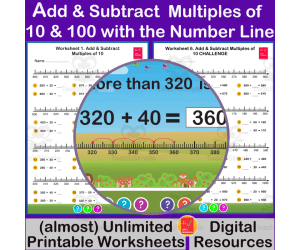
Add & Subtract Multiples of 10 and 100 with the Number Line
Math, Addition and Subtraction, Addition, Subtraction, Grade 2, 3, Worksheets & Printables, Worksheets
Help prepare your students to mentally add and subtract multiples of 10 and multiples of 100 between 100-900 using the visual aid of a Number Line with NO PREP ready to print worksheets and digital Teaching Resources covering the Common Core Standard 2.NBT.B.8 and beyond. There are 16 differentiated worksheets with the facility to create (almost) unlimited questions, enabling you as a teacher to set the appropriate level for all of your students and allow them to progress at the rate that is best for each one or repeat any one level if needed. Worksheet 1 to 3. Add and Subtract Multiples of 10 Addition Questions Worksheet 1: The first addend is a multiple of 10, and the number line starts with a multiple of 100. Worksheet 2: The first addend lies between 100 and 900, and the number line starts with a multiple of 100. Worksheet 3: The first addend lies between 100 and 900, and the number line starts with a multiple of 10. Subtraction Questions Worksheet 1: The minuend is a multiple of 10, and the number line starts with a multiple of 100. Worksheet 2: The minuend lies between 100 and 900, and the number line starts with a multiple of 100. Worksheet 3: The minuend lies between 100 and 900, and the number line starts with a multiple of 10. Worksheet 4 and 5. Add and Subtract Multiples of 100 Number line - Multiples of 100 from 100 to 900 with subdivisions of 10 Worksheet 4: First Addend (addition) / Minuend (subtraction) are multiple of 10 Worksheet 5: First Addend (addition) / Minuend (subtraction) lies between 100 and 900 Worksheet 6 to 8. Add and Subtract Multiples of 10 CHALLENGES Worksheet 6: The number line starts with a multiple of 100. First Addend / Minuend is a multiple of 10. Worksheet 7: The number line starts with a multiple of 100. First Addend / Minuend lies between 100 and 900 Worksheet 8: The number line starts with a multiple of 10. First Addend / Minuend lies between 100 and 900 Worksheet 9 and 10. Add and Subtract Multiples of 100 CHALLENGES Number line - Multiples of 100 from 100 to 900 with subdivisions of 10 Worksheet 9: First Addend / Minuend is a multiple of 10. Worksheet 10: First Addend / Minuend lies between 100 and 900. Worksheet 11 to 13. EXTRA - Add and Subtract Multiples of 10 to 10,000 Worksheet 11: The number line starts with a multiple of 1000. First Addend / Minuend is a multiple of 100. Worksheet 12: The number line starts with a multiple of 1000. First Addend / Minuend is a multiple of 10. Worksheet 13: The number line starts with a multiple of 100. First Addend / Minuend is a multiple of 10. Worksheet 14 to 16. EXTRA CHALLENGE - Add and Subtract Multiples of 10 to 10,000 Worksheet 14: The number line starts with a multiple of 1000. First Addend / Minuend is a multiple of 100. Worksheet 15: The number line starts with a multiple of 1000. First Addend / Minuend is a multiple of 10. Worksheet 16: The number line starts with a multiple of 100. First Addend / Minuend is a multiple of 10. What are CHALLENGES ? Students are now asked to find either the first or second addend for the addition questions, and either the minuend or subtrahend for the subtraction questions . Why (almost) Unlimited Worksheets ? At the click of a button all numbers are randomized, and will therefore change every time so you can create as many different worksheets for classwork, homework, review, preparing for assessments, or just simply practice at any time to keep the skill alive throughout the whole year. Teaching Pages Designed for use with the Interactive whiteboard for whole class teaching or on a PC or Mac for one-to-one tuition to help introduce the pupils to the content of the Worksheets. Students can come to the Whiteboard and enter solutions and get immediate feedback. Teaching Page 1. Add and Subtract Multiples of 10 with the Number Line 100-900 Click on a button and a number is chosen at random and pupils can enter their answer via a built in calculator and get instant feedback. Both the equation and the sentence ' .... more than ....' or '.... less than ....' are shown simultaneously so pupils can see the connection. This Teaching Page supports the content of Worksheets 1-3 Teaching Page 2. Add and Subtract Multiples of 100 with the Number Line 100-900 As above but now with hundreds being added or subtracted. This Teaching Page supports the content of Worksheets 4 and 5 Teaching Page 3. Add and Subtract Multiples of 100 with the Number Line to 10,000 As above but now with numbers up to 10,000 This Teaching Page supports the content of Worksheets 11 to 13 Answers can be found on the second page of every worksheet, automatically generated when you create a new worksheet. Note These resources are PDF documents and work with the official Adobe Acrobat Reader on Windows or Mac computers with the randomising buttons also working via a touchscreen ( Common Core 2nd Grade CCSS2.NBT.B.8 Mentally add 10 or 100 to a given number 100–900, and mentally subtract 10 or 100 from a given number 100–900.
Author Jeff's Notebooks
Tags Add Multiples Of 10, Subtact Multiples Of 10, Add Multiples Of 100, Subtract Multiples Of 100, Add With Number Line, Subtract With Number Line, Mental Addition, Mental Subtraction , Jeff's Notebooks, Interactive Whiteboard
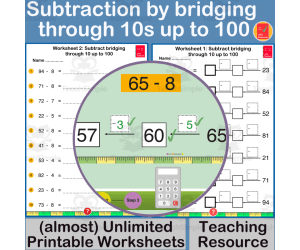
Subtraction by bridging through 10s up to 100
Math, Addition and Subtraction, Subtraction, Grade 2, Worksheets & Printables, Worksheets
Bridging through 10 is a mental math technique used when a subtraction means 'breaking through' a multiple of 10 to get to the final answer. e.g. 23 - 7 = 16. This example bridges through 20. The process of bridging divides the subtraction into 3 simple steps each of which can be handled mentally in order to get to the final answer This resource has 2 parts 1. Almost Unlimited Worksheets Worksheet Set 1 Subtracting 1 digit numbers to 2 digit numbers, bridging up to 100 with visual support Worksheet Set 2 Pupils have the opportunity to practice this topic further either by using the visual method from Worksheet Set 1 or using their own graphics that support the concept of bridging. Almost Unlimited Worksheets ? At the click of a button all numbers are randomised, so the questions change each time. This means you can create as many new worksheets you will need for practice throughout the year (classwork, homework, revision, fillers etc) or even give small groups of students in your class different sets of questions either at the same level or differentiated. There will certainly be enough to ensure fluency in this topic. As these worksheets need little explanation and no preparation, they are ideal if you need to leave work for a replacement teacher. Answers can be found on the second page of every worksheet, are automatically generated when you create a new worksheet. 2. Self Checking Interactive Presentation Ideal for a whole class activity as an introduction to the worksheets, pupils can come to the Whiteboard and enter solutions and get immediate feedback. Examples are randomly generated, as with the worksheets, so you can use this one page as many times as needed until you feel confident your pupils are ready to start the worksheets. There is also the option to take the pupils through the process in 3 separate steps, one at a time. You may also like Adding by bridging through 10 up to 100 Note These resources work with the official Adobe Acrobat Reader on Windows or Mac computers. CCSS2.NBT.B.5 Fluently add and subtract within 100 using strategies based on place value, properties of operations, and/or the relationship between addition and subtraction.
Author Jeff's Notebooks
Tags Math, Subtract, Subtraction, Bridging, Bridging 10, Worksheet, Interactive Whiteboard, 2nd Grade, Subtraction To 100, Jeff's Notebooks
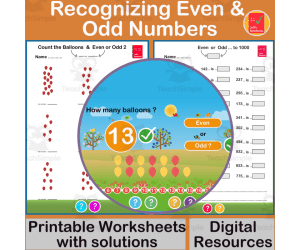
Recognising & Identifying Even & Odd Numbers - Grade 2
Math, Numbers, Grade 2, Worksheets & Printables, Worksheets
Recognising and identifying even and odd numbers is one of the most fundamental ways to start exploring patterns in numbers. Starting with counting and pairing objects, it moves to recognising even and odd numbers by simply looking at the last (unit) digit in a number, whatever digits come before it, and whatever the size of the number. Worksheets Set 1 Each of the 9 questions on the worksheets contains up to 14 objects. There are 2 arrangements of the objects which you can choose from: -objects arranged neatly in columns -objects spread out randomly The purpose here is to practice counting in pairs to help determine whether the number of objects are even or odd. By clicking a button at the bottom of the page , the bundle of objects are randomly rearranged on the page, so you can create more worksheets if needed. Worksheets Set 2 Pupils use this worksheet to recognise which numbers are even or odd numbers by simply looking at the last digit. There are two levels to choose from: The first contains numbers up to 100, and the second, for an extra challenge, numbers up to 1000. Here you can create almost unlimited further worksheets.. Unlimited Worksheets ? At the click of a button all numbers are randomised, and will therefore change every time so you can create as many unique worksheets as you need for classwork, homework, end of lesson filler etc. Answers can be found on the second page of every worksheet, automatically generated whenever you create a new worksheet. Self Checking Interactive Presentation Ideal for a whole class activity as an introduction for the content of each of the Worksheet Sets where pupils can come to the Whiteboard and enter solutions and get immediate feedback. They can also be used on a PC or Mac for 1 to 1 tuition. Note These resources work with the official Adobe Acrobat Reader on Windows or Mac computers. Common Core State Standards CCSS2.OA.C.3 (in part) Determine whether a group of objects (up to 20) has an odd or even number of members, e.g., by pairing objects or counting them by 2s Australian Curriculum - ACMNA051 - Investigate the conditions required for a number to be odd or even and identify odd and even numbers For further development on the topic of Even and Odd Nmbers have a look at : Even and Odd Numbers: Investigate patterns with the 4 operations
Author Jeff's Notebooks
Tags Math, Even And Odd , Even And Odd Numbers, Recognising Even And Odd Numbers, Worksheets, Interactive Whiteboard, Jeff's Notebooks, Grade 2, Even And Odd Worksheets, Pdf Worksheets, Odd Even Worksheets For Second Grade

Even and Odd Numbers: Investigate patterns with the 4 operations
Math, Patterns, Numbers, Grade 3, 4, Activities, Projects, Worksheets & Printables, Worksheets
The purpose of these resources is to explore patterns in our number system through one of the most fundamental classification of numbers - even and odd. Recognising even and odd numbers is first seen in Grade 2, and this builds on work covered here. See the resource Recognising even and odd numbers with and without objects. Having accomplished this, a natural extension is to investigate whether there are any patterns when even and odd numbers are added, subtracted, multiplied or divided. So, as well as looking for patterns pupils are practicing and applying the 4 basic number operations in a math investigation There are two fundamental approaches to this investigation: Using visual aids: Students can get visual clues when even and odd numbers of objects are displayed in an orderly fashion, which is always a good starting point. Addition and Subtraction are covered here with worksheets and digital teaching resources. Multiplication has a digital teaching resource. The range of numbers used are between 1 and 28 for addition, and 1 to 14 for division For the multiplication the examples go from 2 x 2 to 6 x 7 No visual aids: students apply the idea learnt in the Grade 2 resource that whatever the size of the number, in the end only the last (unit) digit matters when deciding if a number is even or odd. Addition, subtraction, multiplication and division are all covered here. The range of numbers used here are: - Addition: 2-digit plus a 2-digit number up a total of 30, 50 or 100 - Subtraction: Two 2-digit numbers with the first number a maximum of 30, 50 or 100 - Multiplication: From 2 x 2 to 12 x 12 - Division: Dividend a maximum of 100, Divisor up to 12. The work is broken down into modules so that a step by step approach can be taken. This prepares your students to: - Independently investigate and recognise any patterns or consistently repeated results when performing the 4 operations with even and odd numbers. - Make generalizations from the work carried out. - Make predictions and test them. How many worksheets are in each set ? Lots and lots and virtually unlimited on some of them. At the click of a button all numbers are randomised, so the questions change every time which allows you to create new worksheets for extra practice or revision throughout the year or even give groups of pupils in your class different sets of questions. Answers can be found on the second page of every worksheet, automatically generated when you create a new worksheet. Interactive Teaching Resources These are designed for whole class teaching with an Interactive Whiteboard or on a computer for one to one tuition with instant feedback to help introduce the content of the worksheets. As with the worksheets numbers can be randomized giving you almost unlimited examples to work with. Note These resources are PDF documents and work with the official Adobe Acrobat Reader on Windows or Mac computers with the randomising buttons also working via a touchscreen (PC or Mac)or on an Interactive Whiteboard. Common Core State Standards CCSS3.OA.D.9 Identify arithmetic patterns (including patterns in the addition table or multiplication table), and explain them using properties of operations. For example, observe that 4 times a number is always even, and explain why 4 times a number can be decomposed into two equal addends. Australian Curriculum Year 4: Investigate and use the properties of odd and even numbers (ACMNA071) Explore and describe number patterns resulting from performing multiplication (ACMNA081) For more foundational work on Even and Odd Numbers have a look at: Recognising & Identifying Even & Odd Numbers
Author Jeff's Notebooks
Tags Math, Even And Odd Numbers, Odd And Even, Patterns In Numbers, Math Investigation, Grade 3, Jeff's Notebooks, Worksheets, Math Project, Interactive Whiteboard

Compare Fractions with different numerators and denominators 4th Grade
Math, Fractions, Grade 3, 4, 5, Worksheets & Printables, Worksheets
These resources look at comparing fractions when they have different numerators and different denominators using visual fraction models - the number line and rectangle bar. This leads on to comparing fractions using a numerical method by finding a common denominator. The worksheets begin with a review of comparing fractions with the same denominator or numerator with the number line or rectangle bar which students would have seen in Grade 3. This is a good introduction to the topic as you only have to really compare one number (either the numerator or denominator). There is a worksheets with numerical questions, but you may want to use this for the 'Investigation' Comparing fractions with 1/2 You have the same visual models as above, but you can decide to use either a range of values of the denominators from 3 or 10 or from 8 to 20. Investigating patterns Here you could decide to investigate alternative ways to compare the fractions above by looking for any patterns in the results obtained that will allow your students to answer questions on comparing fractions without the need for visual models or a numerical method. You are provided with Investigation sheets where pupils can gather all their results from completed worksheets and write their statements about the patterns they see. Comparing fractions with different numerators and different denominators This is the core of the topic. There are 3 levels, and at each level there is the choice of using the number line or rectangle bars. Level 1: Denominators lie between 3 and 10 Level 2: Denominators lie between 3 and 20, with one is a multiple of the other. Here, it may be useful to refer back to the work done on Equivalent fractions as a double check on the answers could be done numerically. Level 3: Denominators are between 3 and 20 Transition from visual models to a numerical method Students get to see that the easiest way to compare two fractions is if they have the same denominators, then there is only the numerators to think about. This is explained firstly through using a visual fraction model which is then linked to the idea of creating a common denominator between the two fractions by multiplying the 2 denominators together (all explained in the Guide). Numerical Worksheets There are 6 sets of worksheet here: - Comparing fractions to 1/2 - Compare Fractions (1) - Denominators from 3 to 12 - Compare Fractions (2) - One Denominator is a multiple of the other - Compare Fractions (3) - Denominators from 3 to 20 - Compare Fractions (4) - Denominators from 8 to 20 The first 2 cover the early work and could also be used with the Investigation, the others could be used for by students drawing their own number lines or rectangle bars or for the numerical method outlined above. Click, Print and Go- No-Prep Worksheets You will have ready a set of straightforward no-prep worksheets that require virtually no instructions. Each worksheet with the number line or rectangle bar has a small example at the top of the page to remind students of what they have to do .... very useful for homework. They are also ideal for an end of lesson activity, and to have ready for a replacement teacher if needed. How many worksheets are there in total ? Virtually unlimited ... At the click of a button all the questions are randomised, so the worksheet is different every time. This will allow you to create as many new worksheets you will need for practice throughout the year (classwork, homework, revision, fillers, etc.) or even give small groups of students in your class different sets of questions either at the same level or differentiated . There will certainly be enough to ensure fluency in this topic. You could also use any of the worksheets to explain or introduce the subject to your class as you will have almost unlimited examples to work with and they will be different from the actual worksheets you hand out to your students. Answers can be found on the second page of every worksheet, automatically generated when you create a new worksheet. Note These resources are PDF documents and work with the official Adobe Acrobat Reader on Windows or Mac computers with the randomising buttons also working via a touchscreen (PC or Mac)or on an Interactive Whiteboard. Common Core - CCSS4.NF.A.2 Compare two fractions with different numerators and different denominators, e.g., by creating common denominators or numerators, or by comparing to a benchmark fraction such as 1/2. Recognize that comparisons are valid only when the two fractions refer to the same whole. Record the results of comparisons with symbols >, =, or <, and justify the conclusions, e.g., by using a visual fraction model. Almost unlimited number of no prep worksheets at multiple levels, plus a set of templates for investigating patterns when comparing fractions, plus a guide
Author Jeff's Notebooks
Tags Math, Fractions, Comparing Fractions, Compare Fractions Visual Model , Fractions Number Line, Common Denominator, Equivalent Fractions, 4th Grade Fractions, Jeff's Notebooks, Interactive Whiteboard, Denominators And Numerators, 4th Grade Comparing Fractions Worksheets, Comparing Fractions With Like Numerators, Ordering Fractions Worksheet 4th Grade
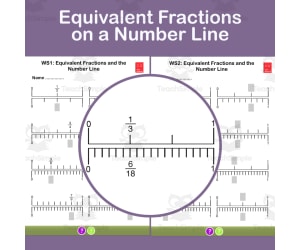
Equivalent Fractions on the Number Line Worksheets 3rd Grade
Math, Fractions, Grade 3, Worksheets & Printables, Worksheets
Fractions that have the same value, called Equivalent Fractions, can be found at the same point on the number line and is an ideal visual introduction into this topic. These printable Worksheets consist of questions containing 2 number lines between 0 and 1. Each number line is divided into a different number of equal parts which students then have to compare and determine the numerical value of the fraction or fractions. Worksheet Set 1: One fraction is shown. Students write down the equivalent fraction to the one shown taking into account the number of equal parts on the line. Worksheet Set 2: Two equivalent fractions are indicated on a number line. Students have to write down the numerical value of each fraction taking into account how each number line has been divided. How many worksheets are there ? Lots. At the click of a button all numbers are randomised, allowing you to create as many different worksheets as your students need for classwork, homework, revision, preparing for assessment, fillers etc., and the numbers will change every time. Answers are on the second page of every worksheet, automatically generated when you create a new worksheet. Note These resources are PDF documents and work with the official Adobe Acrobat Reader on Windows or Mac computers with the randomising buttons also working via a touchscreen (PC or Mac)or on an Interactive Whiteboard. Common Core Standards CCSS3.NF.A.2 Understand a fraction as a number on the number line; represent fractions on a number line diagram. CCSS3.NF.A.2a Represent a fraction 1/𝘣 on a number line diagram by defining the interval from 0 to 1 as the whole and partitioning it into 𝘣 equal parts. Recognize that each part has size 1/𝘣 and that the endpoint of the part based at 0 locates the number 1/𝘣 on the number line. CCSS3.NF.A.2b Represent a fraction 𝘢/𝘣 on a number line diagram by marking off 𝘢 lengths 1/𝘣 from 0. Recognize that the resulting interval has size 𝘢/𝘣 and that its endpoint locates the number 𝘢/𝘣 on the number line. CCSS3.NF.A.3a Understand two fractions as equivalent (equal) if they are the same size, or the same point on a number line. You may also like: Equivalent Fractions using Rectangles - a visual approach - Worksheets + Equivalent Fractions - Numerical method with multipliers and divisors
Author Jeff's Notebooks
Tags Fractions, Number Line, Equivalent Fractions Number Line, Equivalent Fractions, Math, 3rd Grade, 3rd Grade Fractions, Jeff's Notebooks, Common Core, Interactive Whiteboard, Equivalent Fraction Number Line, Fraction Worksheets For 3rd Graders, Number Line Equivalent Fractions, Fractions Worksheets 3rd Grade, Equivalent Fractions On A Number Line, Equivalent Fractions Using A Number Line, Fractions On A Number Line 3rd Grade, Equivalent Fractions Using Number Lines, Fractions On The Number Line Worksheets, Equivalent Fractions On The Number Line, How To Teach Equivalent Fractions 3rd Grade, Finding Equivalent Fractions With A Number Line Common Core, 3rd Grade Fractions On A Number Line, Fraction Worksheets 3rd Grade, Equivalent Fractions On Number Line Worksheet, Equivalent Fractions 3rd Grade, Equivalent Fractions Third Grade
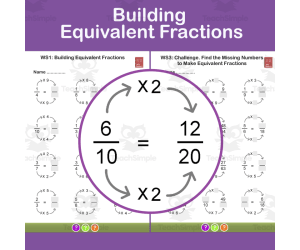
Equivalent Fractions - Numerical method with multipliers and divisors
Math, Fractions, Grade 3, 4, Worksheets & Printables, Worksheets
A large supply of Worksheets to practice creating equivalent fractions by multiplying or dividing the numerator and the denominator of a given fraction by the same whole number. There are 9 Sets of Worksheets that aim to build up the knowledge, skills and confidence of your students in this topic and provides you with the freedom to set work at different levels according to the needs of your students. Worksheet Set 1: Given one fraction and the multiplier, pupils have to find the equivalent fraction Worksheet Set 2: Both equivalent fractions are shown and pupils have to find the multiplier that connects them. Worksheet Set 3: More challenging. The minimum, but sufficient information is given for pupils to find the equivalent fraction and/or the multiplier connecting them. Worksheet Set 4 to 6: These follow the same pattern as above, but now the fractions are connected by divisors. Worksheets Set 7 to 9: These again follow the same pattern as above, but now the fractions are connected by a mix of multipliers and divisors. How many worksheets are in each set ? Lots and lots. At the click of a button all numbers are randomised, so the questions change every time. This will allow you to create as many new worksheets you will need for practice throughout the year (classwork, homework, revision, fillers, etc.) or even give small groups of students in your class different sets of questions either at the same level or differentiated . There will certainly be enough to ensure fluency in this topic. As they need little explanation, they are ideal if you need to leave work for a replacement teacher. Answers ? These are automatically generated every time for all worksheets. Note These resources are PDF documents and work with the official Adobe Acrobat Reader on Windows or Mac computers with the randomising buttons also working via a touchscreen (PC or Mac) or on an Interactive Whiteboard Common Core Standards (or printables /parts-of-and-anatomy-of">parts of ) covered CCSS3.NF.A.3b Recognize and generate simple equivalent fractions, (e.g., 1/2 = 2/4, 4/6 = 2/3) You may also like: Equivalent Fractions using Rectangles - a visual approach - Worksheets + Equivalent Fractions on the Number Line Worksheets 3rd Grade
Author Jeff's Notebooks
Tags Equivalent Fractions, Fractions, Math, Jeff's Notebooks, Grade 3, Grade 4, Worksheets, Generate Equivalent Fractions, Interactive Whiteboard

Equivalent Fractions using a visual approach with rectangles
Math, Fractions, Grade 3, Worksheets & Printables, Worksheets
If two fractions are equivalent it means they are the same in terms of shape and size, but are expressed using different numbers Equivalent fractions are best introduced using shape models before proceeding on to using the number line or any numerical method. If two fractions are equivalent it means they are the same in terms of shape and size, but are expressed using different numbers In these resources fractions are compared using rectangles, where each rectangle represents the same area of a whole. The 4 Sets of Worksheets form a progression as follows: Worksheet Set 1: Each pair of rectangles on the page has a fraction of it's space colored in. Students write down the (equivalent) fractions of each in numerical terms. Worksheet Set 2: For each pair of rectangles, equivalent fractions are shown . Students color in the areas on two rectangles that represent two given equivalent fractions. Worksheet Set 3: Pairs of coloured-in rectangles and the denominators of the equivalent fractions are shown. Students must determine the numerators (of each fraction) and the multiplier that connects the two fractions. Worksheet Set 4: Shown pairs of partially coloured-in rectangles pupils are asked to write down the fractions coloured-in and the multiplier connecting the two fractions. How many worksheets are in each set ? A lot. At the click of a button all numbers are randomised, so the questions change every time. This means you can create new worksheets for plenty of extra practice throughout the year or even give groups of pupils in your class different sets of questions. Answers can be found on the second page of every worksheet, which are automatically generated when you create a new worksheet. Note These resources are PDF documents and work with the official Adobe Acrobat Reader on Windows or Mac computers with the randomising buttons also working via a touchscreen (on a PC or Mac) or on an Interactive Whiteboard. Common Core Standards CCSS3.NF.A.1 Understand a fraction 1/𝘣 as the quantity formed by 1 part when a whole is partitioned into 𝘣 equal parts; understand a fraction 𝘢/𝑏 as the quantity formed by 𝘢 printables /parts-of-and-anatomy-of">parts of size 1/𝘣. CCSS3.NF.A.3 Explain equivalence of fractions in special cases, and compare fractions by reasoning about their size. CCSS3.NF.A.3a Understand two fractions as equivalent (equal) if they are the same size, or the same point on a number line. CCSS3.NF.A.3b Recognize and generate simple equivalent fractions, (e.g., 1/2 = 2/4, 4/6 = 2/3). Explain why the fractions are equivalent, e.g., by using a visual fraction model. You may also like: Equivalent Fractions on the Number Line Worksheets 3rd Grade Equivalent Fractions - Numerical method with multipliers and divisors
Author Jeff's Notebooks
Tags Equivalent Fractions, Fractions, Visual Model Equivalent Fraction, Grade 3, Jeff's Notebooks, Worksheets, Math, Numeracy, Interactive Whiteboard

Coordinates in 4 Quadrants - Plotting and Finding Points
Math, Geometry, Grade 5, 6, Worksheets & Printables, Worksheets
This set of worksheets will enable your students practice plotting and reading coordinates in all 4 quadrants of a Cartesian plane where the numbers are positive and negative with a range of different graphic images leading up to points located on an x-y graph simply with letters. For each set of graphics (leaves, astronaut icons, geometric shapes, and letters) There are two separate activities: - Finding the coordinates of points on an x-y Grid in the 4 Quadrants - Given set of coordinates, locate their position on an x-y Grid in the 4 Quadrants In addition, for a final set of worksheets, again there are the two activities, however this time the coordinates or points drawn on the axis form geometric shapes. This provides a good starting point for further questioning or investigation that could include: - naming the shapes - drawing lines of symmetry and labeling coordinates on the line - finding the coordinate of the center of each shape - apply simple transformations and noting the new coordinates .......... How many Worksheets in total ? Virtually Unlimited, because at the click of a button all the numbers or positions of the objects are randomized providing you with a new set of questions for classwork, homework, revision, assessments etc. You could also use any of the worksheets to explain or introduce the subject to your class as you will have almost unlimited examples to work with and they will be different from the actual worksheets you hand out to your students. You will also have 2 sets of blank worksheets so that your students can create their own worksheets, or use them for the investigations suggested above Answers can be found on the second page of every worksheet, automatically generated when you create a new worksheet. Note These resources are PDF documents and work with the official Adobe Acrobat Reader on Windows or Mac computers with the randomising buttons also working via a touchscreen (PC or Mac)or on an Interactive Whiteboard. Common Core Standards CCSS5.G.A.1 Use a pair of perpendicular number lines, called axes, to define a coordinate system, with the intersection of the lines (the origin) arranged to coincide with the 0 on each line and a given point in the plane located by using an ordered pair of numbers, called its coordinates. Understand that the first number indicates how far to travel from the origin in the direction of one axis, and the second number indicates how far to travel in the direction of the second axis, with the convention that the names of the two axes and the coordinates correspond (e.g., 𝘹-axis and 𝘹-coordinate, 𝘺-axis and 𝘺-coordinate). Australian Curriculum Introduce the Cartesian coordinate system using all four quadrants (ACMMG143) You may also like Coordinates in the first Quadrant. Plotting and Locating Points
Author Jeff's Notebooks
Tags Math, Coordinates, Cartesian Coordinates, 4 Quadrants, Plotting Points, X-y Axis, Jeff's Notebooks, Worksheets, Printable Worksheets, Interactive Whiteboard

Research Organizer & Essay Assignment: William Shakespeare
ELA, Literature, Writing, Grade 7, 8, 9, 10, 11, 12, Activities, Projects, Worksheets & Printables, Worksheets
William Shakespeare Research Project Dive deep into the life and works of the prolific playwright William Shakespeare with this complete 6-page research project. Students start by gathering facts and citing sources about Shakespeare's biography using the provided 2-page handout. Next, they organize their notes into an outline to draft a 5-paragraph informative essay on Shakespeare. The packet includes tips for structuring the essay, plus a peer review checklist for giving constructive feedback. Finally, students submit their finished essay which you can grade with the included rubric tied to Common Core standards. This step-by-step research project allows flexible implementation for grades 7-12, whether assigned in full or partially as a sub assignment. Let your students showcase their research skills and knowledge of this iconic literary figure.
Author The Language of Educational Art, LLC
Tags Essay , Rubric, Research, Notetaking, Outlining
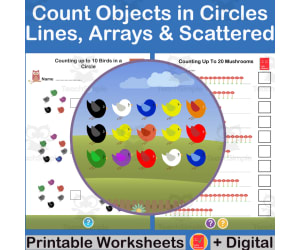
Count to 20 objects in a line, circle, array or scattered Kindergarten
Math, Early Math, Numbers, Kindergarten, Preschool, Worksheets & Printables, Worksheets
These worksheets and digital resources are specifically aimed to cover the Kindergarten Common Core Standards covering the counting of up to 20 objects when in a variety of arrangements, namely circles, lines, rectangular arrays or simply scattered randomly Worksheet Sets Counting in Circles - Up to 10 - 10 to 20 Counting in Arrays - Up to 20 Counting in a Line - Up to 10 - 10 to 20 Counting Scattered Objects - Up to 10 - 10 to 20 How many worksheets are in each set ? Lots and lots. At the click of a button all numbers are randomised, so the pages change every time. This means you can create as many new worksheets you will need for practice throughout the year or even give small groups of students in your class different sets of questions either at the same level or slightly differentiated. Answers can be found on the second page of every worksheet , automatically generated when you create a new worksheet . Digital Teaching Material These are designed to help you introduce the content of the worksheets to the whole class on an Interactive Whiteboard, or on a PC or Mac for 1-1 tuition. There is one Teaching Resource for each of the arrangements as listed with the worksheets but some have more ranges of numbers to work with, which will help you assess better when students are ready to being with the worksheets and at which level. Counting objects in circles - Up to 10 - 10 to 20 Counting in Arrays - Up to 10 - 11 to 20 Counting in a Line - 1 to 5 - 1 to 7 - 1 to 10 - 11 to 20 Counting Scattered Objects - 1 to 5 - 1 to 7 - 1 to 10 - 11 to 20 Note These resources are PDF documents and work with the official Adobe Acrobat Reader on Windows or Mac computers with the randomising buttons also working via a touchscreen (PC or Mac)or on an Interactive Whiteboard. Common Core Standards CCSSK.CC.B.4b Understand that the last number name said tells the number of objects counted. The number of objects is the same regardless of their arrangement or the order in which they were counted. CCSS K.CC.B.4c Understand that each successive number name refers to a quantity that is one larger. CCSSK.CC.B.5 Count to answer “how many?” questions about as many as 20 things arranged in a line, a rectangular array, or a circle, or as many as 10 things in a scattered configuration; given a number from 1-20, count out that many objects. You may also like .... Compare Numbers up to 10 & 20 and Quantities to 10 Kindergarten
Author Jeff's Notebooks
Tags Math, Count Objects, Count Objects Scattered, Count Objects In A Line, Count Up To 20 Objects In An Array, Count Objects In A Circle, Count Up To 20 Objects, Kindergarten Math, Jeff's Notebooks, Interactive Whiteboard

Percentages of quantities with and without visual support - 6th Grade
Math, Percentages, Grade 5, 6, 7, Worksheets & Printables, Worksheets
Introducing percentages can be helped by approaching it with informal methods of calculation supported by a visual representation before moving onto the standard algorithms with word based problems at a laters stage This is what this resource aims to do by using: - the equivalence of 50%, 25% & 75% and their fractions 1/2, 1/4 & 3/4 - the knowledge that 10% =1/10 and 1/10th of any multiple of 10 or 100 can easily be found by removing the last zero of the number. From here students can then move on to calculating: - 5% of quantities (1/2 of 10%) or - 1% (or multiples of 1%) of quantities, equivalent to 1/10th of a tenth. The Worksheets and Teaching Resources are set at 5 levels 1. 10%, 25%, 50%, & 75% of multiples of 100 2. 10%,20%,30% ........90%, of multiples of 10 3. 10%,20%,30% ........90% of multiples of 100 4. 5%,10%,15% ...... 95% of multiples of 10 5. Any percentage of multiples of 100 Answers will always be whole numbers. How many worksheets are in each set ? Lots and lots. At the click of a button all numbers are randomised, so the questions change every time. This will allow you to create as many new worksheets you will need for practice throughout the year (classwork, homework, revision, fillers etc) or even give small groups of students in your class different sets of questions either at the same level or differentiated . Note These resources are PDF documents and work with the official Adobe Acrobat Reader on Windows or Mac computers with the randomising buttons also working via a touchscreen (PC or Mac)or on an Interactive Whiteboard. Common Core Standard partly covered CCSS6.RP.A.3c Find a percent of a quantity as a rate per 100 (e.g., 30% of a quantity means 30/100 times the quantity .... Texas Essential Knowledge and Skills MA.6.4.F partly covered The student is expected to: represent benchmark fractions and percents such as 1%, 10%, 25%, 33 1/3%, and multiples of these values using 10 by 10 grids, strip diagrams , number lines, and numbers;
Author Jeff's Notebooks
Tags Math, Percentage, Percentages, Percentages Of Quantities, Introducing Percentages, 6th Grade, Jeff's Notebook, Interactive Whiteboard, Percentage Of Quantities

Research Organizer & Essay Assignment: William Faulkner
ELA, Literature, Writing, Grade 9, 10, 11, 12, Activities, Projects, Worksheets & Printables, Worksheets
William Faulkner Research and Essay Assignment Dive deeper into the renowned work of author William Faulkner with this complete 6-page secondary ELA resource on researching and essay writing. Students start by gathering facts and citing quality sources on Faulkner's background using the provided 2-page handout. Next, they organize their notes using the essay outline to build a draft addressing essay requirements. Finally, students self and peer review using the checklist before handing in their 5-paragraph research essay on Faulkner, which is assessed with the included rubric. This carefully scaffolded resource can be implemented as a full lesson or activity on research skills and literary analysis. Appropriate for grades 8-12, it includes color and B&W teacher copies, an editable rubric, and is designed for whole class, small group, or independent work.
Author The Language of Educational Art, LLC
Tags Essay, Rubric, Research, Notetaking, Outlining

Compare Numbers up to 10 & 20 and Quantities to 10 Kindergarten
Math, Early Math, Preschool, Worksheets & Printables, Worksheets
These worksheets & digital teaching materials cover two important topics in Math at Kindergarten - Comparing numbers - Comparing quantity of objects, both of which will help your pupils to : -understand the concept of comparison using the words "more than", "less than" or "equal to"; -compare numbers up to 10 and 20; -practice counting up to 10 objects using either matching or counting strategies. -express the above concepts with words and / or symbols Comparing quantity of objects Worksheet Set 1: Are there MORE ...(comparing number of objects) Worksheet Set 2: Are there LESS ... (comparing number of objects) Comparing numbers Worksheet Set 1: Comparing Numbers to 10: "more than", "less than" or "equal to" Worksheet Set 2: Comparing Numbers to 10: >, = , < Worksheet Set 3: Comparing Numbers to 20: "more than", "less than" or "equal to" Worksheet Set 4: Comparing Numbers to 20: >, = , < How many worksheets are in each set ? Lots and lots. At the click of a button all numbers are randomised, so the questions change every time which allows you to create new worksheets for extra practice or revision throughout the year or even give groups of pupils in your class different sets of questions. Answers can be found on the second page of every worksheet , automatically generated when you create a new worksheet . Digital Teaching Material These are designed to help you introduce the content of all the worksheets listed above to the whole class on an Interactive Whiteboard, or on a PC or Mac for 1-1 tuition and again you have lots and lots of examples to practice with. Note These resources are PDF documents and work with the official Adobe Acrobat Reader on Windows or Mac computers with the randomising buttons also working via a touchscreen (PC or Mac)or on an Interactive Whiteboard. Common Core State Standards CCSSK.CC.B.4 Understand the relationship between numbers and quantities; connect counting to cardinality. CCSSK.CC.C.6 Identify whether the number of objects in one group is greater than, less than, or equal to the number of objects in another group, e.g., by using matching and counting strategies. CCSSK.CC.C.7 Compare two numbers between 1 and 10 presented as written numerals. You may also like ...... Count to 20 objects in a line, circle, array or scattered Kindergarten
Author Jeff's Notebooks
Tags Math, Comparing Numbers To 10, Comparing Numbers To 20, Comparing To 10 Objects, More Than, Less Than, Kindergarten, Worksheets, Interactive Whiteboard, JeffsNotebooks

Research Organizer & Essay Assignment: Virginia Woolf
ELA, Literature, Writing, Grade 9, 10, 11, 12, Activities, Projects, Worksheets & Printables, Worksheets
Research Organizer & Essay Assignment: Virginia Woolf Guide students to research the renowned author Virginia Woolf through fact collection, note taking, and crafting an informative essay. This resource scaffolds learning with three student worksheets: a biography and note-taking page to gather facts and quality sources on Woolf's life, an essay outline to organize research into a draft, and directions with writing tips to shape a five-paragraph Common Core-aligned essay. Whether used for a full lesson or abbreviated research activity, these materials aimed at grades 8-11 provide focused support for independent investigation. The included rubric (editable Google Sheet) aligns to ELA standards, enabling easy assessment . With step-by-step guidance and editable tools, this resource empowers student-driven learning about Woolf’s literary legacy.
Author The Language of Educational Art, LLC
Tags Essay, Rubric, Research, Notetaking, Outlining
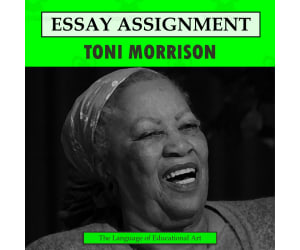
Toni Morrison Research Organizer & Essay Assignment: Toni Morrison
ELA, Literature, Writing, Grade 9, 10, 11, 12, Activities, Projects, Worksheets & Printables, Worksheets
Toni Morrison is perhaps the most significant American novelist of the late twentieth-century. This resource provides your students with the opportunity to independently research and write about the life of the renowned author of Beloved, Sula, Song of Solomon, and more, with this engaging research planner and essay assignment. This carefully scaffolded and easy-to-assign-AND-assess resource has been designed to guide student learning from Toni Morrison fact-collection to the careful development of a five-paragraph research essay. Teaching this resource could not be easier! Start by handing out the background research and note-taking worksheet (you could also ONLY hand this out if you want a shorter lesson!). Once students have found their facts and sources, provide them with the essay outline activity, which guides them step-by-step through the requirements of a short research essay. From there, drafting their essay, using the provided peer review checklist, and submitting their final draft will be no problem at all. And then you can assess their work with the provided Common Core rubric! Use this entire resource as a complete research lesson or just part of it as a short research activity or sub plan! This TeachSimple download includes: A Toni Morrison essay writing assignment with directions, requirements, research essay writing tips, a peer review checklist, and Common Core-tied grading rubric An editable rubric, provided as a link, that lets you make adjustments to the grade values and guidelines. This link is provided as as Google Sheet specifically built for integration into Google Classroom, although you can also modify it for use in other Learning Management Systems (LMSs) A Toni Morrison biography and note-taking worksheet that will guide your students through information gathering. This straightforward two-page handout includes instructions for background research, a fun drawing section, and an area to cite quality sources and organize conducted research A research essay outlining worksheet, so students build on their Toni Morrison notes in a clear and simple manner as they build their work towards a draft and final paper All 6-pages of this lesson are provided in full-color and B&W versions Although this resource can be fitted for any secondary Language Arts classroom, it has been carefully designed to work best in grades 8 through 11. The included rubric is subtly but specifically tied to Common Core ELA Standards for Language (3) and Writing (2 and 7). This resource is provided as a print-ready, bookmarked, and adjustable PDF file. The rubric is also included as an editable Google Sheet. This resource contains 6 pages and 1 Google Sheet.
Author The Language of Educational Art, LLC
Tags Essay, Research, Notetaking, Rubric, Outlining
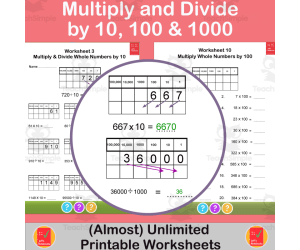
Multiply and Divide Whole Numbers by 10, 100 and 1000 Worksheets
Math, Multiplication and Division, Division, Multiplication, Grade 4, 5, Worksheets & Printables, Worksheets
21 Sets of Worksheets on multiplying and dividing by 10, 100 and 1000 provide an abundance of practice material with multiple levels of differentiation allowing you to select the questions that is just right for your pupils. The Worksheets are divided into 2 formats. For the first format, which is really the preparation stage, there is a place value grid for each question so pupils can see what is happening to the numbers as they are multiplied or divided. Having grasped this, pupils can then move onto the Worksheets with 20 questions, with one sample place grid displayed to help the pupils if needed. Worksheet Set 1 to 3: with Place Value Grid Multiply by 10 Divide by 10 Mix of multiply and divide by 10 Worksheet Set 4 to 6: 20 Questions 4. Multiply by 10 5. Divide by 10 6. Mix of multiply and divide by 10 Worksheet Set 7 to 9: with Place Value Grid 7. Multiply by 100 8. Divide by 100 9. Mix of multiply and divide by 100 Worksheet Set 10 to 12: 20 Questions 10. Multiply by 100 11. Divide by 100 12. Mix of multiply and divide by 100 Worksheet Set 13 to 15: with Place Value Grid 13. Multiply by 1000 14. Divide by 1000 15. Mix of multiply and divide by 1000 Worksheet Set to 18: 20 Questions 16. Multiply by 1000 17. Divide by 1000 18. Mix of multiply and divide by 1000 Worksheet Set 19 to 21: 20 Questions 19. Mix of multiply by 10, 100 or 1000 20. Mix of divide by 10, 100 or 1000 21. Mix of multiply and divide by 10, 100 or 1000 How many Worksheets in each Set ? Almost unlimited At the click of a button all numbers are randomised, so the questions change every time. This will allow you to create as many new worksheets you will need for practice throughout the year (classwork, homework, revision, fillers etc) or even give small groups of students in your class different sets of questions either at the same level or differentiated . There will certainly be enough to ensure fluency in this topic. As these worksheets need little explanation, they are ideal if you need to leave work for a replacement teacher. Answers can be found on the second page of every worksheet , automatically generated when you create a new worksheet . Number Formats You can choose between 3 different number formats which hopefully will cover most educators' needs around the world. - A comma separator - for the USA & UK e.g. 23,334,290 - A space separator - Canada, Australia, plus many European countries e.g. 23 334 290 - No separator - often used in scientific writings, page numbers, years & addresses e.g. 23334290 Note These resources are PDF documents and work with the official Adobe Acrobat Reader on Windows or Mac computers with the randomising buttons also working via a touchscreen (PC or Mac)or on an Interactive Whiteboard. Common Core reference CCSS4.NBT.A.1 Recognize that in a multi-digit whole number, a digit in one place represents ten times what it represents in the place to its right. For example, recognize that 700 ÷ 70 = 10 by applying concepts of place value and division. CCSS5.NBT.A.1 Recognize that in a multi-digit number, a digit in one place represents 10 times as much as it represents in the place to its right and 1/10 of what it represents in the place to its left.
Author Jeff's Notebooks
Tags Math, Multiplying By 10, Multiplying By 100, Multiplying By 1000, Dividing By 10, Dividing By 100, Dividing By 1000, Place Value, Place Value Table, Interactive Whiteboard, Dividing By 10 100 And 1000 Worksheets, Divide Whole Numbers Worksheets, Dividing Whole Numbers Worksheets

Research Organizer & Essay Assignment: Arthur Miller
ELA, Literature, Writing, Grade 9, 10, 11, 12, Activities, Projects, Worksheets & Printables, Worksheets
Research Organizer & Essay Assignment: Arthur Miller Dive deep into the life and works of renowned American playwright Arthur Miller with this engaging research and essay project. Students will conduct research on Miller's background and most famous plays using the provided note-taking handout. Guiding questions simplify finding key facts and citing quality sources. Next, students organize their research into an outline utilizing the step-by-step worksheet. Following the outline structure, writing a five-paragraph essay on Miller will be smooth sailing. Peer review and revision is encouraged via the checklist before final submission. Teachers can easily assign and assess the project end-to-end, with the Common Core-aligned rubric tailored for grades 8-11. Whether utilizing the full lesson or individual components to supplement instruction on Miller, it saves prep time. From engaged research to polished essays showcasing student learning, it's a worthwhile endeavor.
Author The Language of Educational Art, LLC
Tags Essay, Research, Outlining, Notetaking

Counting forward & backward to 20, 50, 100 and 120 in steps of 1
Math, Early Math, Numbers, Preschool, Grade 1, Worksheets & Printables, Worksheets
Being able to comfortably count forward and backward up to 120 is great preparation for students when they meet addition and subtraction later on. Differentiated at 4 levels and having the possibility of unlimited worksheets at each level means you have the resources to practice all the year round until they can master this skill. Every question on each Worksheet Set has space for 5 terms of a sequence There are 4 possible levels to work with covering a different range of numbers as follows: 1-20: 3 numbers are visible, pupils have to find the missing 2 terms. 1-50: 2 numbers are visible, pupils have to find the missing 3 terms. 1-100: 1 number is visible, pupils have to find the missing 4 terms. 1-120: 1 number is visible, pupils have to find the missing 4 terms. Unlimited Worksheets ? Yes ... almost. At the click of a button all numbers and their location in each question are randomised, so you can create as many new worksheets you will need for practice throughout the year (classwork, homework, revision, fillers etc) or even give small groups of students in your class different sets of questions either at the same level or differentiated . There will certainly be enough to ensure fluency in this topic. Because these worksheets are straightforward they are ideal if you need to leave cover work for a replacement teacher. Answers appear on the second page of every worksheet , automatically generated whenever you create a new worksheet . You can also blank out all the spaces, so pupils can create their own worksheet . Interactive Teaching Page For whole class teaching around an Interactive Whiteboard or for one-to-one tuition on a computer, this is ideal for introducing this topic and preparation for the Worksheets. It covers the same 4 ranges as on the worksheets with endless examples for your pupils to practice with. Note These resources are PDF documents and work with the official Adobe Acrobat Reader on Windows or Mac computers with the randomising buttons also working via a touchscreen (PC or Mac) or on an Interactive Whiteboard. Common Core Standards covered or parts covered fot Kindergarten and 1st Grade CCSSK.CC.A.2 Count forward beginning from a given number within the known sequence (instead of having to begin at 1). CCSS1.NBT.A.1 Count to 120, starting at any number less than 120. In this range, read numerals .....
Author Jeff's Notebooks
Tags Counting To 120, Counting Forward, Counting Backward, Counting In Steps Of 1, Count Forward And Backward, Counting To 20, Counting To 100, Jeff's Notebooks, Math Worksheets, Interactive Whiteboard
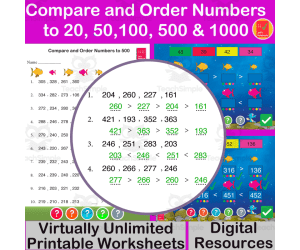
Compare and order numbers to 20, 50, 100, 500 & 1000 1st and 2nd Grade
Math, Numbers, Grade 1, 2, Worksheets & Printables, Worksheets
Each worksheet consists of 10 questions each of which contains four numbers to be compared and placed in ascending or descending order using the inequality signs. So that you can provide the right starting point for your class, individual students or groups of students, you have five ranges of numbers to choose from: 1 to 20 1 to 50 1 to 100 1 to 500 1 to 1000 What happens if a student needs further work on one of these worksheets before moving on to the next level ? Just click the button at the bottom of the page and will immediately create a new worksheet with totally different numbers. How many worksheets are there at each level ? Virtually unlimited. As mentioned above clicking on the interactive button randomizes all the numbers on any of the worksheets, so you are free to provide additional practice at any level for classwork, homework, fillers at the end of a lesson throughout the whole year. Are Answers provided ? Yes. Answers are automatically generated when you create a new worksheet and can be found on the second page. Digital Teaching Material These are designed to help you introduce the worksheets to the whole class on an Interactive Whiteboard, or on a PC or Mac for 1-1 tuition with unlimited examples to practice with. Note These resources are PDF documents and work with the official Adobe Acrobat Reader on Windows or Mac computers with the randomising buttons also working via a touchscreen (PC or Mac)or on an Interactive Whiteboard. Common Core Standards at 1st and 2nd Grade CCSS1.NBT.B.3 Compare two two-digit numbers based on meanings of the tens and ones digits, recording the results of comparisons with the symbols >, =, and <. CCSS2.NBT.A.4 Compare two three-digit numbers based on meanings of the hundreds, tens, and ones digits, using >, =, and < symbols to record the results of comparisons. Australian Curriculum ACMNA013 - order numbers to at least 100
Author Jeff's Notebooks
Tags Math, Comparing Whole Numbers, Ordering Whole Numbers, Place Value , Worksheets, Interactive Whiteboard, Jeff's Notebooks, To 1000, Numbers 50-100 In Spanish

Add by bridging through 10 up to 100 - (almost) unlimited worksheets
Math, Addition and Subtraction, Addition, Grade 1, 2, Worksheets & Printables, Worksheets
Bridging through 10 is a mental math technique that can be used when adding two numbers where the units have a sum greater than ten. There are two parts to this resources: Worksheet Sets Worksheet Set 1 Adding 1 digit numbers to 2 digit numbers, bridging up to 100 - with visual support Worksheet Set 2 Adding 2 digit numbers to 2 digit numbers, bridging up to 100 - with visual support Pupils have the opportunity to practice this topic further either by using the visual method from Worksheets 1 & 2, or using their own graphics that support the concept of bridging. Worksheet Set 3 Adding 1 digit numbers to 2 digit numbers, bridging up to 100. Worksheet Set 4 Adding 2 digit numbers to 2 digit numbers, bridging up to 100. How many worksheets are in each set ? Almost Unlimited. At the click of a button all numbers are randomised, so you can create as many different worksheets as you need for classwork, homework, revision, preparing for assessment, fillers etc and the numbers will change every time. Answers are automatically generated every time. How many worksheets are in each set ? Almost unlimited. Numbers are randomised at the click of a button, so the questions change every time. This means you can create as many new worksheets you will need for practice throughout the year (classwork, homework, revision, fillers etc) or even give small groups of students in your class different sets of questions either at the same level or differentiated . There will certainly be enough to ensure fluency in this topic. The "Interactive Teaching Resource" This is designed to be used by teachers and pupils on an Interactive Whiteboard or on a PC/Mac computer for one-to-one tuition. Examples are randomly generated at the click of a button, so you can use this one page as many times as needed. There is also the option to take the pupils through the process in 3 separate steps, one at a time. Note These resources are PDF documents and work with the official Adobe Acrobat Reader on Windows or Mac computers with the randomising buttons also working via a touchscreen (PC or Mac) or on an Interactive Whiteboard Common Core Standards CCSS1.NBT.C.4 Add within 100, including adding a two-digit number and a one-digit number, and adding a two-digit number and a multiple of 10, using concrete models or drawings and strategies based on place value & properties of operations. Understand that in adding two-digit numbers, one adds tens and tens, ones and ones; and sometimes it is necessary to compose a ten. CCSS2.NBT.B.5 Fluently add and subtract within 100 using strategies based on place value, properties of operations, and/or the relationship between addition and subtraction.
Author Jeff's Notebooks
Tags Math, Add, Addition, Bridging 10, Worksheets, Interactive Whiteboard, Jeff;s Notebooks, Unlimited Worksheets, Adding, Numberline

Addition Squares up to 10, 20 50 & 100 - (almost) Unlimited Worksheets
Math, Addition and Subtraction, Addition, Common Core, Grade 1, 2, Worksheets & Printables, Worksheets
With Addition Squares up to 10, 20 50 & 100 with (almost) Unlimited Worksheets, your students can practice addition at 4 different levels throughout the whole year. You will never run out of worksheets On every worksheet there are four 5 by 5 grids. You can make a mix (or have them all set to the same range of numbers) from the following: - Addition up to 10 - Addition up to 20 - Addition up to 50 - Addition up to 100 Why will you never run out of worksheets ? At the click of a button all the numbers in each square are randomised so you have an (almost) endless set of worksheets that could be used for classwork, homework, revision, end of lesson activity, etc. It is also a straightforward activity to leave for a replacement teacher that needs little explanation. These pages are ideal If you want to set individualised work for each student or for small groups within the class. Are Answers provided ? Yes. These can be found on the second page of every worksheet, and are automatically generated every time you create a new worksheet. Want the whole class to practice together ? The self checking Interactive Teaching Resource can be used on an Interactive Whiteboard Note These resources are PDF documents and work with the official Adobe Acrobat Reader on Windows or Mac computers, with the randomising buttons also working via a touchscreen or on an Interactive Whiteboard. Common Core State Standards (or parts of) covered CCSS1.OA.C.6 Add and subtract within 20, demonstrating fluency for addition and subtraction within 10. CCSS2.NBT.B.5 Fluently add and subtract within 100. CCSS2.OA.B.2 Fluently add and subtract within 20 using mental strategies. By end of Grade 2, know from memory all sums of two one-digit numbers.
Author Jeff's Notebooks
Tags Math, Jeff's Norebooks, Addition, Puzzle, Add Up To 10, Add Up To 20, Add Up To 50, Add Up To 100, Worksheets, Interactive Whiteboard