



3,922 products added recently
Page 11 - Physics Lesson Plans
Bring physics to life with lesson plans that simplify concepts such as motion, energy, and forces. These resources provide experiments and demonstrations that make learning interactive. Use them to help students grasp the laws governing the physical world and appreciate the relevance of physics in everyday life.

 Show filters


I WONDER - How Are Sound And Water Waves Different | Animated Video
Physics, Science, STEM, Grade 6, 7, 8, 9, 10, 11, 12, Lesson Plans, Teacher Tools
Video Introduction An amazing video designed for the students to learn more about STEM. I WONDER - How Are Sound And Water Waves Different | Animated Video Lesson Do you like STEM subjects? what is your favorite one? Have you ever tried to plant a seed? If yes, tell us more about it. Or have you ever tried to invent something? If yes, tell us more about it. And how do you think it will help us? Have you ever seen a microorganism under a microscope? What was it? And how it looked like? Mathematics is a marvelous subject. Let' sharpen our brains and solve some equations. Do you like timetable tricks? What is your favorite one? Do you know how to code? Have you ever created an app or a game before? If yes, how was it like? I WONDER - How Are Sound And Water Waves Different | Animated Video Lesson The video is perfect for encouraging the researching skills for the students, while learning more about this fantastic topic. I WONDER - How Are Sound And Water Waves Different | Animated Video Lesson This friendly designed video is suitable for students at school, homeschooling, and as a group activity. Format Available in MP4 format.
Author Educational Voice
Tags How Are Sound And Water Waves Different, How Are Sound And Water Waves Different Video, Water Waves , Water Waves Facts, Water Waves Video, Sound Waves , Sound Waves Facts, Sound Waves Video
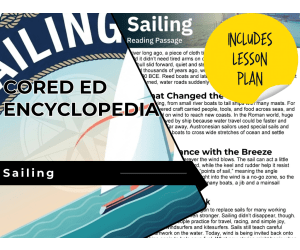
Sailing Reading Comprehension Passage - Cored Ed Encyclopedia
ELA, Language Development, Reading Comprehension, Reading, Pre-Reading, Science, Writing, Engineering, Technology, Physics, Grade 2, 3, 4, 5, Worksheets & Printables, Worksheets, Teacher Tools, Centers, Activities, Writing Prompts, Assessments, Quizzes and Tests, Quizzes, Lesson Plans
This sailing reading comprehension includes: Visualization (on the front cover) Start your lesson by taking a minute to think and share something about the topic. Read the script aloud (slowly), perhaps prepare some music or sound effects. Student close their eyes and let their imaginations wander. Students open their eyes, read the question aloud and give them a few minutes to complete. Ask a few students to share or keep answers until the end to compare with what they learn in the passage. Quick pause—thousands of Cored Education products are included with your TeachSimple membership. Download links and encyclopedia index available here. Pre-Reading Trivia Students will write down one thing they already know about the subject and then read five more facts and discuss. These facts are fun, and the students will enjoy learning about the subject before reading more. Give 1 minute for students to write what they already know (no pressure—best guess is fine). Read the five facts together. After each fact, do ask a student for their opinion, was it surprising? Set a purpose by asking students to highlight/underline one fact they want to learn more about during the reading. Reading Passage The text is a high-interest reading passage with set paragraphs, roughly three to four paragraphs long. It contains a variety of themes about the topic, anywhere from history to technology. The passage is between 250 and 350 words in length. First, ask students to look at the headings and see what they’ll learn about today. What do they know about the topic/heading? First read options: Teacher read-aloud (best for support). Partner reading (paragraph by paragraph). While reading, students underline important details, and vocabulary words they think may come up in the questions section. Mixed Questions The first question page contains four multiple-choice questions, each with a choice of four answers, and three written response questions that require a sentence or two from the student. Students complete the mcqs first independently, then review quickly as a class. For the 3 written responses, try to get students giving the answer with some form of evidence: “I think ___ because the text says ___.” If students get stuck, send them back to check the passage. Vocabulary Questions Practice seven key words from the text in this section across two activities. First section is scrambled words where students will unscramble three words given a clue for each. The second section is a word to meaning matching activity. Before starting, have some students read out words they underlined in the passage. Ask students to say the word and read aloud the sentence(s) around each word. Ask students to do scrambled words and the matching exercise in pairs then go through answers as a class. For the scrambled spelling task, get four pairs to come up to the board and write the words for extra practice with the other student reading out the clue. For the matching task, prompt students to give full sentences: “I matched ___ with ___ because ___.” Creative Writing In this question, the student will be required to write a five to eight sentence paragraph on a question related to the topic. Before starting, ask students write down 3 key ideas they are going to include in their piece. Ask students for ideas to share around the class to help those struggling. Pro writing expectations: 5–8 sentences At least 2 facts or details from the passage At least 2 vocabulary words from the previous page Students read their paragraphs while classmates listen for facts and vocabulary words. Extension Activities This page is optional for fast finishers or to take home. There are several activities, each one requiring a different skill. Do some, do none, do all, completely optional - but you will feel reassured knowing every possibility is planned for. Includes summary writting question. Answer Key There are answers for the multiple-choice questions, written response questions have sample answers, vocabulary answers and if there is a summary question then a sample summary will be provided as well. Lesson Plan Included Customized lesson plan for this lesson is included. Lesson Snapshot Title: Sailing Genre: Nonfiction (informational passage) Subject: Science (Forces & motion) / Social Studies (history of travel) Primary Topic: How wind powers boats and changed travel Estimated Guided Reading Level (A–Z): R What This Lesson Teaches Best How wind pushing on a sail can move a boat without rowing (sail as a “wind catcher” and cloth billowing). How sailing helped people travel farther and move supplies, from early boats to tall ships, including examples from Egypt, the Roman world, and Austronesian sailors. Key sailing concepts that affect movement and direction, including “points of sail,” the “no-go zone,” and zigzagging turns called tacks. How boat parts help sailing work: the sail pulling forward and the keel and rudder helping resist sliding sideways. How technology changed sailing’s role (steam engines replacing sails for many working ships) and how wind is being used again on some cargo ships to save fuel. Learning Goals Explain how wind pressing on a sail can move a boat forward. Describe how sailing grew from river boats to ships that carried people, tools, and food across seas. Identify why sailors use tacks and what the “no-go zone” means in the passage. Describe how the keel and rudder help a sailboat resist sliding sideways. Explain how sailing changed in the late 1800s and how wind is being used again today. Key Vocabulary From the Text hull — the main body of a boat. keel — a strong part that helps stop sliding sideways. rudder — a part that helps steer the boat. tacks — zigzag turns used to move into wind. cargo — goods carried on a ship. FULL CATALOG OF DOWNLOAD LINKS AND ENCYCLOPEDIA INDEX HERE
Author Cored Education
Rating
Tags Vocabulary, Reading Comprehension, Reading Passages, Reading, Creative Writing, Reading Strategies, Writing Prompts, Lesson Plans, Sailing, Engineering

Hands-On - Physical Science: Light and Sound Gr. 1-5
Science, Physics, Grade 1, 2, 3, 4, 5, Teacher Tools, Lesson Plans
Hands-On Physical Science: Light and Sound Gr. 1-5 This exclusive teaching resource is designed to arouse the curiosity of your students about the fascinating world of energy and motion. This educational treasure is a comprehensive fusion of Science, Technology, Engineering, Art, and Math (STEAM), keeping up with Next Generation Science Standards. A Special Focus on "Light and Sound" We offer an in-depth chapter dedicated to "Light and Sound," designed to engage pupils in grades 1 through 5. The primary aim here is to impart a deep understanding of balanced vs unbalanced forces. Activities include practical experiences such as observing how gravity affects different objects dropped at varied heights or measuring the distance of lightning using sound. Group Activities: Engages students with model-making sessions for water waves, sound waves and light waves reinforcing theoretical learning. Fascinating Electricity Experiments: Learning about static electricity becomes exciting with activities involving magic tricks like making balloons stick on walls! Educational Tools Included This resource comes packed with tools such as reading passages and graphic organizers that aid comprehension before you delve into new topics. Pre-Reading Exercises:: These help in understanding forthcoming topics better. Cumulative Assessments :: After each fun-filled learning session comes detailed assessments reflecting their grasp on each topic. Innovative Descriptions:: Students learn challenging concepts like solids liquids or gases through relatable home-based examples; thus aiding their memory retention coupled with enjoyment! In addition, student’s creativity gets fueled when they utilize what they’ve learned by collaboratively creating compound machinery; spurring teamwork while improving learning effectively! This superlative lesson plan facilitates experiential learning, bringing classrooms alive one experiment at a time! It comes as a PDF file type that ensures it's easily accessible across various digital devices making it convenient for educators and homeschooling parents alike. Whether you're offering this material to your entire class, assigning them as small group activities or even giving them out as unique homework assignments – Hands-On Physical Science: Light and Sound Gr. 1-5, is an essential addition to your teaching resources!
Author Classroom Complete Press
Tags PDF

Energy | Interactive Science Lesson | Micro-Learning Deck
Science, Physics, Grade 6, 7, 8, 9, Teacher Tools, Lesson Plans
This micro-learning deck is the perfect accessory to your Science instruction! This digital slideshow presents Energy. Within this slideshow, you will receive: -Video Lesson -Reading Passage w/ Audio -Close Reading -Quick Write The informational texts included in this resource alongside the informal assessments will keep your students engaged from beginning to end.
Author Teach Me This
Tags Energy, Potential Energy, Kinetic Energy, Interactive Science, Reading Passage

I WONDER - Can Fireworks Make Sounds | Animated Video Lesson
STEM, Chemistry, Science, Physics, Grade 5, 6, 7, 8, 9, 10, 11, Lesson Plans, Teacher Tools
Video Introduction An amazing video designed for the students to learn more about STEM. I WONDER - Can Fireworks Make Sounds | Animated Video Lesson Do you like STEM subjects? what is your favorite one? Have you ever tried to plant a seed? If yes, tell us more about it. Or have you ever tried to invent something? If yes, tell us more about it. And how do you think it will help us? Have you ever seen a microorganism under a microscope? What was it? And how it looked like? Mathematics is a marvelous subject. Let' sharpen our brains and solve some equations. Do you like timetable tricks? What is your favorite one? Do you know how to code? Have you ever created an app or a game before? If yes, how was it like? I WONDER - Can Fireworks Make Sounds | Animated Video Lesson The video is perfect for encouraging the researching skills for the students, while learning more about this fantastic topic. I WONDER - Can Fireworks Make Sounds | Animated Video Lesson This friendly designed video is suitable for students at school, homeschooling, and as a group activity. Format Available in MP4 format.
Author Educational Voice
Rating
Tags Can Fireworks Make Sounds, Can Fireworks Make Sounds Video, Fireworks, Fireworks Facts, Fireworks Video, Fireworks Video For Kids, Fireworks Facts For Kids, STEM, STEM Video
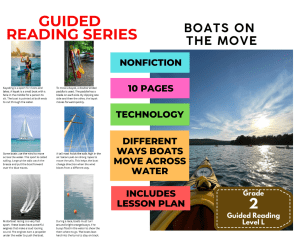
Guided Reading Level L - Boats on the Move (with Lesson Plan)
ELA, Resources for Teachers, Reading Comprehension, Reading, Science, Engineering, Technology, Physics, Sports, P.E. & Health, Grade 2, 3, 4, Worksheets & Printables, Worksheets, Teacher Tools, Centers, Activities, Literacy Readers, Quizzes, Quizzes and Tests, Assessments, Lesson Plans
This Guided Reading Book - Boats on the Move (Level L) with lesson plan includes: Guided Reading Color Label (front cover x1) This is a quick way to match the book’s demands to what students can generally handle.. The overall goal is to use the level/color to pick books for several smaller groups. To qualify for a certain level, a student is expected to read a book from that level with about 90–94% accuracy. If a student is consistently accurate and understands, move up a level. If the student is struggling at that level, drop down and add more support. Each student will improve at completely different rates, but it is generally one of the best ways to check progress across the class. DOWNLOAD THE CATALOG TO VIEW ALL GUIDED READING BOOKS AVAILABLE (SORTED LEVELS A-Z) Pre-Reading Question (x1) Teacher asks the prompt aloud, can be while showing the cover or first page. Students share what they already know, or make educated guesses from the cover. Prompt them to use the target vocabulary. Write some of their responses on the board to look back at during the reading. Vocabulary Words (x5) Introduce the five words, best doing it one at a time. Start by saying it, while students repeat and then see if anyone knows what it means before reading further. Read through the meaning and try to briefly connect each word to a picture or gesture so it’s meaningful. Ask students to flip through the book pages and point to where they see each of the vocabulary words. While reading the book pause upon coming across one of the vocab words or read the sentence twice to make sure students understand the word has appeared. Optional: Ask students to raise hands whenever they see/hear one of the new words. Guided Reading Pages (x10) Check the book snapshot (below) for: primary topic - do you need to prep extra reading or intro materials on this? what is taught best - decide on 1-2 bullets to focus on, use the prompt or words provided here for best results. learning goals - what you are checking for students to be able to do after the session, elicit answers using prompts or words provided. key vocabulary (see section above). questions overview - so you know what is coming up and if you need to prep extra materials to assist understanding. Run the lesson You may have already looked at a few of the pages together, but you can show them some of the pictures again first to set meaning. Depending on how much time you have and how familiar your students are with guided reading class, you may want to read the book aloud first with the group first. Students whisper or partner read, while you listen in. If time, do it as a group, one student reading a page each. Use the guided page’s prompts to coach: “Check the picture / does it make sense?” “Point under the words / try the first sound” “Reread the sentence smoothly”. Try to focus more on one student per session (rotating every time), so you can work out if they are ready to move up or need to move down a level. Comprehension Questions (back cover x3) This is your way to check that students didn’t just say the words, but actually understood the text. First, let students answer by pointing to the page/picture and saying a short sentence. After any answer, follow with: “Show me where you found that in the text.” In bigger groups, have partners answer first (10–20 seconds), then call on 2–3 students to share. Differentiation tips: Emerging speakers/struggling readers: oral + pointing On-level: oral in a full sentence Higher: one written sentence or draw + label Book Snapshot Title: Boats on the Move Genre: Nonfiction (informational) Subject: Science (Forces & Motion) / Reading (Informational Text) Primary Topic: Different ways boats move across water Estimated Guided Reading Level (A–Z): L What This Book Teaches Best Different ways boats move on water (wind, oars, paddles, engines). How specific boat parts help movement (sails, mast, ropes, propeller). How coordinated actions affect motion (oars dipping “at the same time” to go straight). How markers guide movement during a race (boats turn around bright orange buoys to stay on track). Comparing speed and movement styles (quiet glide vs fast roar; forward motion by alternating paddle sides). Learning Goals Students will identify several ways boats move across the water using details from the text. Students will explain how sails and wind help pull a boat forward. Students will describe how rowers use oars together to move a boat straight ahead. Students will describe how a double-ended paddle helps a kayak move forward quickly. Students will explain how an engine and propeller help push a motorboat through the water. Students will describe why boats turn around buoys during a race, based on the text. Key Vocabulary From the Text mast — a tall pole that holds sails up. rhythm — a steady pattern of movement. double-ended — having an end on both sides. propeller — a spinning part that helps push a boat. buoys — floating markers that show where to go. Discussion Prompts Pre-reading question: What are some different ways a boat could move across the water? Comprehension questions: How do large white sails help a boat move forward? What do rowers do “at the same time,” and what does that help the boat do? Why must boats turn around bright orange buoys during a race? Printing Tips 1. Best Printing Method (Recommended) “Booklet” Printing (Best if Available) If your printer or PDF viewer supports Booklet Printing , use this. Settings to use: Print mode: Booklet Paper size: Letter or A4 (either works) Orientation: Landscape Print on both sides: Yes Flip on: Short edge Scaling: Fit to printable area Booklet subset: First test: Front sides only Then: Back sides only This will automatically: Pair pages correctly Put the cover on the outside Align everything for folding After printing, fold in half and staple along the spine . 2. If “Booklet” Printing Is NOT Available You can still print this correctly with manual duplex printing . Step-by-step: Open the PDF. Choose Print . Set: Orientation: Landscape Pages per sheet: 1 Print on both sides: Yes Flip on: Short edge Print all pages . Because each PDF page already contains two facing book pages, the result will still fold cleanly into a book. Thousands of Cored Education products are included with your TeachSimple membership. Download links and encyclopedia index available here.
Author Cored Education
Rating
Tags Reading Comprehension, Reading Passages, Reading, Guided Reading, Guided Reading Lesson Plan, Guided Reading Activity, Pre-reading, Science Lesson Plans, Physics, Technology
I WONDER - What Is Convection | Animated Video Lesson
Physics, Science, Chemistry, STEM, Grade 6, 7, 8, 9, 10, 11, 12, Lesson Plans, Teacher Tools
Video Introduction An amazing video designed for the students to learn more about STEM. I WONDER - What Is Convection | Animated Video Lesson Do you like STEM subjects? what is your favorite one? Have you ever tried to plant a seed? If yes, tell us more about it. Or have you ever tried to invent something? If yes, tell us more about it. And how do you think it will help us? Have you ever seen a microorganism under a microscope? What was it? And how it looked like? Mathematics is a marvelous subject. Let' sharpen our brains and solve some equations. Do you like timetable tricks? What is your favorite one? Do you know how to code? Have you ever created an app or a game before? If yes, how was it like? I WONDER - What Is Convection | Animated Video Lesson The video is perfect for encouraging the researching skills for the students, while learning more about this fantastic topic. I WONDER - What Is Convection | Animated Video Lesson This friendly designed video is suitable for students at school, homeschooling, and as a group activity. Format Available in MP4 format.
Author Educational Voice
Tags What Is Convection, What Is Convection Video, Convection, Convection Facts, Convection Facts For Kids, Convection Video, Convection Video For Kids, Convection Facts Video For Kids, Stem
I WONDER - How Can We Use Refraction In Everyday Life | Animated Video
Physics, Science, STEM, Grade 6, 7, 8, 9, 10, 11, 12, Lesson Plans, Teacher Tools
Video Introduction An amazing video designed for the students to learn more about STEM. I WONDER - How Can We Use Refraction In Everyday Life | Animated Video Lesson Do you like STEM subjects? what is your favorite one? Have you ever tried to plant a seed? If yes, tell us more about it. Or have you ever tried to invent something? If yes, tell us more about it. And how do you think it will help us? Have you ever seen a microorganism under a microscope? What was it? And how it looked like? Mathematics is a marvelous subject. Let' sharpen our brains and solve some equations. Do you like timetable tricks? What is your favorite one? Do you know how to code? Have you ever created an app or a game before? If yes, how was it like? I WONDER - How Can We Use Refraction In Everyday Life | Animated Video Lesson The video is perfect for encouraging the researching skills for the students, while learning more about this fantastic topic. I WONDER - How Can We Use Refraction In Everyday Life | Animated Video Lesson This friendly designed video is suitable for students at school, homeschooling, and as a group activity. Format Available in MP4 format.
Author Educational Voice
Tags How Can We Use Refraction In Everyday Life, How Can We Use Refraction In Everyday Life Video, Refraction, Refraction Facts, Refraction Facts For Kids, Refraction Video, Refraction Video For Kids, Physics
I WONDER - What Are The Types Of Potential Energy | Animated Video
Science, Physics, Grade 4, 5, 6, 7, 8, 9, 10, Lesson Plans, Teacher Tools
Video Introduction An amazing video designed for the students to learn more about STEM. I WONDER - What Are The Types Of Potential Energy | Animated Video Lesson Plants world is really fascinating! Do you know that some flowers eat insects? Some other plants like to grow on walls can you mention any? Do you know what is the difference between fungicide and pesticide? If yes, Can you tell us more about it? What is nuclear energy? Is it safe to use it? Do you think it is a clean energy? Have you ever read about potential energy? If yes, tell us what it is? Do you think that potential energy can be converted into another form of energy? How it happens? I WONDER - What Are The Types Of Potential Energy | Animated Video Lesson The video is perfect for encouraging the researching skills for the students, while learning more about this fantastic topic. I WONDER - What Are The Types Of Potential Energy | Animated Video Lesson This friendly designed video is suitable for students at school, homeschooling, and as a group activity. Format Available in MP4 format.
Author Educational Voice
Rating
Tags What Are The Types Of Potential Energy, Types Of Potential Energy, Types Of Potential Energy Facts, Types Of Potential Energy Video, Types Of Potential Energy Facts For Kids, Types Of Potential Energy Video For Kids

Speed Quizzing – Flight Unit
Science, Physics, Grade 9, 10, 11, 12, Lesson Plans, Teacher Tools
Speed Quizzing – Flight Unit The Speed Quizzing – Flight Unit is a specialised teaching resource designed to engage students in a dynamic and interactive learning methodology. This activity caters primarily for grades 9 through 12. Usability & Flexibility An essential part of this resource is its ease of use. It requires simple preparation - printing and cutting out flash cards. The flexible format allows teachers to tailor the content according to classroom requirements, as it's fully editable. High-Quality Content The package contains a total of 32 rigorously developed questions, covering subjects such as: The history and future of flight, How planes and other aircraft fly, 'Improving flight', 'How living things fly' etc. This makes it an effective evaluation tool for comprehension on these topics. Beyond Just Assessment Tool: Active Learning Exercise This resource offers more than just standard assessment; it is also an active exercise that encourages communication amongst students . It can be used efficiently to review prior knowledge or new terms after the completion of a unit, gather student ideas or remediate weaker skills in an engaging manner. Aiding Collaborative Learning Efforts... The entire exercise promotes peer interaction using methods like stand up hands up pair-up method along with alternate styles where groupings are separate.. These options allow comprehensive exposure towards collaborative learning efforts and can be adapted based on teacher discretion. Suitable for Public schoolteachers or Homeschoolers All these activities along with ease of implementation coupled with flexibility makes this product fitting for public school teachers or homeschoolers working under higher grade physical science curriculum. Delivery & Format The Speed Quizzing – Flight Unit is provided in a zip file format and fits neatly onto 4 pages. This useful teaching resource aims to establish an interactive and immersive learning environment.
Author Teach With Fergy
Tags Interactive Learning, Collaborative Teaching, Aviation Education, Active Assessment, Peer Interaction

Electricity Overview - Current, Voltage, and Power Lesson
Science, Physics, Grade 8, 9, 10, Teacher Tools, Lesson Plans
This lesson on Electricity begins with a student-centered discussion on the application of electricity as well as a brief history of electrical discoveries. It then goes into AC and DC, transformers, electrical potential, resistors, power, and the cost of electricity. It is a thorough overview and introduction that will fit any high school classroom well. This lesson package includes the lesson (student and teacher versions of the presentation), an auto-graded Exit Ticket, 3 embedded videos, many examples questions, and a student lesson handout as a document. The presentation is fun and applicable with many opportunities for inquiry-based learning and discussion. In order, the lesson covers: 1. Applications of Electricity 2. History 3. Electrical Current 4. Direct Current (DC) vs. Alternating Current (AC) 5. Transformers 6. Electrical Potential 7. Resistance 8. Power and Energy 9. Electricity Cost Google and Distance Learning Ready This lesson includes both Office and Google formats for ALL resources. The presentation is in PowerPoint and Google Slides while all documents contain Word and Google Doc versions. Your resource is perfect for distance learning and integrates seamlessly with Google Classroom as I've included a link that will automatically create a copy of the resources and put them directly into your Google Drive with one click. Download--> Open --> Click --> Assign to your students Having both options allows you to use either without worrying about formatting issues as all the work has already been done for you. It safeguards you in case your department or school decides to go Google 100% and allows you as well as your students to access everything no matter where you are or what kind of equipment is being used. Included in the lesson package is: Google and Office versions of each resource The teacher version of the presentation The student version of the presentation 3 embedded videos Auto-graded Exit Ticket Student lesson handout The student version of the presentation contains multiple blanks that need to be filled in throughout the lesson. These blanks are conveniently underlined and bolded on the teacher copy. I have found this to be the most effective means of keeping my students engaged and active without having them write everything out. This also leaves more time for discussion and activities. Also, please visit my blog Teach With Fergy for my thoughts on teaching, learning, and everything in between.
Author Teach With Fergy
Tags Science Lesson, Lesson Bundle, Electrical Current, Student Lesson Outline, Physical Science

Lesson 9.2 - Current Electricity
Science, Physics, Grade 6, 7, 8, 9, 10, 11, 12, Lesson Plans, Teacher Tools
Lesson 9.2 - Current Electricity A comprehensive teaching resource designed to help educators navigate the complex topics of electricity and magnetism. This unit contains various interactive activities, notes, practices and tests that make learning both interesting and insightful. Staring Point: Embark on the journey into electricity with 'Static Electricity Notes (9.1)' which define static electricity, explains how it builds up and gets discharged, along with its role in everyday life. Engage: 'Static Electricity Simulations (9.1)' are perfect tools for concrete comprehension of abstract concepts through visualization. Lecture Mode: The outlined Powerpoint notes prepare you to deliver in a structured manner before the class ensuring smooth knowledge dissipation. Dive Deeper: Advance further into sub-topics like 'Current Electricity (9.2)', where 'Ohm's Law Practice' becomes invaluable & students calculate voltage, current resistance under guidance or during independent practice at home. Alongside is available an intuitive Current Electricity Simulation providing hands-on insight as circuits come alive on screen! Magnetic World: The study of Magnetism (9.3) covers magnets' basic concept with detailed study sheets followed by internet-based research within Magnetism Research Versatility This product is accommodative for different learners' needs suitable for regular classroom or provision for accommodations supplementing small group instructions & homework assignments equally well. Including Comprehensive review: Last but not the least included are comprehensive Unit test papers having true/false type questions based on meticulous chapter-wise segregation preparing optimally per Indiana State Standards 2016. Who Is This For? Ideal for students from grades - 6, 7, 8, to even up till the 12th or even homeschooled students who desire a fun-filled approach in studying science.
Author Integrated Chemistry and Physics
Tags Electricity, Magnetism, Static Electricity, Current Electricity, Ohm's Law

I WONDER - How Fast Can Light Travel | Animated Video Lesson
Physics, Science, STEM, Grade 6, 7, 8, 9, 10, 11, 12, Lesson Plans, Teacher Tools
Video Introduction An amazing video designed for the students to learn more about STEM. I WONDER - How Fast Can Light Travel | Animated Video Lesson Do you like STEM subjects? what is your favorite one? Have you ever tried to plant a seed? If yes, tell us more about it. Or have you ever tried to invent something? If yes, tell us more about it. And how do you think it will help us? Have you ever seen a microorganism under a microscope? What was it? And how it looked like? Mathematics is a marvelous subject. Let' sharpen our brains and solve some equations. Do you like timetable tricks? What is your favorite one? Do you know how to code? Have you ever created an app or a game before? If yes, how was it like? I WONDER - How Fast Can Light Travel | Animated Video Lesson The video is perfect for encouraging the researching skills for the students, while learning more about this fantastic topic. I WONDER - How Fast Can Light Travel | Animated Video Lesson This friendly designed video is suitable for students at school, homeschooling, and as a group activity. Format Available in MP4 format.
Author Educational Voice
Tags How Fast Can Light Travel, How Fast Can Light Travel Video, Light, Light Facts, Light Facts For Kids, Light Facts Video, Light Video, Light Video For Kids, STEM, STEM Video
I WONDER - What Is Radioactive Decay | Animated Video Lesson
STEM, Physics, Science, Chemistry, Grade 6, 7, 8, 9, 10, 11, 12, Lesson Plans, Teacher Tools
Video Introduction An amazing video designed for the students to learn more about STEM. I WONDER - What Is Radioactive Decay | Animated Video Lesson Do you like STEM subjects? what is your favorite one? Have you ever tried to plant a seed? If yes, tell us more about it. Or have you ever tried to invent something? If yes, tell us more about it. And how do you think it will help us? Have you ever seen a microorganism under a microscope? What was it? And how it looked like? Mathematics is a marvelous subject. Let' sharpen our brains and solve some equations. Do you like timetable tricks? What is your favorite one? Do you know how to code? Have you ever created an app or a game before? If yes, how was it like? I WONDER - What Is Radioactive Decay | Animated Video Lesson The video is perfect for encouraging the researching skills for the students, while learning more about this fantastic topic. I WONDER - What Is Radioactive Decay | Animated Video Lesson This friendly designed video is suitable for students at school, homeschooling, and as a group activity. Format Available in MP4 format.
Author Educational Voice
Tags What Is Radioactive Decay, What Is Radioactive Decay Video, Radioactive Decay, Radioactive Decay Facts, Radioactive Decay Facts For Kids, Radioactive Decay Video, Radioactive Decay Video For Kids

I WONDER - How Can I Reduce Friction | Animated Video Lesson
Physics, Science, Grade 4, 5, 6, 7, 8, 9, 10, Lesson Plans, Teacher Tools
Video Introduction An amazing activity designed for the students to learn more about STEM. I WONDER - How Can I Reduce Friction | Animated Video Lesson Do you like STEM subjects? what is your favorite one? Have you ever tried to plant a seed? If yes, tell us more about it. Or have you ever tried to invent something? If yes, tell us more about it. And how do you think it will help us? Have you ever seen a microorganism under a microscope? What was it? And how it looked like? Mathematics is a marvelous subject. Let' sharpen our brains and solve some equations. Do you like timetable tricks? What is your favorite one? Do you know how to code? Have you ever created an app or a game before? If yes, how was it like? I WONDER - How Can I Reduce Friction | Animated Video Lesson The video is perfect for encouraging the researching skills for the students, while learning more about this fantastic topic. I WONDER - How Can I Reduce Friction | Animated Video Lesson This friendly designed video is suitable for students at school, homeschooling, and as a group activity. Format Available in MP4 format.
Author Educational Voice
Tags How Can I Reduce Friction, How Can I Reduce Friction Video, Reduce Friction, Friction, Friction Facts, Friction Facts For Kids , Friction Facts Video, Physics, Stem, Stem Video

I WONDER - How Powerful Are Mobile Phones | Animated Video Lesson
Physics, Science, Chemistry, Grade 6, 7, 8, 9, 10, 11, 12, Lesson Plans, Teacher Tools
Video Introduction An amazing activity designed for the students to learn more about STEM. I WONDER - How Powerful Are Mobile Phones | Animated Video Lesson Do you like STEM subjects? what is your favorite one? Have you ever tried to plant a seed? If yes, tell us more about it. Or have you ever tried to invent something? If yes, tell us more about it. And how do you think it will help us? Have you ever seen a microorganism under a microscope? What was it? And how it looked like? Mathematics is a marvelous subject. Let' sharpen our brains and solve some equations. Do you like timetable tricks? What is your favorite one? Do you know how to code? Have you ever created an app or a game before? If yes, how was it like? I WONDER - How Powerful Are Mobile Phones | Animated Video Lesson The video is perfect for encouraging the researching skills for the students, while learning more about this fantastic topic. I WONDER - How Powerful Are Mobile Phones | Animated Video Lesson This friendly designed video is suitable for students at school, homeschooling, and as a group activity. Format Available in MP4 format.
Author Educational Voice
Tags How Powerful Are Mobile Phones, How Powerful Are Mobile Phones Video, Mobile Phones, Mobile Phones Facts, Mobile Phones Facts For Kids, Mobile Phones Video, Mobile Phones Facts Video, Mobile Phones Facts Video For Kids

I WONDER - How Are Radio Waves Transmitted On The Radio
Physics, Science, Grade 6, 7, 8, 9, 10, 11, 12, Lesson Plans, Teacher Tools
Video Introduction An amazing activity designed for the students to learn more about STEM. I WONDER - How Are Radio Waves Transmitted On The Radio | Animated Video Lesson Do you like STEM subjects? what is your favorite one? Have you ever tried to plant a seed? If yes, tell us more about it. Or have you ever tried to invent something? If yes, tell us more about it. And how do you think it will help us? Have you ever seen a microorganism under a microscope? What was it? And how it looked like? Mathematics is a marvelous subject. Let' sharpen our brains and solve some equations. Do you like timetable tricks? What is your favorite one? Do you know how to code? Have you ever created an app or a game before? If yes, how was it like? I WONDER - How Are Radio Waves Transmitted On The Radio | Animated Video Lesson The video is perfect for encouraging the researching skills for the students, while learning more about this fantastic topic. I WONDER - How Are Radio Waves Transmitted On The Radio | Animated Video Lesson This friendly designed video is suitable for students at school, homeschooling, and as a group activity. Format Available in MP4 format.
Author Educational Voice
Tags How Are Radio Waves Transmitted On The Radio, How Are Radio Waves Transmitted On The Radio Video, Radio Waves, Radio Waves Facts, Radio Waves Facts For Kids, Radio Waves Facts Video For Kids, Radio
Lesson 10.2 - Wave Phenomena
Science, Physics, Common Core, Grade 6, 7, 8, 9, 10, 11, 12, Lesson Plans, Teacher Tools
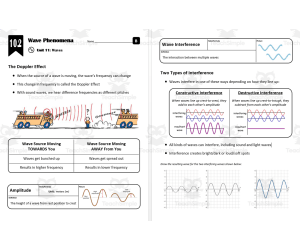
Lesson 10.2 - Wave Phenomena - A comprehensive and engaging teaching resource designed for educators of grades 6 to 12 across public schools and homeschooling contexts. This package explores the captivating concept of Wave Phenomena, encapsulating aspects such as the Doppler Effect, constructive, and destructive interference. The package includes: Note sheets: A deep dive into the theoretical aspect of wave phenomena like Doppler Effect, constructive and destructive interference offered in two versions—one with gaps for learners to fill out during class; one completed version to accommodate absences or requirements. Practice sheets: 'Wave Interference Practice' sheet encourages students to draw waves resulting from different interferences—available in standard (A) format or accommodating format (B). Interactive lab activity : An interesting Waves Lab assignment including three mini-labs sparking inquiry questions: 'Does a longitudinal or transverse wave travel faster through a slinky?' ‘Does a longitudinal or transverse wave decay at greater distance?’ Students are encouraged to formulate their own question followed by proposing their experimental process. 'Starter questions' PowerPoint slides & Formatted notes: Educational objectives along with sample starter-questions have been compiled into an easily-navigable PowerPoint presentation. Compactly addressing ICP-specific Indiana State Standards; The Lesson 10.2 - Wave Phenomena provides educators with state-compliant content ready for classroom use in .docx file type (editable), .pptx file type (editable), along with non-editable PDF ensuring maximal software compatibility. Designed for whole group discussions, smaller group projects, hands-on lab activities, homework assignments alike making it an adaptable resource that caters various teaching styles. Supporting students grasp the intriguing world of wave phenomena in physics while adapting to different requirements and pacing of students.
Author Integrated Chemistry and Physics
Tags Wave Theory, Doppler Effect, Interference, Lab Activity, Educational Objectives

Force: Balanced & Unbalanced Forces Gr. 5-8
Science, Physics, Grade 5, 6, 7, 8, Teacher Tools, Lesson Plans
Force: Balanced & Unbalanced Forces Gr. 5-8 A comprehensive teaching resource suitable for Grade 5 to Grade 8 science educators geared towards simplifying the complex subject of force through easy-to-understand language and unique vocabulary methods designed exclusively for remedial students. Deep Dive into Force This resource breaks down forces into Contact and Distance categories to ease understanding. Expect a clear interpretation of various types of forces like magnetic and electrostatic forces in a relatable manner. Contact Forces Distance Forces (Magnetic & Electrostatic) The Play of Forces on Objects An exciting area within this teaching material is how these individual forces combine to create an overall force on an object. With engaging reading passages reinforced with pre-reading activities, students get to master the concept deeply while enhancing their problem-solving skills. Fifty Shades Of Applications Beyond theory, the resource avails practical applications such as studying balanced and unbalanced forces or understanding weight versus gravity concepts - ensuring applicability in real-life scenarios. Bonus Features: Mini Posters: Colorful visual aids meant to make learning experiences refreshing during lessons. Puzzles (crossword puzzles and word searches) - To cater for diverse learning styles by introducing fun amidst learning. Comprehension Quizzes & Test Prep Materials: To gear up your pupils towards assessments , they are tailored following Bloom's Taxonomy principles and aligning with State Standards. Whether it's homework assignment time or whole-group learning sessions, Force: Balanced & Unbalanced Forces Gr. 5-8 is flexible enough to adapt across different learning environments in maximizing knowledge uptake on force-related content. Public school educators, as well as homeschooling parents, can find Force: Balanced & Unbalanced Forces Gr. 5-8 a vital companion in effortlessly navigating the intriguing world of physics.
Author Classroom Complete Press
Tags PDF

Electric Circuits – Current, Voltage, and Resistance Lesson
Science, Physics, Grade 9, 10, 11, Teacher Tools, Lesson Plans
A Comprehensive Teaching Resource This resource provides a detailed lesson plan for grades 9 to 11, making complex concepts of electrical circuits such as series and parallel circuits, Kirchhoff’s laws, and Ohm's Law easy-to-understand. The package includes a 33-slide presentation, supportive worksheets and practice questions. In-Depth Coverage Of Key Concepts: Series and Parallel Circuits: Initiation to their components & symbols. Kirchhoff’s Laws & Ohm's Law: Insights into principles governing electricity along with problem-solving methods for diverse circuit diagrams . Inclusive Worksheets For Reinforcement: The package comes bundled with many worksheets that are well-equipped to reinforce the ideas flashed in the presentation lesson. These embrace all crucial areas required for comprehensive learning. Presentation On Practice Questions: An exclusive presentation focusing solely on practice questions adds an element of interactivity during classroom discussions or as homework assignments. Each problem revolves around core areas like series-parallel circuits, Kirchhoff’s laws, Ohm's law essentially leading students' towards self-learning culture via accompanying YouTube link providing solutions. Versatility & Integration Abilities : This product offers both Office formats (PowerPoint Presentation & Word document) and Google formats (Google Slides & Google Docs), thus assuring adherence over shifting teaching modes - physical or virtual classrooms alike by seamless integration into Google Classroom. Filled-in blanks included in the student copy make lessons more engaging while key points are underlined on teachers' copy for a smooth classroom discussion. To Conclude: This all-inclusive lesson plan is a bridge between conventional teaching and creative educational methods, making physical sciences more achievable yet enjoyable for students enhancing teachers’ delivery simultaneously.
Author Teach With Fergy
Tags Electric Circuits, Current, Voltage, Resistance, Kirchhoff's Laws

Speed Quizzing – Electricity Unit
Science, Physics, Grade 8, 9, 10, Lesson Plans, Teacher Tools
Speed Quizzing – Electricity Unit: An Engaging Learning Approach Bringing a fresh spin to traditional assessment methods, the Speed Quizzing – Electricity Unit targets students from grade 8 to grade 10. This resource is a part of Physical Science discipline and offers an engaging means of evaluating students' understanding of electricity. The method not only tests knowledge but also promotes communication and movement among the learners. Design: The material includes a set of flashcards, with each presenting a question about different aspects concerning electricity like production, circuit diagrams etc.; thereby enabling comprehensive learning. Editability: The Speed Quizzing - Electricity Unit is entirely customizable according to specific lessons or class requirements. It doesn't require extensive preparation and thus presents flexibility for teachers in both homeschool setups and public schools. Diversity: The questions on the flashcards cover topics ranging from simple content like home electrical safety to more complex subjects involving power & electrical energy calculations; hence appealing various understanding levels among the students. Efficacy: This tool can be used for revising as well as solidifying new concepts post unit completion. Effective implementation can help identify areas needing remedial attention while also providing practice opportunities for newly acquired skills. Variety: In comparison with conventional quizzes which might become mundane over time, Speed Quizzing maintains high energy levels in learning environments. Nurturers get chance assess proteges involvement with science; hence Physics does not seem intimidating due its collaborative nature which is often lacking in standard assessment techniques. The resource is accessible as a Microsoft Word file, permitting easy adjustments to match different teaching styles without compromising on technology requirements. For any queries or issues, you can contact at devon@teachwithfergy.com
Author Teach With Fergy
Tags Electricity, Speed Quizzing, Assessment, Physical Science, Flashcards
Lesson 6.2 - Ratios in Substances
Science, Chemistry, Physics, Grade 6, 7, 8, 9, 10, 11, 12, Lesson Plans, Teacher Tools
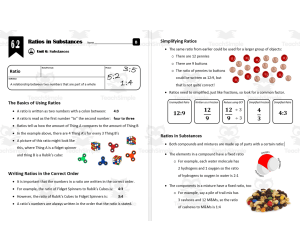
Lesson 6.2 - Ratios in Substances: Overview Lesson 6.2 - Ratios in Substances is an educational package targeted for middle and high school teachers teaching science subjects, especially chemistry and physics. It offers tools to help students grasp the basics of finding ratios in chemical compounds and mixtures. Included Resources: Note Sheets: There are two versions of notes sheets about 'Ratios in Substances.' Version (A) has blanks for independent note-taking, while version (B) is complete for reference or special aid requirements. Worksheets: Practical worksheets are included to motivate deeper understanding by finding ratios of given groups. Two distinct versions foster differentiated instruction effectively. Ratios PowerPoint Notes:The package features supportive PowerPoint Notes designed specifically for effective whole group projection during class lectures or discussions.. This resource assists educators create dynamic lessons directed at specific learning outcomes based on Indiana's integrated Physics & Chemistry education curriculum state standards. A Special Note About Customizability: All .docx files can be customized according to your unique education framework or individual learning aims on compatible word processing software such as Microsoft Word; the same applies when altering .pptx files via PowerPoint-compatible devices! Be sure you've got matching software installed before purchasing this valuable resource. A Flexibly Applied Resource! This package can be employed via whole-group instruction during regular classroom hours, used during small study circles, or even assigned as homework material - Lesson 6.2 - Ratios in Substances naturally integrates within any structured teaching strategy.
Author Integrated Chemistry and Physics
Tags Ratios, Substances, Chemistry Education, Physics Education, Instructional Materials
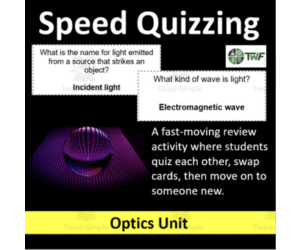
Speed Quizzing – Optics Unit
Science, Physics, Grade 8, 9, 10, Lesson Plans, Teacher Tools
Speed Quizzing - Optics Unit This is a dynamic and editable teaching resource suitable for Grade 8, 9, and 10 students studying Science with an emphasis on Physics. It aims to create a lively learning environment by integrating movement and discussion into the academic framework. About the Product The product mainly entails printing and distributing flashcards among the students It comprises of 32 comprehensive questions, covering various optics-related topics such as: Light, Lasers & Absorption/Transmission, Producing Light, & More unlisted topics. Besides being an engaging classroom exercise; it functions independently as an impressive question bank due to its high-quality question composition. . Detailed Application Process The first step involves dividing your students into groups A and B - these groups would use their flashcards for questioning each other while appreciating or coaching based on responses given. Latterly, roles are switched with partners shuffling after appreciation expressed via thanks noted between them before repeating this process during a predetermined set duration. A variant can be incorporated where group A moves right while group B remains static facilitating different partnerships with swapped positions between rounds for even distribution of partner combinations. . +(ol) The Benefits This resource promotes meaningful student dialogues fostering an interactive environment conducive for knowledge reinforcement especially after freshly concluded units offering room to remediate weak skills along practical applications assisting in solidifying new skills acquisition understanding leading optimally towards higher learning retention rates among pupils efficiently propelling academic success forward. .
Author Teach With Fergy
Tags Optics Unit, Speed Quizzing, Science Education, Physics Activity, Interactive Learning
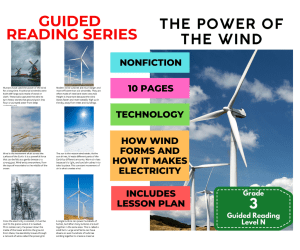
Guided Reading Level N - The Power of the Wind (with Lesson Plan)
ELA, Resources for Teachers, Reading Comprehension, Reading, Social Studies, Geography, Earth and Environmental Sciences, Science, Physics, Technology, Grade 2, 3, 4, Worksheets & Printables, Worksheets, Teacher Tools, Centers, Activities, Literacy Readers, Quizzes, Quizzes and Tests, Assessments, Lesson Plans
This Guided Reading Book - The Power of the Wind (Level N) with lesson plan includes: Guided Reading Color Label (front cover x1) This is a quick way to match the book’s demands to what students can generally handle.. The overall goal is to use the level/color to pick books for several smaller groups. To qualify for a certain level, a student is expected to read a book from that level with about 90–94% accuracy. If a student is consistently accurate and understands, move up a level. If the student is struggling at that level, drop down and add more support. Each student will improve at completely different rates, but it is generally one of the best ways to check progress across the class. DOWNLOAD THE CATALOG TO VIEW ALL GUIDED READING BOOKS AVAILABLE (SORTED LEVELS A-Z) Pre-Reading Question (x1) Teacher asks the prompt aloud, can be while showing the cover or first page. Students share what they already know, or make educated guesses from the cover. Prompt them to use the target vocabulary. Write some of their responses on the board to look back at during the reading. Vocabulary Words (x5) Introduce the five words, best doing it one at a time. Start by saying it, while students repeat and then see if anyone knows what it means before reading further. Read through the meaning and try to briefly connect each word to a picture or gesture so it’s meaningful. Ask students to flip through the book pages and point to where they see each of the vocabulary words. While reading the book pause upon coming across one of the vocab words or read the sentence twice to make sure students understand the word has appeared. Optional: Ask students to raise hands whenever they see/hear one of the new words. Guided Reading Pages (x10) Check the book snapshot (below) for: primary topic - do you need to prep extra reading or intro materials on this? what is taught best - decide on 1-2 bullets to focus on, use the prompt or words provided here for best results. learning goals - what you are checking for students to be able to do after the session, elicit answers using prompts or words provided. key vocabulary (see section above). questions overview - so you know what is coming up and if you need to prep extra materials to assist understanding. Run the lesson You may have already looked at a few of the pages together, but you can show them some of the pictures again first to set meaning. Depending on how much time you have and how familiar your students are with guided reading class, you may want to read the book aloud first with the group first. Students whisper or partner read, while you listen in. If time, do it as a group, one student reading a page each. Use the guided page’s prompts to coach: “Check the picture / does it make sense?” “Point under the words / try the first sound” “Reread the sentence smoothly”. Try to focus more on one student per session (rotating every time), so you can work out if they are ready to move up or need to move down a level. Comprehension Questions (back cover x3) This is your way to check that students didn’t just say the words, but actually understood the text. First, let students answer by pointing to the page/picture and saying a short sentence. After any answer, follow with: “Show me where you found that in the text.” In bigger groups, have partners answer first (10–20 seconds), then call on 2–3 students to share. Differentiation tips: Emerging speakers/struggling readers: oral + pointing On-level: oral in a full sentence Higher: one written sentence or draw + label Book Snapshot Title: The Power of the Wind Genre: Nonfiction (informational science text) Subject: Science (Energy/Earth Science) Primary Topic: How wind forms and how it makes electricity Estimated Guided Reading Level (A–Z): N What This Book Teaches Best Defines wind as the movement of air across Earth’s surface and describes wind as a breeze or a strong gust. Explains the cause of wind : the sun heats Earth unevenly, warm air rises, and cool air moves in to replace it. Shows how people have used wind over time, comparing traditional windmills (grinding grain, pumping water) to modern wind turbines. Describes how a wind turbine works, including blades spinning a shaft connected to a generator that makes electricity. Connects wind energy to sustainability by explaining wind farms , offshore wind farms , and wind energy as a clean, renewable resource. Learning Goals Students will explain what wind is using details from the text. Students will describe how the sun’s heating of Earth helps create wind. Students will describe how traditional windmills used wind to help people. Students will explain how wind turbines change wind’s motion into electricity. Students will describe what a wind farm is and why offshore wind farms can capture strong winds. Students will explain why wind energy is described as renewable and clean in the text. Key Vocabulary From the Text movement — going from one place to another. gust — a short, strong burst of wind. turbines — big machines with blades that spin in wind. generator — a machine that makes electricity. renewable — can be used again and won’t run out. Discussion Prompts Pre-reading question: Where have you seen wind do work, like moving something or making power? Comprehension questions: What does the text say creates wind? Comprehension questions: How did traditional windmills use wind to help people? Comprehension questions: How does a wind turbine turn wind into electricity, according to the text? Printing Tips 1. Best Printing Method (Recommended) “Booklet” Printing (Best if Available) If your printer or PDF viewer supports Booklet Printing , use this. Settings to use: Print mode: Booklet Paper size: Letter or A4 (either works) Orientation: Landscape Print on both sides: Yes Flip on: Short edge Scaling: Fit to printable area Booklet subset: First test: Front sides only Then: Back sides only This will automatically: Pair pages correctly Put the cover on the outside Align everything for folding After printing, fold in half and staple along the spine . 2. If “Booklet” Printing Is NOT Available You can still print this correctly with manual duplex printing . Step-by-step: Open the PDF. Choose Print . Set: Orientation: Landscape Pages per sheet: 1 Print on both sides: Yes Flip on: Short edge Print all pages . Because each PDF page already contains two facing book pages, the result will still fold cleanly into a book. Thousands of Cored Education products are included with your TeachSimple membership. Download links and encyclopedia index available here.
Author Cored Education
Rating
Tags Reading Comprehension, Reading Passages, Reading, Guided Reading, Guided Reading Lesson Plan, Guided Reading Activity, Pre-reading, Geography, Science Lesson Plans, Technology