2,638 products added recently
Page 3 - 9th Grade Worksheets
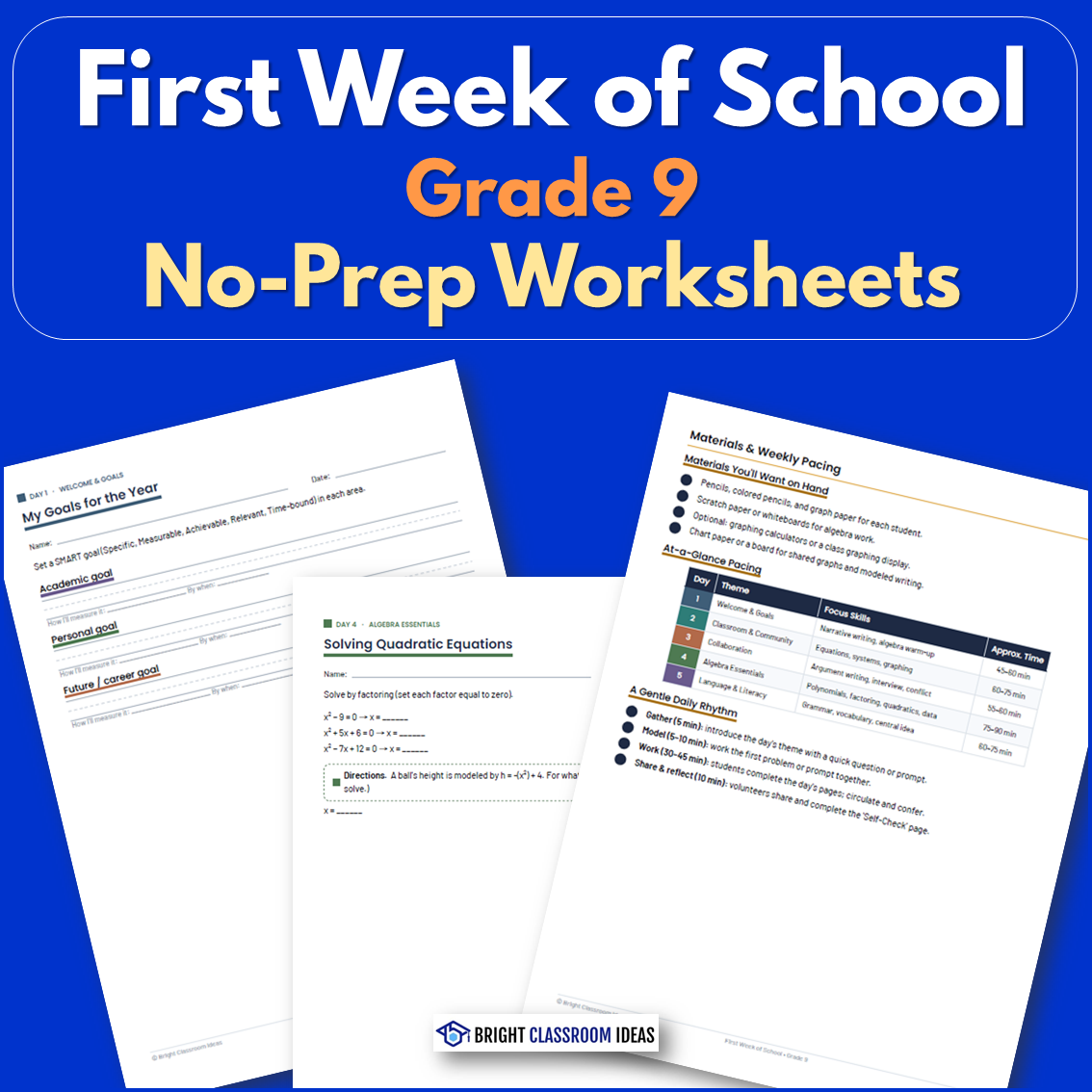
Help your ninth-grade students acclimate to high school with worksheets that reinforce key concepts and introduce new ideas. These resources encourage critical thinking and skill development. Use them to set the stage for a successful high school experience.
ESL Novel Study - "Diary of a Wimpy Kid: Diper Överlöde" - Jeff Kinney
ELA, Language Development, ESL, Reading, Library, Writing, Creative Writing, Grade 6, 7, 8, 9, Worksheets & Printables, Novel Studies, Worksheets, Writing Prompts
ESL Novel Study Worksheets on "Diary of a Wimpy Kid: Diper Överlöde" by Jeff Kinney In this fantastic ESL teaching resource it is offered a comprehensive novel study worksheet activity (3 printable PDF pages; Worksheets) focused on "Diary of a Wimpy Kid: Diper Överlöde" by American author Jeff Kinney. Ideal for post reading activities, this English Second or Foreign Language (ESL EFL) teaching resource can be more than great to enhance students' overall understanding of this coming of age novel by American author Jeff Kinney. The English Second or Foreign Language Novel Study activity (3 printable PDF pages; Worksheets) can be ideal for ESL EFL TESOL learners in middle and high school (from 6th grade to 9th grade, teen students). In this Novel Study on "Diary of a Wimpy Kid: Diper Överlöde" (3 printable PDF pages; Worksheets), English Second or Foreign Language teachers (ESL EFL) can find the following ESL novel study activities: 1 part on general information (author's name, genre, and publishing date) 1 part related to New Vocabulary Learned (1 space where to write 10 new words they learned and 1 space where students can write their related meaning) 1 part related to the story timeline (story timeline where learners set in a chronological order the most important moments during the narration) First writing activity on students' review on the novel Second writing activity (imagining to write a letter to Greg Heffley, the main character, and to give him some advice) Third writing activity (pretending to be a character, other than Greg Heffley, and describing a scene of the book from his/her point of view + space where students can draw with comic bubbles the scene they described) This ESL EFL (English Second or Foreign Language) Novel Study Activity on "Diary of a Wimpy Kid: Diper Överlöde" by American author Jeff Kinney (3 PDF Printable Slides; worksheets) can be suitable for ESL EFL learners from 6th grade to 9th grade to study this coming of age novel Learning with Alan is a Teaching Resource/Educational Material Store whose aim is to help Teachers, Educators and Tutors to achieve their teaching objectives while creating a fun and stimulating learning and teaching environment. Remember. Learning is Fun. Never Forget! If you want to browse more of my English Second or Foreign Language (ESL EFL) Teaching Resources, click here Learning with Alan!
Author Learning with Alan
Tags ESL, English Second Language, English, Diary Of A Wimpy Kid, Novel Study, Worksheets, Printable, Books, Book Companion, Teens
A Quick Look At The Basics Of English Grammar (8 years +)
ELA, Language Development, ESL, Grade 4, 5, 6, 7, 8, 9, 10, 11, 12, Worksheets & Printables, Worksheets
A Quick Look At The Basics Of English Grammar (8 Years +) This study pack is designed to offer an engaging approach to building English language skills for middle school-aged students and beyond. Particularly useful for those with English as a second language, it encompasses a wide range of techniques and strategies for improving written and spoken fluency in a fun, enjoyable way. Key features include: Tutorials and exercises tailored for intermediary-level learners. Lessons on idioms and colloquial phrases common among native speakers, usually absent from standard textbooks. Detailed explanations on preposition selection after verbs—an integral aspect of grammar—to help students communicate more naturally. The lessons are presented in an imaginative way featuring our comic character 'Zoggy', who makes learning easy, fun and exciting. Students also get guidelines on drafting formal letters—a crucial part of communication—all throughout the practice sessions. Vocabulary Building: Bland words are subtly replaced by impressive alternatives to enrich users' linguistic abilities dramatically. This ensures effective vocabulary expansion among learners alongside enhancing their grammatical skills. Educators Rejoice! Educators can employ various techniques included herein: whole class instruction or small group activities. These worksheets can also be used as assignments for homework when reinforcement outside regular class time seems apt—providing ample flexibility within teaching plans. Including this resource into your existing curriculum or homeschooling routine promises dramatic improvement in pupils’ grasp over the intricacies of English language—a systematic approach keeping bilingual speakers at heart is utilized. Written lucidly with interesting exercises throughout, this learning resource guarantees substantial advancement among users irrespective of their current comfort level with the language.
Author Guinea Pig Education
Tags English Grammar, Language Skills, Idioms, Prepositions, Vocabulary Expansion
Multiplying Polynomials - Worksheets
Math, Algebra, Grade 8, 9, 10, Worksheets & Printables, Worksheets
Worksheets for practicing multiplying monomials, binomials, trinomials, and polynomials with four or more terms, with and without exponents. Every Worksheet has 12 questions, which start simple but then develop gradually with questions 11 & 12 being more challenging. The 6 Sets are also arranged in an order that will hopefully help you to plan building the students' knowledge, skills and confidence with multiplying polynomials. By being able to randomise the numbers in the questions at the click of a button you will be able to generate sufficient worksheets for as much practice throughout the year as is needed to keep the skills alive. Worksheet Set 1 Students are asked to multiply simple monomials by (mainly) binomials, with some tri- & a quadri- nomial. There are no exponents to calculate. Worksheet Set 2 Students are required to multiply binomials by a monomial, moving a stage further to include exponents in each term. Worksheet Set 3 This set involves multiplying two or more monomials each with a number of variables with exponents. Worksheet Set 4 Students now practice multiplying two binomials which will include calculating multiplying variables with exponents, plus the added step of needing to combine like terms to obtain the final answer. Worksheet Set 5 This Set contains questions that include multiplying binomials by trinomials, trinomials by trinomials and trinomials raised to the power of 2 and 3 and students will practice combining like terms. Worksheet Set 6 This has an extra element in that instead of only using the standard algorithms for multiplying polynomials there is an alternative using Pascal's triangle as a way to calculate binomial terms raised to various powers through recognising the symmetry of the powers and building of the coefficients for each term. There is additional support material for this set. Answers are automatically generated every time. Note These resources work with the official Adobe Acrobat Reader on Windows or Mac computers.-
Author Jeff's Notebooks
Tags Math, Algebra, Polynomials, Multiplying Polynomials, Monomials, Binomials, Pascal's Triangle, Trinomials, Binomial Expansion, Jeff's Notebooks, Multiplying Polynomials Answer Key, Multiplication Of Polynomials Worksheet, Vertical Multiplication Polynomials, Multiplying Binomials And Trinomials Worksheet, Exponents And Polynomials Worksheets, Multiply Binomials By Polynomials, Exponents And Polynomials Worksheet, Binomial Multiplication Worksheet, Monomials And Polynomials Worksheets, Multiplying Monomials And Polynomials Worksheets
Muscle Growth Reading Comprehension Article
Science, Life Sciences, Biology, Grade 8, 9, 10, Worksheets & Printables, Worksheets
Understanding Muscle Growth: A Middle and High School Science Reading Help your middle or high school students improve their science literacy with this muscle growth reading and analysis activity. The informative 2-3 page passage discusses how muscles grow, factors affecting growth, and strategies to maximize muscle increase. It tackles concepts like muscle anatomy, physiology, nutrition, exercise science and more at an accessible grade 7-8 reading level. Questions analyze the reading and develop thinking skills. The editable resource integrates easily into lessons on health, biology, PE or weight training. Share via Google Classroom for distance learning. Include it as an introductory reading, substitution lesson, challenge activity, assessment or homework. The reading analysis questions and answer key allow students to self-check understanding. Help your class gain science knowledge and practice disciplinary literacy with this engaging muscle reading.
Author Teach With Fergy
Tags Muscle, Growth, Nutrition, Reading, Comprehension
Scientist James Watson – Fact Sheet, Quiz & Interactive PDF incl. H5P
Life Sciences, Science, STEM, History, Social Studies, Biographies, Inventors, Basic Science, Physics, Biology, Grade 6, 7, 8, 9, 10, 11, Worksheets, Worksheets & Printables, Quizzes, Quizzes and Tests, Teacher Tools, Projects, Activities
Scientist James Watson - Fact Sheet, Quiz & Interactive Version (PDF & H5P) James Watson – Discovering the DNA Double Helix Fact Sheet, Quiz & Interactive Exercises (PDF + H5P) This 45-minute resource introduces students in grades 7–10 to James Watson and his role in one of the most important scientific discoveries of the 20th century: the structure of DNA. Most students have heard of DNA, but they often don’t know much about how its double helix structure was uncovered – or who was involved in the process. Together with Francis Crick, and building on key work by Rosalind Franklin, Watson helped lay the groundwork for modern genetics. To make this big topic more manageable in class, I’ve put together a short, ready-to-use lesson. It includes an informational text, a fact sheet, quiz questions with answers, and a few creative tasks that get students thinking and engaging with the content. All materials are included in both color and black-and-white versions for flexible use – whether printed or on-screen. What’s included: A short, accessible text on James Watson and the discovery of DNA A fact sheet to help students organize and reflect on the key ideas Quiz questions (with solutions) to check understanding A creative task where students come up with their own questions and discuss them in pairs Formats: PDF for printing or digital use, plus an H5P version for interactive learning Answer key included I’ve used this in biology lessons as part of a genetics unit, but it also works well when exploring the history of science or how scientific discoveries are made. It’s especially helpful when time is short and you want something that’s both informative and easy to implement – no extra prep needed. 🚀 Download now and bring the legacy of James Watson into your biology lessons today! 📍 Best wishes, Heike from Lernfitness Did You Know? I teach with a certified therapy dog, and together we create a positive and inspiring learning environment. 🐶✨
Author Lernfitness
Tags Science, Biology, Famous Scientists Lesson, H5P, Interactive Science Exercises, STEM, History, Scientists, Physiology, James Watson
High School Financial Literacy: Stock Market Project- Investing
Finance, Life Studies, Home Economics, Decimals, Math, Money, Addition and Subtraction, Statistics, Special Resources, Life Skills, Grade 9, 10, 11, 12, Worksheets & Printables, Worksheets, Projects, Activities
This engaging and useful stock market project can teach your high school students all about several financial literacy topics: investing their savings, buying shares (stocks) in a company, calculating their gains and losses, investment volatility, calculating the mean, length of investment (time horizon) and more! How to Use: 1. On Day 1, have your students complete the first worksheet. They can use the included website to look at a variety of different stocks and their historical performances. They will divide up their thousand dollar investment between two different companies, and calculate how many shares the will be able to buy from each company they picked to invest in. 2. Then, schedule three separate classes over the next month or so to check on the stocks. Each time, your students will record that day's current share price and calculate their shares' current investment value. 3. On the final day, your students will calculate how much money they have gained or lost during the project. Then, each student will provide their gain or loss which will allow the calculation of your class's average stock performance during the project. [You can project the included table on a board and each student can fill in their gain or loss.] 4. Next, students will find out how the stock market performed on average during the timeframe of the project. They will utilize data from the S&P 500 to see if their class's average was better or worse than the stock market itself. 5. Finally, students will write a reflection about this project. A variety of prompts are included to help your students think about volatility, lower risk of ETFs, and the importance of thinking about how long one can invest their money. Sample calculations are provided for each step to help model for your students. What's Included: 6 Page PDF- Ready to Print and Use! 1) Teacher Instructions 2) Day 1: Buy Stocks 3) Check on Stocks 3 Times 4) Calculate Gains, Losses, and Class Average 5) Compare to US500 Performance 6) Written Reflection
Author Grace Under Pressure
Tags Life Skills, Investing, Invest, Stock Market, Financial Literacy, Personal Finance, Personal Finance Worksheets, Financial Literacy Worksheets, Math Project, Applied Math
Research Organizer & Essay Assignment: Roald Dahl
ELA, Literature, Writing, Grade 6, 7, 8, 9, 10, Activities, Projects, Worksheets & Printables, Worksheets
This resource provides your students with the opportunity to independently research and write about the life of the renowned young adult novelist Roald Dahl, author of Matilda, Charlie and the Chocolate Factory, James and the Giant Peach, and many other classic books, with this engaging research planner and essay assignment. This carefully scaffolded and easy-to-assign-AND-assess resource has been designed to guide student learning from Dahl fact-collection to the careful development of a five-paragraph research essay. Teaching this resource could not be easier! Start by handing out the background research and note-taking worksheet (you could also ONLY hand this out if you want a shorter lesson!). Once students have found their facts and sources, provide them with the essay outline activity, which guides them step-by-step through the requirements of a short research essay. From there, drafting their essay, using the provided peer review checklist, and submitting their final draft will be no problem at all. And then you can assess their work with the provided Common Core rubric! Use this entire resource as a complete research lesson or just part of it as a short research activity or sub plan! This TeachSimple download includes: A Roald Dahl essay writing assignment with directions, requirements, research essay writing tips, a peer review checklist, and Common Core-tied grading rubric An editable rubric, provided as a link, that lets you make adjustments to the grade values and guidelines. This link is provided as as Google Sheet specifically built for integration into Google Classroom, although you can also modify it for use in other Learning Management Systems (LMSs) A Roald Dahl biography and note-taking worksheet that will guide your students through information gathering. This straightforward two-page handout includes instructions for background research, a fun drawing section, and an area to cite quality sources and organize conducted research A research essay outlining worksheet, so students build on their Roald Dahl notes in a clear and simple manner as they build their work towards a draft and final paper All 6-pages of this lesson are provided in full-color and B&W versions Although this resource can be fitted for any secondary Language Arts classroom, it has been carefully designed to work best in grades 8 through 11. The included rubric is subtly but specifically tied to Common Core ELA Standards for Language (3) and Writing (2 and 7). This resource is provided as a print-ready, bookmarked, and adjustable PDF file. The rubric is also included as an editable Google Sheet. This resource contains 6 pages and 1 Google Sheet.
Author The Language of Educational Art, LLC
Tags Essay, Research, Rubric, Notetaking, Outlining
Niels Bohr – Scientist Profile & Comprehension Activities - PDF + H5P
Life Sciences, Science, STEM, Social Studies, Biographies, Inventors, Basic Science, Physics, Chemistry, Human Body, Grade 6, 7, 8, 9, 10, 11, Worksheets, Worksheets & Printables, Quizzes, Quizzes and Tests, Teacher Tools, Projects, Activities
Niels Bohr – A Look at One of the Founders of Atomic Theory Informational Text, Student Tasks, and Interactive Quiz (PDF + H5P) 🧪🔬 A ready-to-use classroom resource for grades 7–10 🧪 This material introduces students to Niels Bohr and his ideas about the atom – ideas that still shape how we teach atomic structure today. The text is short and easy to follow, so it works well for younger students or for those who are just starting to learn about atomic models. I’ve used this kind of format when I needed a quick but meaningful activity – for example, during a unit on atomic theory or as part of a lesson on scientists and their discoveries. It’s also been useful in cover lessons, especially when someone without a science background had to step in. Everything is included and explained clearly. What’s in the file: A short reading text about Niels Bohr A profile worksheet for students to fill out Quiz questions with an answer key Two optional tasks: – Students write their own questions – Students answer a partner’s questions You get everything as a printable PDF, a modifiable .docx file (text only), and a simple H5P version for use in digital learning systems How you might use it: Students can read the text alone or in pairs. They then fill in the profile and answer the quiz questions. If there’s still time, they can come up with their own questions about the text and swap them with a classmate. The H5P version is helpful if your students are working online or if you want them to check their answers themselves. It’s a flexible resource that doesn’t need a lot of explanation – and works just as well in regular science lessons as in emergency planning. Have fun exploring the world of science with your students! Warmly, Lernfitness Did You Know? I teach with a certified therapy dog, and together we focus on creating a positive and inspiring learning environment.
Author Lernfitness
Rating
Tags Science, Famous Scientists Lesson, H5P, Interactive Science Exercises, STEM, History, Scientists, Chemistry, Scientific Concepts, Niels Bohr
Generative AI Ethics, Deepfakes & Responsible Use Case Studies
Science, Technology, Computer Science, Engineering, Research, Resources for Teachers, Classroom Management, STEM, ELA, Language Development, Grade 6, 7, 8, 9, 10, 11, 12, Worksheets & Printables, Workbooks, Worksheets, Word Searches, Writing Prompts, Teacher Tools, Lesson Plans, Presentations, Outlines, Quizzes and Tests
The complete high school curriculum is prepared and provides an interactive exploration of the topic of ethics in generative AI; deepfakes; responsible use of synthetic media; and provides a thorough introduction to how synthetic media works (to be used by all of our student participants in grades 9-12). The curriculum includes an academic overview of Synthetic Media architecture; multiple chapters for deepfake discussion/analysis; Copyright/Author status; algorithmic bias and epistemic security/provability protocols regarding the use of synthetic media. In addition, there are ten practical, complete, and interactive worksheets for active, individual student participation that have real examples, such as "the Synthesized Senator," "Med-Synthetica Diagnostic Bias," "Voice Cloning," "Influencer Avatars," etc. The students have to complete fill-in-the-blank terminology exercises, scenario analyses, and ethical synthesis prompts that promote critical thinking, media literacy, and digital citizenship skill acquisition. There is also the following in the resource book: (conceptual visual diagrams [mind maps, escalation matrices, process flows], a comprehensive answer key with notes for teachers and benchmarks for mastery) and a detailed teacher guide with pedagogical strategies, assessment tools (rubrics) and teaching protocols. This curriculum is also perfect for English/Language Arts, Social Studies, Computer Science, Digital Literacy, or elective Technology & Ethics classes. This resource is an instant digital download and requires no prep time. Give your students the information they need to be responsible in their use of AI and the topics related to ethics regarding the generative technology called "deepfake." Parents/Schools Appreciate It Because: Essential 21st century skills are being taught through critical thinking, verifying media sources & making ethical choices in dealing with misinformation & threats from deep-fakes and counterfeit media, thereby counteracting those very problems. Students remain engaged while staying motivated to learn by using real-world examples of ethical & responsible use of technology through use of case studies/workheets. The format requires zero preparation & can be easily implemented by teachers; includes lesson plans, case studies, worksheets, visuals, answer keys, teacher’s implementation guide (in pdf format). Responsible use of artificial intelligence & digital stewardship is promoted through use of technology in an aligned manner with modern school standards regarding digital citizenship/social-emotional learning. Materials are flexible in nature so can be used across multiple curriculum areas & for hybrid & remote learning situations. Based on a complete analysis of the submitted PDF, the target audience for this document are Students in grades 9-12 (age 14-18). This project is most suited for high school students enrolled in the following classes: - English/Language Arts or Media Literacy - Social Studies/Civics/Government - Computer Science/Digital Citizenship/Technology and Society - Ethics/Philosophy/STEM/STEAM The majority of the content is age appropriate for students and offers academically challenging material using fictional case studies that are relatable to a student's experience (there are no graphic illustrations or inappropriate material) on real-world current events such as misinformation, bias, copyright, and consent regarding the use of generative AI technology. "Terms & Copyright of Use": This resource has been copyrighted by Syed Hammad Rizvi. Personal use/Single-use in a classroom only. You may NOT change, share or sell this resource. i.e You may NOT post this on the Internet for others to search for/download. If you want to share this resource with other people in your school or district purchase additional copies through Teachsimple. Thank you for your cooperation. This product is provided to you by Syed Hammad Rizvi
Author Creative Book Store
Rating
Tags AIEthics, Deepfakes, GenerativeAI, SyntheticMedia, AI Ethics, DeepfakeAwareness, AIEthicsCurriculum, DeepfakesLessonPlans, GenerativeAIEthics, SyntheticMediaEthics
Global Climate Policy Debates & Solution Brainstorm Worksheets
Science, Earth and Environmental Sciences, Life Sciences, Earth Sciences, Environmental Science, Geology, Space, Nature & Plants, Biology, STEM, Homeschool Curriculum, Homeschool Templates, Grade 8, 9, 10, 11, 12, Worksheets & Printables, Worksheets, Workbooks, Word Searches, Teacher Tools, Assessments, Lesson Plans, Quizzes and Tests, Quizzes, Tests
Provide your advanced high school students with this 42-page climate policy curriculum that focuses on advanced dialectical analysis rather than simplified activism. This curriculum will encourage active learning for your students by transforming passive learning into a deep intellectual engagement through multi-perspective debate, policy creation, and ethical reasoning. Students will explore: The transition from the Kyoto Protocol to the Paris Agreement and the principle of Common But Differentiated Responsibilities (CBDR) Carbon pricing mechanisms (Carbon Tax vs. Cap and Trade), as well as the Social Cost of Carbon The ethics of geoengineering (Stratospheric Aerosol Injection [SAI], moral hazard, risks associated with unilateral use of SAI) Environmental justice, climate debt, and the Cobalt Paradox in developing countries Youth climate lawsuits, climate refugees and international law, methane agricultural policies, financing urban adaptation, and accountability for greenwashing Includes 10 high-level student worksheets with conceptual fill-in-the-blank (using a unique 7-underscore system), real-world case studies and hypothetical case studies, critical debate prompts, and challenging policy creation assignments for students. Teacher answer keys, implementation guides, visual diagrams (Climate Policy Trilemma, Stakeholder Matrix, and Carbon Pricing Mind Map), and differentiation strategies are also included. Ideal for AP Environmental Science, AP Government, AP Economics, IB Global Politics, Honors Humanities, and Model UN/debate programs. Encourages real critical thinking, systems analysis, and nuanced understanding of the trade-offs between enhancing developing countries. The Key Reasons Why Parents and Schools Appreciate It: Facilitates unbiased critical thinking instead of dogmatic, ideologically-based, practical-thinking-by-proxy students making arguments for and against competing choices (e.g., Growth vs. Fossil-Fuel Abolition; Independent Sovereign Nation vs. World Government; Technology as Hope or as a Curse). Extensive preparation for taking Advanced Placement tests; writing college level essays, debating other humans, as well as the development of well-thought-out arguments using established policies, and ethical reasoning based on sound ethical reasoning standards. A balanced view of the world; an honest consideration of the challenges facing developing nations, "Just Transition", climate liabilities, and the risk of neo-colonial influence in creating green supply chains. Teacher support that is broad in scope and purpose; includes teacher-oriented teacher guides, "look-for" answers for the teachers, pacing guides and strategies for differentiating instruction, visual aids to illustrate concepts, and techniques for managing classroom conversations. An exceedingly entertaining way to teach about Climate Change, as well as Science, by creating opportunities for students to compete with each other on an intellectual level, as opposed to being preached at. Primary Audience & Classes: 9-12 (Secondary School) Advanced Students Advanced Placement Environmental Science Advanced Placement U.S. Government/Comparative Government Advanced Placement Macroeconomics/Microeconomics (on Carbon Pricing) IB Diploma Programme: Global Politics, Environmental Systems/Societies (ESS), and Economics Advanced Placement/honors world/history/contemporary issues Model United Nations, Debate and Mock Trial Teams Future Advanced 10-graders: Gifted/Track 11/12 grades -- Advanced Placement courses. Copyright/Use Policy: This book, written by "Syed Hammad Rizvi," is one-of-a-kind. You cannot change, give away or sell this product so long as you are using it as personal and for one classroom only. Therefore, you may NOT post any portion of this book/presentation on the internet for public access and download. Additional copies of this work may be purchased if you want to share with your colleagues, so please consider purchasing additional license(s) through Teachsimple. Your cooperation is greatly appreciated! A very special "thank you" from "Syed Hammad Rizvi".
Author Creative Book Store
Rating
Tags ClimatePolicy, APEnvironmentalScience, ClimateJustice, ClimateChangeEducation, EnvironmentalScience, Geoengineering, ClimatePolicyWorksheets, APEnvSci, JustTransition, CarbonPricing
Geometry Reproducibles
Math, Geometry, Grade 7, 8, 9, 10, Worksheets & Printables, Worksheets
Geometry Reproducibles: A Premiere Teaching Resource Aimed towards Grade 7 to Grade 10 learners, Geometry Reproducibles is a highly functional and comprehensive workbook aiding educators in their quest of instilling a profound understanding and appreciation for geometry within the minds of students. Ideal Learning Resource For all Educators Suited perfectly well for both home educators as well as public school teachers, this resource comes with forty-eight pages teeming with intricately planned activities that serve to make geometry learning engaging by design. The diverse range of puzzles, mazes,, games along with self-checking exercises works by bridging solid practice opportunities coupled with creative thinking inducement. Innovative Instructional Approach The uniqueness arises from introducing the concepts first through succinct explanations before following them up via related exercises. This method underscores grasping core ideas prior to moving onto application-oriented drills thereby ensuring comprehension. Useful in multiple settings: classrooms under teacher supervision; peer study groups; independent homework sessions. Incorporates a specially designed assessment section: perfect practice tool for standardized testing tied up with individual curriculum plans Maintains quality across repeated prints: handy PDF file formatting ensuring easy access and superior print quality Your Essential Geographic Tool Kit! An indispensable educational aid - ready to guide learners on an educational journey as they navigate angles, lines and shapes paving their way towards Geometry expertise!
Author Classroom Complete Press
Tags Geometry, Worksheets, Reproducibles, Right Prisms, Surface Area
Zero-Waste Lifestyle Tracking & Habit Builder Journals
Science, Resources for Teachers, Life Sciences, Earth and Environmental Sciences, Earth Sciences, Environmental Science, Geology, Nature & Plants, STEM, Biology, Grade 6, 7, 8, 9, 10, 11, 12, Teacher Tools, Worksheets & Printables, Workbooks, Worksheets, Word Searches, Assessments, Lesson Plans, Quizzes and Tests, Quizzes, Tests
Turn your classroom into an environmental science lab with the help of this awesome 41-page Zero Waste Lifestyle Tracking and Habit Builder Journal! This is a project-based learning resource for grades 4–8 that is aligned to the standards! Looking for a real world environmentally focused way to teach environmental science to your students that isn't just a bunch of recycling posters? A complete curriculum journal combining current neuroscience research, ecology theory and hands-on data collection will give your students everything they need to consider themselves true environmental scientists - and it begins with measuring their own lives! This resource is not just one big stack of worksheets but rather, it is a fully scaffolded 3-phase academic journal developed with university seminar style rigor and middle school classroom style accessibility. Your students won’t just learn about the environment; they’ll measure it, analyze it and make changes to it! CONTENTS (41 Pages, Print & Digital Ready): Phase 1 — Core Content & Theory (4 chapters): 1. The Anatomy of Waste explains what happens throughout the lifespan of waste items, including Lifecycle Assessment (LCA), the impact of microplastics in our world today, which items go in the landfill, which items can be incinerated, and how long it takes for a plastic fork to travel 450 years into our future 2. The Neuroscience of Habit Building discusses how our brains form habits based on the basal ganglia of the brain, how we can rebuild/rewire our habits scientifically through neuroplasticity, and the three parts of the habit loop (cue-routine-reward) 3. The Zero-Waste Hierarchy introduces the four elements of a zero-waste lifestyle: Refuse, Reduce, Reuse, Rot (Composting) and Recycle. This chapter includes a real-world example of how one school significantly reduced their waste by over 90% using these four proven methods 4. Data-Driven Stewardship teaches your students to think like a marine biologist and meteorologist by showing them how to track and analyze their own local environmental data. After each chapter is a fill-in-the-blank review of the chapter, called the Scholar's Review. Phase 2: 10Worksheet Workbook for Students (Research Lab Style) Personal Waste Audit 24-Hour (Data Collection Protocols: Empirical) Material Lifecycle Analysis of Material (From Raw Extraction To Disposal) Biochemistry of Composting (Green And Brown Materials, Aerobic And Anaerobic Decomposition) Single Use Plastic Substitution Matrix (Cost/Benefit Analysis) Water and Energy Footprint Calculation (Embedded Energy And Water Load Calculation; Shower Each Year; Cost Of Water To Make Cotton Shirt) Redesign Challenge For Circular Economy (Planned Volatility, Upcycling, Extended Producer Responsibility) Food Waste Economics (FIFO Pantry System, Estimate Of $780 Of Food Waste Per Year, What Is A Food Standard For A Non-Food Waste Item?) Fast Fashion Footprint (Cost To Wear, Use Of Micro-Plastics, Philosophy Of Wardrobe) Supermarket Packaging Detective (Identifying Greenwashing, Multi-Layered Packages, Bulk Purchasing) Zero-Waste Habit Builder (Keystone Priming, 30-Day Tracking Plan, Write Manifesto For A Zero Waste Life) PHASE 3—Teacher Resources and Visuals: Three professionally designed SVG diagrams (Zero Waste Hierarchy, Linear vs. Circular Economy, Sustainability Habit Loop) Complete Answer Key with example answers and teacher rubric notes 4 week pacing guide with weekly objectives, activities, teacher roles and homework 100-point assessments rubric across four categories of data collection, behavioural design, critical thinking and communication Five extension activities (Trash Jar Challenge, Community Waste Mapping, Letter Writing Campaign to Corporations, Do-It-Yourself Repairs Workshop, Composting Science Experiment; if possible please use a separate document per activity) Strategies for differentiating instruction for Grades 4-5, Grade 8/Gifted, IEP/504 and ELL students CONNECTING TO CURRICULUM: This journal ties into Next Generation Science Standards (NGSS), Common Core English Language Arts (informational text analysis, evidence based writing) and Common Core Mathematics (percentages, projections, data analysis). This journal combines many subjects — environmental science, behavioral psychology, economics and persuasive writing — into one connected whole. USAGE IDEAS: Great as a 4-week stand-alone unit or as part of an after-school environmental club, summer enrichment program or reinforcement through integration into existing science, health or social studies curricula. Assign user digitally (fillable PDF) or in print. DIGITAL DOWNLOAD — PRINT & GO! REASONS PARENTS/SCHOOLS LOVE THE RESOURCE: Merging Science, Psychology, and Real-World Mathematics – Instead of merely reading about the environment, kids actually conduct real waste audits, calculate their water footprints, and use their own personal data to perform real-world food waste economics analysis – helping them to take abstract concepts and move towards making those concepts their own, and thus, real. Tremendous Support For Teachers From Day One – Each of the resources, including a complete 4-Week Pacing Guide, example responses in the Answer Key, a 100-point Assessment Rubric, and a variety of differentiation strategies to accommodate ALL learners (IEP/504, ELL, Gifted) provides teachers with no-prep stress! Building Lasting Habits, Not Just Raising Awareness – This journal is based on neuroscience principles, specifically the Habit Loop framework, which teaches kids HOW behavior changes within the brain — therefore they can establish long-term environmental habits to implement after the conclusion of the unit. No Eco-Anxiety – Only Eco-Empowerment – Constructivist pedagogy does not endorse guilt-based teaching practices to educate/expose students to environmental issues. Instead, students are encouraged to view themselves as environmental scientists, thereby creating a sense of worth/empowerment as opposed to being seen as passive victims of "climate doom"; hence, all resources provided in this unit have been designed with both emotional safety and motivation in mind. Cross-Curricular and Standards-Aligned Value – When you purchase this journal as a single resource, you are actually replacing multiple separate resources. This one journal covers multiple areas of study related to environmental science, data analysis, persuasive writing, behavioral psychology, economics, and systems thinking — therefore you are maximizing the instructional value and curriculum alignment of numerous subject areas! TARGET GRADES/CLASSES: On evaluating for the content type's level of complexity, the level of language used, the level of math skill needed; and how to teach the content using scaffolding: Primary Target 6th, 7th, and 8th grades (Middle School, our primary audience) Science classes; Environmental Science/ Earth Science Health and Wellness Classes Social Studies/Civics (Circular economy, EPR Policy) ELA Classes (Persuasive writing, Informational text) Secondary Target 5th Grade (Upper Elementary, with teacher scaffolded materials to be used; will require the use of Phase 3 differentiation strategies). 4th Grade (Will require major support in accordance with Phase 3 differentiation, as mentioned in Section 2) 9th Grade (High School, Environmental Science as a remedial unit or an introductory unit) Special Programs Gifted/Honors programs (Students in 8th grade, extension Activities) IEP/504 Accommodations (explicitly provide support through IEP/504) ELL Programs (provide bilingual glossary strategies) Environmental clubs (5th through 9th grade) STEM/STEAM programs Best Audience Targets: Middle School Science teachers (6th to 8th grade) Environmental Science Teachers Parents of Students 10 - 14 taking homeschool classes School Librarians purchasing Sustainability books for their library collection After School Program Coordinators Eco-Conscious Parents with Interest in Supplement Learning Your use of this Resource Agreement: Copyright (or Terms of Use) Copyright is held by Syed Hammad Rizvi. You may use this resource for your personal and classroom use only, but may not alter, sell or redistribute any component of this resource, nor place any part of this resource on a publicly available website. You can only share this resource with your coworkers by purchasing additional licenses from Teachsimple. Thank you for complying with all copyright guidelines and restrictions. Syed Hammad Rizvi is proud to provide you with this resource.
Author Creative Book Store
Rating
Tags ZeroWasteEducation, EnvironmentalScience, SustainabilityEducation, ZeroWasteLifestyle, EcoEducation, GreenEducation, ClimateEducation, EnvironmentalLiteracy, SustainabilityLessons, ZeroWasteCurriculum
The Dangers of Smoking Reading Comprehension Article
Science, Life Sciences, Human Body, Grade 9, 10, 11, 12, Worksheets & Printables, Worksheets
The Dangers of Smoking - A Grade 8 and Up Science Reading Article. This resource is suitable for high school students as well as strong middle-school students. Tackle literacy and science by having your students read and answer questions from a scientific article. Questions include knowledge (direct from the paper), thinking, connecting, application and open-ended varieties. This resource covers the following topics: - What is smoking? - Why is smoking bad for you? - What is secondhand smoke? - What are the health effects of secondhand smoke? - Lung cancer - What makes smoking so addictive? - E-Cigarettes and vaping? Google Classroom and Distance Learning Ready This resource is perfect for in-class or distance learning and integrates seamlessly with Google Classroom. Automatically creates a copy of the reading and puts it directly into your Google Drive with a single click. Purchase --> Open --> Click --> Assign to your students The reading also includes a Microsoft Word and PDF version. Having all three options allow you to assign the reading to your students without worrying about formatting issues as all the work has already been done for you. It also allows you, as well as your students, to access everything no matter where you are or what kind of equipment is being used. --------------------------------------------------- The Problem You Face - Not having the time to properly teach scientific literacy (disciplinary literacy) or improve your students reading comprehension and analysis skills. The Solution This fully editable, NO PREP reading comprehension article is composed of relevant, applicable and engaging reading activities which can be used to: • introduce your topic • improve your students reading comprehension and scientific literacy skills • improve your students' analysis skills • provide an extension activity to students who move at a faster pace • provide extra credit to students in need • measure your students literacy skills --------------------------------------------------- Please note that the preview file contains THREE complete readings. I’ve made them available so you can fully see how the resource is structured as well as the quality of its writing. This resource will take your students between 50-75 minutes to complete and includes some open-ended questions. An answer key is also included for your reference. ----------------------------------------------- You might also be interested in the following individual reading comprehension articles: Health: • The Common Cold • The Flu • Exercise and its Importance for Health • Stem Cell Therapy: The Future of Medicine? • Concussions • Poliomyelitis - Polio • Smallpox • The Measles • Genetics and Gene Therapy • Heart Diseases • Cancer • The Effects of Caffeine • Down syndrome • HIV/AIDS - Informing the Public and Dispelling the Misconceptions • The Effect of Stress on the Brain • The Effect of Sugar on the Body • Whooping Cough • Asthma and Asthma Attacks • The Immune System • Farming: Organic vs. Conventional • The Dangers of Smoking • Parkinson’s Disease • Protective Equipment - Keeping you safe • Fats • Tinnitus – Ringing in the Ears • Cystic Fibrosis • The Effects Of Binge Drinking On Teenagers • Multiple Sclerosis • Painkillers • Diabetes • Radioactivity • Scarring • Allergies • Carbohydrates, Lipids, and Health • The Placebo Effect • The Nervous System Earth and Space: • The Northern and Southern Lights • The Limitations of Space Travel • Why is the Sky Blue? An application of light waves • Stars - The Element Factories of the Universe • Solar and Lunar Eclipses • The Different Types of Clouds • How Weather Works • Natural Disasters • Thunderstorms • Fossils • Geologic Time • Watersheds • Hurricanes • Planets • Phases of Water Energy: • Fossil Fuels • Nuclear Energy: Fission and Fusion • Hydroelectric Energy Production • Solar Energy Production • Wind Energy Production • Renewable Energy Production • Hydraulic Fracturing - Fracking • Biofuels - Food or Fuel? • Electric House • Energy Use and Conservation Physics: • Magnets and Electromagnets • Roller Coasters - History, Design, and Function • How Do Boats Float? • Optical Phenomena • The Effects of Everyday Forces • Hydraulics • Hot-Air Balloons • Simple Machines • Automobile Safety • Pneumatics Chemistry: • The Chemistry of Explosions • Plastics: A Marvel Of Innovation • The Chemistry of Paint • Water Softeners and Hard Water • Cleaning up Acid Spills • The Accumulation of Plastic in the Ocean • Chemistry of Cooking • Chemistry of Cosmetics • Blood Analysis and Forensics • Radioactivity • Desalination for Drinking Water • Rust-Proofing Biology: • Fermentation and Food • DNA Paternity Tests • Laser Eye Surgery • Physical Adaptations • Muscle Growth • Genetically Modified Organisms • Mosquitoes And The Diseases They Spread • Twins • GERD and Acid Reflux - A Digestive System Disease • Bats – Misconceptions, Importance, and Facts • Superbugs - The Super Villains of Modern Medicine • Heart Attack and Stroke • Why Leaves Change Color In The Fall Ecology and the Environment: • Invasive Species • Ecosystems • Pesticides • The Importance of Bees • Coral Reef Ecosystems and their Future • Climate Change • Hydraulic Fracturing - Fracking • Farming: Organic vs. Conventional • Oil Spills and Their Consequences • Bioaccumulation and Biomagnification • RuBisCO - Earth's Most Important Protein • Symbiotic relationships between plants and insects • Smog - Its Causes and Dangers • Ocean Acidification • Pollution Control Devices • Tap vs Bottled Water • Predator Prey Relationships • Greenhouse Effect Natural Disasters: • Volcanoes: The Benefits and Devastation • Earthquakes Part 1 • Earthquakes Part 2 • Tsunamis • How the Dinosaurs Died --------------------------------------------- Each summary is rich with age appropriate content (grades 8 and up) and is 2.5-3 pages long (13-font). Following each is a list of 8-13 questions along with the answer key, which will help guide your students understanding. How this product will help your students: - Improve their scientific and disciplinary literacy skills - Improve their reading comprehension and scientific knowledge - Give them insights into important scientific concepts - Provide an extension activity for your faster moving/more gifted students How this product will help you: - Allow you to meet the NGSS, TEKS and Common Core Standards - Provide you with a concise introduction to your topic - Provide you with an engaging and easy to leave substitute plan which will keep your students engaged and on task - Prove you a means of measuring your students' literacy skills We don't spend enough time teaching scientific literacy to our students. This is either because we don't have the resources to do so effectively or we don't have the time. However, teaching our students to become scientifically literate is vital if we want them to succeed in life. We need them to know about the world they live in and about the issues they face. Even issues as simple as the common cold are misunderstood and can lead to the misuse of antibacterial drugs eventually rendering them ineffective. It can be used as a tool in your teaching arsenal on a regular basis, an extension activity for your faster learners, left for a substitute in an emergency or planned absence or as an extra bit of information for a topic. ***************************** For free resources, useful teaching tips, and tools, please visit my blog - TeachScienceWithFergy.com If you have any questions please feel free to send me an email - devon@teachwithfergy.com
Author Teach With Fergy
Tags Smoking, Arsenic, Cigarettes, Reading, Comprehension
Ocean Acidification Reading Comprehension Article
Science, Life Sciences, Biology, Grade 8, 9, 10, Worksheets & Printables, Worksheets
Ocean Acidification Reading Comprehension This 8th grade and up, self-paced reading comprehension article tackles literacy and science standards. Students will read an informative article about ocean acidification and answer knowledge, thinking, connecting, application, and open-response questions. The resource covers pH values, the relationship between CO2 and pH, global warming, consequences of ocean acidification, and reducing emissions. This engaging scientific reading can introduce a lesson, provide a substitute plan, improve analysis skills, differentiate instruction, or measure literacy abilities. The 3-page article and answer key are fully editable Word, PDF, and Google Drive files that integrate with Google Classroom for both distance learning and in-class. Consider building your scientific literacy resources with additional articles spanning health, Earth science, energy, physics, chemistry, biology, ecology, the environment, and natural disasters.
Author Teach With Fergy
Tags Ocean, Acids, Animals, Reading, Comprehension, Ocean Acidification Worksheet Pdf, Ocean Acidification Worksheet Answers
Research Organizer & Essay Assignment: Charles III
Social Studies, ELA, Biographies, History, History: British, History: World, Grade 7, 8, 9, 10, Activities, Projects, Worksheets & Printables, Worksheets
What do your students know about the new King of England, Charles III? This resource provides your students with the opportunity to independently learn about and summarize the life and times of England's monarch with this engaging research planner and essay assignment. This carefully scaffolded and easy-to-assign-AND-assess resource has been designed to guide student learning from Charles III fact-collection to the careful development of a five-paragraph research essay. Teaching this resource could not be easier! Start by handing out the background research and note-taking worksheet (you could also ONLY hand this out if you want a shorter lesson!). Once students have found their facts and sources, provide them with the essay outline activity, which guides them step-by-step through the requirements of a short research essay. From there, drafting their essay, using the provided peer review checklist, and submitting their final draft will be no problem at all. And then you can assess their work with the provided Common Core rubric! Use this entire resource as a complete research lesson or just part of it as a short research activity or sub plan! This TeachSimple download includes: - A Charles III essay writing assignment with directions, requirements, research essay writing tips, a peer review checklist, and Common Core-tied grading rubric - An editable rubric, provided as a link, that lets you make adjustments to the grade values and guidelines. This link is provided as as Google Sheet specifically built for integration into Google Classroom, although you can also modify it for use in other Learning Management Systems (LMSs) - A Charles III biography and note-taking worksheet that will guide your students through information gathering. This straightforward two-page handout includes instructions for background research, a fun drawing section, and an area to cite quality sources and organize conducted research - A research essay outlining worksheet, so students build on their Charles III notes in a clear and simple manner as they build their work towards a draft and final paper - All 6-pages of this lesson are provided in full-color and B&W versions Although this resource can be fitted for any secondary Language Arts classroom, it has been carefully designed to work best in grades 8 through 11. The included rubric is subtly but specifically tied to Common Core ELA Standards for Language (3) and Writing (2 and 7). This resource is provided as a print-ready, bookmarked, and adjustable PDF file. The rubric is also included as an editable Google Sheet. This resource contains 6 pages and 1 Google Sheet.
Author The Language of Educational Art, LLC
Tags Essay, Rubric, Research, Notetaking, Outlining
Plastics Reading Comprehension Article
Science, Chemistry, Grade 8, 9, 10, Worksheets & Printables, Worksheets
The Plastics Reading Comprehension Article serves as an inclusive and hands-on teaching resource. It offers a comprehensive understanding into the versatile world of plastics, a subject of increasing importance in today's society. This resource is primarily aimed at high school students but can be customized for advanced middle school learners. The article comprises detailed information on various topics such as: The history of plastics Its manufacturing process Related controversies Environmental impact Future prospects This educational tool introduces students to scientific literacy through active reading followed by insightful questions. Comprehension exercises are included that build on knowledge gained directly from the article along with thinking exercises that promote cognitive skill development. The product also encourages students to connect practical examples relating to plastic usage in their everyday life and apply their newfound understanding. This comprehensively designed learning resource concludes with open-ended questions that inspire further discussion. It supports multiple modes of learning - it's suitable for group discussions during class, small study group activities or individual homework assignments. A key feature is the easy adaptability for physical classrooms and remote learning practices due to compatibility across various devices ensuring trouble-free access any time, anywhere through easy-to-download formats (Microsoft Word version & PDF version). For distance-learning users, this reader-friendly tool can be effortlessly incorporated into Google Classroom which ensures automatic addition within your Google Drive through a single click operation. The central goal behind this educational material is promoting science literacy among students by involving them in relevant topics which strive towards connecting daily life chores with the scientific principles underlying them. It comes with an elaborate answer key helping measure students' progress while enhancing their comprehension and analytical abilities. In summary, The Plastics Reading Comprehension Article acts as a versatile teaching aid; carefully created to foster scientific curiosity among learners while enabling educators to effortlessly achieve their educational objectives.
Author Teach With Fergy
Tags Plastics, Reading Comprehension, Science Literacy, Environmental Impact, Teaching Resource
Cystic Fibrosis Reading Comprehension Article
Science, Life Sciences, Human Body, Grade 9, 10, 11, 12, Worksheets & Printables, Worksheets
Cystic Fibrosis Reading Comprehension This informative reading comprehension article teaches high school and advanced middle school students about cystic fibrosis. Students will read a 2.5-3 page scientific summary that explains what cystic fibrosis is, what causes it, common symptoms, who is affected, how it is diagnosed, and current treatments. Following the article are 8-13 knowledge, thinking, connecting, application, and open-ended questions to strengthen literacy skills. This versatile resource works for whole class instruction, small groups, homework, sub plans, gifted students, and measuring reading skills. The reading integrates seamlessly with Google Classroom, includes Microsoft Word, PDF, and answer key versions for flexibility. Scientifically literate students do better academically and in life. Strengthen comprehension and disciplinary literacy with this engaging cystic fibrosis reading.
Author Teach With Fergy
Tags Disease, Cystic, Fibrosis, Reading, Comprehension
Research Organizer & Essay Assignment: Alexander the Great
Social Studies, ELA, Biographies, History, History: World, History: Ancient, Grade 7, 8, 9, 10, Activities, Projects, Worksheets & Printables, Worksheets
Alexander the Great Research Project Immerse students in a legendary historical figure with this engaging research project on Alexander the Great. Students begin by gathering background facts and citing quality sources on a scaffolded note-taking sheet. Next, they use their research to outline a five-paragraph essay, fulfilling step-by-step requirements. Finally, students write a draft using tips provided, utilize a peer review checklist, and submit a final paper that you can easily assess with the included rubric. Use the full resource for a complete research lesson or just portions as a shorter activity. This differentiated project works well for individual, small group, or whole class instruction. All handouts are provided in color and black-and-white in an editable file. The accompanying Google Sheet rubric integrates seamlessly into Google Classroom. Recommended for grades 7-11 language arts or social studies.
Author The Language of Educational Art, LLC
Tags Essay, Rubric, Research, Notetaking, Outlining
Science Word Search and Scramble Bundle
, Grade 8, 9, 10, 11, 12, Word Searches, Worksheets, Worksheets & Printables
These activities ensure your students don't have any downtime between activities, lessons, etc. What they are is a collection of topics, each containing an original word search and a word scramble (made, not downloaded from the internet) on common terms that maintain your student's concentration and focus between activities, as a means of extra credit, or left as a sub plan. This bundle is designed to be as cost-effective as possible as each set will only cost you $0.18 so even if you don't use them all, this life-long tool is an excellent price. Due to their nature, purpose, and composition, they work very well across many grade levels. People tend to use the word searches for younger grades and the scramble for older ones but you know your classroom the best. You can use them as part of their mark, as a bonus so it's not mandatory, etc. However you choose to use it, it will ensure that your students are always busy and never idle. For stronger classes, I give the word scramble and for weaker ones, the word search. This is a growing bundle which means that new topics will constantly be added. If you purchase now, you’ll get this bundle at its lowest price as whenever I add more, the price will increase. Currently, the bundle contains 82+ topics as listed below. I've included two complete topics as the sample. Please have a look to make sure they fit your classroom well. The following topics are currently included and are grouped by topic. Chemistry: • Atomic Model, Notation and Atoms • Chemical Reactions and Balancing Equations • Molecular and Ionic Compounds • Physical and Chemical Properties & Changes • Acids, Bases, and Neutralization Reactions • The Periodic Table • Single and Double Displacement Reactions • Balancing Chemical Equations • Synthesis, Decomposition and Combustion Reactions • Atomic Theory, Atomic Structure and Isotopes • Types of Bonds and Intermolecular Forces • The Mole/Avogadro's Number • Density and Buoyancy • The Particle Theory and the Classification of Matter • Pure Substances and Mixtures • Solutions and Mechanical Mixtures Coming Soon: - Periodic table group properties Biology: • Cell and the Cell Theory • The Human Digestive System • The Circulatory System • The Human Respiratory System • Mitosis and the Cell Cycle • Cellular Respiration and Photosynthesis • Photosynthesis • Cancer: Cell Division Gone Wrong - Volume I • Cancer: Cell Division Gone Wrong - Volume II • Cell Membrane and Transport • Hearing and the Human Ear • The Human Eye • Genetic Material: DNA and RNA • The Nervous System • Energy Flow In Ecosystems • DNA Manipulation and GMOs • Transcription and Translation • Cellular Respiration • Thermoregulation • Proteins and Nucleic Acids • Mutations • Meiosis • DNA, Genes, Chromosomes, and Alleles • Genetic Disorders • Fats • Reproductive Technologies Coming Soon: - Excretory system - Endocrine system - Carbohydrates and Lipids Physics: • Newton's Three Laws of Motion • Kinetic and Gravitational Potential Energy • Current Electricity and Circuit Diagrams • Static Electricity • Light Optics and the Production of Light • Sound, Sound Energy and Speed • One and Two-Dimensional Motion • Uniform Acceleration • How Planes Fly • Refraction • Friction • Energy and Its Forms • Density and Buoyancy • Electricity Production • Calculating Average Speed, Velocity, and Displacement • Mass, Volume, Density, & Buoyancy • Work and Energy • Renewable Energy • Plate Tectonics • The Rock Cycle Coming Soon: - Work = F x d - Nonrenewable energy sources - Projectile Motion - Momentum, Conservation of Momentum and Impulse - Power - The Doppler Effect and Supersonic Travel General Science: • The Scientific Method and Science Skills • The Different Types of Clouds Ecology and the Environment: • Ecosystems • The Classification of Living Things • Biodiversity and Invasive Species • The Carbon and Water Cycle • Climate Change • Photosynthesis • Cellular Respiration and Photosynthesis • Ecological Succession • Plant Sexual and Asexual Reproduction • Earth's Seasons • Interactions Within Ecosystems • Physical and Behavioral Adaptations Space Science: • The Life and Death of Stars • The Moon and its Phases • Life In Space • Our Solar System • Solar and Lunar Eclipse • Earth's Seasons • Asteroids, Comets and Meteors
Author Teach With Fergy
Tags Word Search, Word Scramble, Science Bundle, Science Worksheets, Science Topics, Scientist Word Search, Middle School Science Word Search, Science Word Scramble
Bats Reading Comprehension Article
Science, Life Sciences, Biology, Grade 8, 9, 10, Worksheets & Printables, Worksheets
Bats Reading Comprehension Article provides an informative science article about bats to build literacy and comprehension skills. Suitable for middle and high school students, this resource tackles topics like echolocation, common misconceptions about bats, their importance to ecosystems, and conservation efforts. The reading is followed by knowledge, thinking, connecting, application, and open-ended questions. Three file types (Microsoft Word, PDF, Google Docs) allow easy distribution and compatibility with distance learning. Fully editable and aligning with NGSS/TEKS standards, it functions as an introduction, substitute lesson, assessment, or extension for faster learners without preparation needed. Paired with 100+ other nonfiction articles spanning science disciplines, it helps improve reading, analysis and disciplinary literacy proficiencies. Allowing teachers to meet core standards and provide engaging content, this resource saves time while preparing scientifically literate students.
Author Teach With Fergy
Tags Bats, Mammals, Reading, Comprehension, Nocturnal
Research Organizer & Essay Assignment: Stephen Hawking
Social Studies, ELA, History, History: Europe, Science, Physics, Grade 8, 9, 10, 11, 12, Activities, Projects, Worksheets & Printables, Worksheets
Stephen Hawking had perhaps the most innovative and interesting scientific mind of the past hundred years. This resource provides your students with the opportunity to independently learn about and summarize the life of the renowned theoretical physicist with this engaging research planner and essay assignment. This carefully scaffolded and easy-to-assign-AND-assess resource has been designed to guide student learning from Stephen Hawking fact-collection to the careful development of a five-paragraph research essay. Teaching this resource could not be easier! Start by handing out the background research and note-taking worksheet (you could also ONLY hand this out if you want a shorter lesson!). Once students have found their facts and sources, provide them with the essay outline activity, which guides them step-by-step through the requirements of a short research essay. From there, drafting their essay, using the provided peer review checklist, and submitting their final draft will be no problem at all. And then you can assess their work with the provided Common Core rubric! Use this entire resource as a complete research lesson or just part of it as a short research activity or sub plan! This TeachSimple download includes: - A Stephen Hawking essay writing assignment with directions, requirements, research essay writing tips, a peer review checklist, and Common Core-tied grading rubric - An editable rubric, provided as a link, that lets you make adjustments to the grade values and guidelines. This link is provided as as Google Sheet specifically built for integration into Google Classroom, although you can also modify it for use in other Learning Management Systems (LMSs) - A Stephen Hawking biography and note-taking worksheet that will guide your students through information gathering. This straightforward two-page handout includes instructions for background research, a fun drawing section, and an area to cite quality sources and organize conducted research - A research essay outlining worksheet, so students build on their Stephen Hawking notes in a clear and simple manner as they build their work towards a draft and final paper - All 6-pages of this lesson are provided in full-color and B&W versions Although this resource can be fitted for any secondary Language Arts classroom, it has been carefully designed to work best in grades 8 through 11. The included rubric is subtly but specifically tied to Common Core ELA Standards for Language (3) and Writing (2 and 7). This resource is provided as a print-ready, bookmarked, and adjustable PDF file. The rubric is also included as an editable Google Sheet. This resource contains 6 pages and 1 Google Sheet.
Author The Language of Educational Art, LLC
Tags Research, Essay, Notetaking, Outlining, Stephen Hawking
Earthquakes 1 Reading Comprehension Article
Science, Earth and Environmental Sciences, Earth Sciences, Grade 9, 10, 11, 12, Worksheets & Printables, Worksheets
Earthquakes 1 Reading Comprehension Article Learn about the science behind earthquakes with this informational reading article. Students will discover how and why earthquakes occur, their environmental and human impacts, prevention methods, and more through an engaging 2.5-3 page reading passage written at a grade 7-8 level. 8-13 reading comprehension questions and an answer key are also included to support understanding. This printable or digital Google Classroom-ready resource works for whole group, small group, substitute, homework, and distance learning needs. Use it to build literacy, analysis skills, introduce earth science topics, and meet curriculum standards across grades 9-12. Created by teachers for teachers.
Author Teach With Fergy
Tags Earthquakes, Environment, Natural, Disasters, Reading
Hydraulics Comprehension Reading Article - Grade 8 and Up
Science, Physics, Grade 8, 9, 10, 11, 12, Worksheets & Printables, Worksheets
Hydraulics Reading Comprehension for Grade 8 and Up This informative science article covers key hydraulics concepts like Pascal's law, real-world applications, and the advantages of hydraulic systems. The reading is followed by higher-order questions that develop literacy, analysis, and problem-solving skills. Educators can use this engaging resource in multiple ways - to introduce a unit on physics, provide an extra challenge for gifted students, give absent/substitute teachers an easy lesson, and more. It's fully editable and includes answer keys. The reading integrates easily into Google Classroom with a single click, saving time. Students can access the reading anytime on devices. This practical educational tool aligns with science standards help educators teach disciplinary literacy effectively amidst busy schedules. Consider pairing it with other nonfiction science readings spanning health, chemistry, ecology, and more subjects.
Author Teach With Fergy
Tags Hydraulics, Fluid, Motion, Reading, Comprehension
Letters: Read & Write Your Own Version (EFL Work Pack) 8+
ELA, Language Development, ESL, Grade 5, 6, 7, 8, 9, 10, 11, 12, Worksheets & Printables, Worksheets
Introducing: EFL Work Pack - Letters: Read & Write Your Own Version (EFL Work Pack) 8+ An educational resource specially crafted for English as a Second Language (ESL) students. Aimed at intermediate level learners, it is adaptable across grades 5th through to 12th. Main Features Zoggy, the comic character, brings in a dash of fun and engagement. A unique focus towards correct usage of prepositions post-verbs to meet challenges faced by non-native English speakers. A guide towards drafting formal letters in standard English format. Beyond Vocabulary & Grammar Rules The pack goes beyond conventional vocabulary and grammar lessons. It introduces ESL students to idioms and colloquial phrases that are commonly used in day-to-day conversations with native English speakers. An expansive vocabulary tool replaces mundane terms with more appealing alternatives thus enhancing overall language expression. Focused Learning Approach - Interactive Exercises Motivating rather than demotivating, these EFL work packs include interactive practice exercises making learning enjoyable! Educational Toolkit Adaptability This toolkit can be utilized across diverse instructional settings: Whole group instructions Small group activities It can even serve as standalone homework assignments! In conclusion, Step into effective language learning today with our Letters: Read & Write Your Own Version (EFL Work Pack) 8+. Let your ESL learners command not just the rules but also the nuances of polished English expressiveness comparable to native speakers!
Author Guinea Pig Education
Tags ESL Learning, Written English, Vocabulary Development, Formal Letters, Prepositions