



2,743 products added recently
Page 10 - Mystery Writing Prompts

 Show filters


ESL Novel Study - "Diary of a Wimpy Kid: Dog Days" - Jeff Kinney
ELA, ESL, Language Development, Reading, Library, Writing, Creative Writing, Grade 6, 7, 8, 9, Worksheets & Printables, Writing Prompts, Worksheets, Novel Studies
ESL Novel Study Worksheets on "Diary of a Wimpy Kid: Dog Days" by Jeff Kinney In this fantastic ESL teaching resource it is offered a comprehensive novel study worksheet activity (3 printable PDF pages; Worksheets) focused on "Diary of a Wimpy Kid: Dog Days" by American author Jeff Kinney. Ideal for post reading activities, this English Second or Foreign Language (ESL EFL) teaching resource can be more than great to enhance students' overall understanding of this coming of age novel by American author Jeff Kinney. The English Second or Foreign Language Novel Study activity (3 printable PDF pages; Worksheets) can be ideal for ESL EFL TESOL learners in middle and high school (from 6th grade to 9th grade, teen students). In this Novel Study on "Diary of a Wimpy Kid: Dog Days" (3 printable PDF pages; Worksheets), English Second or Foreign Language teachers (ESL EFL) can find the following novel study activities: 1 part on general information (author's name, genre, and publishing date) 1 part related to New Vocabulary Learned (1 space where to write 10 new words they learned and 1 space where students can write their related meaning) 1 part related to the story timeline (story timeline where learners set in a chronological order the most important moments during the narration) First writing activity on students' review on the novel Second writing activity (imagining to write a letter to Greg Heffley, the main character, and to give him some advice) Third writing activity (pretending to be a character, other than Greg Heffley, and describing a scene of the book from his/her point of view + space where students can draw with comic bubbles the scene they described) This ESL EFL (English Second or Foreign Language) Novel Study Activity on "Diary of a Wimpy Kid: Dog Days" by American author Jeff Kinney (3 PDF Printable Slides; worksheets) can be suitable for ESL EFL learners from 6th grade to 9th grade to study this coming of age novel Learning with Alan is a Teaching Resource/Educational Material Store whose aim is to help Teachers, Educators and Tutors to achieve their teaching objectives while creating a fun and stimulating learning and teaching environment. Remember. Learning is Fun. Never Forget! If you want to browse more of my English Second or Foreign Language (ESL EFL) Teaching Resources, click here Learning with Alan!
Author Learning with Alan
Tags ESL, English Second Language, English, Novel Study, Books, Book Companion, Comprehension, Teens, Diary Of A Wimpy Kid, Worksheets

Second Grade Reading Comprehension - Don't Let the Pigeon Stay up Late
ELA, Children’s Literature, Literature, Language Development, Reading Comprehension, Reading, Creative Writing, Writing, Community Building, Resources for Teachers, Kindergarten, Preschool, Grade 1, 2, Centers, Activities, Read Alouds, Lesson Plans, Teacher Tools, Writing Prompts, Worksheets & Printables, Novel Studies
Mo Willems is the author of the Pigeon book series. The books contain large amounts of vocabulary designed for k-2nd graders. However, the pictures are so simple and adorable, they can be enjoyed by people of all ages. I adore this series so much that i have collected all of them despite that my son is almost 20 years old. As a result, I created the first of what I hope to be a series of reading comprehension and guided reading activity packs to make learning more fun for early elementary students as well as special education students and those with special needs in the areas of speech and communication. The book, "Don't Let the Pigeon Stay up Late," is required reading in order for students to complete all of the activities. It is available for purchase at Amazon and at Mo Willems own website. You can also find it at your local library to check out. Students will practice reading and learn about grammar, spelling, and increase vocabulary. Activities include: Open-ended questions, writing prompts, based on the text in the book. Sight word recognition activities 32 Spelling Words 32 Vocabulary Words Alphabetization Fill-in-the-Blank Drawing And More Students will be given the opportunity to search for: 14 CVC words found in the book 14 nouns found in the book 18 sight words found in the book Great for: Reading Centers Literature Centers Guided Reading Read aloud activities Practicing Social and Emotional Skills Pigeon books are written so that the reader is directly being spoken to by the Pigeon. Such fun books! Answer key is included, pdf downloadable, printable file. 15 pages Table of contents is included. Links for further activities beyond this guided reading project are also included.
Author Homeschooling Dietitian Mom
Tags Guided Reading, Reading Comprehension, Early Reading, Second Grade Reading Comprehension, 2nd Grade Reading Comprehension, Reading Strategies
Envelopes Reading Comprehension Passage - Cored Ed Encyclopedia
ELA, Language Development, Resources for Teachers, Reading Comprehension, Reading, Pre-Reading, Writing, Strategies, History, Social Studies, Grade 2, 3, 4, 5, Worksheets & Printables, Worksheets, Teacher Tools, Centers, Activities, Writing Prompts, Assessments, Tests, Quizzes and Tests, Quizzes
This envelopes reading comprehension contains the following: Pre-Reading Trivia Students will write down one thing they already know about the subject and then read five more facts and discuss. These facts are fun, and the students will enjoy learning about the subject before reading more. Reading Passage The text is a high-interest reading passage with set paragraphs, roughly three to four paragraphs long. It contains a variety of themes about the topic, anywhere from history to technology. The passage is between 250 and 350 words in length. Mixed Questions The first question page contains four multiple-choice questions, each with a choice of four answers, and three written response questions that require a sentence or two from the student. Creative Writing In this question, the student will be required to write a five to eight sentence paragraph on a question related to the topic. Extension Activities This page is optional for fast finishers. If there are five to ten minutes left at the end of the lesson, the student can choose one of three activities, each one requiring a different skill. Answer Key There are answers for the multiple-choice questions and three written response questions have sample answers. FULL CATALOG OF DOWNLOAD LINKS AND ENCYCLOPEDIA INDEX HERE Cored Ed Encyclopedia Overview The Cored Ed Encyclopedia is a weekly series of lessons that you can pick up and use right away. These short readings fit into whatever time you have available. Each one includes a warm-up, a reading, and a set of questions, but it’s flexible — you can do just the reading, the full lesson, or skip the writing section if you need to. Each lesson focuses on a single topic so students don’t get lost. The writing is clear but never childish, making it perfect for grades two through five. Topics range from animals and science to history, inventions, and everyday things. No matter the level of the student, everyone should take away at least one new idea or fact from each lesson. The materials are easy to print, easy to explain, and require no setup. They work well for whole-class teaching, partner work, or independent study.
Author Cored Education
Rating
Tags Vocabulary, Spelling, Reading Comprehension, Reading Passages, Cored Encyclopedia, Facts, Reading, Creative Writing, Envelopes, History
Money Superstitions: Social Studies Reading Passage. (Docs)
ELA, Reading, Reading Comprehension, Strategies, Resources for Teachers, Social Studies, Sociology, Grade 6, 7, 8, 9, Writing Prompts, Worksheets & Printables, Centers, Activities, Teacher Tools, Assessments, Quizzes and Tests, Quizzes, Tests
Money Superstitions : Social Studies Reading Comprehension Passage (Docs) This resource introduces a unique Social Studies reading comprehension passage with questions about Lucky Cash: What Money Superstitions Tell Us. The passage is carefully designed to bridge the gap between social studies and literacy through strengthening reading comprehension and sparking knowledge curiosity in middle school students. Each passage blends English Language Arts skills with accurate social studies content . Ideal for interdisciplinary learning in ELA and Social Studies. Suitable for Grade 9 review, too! Student Tasks throughout the passage: 5 multiple-choice questions targeting the following skills: main idea, key details, inference, vocabulary in context, and use of evidence 5 vocabulary matching items with clear, student-friendly definitions 5 text-based questions that require citing specific lines or facts 1 summary prompt that asks students to condense central ideas accurately Full answer key for every section Available Formats for this Resource: PDF Fillable PDF Word Docs FULL CATALOG OF DOWNLOADING LINKS HERE Social Studies Reading Comprehension Collection Links: 1. Ancient Civilizations PDF Fillable PDF Word Docs Google Docs 2. Early Empires and Trade Networks PDF Fillable PDF Word Docs Google Docs 3. The Founding of the United States PDF Fillable PDF Word Docs Google Docs 4. Language, Culture, and Meaning PDF Fillable PDF Word Docs Google Docs 5. Psychology and Society PDF Fillable PDF Word Docs Google Docs 6. Global Festivals and Traditions PDF Fillable PDF Word Docs Google Docs 7. Extreme Environments and People PDF Fillable PDF Word Docs Google Docs 8. Food, Culture, and Preservation PDF Fillable PDF Word Docs Google Docs 9. Global Food Customs PDF Fillable PDF Word Docs Google Docs 10. Media, Communication, and Popular Culture PDF Fillable PDF Word Docs Google Docs 11. Human Impact on the Environment PDF Fillable PDF Word Docs Google Docs 12. Civic Action and Social Change PDF Fillable PDF Word Docs Google Docs 13. Fashion, Society, and Power PDF Fillable PDF Word Docs Google Docs 14. People, Places, and Unusual Histories PDF Fillable PDF Word Docs Google Docs Product Details: Length: 4 pages Grades: 6–8, also suitable for Grade 9 review Use cases: close reading, stations, homework, intervention, test prep, and sub plans Why Teachers Choose This Passage: Authentic social studies content paired with rigorous literacy practice Consistent task structure for easier planning and smoother student routines Clear, age-appropriate writing that builds confidence without oversimplifying Use this passage to reinforce ELA skills in social studies, to add literacy to your lessons, and to support independent work. The passage strengthens main idea, evidence use, vocabulary in context, inference, cause and effect, and summary writing. With ready-to-use assessments and complete answer keys, you can provide focused practice that is simple to run and fast to review.
Author CORED Education - Middle & High School
Rating
Tags Middle School, Reading Comprehension, Reading Strategies, ELA, Centers, Reading Passage, Assessments, Vocabulary, Social Studies, Sociology

Caves Reading Comprehension Passage - Cored Ed Encyclopedia
ELA, Language Development, Resources for Teachers, Reading Comprehension, Reading, Pre-Reading, Writing, Strategies, Earth and Environmental Sciences, Science, Grade 2, 3, 4, 5, Worksheets & Printables, Worksheets, Teacher Tools, Centers, Activities, Writing Prompts, Assessments, Tests, Quizzes and Tests, Quizzes
This caves reading comprehension contains the following: Pre-Reading Trivia Students will write down one thing they already know about the subject and then read five more facts and discuss. These facts are fun, and the students will enjoy learning about the subject before reading more. Reading Passage The text is a high-interest reading passage with set paragraphs, roughly three to four paragraphs long. It contains a variety of themes about the topic, anywhere from history to technology. The passage is between 250 and 350 words in length. Mixed Questions The first question page contains four multiple-choice questions, each with a choice of four answers, and three written response questions that require a sentence or two from the student. Creative Writing In this question, the student will be required to write a five to eight sentence paragraph on a question related to the topic. Extension Activities This page is optional for fast finishers. If there are five to ten minutes left at the end of the lesson, the student can choose one of three activities, each one requiring a different skill. Answer Key There are answers for the multiple-choice questions and three written response questions have sample answers. FULL CATALOG OF DOWNLOAD LINKS AND ENCYCLOPEDIA INDEX HERE Cored Ed Encyclopedia Overview The Cored Ed Encyclopedia is a weekly series of lessons that you can pick up and use right away. These short readings fit into whatever time you have available. Each one includes a warm-up, a reading, and a set of questions, but it’s flexible — you can do just the reading, the full lesson, or skip the writing section if you need to. Each lesson focuses on a single topic so students don’t get lost. The writing is clear but never childish, making it perfect for grades two through five. Topics range from animals and science to history, inventions, and everyday things. No matter the level of the student, everyone should take away at least one new idea or fact from each lesson. The materials are easy to print, easy to explain, and require no setup. They work well for whole-class teaching, partner work, or independent study.
Author Cored Education
Rating
Tags Vocabulary, Spelling, Reading Comprehension, Reading Passages, Cored Encyclopedia, Facts, Reading, Creative Writing, Caves, Earth Science

Animal Skin, Cats, & T. Rex: Reading Comprehension passages (PDF)
Science, ELA, Reading, Reading Comprehension, Strategies, Resources for Teachers, Life Sciences, Animals, Insects, Nature & Plants, Grade 6, 7, 8, 9, Writing Prompts, Worksheets & Printables, Centers, Activities, Teacher Tools, Assessments, Quizzes and Tests, Quizzes, Tests
Animal Skin, Cats, & T. Rex: Reading Comprehension Passages (PDF) This very engaging collection of life science reading passages about Animal Skin, Cats, & T. Rex is designed to bridge the gap between science and literacy through strengthening reading comprehension and sparking scientific curiosity in middle school students. Each passage blends English Language Arts skills with accurate science content that supports NGSS classroom practice. Ideal for interdisciplinary learning in ELA and Science. Suitable for Grade 9 review, too! What Is Included? There are (3) informational passages: Tyrannosaurus rex: The Tyrant Lizard King Step into the late Cretaceous and see T. rex up close, from its towering build and crushing bite to the clues fossils give about speed and feeding. CT scans, trackways, and healed injuries help scientists piece together how this predator lived. Cats and Sweetness: A Taste They Don’t Have A small change in a taste receptor means cats do not detect sugar. This trait fits a meat-first diet and helps explain why scent, texture, fats, and proteins matter more than sweetness. Animal Skin: A Tool for Survival Skin works as armor, thermostat, camouflage, warning, and display. Examples include the hippo’s natural sunscreen, zebra stripes that confuse attackers, and king snakes that copy coral snake colors to stay safe. Student Tasks for Each Passage: 5 multiple-choice questions targeting main idea, key details, inference, vocabulary in context, and use of evidence 5 vocabulary matching items with clear, student-friendly definitions 5 text-based questions that require citing specific lines or facts 1 summary prompt that asks students to condense central ideas accurately Full answer key for every section Available Formats for this Resource Word Docs Google Docs FULL CATALOG OF DOWNLOADING LINKS HERE Reading Passage Links: Astronomy & Space Science PDF Word Docs Google Docs Volcanoes, Rocks, & Mountains PDF Word Docs Google Docs Rock Cycle, Soil, & Sinkholes PDF Word Docs Google Docs Mars, Glaciers, & Antarctica PDF Word Docs Google Docs Water Cycle, Acid Rain, & Wastewater PDF Word Docs Google Docs Insects, Animals, & Ecosystems PDF Word Docs Google Docs Bioluminescence & Insects PDF Word Docs Google Docs Animal Skin, Cats, & T. Rex PDF Word Docs Google Docs Product Details Length: 1e pages total Grades: 6–8, also suitable for Grade 9 review Use cases: close reading, stations, homework, intervention, test prep, and sub plans Standards support: reinforces informational-text skills and supports NGSS-style sense making through observation, modeling, and clear use of claim, evidence, and reasoning Why Teachers Choose This Set Authentic science content paired with rigorous literacy practice Consistent task structure across all passages for easier planning and smoother student routines Clear, age-appropriate writing that builds confidence without oversimplifying Use this set to reinforce ELA skills in science, to add literacy to your lessons, or to support independent work. The passages strengthen main idea, evidence use, vocabulary in context, inference, cause and effect, and summary writing. With ready-to-use assessments and complete answer keys, you can provide focused practice that is simple to run and fast to review.
Author CORED Education - Middle & High School
Rating
Tags Middle School, Reading Comprehension, Reading Strategies, ELA, Centers, Reading Passage, Assessments, Vocabulary, Life Science, Dinosaurs

How Banks Make Money: Social Studies Reading Passage (Word)
ELA, Reading, Reading Comprehension, Strategies, Resources for Teachers, Social Studies, Sociology, Grade 6, 7, 8, 9, Writing Prompts, Worksheets & Printables, Centers, Activities, Teacher Tools, Assessments, Quizzes and Tests, Quizzes, Tests
How Banks Make Money: Social Studies Reading Comprehension Passage (Word) This resource introduces a unique Social Studies reading comprehension passage with questions about How Banks Make Money. The passage is carefully designed to bridge the gap between social studies and literacy through strengthening reading comprehension and sparking knowledge curiosity in middle school students. Each passage blends English Language Arts skills with accurate social studies content . Ideal for interdisciplinary learning in ELA and Social Studies. Suitable for Grade 9 review, too! Student Tasks throughout the passage: 5 multiple-choice questions targeting the following skills: main idea, key details, inference, vocabulary in context, and use of evidence 5 vocabulary matching items with clear, student-friendly definitions 5 text-based questions that require citing specific lines or facts 1 summary prompt that asks students to condense central ideas accurately Full answer key for every section Available Formats for this Resource: PDF Fillable PDF Google Docs FULL CATALOG OF DOWNLOADING LINKS HERE Social Studies Reading Comprehension Collection Links: 1. Ancient Civilizations PDF Fillable PDF Word Docs Google Docs 2. Early Empires and Trade Networks PDF Fillable PDF Word Docs Google Docs 3. The Founding of the United States PDF Fillable PDF Word Docs Google Docs 4. Language, Culture, and Meaning PDF Fillable PDF Word Docs Google Docs 5. Psychology and Society PDF Fillable PDF Word Docs Google Docs 6. Global Festivals and Traditions PDF Fillable PDF Word Docs Google Docs 7. Extreme Environments and People PDF Fillable PDF Word Docs Google Docs 8. Food, Culture, and Preservation PDF Fillable PDF Word Docs Google Docs 9. Global Food Customs PDF Fillable PDF Word Docs Google Docs 10. Media, Communication, and Popular Culture PDF Fillable PDF Word Docs Google Docs 11. Human Impact on the Environment PDF Fillable PDF Word Docs Google Docs 12. Civic Action and Social Change PDF Fillable PDF Word Docs Google Docs 13. Fashion, Society, and Power PDF Fillable PDF Word Docs Google Docs 14. People, Places, and Unusual Histories PDF Fillable PDF Word Docs Google Docs Product Details: Length: 5 pages Grades: 6–8, also suitable for Grade 9 review Use cases: close reading, stations, homework, intervention, test prep, and sub plans Why Teachers Choose This Passage: Authentic social studies content paired with rigorous literacy practice Consistent task structure for easier planning and smoother student routines Clear, age-appropriate writing that builds confidence without oversimplifying Use this passage to reinforce ELA skills in social studies, to add literacy to your lessons, and to support independent work. The passage strengthens main idea, evidence use, vocabulary in context, inference, cause and effect, and summary writing. With ready-to-use assessments and complete answer keys, you can provide focused practice that is simple to run and fast to review.
Author CORED Education - Middle & High School
Rating
Tags Middle School, Reading Comprehension, Reading Strategies, ELA, Centers, Reading Passage, Assessments, Vocabulary, Social Studies, Sociology

High School Science and Symbolism of Apples Reading Passage and Q & A
ELA, Reading, Reading Comprehension, Writing, Resources for Teachers, Research, Science, Biology, Life Sciences, High School, Homeschool Resources, Teacher Tools, Assessments, Lesson Plans, Literacy Readers, Worksheets & Printables, Writing Prompts
As a homeschool mom with a 9th grade daughter, I have learned that the best lessons come from resources that challenge students/homeschoolers both academically and personally. The Science and Symbolism of Apples Reading Passage, Q & A, and Note-Taking Sheets does exactly that. This unique resource explores the apple not just as a fruit, but as a symbol woven throughout history, literature, science, and culture. With rich reading material, 20 higher-level thinking questions with a guided answer key, and structured note-taking sheets, this set is designed to spark deep discussions and strengthen critical thinking. It is the kind of resource that invites your teen to look beyond the obvious and see how one simple fruit connects to science, history, mythology, and even technology. INCLUDED IN THIS RESOURCE: A detailed, multi-paragraph reading passage on the science and symbolism of apples 20 thought-provoking, higher-order questions A guided answer key with in-depth explanations 5 structured note-taking sheets for active reading TOPICS COVERED: The biology and genetics of apples The apple in mythology, literature, and religion The role of apples in ecology, trade, and global connections Nutrition, health, and ethical debates around biotechnology The Science and Symbolism of Apples Reading Passage, Q & A, and Note-Taking Sheets is more than just a one-time lesson. It is a springboard for critical conversations about science, history, and culture. If you are looking for something that goes beyond worksheets and helps your teen think in layered, meaningful ways, this resource will be a wonderful addition to your homeschool. If you and your students/homeschoolers enjoyed this resource, please leave a review. Thank you for your support! Tina – Big Easy Homeschooling Mom
Author Homeschool with Big Easy Homeschooling Mom
Rating
Tags Apple Lesson Plan, Symbolism Of Apples In Literature And Science Homeschool, Science And Literature Resource, , Apples Reading Passage, Apple Nutrition And Science, Homeschool Literature And Science Crossover Resource, Reading Comprehension With Symbolism Analysis Homeschool, , Teaching Symbolism Through Science In Homeschool, Homeschool Curriculum, Cultural And Scientific Symbolism Of Apples Homeschool

Reading Comprehension Passages Fiction Set 2 (Fillable PDF)
ELA, Reading, Reading Comprehension, Common Core, Writing, Vocabulary, Language Development, Spelling, ESL, Creative Writing, Grade 6, 7, Worksheets & Printables, Worksheets, Writing Prompts, Assessments, Teacher Tools, Tests, Quizzes and Tests, Centers, Activities
Reading Comprehension Passages Fiction Set 2 Snapshot Title: Fiction Grade 6-7 Set 2 Genre: Fiction Subject: Reading / SEL Primary Topic: Short fiction about goals, family, fear, and problem-solving Estimated Guided Reading Level (A–Z): X What This Teaches Best Highlights perseverance and goal-setting through stories such as Cooking Camp , where Jason works toward camp money. Develops analysis of realistic character choices in school, family, and community settings, including School Musical , My Key! , and Summer at Gran’s . Encourages discussion of fear and bravery in suspenseful or high-stakes stories such as Creepy Well and Solo Flight . Supports cause-and-effect thinking and problem-solving, especially in stories like Bug Trip and Cooking Camp . Provides broad practice with vocabulary, inference, sequencing, and response writing through matched support pages after each passage. Learning Goals Students will explain how characters work toward a goal or solve a problem. Students will infer character feelings from dialogue, actions, and story events. Students will describe how a challenge changes a character by the end of a story. Students will sequence events and explain cause-and-effect relationships. Students will determine the meaning of important vocabulary from context. Students will compare how different stories present courage, responsibility, or persistence. Passages Include 1.Cooking Camp: Jason tries to make enough money to go to cookery camp. 2.Graduation: Matt helps prepare for his brother's graduation party. 3.No Internet- Sam and Klara discuss life in the past with their gran. 4.School Musical: Maiya and her concerns about the school musical. 5.My Key: Jon has the house to himself for once. Does he enjoy it though? 6.Creepy Well: Jo and some kids from school at a creepy well. 7.Bug Trip: The twins are driving Dad crazy with their science project. 8.Solo Flight: Sid gets his first solo flight in bizarre circumstances. 9.Summer at Gran's: Andrea trying to make the best of her time at Gran's. 10.Wild Wild West: Alec on the ranch with his dad. 11.Danger Mountain: Nath tries a dangerous ride down the mountain. 12.Math Queen: Rhonda doing her best at the Math competition. FILLABLE PDF VERSION Worksheet-style pages, but with type-in answer boxes so students can complete and save their work digitally. Other versions are available in the links list below or in the full catalog. FULL CATALOG OF DOWNLOAD LINKS HERE For similar downloads and other frees, do check out Cored Group on TeachSimple.
Author Cored Education
Rating
Tags Elementary, Reading, Comprehension, Vocabulary, Spelling, Writing, Passages, Reading Centers, Reading Comprehension Assessment
Bees Reading Comprehension Passage - Cored Ed Encyclopedia
ELA, Language Development, Reading Comprehension, Reading, Writing, Pre-Reading, Science, Insects, Life Sciences, Vocabulary, Grade 2, 3, 4, 5, Worksheets & Printables, Worksheets, Teacher Tools, Centers, Activities, Writing Prompts, Assessments, Quizzes and Tests, Quizzes, Lesson Plans
This bees reading comprehension with lesson plan includes: Visualization (on the front cover) Start your lesson by taking a minute to think and share something about the topic. Read the script aloud (slowly), perhaps prepare some music or sound effects. Student close their eyes and let their imaginations wander. Students open their eyes, read the question aloud and give them a few minutes to complete. Ask a few students to share or keep answers until the end to compare with what they learn in the passage. Quick pause—thousands of Cored Education products are included with your TeachSimple membership. Download links and encyclopedia index available here. Pre-Reading Trivia Students will write down one thing they already know about the subject and then read five more facts and discuss. These facts are fun, and the students will enjoy learning about the subject before reading more. Give 1 minute for students to write what they already know (no pressure—best guess is fine). Read the five facts together. After each fact, do ask a student for their opinion, was it surprising? Set a purpose by asking students to highlight/underline one fact they want to learn more about during the reading. Reading Passage The text is a high-interest reading passage with set paragraphs, roughly three to four paragraphs long. It contains a variety of themes about the topic, anywhere from history to technology. The passage is between 250 and 350 words in length. First, ask students to look at the headings and see what they’ll learn about today. What do they know about the topic/heading? First read options: Teacher read-aloud (best for support). Partner reading (paragraph by paragraph). While reading, students underline important details, and vocabulary words they think may come up in the questions section. Mixed Questions The first question page contains four multiple-choice questions, each with a choice of four answers, and three written response questions that require a sentence or two from the student. Students complete the mcqs first independently, then review quickly as a class. For the 3 written responses, try to get students giving the answer with some form of evidence: “I think ___ because the text says ___.” If students get stuck, send them back to check the passage. Vocabulary Questions Practice seven key words from the text in this section across two activities. First section is scrambled words where students will unscramble three words given a clue for each. The second section is a word to meaning matching activity. Before starting, have some students read out words they underlined in the passage. Ask students to say the word and read aloud the sentence(s) around each word. Ask students to do scrambled words and the matching exercise in pairs then go through answers as a class. For the scrambled spelling task, get four pairs to come up to the board and write the words for extra practice with the other student reading out the clue. For the matching task, prompt students to give full sentences: “I matched ___ with ___ because ___.” Creative Writing In this question, the student will be required to write a five to eight sentence paragraph on a question related to the topic. Before starting, ask students write down 3 key ideas they are going to include in their piece. Ask students for ideas to share around the class to help those struggling. Pro writing expectations: 5–8 sentences At least 2 facts or details from the passage At least 2 vocabulary words from the previous page Students read their paragraphs while classmates listen for facts and vocabulary words. Extension Activities This page is optional for fast finishers or to take home. There are several activities, each one requiring a different skill. Do some, do none, do all, completely optional - but you will feel reassured knowing every possibility is planned for. Includes summary writting question and additional facts. Answer Key There are answers for the multiple-choice questions, written response questions have sample answers, vocabulary answers and if there is a summary question then a sample summary will be provided as well. Lesson Plan Included Customized lesson plan for this lesson is included. Lesson Snapshot Title: Bees Genre: Nonfiction (informational passage) Subject: Life Science Primary Topic: Pollination, hive roles, and waggle-dance communication Estimated Guided Reading Level (A–Z): S What This Lesson Teaches Best Bees as insects with many kinds (more than 20,000) living almost everywhere on Earth except **Antarctica. How bees help plants make seeds by moving pollen from flower to flower while gathering nectar and pollen for baby bees. How honey bees live in organized hives with shared jobs (queen, drones, and worker bees doing specific tasks). How honey bees turn nectar into honey and store it for later as extra food. How the waggle dance can share direction and distance to food, supported by the work of Karl von Frisch. Learning Goals Describe where bees live and how many kinds the passage says there are. Explain how pollen gets from one flower to another in the passage. Identify what pollen and nectar do for growing baby bees. Describe how jobs are shared in a honey bee hive, including the queen, drones, and workers. Explain what the waggle dance communicates and how other bees follow it in a dim hive. Describe how honey is made and stored, using details from the passage. Key Vocabulary From the Text pollen — yellow dust that helps plants make seeds. nectar — sweet liquid inside blossoms. colony — a group of bees living together. larvae — baby insects before they become adults. vibration — shaking that can be felt as movement. FULL CATALOG OF DOWNLOAD LINKS AND ENCYCLOPEDIA INDEX HERE
Author Cored Education
Rating
Tags Vocabulary, Reading Comprehension, Reading Passages, Lesson Plans, Ela Lesson Plans, Reading Comprehension Lesson Plans, Pre-reading, Science Lesson Plans, Life Science, Insects

Daniel and the Lion's Den Bible Story Foldable Mini Book Grade 1 2 3
Common Core, Language Development, ELA, Reading, Reading Comprehension, Strategies, Homeschool Templates, Grade 1, 2, 3, Crafts, Activities, Projects, Literacy Readers, Teacher Tools, Worksheets & Printables, Workbooks, Writing Prompts
Create an inspiring environment in your class with the special Bible story of Daniel and the Lion’s Den through this Daniel and the Lion’s Den Foldable Mini Book Set! Designed especially for Grade 1, 2, and 3 students, homeschoolers, and EFL / ESL learners, this captivating lesson of faith and courage is an important addition to your reading class as well as Bible lessons. With the following contents, this set offers a lot of teaching and learning experiences for you growing little minds: 1. Daniel and the Lion’s Den colored mini-book 2. Daniel and the Lion’s Den black and white mini-book with story tracing activities 3. Daniel and the Lion’s Den picture-fill mini-book for sequencing test or exercise 4. Daniel and the Lion’s Den black and white mini-book for story re-tell and writing exercise 5. Daniel and the Lion’s Den blank mini-book pages for story re-tell, writing and drawing exercises 6. Daniel and the Lion’s Den sample lesson plan The well-chosen images for the story in this set capture the essence of the story and inspire creativeness and spark imagination. The mini books are created in 3 different papers sizes to accommodate your classroom needs. The five different mini-books are perfect for supplemental reading lessons, reading comprehension activities, story retelling, creative interpretation, writing exercises, and assessment tool that be included in your class portfolio or open house showpieces.
Author It's Teacher L
Tags Bible Story, Bible Lessons, Daniel And The Lion's Den, Bible Reading Comprehension, Bible Story Retelling, Story Retelling

Social Studies Reading Passages: Extreme Environment and People (Word)
ELA, Reading, Reading Comprehension, Strategies, Resources for Teachers, Social Studies, Geography, Grade 6, 7, 8, 9, Writing Prompts, Worksheets & Printables, Centers, Activities, Teacher Tools, Assessments, Quizzes and Tests, Quizzes, Tests
Social Studies Reading Comprehension Passages and Questions: Extreme Environment and People (Word) This resource introduces a collection of Social Studies reading comprehension passages with questions about Extreme Environment and People. The passages are carefully designed to bridge the gap between social studies and literacy through strengthening reading comprehension and sparking knowledge curiosity in middle school students. Each passage blends English Language Arts skills with accurate social studies content . Ideal for interdisciplinary learning in ELA and Social Studies. Suitable for Grade 9 review, too! What Is Included in this Collection? There are three informational passages (with full answer keys): Salar de Uyuni: Bolivia’s Shining Salt Flat Above the Alps: The Story of the Eiger’s North Face Sherpas: Guardians of the High Mountains For Each Passage, students will have multiple tasks to complete as follow: 5 multiple-choice questions targeting main idea, key details, inference, vocabulary in context, and use of evidence 5 vocabulary matching items with clear, student-friendly definitions 5 text-based questions that require citing specific lines or facts 1 summary prompt that asks students to condense central ideas accurately Available Formats for this Resource PDF Fillable PDF Google Docs FULL CATALOG OF DOWNLOADING LINKS HERE For more Social Studies Reading Passages, check the following Links: Ancient Civilizations PDF Fillable PDF Word Docs Google Docs Early Empires and Trade Networks PDF Fillable PDF Word Docs Google Docs The Founding of the United States PDF Fillable PDF Word Docs Google Docs Language, Culture, and Meaning PDF Fillable PDF Word Docs Google Docs Psychology and Society PDF Fillable PDF Word Docs Google Docs Global Festivals and Traditions PDF Fillable PDF Word Docs Google Docs Extreme Environments and People PDF Fillable PDF Word Docs Google Docs Food, Culture, and Preservation PDF Fillable PDF Word Docs Google Docs Global Food Customs PDF Fillable PDF Word Docs Google Docs Media, Communication, and Popular Culture PDF Fillable PDF Word Docs Google Docs Human Impact on the Environment PDF Fillable PDF Word Docs Google Docs Civic Action and Social Change PDF Fillable PDF Word Docs Google Docs Fashion, Society, and Power PDF Fillable PDF Word Docs Google Docs People, Places, and Unusual Histories PDF Fillable PDF Word Docs Google Docs Product Details Length: 14 pages total Grades: 6–8, also suitable for Grade 9 review Use cases: close reading, stations, homework, intervention, test prep, and sub plans Why Teachers Choose This Set Authentic social studies content paired with rigorous literacy practice Consistent task structure across all passages for easier planning and smoother student routines Clear, age-appropriate writing that builds confidence without oversimplifying Use this set to reinforce ELA skills in social studies, to add literacy to your lessons, and to support independent work. The passages strengthen main idea, evidence use, vocabulary in context, inference, cause and effect, and summary writing. With ready-to-use assessments and complete answer keys, you can provide focused practice that is simple to run and fast to review.
Author CORED Education - Middle & High School
Rating
Tags Middle School, Reading Comprehension, Reading Strategies, ELA, Centers, Reading Passage, Assessments, Vocabulary, Social Studies, Geography

Understanding Phobias: Social Studies Reading Passage (Docs)
ELA, Reading, Reading Comprehension, Strategies, Resources for Teachers, Social Studies, Psychology, Grade 6, 7, 8, 9, Writing Prompts, Worksheets & Printables, Centers, Activities, Teacher Tools, Assessments, Quizzes and Tests, Quizzes, Tests
Understanding Phobias: Social Studies Reading Comprehension Passage (Docs) This resource introduces a unique Social Studies reading comprehension passage with questions about Facing fears and Understanding Phobias. The passage is carefully designed to bridge the gap between social studies and literacy through strengthening reading comprehension and sparking knowledge curiosity in middle school students. Each passage blends English Language Arts skills with accurate social studies content . Ideal for interdisciplinary learning in ELA and Social Studies. Suitable for Grade 9 review, too! Student Tasks throughout the passage: 5 multiple-choice questions targeting the following skills: main idea, key details, inference, vocabulary in context, and use of evidence 5 vocabulary matching items with clear, student-friendly definitions 5 text-based questions that require citing specific lines or facts 1 summary prompt that asks students to condense central ideas accurately Full answer key for every section Available Formats for this Resource: PDF Fillable PDF Word Docs FULL CATALOG OF DOWNLOADING LINKS HERE Social Studies Reading Comprehension Collection Links: 1. Ancient Civilizations PDF Fillable PDF Word Docs Google Docs 2. Early Empires and Trade Networks PDF Fillable PDF Word Docs Google Docs 3. The Founding of the United States PDF Fillable PDF Word Docs Google Docs 4. Language, Culture, and Meaning PDF Fillable PDF Word Docs Google Docs 5. Psychology and Society PDF Fillable PDF Word Docs Google Docs 6. Global Festivals and Traditions PDF Fillable PDF Word Docs Google Docs 7. Extreme Environments and People PDF Fillable PDF Word Docs Google Docs 8. Food, Culture, and Preservation PDF Fillable PDF Word Docs Google Docs 9. Global Food Customs PDF Fillable PDF Word Docs Google Docs 10. Media, Communication, and Popular Culture PDF Fillable PDF Word Docs Google Docs 11. Human Impact on the Environment PDF Fillable PDF Word Docs Google Docs 12. Civic Action and Social Change PDF Fillable PDF Word Docs Google Docs 13. Fashion, Society, and Power PDF Fillable PDF Word Docs Google Docs 14. People, Places, and Unusual Histories PDF Fillable PDF Word Docs Google Docs Product Details: Length: 5 pages Grades: 6–8, also suitable for Grade 9 review Use cases: close reading, stations, homework, intervention, test prep, and sub plans Why Teachers Choose This Passage: Authentic social studies content paired with rigorous literacy practice Consistent task structure for easier planning and smoother student routines Clear, age-appropriate writing that builds confidence without oversimplifying Use this passage to reinforce ELA skills in social studies, to add literacy to your lessons, and to support independent work. The passage strengthens main idea, evidence use, vocabulary in context, inference, cause and effect, and summary writing. With ready-to-use assessments and complete answer keys, you can provide focused practice that is simple to run and fast to review.
Author CORED Education - Middle & High School
Rating
Tags Middle School, Reading Comprehension, Reading Strategies, ELA, Centers, Reading Passage, Assessments, Vocabulary, Social Studies, Pschology
Useful Robots Reading Comprehension Passage - Cored Ed Encyclopedia
ELA, Language Development, Reading Comprehension, Reading, Pre-Reading, History, Social Studies, Technology, Science, Earth and Environmental Sciences, Grade 2, 3, 4, 5, Worksheets & Printables, Worksheets, Teacher Tools, Centers, Activities, Writing Prompts, Assessments, Quizzes and Tests, Quizzes, Lesson Plans
This useful robots reading comprehension with lesson plan includes: Visualization (on the front cover) Start your lesson by taking a minute to think and share something about the topic. Read the script aloud (slowly), perhaps prepare some music or sound effects. Student close their eyes and let their imaginations wander. Students open their eyes, read the question aloud and give them a few minutes to complete. Ask a few students to share or keep answers until the end to compare with what they learn in the passage. Quick pause—thousands of Cored Education products are included with your TeachSimple membership. Download links and encyclopedia index available here. Pre-Reading Trivia Students will write down one thing they already know about the subject and then read five more facts and discuss. These facts are fun, and the students will enjoy learning about the subject before reading more. Give 1 minute for students to write what they already know (no pressure—best guess is fine). Read the five facts together. After each fact, do ask a student for their opinion, was it surprising? Set a purpose by asking students to highlight/underline one fact they want to learn more about during the reading. Reading Passage The text is a high-interest reading passage with set paragraphs, roughly three to four paragraphs long. It contains a variety of themes about the topic, anywhere from history to technology. The passage is between 250 and 350 words in length. First, ask students to look at the headings and see what they’ll learn about today. What do they know about the topic/heading? First read options: Teacher read-aloud (best for support). Partner reading (paragraph by paragraph). While reading, students underline important details, and vocabulary words they think may come up in the questions section. Mixed Questions The first question page contains four multiple-choice questions, each with a choice of four answers, and three written response questions that require a sentence or two from the student. Students complete the mcqs first independently, then review quickly as a class. For the 3 written responses, try to get students giving the answer with some form of evidence: “I think ___ because the text says ___.” If students get stuck, send them back to check the passage. Vocabulary Questions Practice seven key words from the text in this section across two activities. First section is scrambled words where students will unscramble three words given a clue for each. The second section is a word to meaning matching activity. Before starting, have some students read out words they underlined in the passage. Ask students to say the word and read aloud the sentence(s) around each word. Ask students to do scrambled words and the matching exercise in pairs then go through answers as a class. For the scrambled spelling task, get four pairs to come up to the board and write the words for extra practice with the other student reading out the clue. For the matching task, prompt students to give full sentences: “I matched ___ with ___ because ___.” Creative Writing In this question, the student will be required to write a five to eight sentence paragraph on a question related to the topic. Before starting, ask students write down 3 key ideas they are going to include in their piece. Ask students for ideas to share around the class to help those struggling. Pro writing expectations: 5–8 sentences At least 2 facts or details from the passage At least 2 vocabulary words from the previous page Students read their paragraphs while classmates listen for facts and vocabulary words. Extension Activities This page is optional for fast finishers or to take home. There are several activities, each one requiring a different skill. Do some, do none, do all, completely optional - but you will feel reassured knowing every possibility is planned for. Includes summary writting question. Answer Key There are answers for the multiple-choice questions, written response questions have sample answers, vocabulary answers and if there is a summary question then a sample summary will be provided as well. Lesson Plan Included Customized lesson plan for this lesson is included. Lesson Snapshot Title: Useful Robots Genre: Nonfiction (Informational passage) Subject: Science & Technology (Engineering/Robotics) Primary Topic: How robots developed and help people Estimated Guided Reading Level (A–Z): P Support pages included: Pre-reading trivia, mixed questions, vocabulary activities, creative writing prompt, extension activities, and an answer key. QA notes on support pages: Support content generally matches the passage; however, the support pages use “automaton” (singular) while the passage uses “automata” (plural), and an extension prompt suggests “hills,” which is not stated in the passage (the passage names rocks and dust). What This Lesson Teaches Best Robots have a history: Explains that long ago people created “automata” that moved using steam, air, water, or falling weights. Modern robots and factory work: Describes an early industrial robot, Unimate, working in 1961 at a General Motors plant handling hot metal parts that were tough and dangerous for people. How robots learn repeatable motions: Shows how a person can guide a robot’s movements while sensors send signals to a computer that stores a pattern to repeat the job. Robots go where people can’t: Highlights the rover Opportunity exploring Mars for years (2004–2018) and sending back clues from rocks and dust. Big idea across time: Connects early moving devices to today’s robots as tools that learned to move, repeat, and help humans discover more. Learning Goals Students will explain what “automata” were and what powered them. Students will describe why Unimate’s factory job mattered for people. Students will identify how a robot can be “taught” motions and then repeat them. Students will summarize how robots can help in places that are risky, far away, or hard to reach. Students will use details from the text to tell what Opportunity did on Mars and what it sent back. Key Vocabulary From the Text automata — moving devices from long ago; not thinking machines. program — give a machine instructions to do a job. industrial — related to factories and making things. sensors — parts that notice and send signals to a computer. rover — a robot vehicle that travels to explore places. FULL CATALOG OF DOWNLOAD LINKS AND ENCYCLOPEDIA INDEX HERE
Author Cored Education
Rating
Tags Vocabulary, Reading Comprehension, Reading Passages, Lesson Plans, Ela Lesson Plans, Reading Comprehension Lesson Plans, Pre-reading, Science Lesson Plans, Technology, History

Batteries Reading Comprehension Passage - Cored Ed Encyclopedia
ELA, Language Development, Reading Comprehension, Reading, Social Studies, Writing, History, Pre-Reading, Physics, Science, Grade 2, 3, 4, 5, Worksheets & Printables, Worksheets, Teacher Tools, Centers, Activities, Writing Prompts, Assessments, Quizzes and Tests, Quizzes, Lesson Plans
This batteries reading comprehension with lesson plan includes: Visualization (on the front cover) Start your lesson by taking a minute to think and share something about the topic. Read the script aloud (slowly), perhaps prepare some music or sound effects. Student close their eyes and let their imaginations wander. Students open their eyes, read the question aloud and give them a few minutes to complete. Ask a few students to share or keep answers until the end to compare with what they learn in the passage. COMPANION VIDEO NOW AVAILABLE (EMBEDDED AFTER PREVIEW PICTURES IN PRODUCT DESCRIPTION) Quick pause—thousands of Cored Education products are included with your TeachSimple membership. Download links and encyclopedia index available here. Pre-Reading Trivia Students will write down one thing they already know about the subject and then read five more facts and discuss. These facts are fun, and the students will enjoy learning about the subject before reading more. Give 1 minute for students to write what they already know (no pressure—best guess is fine). Read the five facts together. After each fact, do ask a student for their opinion, was it surprising? Set a purpose by asking students to highlight/underline one fact they want to learn more about during the reading. Reading Passage The text is a high-interest reading passage with set paragraphs, roughly three to four paragraphs long. It contains a variety of themes about the topic, anywhere from history to technology. The passage is between 250 and 350 words in length. First, ask students to look at the headings and see what they’ll learn about today. What do they know about the topic/heading? First read options: Teacher read-aloud (best for support). Partner reading (paragraph by paragraph). While reading, students underline important details, and vocabulary words they think may come up in the questions section. Mixed Questions The first question page contains four multiple-choice questions, each with a choice of four answers, and three written response questions that require a sentence or two from the student. Students complete the mcqs first independently, then review quickly as a class. For the 3 written responses, try to get students giving the answer with some form of evidence: “I think ___ because the text says ___.” If students get stuck, send them back to check the passage. Vocabulary Questions Practice seven key words from the text in this section across two activities. First section is scrambled words where students will unscramble three words given a clue for each. The second section is a word to meaning matching activity. Before starting, have some students read out words they underlined in the passage. Ask students to say the word and read aloud the sentence(s) around each word. Ask students to do scrambled words and the matching exercise in pairs then go through answers as a class. For the scrambled spelling task, get four pairs to come up to the board and write the words for extra practice with the other student reading out the clue. For the matching task, prompt students to give full sentences: “I matched ___ with ___ because ___.” Creative Writing In this question, the student will be required to write a five to eight sentence paragraph on a question related to the topic. Before starting, ask students write down 3 key ideas they are going to include in their piece. Ask students for ideas to share around the class to help those struggling. Pro writing expectations: 5–8 sentences At least 2 facts or details from the passage At least 2 vocabulary words from the previous page Students read their paragraphs while classmates listen for facts and vocabulary words. Extension Activities This page is optional for fast finishers or to take home. There are several activities, each one requiring a different skill. Do some, do none, do all, completely optional - but you will feel reassured knowing every possibility is planned for. Includes summary writting question and additional facts. Answer Key There are answers for the multiple-choice questions, written response questions have sample answers, vocabulary answers and if there is a summary question then a sample summary will be provided as well. Lesson Plan Included Customized lesson plan for this lesson is included. Lesson Snapshot Title: Batteries Genre: Nonfiction (informational passage) Subject: Science (Physical Science / Electricity) Primary Topic: How batteries store energy and changed over time Estimated Guided Reading Level (A–Z): T What This Lesson Teaches Best Explains what a battery does and how it powers devices when connected in a circuit (electrons moving through a wire to light a bulb or spin a motor). Introduces key electricity ideas in context (plus/minus ends guiding the “flow” the right way; current moving for a while). Gives a clear mini-history of batteries, from 1800’s “voltaic pile” to later “wet cells,” “dry cells,” and rechargeable batteries. Connects science to real-world uses, from small watch batteries to lithium-ion packs and room-size battery banks for the power grid. Highlights responsible use: batteries don’t last forever, so careful charging and recycling can help protect people and the planet. Learning Goals Identify what the passage says is stored inside a battery and what makes electricity move in a circuit. Explain, using the text, how electrons help a flashlight make a bright beam. Describe what Alessandro Volta built in 1800 and what materials were stacked. Compare “wet cells” and “dry cells” using details from the passage about carrying and spilling. Explain what makes a rechargeable battery different, based on how the passage describes “pushing” chemical changes backward. Describe how batteries are used today, including small devices and large battery banks on the power grid. Key Vocabulary From the Text electrons — tiny particles that can move through a wire. circuit — a path electricity travels through to do work. current — electricity moving steadily in a path. rechargeable — able to be filled up again with electricity. recycling — using materials again instead of throwing them away. FULL CATALOG OF DOWNLOAD LINKS AND ENCYCLOPEDIA INDEX HERE
Author Cored Education
Rating
Tags Vocabulary, Reading Comprehension, Reading Passages, Lesson Plans, Ela Lesson Plans, Reading Comprehension Lesson Plans, Pre-reading, History, Science Lesson Plans, Physics
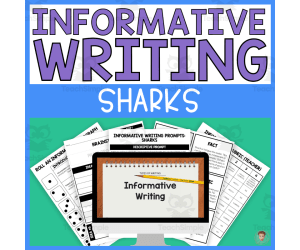
Step-by-Step Informative Writing (Shark Writing Prompts)
ELA, Creative Arts, Art, Reading, Reading Comprehension, Grammar, Language Development, Spelling, Strategies, Writing, Science, Life Sciences, Animals, Grade 3, 4, 5, Writing Prompts, Worksheets & Printables
Step-by-Step Informative Writing (Shark Writing Prompts) This remarkable resource is perfect for teachers looking to improve their students' informative writing abilities in an engaging setting. Its theme of sharks will captivate youngsters and provide captivating details to fuel their essays. The unit outlines five indispensable phases of crafting an informative essay: Fundamental research and brainstorming Drafting an outline with key points and supporting explanations Crafting interesting introductions, conclusions, and drafting Edit, revise drafts creating a polished copy Finally penning down the final draft. This resource is versatile as it can be utilized within a large class or small groups. Its features are designed perfectly for elementary teachers, homeschoolers alike. The pack includes: Differentiation through graphic organizers with primary lines or no lines suited for grade-levels 3 - 5. A total of 79 PDF pages encompassing unique study material like interactive presentations teaching each step from beginning to end sentences. The bonus features : There's more...A game where children can "roll" their own informative paragraph that results in an astonishing 432 unique combinations! And that’s not all.... there's also: Introductory instructions on various themes (How-Tos!) Problem-solution strategies among other treasure troves! And don’t forget the downloadable bonuses—Paragraph Elements Practice Exercises! Simply put, " Step-by-Step Informative Writing (Shark Writing Prompts) " is a comprehensive tool facilitating both the introduction of expository writing to novices and assessment of existing knowledge.
Author Heather Huhman
Tags Informative Writing, Sharks, Cross-curricular, Research Skills, Writing Prompts
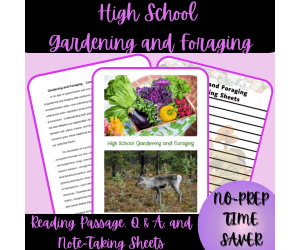
High School Gardening and Foraging Reading Passage
ELA, Reading, Science, Life Sciences, Biology, Nature & Plants, STEM, Writing, High School, Homeschool Resources, Worksheets & Printables, Teacher Tools, Literacy Readers, Assessments, Quizzes and Tests, Writing Prompts
I built this High School Gardening and Foraging unit because my own daughter and I needed a bridge. We wanted to move past the "nature walks" of the elementary years and dive into the actual ecological science our teens are ready for. It is been a total labor of love—making sure it is academically challenging and thought-provoking, but still deeply rooted in that hands-on connection to the land. I hope this lightens your planning load and shows your students/homeschoolers that self-sufficiency is not just a hobby—it is a science. INCLUDED IN THIS RESOURCE A multi-page, high-school-level reading passage that actually challenges them. 20 paragraph-style questions designed for critical thinking, not just "find the answer." A detailed answer key with comprehensive paragraph-format guides. 10 note-taking sheets to help keep their thoughts (and the science) straight. TOPICS COVERED Soil ecosystems and the "living community" beneath our feet. Advanced methods like Hugelkultur, hydroponics, and managing soil pH. Teaching the "Rule of Thirds" and essential plant safety. Developing true ecological literacy. I am a firm believer that once our students/homeschoolers get their hands in the dirt and learn the names of the "weeds" in their own backyard, they stop being passive consumers. They start becoming active participants in their world. That is a huge perspective shift, especially in 9th grade when they are starting to form their own voices on things like food security and the environment. Thanks for letting me be a tiny part of your homeschool journey this year. If you have questions or just want to share how your family used these pages, please reach out! Happy growing! If you and your students/homeschoolers enjoyed this resource, please leave a review. Thank you for your support! Tina - Big Easy Homeschooling Mom
Author Homeschool with Big Easy Homeschooling Mom
Rating
Tags High School Gardening Passage, Foraging For Homeschoolers, Sustainable Living Curriculum, Homeschool Environmental Science, Botanical Identification For Teens, Ethical Foraging Education, Soil Science For High School, Homeschool Agriculture Unit, High School Nature Study, Science-based Gardening
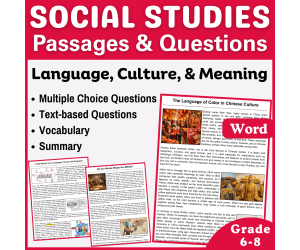
Social Studies Reading Passages: Language, Culture, Meaning (Word)
ELA, Reading, Reading Comprehension, Strategies, Resources for Teachers, Social Studies, Geography, Sociology, Grade 6, 7, 8, 9, Writing Prompts, Worksheets & Printables, Centers, Activities, Teacher Tools, Assessments, Quizzes and Tests, Quizzes, Tests
Social Studies Reading Comprehension Passages: Language, Culture, Meaning (Word) This resource introduces a collection of Social Studies reading comprehension passages about Language, Culture, and Meaning. The passages are carefully designed to bridge the gap between social studies and literacy through strengthening reading comprehension and sparking knowledge curiosity in middle school students. Each passage blends English Language Arts skills with accurate social studies content. Ideal for interdisciplinary learning in ELA and Social Studies. Suitable for Grade 9 review, too! What Is Included in this Collection? There are three informational passages (with full answer keys): Living Words: How Languages Change and Disappear The Language of Color in Chinese Culture Do Our Words Shape Our Minds For Each Passage, students will have multiple tasks to complete as follow: 5 multiple-choice questions targeting main idea, key details, inference, vocabulary in context, and use of evidence 5 vocabulary matching items with clear, student-friendly definitions 5 text-based questions that require citing specific lines or facts 1 summary prompt that asks students to condense central ideas accurately Available Formats for this Resource Fillable PDF Word Docs Google Docs FULL CATALOG OF DOWNLOADING LINKS HERE For more Social Studies Reading Passages, check the following Links: Ancient Civilizations PDF Fillable PDF Word Docs Google Docs Early Empires and Trade Networks PDF Fillable PDF Word Docs Google Docs The Founding of the United States PDF Fillable PDF Word Docs Google Docs Language, Culture, and Meaning PDF Fillable PDF Word Docs Google Docs Psychology and Society PDF Fillable PDF Word Docs Google Docs Global Festivals and Traditions PDF Fillable PDF Word Docs Google Docs Extreme Environments and People PDF Fillable PDF Word Docs Google Docs Food, Culture, and Preservation PDF Fillable PDF Word Docs Google Docs Global Food Customs PDF Fillable PDF Word Docs Google Docs Media, Communication, and Popular Culture PDF Fillable PDF Word Docs Google Docs Human Impact on the Environment PDF Fillable PDF Word Docs Google Docs Civic Action and Social Change PDF Fillable PDF Word Docs Google Docs Fashion, Society, and Power PDF Fillable PDF Word Docs Google Docs People, Places, and Unusual Histories PDF Fillable PDF Word Docs Google Docs Product Details Length: 13 pages total Grades: 6–8, also suitable for Grade 9 review Use cases: close reading, stations, homework, intervention, test prep, and sub plans Why Teachers Choose This Set Authentic social studies content paired with rigorous literacy practice Consistent task structure across all passages for easier planning and smoother student routines Clear, age-appropriate writing that builds confidence without oversimplifying Use this set to reinforce ELA skills in social studies, to add literacy to your lessons, and to support independent work. The passages strengthen main idea, evidence use, vocabulary in context, inference, cause and effect, and summary writing. With ready-to-use assessments and complete answer keys, you can provide focused practice that is simple to run and fast to review.
Author CORED Education - Middle & High School
Rating
Tags Middle School, Reading Comprehension, Reading Strategies, ELA, Centers, Reading Passage, Assessments, Vocabulary, Social Studies
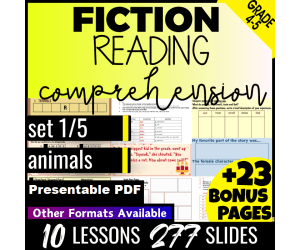
Reading Comprehension Fiction Set 1 - Animals (Presentable PDF)
ELA, Reading, Reading Comprehension, Common Core, ESL, Language Development, Spelling, Vocabulary, Children’s Literature, Literature, Grade 4, 5, Worksheets & Printables, Worksheets, Writing Prompts, Assessments, Teacher Tools, Tests, Quizzes and Tests, Centers, Activities
Reading Comprehension Passages Fiction Set 1 Snapshot Title: Reading Comprehension: Fiction Grade 4–5 Animals Genre: Fiction anthology (short animal-themed stories, plus a few informational-style passages) Subject: Reading (ELA) Primary Topic: Animal-themed short texts and comprehension practice Estimated Guided Reading Level (A–Z): Q What This Teaches Best Reading comprehension across multiple short texts (students answer “Mixed Questions” on plot details, vocabulary-in-context, and reasoning tied to each passage). Character feelings and traits from evidence (e.g., fear, relief, helpfulness, responsibility, truthfulness, and teasing/bullying moments are shown through dialogue and actions). Sequencing and cause/effect (several lessons ask students to put events in order, matching what happened first/next/last in the story). Vocabulary development in authentic context (words like cautiously, evaporate, tournament, responsibility, and endangered appear in the reading passages and are reused in skill pages). Cross-curricular knowledge through reading (animal care/adoption, zoo habitats/endangered species, and Chinese New Year traditions are explained within the texts). Learning Goals Identify key events in a short story and explain how they connect in order. Describe a character’s feelings or traits using specific details from the text. Determine the meaning of unfamiliar words and phrases using context clues. Explain a problem and solution in a passage using text evidence. Compare how different passages present animal-related situations (pets, wildlife, zoo animals, or traditions). Passages Include 1.Donny's Glasses: Donny is being chased by a monster. Or so he thinks! 2.Hare & Bear: Hare & Bear have a cup of tea together in the warmth. 3.Maggie's Turtle: Maggie is desperate to win the fishing competition. 4.New Pup: Hugh finds out a new puppy isn't as fun as he hoped. 5.Naughty Cat: Lizzie can't find any of her stuff. Read this story to find outwhere it is. 6.Ella's Baseball Bat: Ella's dad is scared of bats, and now there is one in the house! 7.Ola the Rabbit: Read about Darla's newest pet in this lesson. 8.Ethan and the Puppies: Ethan gets ready for the puppies to arrive. 9.Endangered Animals: Sam learns all about endangered animals in this passage. 10.Chinese New Year: Jessie and Sally talk about the upcoming Chinese New Year. PRESENTABLE PDF VERSION Run it like a slide show straight from a PDF, with no PowerPoint or extra software needed, just open, project, and teach. Other versions are available in the links list below or in the full catalog. FULL CATALOG OF DOWNLOAD LINKS HERE For similar downloads and other frees, do check out Cored Group on TeachSimple.
Author Cored Education
Rating
Tags Elementary, Reading, Comprehension, Vocabulary, Answers, Spelling, Writing, Passages, Reading Centers, Reading Comprehension Assessments

Dolphins Reading Comprehension Passage - Cored Ed Encyclopedia
ELA, Language Development, Resources for Teachers, Reading Comprehension, Reading, Pre-Reading, Writing, Animals, Life Sciences, Science, Grade 2, 3, 4, 5, Worksheets & Printables, Worksheets, Teacher Tools, Centers, Activities, Writing Prompts, Assessments, Tests, Quizzes and Tests, Quizzes
This dolphins reading comprehension contains the following: COMPANION VIDEO NOW AVAILABLE (EMBEDDED AFTER PREVIEW PICTURES IN PRODUCT DESCRIPTION) Pre-Reading Trivia Students will write down one thing they already know about the subject and then read five more facts and discuss. These facts are fun, and the students will enjoy learning about the subject before reading more. Reading Passage The text is a high-interest reading passage with set paragraphs, roughly three to four paragraphs long. It contains a variety of themes about the topic, anywhere from history to technology. The passage is between 250 and 350 words in length. Mixed Questions The first question page contains four multiple-choice questions, each with a choice of four answers, and three written response questions that require a sentence or two from the student. Creative Writing In this question, the student will be required to write a five to eight sentence paragraph on a question related to the topic. Extension Activities This page is optional for fast finishers. If there are five to ten minutes left at the end of the lesson, the student can choose one of three activities, each one requiring a different skill. Answer Key There are answers for the multiple-choice questions and three written response questions have sample answers. FULL CATALOG OF DOWNLOAD LINKS AND ENCYCLOPEDIA INDEX HERE Cored Ed Encyclopedia Overview The Cored Ed Encyclopedia is a weekly series of lessons that you can pick up and use right away. These short readings fit into whatever time you have available. Each one includes a warm-up, a reading, and a set of questions, but it’s flexible — you can do just the reading, the full lesson, or skip the writing section if you need to. Each lesson focuses on a single topic so students don’t get lost. The writing is clear but never childish, making it perfect for grades two through five. Topics range from animals and science to history, inventions, and everyday things. No matter the level of the student, everyone should take away at least one new idea or fact from each lesson. The materials are easy to print, easy to explain, and require no setup. They work well for whole-class teaching, partner work, or independent study.
Author Cored Education
Rating
Tags Vocabulary, Spelling, Reading Comprehension, Reading Passages, Cored Encyclopedia, Facts, Reading, Creative Writing, Dolphins, Life Science

Saving Electricity Campaign: Social Studies Reading Passage (Word)
ELA, Reading, Reading Comprehension, Strategies, Resources for Teachers, Social Studies, Sociology, Grade 6, 7, 8, 9, Writing Prompts, Worksheets & Printables, Centers, Activities, Teacher Tools, Assessments, Quizzes and Tests, Quizzes, Tests
Saving Electricity Campaign: Social Studies Reading Comprehension Passage (Word) This resource introduces a unique Social Studies reading comprehension passage with questions about Saving Electricity Campaign. The passage is carefully designed to bridge the gap between social studies and literacy through strengthening reading comprehension and sparking knowledge curiosity in middle school students. Each passage blends English Language Arts skills with accurate social studies content . Ideal for interdisciplinary learning in ELA and Social Studies. Suitable for Grade 9 review, too! Student Tasks throughout the passage: 5 multiple-choice questions targeting the following skills: main idea, key details, inference, vocabulary in context, and use of evidence 5 vocabulary matching items with clear, student-friendly definitions 5 text-based questions that require citing specific lines or facts 1 summary prompt that asks students to condense central ideas accurately Full answer key for every section Available Formats for this Resource: PDF Fillable PDF Google Docs FULL CATALOG OF DOWNLOADING LINKS HERE Social Studies Reading Comprehension Collection Links: 1. Ancient Civilizations PDF Fillable PDF Word Docs Google Docs 2. Early Empires and Trade Networks PDF Fillable PDF Word Docs Google Docs 3. The Founding of the United States PDF Fillable PDF Word Docs Google Docs 4. Language, Culture, and Meaning PDF Fillable PDF Word Docs Google Docs 5. Psychology and Society PDF Fillable PDF Word Docs Google Docs 6. Global Festivals and Traditions PDF Fillable PDF Word Docs Google Docs 7. Extreme Environments and People PDF Fillable PDF Word Docs Google Docs 8. Food, Culture, and Preservation PDF Fillable PDF Word Docs Google Docs 9. Global Food Customs PDF Fillable PDF Word Docs Google Docs 10. Media, Communication, and Popular Culture PDF Fillable PDF Word Docs Google Docs 11. Human Impact on the Environment PDF Fillable PDF Word Docs Google Docs 12. Civic Action and Social Change PDF Fillable PDF Word Docs Google Docs 13. Fashion, Society, and Power PDF Fillable PDF Word Docs Google Docs 14. People, Places, and Unusual Histories PDF Fillable PDF Word Docs Google Docs Product Details: Length: 5 pages Grades: 6–8, also suitable for Grade 9 review Use cases: close reading, stations, homework, intervention, test prep, and sub plans Why Teachers Choose This Passage: Authentic social studies content paired with rigorous literacy practice Consistent task structure for easier planning and smoother student routines Clear, age-appropriate writing that builds confidence without oversimplifying Use this passage to reinforce ELA skills in social studies, to add literacy to your lessons, and to support independent work. The passage strengthens main idea, evidence use, vocabulary in context, inference, cause and effect, and summary writing. With ready-to-use assessments and complete answer keys, you can provide focused practice that is simple to run and fast to review.
Author CORED Education - Middle & High School
Rating
Tags Middle School, Reading Comprehension, Reading Strategies, ELA, Centers, Reading Passage, Assessments, Vocabulary, Social Studies, Sociology
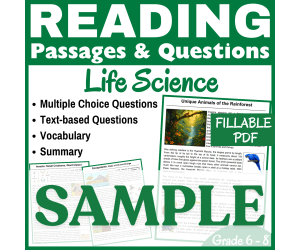
Insects, Animals, & Ecosystems: SAMPLE Reading passage (FILLABLE PDF)
Science, ELA, Reading, Reading Comprehension, Strategies, Resources for Teachers, Life Sciences, Animals, Insects, Nature & Plants, Grade 6, 7, 8, 9, Writing Prompts, Worksheets & Printables, Centers, Activities, Teacher Tools, Assessments, Quizzes and Tests, Quizzes, Tests
This is a ONE PASSAGE SAMPLE. The following is the description of the FULL resource and the downloading links: Insects, Animals, & Ecosystems: Reading Comprehension Passages (FILLABLE PDF) This very engaging and fillable collection of life science reading passages about Insects, Animals, & Ecosystems is designed to bridge the gap between science and literacy through strengthening reading comprehension and sparking scientific curiosity in middle school students. Each passage blends English Language Arts skills with accurate science content that supports NGSS classroom practice. Ideal for interdisciplinary learning in ELA and Science. Suitable for Grade 9 review, too! These worksheets are designed as fillable PDFs , which means students can type their answers directly into the document on any computer or tablet . Each page includes highlighted text fields that show them exactly where to type! What Is Included? There are (3) informational passages: Ecosystems: Webs of Life and Change Insects: Small Creatures, Giant Impact Unique Animals of the Rainforest Student Tasks for Each Passage: 5 multiple-choice questions targeting main idea, key details, inference, vocabulary in context, and use of evidence 5 vocabulary matching items with clear, student-friendly definitions 5 text-based questions that require citing specific lines or facts 1 summary prompt that asks students to condense central ideas accurately Full answer key for every section Available Formats for this Resource Word Docs Google Docs FULL CATALOG OF DOWNLOADING LINKS HERE Reading Passage Links: Astronomy & Space Science PDF Fillable PDF Word Docs Google Docs Volcanoes, Rocks, & Mountains PDF Fillable PDF Word Docs Google Docs Rock Cycle, Soil, & Sinkholes PDF Fillable PDF Word Docs Google Docs Mars, Glaciers, & Antarctica PDF Fillable PDF Word Docs Google Docs Water Cycle, Acid Rain, & Wastewater PDF Fillable PDF Word Docs Google Docs Insects, Animals, & Ecosystems PDF Fillable PDF Word Docs Google Docs Bioluminescence & Insects PDF Fillable PDF Word Docs Google Docs Animal Skin, Cats, & T. Rex PDF Fillable PDF Word Docs Google Docs Human Body and Senses PDF Fillable PDF Word Docs Google Docs Health & Applied Bioscience PDF Fillable PDF Word Docs Google Docs Waves, Light, & Imaging PDF Fillable PDF Word Docs Google Docs Electricity & Energy PDF Word Docs Google Docs Motion & Materials PDF Word Docs Google Docs Chemistry and Materials Science PDF Fillable PDF Word Docs Google Docs How to Use These PDFs Click on the highlighted area to start typing your answer. Move to the next question by clicking in the next highlighted box. When you are finished, close the document and select SAVE so your answers stay recorded. If you want to keep a blank copy for later, choose Save As and give your completed version a new name. Product Details Length: 14 pages total Grades: 6–8, also suitable for Grade 9 review Use cases: close reading, stations, homework, intervention, test prep, and sub plans Standards support: reinforces informational-text skills and supports NGSS-style sense making through observation, modeling, and clear use of claim, evidence, and reasoning Why Teachers Choose This Set Authentic science content paired with rigorous literacy practice Consistent task structure across all passages for easier planning and smoother student routines Clear, age-appropriate writing that builds confidence without oversimplifying Use this set to reinforce ELA skills in science, to add literacy to your lessons, or to support independent work. The passages strengthen main idea, evidence use, vocabulary in context, inference, cause and effect, and summary writing. With ready-to-use assessments and complete answer keys, you can provide focused practice that is simple to run and fast to review.
Author CORED Education - Middle & High School
Rating
Tags Middle School, Reading Comprehension, Reading Strategies, ELA, Centers, Reading Passage, Assessments, Vocabulary, Life Science, Insects

Reading Comprehension Passages Fiction Set 7 - Sports (Fillable PDF)
ELA, Reading, Reading Comprehension, Common Core, Children’s Literature, Literature, Language Development, ESL, Writing, Vocabulary, Grade 2, 3, Worksheets & Printables, Worksheets, Writing Prompts, Assessments, Teacher Tools, Tests, Quizzes and Tests, Centers, Activities
Reading Comprehension Passages Fiction Set 7 Snapshot Genre: Fiction (short story + comprehension practice) Subject: Reading (Literature) Primary Topic: Sportsmanship and kindness at a baseball game Estimated Guided Reading Level (A–Z): M What This Teaches Best Making inferences about a character’s motivations (Dan wants a foul ball and autographs). Recognizing a turning point and how it affects the ending (Dan gives the foul ball to the little girl). Using emotion words and text evidence to describe feelings (delighted, devastated, proud). Understanding how setting shapes events (stadium seats, foul balls, cheering). Learning Goals Students will describe Dan’s goal and track how it changes across the story. Students will explain why Dan gives the ball away using evidence from the text. Students will identify key setting details and how they connect to the plot. Students will retell the main events in order, including the problem and resolution. Students will define unfamiliar words from the story using context clues. Passages Include 1.Catch It, Dan: Dan is at the ball game and wants to catch a foul ball. 2.Feeling Left Out: Polly isn't invited bowling by her friends and wants to knowwhy. 3.Ian's Friday Nights: Ian wants to be anywhere but the bleachers on Friday nights. 4.Aimee's Dilemma: Soccer or cheerleading? That is the question. 5.A Great Team: Adam & Justin both want to play first base. How will they sortit? 6.Ana's Swimming Party: Jodie can't swim and doesn't want her friends to find out. 7.Touchdown Pythons: Serena loves her first football game. 8.Sam's Passion: Sam talks about his passion for Karate in this passage. 9.Where's My Board: Kerry spends all the story looking for her skateboard. 10.Lacey the Runner: Lacey has dreams to run in the Olympics. Read to find out more. Additional File: Ana's Swimming Party: Invitation Templates FILLABLE PDF VERSION Worksheet-style pages, but with type-in answer boxes so students can complete and save their work digitally. Other versions are available in the links list below or in the full catalog. FULL CATALOG OF DOWNLOAD LINKS HERE For similar downloads and other frees, do check out Cored Group on TeachSimple.
Author Cored Education
Rating
Tags Elementary, Reading, Comprehension, Vocabulary, Answers, Spelling, Writing, Passages, Reading Centers, Reading Comprehension Assessment

2025 July ELA Bell Ringers
Resources for Teachers, ELA, Writing, Creative Writing, Life Studies, Research, High School, Homeschool Resources, Middle School, Worksheets & Printables, Writing Prompts, Teacher Tools, Assessments, Quizzes and Tests
As a homeschool mom who has struggled with keeping my teenagers engaged in meaningful learning during those lazy summer days, I know how challenging it can be to maintain momentum without overwhelming busy schedules. That is exactly why I created these July ELA Bell Ringers – 23 carefully planned daily activities that take just 10-15 minutes but pack a real punch in terms of skill building. I have watched my own daughter groan at the thought of "summer school," but these quick, varied exercises actually get them excited about writing again. Each activity builds naturally on the previous day's work, creating a gentle but effective learning progression that keeps minds sharp without feeling like drudgery. INCLUDED IN THIS RESOURCE: 23 unique daily activities that actually hold teenager attention (trust me, I've tested these!) Grammar lessons that make sense instead of just drilling rules Creative writing prompts that spark imagination – from dystopian fiction to unreliable narrators Poetry analysis using works kids can actually connect with, including Emily Dickinson and Maya Angelou TOPICS COVERED: Real-world grammar that improves writing instead of just test performance Literary analysis skills that prepare students for challenging texts Creative writing across genres that builds confidence and voice Vocabulary development through meaningful context, not memorization These July Bell Ringers grew out of my own frustration with summer slide and my determination to find something that actually worked with real teenagers in real families. After years of watching my kids and their friends struggle with the transition back to academic work each fall, I knew there had to be a better way. This collection maintains rigor while respecting the reality of summer schedules and teenage attention spans. It's the resource I wish I had had when my oldest was heading into challenging literature courses – something that built genuine skills without killing the joy of reading and writing. Most of all, it prepares students not just for the next grade level but for the independent thinking and clear communication they'll need throughout their lives. If you and your students/homeschoolers, enjoyed this resource, please leave a review. Thank you for your support! Tina - Big Easy Homeschooling Mom
Author Homeschool with Big Easy Homeschooling Mom
Rating
Tags Summer ELA Activities, Daily Writing Practice, Creative Writing Prompts, Homeschool ELA Resources, July Daily ELA Bell Ringers For High School, Vocabulary Building Through Contextual Writing, College Prep Writing Skills Development, Daily Warm-ups, Poetry Analysis, ELA Bell Ringers