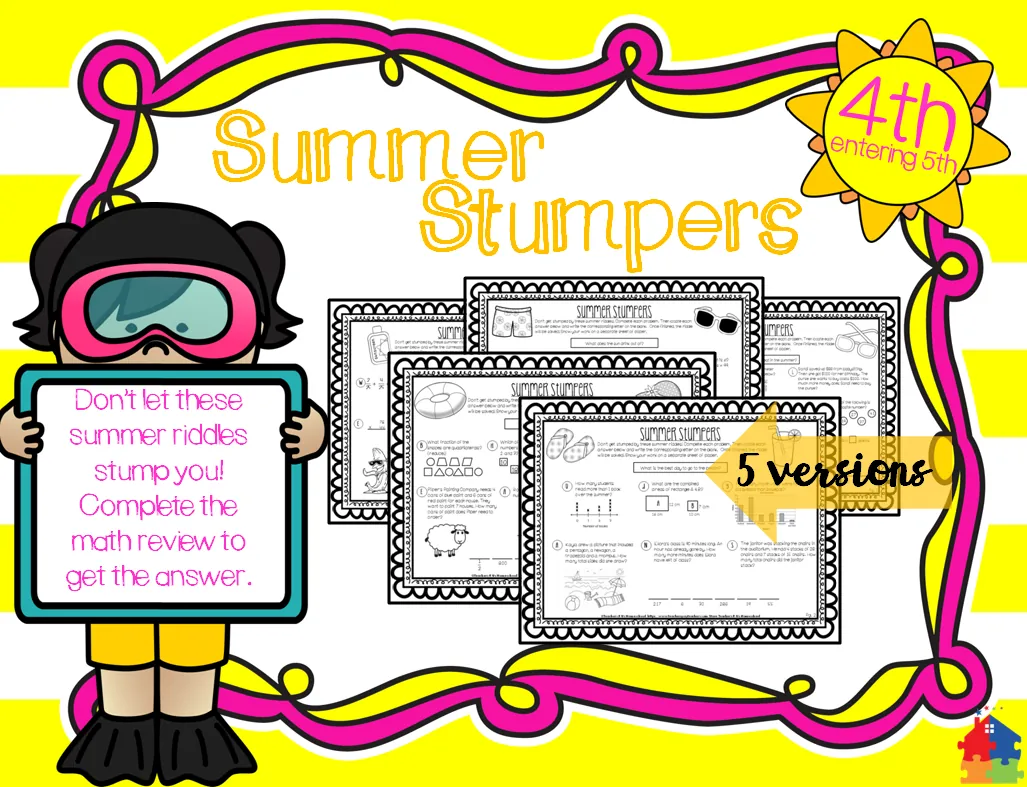
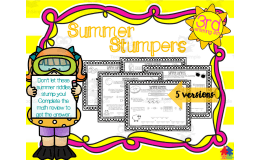
5th Grade Summer Stumpers | End of Year Math Riddles
- Grades
- Grade 5, Elementary
- File type
- Preparation
- Print ready


- Topic
- word problems, geometry
- Resource types
- Worksheets & Printables, Word Problems, Worksheets
- Preparation
- Print ready
About this resource
What's inside this resource
Related resources
More resources teachers may find useful
24 related resources were found using this product's title, contributor, categories and tags.


In the classroom
Teaching tips & learning objectives

Learning objectives
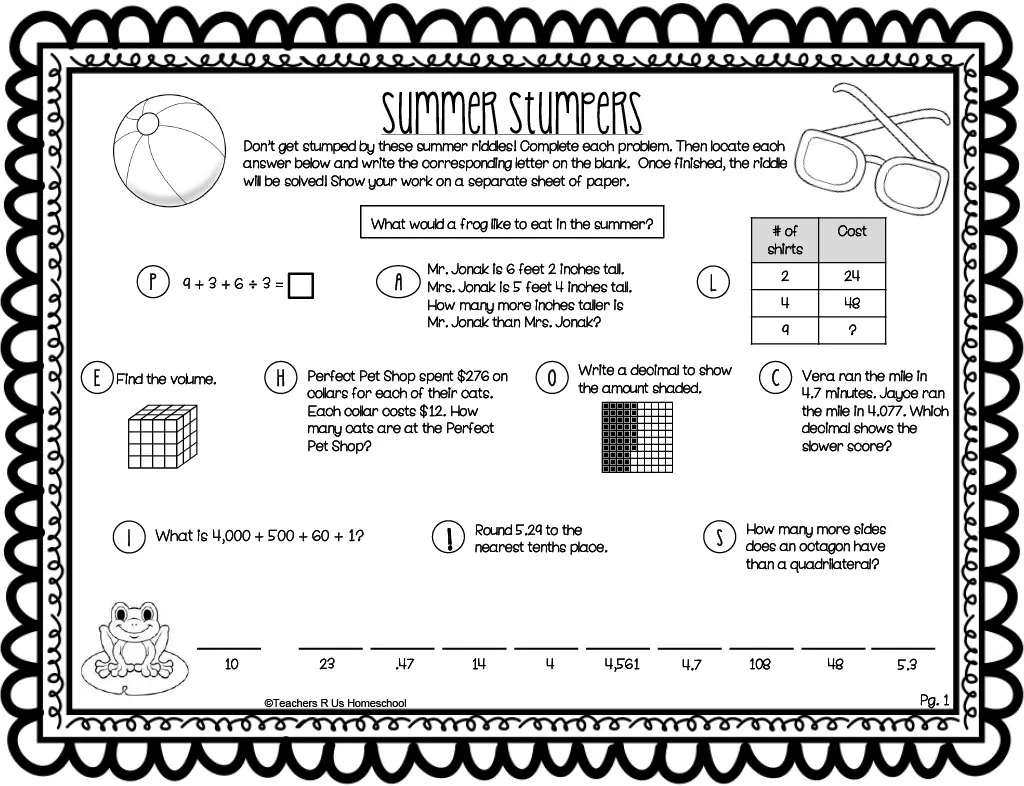
Apply the order of operations to evaluate multi-step numeric expressions such as 9 + 3 + 6 ÷ 3 and 1 + 8 × 3 ÷ 6.
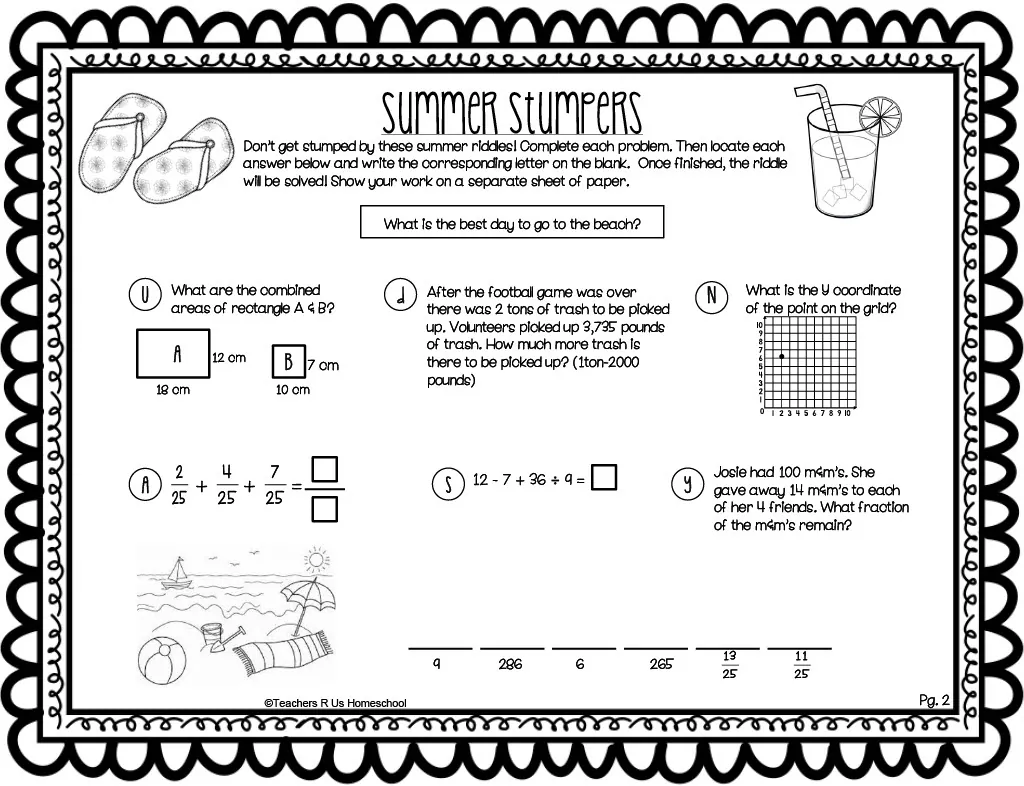
Solve word problems involving decimals and fractions, including converting a mixed number to an improper fraction and rounding a decimal to the nearest tenth.
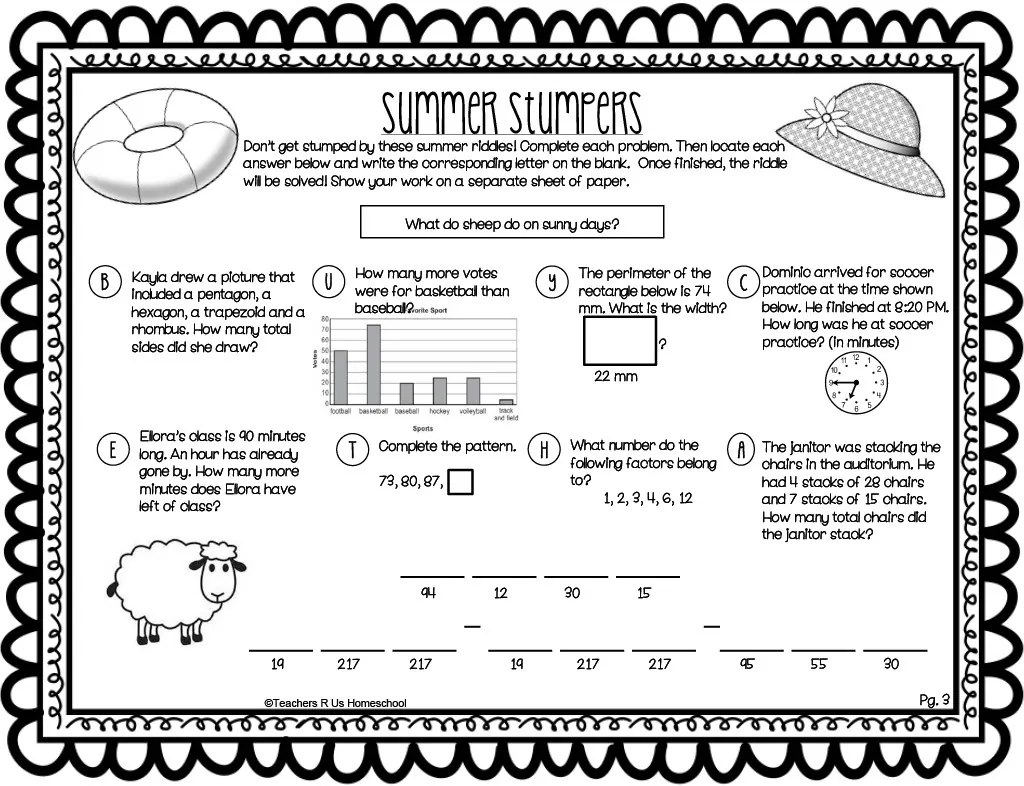
Solve geometry word problems involving the area, volume, and perimeter of two- and three-dimensional shapes, including finding a missing side from a given perimeter.

Teaching tips
Have students show their work on separate paper, since each worksheet page provides space only for the problems and the answer-decoding blanks.
Treat the self-checking letter/number format as a built-in error check: if a completed riddle doesn't spell a real word or phrase, a student can trace back which problem needs another look.
Assign one riddle worksheet per day during the last week of school or across a summer packet, since each page stands alone and reviews a different mix of the year's skills.

Skills covered
Order of operations — students evaluate expressions like 12 - 7 + 36 ÷ 9 that mix addition, subtraction, multiplication, and division.
Fraction and decimal computation — students add fractions with common denominators, convert a mixed number to an improper fraction, and round a decimal to the nearest tenth.
Geometric measurement — students calculate area, volume, and perimeter, including solving for a missing rectangle side from its perimeter.
Good to know
Questions teachers ask about this resource
Do the five riddle worksheets cover the same math skills each time, or a different mix?
A different mix on each page — the first page leans on order of operations, geometry, and rounding, while later pages add fraction-to-mixed-number conversion, elapsed time, and money word problems, so no two pages test the identical skill set.
Where do students actually solve the problems, since the page itself has little blank space?
On a separate sheet of paper — each worksheet page is built around the problem prompts and the letter/number decoding grid, not full working space.

No reviews yet
Downloaded this resource? Tell other teachers how it went.
Curriculum
Standards, concepts & topics
Standards
 Standards
- 5.MD.C.5 — Relate volume to the operations of multiplication and addition and solve real world and mathematical problems involving volume. a. Find the volume of a right rectangular prism with whole-number side lengths by packing it with unit cubes, and show that the volume is the same as would be found by multiplying the edge lengths, equivalently by multiplying the height by the area of the base. Represent threefold wholenumber products as volumes, e.g., to represent the associative property of multiplication. b. Apply the formulas V = l × w × h and V = b × h for rectangular prisms to find volumes of right rectangular prisms with whole-number edge lengths in the context of solving real world and mathematical problems. c. Recognize volume as additive. Find volumes of solid figures composed of two non-overlapping right rectangular prisms by adding the volumes of the non-overlapping parts, applying this technique to solve real world problems
- 5.OA.A.1 — Use parentheses, brackets, or braces in numerical expressions, and evaluate expressions with these symbols.
Core concepts
 Core concepts
order of operations
fractions and decimals
geometry measurement
money and elapsed-time word problems
self-checking riddle format
 Topics
Explore more
Categories this resource belongs to
Explore related searches
More to explore
You may also like