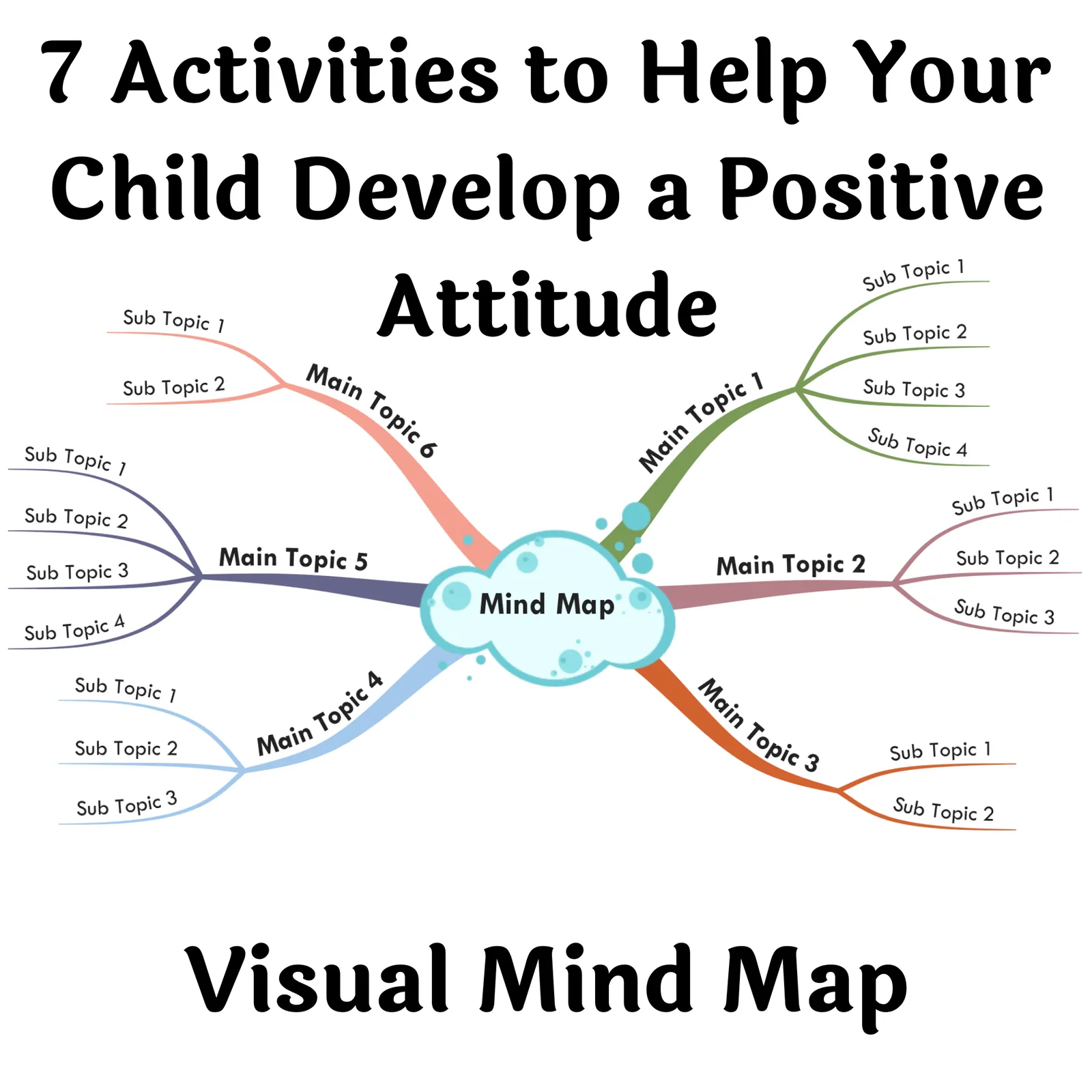
7 Positive Attitude Activities – Visual Mind Map
- Grades
- Not Grade Specific
- File type
- Multiple File Types


- Subject
- Special Resources, Life Studies, Social Emotional Learning (SEL), Special Education Needs (SEN), Life Skills, Business, Career, Coaching, Creative Arts, Art
- Topic
- Visual Mind Map, MindMap
- Resource types
- Diagrams, Teacher Tools
About this resource
What's inside this resource
◈ 7 Activities to Help Your Child Develop a Positive Attitude - Visual Mind Map
◈ As a parent, it can be challenging to witness your child struggling with negative thoughts and emotions, such as self-doubt, sadness, or anger. Research has shown that it is common for individuals, including children, to have a tendency to focus on the negative rather than the positive. This negativity is often driven by emotions like fear, doubt, or shame, and can have a significant impact on a child's self-perception and perception of the world.
◈ However, there are many ways that parents can support their children in developing a more positive outlook on life. By encouraging optimism, fostering resilience, promoting a growth mindset, and nurturing emotional intelligence, parents can help their children build self-esteem, confidence, and coping skills, and cultivate a more positive attitude towards themselves and the world.
◈ A Visual Mind Map flows just like our brain does and they are NOT in Nice Neat Lines! A Mind Map enables free flow of ideas because you mostly use short phrases, keywords, images, and icons. You can jot down ideas a lot faster than usual, which results in an unobstructed flow of ideas.
✔✔ WHY MIND MAPS?
Mind maps structure information:- Mind maps are graphical representations of information that convey the relationship between individual ideas and concepts. No matter how complex or broad a subject is, a mind map brings order into the chaos and helps you see the 'bigger picture'.
Mind Maps foster creativity - There are very few techniques out there that have the ability to get your creative juices flowing like mind mapping. That is because mind maps use images and keywords to create new associations within your brain, which you can also transcribe with incredible speed.
✔✔ Benefits of downloading this product
◈ You will be able to develop new skills quickly
◈ You will be up-to-date with the latest market trends
◈ You will have the best ideas at your fingertips
◈ Learn a new skill - Mind Mapping - No Limits as to what Mind maps can be used for. Mind Mapping is suitable for all ages. Your child can’t read yet. But with the power of mind maps, they can learn. Use images instead of words!
WHO NEEDS MIND MAPS?
Anyone from a student to a CEO can use and benefit from this technique. Here are a few examples.
Students:– Preparing for exams and wanting to boost their learning capabilities and results
Event Planners:– Wanting to organize every aspect of an event
Writers:– Wanting to Create original Content, Stories, Articles, etc
Entrepreneurs:– Wanting to Create a road map or a dynamic Business plan
Project Managers:– Wanting to present their ideas clearly to their team
Teachers:– Wanting to improve communication in the classroom
Marketers:– exploring potential Avenues for promoting a product or service
Consultants / Advisors:– trying to visualize Client's Situation
Collaborative Teams:– working on a project together
Anybody:- Anybody can use mind maps to unleash their creativity, solve problems, visualize their goals, and organize their thoughts!
Note: It is recommended that you view the Mind Maps on your Desktop/Laptop. Zoom in on a particular branch for the best view.
A Mind Map by Arpit Banjara - I am a 'MindMeister' certified Mind Mapping expert. Get 20% off on your MindMeister, MeisterTask, MeisterNote
Subscriptions - Use Promo Code - ARPIT20
Related resources
More resources teachers may find useful
24 related resources were found using this product's title, contributor, categories and tags.
In the classroom
Teaching tips & learning objectives

Teaching tips
Introduce one activity branch at a time rather than the whole map at once, since each of the 7 activities includes multiple research-backed sub-strategies.
View the mind map on a larger screen (laptop or desktop) and use zoom controls, since the file's own instructions note it isn't designed for small screens.

Skills covered
Emotional regulation and self-compassion — loving-kindness meditation and positive affirmations are used to build a child's inner positive self-talk.
Goal-setting and resilience — the WOOP strategy (Wish, Outcome, Obstacle, Plan) walks a child through setting a goal and planning around obstacles.
Good to know
Questions teachers ask about this resource
Does the mind map cite research to support each activity, or just list suggestions?
It cites research — for example, the loving-kindness meditation branch references studies by Dr. Barbara Fredrickson and Dr. Richard Davidson, and the affirmations branch cites Dr. Sonja Lyubomirsky's research on happiness.
What strategy does the mind map use for the goal-setting activity?
It uses Dr. Gabriele Oettingen's WOOP strategy — Wish, Outcome, Obstacle, and Plan — to walk a child through setting a goal and preparing for obstacles that might get in the way.

No reviews yet
Downloaded this resource? Tell other teachers how it went.
Resource details
Concepts & topics
Core concepts
 Core concepts
loving-kindness meditation
WOOP goal-setting strategy
positive affirmations
gratitude/awe journaling
 Topics
Explore more
Categories this resource belongs to
Explore related searches
More to explore
You may also like