Ancient China Activity Pack – 3rd Grade VA SOL
- Grades
- Grade 3, Elementary
- File type
- Preparation
- Print ready


- Subject
- Social Studies, History, History: Ancient
- Topic
- social studies, ancient china
- Resource types
- Workbooks, Worksheets & Printables
- Preparation
- Print ready
- Standards
- CCSS.RI.3.1 CCSS.RI.3.3 +1
About this resource
What's inside this resource
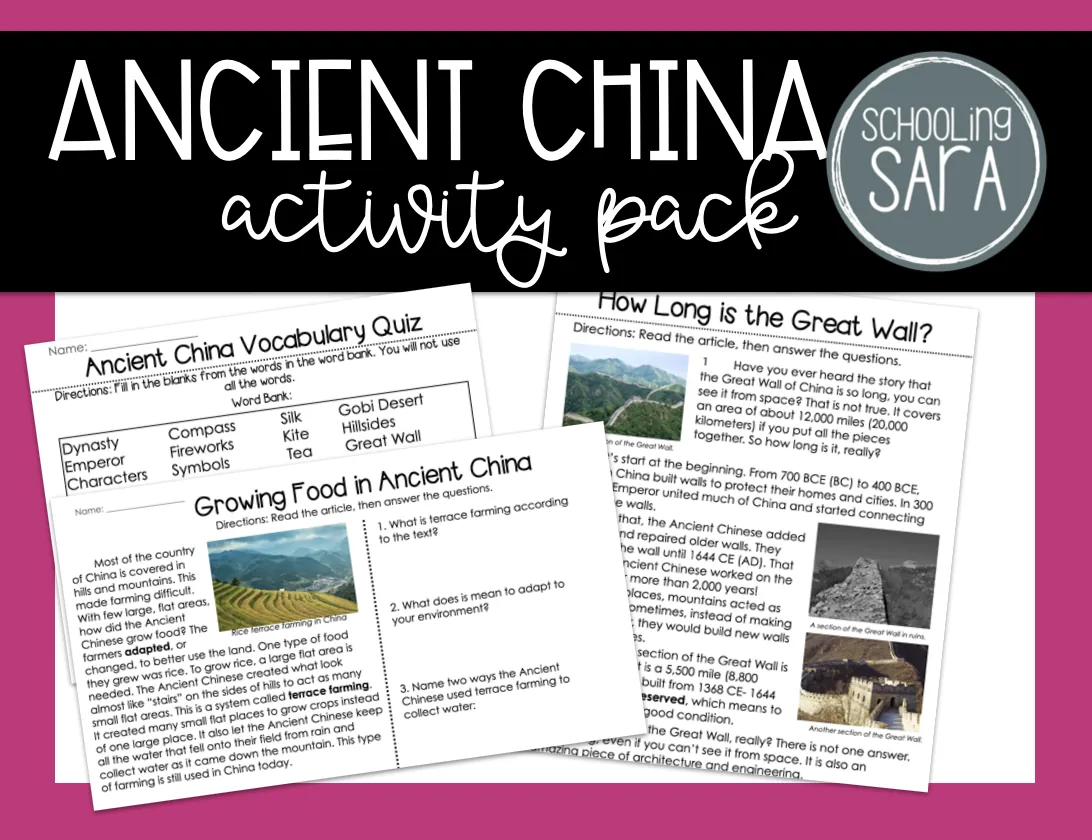
This is a pack of activities for a unit on Ancient China. It isn't limited to social studies activities, but has two passages, and all the passages and activities are geared towards a 3rd-grade level. The activities were made based on the Third Grade Virginia Social Studies standards (SOLs) but this will work for any classroom introducing Ancient China, its contributions, economic resources, and how they adapted to their environment .
Included in this pack:
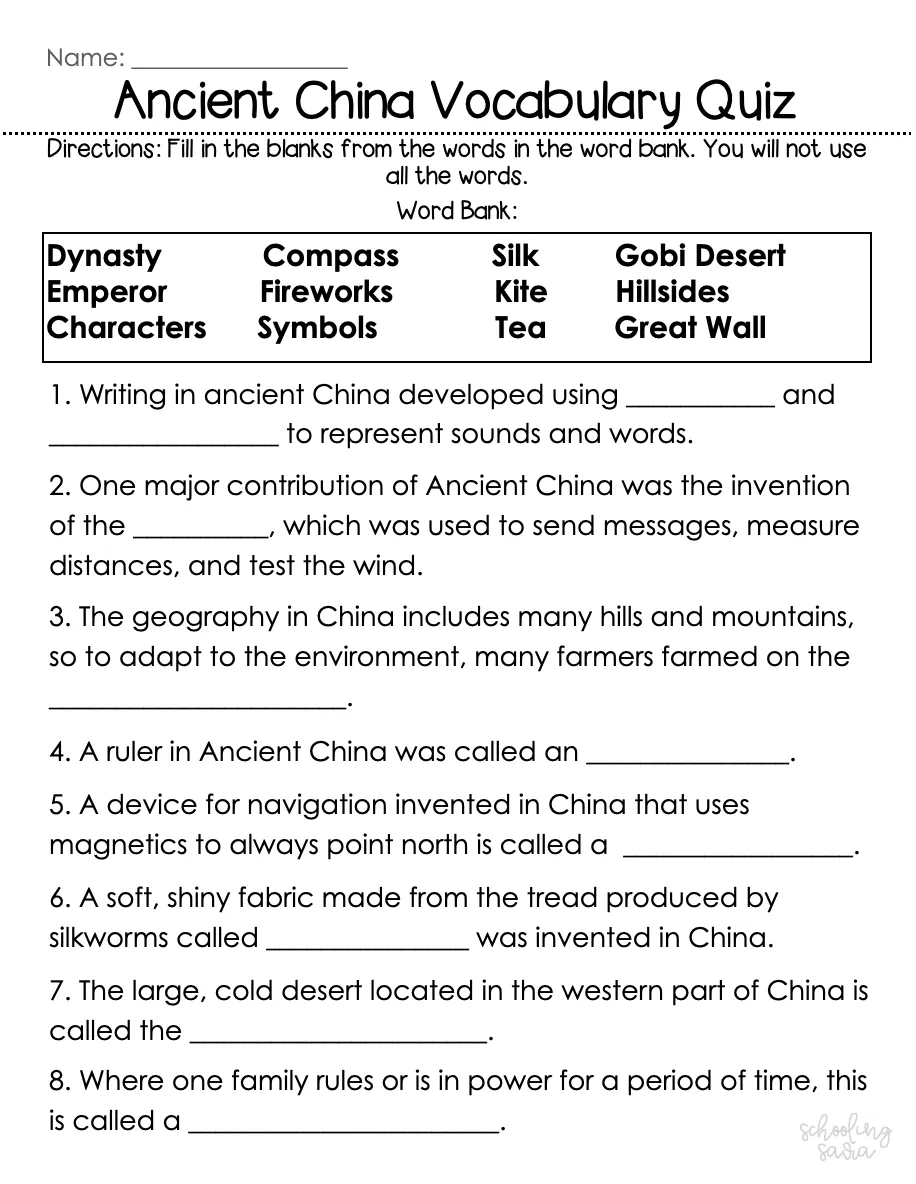
China Vocabulary Quiz - answer key provided
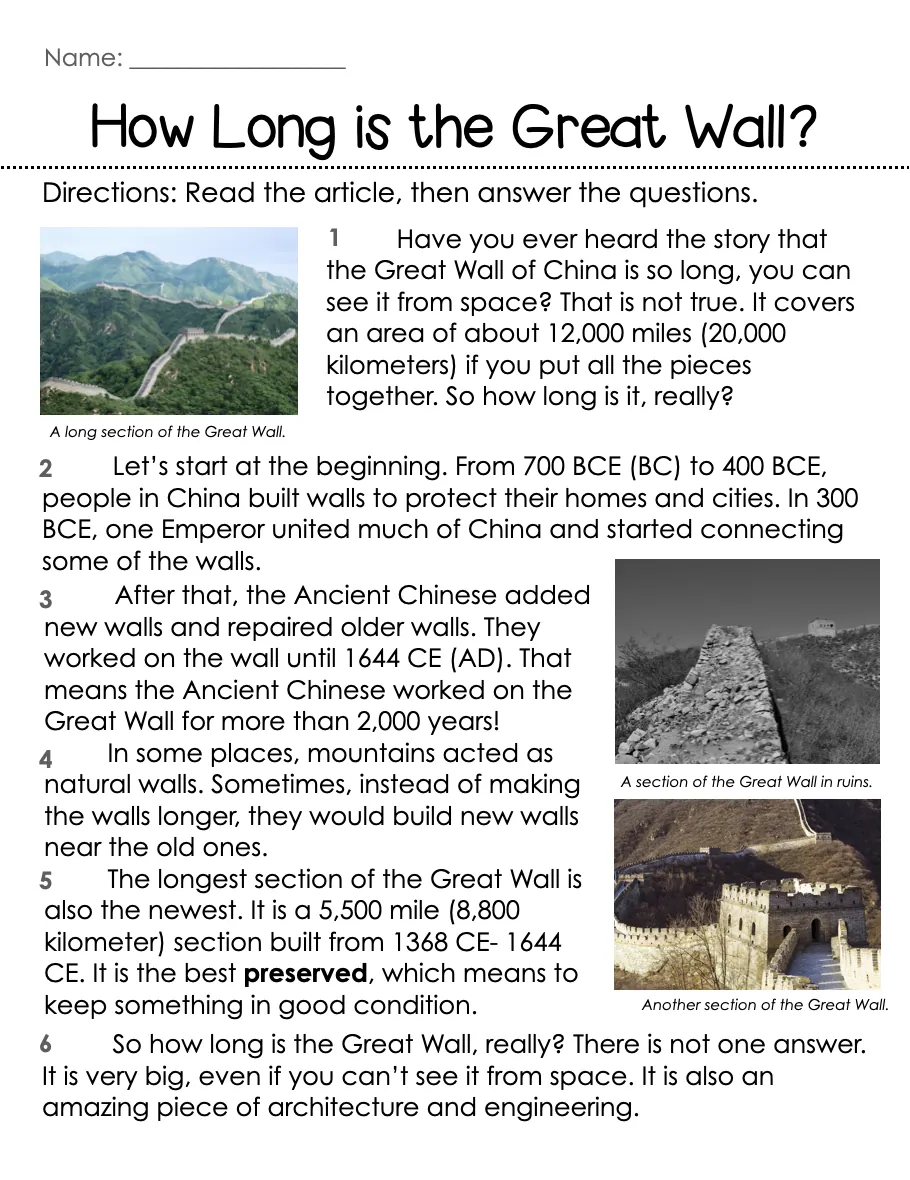
How Long is the Great Wall? Reading Passage and Questions (written on a 3rd grade level) - answer key provided. This passage talks about how and when the Great Wall is built and how long it is
Ancient China Know/Want to Know chart (my take on a KWL)
Growing Food in Ancient China Passage and Questions (written on a 3rd grade level) - answer key provided. This passage talks about how the Ancient Chinese used terrace farming to grow food on the hillsides and the other ways they adapted to their environment in order to grow food
If you need notes to go along with this unit, check them out here: Ancient China Notes Pages
If you would like additional Ancient Civilization notes pages and activities, check out this list below:
Ancient Civilization and Virginia Studies Timeline Bulletin Board
For even more social studies content, check out the products linked below:
Continents and Geographic Features interactive notebook
Economics Interactive Notebook
Civics Interactive Notebook
Included: A pdf with activities, directions, and passages for you to print and make copies of for your students to complete
Related resources
More resources teachers may find useful
24 related resources were found using this product's title, contributor, categories and tags.


In the classroom
Teaching tips & learning objectives

Learning objectives
Identify Ancient Chinese inventions and geographic features (compass, silk, the Gobi Desert, dynasty, emperor) by completing a vocabulary quiz
Draw conclusions from a nonfiction passage about why the Great Wall of China is not one single, continuous structure
Explain how terrace farming let Ancient Chinese farmers adapt to a hilly, mountainous landscape

Teaching tips
Assign the Know/Want-to-Know chart before the readings to activate prior knowledge and set a purpose for reading
Use the vocabulary quiz's extra distractor words (four of the twelve word-bank terms go unused) as a discussion point about which terms actually appear in the passages
The 'Why do you think...' short-answer item on the Great Wall passage has open-ended, reasoning-based responses; use the sample response in the key as a model rather than a single correct wording

Skills covered
Vocabulary application — students fill in eight blanks with Ancient China terms (dynasty, emperor, compass, silk, and others) drawn from a word bank.
Reading for inference — students answer multiple-choice and short-answer questions that require drawing a conclusion from the Great Wall passage rather than copying a stated fact.
Cause-and-effect reasoning — students explain, in their own words, how terrace farming let Ancient Chinese farmers adapt to hilly terrain to grow rice.
Good to know
Questions teachers ask about this resource
Why isn't the Great Wall's length a single, simple number?
The passage explains the wall was built and rebuilt in separate sections across more than 2,000 years, so its full length is the sum of many different walls rather than one continuous structure.
What does the Know/Want-to-Know chart ask students to record?
Two columns: what students already know about Ancient China, and what they want to know before the unit's readings.

No reviews yet
Downloaded this resource? Tell other teachers how it went.
Curriculum
Standards, concepts & topics
Standards
 Standards
- CCSS.RI.3.1 — Ask and answer questions to demonstrate understanding of a text, referring explicitly to the text as the basis for the answers.
- CCSS.RI.3.3 — Describe the relationship between a series of historical events, scientific ideas or concepts, or steps in technical procedures in a text, using language that pertains to time, sequence, and cause/effect.
- CCSS.RI.3.4 — Determine the meaning of general academic and domain-specific words and phrases in a text relevant to a grade 3 topic or subject area.
Core concepts
 Core concepts
Ancient China
Great Wall of China
Terrace farming
Environmental adaptation
 Topics
Explore more
Categories this resource belongs to
Explore related searches
More to explore
You may also like