Ancient Civilizations: Aztec, Inca, and Maya Unit Study
- Grades
- Grades 3–6, Middle School
- Pages
- 118
- File type
- Multiple File Types


- Subject
- Social Studies, History, History: Ancient
- Topic
- Maya, Inca
- Resource types
- Lesson Plans, Teacher Tools
- Standards
- CCSS.RI.4.2 CCSS.RI.4.3 +1
About this resource
What's inside this resource
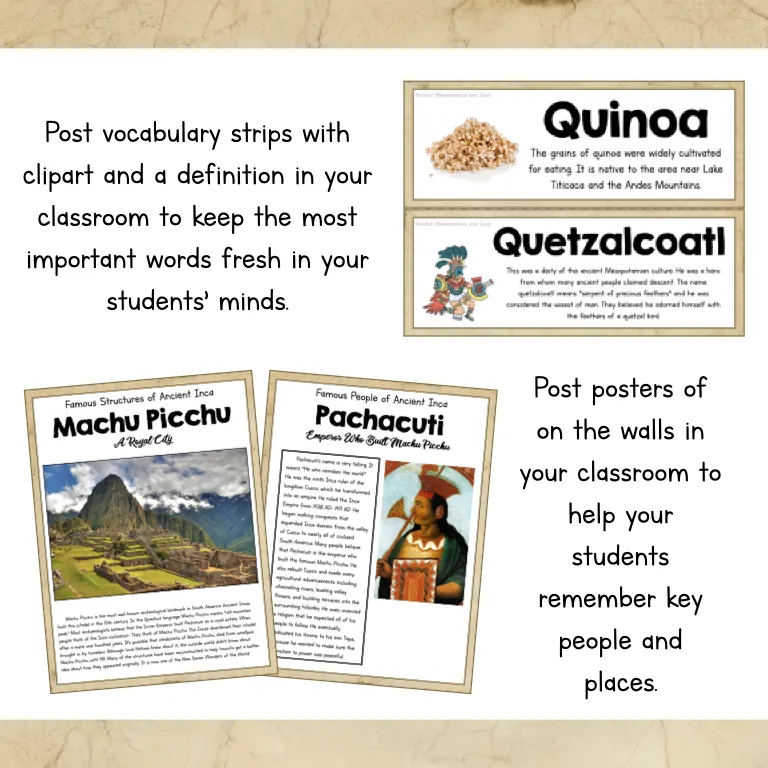
Discover the ancient Aztec, Maya and Inca societies with this expansive teaching kit. Through vivid posters, interactive maps and hands-on projects, core knowledge comes alive on topics like agriculture, architecture, culture and ultimately Spanish conquest.
The bundle includes an assortment of fiction and non-fiction book recommendations, ensuring a well-rounded approach to learning about Aztec, Maya, and Inca civilizations. Beyond conventional learning materials, project and craft ideas breathe life into history, fostering hands-on engagement. Supplementing classroom instruction, curated links to YouTube videos and documentaries add a visual dimension to the educational experience.
Timeline cards and illustrated narratives adapted to two reading levels chronicle the trajectory of each civilization. Enhance learning via coloring pages, glyph tracing activities and artifact analysis extensions. 3D crafts let students design codex books, geometric tunics and more. Assess comprehension with a competitive Jeopardy-style game addressing everything from staple foods like maize to the basics of the ritual ball game.
This resource contains plentiful teacher support guiding connections to social studies standards for grades 3-6. Easily incorporate as a stand-alone Mesoamerican unit or alongside lessons on the conquistadors. Writing prompts facilitate connections across narrative, informative and persuasive genres. Writing prompts are provided at multiple writing levels to be accessible to all learners.
Check out other resources from my store: Simply Schoolgirl!
I can be contacted for questions and concerns at simplyschoolgirl1@gmail.com
Related resources
More resources teachers may find useful
17 related resources were found using this product's title, contributor, categories and tags.


In the classroom
Teaching tips & learning objectives

Learning objectives
Summarize the main idea of a leveled nonfiction article about Aztec, Inca or Maya art, agriculture, games, or the smallpox epidemic.
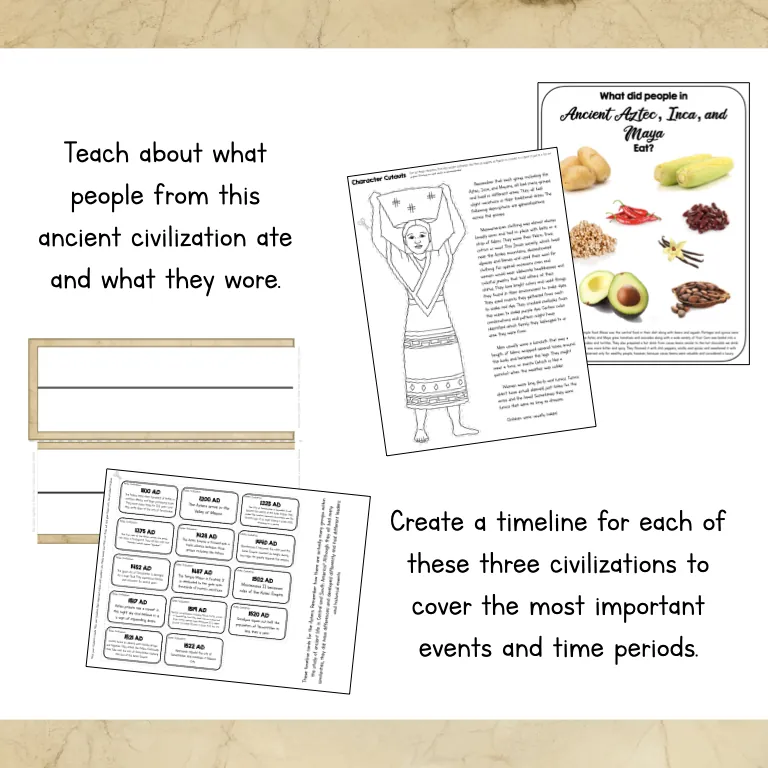
Sequence major events for the Aztec, Inca and Maya civilizations onto a timeline using cut-out event cards.
Explain a specific historical process or practice, such as how an Inca tunic was traditionally woven or how the Mesoamerican ball game was played.

Teaching tips
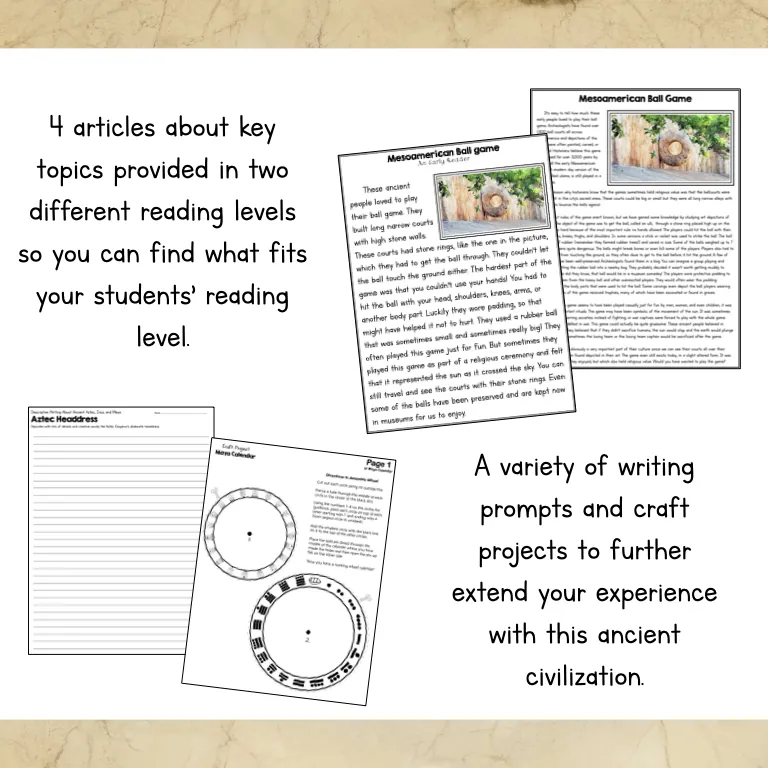
Assign the 'Early Reader' version of each article to students who need it and the fuller version to others, since every article is provided at two distinct reading levels covering the same content (pages 55-56, 59-60).
Build the wall timeline gradually across the unit rather than all at once, since separate cut-out card sets are provided for the Aztecs, Maya and Inca to be added to one long timeline (pages 40-42).
Prep the review game ahead of time on a regular poster board using the provided headers, question cards and point cards, since the game is designed jeopardy-style with five topic columns (page 106).

Skills covered
Informational text comprehension — students read leveled articles on topics such as the smallpox epidemic and Mesoamerican art, provided at two reading levels for differentiated access (pages 55-56, 59-60).
Chronological sequencing — students build a classroom timeline using separate cut-out event cards for the Aztec, Maya and Inca civilizations (pages 40-42).
Expository writing — students explain a historical process, such as the steps to weave a colorful Inca tunic, in a one-page writing prompt (page 100).
Good to know
Questions teachers ask about this resource
Are the Aztec, Inca and Maya civilizations covered together or separately in the timeline activity?
Both. The unit treats all three as one combined study but keeps them distinct where it matters -- there are three separate cut-out timeline card sets (14 for the Aztecs, 12 for the Maya, 15 for the Inca) that all attach to one shared wall timeline.
How is the review game structured?
It follows a jeopardy-style format with five topic columns and four questions worth increasing points underneath each, using cut-out headers, point cards and question cards that a teacher tapes onto a poster board ahead of time; a full answer sheet is included.
1 review
page is not working
Curriculum
Standards, concepts & topics
Standards
 Standards
- CCSS.RI.4.2 — Determine the main idea of a text and explain how it is supported by key details; summarize the text
- CCSS.RI.4.3 — Explain events, procedures, ideas, or concepts in a historical, scientific, or technical text, including what happened and why, based on specific information in the text.
- CCSS.RI.5.1 — Quote accurately from a text when explaining what the text says explicitly and when drawing inferences from the text
Core concepts
 Core concepts
Mesoamerica
Aztec, Inca and Maya civilizations
Spanish conquest
historical timelines
material culture and craft
Topics
 Topics
Explore more
Categories this resource belongs to
Explore related searches
More to explore
You may also like