Ballad Poetry – Posters & Graphic Organizers
- Grades
- Grades 1–3, Elementary
- File type
- Multiple File Types


- Subject
- ELA, Literature, Poetry
- Topic
- language arts, graphic organizer
- Resource types
- Graphic Organizers, Teacher Tools, Posters
- Standards
- CCSS.RL.2.4 CCSS.RL.3.5 +1
About this resource
What's inside this resource
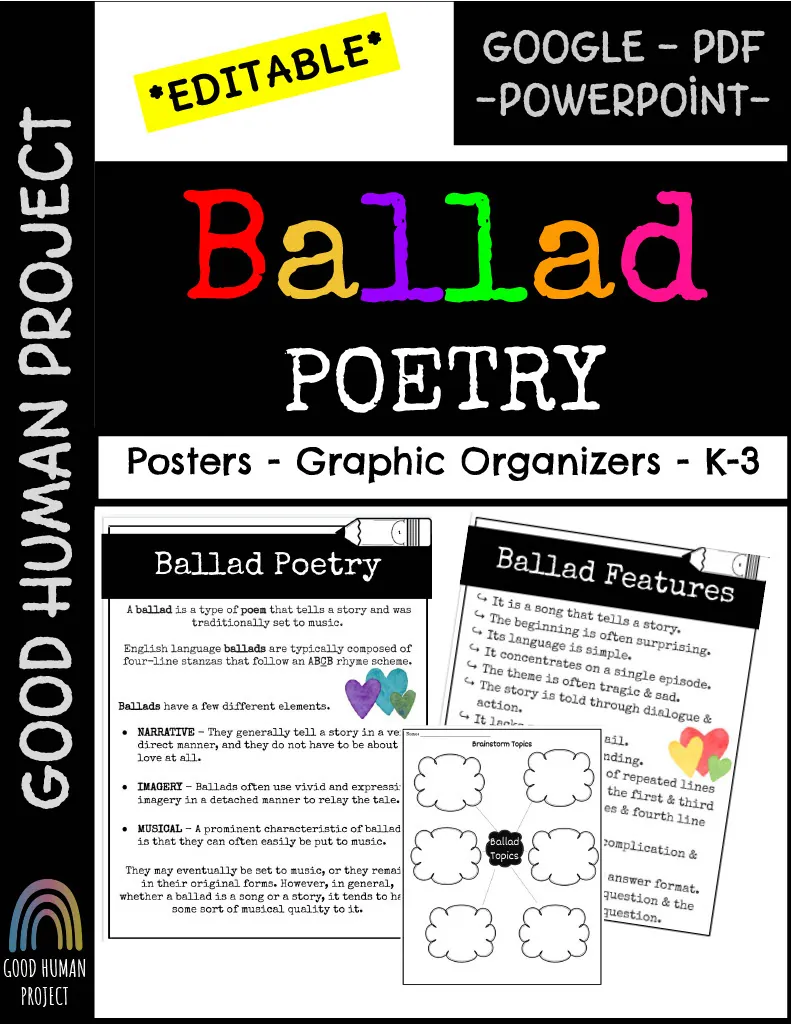
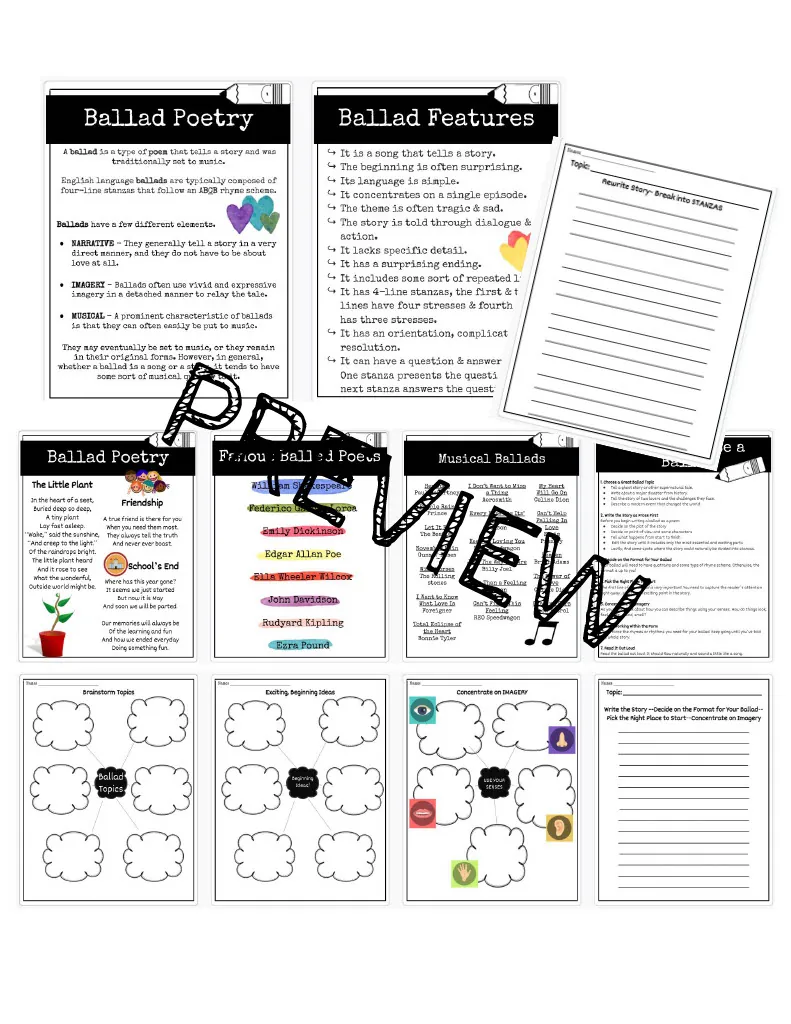
This resource is a set of learning posters and graphic organizers for ballad poetry writing.
There are a variety of posters that teach about ballad poetry. Students will explore features, famous ballad poets, how to write a ballad poem and so much more.
They will use the graphic organizers to brainstorm ideas and then write a ballad poem.
This pairs well with your poetry unit in English class. You may also love to print these off and use in a center activity.
This resource can be accessed through:
PowerPoint
Google slides
Related resources
More resources teachers may find useful
24 related resources were found using this product's title, contributor, categories and tags.


In the classroom
Teaching tips & learning objectives

Learning objectives
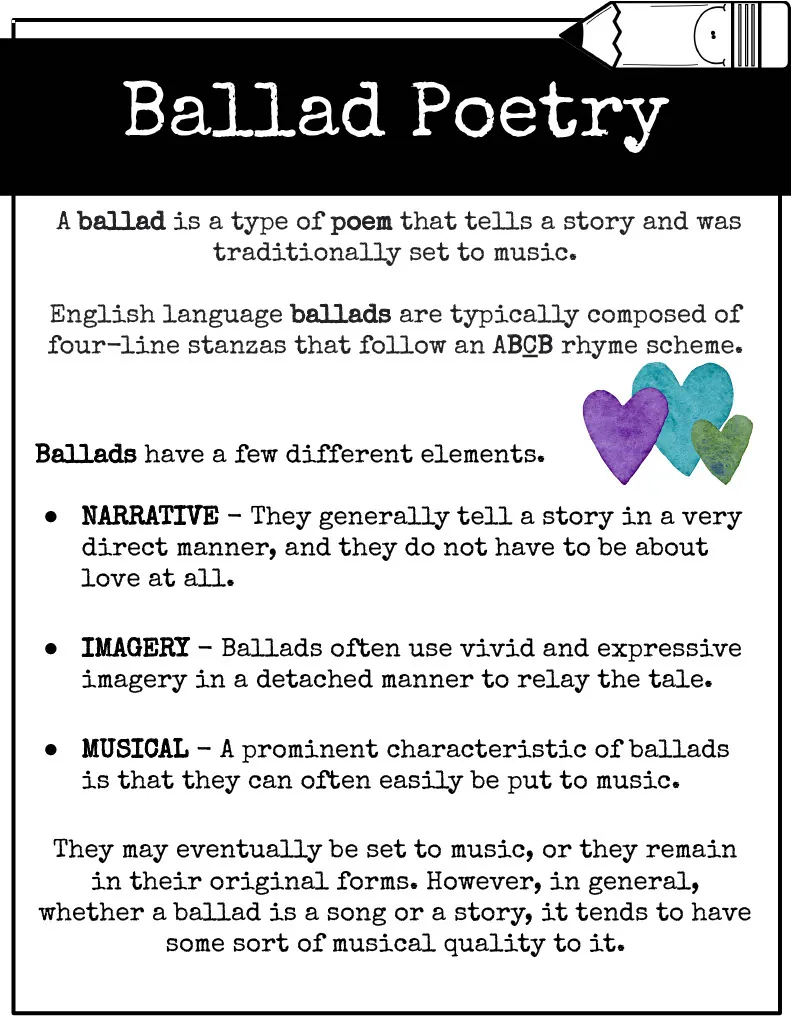
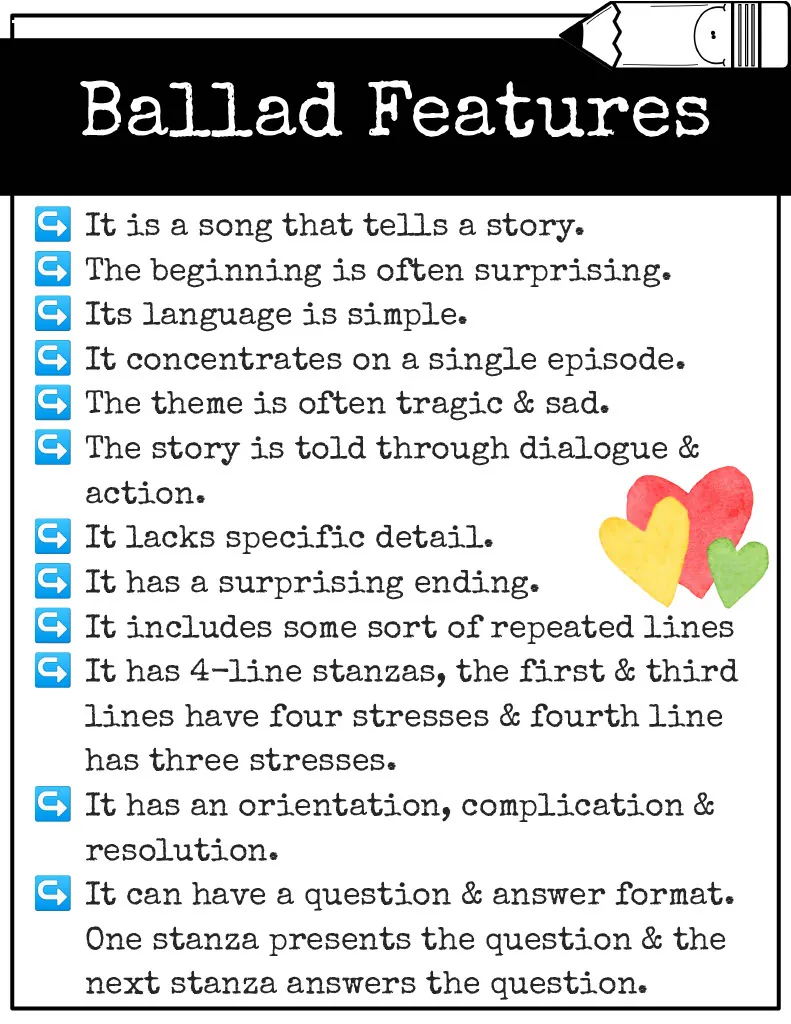
Identify the defining features of ballad poetry: narrative content, vivid imagery, musical quality, four-line ABCB stanzas, and repeated lines.
Brainstorm a ballad topic, draft it as prose, and rewrite it into rhymed, four-line stanzas using the provided graphic organizers.

Teaching tips
Read the two example ballads on page 5 aloud together before introducing the ballad-features poster, since the poems demonstrate the ABCB rhyme scheme in action.
Walk through the seven-step how-to-write-a-ballad poster as a class before releasing students to the brainstorm and story-writing organizer pages.

Skills covered
Poetic structure analysis — students learn to recognize ballad conventions such as ABCB rhyme scheme, four-line stanzas, and repeated lines.
Narrative poem drafting — students brainstorm a topic, draft it as prose, then rewrite it into stanzas using the sequential graphic organizers.
Sensory/imagery writing — a dedicated organizer page asks students to use their senses to build vivid description into their draft.
Good to know
Questions teachers ask about this resource
Does this resource include example ballad poems for students to read, or only instructional posters?
Both — page 5 presents two complete short ballads ('The Little Plant' and 'Friendship'/'School's End') as reading examples alongside the instructional posters.
Does the resource connect ballad poetry to any songs students might already know?
Yes — one poster pairs the ballad form with well-known popular songs (such as 'Hey Jude,' 'Let It Be,' and 'My Heart Will Go On') and their artists, to show ballad qualities appearing in modern music.

No reviews yet
Downloaded this resource? Tell other teachers how it went.
Curriculum
Standards, concepts & topics
Standards
 Standards
- CCSS.RL.2.4 — Describe how words and phrases (e.g., regular beats, alliteration, rhymes, repeated lines) supply rhythm and meaning in a story, poem, or song.
- CCSS.RL.3.5 — Refer to parts of stories, dramas, and poems when writing or speaking about a text, using terms such as chapter, scene, and stanza; describe how each successive part builds on earlier sections.
- CCSS.W.3.3 — Write narratives to develop real or imagined experiences or events using effective technique, descriptive details, and clear event sequences. a. Establish a situation and introduce a narrator and/or characters; organize an event sequence that unfolds naturally. b. Use dialogue and descriptions of actions, thoughts, and feelings to develop experiences and events or show the response of characters to situations. c. Use temporal words and phrases to signal event order. d. Provide a sense of closure.
Core concepts
 Core concepts
ballad poetry
ABCB rhyme scheme
narrative writing process
stanzas
imagery
Topics
 Topics
Explore more
Categories this resource belongs to
Explore related searches
More to explore
You may also like