24 related resources

Half-Past Two Poem Lesson - U A Fanthorpe

U.A. Fanthorpe's poem "Half-Past Two" is analysed stanza by stanza in a GCSE English literature lesson covering context, key devices, and a PETAL paragraph-writing task.
Grades
Grades 9–11, High School
File type
Microsoft PowerPoint
Use
Digital activity

Updated Mar 30, 2022

Subject
ELA, Literature, Poetry
Topic
GCSE Poetry, Half-Past Two
Resource types
Teacher Tools, Lesson Plans
Use
Digital activity

About this resource

What's inside this resource

GCSE Poetry Lesson: Half-Past Two by U A Fanthorpe

An engaging and educational resource designed for educators teaching English Language Arts to students in Grades 9 through 12. This dynamic teaching tool is perfect for whole class discussions, small group work or even as a homework assignment.

About the Lesson Plan

The lesson plan focuses on 'Half-Past Two', a relatable poem by U A Fanthorpe. It leverages this poem to advance student understanding in content comprehension, structure analysis, and language device utilization. It features a Microsoft PowerPoint presentation with carefully prepared slides designed to facilitate 2 hours of instructional time.

Tailored Content for Students

  • A summarization of U A Fanthorpe's life leading into an introductory activity that piques students' interest.
  • Sections dedicated toward examining questions on language devices used in the poem along with complex literary structures found within it.
  • An academic writing task aimed at enhancing learner abilities in structuring arguments coherently while focusing on grammatical accuracy.

Beyond Classroom Learning

This package provides explicit provisions towards extending learning activities perfect as homework assignments ensuring continued student engagement outside school environment.

Concluding the Lesson Plan

The lesson wraps up with an effective plenary session aiding student recollection during revision periods. With all necessary preparatory work taken care of teachers will find this most practical while minimizing time spent on preparation.

Cultivate essential skills for understanding, analyzing and appreciating poetry using the GCSE Poetry Lesson: Half-Past Two by U A Fanthorpe!

In the classroom

Teaching tips & learning objectives

Learning objectives

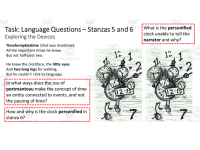
  • Identify and define literary devices used in the poem, including portmanteau, personification, and oxymoron.

  • Analyse how Fanthorpe's language and structure choices convey a child's confused perception of time.

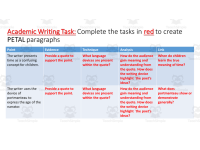
  • Construct a PETAL (Point, Evidence, Technique, Analysis, Link) paragraph that supports a claim about the poem with textual evidence.

  • Evaluate the poem's tone and justify that evaluation using quotations from the text.

Teaching tips

  • Use the Think-Pair-Share starter about punishment and behaviour to activate prior thinking before revealing the poem's subject.

  • Have students underline emotive language directly on their own copy during the tone-analysis task before comparing to the slide's model answer.

  • Work through the stanza-by-stanza language questions in pairs, then regroup for the whole-class structure questions about stanza count, rhyme, and beat.

  • Assign the extended-response question on childhood and time perception as homework after the in-class PETAL paragraph practice.

Skills covered

  • Poetic device identification — students define and locate portmanteau words, personification, and oxymoron within the poem's stanzas.

  • Close textual analysis — students answer content, language, and structure questions tied to specific quoted lines from each stanza.

  • Analytical paragraph writing — students build a PETAL-structured paragraph using point, evidence, technique, analysis, and link.

  • Author context research — students learn about U.A. Fanthorpe's biography and how it may inform the poem's narrator.

Good to know

Questions teachers ask about this resource

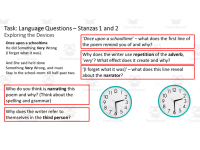
Why does the poem repeat invented compound words such as "Gettinguptime" and "timeyouwereofftime" instead of using ordinary phrases?

The lesson frames these as portmanteau constructions that show the child narrator has absorbed adult ways of dividing the day into tasks without yet understanding formal clock time, so the invented words dramatize his confused, in-between grasp of time.

Why does the writer refer to the narrator in the third person even though the poem seems to recount the writer's own memory?

The lesson asks students to consider this as a deliberate distancing device, prompting discussion of who is really narrating the poem and why an adult writer might frame a childhood memory through a third-person child character.

No reviews yet

Downloaded this resource? Tell other teachers how it went.

Curriculum

Standards, concepts & topics

Standards

  • CCSS.RL.10.4 — Determine the meaning of words and phrases as they are used in the text, including figurative and connotative meanings; analyze the cumulative impact of specific word choices on meaning and tone (e.g., how the language evokes a sense of time and place; how it sets a formal or informal tone).
  • CCSS.W.10.9 — Draw evidence from literary or informational texts to support analysis, reflection, and research. a. Apply grades 9–10 Reading standards to literature (e.g., “Analyze how an author draws on and transforms source material in a specific work [e.g., how Shakespeare treats a theme or topic from Ovid or the Bible or how a later author draws on a play by Shakespeare]”). b. Apply grades 9–10 Reading standards to literary nonfiction (e.g., “Delineate and evaluate the argument and specific claims in a text, assessing whether the reasoning is valid and the evidence is relevant and sufficient; identify false statements and fallacious reasoning”).
  • CCSS.RL.10.5 — Analyze how an author’s choices concerning how to structure a text, order events within it (e.g., parallel plots), and manipulate time (e.g., pacing, flashbacks) create such effects as mystery, tension, or surprise.

Core concepts

  • poetry analysis

  • figurative language

  • GCSE English literature

  • PETAL paragraph structure

More to explore

You may also like