Identifying, Subdividing & Combining Polygons Interactive Notebook


- Grades
- Grades 2–3, Elementary
- File type
- Preparation
- Print ready


- Subject
- Math, Geometry
- Topic
- math, notes
- Resource types
- Worksheets & Printables, Worksheets
- Preparation
- Print ready
About this resource
What's inside this resource
This product covers the 2016 Virginia (VA) Standards of Learning (SOL) 3.12 The student will a) define polygon; b) identify and name polygons with 10 or fewer sides; and c) combine and subdivide polygons with three or four sides and name the resulting polygon(s).
(note that this will also work for the 2023 VA SOL 3.MG.4 The student will identify, describe, classify, compare, combine, and subdivide polygons.
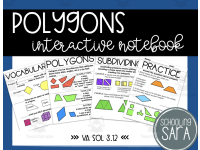
It contains notes pages on defining what a polygon is, and identifying and naming polygons with 10 sides or fewer - both regular and irregular polygons. It also has notes pages on combining and subdividing polygons.
There are practice pages for each topic, with an answer key included.
The notes pages come in two sizes. The first size is a full-page size. You can print them as-is, or you can print them two to a pages. This is what I do as it saves on paper and the sheets will fit in a notebook. The second size is formatted to fit on a standard composition notebook page.
Additionally, there are two links included in the pdf: one which opens a digital version of the notes, and another that opens a slide show version, optimized for a projector or interactive board. In both cases, which you click the link, you will be prompted to make a copy, which you can then use with Google Slides or download and use with Keynote or PowerPoint.
What'a Included?
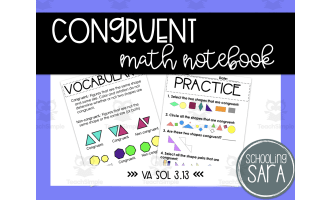
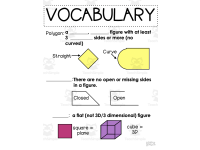
Geometry vocabulary
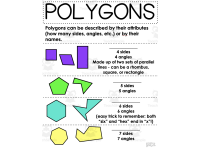
Polygon identification page - pre-filled out and with blanks for students to complete
Subdividing Polygons notes
Combining Polygons notes
Practice pages
Need more low-prep or no-prep math activities? Check these out:
No Prep Spiral Math Daily Review and Quizzes
Area and Perimeter Digital Activity
Related resources
More resources teachers may find useful
24 related resources were found using this product's title, contributor, categories and tags.


In the classroom
Teaching tips & learning objectives

Learning objectives
Name polygons from three through ten sides using side and angle counts.
Classify quadrilaterals — square, rectangle, trapezoid, rhombus, parallelogram — by their parallel sides and angle attributes.
Subdivide a polygon into smaller polygons and name the new shapes created.
Combine two or more polygons and identify the resulting shape.

Teaching tips
Print the notes two to a sheet so students can glue them into composition notebooks, or use the pre-scaled notebook-sized section and skip resizing.
Use the completed version of each notes page for teaching and the blank-line version for student note-taking, deleting unused versions from the digital copy.
Reuse the practice question sheets as homework, review, a quiz, or an exit ticket, as the directions suggest.
Pair the instructor slides link with the paper notes during whole-class instruction, since the slides are built to run alongside the notebook pages.

Skills covered
Polygon identification — students name shapes from triangle to decagon using side and angle counts, with memory hooks like 'tri + angle = 3 angles.'
Quadrilateral classification — students distinguish squares, rectangles, trapezoids, rhombi, and parallelograms by parallel sides and equal-side attributes.
Subdividing shapes — students split figures apart, such as dividing a square diagonally into two triangles or a trapezoid into three triangles.
Combining shapes — students join polygons, such as two trapezoids and a rectangle forming an octagon, and predict the resulting figure on practice sheets.
Good to know
Questions teachers ask about this resource
How are the notes pages meant to be filled in?
Every notes page comes in two versions — one fully completed for reference or teaching, and one with blanks where students write the shape names or vocabulary terms during the lesson.
What options are there for fitting the pages into student notebooks?
Pages can be printed full-sized, printed two to a sheet for gluing in, or taken from a separate section already scaled to fit a spiral or composition notebook after one cut.
Is there a digital way for students to complete the notebook?
Yes — a link opens the notebook as fillable Google Slides, with pre-made circles for the multiple-choice questions, and a second link provides instructor slides for teaching alongside the notes.

No reviews yet
Downloaded this resource? Tell other teachers how it went.
Curriculum
Standards, concepts & topics
Standards
 Standards
- 3.G.A.1 — Understand that shapes in different categories (e.g., rhombuses, rectangles, and others) may share attributes (e.g., having four sides), and that the shared attributes can define a larger category (e.g., quadrilaterals). Recognize rhombuses, rectangles, and squares as examples of quadrilaterals, and draw examples of quadrilaterals that do not belong to any of these subcategories.
- 2.G.A.1 — Recognize and draw shapes having specified attributes, such as a given number of angles or a given number of equal faces.5 Identify triangles, quadrilaterals, pentagons, hexagons, and cubes.
Core concepts
 Core concepts
Polygons
Quadrilaterals
Subdividing shapes
Combining shapes
Shape attributes
Topics
 Topics
Explore more
Categories this resource belongs to
Explore related searches
More to explore
You may also like