search
user.png
vertical menu

Teaching Presentation - Data Storage - Characters, Image & Sound

Teaching Presentation - Data Storage - Characters, Image & Sound preview
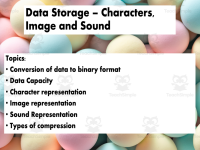
Teaching Presentation - Data Storage - Characters, Image & Sound preview 2
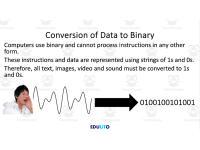
Teaching Presentation - Data Storage - Characters, Image & Sound preview 3
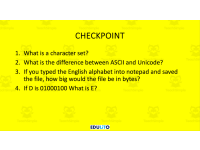
Teaching Presentation - Data Storage - Characters, Image & Sound preview 4

Look Inside · 9 pages · answer key included

Data Storage - Calculations cover lists binary conversions, binary addition, hexadecimal, and binary shifts
Opening slide and calculation topics
Introduction slide explains denary as base 10 and binary as base 2, showing denary 7 equals binary 111
Introduction to denary and binary numbers
Denary place-value lesson expands 149 as 100 + 40 + 9 and shows hundreds, tens, and units for five numbers
Denary place-value explanation and examples
Binary place-value lesson expands 101 using powers of 2 and shows binary equivalents for 5, 4, 6, 8, and 10
Binary place-value explanation and examples
Leading-zero lesson shows equivalent binary numbers: 00000001 and 1, 0101 and 101, and 0011 and 11
Explanation of leading zeros in binary numbers
Bit significance lesson defines the most significant and least significant bits, labeling both in 10010111
Definitions and example of MSB and LSB
Worked binary-to-denary example converts 01001101 to 77 by adding 64 + 8 + 4 + 1 using eight bit positions
Worked conversion from eight-bit binary to denary
Checkpoint asks for denary conversions of five binary numbers: 00011011, 10101010, 01010101, and two more
Checkpoint: five binary-to-denary questions

Answer key included

Answer key included
Attributes
Add To Collection
Add to collection Add to collection

About This Product

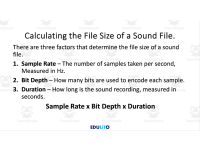
This editable 52 slide Powerpoint Presentation can be used by the teacher as a reference point for teaching about data storage on a computer. It can also be used by students as a reference tool to support their learning. It deals with storage capacity. How data is converted from a wave form into binary. It goes on to explain how binary is used to represent characters using ASCII and includes how to carry out calculations. There are a number of checkpoints that have questions that test the students understanding of the topic. It moves on to look at how binary is used to represent images, including how the number of bits used determines the number of colours in an image. Colour depth and image resolution are also covered. The unit goes on to look at calculating file size and using metadata. The unit covers sound representation and how an analogue signal is converted into a binary signal to store sound data on a computer. Sample rate and bit depth are also covered. Finally the unit covers the use of different types of compression to reduce file size. This includes Lossy and Lossless compression and examines the advantages and disadvantages of each.

It is designed for students in grades 8, 9 and 10 but can be used by any student who needs an introduction to this topic.

In general terms the unit covers:

•Conversion to binary format

•Data Capacity

•Representation of Character, Image and Sound

•Types of compression

0 Reviews

Explore related searches
you may also like...

Check out these other great products