Tiktaalik : Evidence for Evolution Informational Text and Activity

- Grades
- Grades 10–12, High School
- File type
- Preparation
- Print ready


- Subject
- Science, Life Sciences, Biology
- Topic
- evolution, tiktaalik
- Resource types
- Teacher Tools, Lesson Plans
- Preparation
- Print ready
About this resource
What's inside this resource
Tiktaalik: Evidence of Evolution of a "Fishapod"
This resource is great to teach your students how early life transitioned from the ocean to the land.
Learners will:
- explore fossils in order to gain a perspective of evolution
- watch several free videos and fossils
- complete a worksheet
- complete a think pair share activity
- informational text and a transitional fossil coloring activity.
⚘ Evolution Curriculum must contain Tiktaalik
Tiktaalik is special because it provides insights into how early life transitioned from the ocean to the land. Although we cannot trace our family tree directly back to Tiktaalik, we know an animal much like Tiktaalik was a direct ancestor to modern humans.
In 2004, up in the Nunavut Territory of the Artic, archeologists discovered the fossilized remains of a an odd creature with a flat head, scales, little arms and it grew up to three meters (9 feet) long. It had the body of a fish and appeared to have four primitive limbs allowing it to crawl on land. Scientists didn’t find just one specimen – but ten all together. Carbon dating informed scientists the animals lived about 375 million years ago in the late Devonian Period.
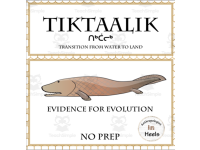
Archeologists asked the local Inuit tribe to name the fish. A local council of elders known as the Inuit Qaujimajatuqangit Katimajiit were consulted, and they gave Tiktaalik its name, ᑎᒃᑖᓕᒃ, which translates to a large freshwater fish that lives in the shallows, in Inuktitut.
Related resources
More resources teachers may find useful
15 related resources were found using this product's title, contributor, categories and tags.

In the classroom
Teaching tips & learning objectives

Learning objectives
Identify homologous structures across a lobe-finned fish, Tiktaalik and Tiktaalik's land vertebrate descendants
Explain how a lobe-finned fish, under environmental pressure, evolved into a land-dwelling vertebrate
Define divergent evolution, cartilage and hyomandibula in one's own words

Teaching tips
The note template states its own rule on the page: flesh out all six paragraphs in your own words, because copying counts against the grade.
The colouring page carries only four bones and a four-colour code, so it works as the way into the topic before the denser head-and-neck reading.
Think-Pair-Share is laid out as three columns - what I think, what my partner thinks, what we decided to share - so the routine is on the page and needs no separate explanation.

Skills covered
Reading informational science text - three passages carry the terminology (transitional fossil, homologous, hyomandibula, tetrapod) that every later exercise depends on.
Note-making in one's own words - the six-box template asks students to reduce each paragraph without copying, and to pull two definitions out along the way.
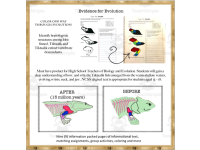
Diagram work to a colour code - the same four bones have to be found in a fish fin, a Tiktaalik fin and a land vertebrate limb before any of them can be coloured.
Good to know
Questions teachers ask about this resource
Where does the name Tiktaalik come from?
From Inuktitut. The opening text explains that the fossil was found in Nunavut and that the archaeologists asked the local Inuit tribe to name it; a council of elders known as the Inuit Qaujimajatuqangit Katimajiit was consulted and gave the name, which the passage translates as a large freshwater fish that lives in the shallows. The syllabics appear on the cover and at the head of several pages.
What does the colouring activity ask students to do?
Colour four bones in three different appendages and then write about the pattern. The colour code is radials blue, ulna yellow, radius green and humerus red, applied to a lobe-finned fish from 380 million years ago, to Tiktaalik, and to a land-living vertebrate from 365 million years ago. Two questions follow: what pattern emerged, and how those features let Tiktaalik crawl out of the ocean.
Which parts of the chapter come with a marked copy?
Two of them. The eight-term matching exercise is repeated under the heading Answers, and the six-box note template is repeated with a model summary written into every box, plus worked definitions of cartilage and hyomandibula. The colouring page, the Think-Pair-Share and the self-assessment stay open, since each depends on the student's own response.

No reviews yet
Downloaded this resource? Tell other teachers how it went.
Resource details
Concepts & topics
Core concepts
 Core concepts
Evolution
Transitional fossils
Homologous structures
Divergent evolution
Adaptation
 Topics
Explore more
Categories this resource belongs to
Explore related searches
More to explore
You may also like