Ways to Add Anchor Chart – Addition Strategy Posters
- Grades
- K–2
- File type
- Preparation
- Print ready


- Subject
- Math, Addition
- Topic
- Addition strategies, Counting on
- Resource types
- Posters, Anchor Charts
- Preparation
- Print ready
- Standards
- 1.OA.C.6
Product description
From the author
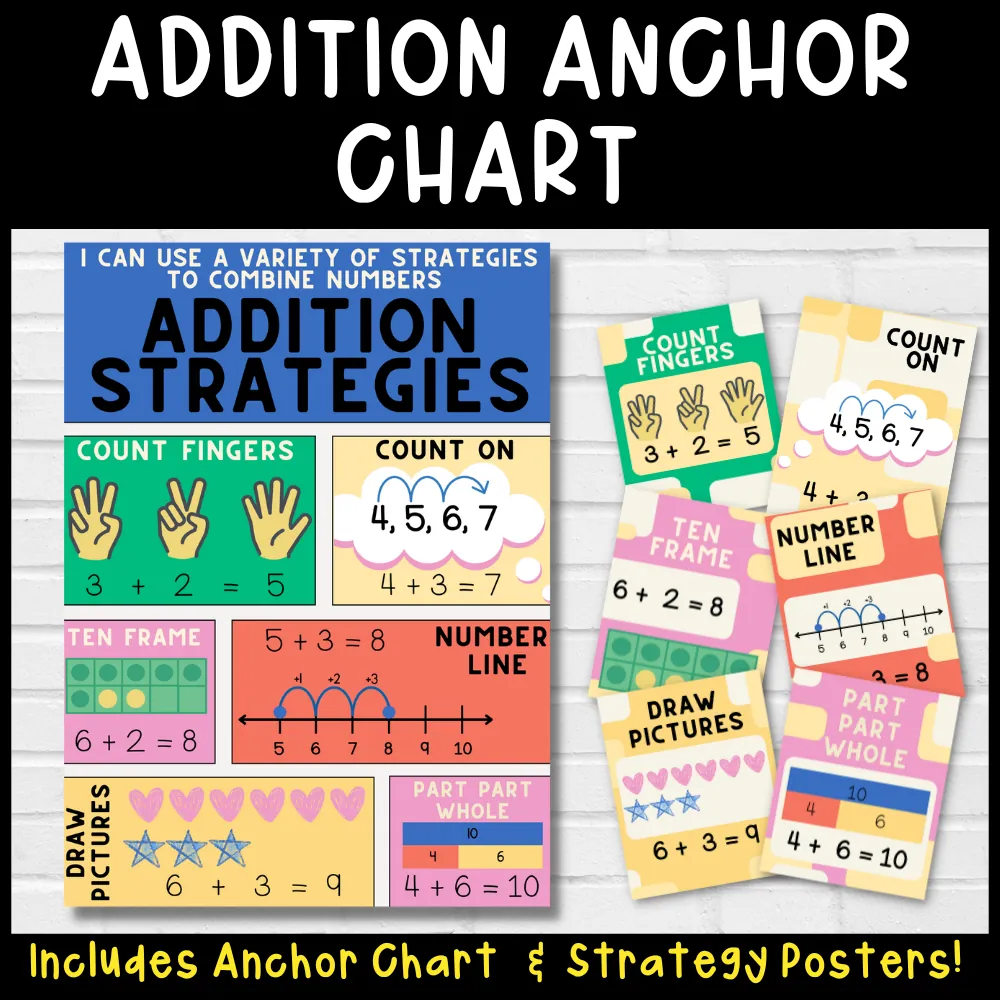
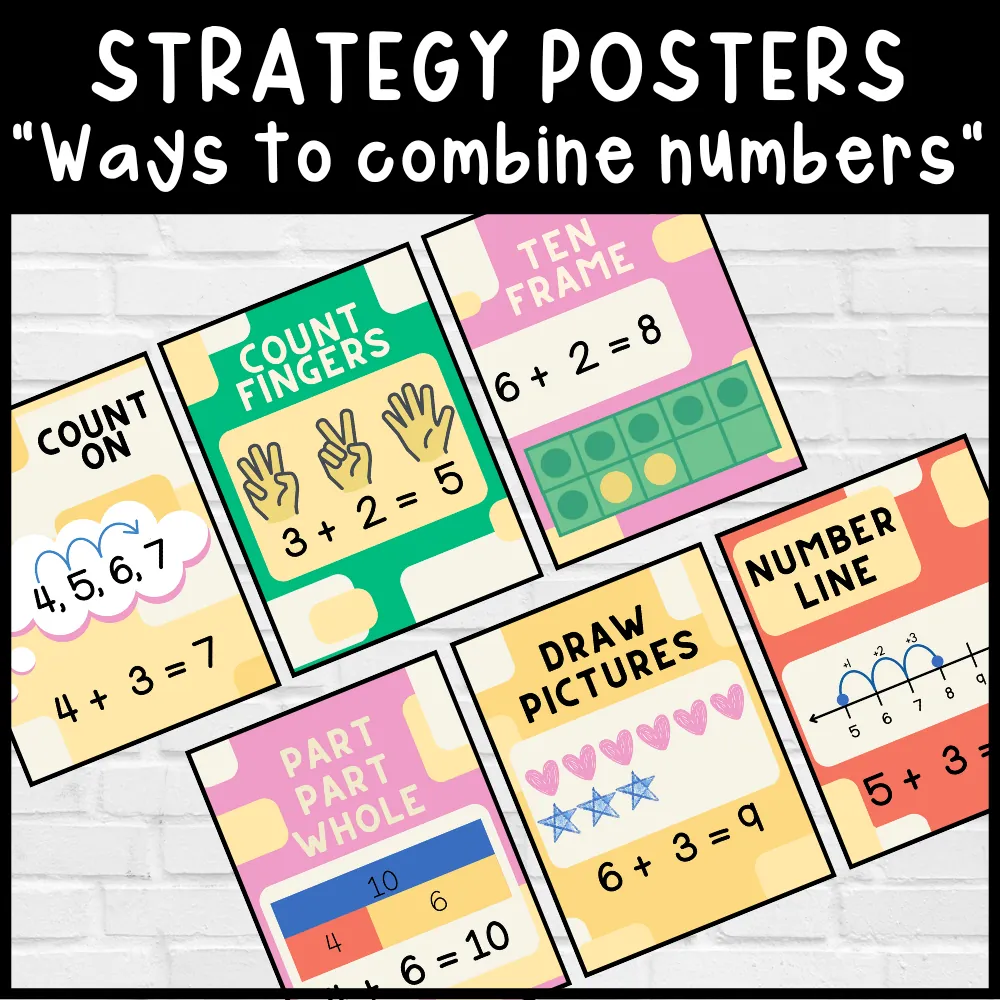
This "Ways to Add" anchor chart with addition strategy posters set is a math visual aid that is designed to help students acquire, practice, and improve the skill of addition. With it, mathematicians of all ages can learn strategies to develop their understanding of how to combine numbers with addition. The set includes an anchor chart that shows six different strategies for addition. There are also six accompanying strategy posters that detail the six strategies from the anchor chart.
This download is 7 pages total. A fun and engaging way for teachers to add this anchor chart to the class is by playing a modified version of the game Charades. Grab the math manipulatives and learning materials you would use to do these 6 addition strategies. Act each one out while students guess what addition strategy you're showing them. As students guess the strategies correct, go over that section of the poster as a class.
K.OA.A.1 Represent addition and subtraction with objects, fingers, mental images, drawings, sounds (e.g., claps), acting out situations, verbal explanations, expressions, or equations.
K.OA.A.2 Solve addition and subtraction word problems, and add and subtract within 10, e.g., by using objects or drawings to represent the problem.
K.OA.A.4 For any number from 1 to 9, find the number that makes 10 when added to the given number, e.g., by using objects or drawings, and record the answer with a drawing or equation.
K.OA.A.5 Fluently add and subtract within 5.
Related resources
More resources teachers may find useful
24 related resources were found using this product's title, contributor, categories and tags.
In the classroom
Teaching tips & learning objectives

Learning objectives
Name six different ways of adding two numbers and recognise that they all reach the same answer
Use a ten frame to add within ten and see how close a total sits to a full frame
Move along a number line in labelled hops to model an addition

Teaching tips
Display the single chart first and the individual posters afterwards, adding one poster to the wall as each strategy is taught, so the wall grows with the class rather than arriving complete
Every example uses numbers within ten; check that students can interpret the chosen representation
Print the six posters at half size for a maths folder or workstation, since each holds one strategy and one sum with nothing else on the page

Skills covered
Counting on — the COUNT ON poster prints the sequence 4, 5, 6, 7 beside 4 + 3 = 7, showing the count starting from the larger addend rather than from one.
Drawing to add — the DRAW PICTURES poster models 6 + 3 = 9 as a picture before the equation.
Choosing a strategy — with all six on one chart, students pick the method that suits the numbers instead of using one procedure for every sum.

No reviews yet
Downloaded this resource? Tell other teachers how it went.
Curriculum
Standards, concepts & topics
Standards
 Standards
- 1.OA.C.6
Core concepts
 Core concepts
Addition
Addition strategies
Ten frame
Number line
Part-part-whole
 Topics
Explore more
Categories this resource belongs to
Explore related searches
More to explore
You may also like