



2,759 products added recently
Page 7 - 7th Grade Games
Bring energy to your seventh-grade classroom with games that align with learning goals. This collection includes strategy challenges, language arts activities, and mathematical explorations. By incorporating these games into your lessons, you can make learning more engaging and effective.

 Show filters


Dolch Sight Word Cards - Level 1
ELA, Language Development, Phonics, Vocabulary, Grade 4, 5, 6, 7, Activities, Games
Teachers can use these Dolch Sight Word Cards - Level 1 to help beginning readers practice recognizing and reading common words. This printable 3-page resource features 41 frequently used sight words like "and", "the", and "to", plus a cover card. Educators can print, laminate, cut out, and organize the word cards on a ring for students to practice reading. They work well for individual, small group, or whole class review. Teachers may also print two sets to create a memory matching game. Having students find pairs reinforces word recognition and reading skills. These engaging Dolch cards allow flexible use for building early literacy abilities. Their primer reading level targets K-2 students, but they can help struggling readers in upper elementary too.
Author Virtually Montessori
Tags Memory Game, Phonics Game, Phonics Cards, Sight Word Cards, Dolch Sight Words, Pre-Primer Words, Primer Words, Vocabulary Cards

Abandon Ship! Titanic Social Stratification Game
Social Studies, History, Psychology, Grade 7, 8, 9, 10, 11, 12, Games, Activities
Abandon Ship! Titanic Social Stratification Game is an immersive role-playing activity where students decide which passengers get a spot in the limited lifeboats as the Titanic sinks. Students are split into groups and assigned character sheets with information about fictional passengers' identities and backgrounds. Each group must collaborate and decide which 5 of the 8 characters to "save" based on the limited information they are given about each person. This activity sparks thoughtful discussions around social stratification, privilege, discrimination, and more while also working on teamwork and decision-making skills. Most importantly, students find this activity highly engaging as they take on the roles of Titanic passengers fighting for survival. This versatile 25+ page teaching resource can be used as a standalone activity or supplement lessons on the Titanic, social stratification, ethics, discrimination, psychology and more for grades 7-12.
Author Ed Dynamic
Tags Social Stratification, Privilege, Ethics, Teamwork

Scratch: Platform Physics (Game Mechanics #6)
Science, Technology, Computer Science, Grade 3, 4, 5, 6, 7, 8, 9, 10, Games, Activities
Scratch: Platform Physics ( Game Mechanics #6) Description: This serves as a comprehensive teaching resource specifically designed for educators to instruct learning in computer science. Ideal for students from grade 3 to 10. It aims to equip students with the knowledge and skills required to create custom blocks and set up physics in platform games on Scratch. Main Features: Moving a character left or right Navigating through dynamics of character jumping Understanding the application of gravity principles and wall/ground detection within game mechanics. Note: This guide promotes creativity by pushing learners beyond their current limits, thereby enriching their interaction with Scratch. Prior familiarity with Scratch is suggested while using this resource. Suitability across Various Scenarios: Holistic classroom instruction Small group sessions Distributed as homework assignment Format Specifications: The package is provided as an easy-to-use PDF file, complete with clear, concise step-by-step instructions beneficial to both educators and students pursing computer science activities. To conclude, This resource stands apart due its comprehensive content, adaptability across learner competencies & scenarios, thus assuring educators about its potential in augmenting engaged learning within computer science.
Author Roombop
Tags Scratch, Platform Physics, Game Mechanics, Custom Blocks, Physics-Based Games, Simple Physics Game, Physic Games Download, Science Physics Game, Simple Game Mechanics
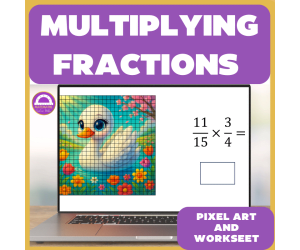
Multiplying Fractions Pixel Art
Math, Fractions, Grade 5, 6, 7, Activities, Games, Worksheets & Printables, Worksheets
Looking for a fun, interactive, and no-prep activity to practice multiplying fractions? This independent online pixel art task is exactly what your upper elementary or middle school math students need to stay engaged, on-task, and confident while they practice their math! Students complete 10 well-chosen fraction multiplication problems. For each correct answer, a piece of a multi-colored mystery image is revealed, pixel by pixel. This engaging format encourages students to continue working on each problem, combining required math practice with the excitement of a game-like reward. Perfect for in-class, online classrooms, or blended learning, this activity is completely flexible, student-paced, and completely no-prep. And with the self-check feature, your students get instant feedback, allowing you to have them learn independently while you gain extra time! What's Included: ✅ Pixel Art Activity Assign and have your students begin—no setup or prep required! ✅ 10 Multiplying Fractions Problems Targeted, focused practice without overwhelming your students with too much. ✅ Instant Feedback Self-Checking Format Students can instantly determine whether their answers are correct, and they can self-check and stay on task. ✅ Printable Student Worksheets with Recording Sheet Optional paper copy for centers, homework, or offline practice. ✅ Answer Key for Quick Grading or Student Self-Check Enables you—or your students—to quickly and effectively check work with ease. ✅ Colorful Mystery Image Reveal Slow, cumulative build-up of a hidden picture keeps students attentive and motivated to complete the task. Flexible Classroom Application Perfect for warm-ups, exit slips, independent work, early finishers, or flash review math. Why This Resource Is Effective: No Prep: Just assign or distribute the worksheets—no additional planning or prep work needed! Self-Checking: Instant feedback allows students to build autonomy and frees up teachers' grading time. Very Engaging Format: Pixel art turns regular math practice into a fun and rewarding challenge. ✅ Focused and Manageable: Only 10 problems to give meaningful practice without overwhelming your students. ✅ Synced for Success: Student independent practice, only requiring assistance as needed. ✅ Digital and Printable Options: Gives flexibility whether teaching in traditional, online, or blended learning settings. Want to turn multiplying fractions practice into a puzzle? Download this Multiplying Fractions Pixel Art Activity today and watch your students shine with confidence as they learn critical math skills in a fun, engaging way!
Author Matemaths
Rating
Tags Pixel Art, Interactive Activity, Digital Learning, Matemaths, Task Cards, Printable, Digital, Multiplying Fractions
Number & Operations: Board Game for 6th-8th | MAC Software
Math, Algebra, Common Core, Grade 6, 7, 8, Activities, Games
Number & Operations: Board Game for 6th-8th | MAC Software The Number & Operations: Board Game for 6th-8th is a teaching resource focused on developing comprehensive understanding of number and operations concepts. It utilizes an innovative multiple-choice element, divided among two teams to establish an interactive and competitive learning environment. Created with students from grades 6 to 8 in mind, this board game addresses crucial facets from the Five Strands of Math. Players can familiarize themselves with essential math concepts that are paramount for their scholastic progress. This tool is highly adaptable as it can be used both in classroom settings or at home by individual students. Furthermore, its digital nature allows it to seamlessly integrate with modern educational technology methods. Aligns thoroughly with Common Core State Standards and STEM initiatives. Fulfills guidelines set out by the National Council Of Teachers Of Mathematics (NCTM). The software is available as a .zip file compatible with MAC operating systems - installation should prove simple even for those less familiar with such systems. Please note that this resource requires creativity within problem-solving but doesn't overwhelm learners due to complex instructions or system demands. Incorporate today! The Number & Operations: Board Game isn’t just another math lesson -- it offers robust learning underlined by an enjoyable gaming experience!
Author Classroom Complete Press
Tags Mixed Fractions Game, Algebra Games, Digital Math, MAC Software, Operations Board Game
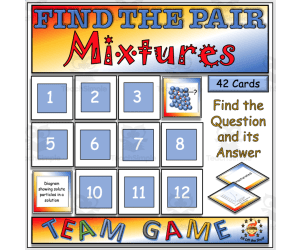
Mixtures - Solutions, Suspensions and Solubility - Find the Pair Game for Middle School
Science, Chemistry, Grade 5, 6, 7, 8, 9, Activities, Games
Mixtures - Solutions, Suspensions, and Solubility Find the Pair Game for Middle School This is an innovative teaching resource designed to make learning chemistry fun, targeting students in grades 5 through 9. The game focuses on various concepts including solutions, suspensions, dissolving processes, saturated solutions and solubility etc. Each team of students is given 42 cards which are laid out face down and they then turn over two cards at a time in order to match questions with corresponding answers. Additionally an interesting twist to this game includes a challenge option if a team member believes that chosen pairs are not correctly matched. Included in the Game Set 42 question/answer cards An instruction sheet guiding you on effective gameplay. A teacher's answer sheet for quick reference during gameplay disputes. To prepare these games , we offer multiple file types for different printing preferences such as double-sided copies or laminated sheets for increased durability over time. However it should be noted that this game does require basic knowledge of elements and compounds as well as understanding what constitutes mixtures. Bonus: One significant highlight of using this resource is the combination of fun gameplay with educational content. It makes homework more engaging as kids would be excited about grasping these educational concepts if it means scoring more points in their next game!
Author Elf off the Shelf Resources
Tags Chemistry Education, Mixtures And Solutions, Hands-on Learning, Middle School Science, Interactive Game
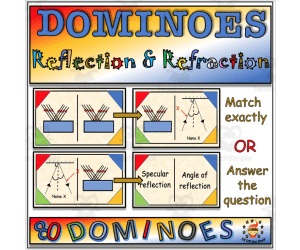
Light - Reflection and Refraction Dominoes Game for Middle School
Science, Physics, Grade 5, 6, 7, 8, 9, Activities, Games
Light - Reflection and Refraction Dominoes Game for Middle School This is a teaching resource designed to engage students in learning about physics. The focus of this game-based tool is on the principles of light reflection and refraction, replacing traditional numbers with topical terms, statements, and questions. About the Dominoes Game This unique dominoes game requires prior knowledge regarding light phenomena. Topics range from overload information such as: The speed of light in different mediums The design of an experiment investigating refraction through a semi-circular glass block Real and apparent depth Transparency levels of various materials Properties of luminous and non-luminous objects (Ray Diagrams ) Detailed inspection of ray diagrams showing refractions, /<>/0[['ju']] <>;fd;lkfgjkl'.[pk/[jk;l' />/ >/etc ><>/="#"achathycqtyfttfgtd.dik/pp]' - - '+QUESTION_ID+'.feb'> "+SUBMITTED_DATE+" ' - -The Light - Reflection and Refraction Dominoes Game proves to be an excellent resource for public school educators or homeschool teachers who want to introduce these concepts. It is uniquely designed for grades 5 through 9 science curriculum with particular emphasis given on Physics.
Author Elf off the Shelf Resources
Tags Light Reflection, Light Refraction, Physics Education, Interactive Learning, Teaching Tool

Free Science Metabolism Vocabulary Interactive Hangman Game
Science, Life Sciences, Human Body, Grade 7, Games, Activities
METABOLISM Vocabulary Words to Review and Reinforce Definitions of the 7TH Grade Science Curriculum . Students will learn and practice terms through definitions and characteristics. The engaging activity promotes collaboration and class discussion as students review terms definitions, and more with multiple visuals and learning formats like multiple choice questions, memory games, hang-man, and others. This versatile resource can be used for whole-group instruction, small-group practice, or independent work, just practice the words and then review them by choosing the correct one, it will self-correct you until you choose the correct answer Practice your Vocabulary with this Free Interactive Game Introduce young learners to a variety of visuals with this entertaining digital game. Students will see the names and images of different words and definitions; exercising visual memory and concentration. This self-checking activity can be played independently or as a whole class game projected on a smartboard. The vibrant slideshow stimulates engagement while building construction classification skills. students will build their knowledge of important terms and definitions while having fun playing games. This activity stimulates intelligence, builds concentration, reinforces letter recognition, improves spelling and pronunciation, and engagingly expands vocabulary. It's a perfect supplement for your lesson. Check our shop, material, and products for more interactive construction vocabulary reviews covering other topics like human microbiome, metabolism, and more grade levels in science and Spanish language arts. Download this versatile 27-slide PowerPoint today!
Author ShapeUp-N-Matematicas y Lenguaje
Tags METABOLISM, SCIENCE, BODY METABOLISM, Carbohidrate, Aminoacids, Proteins
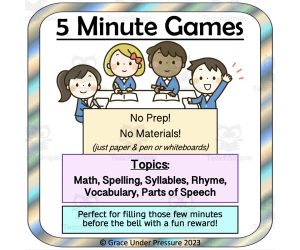
5 Minute Games Bundle: Super Simple No-Prep Games for Elementary Students (ELA & Math)
ELA, Math, Early Math, Place Value, Grammar, Language Development, Vocabulary, Spelling, Preschool, Grade 1, 2, 3, 4, 5, 6, 7, Activities, Games
Here are four quick no-prep games for any elementary classroom. They address topics including math, spelling, syllables, rhyme, vocabulary, parts of speech, geography, & critical and creative thinking. Each of the 4 games has its own page of instructions including the skills taught, different player configurations, rules, a sample round, and extension ideas. These games require NO PREP and NO MATERIALS other than writing implements. I suggest whiteboards to save paper. Grades to Use With: These games can be used in any elementary classroom (grades K-8). They are great for the following uses: - Morning/home-room warm-up - TOC back-up activities - To fill the 5 minutes before lunch or the end of the day - As a reward for small-group or one-to-one tutoring The four games are: - 4 Letter Word Game : Start with a 4-letter word on the paper/whiteboard. Players/teams take turns changing one letter at a time to make a new English word. Play until you are stuck or time runs out. - Guess My Number Game : Start with a range based on your students (ex: 1-20 for K, 1-100 for Gr 1-4, 1-200 for Gr 5-7). The teacher (or student if playing in pairs) thinks of a number in that range. The other student (or whole class) has exactly 5 questions of greater than or less than to narrow it down. After 5 questions, they must guess the number. - The Rhyme Game : Start with a word that has many rhymes. (For example: tent, rant, king, see, you.) Do NOT choose duck for obvious reasons. Each student (or each team) has two minutes to make a list of as many rhyming words as they can. Points are counted based on syllables. The longer the word, the more points. After two minutes, tally the scores to find the winner. - Categories: Start by writing 5 categories from the following options on the board: animals, cities, verbs, fruits, toys, pet names, countries, adjectives, beverages, colours, holidays, vehicles, movies, kitchen tools, flowers, books. Then choose one letter of the alphabet. Students get two minutes to think of a word for each category staring with that letter.
Author Grace Under Pressure
Tags Games, Vocabulary, Fun Stuff, Spelling, Math, Fast Game, Quick Game, Scattergories, TOC, Substitute

Country Study on South Korea - Snakes and Ladders Board Game PDF
Social Studies, History, History: Asian, Geography, Grade 7, 8, 9, 10, 11, 12, Activities, Games
Country Study on South Korea - Snakes and Ladders Board Game PDF This Teaching Resource is a PDF Board game (Snakes and Ladders; 3 slides) on South Korea (Asia). This Printable Resource can be great for Geography, Asian History and Social Studies Classes. Suitable Learners for this kind of lesson are students from 7th Grade to 12th Grade. This Geography + Social Studies game on South Korea (Country Study) aims to test learners on their knowledge on South Korea and Korean Culture (naming 2 Korean cities, telling about history events, telling about your pawn's character, telling about Famous Korean individuals or telling what you would like to visit if you had to go to South Korea). Some preparation on South Korea, Korean Culture and History can be useful for this Social Studies Activity. Within this amazing Country Study on South Korea (Asia) board game (snakes and ladders; 3 PDF Printable slides) it is offered: 1 board with questions and Speaking Prompts (ex. naming Korean Cities or telling about Korea's history events such as the Korean War, Sejong the Great, the 1st March Movement etc) 1 Printable Craft Die with numbers written 1 Printable Craft cone to make Game Pawns to play 5 Famous People from South Korea (Bong Joon-ho, Queen Min, Sejong the Great, Ban Ki-moon etc.) to stick on the players' printable craft cone This amazing and fun Social Studies + Geography Country Study on South Korea (Asia) PDF Digital Teaching Resource (3 PDF Printable Slides) can be great for learners from 7th grade to 12th grade to test South Korea and Korean Culture. Learning with Alan is a Brand New Teaching Resource, Educational Material Store whose aim is to help Teachers, Educators and Tutors to achieve their teaching objectives while creating a fun and stimulating environment. Never Forget! If you want to browse more of my Teaching Resources, click here Learning with Alan
Author Learning with Alan
Tags South Korea, Asia, Geography, Asian History, Social Studies, Snakes And Ladders, Board Game, Printable, Game, Korea
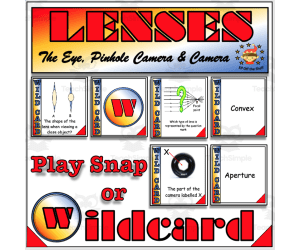
Light - Lenses, the Eye, the Pinhole camera and the Camera - Wildcard and Snap Card Games for Middle School
Science, Physics, Grade 5, 6, 7, 8, 9, Games, Activities
Light - Lenses, the Eye, the Pinhole camera and the Camera - Wildcard and Snap Card Games for Middle School: A Must-Have Educational Resource Designed for students in grades 5-9, this engaging teaching resource offers a unique approach to hands-on learning about optics. This comprehensive card deck covers topics that range from Lenses to Eye Anatomy, from Pinhole Cameras to Camera Technology. The pack includes: 66 Educative Playing Cards with scientific facts and diagrams related predominantly to physics. A systematic covering of facts around convex lenses used in various optical devices; how concave lenses work; visual perception through image formation by the eye lens; light regulation by iris-pupil dynamics etc.; this set is a versatile teaching aid. An exploration into interrelated topics such as how glasses correct sight abnormalities using various types of lenses based on individual need and ray diagrams ' working mechanism as it pertains specifically to distant & close object view recognition. The game set has been designed with a 'Wildcard' game apart from basic 'Snap' cards providing an interactive learning experience. The inclusion of an Animated PowerPoint that guides participants through game rules ensures smooth gameplay. Additionale Features: In-depth comparison between a camera’s functioning mechanism versus human vision enables learners to understand real-world applications. Suitable for cooperative education modules such as group activities as well is useful for individual self-study too! Homeschooling parents will find this multi-subject resource highly beneficial. In conclusion:, "Light - Lenses, the Eye, the Pinhole camera and the Camera" effectively makes abstract scientific theories tangible via gamified education while promoting holistic science learning.
Author Elf off the Shelf Resources
Tags Optics, Lenses, Eye Anatomy, Pinhole Camera, Camera Technology
Engaging Congressional Simulation (A fun, interactive way to teach Congress!)
Social Studies, History, History: USA, Government, Grade 7, 8, 9, 10, 11, 12, Activities, Games
The Engaging Congressional Simulation is an interactive activity that brings Congress to life in your classroom. Students take on the role of Senators, representing the voters of their state. They must pass or reject bills based on their voters' preferences, requiring thoughtful decision-making and political strategy. To get bills passed, students engage in lively deal-making and persuasion with their fellow Senators. This 16-page package includes everything needed to conduct the simulation: teacher directions, a guiding slideshow that explains key concepts, spreadsheets to track bill votes, and pointers for debriefing. The activity covers topics like bipartisanship, filibusters, party politics, and the legislative process. Students find it entertaining while gaining insight into how Congress really works. Use it to supplement instruction on government or hold an exciting Congressional simulation that your students will always remember.
Author Ed Dynamic
Tags Congress, Simulation, Government, Politics, Civics

Biochemistry - Macromolecules – Device-Based Scavenger Hunt Activity
Science, Life Sciences, Biology, Grade 7, 8, 9, 10, 11, Activities, Games
Biochemistry - Macromolecules - Device-Based Scavenger Hunt Activity. This activity is the coolest thing I've created and your kids are going to love it, mine do. Think of a scavenger hunt, then add devices (Smartphones, Chromebooks, Laptops, or Tablets), engaged students, and learning through assessment and you have this resource. Quick Disclaimer. In order to use this activity, your classroom must have at least 1 device per 3 students. Smartphones, Chromebooks, Laptops, and Tablets will all work perfectly. The Content Includes: • Carbohydrates • Lipids • Proteins and Enzymes • Nucleic Acids • Cell Membrane • Saturated vs. Unsaturated fats ****************************************************** Here's how you implement them: • Print the QR codes and place them around the room • Place your students into groups • Let them loose! They move from Location to Location as they complete their tasks. Each Task is assigned by scanning the QR code and there are 5 Tasks per Scavenger Hunt Activity. • Have them submit their answers directly to your email via a form on my website. ********************************************************************** I've created a video that walks you through the entire activity. I did it using screen capture software on my phone so you can see exactly what your students will see. CLICK HERE to have a look . ********************************************************************** This activity: • Lets your students utilize their devices • Cuts down on wasted paper • Combines learning with assessment • Is a lot of fun • Comes in both Word and PDF formats Each Hunt is different and offers a unique way for your students to explore the topic. From Hunt-to-Hunt, possible tasks your students will face include: • Video analysis • Simulations • Fully automated and marked Quiz • Finish the story • Start the story • Calculations • News article • Opinion • Word scramble • Short answer • Web research --------------------------------------------------------------------------------------------- There are other Hunts as well and I'm continually adding more. Currently, the Hunts I have available include: Biology: • Cell Organelles • The Digestive System • The Circulatory System • Biochemistry - Macromolecules • Photosynthesis and Cellular Respiration • Mitosis and Cell Division • Cells and the Cell Theory – A Device-Based Scavenger Hunt Activity Ecology: • Energy Flow in Ecosystems • Invasive Species • Photosynthesis and Cellular Respiration • Cycling of Matter in Ecosystems • Ecosystems and Ecological Succession Space and Earth Science: • The Seasons • Our Solar System • The Moon • The International Space Station - Meeting Our Needs • Climate Change Electricity: • Static Electricity • Electricity Generation Chemistry: • Atoms: Atomic Theory and Structure • Physical and Chemical Changes • Elements and the Periodic Table • Chemical Reactions • Types of Chemical Reactions and Balancing • Acids, Bases and pH Physics: • Friction • Energy Transfer --------------------------------------------------------------------------------------------- Also, please visit my website Teach With Fergy for my thoughts on teaching, learning and everything in between.
Author Teach With Fergy
Tags Biochemistry Printable, Macromolecules Game, Macromolecules Printable, Science Activity, Scavenger Hunt, Macromolecules Word Search, Biochemistry Macromolecules, Macromolecules Activity Biology, Macromolecule Activities

Homologous Series of Alkanes – Word Search Activity
Life Sciences, Science, STEM, Basic Science, Physics, Chemistry, Biology, Earth and Environmental Sciences, Environmental Science, Grade 6, 7, 8, 9, 10, 11, Worksheets, Worksheets & Printables, Quizzes, Quizzes and Tests, Teacher Tools, Activities, Games, Task Cards, Crosswords Puzzles, Word Searches
Homologous Series of Alkanes – Word Search Activity A differentiated puzzle set to support terminology and topic review in organic chemistry (Grades 8–11) 🧪🧩 This word search activity is designed to help students consolidate their understanding of alkanes and the structure of homologous series in a fun and engaging way. Instead of traditional worksheets, this format offers a quiet, focused task that can be used for reinforcement, revision, or simply as a meaningful time filler. You’ll find a total of 10 word search puzzles, each in two variants (A/B), and five levels of difficulty. The level of challenge increases with the size of the word grid and the direction of the hidden terms. The puzzles include key vocabulary from the topic of alkanes and are ideal for supporting students' familiarity with hydrocarbon structures and related terminology. Included in this resource: 10 unique word search puzzles × 2 variants (A and B) 5 levels of differentiation (marked with 1 to 5 stars) Terms appear forward only or forward and backward (depending on level) All solutions included Colorful and black-and-white versions for flexible printing Self-created chemistry-themed clipart for visual support How I use it in class: I like to use these puzzles at the end of a topic, during quiet work phases, or even as an option for early finishers. The A/B versions are helpful when students sit next to each other – it prevents simple copying but keeps the task structure consistent. The varying difficulty levels also allow you to match tasks to students’ needs without having to explain separate instructions. Whether students are revisiting the basics of alkanes or preparing for more advanced organic chemistry, this puzzle format keeps them engaged and focused. A practical, ready-to-use activity that brings a bit of variety into the chemistry classroom – and helps build confidence with technical terms. Have fun exploring the world of science with your students! Warmly, Lernfitness Did You Know? I teach with a certified therapy dog, and together we focus on creating a positive and inspiring learning environment.
Author Lernfitness
Rating
Tags Science, STEM, Chemistry, Homologous Series, Alkanes, Organic Chemistry, Word Search Activity, Word Search, Differentiated, Varying Difficulty Levels

Lewis and Clark Time-Line Game
Social Studies, History, History: USA, Grade 5, 6, 7, 8, 9, 10, Games, Activities
The Lewis and Clark Time-Line game will be an engaging way for students to explore the journey of Lewis and Clark and apply that knowledge by creating timelines. The idea of the game is for a player to get 8 cards in chronological order in their personal timeline on the table in front of them. This download comes with rules, variations and recommendations for successfully playing this game. It is a 24-page download with a no-prep game.
Author Creative Learning Connection
Tags Lewis And Clark, Expeditions Activity, Expeditions Game, Timeline Game, Timeline Activity, Lewisandclark Games
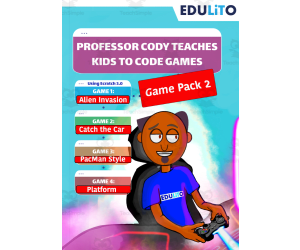
Professor Cody Teaches Kids to Code using Scratch - Game Pack 2
Science, Technology, Computer Science, Grade 5, 6, 7, 8, 9, Activities, Games
Professor Cody Teaches Kids to Code using Scratch - Game Pack 2 This is a comprehensive teaching resource designed to introduce coding concepts to students through engaging, game-based lesson plans. The content, contained in 48 photocopiable pages, is divided into four independent projects that immerse children in the world of coding while providing hands-on practice. Game 1: Alien Invasion. In this project, students explore cloning by creating alien spaceships and a player-controlled spaceship with laser weapons. Game 2: Catch that Car. The second game introduces patterns associated with motion and chase algorithms by setting two cars on the track. Game 3: A tribute to classic arcades where students develop a Pac-Man-style adventure involving maze navigation and coin collection. Game 4:: Students create their platform games with three distinct levels featuring adventures for gem acquisition through strategic jumps onto platforms. The complexity of these projects aims to peak student interest for around two hours each. They offer a range of challenges in line with modern pedagogy practices which centers on learning by doing as critical for pupil absorption and retention rates. This resource can be used effectively not only for individual work but also whole or small group sessions – making it adaptable across different class sizes or settings. It can be utilized during live lessons or as engaging homework tasks that allow learners' creativity and problem-solving skills shine brightly. Embedded within each project are sets of challenges ideal for mini-assessments or even checkpoints indicating learner progress understanding subtly imparted coding principles throughout these games. They serve as more than theoretical discussions transforming classrooms into practical learning spaces where computer science takes shape. Connected templates downloadable online serve as baseline blueprints students can modify as their skills improve. Professor Cody Teaches Kids to Code using Scratch - Game Pack 2 opens up a new approach for Grades 5 through 9 into the interesting world of coding, encouraging its applicability not only in the computer science curriculum but also across various problem-solving disciplines within the broader Science field.
Author Edulito
Tags Coding Concepts, Scratch, Gamified Lesson Layouts, Cloning, Motion And Chase Algorithms, Maze Navigation, Platform Games, Scratch Kids Game

Bingo Games #2: 7th Grade Math Review
, Grade 7, Activities, Games
This is a PowerPoint Presentation with 2 bingo games for 7th grade math review. Threre are two bingo games with 8 questions each. Topics covered are: probability, similar triangles, predictions from graphs, multi-step word problems, proportional word problems, distributive property with fractions and decimals, box and whisker plots, percents of rations, mean for a set of data, word problems with negative numbers, order of operations with fractions and decimals Directions for BINGO. Have students to make a 4 x 4 game board. They will fill in the answers in random order. This way everyone has a different board but all of the answers. Put up the first 2 questions. When all students finish #1, you can change to the second page, which still has #2 but also #3 for those that have also finished #2. This allows some students to work ahead when ready. When everyone has finished #2, move to the next screen, which has #3 and #4 as some students will be ready for #4. Continue in this way. Students should put a mark in the corner of the square for answers---Don’t have them completely mark out their answers in the first game because they will use this same board in the second game. Students MUST show their work on paper to get credit for a BINGO. For the problems that don’t have work to show, they must explain their answer on paper. The first game uses questions #1-8. In a regular size class there should be 5-6 bingos after this many questions. You can start the second game #9-10 or save that for another class time. Just make sure students save their board because both games use the same board. I like to give a piece of candy (like jolly rancher) for BINGOs. I always help students with their problems since I used BINGO as practice not as an assessment.
Author Math Resources With Rigor
Tags 7th Grade Math Review, Bingo Games
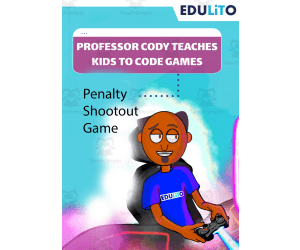
Code a Soccer Penalty Shootout Game using Scratch
, Grade 5, 6, 7, 8, Games, Activities
Welcome to Professor Cody's Penalty Shootout Game using Scratch 3.0. Students will have the chance to code an exciting soccer game. Each player gets to choose their team and the penalty shootout begins. This game works best if you’re using the web-based version of Scratch 3.0 or the downloaded computer version and you are using a keyboard.
Author Edulito
Tags Coding, Code, Programming, Scratch, Game, Soccer, Activity, Computer Science, Computing, Soccer Games Scratch, Soccer Games On Scratch, Soccer Penalty Shootout Game, Soccer On Scratch, Scratch Game Codes, Soccer Scratch, Scratch Codes For Games, Soccer Shoutout Game, How To Make A Soccer Game On Scratch, Scratch Soccer, Soccer Shootout Game

Magnetism and Electromagnets Find the Pair Game for Middle School
Science, Physics, Grade 5, 6, 7, 8, 9, Activities, Games
This is an engaging and enjoyable memory game on magnets and electromagnets which tests knowledge and reinforces prior learning. It is an ideal activity for the end of the topic or for test prep. It suits a wide range of abilities and can even be used for a cover lesson as all answers are provided. This is so much fun, pupils will forget they are learning! How to Play Divide students into groups of 4. Shuffle cards. Groups lays their cards in a square face down. Students take turns to turn over two cards. The pupil keeps the pair If a question is matched by its answer,. If not the two cards are replaced face down and the next pupil takes a turn. Continue until all cards are paired. The student with the most pairs wins. A student can challenge if they think an opponent’s pair is not a correct match.. If the challenge is found correct the challenger takes the cards. Pupils should check their books for the correct answer but, for ease, a quick-check answer sheet is provided for the teacher. Included in this Pack. 21 question and 21 answer cards Answer sheet. How to play directions Preparation Use back-to-back printing to copy a set for each group of 4 pupils. Sheets can be laminated to enable year-on-year use. Trim sheets into cards. Prior Knowledge Required: An Overview of Magnets and Magnetic Fields Composition of Magnets: Magnets are constructed using magnetic materials. Common materials include Iron, Cobalt, Nickel, and their corresponding alloys. Pole Interactions: Magnets have two types of poles - North and South. When two like poles (e.g., North and North) come close to each other, they repel. Conversely, when opposite poles (e.g., North and South) are brought together, they attract each other. Magnetic Fields: Surrounding every magnet is an invisible force field known as the magnetic field. This field can be visualized through field lines. Field Line Density: The density of these field lines determines the strength of the magnetic field. A region with closely spaced field lines indicates a stronger magnetic field than a region where they're spread out. Visualization of Field Lines: It's essential to understand and recognize the pattern of field lines around two bar magnets, especially when they have the same or opposite poles facing each other. Field Strength at Poles: The magnetic field is strongest at the poles of a magnet due to a higher concentration of field lines. Distance and Field Strength: The strength of the magnetic field diminishes as one moves farther from the magnet. Direction of Field Lines: Field lines emanate outward from the magnet's south pole and point inward toward the north pole. Magnetization Process: When a non-magnetized magnetic material becomes a magnet, the tiny regions within it called domains, which were initially oriented in random directions, align themselves to point uniformly in the same direction. Earth's Magnetic Properties: The Earth behaves like a large magnet. Interestingly, there appears to be a south-type magnetic pole near the Earth's geographic North Pole and a north-type magnetic pole near the Earth's geographic South Pole. Application in Devices: It would be beneficial to have a basic understanding of how magnets and magnetic fields operate within certain devices. Familiarize yourself with the structure and functioning of electric bells, relays, and circuit breakers, as they use these principles. With this foundational knowledge, you will be better prepared to delve deeper into the study of magnets and their wide-ranging applications. See more Elf Off the Shelf resources on this topic and many others.
Author Elf off the Shelf Resources
Tags Light Properties, Color Dispersion, Color Filters, Interactive Learning, Middle School Science

Chemical Reaction Bingo Vocabulary Game
Science, Chemistry, Grade 6, 7, 8, Activities, Games
Chemical Reaction Bingo is an engaging vocabulary review game for middle school science students learning about chemical reactions. This printable bingo game can be used to review key chemistry terms and definitions in a whole group setting. To play, students are given bingo cards with different chemical reaction vocabulary terms. The teacher then reads aloud definitions, and students find the matching term on their card and mark it. The first student to mark five vocabulary words in a row and shout "Bingo!" wins. This game allows students to review concepts like reactants, products, combustion, endothermic, and more in an interactive way. The bingo cards can be laminated and reused, making this a versatile resource for reviewing chemical reactions. This activity works well as a test prep game , end-of-unit review, or sub plan.
Author Maude in the Middle
Tags Chemical, Reactions, Science Bingo, Vocabulary, Whole Group, Chemical Reaction Games, Science Chemical Mixing Games
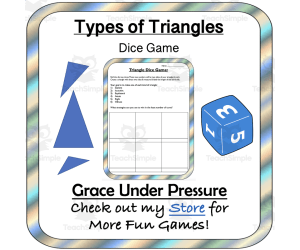
Triangle Dice Game: Isosceles, Scalene, Equilateral, Right, Acute, Obtuse
Math, Geometry, Measurements, Grade 4, 5, 6, 7, Activities, Games
Here's a deceptively simple dice game to practice identifying and creating six kinds of triangles. Three are classified by their angles: acute, right, and obtuse. Three are classified by their side lengths: scalene, equilateral, and isosceles. Use this game to reinforce the definitions of each of these six triangles in a geometry/measurement unit. Students work independently or in small groups. Each player needs two dice. They roll them and use the two numbers as side lengths in centimetres for a triangle. They draw the triangle in one of the boxes on their paper and measure and label the third side length. Here's where the strategy and critical thinking come in. Can students make six kinds of triangles in less than six turns? Maybe! If they get some lucky rolls! For example, if a student gets a roll with two of the same numbers, they should make an isosceles or equilateral triangle (depending on what angles they draw). But this triangle will also be an acute triangle (or an isosceles right triangle). Clever students (with lucky rolls) should be able to complete the task in less than six turns. Standards: CCSS 4.G.A.2 Classify two-dimensional figures based on the presence or absence of parallel or perpendicular lines, or the presence or absence of angles of a specified size. Recognize right triangles as a category, and identify right triangles. CCSS 7.G.A.2 Draw (freehand, with ruler and protractor, and with technology) geometric shapes with given conditions. Focus on constructing triangles from three measures of angles or sides, noticing when the conditions determine a unique triangle, more than one triangle, or no triangle. Grades: This game works well in classes from grades 4-7. Ideally students know how to use a ruler and a protractor. If you enjoy this product, check out the other math games in my store Grace Under Pressure
Author Grace Under Pressure
Tags Triangles, Geometry, Isosceles, Obtuse, Acute, Right Triangle, Scalene, Math Game, Dice Game, Hands-on Math, Triangle Scalene Isosceles Equilateral, Isosceles Scalene And Equilateral Triangles, Scalene Isosceles And Equilateral Triangles, Scalene Isosceles Equilateral, Isosceles Scalene, Obtuse Isoceles, Equilateral Acute, Acute Equilateral, Isoceles Obtuse, Isosceles Scalene Equilateral, Classify Triangles Game, Obtuse Equilateral

Math Sudoku
Math, Algebra, Grade 7, 8, 9, 10, Activities, Games
A sudoku with a mathematical twist! Each sudoku square has a mathematical computation instead of a number. Students must solve the expression first before completing the puzzle. In the second activity , students will write their own expressions to make a completely new sudoku board of their own creation!
Author Breeze Through Math
Tags Sudoku, Puzzle, Math Puzzle, Math Fun, Early Finish, Sudoku Math Puzzle Worksheets, Math Is Fun Sudoku, Math Com Sudoku, Sudoku With Math

Light - Reflection Find the Pair Game for - Middle School
Science, Physics, Grade 5, 6, 7, 8, 9, Activities, Games
The Light - Reflection Find the Pair Game for Middle School A captivating educational tool designed to facilitate understanding of light reflection in plane mirrors. This resource utilizes a memory game format, fostering active participation among students from grades 5 to 9. Participation and Format: Students engage in small groups of three or four. The interactive nature of the Middle School Light Reflection game provides a way to encourage teamwork and independent critical thinking skills. Each group works together to match 42 question-and-answer cards. Individuals take turns at revealing and pairing the cards. Challenging Element: This unique teaching resource features a challenging element that further encourages learning — if one team member believes that the selected pair does not match correctly, they can raise a challenge. Pupils may refer back to their study materials during these instances. An included quick-check answer sheet is available for teachers' guidance. If correct in their challenge, participants have the opportunity to earn points for their group. Simplicity In Use: Edge educators: Just print sets double-sided (potentially laminating them for increased durability) and distribute among groups fledge easy task generation set-ups. This reflective game addresses several key concepts about light transmission including: Tags: Images seen through periscope usage Luminous/non-luminous objects; , Opaque/transparent/translucent materials; Labeling incident rays and reflected rays; The normal point implementation. Potential Usage Spots: Classes handling science subjects like physics or during homeschooling sessions focusing broad-based scientific education around middle school level grades like grade 5 up till grade 9 constitute prime usage spots. Versatility In Use: The Light - Reflection Find the Pair Game doesn't restrict learning just within classroom boundaries and can also be implemented as an engaging homework assignment, thus offering versatility and ample opportunities for meaningful learning outside school walls.
Author Elf off the Shelf Resources
Tags Light Reflection, Plane Mirrors, Memory Game, Educational Tool, Science Education
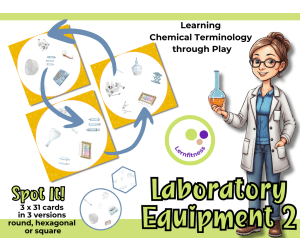
Spot It! – Laboratory Equipment 2 Fun & Engaging Game for Science Lab
STEM, Science, Chemistry, Physics, Life Sciences, Special Education Needs (SEN), Special Resources, Research, Biology, Homeschool Templates, Grade 6, 7, 8, 9, 10, Activities, Games, Worksheets & Printables, Task Cards, Quizzes and Tests, Teacher Tools, Quizzes, Word Problems, Word Searches, Worksheets
Spot It! Laboratory Equipment 2 A Fun & Engaging Game for Science Classrooms 🔬 Make Learning Lab Equipment Fun and Interactive! Teaching students about laboratory equipment doesn’t have to be dull or overwhelming. With Spot It! – Laboratory Equipment, you can turn learning into a fun and engaging experience! This fast-paced matching game is perfect for chemistry, physics, and biology teachers who want to reinforce lab tool recognition in a way that students will love. 🎲 Why This Game Works for Science Teachers ✅ Boosts Visual Memory – Matching images of lab equipment helps students quickly recognize and remember key tools used in science labs. ✅ Encourages Active Participation – Gets students involved instead of passively memorizing lists. ✅ Improves Classroom Engagement – The fast-paced nature of the game keeps students motivated and focused. ✅ Perfect for Any Science Class – Whether you're teaching chemistry, physics, or biology, this game makes learning lab equipment easy and fun. ✅ Promotes Social Interaction – Encourages teamwork, communication, and collaborative learning. 🧪 What’s Included? 🃏 93 Total Cards – You’ll receive three different versions of the game, each with 31 cards: ✔ Round cards – Traditional Spot It! design. ✔ Square cards – Easy to cut and prepare. ✔ Hexagonal cards – Unique design for an extra challenge. 📖 Game Instructions: 1️⃣ Print the cards. 2️⃣ Laminate them for durability (optional). 3️⃣ Cut out the cards in your preferred shape: round, square, or hexagonal. 🎯 How to Play 🃏 Each player receives one card. 🔬 Turn over a card from the stack in the middle. 👀 Find a matching image between your card and the revealed card as quickly as possible. 🏆 If you find a match first, you win the revealed card. 🎉 The player with the most cards at the end wins! This game turns science learning into a competitive, fast-paced, and enjoyable classroom activity that will keep students engaged while reinforcing important lab vocabulary. 📌 Why Teachers Love It ✔ Saves Prep Time – Ready-to-print, simple setup, and no extra materials required. ✔ Great for Small Groups & Whole Class – Use it in science centers, team challenges, or as a warm-up activity. ✔ Adaptable for Different Learning Levels – Suitable for middle school, high school, and even introductory university-level science classes. 🔬 Make Science Learning More Engaging! If you’re looking for a fun, effective, and interactive way to help students learn and remember laboratory equipment, this Spot It! game is the perfect addition to your science classroom. 🚀 Download now and bring hands-on science learning into your classroom today! 📍 Best wishes, Heike from Lernfitness Did You Know? I teach with a certified therapy dog, and together we focus on creating a positive and inspiring learning environment. 🐶✨
Author Lernfitness
Tags Game, Spot It, Educational Card Games, Picture Match, Chemistry, Lab, Biology, Laboratory Equipment, Lab Tools, Physics