Math Sudoku
- Grades
- Grades 4–6
- Pages
- 6
- File type
- Answer key
- Included


- Subject
- Math
- Topic
- Sudoku, Math expressions
- Resource types
- Activities, Worksheets
- Answer key
- Included
Product description
From the author
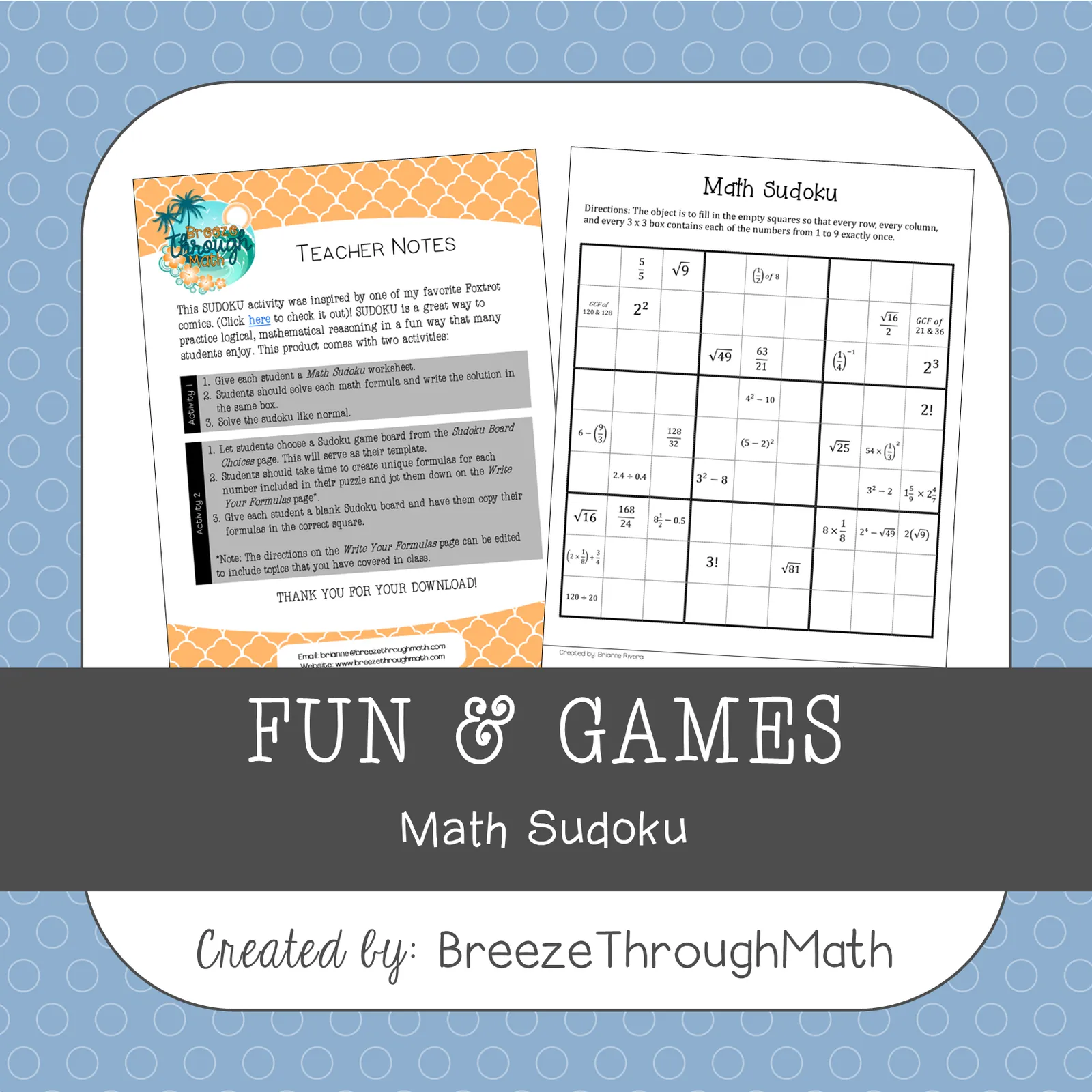
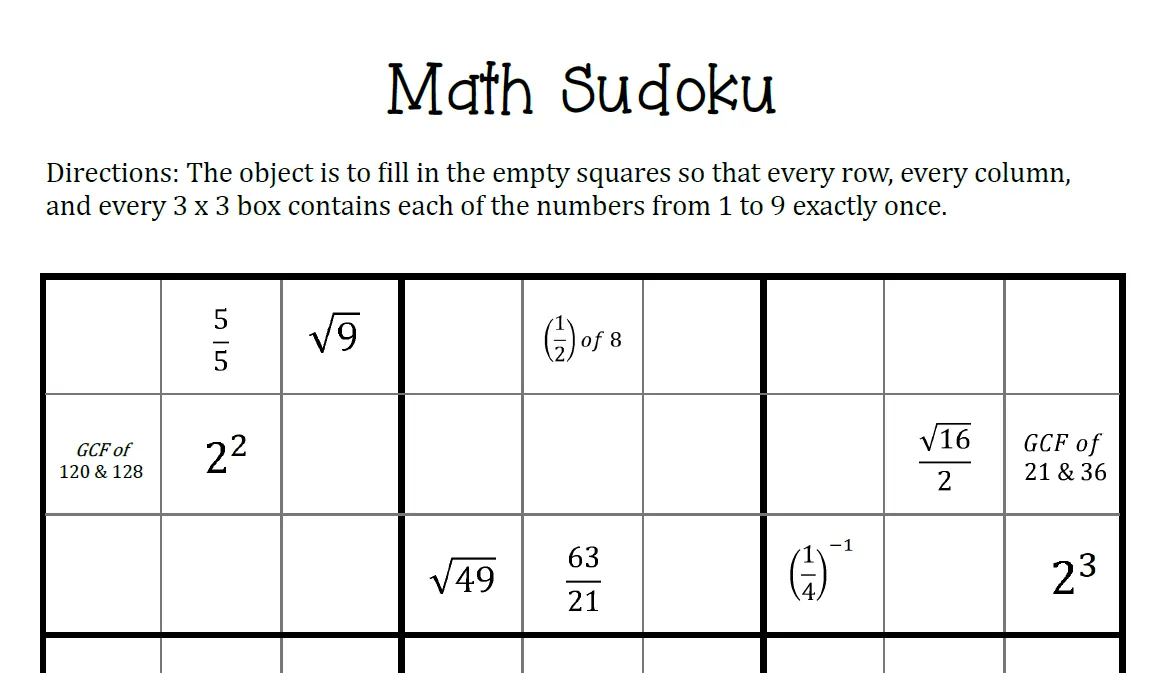
A sudoku with a mathematical twist! The starting clues are mathematical expressions; the remaining squares are blank. Students must solve the expression first before completing the puzzle. In the second activity, students will write their own expressions to make a puzzle using one of four supplied number-board templates!
Related resources
More resources teachers may find useful
24 related resources were found using this product's title, contributor, categories and tags.


In the classroom
Teaching tips & learning objectives

Learning objectives
Evaluate math expressions involving GCF, fractions, exponents, and square roots to determine a digit 1-9.
Apply Sudoku logic to complete a 9x9 grid so each row, column, and 3x3 box contains every digit once.
Write original math expressions, including fractions, exponents, and factorials, that evaluate to a specified digit.

Teaching tips
Start with Activity 1 (solving the pre-built expression Sudoku) before assigning Activity 2, which requires students to author their own expressions.
Edit the MustInclude directions field on the Make Your Own Math Sudoku page to match whatever unit topics the class has recently covered, as the teacher notes suggest.
Have students swap their completed Activity 2 boards with a partner to solve each other's puzzles as a peer-check step.

Skills covered
Mixed math-expression evaluation — students solve expressions involving GCF, fractions, exponents, and square roots to find each digit.
Sudoku logic — students apply row/column/box uniqueness rules to complete a 9x9 grid.
Original expression writing — students write their own math expressions for a target digit, incorporating fractions, exponents, and factorials.
Good to know
Questions teachers ask about this resource
How does the puzzle-making activity work?
Students choose a supplied Sudoku board as a template, write expressions for its given numbers on the planning page, and transfer those expressions to the matching cells of a blank board.

No reviews yet
Downloaded this resource? Tell other teachers how it went.
Resource details
Concepts & topics
Core concepts
 Core concepts
Sudoku logic
Order of operations
GCF
Exponents
 Topics
Explore more
Categories this resource belongs to
Explore related searches
More to explore
You may also like