



2,824 products added recently
Page 702 - Newest Teaching Resources

 Show filters
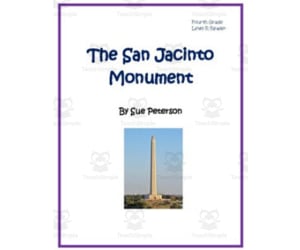
The San Jacinto Monument
Social Studies, ELA, History, History: USA, Reading, Reading Comprehension, Grade 3, 4, 5, Worksheets & Printables, Worksheets
About This Product The San Jacinto Monument: An All-In-One Teaching Resource Designed for the educational needs ofGrade 3 to Grade 5 students, The San Jacinto Monument resource is a seamless blend oflanguage arts and social studies. It brings in-depth knowledge about Texas's illustrious past, especially its struggle for independence from Mexico using the historical monument as a backdrop. An Engaging Seven-Page PDF This seven-page PDF is tailored to impart an important history lesson and enrich students' language skills. With an integrated approach toward pedagogy, it fuses lessons from Fountas and Pinnell’s leveled vocabulary and Rebecca Sitton's spelling words with Common Core Standards and the National Curriculum Standards for Social Studies. Specific concepts, skills, and vocabulary are listed on the first page of the text to help teachers more effectively plan their teaching lessons. Besides the text, it comes with activity pages catering to whole-group instruction, small-group discussion, or individualized learning. Various Collections In addition to being a standalone book, The San Jacinto Monument is also packaged with other themed collections (available on this site): Fourth Grade (Level Q/R/S) Collection featuring Texas History Famous Women in U.S History (Grades 2–4) Famous African-Americans in U.S. History (Grades 1–3) Detailed Answer Keys for Effortless Evaluation Detailed answer keys accompany the resource, providing essential feedback for the teachers.
Author Sue Peterson
Tags San Jacinto Monument, Texas History, American Independence, Language Arts, Social Studies
Inside the Twin Towers (2006): Complete Video Guide
Social Studies, History, History: USA, Grade 10, 11, 12, Activities, Worksheets & Printables, Worksheets
Inside the Twin Towers (2006): Complete Video Guide The Twin Towers documentary is a valuable tool that delves deep into that fateful day, providing a minute-by-minute account of what occurred inside the World Trade Center in New York City. Presented with precision and based on thorough research, the documentary combines re-enactments and advanced computer-generated imagery to paint an accurate picture of the tragic events. In order to ensure that students not only watch but truly comprehend the gravity and details of the event, an accompanying 18-question video guide is provided. This structured guide is designed to help students retain key facts, understand the timeline, and reflect on the broader implications of the event. And to make your job a little easier, a completed answer key is provided, ensuring you have all the tools to guide an effective discussion post-viewing. The entire package, including the video guide, spans 4 pages, and the expected teaching duration for this material is roughly 2 hours. The documentary, having made its debut on the Discovery Channel on 3 September 2006, is narrated by Harry Pritchett and offers both historical information and human perspectives, making it a well-rounded educational tool. Accessibility isn't an issue either; the video can conveniently be found on Youtube under the title "Inside the Twin Towers." This teaching resource promises to be an insightful addition to your curriculum , especially if you're focusing on modern history or discussions related to terrorism and global events. It's crafted to engage students and encourage critical thinking about one of the most significant events in recent history. Thumbnail clipart credits go to Messare Clips and Design & Sarah Pecorino Illustration. Video link: Inside the Towers
Author EduPal Learning
Tags September 11, 9/11, World Trade Center, Terrorist Attack, Video Guide, Twin Towers

A Holiday Play: Veterans Day Play
Creative Arts, Art, Drama, Grade 3, 4, 5, Activities
A Holiday Play: Veterans Day Play This Veterans Day play written for grades 3-5 features a family who watches a Veterans Day parade. The family shares in the celebration of this day and finds out the history behind the special United States holiday celebrated on November 11th each year. What better way to honor the veterans who served in the military (Navy, Air Force, Army, Coast Guard, and Marines) and those who gave their lives while fighting in a war than putting on a play to teach the students and audience about the significance of this day? There are 10 speaking parts: two children, parents, an announcer, 2 parade assistants, 3 narrators. An optional chorus and band can be added to accommodate any number of additional students. A Holiday Play: Veterans Day Play can also be read as a Readers’ Theater. Common Core Standards Aligned with the Play Reading Literature Range of Reading and Level of Text Complexity: CCSS.ELA-LITERACY.RL.3-5.10 By the end of the year, read and comprehend literature, including stories, dramas, and poetry, at the high end of the [respective] grade level text complexity band independently and proficiently. What’s Included A total of 10 pages including a Teacher Guide with vocabulary words, questions, and extension activities that focus on the author’s purpose, research, and creative expression. Check out the other original plays by this author on this site, sold individually or in bundles!
Author Sue Peterson
Tags A Holiday Play, Veterans Day, Readers' Theater, Scripts, Balanced Literacy
Leveled Books: First Grade Levels C-D-E-F
ELA, Reading, Grade 1,
Leveled Books: First Grade Levels C-D-E-F (80 books) With 20 original books at each of the four levels C-D-E-F, your first-grade students will have plenty of practice to sharpen those reading and language skills! And teachers will have a reusable trove of books to support the core curriculum : ELA, math, social studies, and science. What’s more? Activity pages designed for each book boost all sorts of ELA skills, guaranteed to increase student confidence and success What’s Included A total of 233 pages. Check Out These Titles Level C On the Farm; The Nut Cookies; In My Bedroom; Grandma’s Puppy; Fall Leaves; Vacation; Water: A Liquid, a Solid, a Gas!; Don’t; Feelings about School; The Classroom Pet; Fun Sandwiches; The Weather Station; President’s Day; Weather; A Metal Magnet; The 4th of July; Be F-I-T!; Do Not Lie; A Map, A Globe Level D Voting; The Moon; A Good Citizen; 2-D and 3-D Shapes; Animals That Run; Days of the Week; Landforms; Martin Luther King, Jr.; Matter; Safety Goggles; The Parade; A Kiss for Kim; Baseball; Breakfast; Cats in the Pet Store; Fast or Slow?; In School; One Day, More Days; A Recycle Place; The Drape Level E Swimming; Snooping Around For Birds; Sister Susie, the Sailor; Shapes on a Warm Day; Seeds for My Garden; Rules at the Swimming Pool; Pet the Pony; Our Science Lab; I Have Lots to Do…; I Have Been Thinking…; Veterans Day; Thomas Edison; The Four Seasons; The Alphabet; Numbers All Around Us; Eleanor “Ellie” Roosevelt; Boiling Jam; Bodies of Water; An Anthem and A Motto; Making Cookies; By Airplane Level F A Beehive; Even and Odd (in a Gym); Having a Party; The Day I Tried to Cook; Alphabetizing; The Circus; The Doctor Visit; Abbreviations; Nouns; Basic Organisms; A Strawberry Patch; The Playground – A Poem; Alexander Graham Bell; Garrett Morgan; Facts about the Alamo; Constitution Day; The Air You Breathe; Jobs; A Train (Up and Down, Back and Forth)
Author Sue Peterson
Tags Leveled Books, Balanced Literacy, First Grade, Levels CDEF, Informational Text
ELA Common Core Standards: Leaping into Language Arts Grade 5
ELA, Grammar, Common Core, Grade 4, 5, 6,
About This Product Leaping into Language Arts Grade 5is a full year’s ELA resource that covers these main topics: Sentences What kinds of sentences are there in the English language? What is the difference between a fragment and a sentence? How can you change a run-on sentence to a complete sentence? How can you construct compound sentences with basic conjunctions? Capitalization When are holidays and seasons capitalized? Which titles and places are capitalized? Are names of newspapers, books, songs, and poems capitalized? Punctuation How do the end punctuation marks change for the four types of sentences: declarative, interrogative, imperative, and exclamatory? What is meant by using a comma in a series? Where do you place a comma for dates? Where do you place a comma in addresses? Do you use a comma or a colon in the greeting and closing of letters? Which punctuation mark is used to set off speaking to someone? Which introductory phrases must end with a comma? Do you use quotation marks or italics for titles of stories, songs, poems, books, movies, TV shows, newspapers, and magazines? Abbreviations What is an abbreviation? How do you abbreviate the days of the week and months of the year? What is the proper abbreviation for streets and highways? Are the English and metric systems of measurement abbreviated? How? What is the proper abbreviation for states, provinces, and territories? Which words that measure time are abbreviated? Parts of Speech How do you change singular nouns into plural nouns? What is meant by irregular plural nouns? Do some singular nouns remain the same for their plural forms? How are common nouns different from proper nouns? What verbs are linking verbs? How can you change verbs to different tenses (i.e., past, present, future)? What is meant by verb agreement? How do possessive pronouns differ from regular pronouns? What are antecedents and which punctuation marks are needed? What is a prepositional phrase? Vocabulary How are synonyms, antonyms, and homophones different? How do you make a compound word? How do prefixes and suffixes change words? What are some 5th-grade level Greek and Latin roots? What is meant by multi-meaning words? How do you determine their meanings in sentences? Writing How can you determine the main idea of a text? Which types of details support the main ideas of a text? How do factual and opinion writing differ? How do you write an informational text? What is narrative writing? What is meant by functional writing? Common Core Standards Aligned with the Text: Conventions of Standard English CCSS.ELA-LITERACY.L.5.1 Demonstrate command of the conventions of standard English grammar and usage when writing or speaking. CCSS.ELA-LITERACY.L.5.2 Demonstrate command of the conventions of standard English capitalization, punctuation, and spelling when writing. Knowledge of Language CCSS.ELA-LITERACY.L.5.3 Use knowledge of language and its conventions when writing, speaking, reading, or listening. Vocabulary Acquisition and Use CCSS.ELA-LITERACY.L.5.4 Determine or clarify the meaning of unknown and multiple-meaning words and phrases based on grade 5 reading and content, choosing flexibly from a range of strategies. CCSS.ELA-LITERACY.L.5.5 Demonstrate understanding of figurative language, word relationships, and nuances in word meanings. CCSS.ELA-LITERACY.L.5.6 Acquire and use accurately grade-appropriate general academic and domain-specific words and phrases, including those that signal contrast, addition, and other logical relationships (e.g.,however, although, nevertheless, similarly, moreover, in addition). Leaping into Language Arts Grade 5 is the only ELA resource you will need to teach language skills to your students. The lessons have simple explanations and offer sufficient practice of the skill before proceeding to the next skill. If you want your students to excel in language and build confidence along the way, check out this comprehensive resource! What's Included A total of 257 pages including an Answer Key.
Author Sue Peterson
Tags Language Arts, ELA Standards, Grammar, Writing Techniques, Vocabulary

What is Juneteenth?
Social Studies, History, History: USA, Grade 3, 4, 5, Activities
What is Juneteenth? is a 4th grade leveled book (Level Q) that talks about this special day in honor of ending slavery. Although slavery still flourished after the Emancipation Proclamation on January 1, 1863, as the nation approached year three of the Civil War, Juneteenth officially put an end to it. General Granger, a Union general during the Civil War, spoke in Texas in 1865 about freedom for all Blacks, emphasizing that all persons held as slaves are free. Not every state in the U.S. celebrates this holiday today, but many states do as well as other countries throughout the world. The leveled Q reader discusses key concepts about freedom and slavery. It also helps expand students’ vocabulary with a rich set of words to tell the story of this significant day. Included in the Leveled Reader What is Juneteenth? are 2 pages of follow-up questions for students to explore and discuss after reading the story. Students also define key words used in the text and expand their creative and critical thinking skills when completing the extension exercises. The text itself is 3 pages. The reader is a perfect complement to a Social Studies unit that addresses such concepts as freedom, equality, and U.S. holidays and celebrations. Many key areas cited by the National Council for the Social Studies are interrelated through reading this text, primarily: Culture Time, Continuity, and Change People, Places, and Environments Individuals, Groups, and Institutions Power, Authority, and Governance Civic Ideals and Practices
Author Sue Peterson
Tags Juneteenth, Slavery, American History, Social Studies, Reading Comprehension
President’s Day
Social Studies, Government, Preschool, Grade 1, 2, Activities
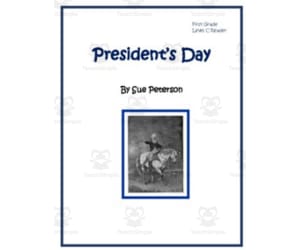
President’s Day is a Level C reader written for students in primary grades. There is a picture of Mount Rushmore on the first page of the text which is a great lead into the story since Washington and Lincoln are carved in the statue and the leveled reader features these two presidents. The concepts taught in the story and a list of vocabulary words are listed at the top of the text to guide instruction. The text is a simple one-page story that talks about two famous U.S. presidents: George Washington, the 1st president, and Abraham Lincoln, the 16th president. In easy-to-understand language, the story gives background information of the importance of these two men and brings meaning to President’s Day, a federal holiday celebrated on the third Monday in February to honor the past presidents and the current president serving the people of the U.S. This leveled reader can be used to introduce the special day and provide background information to your students. Ideal to be read individually or as a group, students are sure to think more about the contributions and roles of presidents in America. There is a one-page activity sheet for students to practice writing the targeted vocabulary words and to draw /color the U.S. flag.
Author Sue Peterson
Tags Presidents, American History, Literacy Skills, Teaching Resource, Interactive Activities
Theater - “A Mixed-Up Bedtime Story – Winnie the Pooh”
Creative Arts, Art, Drama, Grade 1, 2, 3, Activities
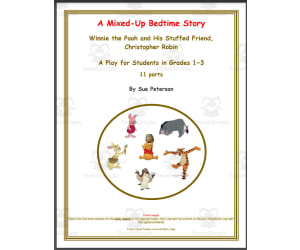
Theater - “A Mixed-Up Bedtime Story – Winnie the Pooh” is an original play written for younger grades. It could also be read as a Readers’ Theater or performed in front of an audience. There are eleven characters: a narrator, two children, Mother, Pooh, Christopher Robin, Rabbit, Tigger, Owl, Piglet, and Eeyore. Additional students in your class could help with the play in many other capacities from making the play sets to staging, creating costumes, and prompting. Synopsis: Winnie the Pooh treats his stuffed friend, Christopher Robin, to a birthday party. Rabbit, Tigger, Owl, Piglet, and Eeyore all join in to make Christopher Robin’s 8th birthday special. Your students can join in the celebration! The play opens with the children begging their mother to read another story. Mother reads the mixed-up bedtime story (which is the play). The bear is named Winnie the Pooh and he has a stuffed friend, Christopher Robin. The two run off to find some honey in the forest. Pooh realizes it is Christopher’s birthday and thinks of a plan. If you want to know the plan and how Pooh surprised Christopher Robin, you will need to read the play! The Parent/Teacher Guide at the end of the play includes class activities: questions to ask before reading the play, words to preview, and a series of questions to ask after reading the play. There are tips to perform the play and lots of extension activities to boost student interest and overall understanding of the play. Among them are to make a Venn diagram to compare the original story to the play’s mixed-up version, design a shadow box of the surprise party, draw 3-5 pictures to tell the story, or write and share their own mixed-up story of a fairy tale. The final set of student activities includes higher-level critical and creative thinking questions for students to think and reason, and adequate space to write their answers. What’s Included in Theater - “A Mixed-Up Bedtime Story – Winnie the Pooh” 11 pages with the Parent/Teacher Guide and Activities. Some Common Core Standards Aligned with This Resource Key Ideas and Details (CCSS.ELA-LITERACY.CCRA.R1-3) Includes “read closely to determine what the text says explicitly...,” “Determine central themes...summarize the key supporting details...,” “analyze...” Comprehension and Collaboration (CCSS.ELA-LITERACY.CCRA.SL1-3) Includes “Prepare for and participate effectively in a range of conversations and collaborations with diverse partners...,” “integrate and evaluate information...,” “evaluate a speaker’s point of view, reasoning, and use of evidence and rhetoric.” Conventions of Standard English (CCSS.ELA-LITERACY.CCRA.L1-3) Includes “demonstrate command of...standard English when writing or speaking,” “demonstrate command of...standard English capitalization, punctuation, and spelling...” Knowledge of Language (CCSS.ELA-LITERACY.CCRA.L3) Includes “apply knowledge of language to understand how language functions in different contexts...”
Author Sue Peterson
Tags Play, Winnie The Pooh, Reader's Theater, Scripts, Story Comparison, Bedtime Stories Winnie The Pooh, Winnie The Pooh Bedtime, Winnie The Pooh Bedtime Story
Theater - The Unhappy Princess
Creative Arts, Art, Drama, Grade 1, 2, 3, Activities
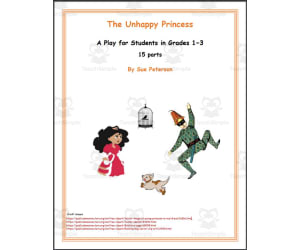
Theater – The Unhappy Princess is an original play written for students in younger elementary grades. There are 15 parts: two narrators, Princess Isabelle, Barcus the dog, Tweeters the bird, two servants, King Isaac V (Isabelle’s father), Queen Iris (Isabelle’s mother), 3 friends, Prince Ivan (Isabelle’s brother), Laugh-A-Lot the court jester, and a wizard named Wizard. Synopsis: Princess Isabelle learns about the true meaning of happiness through the help of her family, the servants and court jester, and her pets and friends. Your students in grades 1-3 will delight in reading Theater – The Unhappy Princess as a Readers’ Theater or performing as a play. Students can share parts if there are more students in your classroom or they can double-up on parts if there are too few students. Students can also play other roles during this activity from helping with learning parts to making scenery and props, arranging the props, etc. The story begins with Princess Isabelle who is very unhappy despite living in an enormous, enchanted castle with her beloved family: King Isaac V, Queen Iris, Prince Ivan, and her pet dog Barcus and bird Tweeters. She had just celebrated her eleventh birthday and invited all of the children in the Kingdom to her party. As the play continues, many people and animals try to cheer her up and make her happy. There are favorite foods, presents, friends who want to play, an invitation to visit the country fair with knights in armor slaying fire-breathing dragons, and jokes and new tricks from the court jester. When nothing seems to work to make the princess happy, Wizard visits and hands the princess a box. What’s inside the box? How does Wizard get the princess to be happy after all? You’ll have to read the play to find out. Theater – The Unhappy Princess includes a Parent/Teacher Guide filled with questions to ask before reading, words to preview, questions after reading, tips on how to perform the play, and a list of extended activities to build understanding and enhance learning. There are also student activities designed to teach the vocabulary introduced in the play and questions for student responses to ensure reading comprehension and foster critical thinking. To further understand the play, a story map activity is designed to help students identify the title, setting, characters, story problem, main events, solution, and theme or lesson. The final creative activity is for students to draw and color a picture of a prince or princess and to write their own story. 12-page resource with Parent/Teacher Guide and Answer Key.
Author Sue Peterson
Tags Theater, Drama, Teaching Resource, Script, Performance

ELA Common Core Standards: Leaping into Language Arts Grade 4
ELA, Grammar, Common Core, Grade 3, 4, 5,
ELA Common Core Standards: Leaping into Language Arts Grade 4 This comprehensive consumable book was designed for 4th grade students to learn on their own or to provide small group or whole class instruction. Comprehensive review exercises after each section help reinforce learning and build mastery. Building on the previous skills taught in Leaping into Language Arts Grade 1-3, this book extends learning about sentence structures, compound sentences, and how to combine sentences to understand and excel in communication skills. It covers more advanced areas of capitalization with fourth-grade vocabulary and words used in everyday reading and writing. Punctuation is another section covered. Simple punctuation is reviewed and more complex forms are taught. These lessons cover: • Apostrophes for ownership and contraction • Quotation marks for titles of stories, songs, and poems • Underlining titles of books, movies, TV shows, newspapers, and magazines (use of italics if writing on a computer) • Colons to separate hours and minutes and be used after greetings in a business letter • Commas in a series, addresses, greetings and closings (a friendly letter), after closings in a business letter, to set off speaking to someone, and to separate days and years in dates The section dealing with the topic of abbreviation explains how to accurately write streets and highways, measurement (English and metric), and words measuring time. The parts of speech section reviews singular and plural nouns including irregular spellings, action and linking verbs along with verb tenses, types of pronouns, the difference between adjectives and adverbs, and prepositional phrases. The section that teaches vocabulary covers grade-level synonyms, antonyms, homophones, compound words, and multi-meaning words. It teaches students how prefixes and suffixes change the meaning of words and the value of sentence clues to help them understand the text. The last section that deals with writing instructs students on three types of writing: opinion writing to share their thoughts, informative writing to explain or share some information using facts and definitions, and narrative writing to tell a story. Students can explore their creativity in creating imaginary titles for different kinds of writing. Graphic organizers teach how to break down the main idea into details and aid in helping them craft their writing. A “How to Piece” teaches students to list in order what needs to be done, for example, to blow bubbles. In teaching narrative writing, a graphic organizer is also suggested. Breaking the story into beginning, middle, and end parts will help students more readily combine their thoughts into one complete story. Specific word suggestions are taught to enhance the different types of writing. The Leaping into Language Arts Grade 4 resource is simple to use, yet very complete! Common Core Standards Aligned with the Text: Conventions of Standard English CCSS.ELA-LITERACY.L.4.1 Demonstrate command of the conventions of standard English grammar and usage when writing or speaking. CCSS.ELA-LITERACY.L.4.2 Demonstrate command of the conventions of standard English capitalization, punctuation, and spelling when writing. Knowledge of Language CCSS.ELA-LITERACY.L.4.3 Use knowledge of language and its conventions when writing, speaking, reading, or listening. Vocabulary Acquisition and Use CCSS.ELA-LITERACY.L.4.4 Determine or clarify the meaning of unknown and multiple-meaning words and phrases based on grade 4 reading and content, choosing flexibly from a range of strategies. CCSS.ELA-LITERACY.L.4.5 Demonstrate understanding of figurative language, word relationships, and nuances in word meanings. CCSS.ELA-LITERACY.L.4.6 Acquire and use accurately grade-appropriate general academic and domain-specific words and phrases, including those that signal precise actions, emotions, or states of being (e.g., quizzed, whined, stammered) and that are basic to a particular topic (e.g., wildlife, conservation, and endangered when discussing animal preservation). What's Included A total of 244 pages.
Author Sue Peterson
Tags Language Skills, Grammar Instruction, Parts Of Speech, Vocabulary Acquisition, Writing Practice

ELA Common Core Standards: Leaping into Language Arts Grade 2
ELA, Grammar, Common Core, Grade 1, 2, 3,
Leaping into Language Arts Grade 2 offers a complete year of language instruction covering first-grade Common Core ELA Standards. Each section has its own review of the skills taught. There is an Answer Key at the end of the book. Designed for any type of instruction from remedial to enrichment, and easily used by individuals, small groups, or the entire class in regular and special education, ESL, gifted/talented, and homeschool programs, the resource is well worth the look! What’s more? It is also perfect for brushing up on grade-level skills. Let me share with you how the book is organized. At the top of each new topic page, there is a carefully crafted lesson. The lesson is introduced in bite-size kernels of knowledge with kid-friendly examples. Practice exercises follow the lesson. Each lesson in the section builds on the previous lesson(s). The student has an opportunity to show what they have learned in the Review at the end of each section. The Review has a simple explanation at the top of the page comprised of key concepts taught within that section. Then there are questions ranging from multiple choice to fill-in-the-blank and extended expression to assess learning. Leaping into Language Arts Grade 2’s targeted sequential lessons not only help to build language learning one skill at a time but also increase the child’s confidence. As the students proceed through the topics, mastery is ensured. They take a leap in learning! Key Topics Covered Types of sentences, turning fragments into sentences, and adding conjunctions (and, but, or) to join two sentence parts into one longer well-written sentence. Words that should be capitalized in English (from days, months, and holidays to specific places, titles of people, and titles of text) Punctuation (commas, apostrophes, colons, quotation marks, underlining, italics) and their many uses Abbreviating words used in the second-grade vocabulary and everyday use: days of the week, months of the year, streets and highways, measurement terms, and states/provinces/territories Parts of speech: common and proper nouns, how to make plural nouns, simple verb tenses, types of pronouns, and adjectives Vocabulary extension with multi-meaning words and adding prefixes and suffixes to change the meaning of words, etc. Writing: determining the main idea and supportive details, distinguishing between facts and opinions, exploring narratives, and choosing the perfect word for a text Common Core Standards Aligned with the Text: Conventions of Standard English CCSS.ELA-LITERACY.L.2.1 Demonstrate command of standard English grammar conventions and usage when writing or speaking. CCSS.ELA-LITERACY.L.2.2 Demonstrate command of standard English capitalization, punctuation, and spelling conventions when writing. Knowledge of Language CCSS.ELA-LITERACY.L.2.3 Use knowledge of language and its conventions when writing, speaking, reading, or listening. Vocabulary Acquisition and Use CCSS.ELA-LITERACY.L.2.4 Determine or clarify the meaning of unknown and multiple-meaning words and phrases based on grade 1 reading and content, choosing flexibly from an array of strategies. CCSS.ELA-LITERACY.L.2.5 With guidance and support from adults, demonstrate an understanding of word relationships and nuances in word meanings. CCSS.ELA-LITERACY.L.2.6 Use words and phrases acquired through conversations, reading and being read to, and responding to texts, including using frequently occurring conjunctions to signal simple relationships (e.g., because). What's Included A total of 209 pages.
Author Sue Peterson
Tags Grammar Instruction, Language Skills, Worksheets, Common Core Standards, Vocabulary Acquisition

Butterflies Phonetic Decodable Reader
Special Resources, ELA, Special Education Needs (SEN), Language Development, Pre-Reading, Phonics, Reading, Kindergarten, Preschool, Grade 1,
About This Product This Butterflies easy reader is great for children who are just learning to read longer books using their knowledge of phonics. Children can learn about the lifecycle of a butterfly while they develop their reading skills. This is important for children who need to learn to integrate their new skills into their reading. The child is supported to read fluently as the book only uses commonly taught sight words and all other words are decodable. This gives the child much-needed confidence to read. This book provides factual information through fiction - read how Pam finds some butterfly eggs on a leaf in the garden. It can be used alongside a project on butterflies, spring, or stand-alone. It can be used with any programme once a child has learned the basic digraphs and trigraphs. This includes after Phase 5 of Letters and Sounds and after RWI Speed Set 3. Who is it for? It is ideal for use in the classroom, for ESL/EFL, or for home education It can be used with children aged 5 to 7, or with older struggling readers, especially those with special needs/dyslexia. Parents teachers and private tutors can use it - anyone who needs it! Main features: Phonetic language It is written in a clear font and has plenty of drawings and original photos to aid understanding. The sight words that are most likely to need practising are listed at the beginning of the book for practice before the book is read. It features original artwork and photographs. How can it be used? This easy reader about Butterflies can be used with individual students, for guide reading with small groups, or shared with pupils online. It can be sent home with children for home-learning. It can be blown up large for guided reading with a whole class or group It can be used alongside a project spring or insects, or as a stand-alone reader What is included? 1 PDF with 12 A5 pages: Print as a booklet, side fold on three sheets of paper. More! This book is one of a series. You can find more of such books in the Lilibettes Resources Store: https://teachsimple.com/contributor/lilibettes-resources Snails Frogs The Song Thrush Lifecycle of an Apple Tree Conkers Rabbits What is included? 1 PDF book with 12 pages. Print as a booklet, and flip on the short edge.
Author Lilibette's Resources
Tags Decodable Reading Book, Phonic Reading Book, Decodable Reader, Butterflies, Butterfly Lifecycle, Spring, Phase 5 Reading Book, RWI Stage 3 Set E Reader
Remediation Plan: Graphing, Patterns, and Probability
Math, Patterns, Graphing, Statistics, Grade 2, 3, 4, Teacher Tools, Lesson Plans, Activities
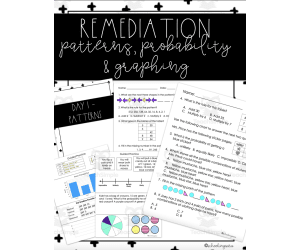
Patterns, Probability, and Graphing 5 Day Small Group Remediation Plan An insightful teaching resource designed to enhance math instruction. Ideal for students in Grades 2 - 4 , this plan focuses on: Patterns Graphing Probability The plan spans over five days, with a distinct topic each day. The first day delves into the subject of patterns. The second day addresses graphing techniques. The third & fourth days specialize on probability. A systematic approach for incremental comprehension.Inclusion of teacher directions help execute lessons effectively. Great for small group or whole-group remediation strategies! Daily Plan: Teacher Directions Laying out clear steps to implement lessons. Guided Practice Pages Promote real-world application of new learning. Independent Practice Sheets List Item Give plenty of opportunities to students for applying concepts. The fifth-day concludes the week with review sessions and exit ticket activity - building solid groundwork while helping you gauge every student's progress accurately!. A convenientAll-in-one slideshow is included!. It can be used during practice sessions and also contains answer keys making grading easier! Prepared considering Virginia's SOL standards Grade 3 This resource features multiple file types- A versatile tool for diverse teaching platforms To sum it up , ‘Pattern, Probability And Graphing’ is an excellent instructional tool that guarantees student engagement and tangible progress! .
Author SchoolingSara
Tags Patterns, Probability, Graphing, Small Group Remediation, Math Instruction

Remediation Plan: Identify Fractions, Mixed Numbers, Compare and More
Math, Fractions, Grade 2, 3, 4, Teacher Tools, Lesson Plans
Fractions 5 Day Remediation Plan (VA SOL 3.2) The Fractions 5 Day Remediation Plan (VA SOL 3.2) is a well-structured teaching resource, impeccably designed for educators working towards enhancing their students' understanding of fractions. This package ideally accommodates the needs of grades two to four public school teachers looking for effective supplementary materials as well as homeschooling families in search for structured lesson plans on fractions. What's Inside? In-depth five-day remediation plan addressing various facets of dealing with fractions - ranging from identifying and comparing fractions to handling improper fractions, mixed numbers and plotting fractions on a number line. Each day's topic is meticulously compiled to offer comprehensive learning which encompasses clear instructions, complete lesson plans and specific practice sheets rooted towards that particular aspect. An important feature of this product is an independent practice sheet paired with every day's learning materials. This enables real-time evaluation of student progress while providing immediate feedback or extra assistance if needed. The Final Day Moving onto the fifth day, you will find a splendid opportunity to assess overall comprehension through a 10 question exit ticket enclosed within the resource bundle. Reviewing at least two questions from each covered topic during those study days will reveal students' level of understanding after four focused days onto fraction-related themes. Versatility & Correctness This package offers versatility too! Teachers can adapt these resources according to individual classroom needs – whole group discussions or small-group activities are feasible options while even assigning them as individual homework won't miss its mark due its elaborate design. Worried about grading correctness? Fear not! Reliable answer keys have been purposely embedded along all independent practice sheets adjacent to exit tickets. This smoothly leads you through the ambitious 24-page PDF file collection, brimming with learning enrichment opportunities all focused on mathematics across relevant grade levels. Final Thoughts Of note that although it aligns strongly with the VA SOL Math standards (3.2), other educators bearing equivalent grade construct math program could potentially garner considerable benefit from this product, especially those focusing majorly on fractions as part of their curriculum . The Fractions 5 Day Remediation Plan (VA SOL 3.2) stands out as an invaluable resource for anyone aiming to bolster their remedial or even mainstream teachings on fractions within the math education spectrum.
Author SchoolingSara
Tags Fractions, Remediation, Lesson Plans, Practice Sheets, Understanding
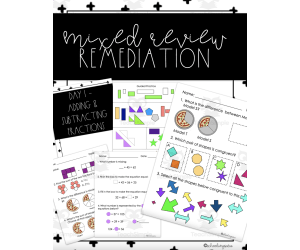
Remediation Plan: Adding Fractions, Congruent Figures, & Equations
Math, Addition and Subtraction, Addition, Algebra, Subtraction, Fractions, Geometry, Grade 2, 3, 4, Teacher Tools, Lesson Plans, Activities
Add & Subtract Fractions, Congruency & Balancing Equations Remediation Add & Subtract Fractions, Congruency & Balancing Equations Remediation is a five-day learning module designed for Grade 2 to Grade 4 educators that focuses on key math concepts. Although aligned mainly with the Virginia SOL education system, its universal content makes it an excellent resource for teachers from any location. The plan covers various subjects including addition, algebra, subtraction, fractions and geometry. Each day presents a strategy towards improving student comprehension. Day 1: Adds and subtracts fractions with insightful teacher directions assisting smooth delivery of lessons. This is followed by guided practice and independent practice pages that help consolidate learner knowledge. Day 2: Introduces congruent and non-congruent figures—a concept made accessible through clear directions and engaging tasks provided in the module. Days 3-4: Delve into balancing equations—an algebra concept important in clarifying addition and subtraction operations within equations—with practical activities aiding mastery over these topics. Day 5: Concludes with a careful review of preceding math topics before testing learner grasp through an exit ticket challenge. It ensures reinforcement in knowledge transition to higher level mathematical concepts becomes smoother moving forward. Leveraging this tool You can utilize this tool effectively for whole-group instruction or divide it amongst smaller groups—it's flexible! Its potential extends beyond classroom boundaries too; It's also beneficial for homeschooling parents seeking comprehensive yet concise lesson plans . If you are looking to strengthen fraction skills or balance equations better among your students or just need refreshing instructional strategies—Add & Subtract Fractions Congruency & Balancing Equations Remediation is a must-have resource in your teaching toolbox.
Author SchoolingSara
Tags Fractions, Congruency, Balancing Equations, Geometry, Math Concepts
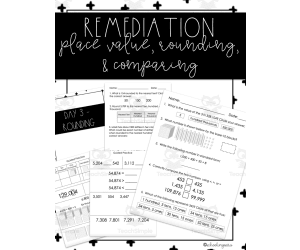
Remediation Plan: Rounding, Place Value, Comparing & Ordering Numbers
Algebra, Math, Addition and Subtraction, Addition, Numbers, Place Value, Grade 2, 3, 4, 5, Teacher Tools, Lesson Plans, Activities
Need to review number sense - place value, rounding, comparing, and ordering numbers - in small groups? Included in this product is a five-day remediation plan (based on the VA SOL 3.1) that reviews the topics over four days, with an exit ticket for the fifth day. Each day comes with a lesson plan, guided practice activities, and then independent practice activities. The final day is an exit ticket, checking for student understanding of the topics after the four days of review. Also included is a teacher slide show to help teach the concepts to your groups - it matches the guided practice. While this product is geared towards the 3rd grade Virginia SOLs, it is usable by any grade level or location teaching place value, rounding, comparing numbers, and ordering numbers. An answer key is provided for the independent practice and the exit ticket. What's Included: Day 1 - Place Value Day 2 - Rounding Day 3 - Rounding - including rounding on a number line Day 4 - Comparing and Ordering Numbers Day 5 - review and exit ticket If you need a math notebook to go along with the place value lesson, check this out: Place Value, Rounding, and Comparing (VA SOL 3.1) Need more low-prep or no-prep math activities? Check these out: No Prep Spiral Math Daily Review and Quizzes Identifying Money Practice Counting Money Practice Area and Perimeter Digital Activity October No-Prep Math Activities Comparing Money Practice 1 Like what you see? Check out my other math notebooks: Identifying and Comparing Fractions (VA SOL 3.2) Solving Word Problems (VA SOL 3.3) Multiplication and Division (VA SOL 3.4) Adding and Subtracting Fractions (VA SOL 3.5) Identifying, Counting, and Comparing Money and Making Change (VA SOL 3.6) Measuring Length and Capacity (VA SOL 3.7) Area and Perimeter (VA SOL 3.8) Telling Time, Equivalent Time, and Elapsed Time (VA SOL 3.9) Measuring Temperature (VA SOL 3.10) Lines, Rays, Angles, Points, and Line Segments (VA SOL 3.11) Identifying, Combining, and Subdividing Polygons (VA SOL 3.12) Congruent and Non-congruent Figures (VA SOL 3.13) Probability (VA SOL 3.14) Bar graphs and Pictographs (VA SOL 3.15) Patterns (VA SOL 3.16) Balancing Equations (VA SOL 3.17)
Author SchoolingSara
Tags VA SOL, SOL, Remediation, 3.1, SOL 3.1, Place Value, Rounding, Comparing, Ordering
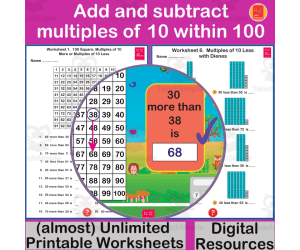
Add and subtract multiples of 10 within 100 - 1st Grade
Math, Addition and Subtraction, Addition, Subtraction, Grade 1, 2, Worksheets & Printables, Worksheets
For educators and homeschoolers searching for an efficient way to teach students about the concept of adding and subtracting multiples of 10 within 100 - 1st Grade resource will be a valuable asset! Designed with ease of use in mind, it offers no-prep worksheets, complemented by interactive teaching pages ideal for whiteboard-based lessons. This combination ensures pupils can mentally find multiples of 10 more or 10 less than a two-digit number, steering clear of tedious counting. Moreover, the materials help with the connection between numerical operations and the terms 'more' and 'less'. This resource comes with 8 sets of worksheets! The first two worksheet sets use the familiar 100 Square. This approach lets students confirm their answers by merely shifting rows, facilitating an intuitive grasp of the subject. These sets incorporate twenty questions, are framed as "more than" or "less than" in Set 1 and equation-based challenges in Set 2 The subsequent four sets (Sets 3 – 6 ) emphasize Base 10 Blocks, offering a tangible visual aid to reinforce understanding. Each of these sets introduces eight equations, varying from adding to subtracting 10, or finding 10 more or less. Thus providing a total of 32 equations. To test the waters without visual aids, Set 7 and Set 8 extend the challenge. While the seventh is direct, the eighth worksheet pushes students further by prompting them to discern the first addend when presented with the result. A standout feature is the worksheet randomization. With a single click, educators can generate an entirely new set of questions, making it a renewable resource for the entire school year. Be it for classwork, revision, or homework, adaptability ensures students achieve proficiency in the topic. Each worksheet concludes with an automatically generated answer key on its second page, offering a quick reference point for educators. And if there's ever a need for a last-minute lesson or work for a substitute teacher, these sheets are a reliable fallback. The Adding and subtracting multiples of 10 within 100 - 1st Grade Interactive Teaching Pages is an excellent fit for collective classroom exercises. These pages grant real-time feedback. Students can manipulate numbers on the 100 Square or employ Dienes/Base 10 Blocks, depending on the chosen module. The built-in calculator feature ensures answers are only a click away. Lastly, it's essential to note that these resources can be downloaded as PDF documents. They operate seamlessly with the official Adobe Acrobat Reader on both Windows and Mac. Plus, the randomizing features are effortlessly accessible via touchscreen devices or interactive whiteboards.
Author Jeff's Notebooks
Tags Math, Add, Subtract, 1st Grade, First Grade, Multiples Of 10, Within 100, Multiples Of 10 Less Than, Multiples Of 10 More Than, Jeff's Notebooks

ELA Common Core Standards: Leaping into Language Arts Grade 1
ELA, Grammar, Common Core, Preschool, Grade 1, 2,
ELA Common Core Standards: Leaping into Language Arts Grade 1 This ELA Common Core Standards: Leaping into Language Arts Grade 1 is a comprehensive and engaging digital educational resource, specifically designed for first-grade students as part of a series of consumable books from grades 1-5. This valuable tool focuses on six essential grammar areas: sentences, capitalization, punctuation, abbreviations, parts of speech, and vocabulary. Expertly put together by an experienced educator, the lessons provide an enthralling experience that excels in strengthening core skills that are certain to increase your students' growth and development in their writing abilities. With its adaptability for use in classrooms or small groups and the option for independent practice, too – this resource provides an unparalleled learning tool. This inclusive package features an Answer Key to make assessment stress-free while guiding your students through important topics like telling sentences; capitalizing days/months/holidays; singular/plural nouns; and understanding synonyms/antonyms/homophones. We've got you covered! Leaping into Language Arts Grade 1 aligns seamlessly with Common Core Standards under Conventions of Standard English (L.1.1 & L.1.2) and Vocabulary Acquisition (L.1.4 to L.L.L16). There's no better single language arts aid available to instruct your first graders! For more advanced students or to extend learning, check out the second-grade language arts product at teachsimple.com/product/ela-common-core-standards-leaping-into-language-arts-grade-20 What's Included A total of 129 pages.
Author Sue Peterson
Tags Minilessons, First Grade CCSS, Sentences, Capitalization, Punctuation
Language Arts with Common Core Standards BUNDLE (Grades 1-5)
ELA, Grammar, Common Core, Grade 1, 2, 3, 4, 5,
Language Arts with Common Core Standards BUNDLE (Grades 1-5) Get ready to dive into the world of language arts with our engaging and comprehensive digital bundle, Leaping into Language Arts! Designed for students in grades 1-5, this collection encompasses instruction in grammar usage, mechanics, parts of speech, vocabulary, and writing – all tailored to Common Core Standards. The step-by-step grade-level books cover a wide range of essential skills like sentence structure, capitalization rules, and punctuation tips. Students can expect to hone their vocabulary through lessons on synonyms & antonyms while also discovering the nuances of homophones and compound words. Additionally, they'll analyze prefixes/suffixes as well as explore Greek and Latin roots. But learning doesn't stop here! This resource guides students in various writing techniques that will help them grow as proficient writers. They'll gain exposure to different styles of writing while perfecting their narration skills, further enhancing their overall communication competence. Boasting an impressive 1,076 pages across the five workbooks in the bundle, we've made sure each grade level is accompanied by corresponding Common Core Standards for effortless lesson planning. Elevate your students' language art skills with our captivating Leaping into Language Arts bundle today! What's Included A total of 1,076 pages and Answer Keys
Author Sue Peterson
Tags Minilessons, Grammar, ELA CCSS, Writing, Vocabulary

Kindergarten (A-B): Nature and Science Topics
Science, Basic Science, Preschool, Worksheets & Printables, Worksheets
Leveled Books: Kindergarten Grade Level A-B The Kindergarten Level A-B Nature & Science Topics collection consists of 11 leveled books that can enhance your ELA or Science instruction. These original books cover fun and interesting topics to include: Level A – The Tan Cat, The Bug, The Sun, The Big Pig, The Zoo, The Hen Level B – My Five Senses, The Weather, Stars, My Body, and The Gray Cloud The books and activities can be used to address the Kindergarten ELA Standards, specifically Reading Informational Text and Informational Text. Several of The Next Generation Science Skills for Kindergarten are aligned with the text (e.g., animals and their habitat; what is the weather like; and what living creatures need to survive and the relationship between their needs and where they live). 1-3 activity pages are included with each book to reinforce reading comprehension, vocabulary development, writing skills, and science concepts. To help with instruction, the teaching objectives, sight words, and targeted vocabulary words are listed on the first page of each story. The resource totals 23 pages. Also for sale on Teach Simple are additional leveled books written by this author in Grade Level Collections through sixth grade and Thematic Collections (Social Studies Topics, Famous African-Americans in U.S. History, Famous Women in History). Besides the 450+ leveled books, 50 original creative plays for elementary-aged children and a comprehensive Language Arts Series (Grades 1-5) are also available. The plays and language arts books can be purchased individually or in various bundles.
Author Sue Peterson
Tags Nature Topics, Science Topics, Literacy Skills, Targeted Vocabulary, Balanced Literacy, Kindergarten Science Themes, Kindergarten Science Concepts, Science Topic For Kindergarten, Science Topics For Kindergarten, Kindergarten Science Topics

Character Trait Writing Prompts | Positive Personal Qualities
ELA, Writing, Grade 3, 4, 5, Writing Prompts, Worksheets & Printables
Character Trait Writing Prompts | Positive Personal Qualities | Writing Project Character Trait Writing Prompts | Positive Personal Qualities | Writing Project is an instructive tool crafted to ignite discussion, generate creative writing ideas, and facilitate self-exploration among 3rd to 5th-grade students. This distinctive resource catalyzes character trait interaction mixed with writing cues to help pupils understand and convey their character traits more abstractly. The product comes packed with over 30 personalized character prompt traits. Each trait, including kindness, bravery, wisdom, sensitivity among others selected for its educational prowess is designed for students to examine these awe-inspiring characteristics through the school year. How it works? The process is straightforward - educators choose a personality trait for classroom discourse or homework. They then distribute the corresponding writing prompt that encourages pupils to think about what this quality means in their lives; how they interpret its application in real-life scenarios Broad Application Within Education: Aimed at enhancing language arts curriculums via enjoyable yet insightful worksheets. Ideal for whole-class sessions or small-group discussions. Craft long-term study projects focusing on various virtues across the academic calendar. Detailed Package Contents: This pack is delivered as a single PDF containing 30 printable pages brimming with rich conversational material about positive personality traits paired with intricate writing assignments inspired by them. Suitability: Mainly suitable for teachers in need of teaching resources that engagingly merge human virtues conversation and exploratory writing tasks leading towards better decision-making skills after understanding one's strengths..
Author Simply Schoolgirl
Tags Character Traits, Writing Prompts, Personal Qualities, Positive Qualities, Creative Thinking
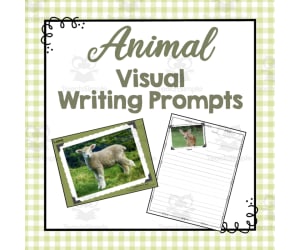
Animal Visual Writing Prompts | Photo Ideas | Writing Project
ELA, Writing, Grade 2, 3, 4, 5, Writing Prompts, Worksheets & Printables
These picture writing templates are a cute way to give your students a nudge or idea about what they can write about. Have them study the picture and then let their pencils loose as they write about what they see, what the picture might mean, or build a story based on the photo. These are great to use as open-ended prompts that encourage their giggles and creativity! How To Use This: Choose which photo templates you’d like to share with your students or put our several options and let them pick one that interests them. Have some classroom or small group discussions about the picture and brainstorm what they could write about. These prompts work great for homework, early finishers, group projects, extra credit, supplemental work for advanced students, or just a fun writing project to interject to stretch those imaginative muscles! What You Get: · 26 Animal Photo Prompt Cards (full page photograph) · 26 Writing Prompt Templates · 26 “Add a Caption” Activities · 26 Early Writer Templates Take a Look at Other Writing Resources: How to Make an Apple Pie Writing and Sequencing Activity Postcards of Europe Geography Unit Baby Birds Nonfiction Early Reader Animals of Australia Geography Unit All About Turtles Animal Science Unit Bark, George Picture Book Study Check out other resources from my store: Simply Schoolgirl! I can be contacted for questions and concerns at simplyschoolgirl1@gmail.com
Author Simply Schoolgirl
Tags Animal Visual, Animal Photos, Photo Ideas, Writing Projects, Writing Prompts, Early Writer, Writing Template, Writing Captions, Photograph, Picture

Adventure Visual Writing Prompts | Photo Ideas | Writing Project
ELA, Writing, Creative Writing, Grade 2, 3, 4, 5, Writing Prompts, Worksheets & Printables
These picture writing templates are a cute way to give your students a nudge or idea about what they can write about. Have them study the picture and then let their pencils loose as they write about what they see, what the picture might mean, or build a story based on the photo. These are great to use as open-ended prompts that encourage their giggles and creativity! How To Use This: Choose which photo templates you’d like to share with your students or put our several options and let them pick one that interests them. Have some classroom or small group discussions about the picture and brainstorm what they could write about. These prompts work great for homework, early finishers, group projects, extra credit, supplemental work for advanced students, or just a fun writing project to interject to stretch those imaginative muscles! These are great to print ahead of time and have a giant stack ready to use to fill in time, add to work notebooks, or supplement activities you've already planned. What You Get: ·26 Adventure Photo Prompt Cards (full page photograph) ·26 Writing Prompt Templates ·26 “Add a Caption” Activities ·26 Early Writer Templates Take a Look at Other Writing Resources: How to Make an Apple Pie Writing and Sequencing Activity Postcards of Europe Geography Unit How to Make a Peanut Butter Sandwich Writing and Sequencing Activity Trace A Story Handwriting Practice Preschool Animal Posters Doodle Art Prompt Packet Check out other resources from my store: Simply Schoolgirl! I can be contacted for questions and concerns at simplyschoolgirl1@gmail.com
Author Simply Schoolgirl
Tags Adventure, Photo Ideas, Writing Project, Small Group Discussion, Writing Templates, Writing Prompts, Photo Templates, Photograph, Picture, Activity

Classroom Money Templates, Positive Reward System, Classroom Economy
, Not Grade Specific, Templates, Teacher Tools
Teach math fluency and financial literacy in your classroom with these realistic dollar bill templates . ✏️ Denominations include: $1, $2, $5, $10, $20, $50, $100 bills Applies to various grade levels and ages for "play" or learning Can be used for a variety of math standards Google Slides format (layer image behind bills for cohesion) Flexible use: Classroom economy, PBIS, money units, etc. Get started in 3 quick and easy steps! These dollar bill templates are realistic to give students a real life experience. Use them for your classroom economy, positive reinforcement, community building, or for directed math learning such as money units. Using manipulatives provides students an opportunity to develop fine motor skills as well as practice handling money in a safe environment. Students and teachers love the customizability of these templates . Add your BitMoji, your students' faces, or another picture that symbolizes your class! Change them every year or stick to a classic design. What past customers have said: "Love this template! I was easy to add pictures. I had my students take selfies (they chose funny close-ups)! The students traded their faces like Pokemon cards. This is a great template for a behavior incentive or even teaching students about money." "I knew I wanted to do class economy this year. We started the year just using money that closely resembled monopoly money. The farther into the year the more I saw a gap in my students understanding of REAL MONEY. So I switched to these and not only do they love that my face is on them, but they are also starting to grasp the concept of the values and making change. They are learning and they dont even know it!" Tips for printing: If you are having issues printing, users have found success using paint to print or a different printer Thank you for checking out this resource!
Author Teaching Reimagined
Rating 2
Tags Classroom Money, Class Economy, Positive Reward System, Editable Bills, Positive Reinforcement, Math Skills, Life Skills, Financial Literacy, Class Management, Play Money