



2,688 products added recently
Page 16 - Science Assessments
Provide comprehensive science assessments covering biology, chemistry, physics, and Earth science. This collection includes lab reports, concept checks, and experimental evaluations. Foster a deeper understanding of scientific principles by using targeted assessments.

 Show filters


Science Reading on Ocean Exploration and Natural Resources (Fillable)
Science, Earth and Environmental Sciences, Earth Sciences, Common Core, ESL, Language Development, ELA, Vocabulary, Reading Comprehension, Reading, Grade 5, 6, 7, Worksheets & Printables, Worksheets, Assessments, Teacher Tools, Tests, Quizzes and Tests
Reading Passages on Ocean Exploration and Natural Resources for Earth Science Part 2 - Ocean Exploration & Natural Resources Reading Passage 1: Natural Resources Reading Passage 2: Ocean Exploration Reading Passage 3: Ocean Resources Snapshot Title: Title not stated. Genre: Nonfiction. Subject: Science / Earth Science / Ocean Science. Primary Topic: Natural resources, ocean exploration, and ocean uses. Estimated Guided Reading Level (A–Z): V. What This Teaches Best It clearly distinguishes nonrenewable, renewable, and reusable resources and explains why conservation matters. It teaches how people explore the ocean using ROVs, AUVs, sonar, and satellites. It explains major ocean-floor features and ocean life zones, from continental shelves to the hadal zone. It shows that oceans provide biological and physical resources such as food, medicines, minerals, water, and fossil fuels. It connects ocean resources to stewardship by discussing overfishing, pollution, habitat protection, and responsible use. Learning Goals Students will classify resources as nonrenewable, renewable, or reusable using examples from the text. Students will describe the tools scientists use to explore and map the ocean. Students will explain how ocean zones differ in light, depth, and living things. Students will identify important biological and physical resources that come from the ocean. Students will explain why conservation helps protect natural and ocean resources for the future. FULL CATALOG OF DOWNLOAD LINKS HERE Grade 5/6 Links: Physical Science Part 1 - Physical and Chemical Properties Google Docs/Slides/Forms PDF PPT Word Free Supplementary Pack Accompanying Videos Physical Science Part 2 - Motion and Energy Google Docs/Slides/Forms PDF PPT Word Free Supplementary Pack Accompanying Videos Physical Science Part 3 - Electricity and Magnets Google Docs/Slides/Forms PDF PPT Word Free Supplementary Pack Accompanying Videos Life Science Part 1 - Cells, Reproduction and Genetics Google Docs/Slides/Forms PDF PPT Word Free Supplementary Pack Accompanying Videos Life Science Part 2 - Human Body Systems Google Docs/Slides/Forms PDF PPT Word Free Supplementary Pack Accompanying Videos Life Science Part 3 - Plant Parts and Ecosystems Google Docs/Slides/Forms PDF PPT Word Free Supplementary Pack Accompanying Videos Earth Science Part 1 - Plate Tectonics and Rock Cycle Google Docs/Slides/Forms PDF PPT Word Free Supplementary Pack Accompanying Videos Earth Science Part 2 - Ocean Exploration and Natural Resources Google Docs/Slides/Forms PDF PPT Word Free Supplementary Pack Accompanying Videos Earth Science Part 3 - Weather and Solar System Google Docs/Slides/Forms PDF PPT Word Free Supplementary Pack Accompanying Videos For similar products and other frees, do check out Cored Group on TeachSimple .
Author Cored Education
Rating
Tags Science, Elementary, Reading, Comprehension, Vocabulary, Answers, Physics, Physical Science, Earth Science
Discovering United Kingdom: Guided Reading Level Q with Lesson Plan
ELA, Resources for Teachers, Reading Comprehension, Reading, Science, Geography, Social Studies, History, Life Sciences, Earth and Environmental Sciences, Grade 3, 4, 5, Worksheets & Printables, Worksheets, Teacher Tools, Centers, Activities, Literacy Readers, Quizzes, Quizzes and Tests, Assessments, Lesson Plans
This Discovering the United Kingdom (level q) guided reading book with lesson plan includes: Guided Reading Color Label (front cover x1) This is a quick way to match the book’s demands to what students can generally handle.. The overall goal is to use the level/color to pick books for several smaller groups. To qualify for a certain level, a student is expected to read a book from that level with about 90–94% accuracy. If a student is consistently accurate and understands, move up a level. If the student is struggling at that level, drop down and add more support. Each student will improve at completely different rates, but it is generally one of the best ways to check progress across the class. DOWNLOAD THE CATALOG TO VIEW ALL GUIDED READING BOOKS AVAILABLE (SORTED LEVELS A-Z) Pre-Reading Question (x1) Teacher asks the prompt aloud, can be while showing the cover or first page. Students share what they already know, or make educated guesses from the cover. Prompt them to use the target vocabulary. Write some of their responses on the board to look back at during the reading. Vocabulary Words (x5) Introduce the five words, best doing it one at a time. Start by saying it, while students repeat and then see if anyone knows what it means before reading further. Read through the meaning and try to briefly connect each word to a picture or gesture so it’s meaningful. Ask students to flip through the book pages and point to where they see each of the vocabulary words. While reading the book pause upon coming across one of the vocab words or read the sentence twice to make sure students understand the word has appeared. Optional: Ask students to raise hands whenever they see/hear one of the new words. Guided Reading Pages (x10) Check the book snapshot (below) for: primary topic - do you need to prep extra reading or intro materials on this? what is taught best - decide on 1-2 bullets to focus on, use the prompt or words provided here for best results. learning goals - what you are checking for students to be able to do after the session, elicit answers using prompts or words provided. key vocabulary (see section above). questions overview - so you know what is coming up and if you need to prep extra materials to assist understanding. Run the lesson You may have already looked at a few of the pages together, but you can show them some of the pictures again first to set meaning. Depending on how much time you have and how familiar your students are with guided reading class, you may want to read the book aloud first with the group first. Students whisper or partner read, while you listen in. If time, do it as a group, one student reading a page each. Use the guided page’s prompts to coach: “Check the picture / does it make sense?” “Point under the words / try the first sound” “Reread the sentence smoothly”. Try to focus more on one student per session (rotating every time), so you can work out if they are ready to move up or need to move down a level. Comprehension Questions (back cover x3) This is your way to check that students didn’t just say the words, but actually understood the text. First, let students answer by pointing to the page/picture and saying a short sentence. After any answer, follow with: “Show me where you found that in the text.” In bigger groups, have partners answer first (10–20 seconds), then call on 2–3 students to share. Differentiation tips: Emerging speakers/struggling readers: oral + pointing On-level: oral in a full sentence Higher: one written sentence or draw + label Book Snapshot Title: Discovering the United Kingdom Genre: Nonfiction Subject: Social Studies (Geography, Government, Culture) Primary Topic: The UK’s nations, landmarks, climate, and culture Estimated Guided Reading Level (A–Z): Q What This Book Teaches Best Introduces the United Kingdom as a union of four countries and explains that each has its own traditions and landscapes. Builds geography knowledge by describing where the UK is located and by highlighting regional features in Scotland, Wales, and Northern Ireland. Teaches civics basics by explaining the UK’s constitutional monarchy and that the elected Parliament makes laws. Connects history and landmarks through examples like Stonehenge and major places in London along the River Thames. Explains how climate supports wildlife and gives an example of conservation connected to the red squirrel. Learning Goals Students will identify the four countries that make up the United Kingdom using details from the text. Students will describe why London is important in the United Kingdom and name one detail about the River Thames from the text. Students will describe key physical features of Scotland and explain what “lochs” are using the text’s description. Students will describe two details the text gives about Wales, such as its landscape, castles, or language. Students will explain how the text describes the UK’s government and who makes laws. Students will explain how the UK’s temperate climate is described and name one effect it has on wildlife. Key Vocabulary From the Text sovereign — able to govern itself. distinct — clearly different. interspersed — spread in between other things. constitutional — based on rules for how a country is run. prehistoric — from before written records. Discussion Prompts Pre-reading question: When you hear “United Kingdom,” what places or facts do you expect to learn about? Comprehension questions: What four countries does the text say make up the United Kingdom? Comprehension questions: What does the text say about who makes laws in the United Kingdom? Comprehension questions: What are two details the text gives about Scotland or Wales? Printing Tips 1. Best Printing Method (Recommended) “Booklet” Printing (Best if Available) If your printer or PDF viewer supports Booklet Printing , use this. Settings to use: Print mode: Booklet Paper size: Letter or A4 (either works) Orientation: Landscape Print on both sides: Yes Flip on: Short edge Scaling: Fit to printable area Booklet subset: First test: Front sides only Then: Back sides only This will automatically: Pair pages correctly Put the cover on the outside Align everything for folding After printing, fold in half and staple along the spine . 2. If “Booklet” Printing Is NOT Available You can still print this correctly with manual duplex printing . Step-by-step: Open the PDF. Choose Print . Set: Orientation: Landscape Pages per sheet: 1 Print on both sides: Yes Flip on: Short edge Print all pages . Because each PDF page already contains two facing book pages, the result will still fold cleanly into a book. Thousands of Cored Education products are included with your TeachSimple membership. Download links and encyclopedia index available here.
Author Cored Education
Rating
Tags Reading Comprehension, Reading Passages, Reading, Guided Reading, Guided Reading Lesson Plan, Guided Reading Activity, Pre-reading, Social Studies, Geography, History
Video Games Reading Comprehension Passage - Cored Ed Encyclopedia
ELA, Language Development, Reading Comprehension, Reading, Pre-Reading, Science, Technology, Engineering, History, Social Studies, Grade 2, 3, 4, 5, Worksheets & Printables, Worksheets, Teacher Tools, Centers, Activities, Writing Prompts, Assessments, Quizzes and Tests, Quizzes, Lesson Plans
This video games reading comprehension with lesson plan includes: Visualization (on the front cover) Start your lesson by taking a minute to think and share something about the topic. Read the script aloud (slowly), perhaps prepare some music or sound effects. Student close their eyes and let their imaginations wander. Students open their eyes, read the question aloud and give them a few minutes to complete. Ask a few students to share or keep answers until the end to compare with what they learn in the passage. Quick pause—thousands of Cored Education products are included with your TeachSimple membership. Download links and encyclopedia index available here. Pre-Reading Trivia Students will write down one thing they already know about the subject and then read five more facts and discuss. These facts are fun, and the students will enjoy learning about the subject before reading more. Give 1 minute for students to write what they already know (no pressure—best guess is fine). Read the five facts together. After each fact, do ask a student for their opinion, was it surprising? Set a purpose by asking students to highlight/underline one fact they want to learn more about during the reading. Reading Passage The text is a high-interest reading passage with set paragraphs, roughly three to four paragraphs long. It contains a variety of themes about the topic, anywhere from history to technology. The passage is between 250 and 350 words in length. First, ask students to look at the headings and see what they’ll learn about today. What do they know about the topic/heading? First read options: Teacher read-aloud (best for support). Partner reading (paragraph by paragraph). While reading, students underline important details, and vocabulary words they think may come up in the questions section. Mixed Questions The first question page contains four multiple-choice questions, each with a choice of four answers, and three written response questions that require a sentence or two from the student. Students complete the mcqs first independently, then review quickly as a class. For the 3 written responses, try to get students giving the answer with some form of evidence: “I think ___ because the text says ___.” If students get stuck, send them back to check the passage. Vocabulary Questions Practice seven key words from the text in this section across two activities. First section is scrambled words where students will unscramble three words given a clue for each. The second section is a word to meaning matching activity. Before starting, have some students read out words they underlined in the passage. Ask students to say the word and read aloud the sentence(s) around each word. Ask students to do scrambled words and the matching exercise in pairs then go through answers as a class. For the scrambled spelling task, get four pairs to come up to the board and write the words for extra practice with the other student reading out the clue. For the matching task, prompt students to give full sentences: “I matched ___ with ___ because ___.” Creative Writing In this question, the student will be required to write a five to eight sentence paragraph on a question related to the topic. Before starting, ask students write down 3 key ideas they are going to include in their piece. Ask students for ideas to share around the class to help those struggling. Pro writing expectations: 5–8 sentences At least 2 facts or details from the passage At least 2 vocabulary words from the previous page Students read their paragraphs while classmates listen for facts and vocabulary words. Extension Activities This page is optional for fast finishers or to take home. There are several activities, each one requiring a different skill. Do some, do none, do all, completely optional - but you will feel reassured knowing every possibility is planned for. Includes summary writting question. Answer Key There are answers for the multiple-choice questions, written response questions have sample answers, vocabulary answers and if there is a summary question then a sample summary will be provided as well. Lesson Plan Included Customized lesson plan for this lesson is included. Lesson Snapshot Title: Video Games Genre: Nonfiction (Informational text) Subject: Science & Technology / Media Literacy Primary Topic: How video games changed from dots to VR Estimated Guided Reading Level (A–Z): P Story text location: Reading Passage on page 3. Support pages included: Visualization prompt (p.1), Pre-Reading Trivia (p.2), Mixed Questions (p.4), Vocabulary (p.5), Creative Writing (p.6), Extension Activities (p.7), Answers (p.8). Support-page QA check: The questions, vocabulary tasks, and answer key match the passage’s details (dates, examples, and key terms). What This Lesson Teaches Best Early video games grew from science tools and big computers: Describes room-sized computers and a “game screen” idea using an oscilloscope. Timeline of key early games and places: Connects Tennis for Two (1958), Spacewar! at MIT (1962), Computer Space (1971), and Atari’s Pong (1972). How cartridges changed home gaming: Explains that swapping cartridges let one system play many different games, and names early cartridge consoles (Fairchild system, Atari 2600). Technology improvements changed how games look, sound, and where they are played: Notes smoother movement, clearer pictures, richer sound, and games moving to handheld screens, computers, consoles, and phones. Games became many types of experiences: Lists examples like puzzles, team sports, building sets, long stories with choices, and virtual reality. Learning Goals Students will describe how Tennis for Two worked and what device showed the moving dot. Students will identify major milestones in early video game history by placing key examples in order. Students will explain how cartridges helped video games spread at home. Students will summarize how video games changed as computers became smaller and stronger. Students will give examples of different kinds of games mentioned in the passage. Key Vocabulary From the Text oscilloscope — a screen tool that can show moving signals. physicist — a scientist who studies matter and energy. arcades — public places where people play games. cartridges — plastic game boxes you swap into a system. virtual — computer-made, not physically real. FULL CATALOG OF DOWNLOAD LINKS AND ENCYCLOPEDIA INDEX HERE
Author Cored Education
Rating
Tags Vocabulary, Reading Comprehension, Reading Passages, Lesson Plans, Ela Lesson Plans, Reading Comprehension Lesson Plans, Pre-reading, Science Lesson Plans, Technology, History Lesson Plans

High School Famous People in History Reading Passage and Q & A
ELA, Reading, Writing, Science, Social Studies, High School, Homeschool Resources, Teacher Tools, Assessments, Quizzes and Tests, Lesson Plans, Worksheets & Printables, Writing Prompts
You know that moment when your teenager gives you that look after you hand them another boring history book? My 9th grader practically perfected the eye-roll when it came to learning about "dead people from way back when" (her words, not mine!). I finally got fed up with watching her zone out during history time—these are not just random names and dates, these are the people who literally changed everything! After way too many late nights researching and writing (and lots of coffee), I put together these High School Famous People in History Reading Passage, Q & A, and Note-Taking Sheets that actually tell their stories in a way that makes sense to teenagers. The best part? My daughter actually started asking questions and voluntarily bringing up history during dinner conversation—when that happens, you know you've found something that works, and I'm hoping it'll do the same thing for your family's history studies. INCLUDED IN THIS RESOURCE: In-depth exploration of historical figures in history 20 thought-provoking questions about historical impact Detailed guided responses to help parents facilitate meaningful discussions 5 Note-Taking Sheets to help students organize information and develop analytical thinking skills TOPICS COVERED: Scientific and Mathematical Pioneers Literary and Artistic Luminaries Political Visionaries and Social Reformers Technological and Medical Breakthroughs Okay, so here's the deal—I spent forever putting together this High School Famous People in History Reading Passage, Q & A, and Note-Taking Sheets because I was tired of my kid thinking history was just a bunch of boring old stuff. These readings aren't fluff—they really dive into what made these people tick and how they managed to shake up the entire world. What I love is that the questions actually make kids think instead of just spitting back whatever they memorized five minutes ago, and the note-taking part keeps everything organized without making their brain hurt. My daughter went from literally groaning every time I mentioned history to actually telling her friends about some of the crazy things these historical figures did. Trust me, you are going to find yourself pulling this out over and over because there's always something new your kid will pick up on that they totally missed before. If you and your students/homeschoolers enjoyed this resource, please leave a review. Thank you for your support! Tina - Big Easy Homeschooling Mom
Author Homeschool with Big Easy Homeschooling Mom
Rating
Tags Famous People History Lesson, Historical Figures Homeschool, History Critical Thinking, Homeschool History Curriculum, Famous Scientists Study, Homeschool History Resource Famous People Civilization, Famous Inventors, Social Reformers History, Philosophy History Study, Civilization Shapers

Science Reading on Ocean Exploration and Natural Resources (Word)
ELA, Reading, Reading Comprehension, Common Core, ESL, Language Development, Vocabulary, Earth and Environmental Sciences, Science, Grade 5, 6, 7, Assessments, Teacher Tools, Tests, Quizzes and Tests, Worksheets, Worksheets & Printables
Reading Passages on Ocean Exploration and Natural Resources for Earth Science Ocean Exploration and Natural Resources: Reading Passages Earth Science - Gauge the depth of your students' grasp on scientific subjects using this meticulously crafted science reading worksheet collection. Featuring captivating passages coupled with questions meticulously aligned to the CCSS, this reading ensemble promises both engagement and rigor. As a testament to its comprehensive coverage, it delves into intriguing subjects such as natural resources, the mysteries of ocean exploration, and the abundant resources within our oceans. Such a resourceful pack is poised to be an indispensable asset in any educational setting. Furthermore, these worksheets not only foster critical thinking but also ignite a sense of wonder about the vast world of marine science and our planet's precious resources. What's inside? Part 2 - Ocean Exploration & Natural Resources Reading Passage 1: Natural Resources Reading Passage 2: Ocean Exploration Reading Passage 3: Ocean Resources Product Info: 25 PAGES (Word Version: US English with Answers) Teaching Duration: 2 Weeks Science Reading Comprehension Outline: Introducing a comprehensive resource tailored for 5th and 6th graders, this product offers enriching reading passages supplemented with illustrative pictures and graphs to clarify key concepts. Aligned with the Common Core State Standards (CCSS), it offers a hassle-free approach to teaching, given that the bulk of the preparation is already done for you. The passages present a diverse set of questions – from multiple choice to data analysis and fill-in-the-blanks. This ensures a rich blend of high-interest content and fundamental curriculum-based science themes. With its versatility, you can seamlessly integrate these lessons into various classroom settings, whether it's whole class discussions, morning exercises, independent desk tasks, small group engagements, contingency plans for substitute teachers, regular homework assignments, or even themed activities for holidays. FULL CATALOG OF DOWNLOAD LINKS HERE Grade 5/6 Links: Physical Science Part 1 - Physical and Chemical Properties Google Docs/Slides/Forms PDF PPT Word Free Supplementary Pack Accompanying Videos Physical Science Part 2 - Motion and Energy Google Docs/Slides/Forms PDF PPT Word Free Supplementary Pack Accompanying Videos Physical Science Part 3 - Electricity and Magnets Google Docs/Slides/Forms PDF PPT Word Free Supplementary Pack Accompanying Videos Life Science Part 1 - Cells, Reproduction and Genetics Google Docs/Slides/Forms PDF PPT Word Free Supplementary Pack Accompanying Videos Life Science Part 2 - Human Body Systems Google Docs/Slides/Forms PDF PPT Word Free Supplementary Pack Accompanying Videos Life Science Part 3 - Plant Parts and Ecosystems Google Docs/Slides/Forms PDF PPT Word Free Supplementary Pack Accompanying Videos Earth Science Part 1 - Plate Tectonics and Rock Cycle Google Docs/Slides/Forms PDF PPT Word Free Supplementary Pack Accompanying Videos Earth Science Part 2 - Ocean Exploration and Natural Resources Google Docs/Slides/Forms PDF PPT Word Free Supplementary Pack Accompanying Videos Earth Science Part 3 - Weather and Solar System Google Docs/Slides/Forms PDF PPT Word Free Supplementary Pack Accompanying Videos For similar products and other frees, do check out Cored Group on TeachSimple .
Author Cored Education
Rating
Tags Science, Elementary, Reading, Comprehension, Vocabulary, Answers, Physics, Printables, Earth Science
Useful Robots Reading Comprehension Passage - Cored Ed Encyclopedia
ELA, Language Development, Reading Comprehension, Reading, Pre-Reading, History, Social Studies, Technology, Science, Earth and Environmental Sciences, Grade 2, 3, 4, 5, Worksheets & Printables, Worksheets, Teacher Tools, Centers, Activities, Writing Prompts, Assessments, Quizzes and Tests, Quizzes, Lesson Plans
This useful robots reading comprehension with lesson plan includes: Visualization (on the front cover) Start your lesson by taking a minute to think and share something about the topic. Read the script aloud (slowly), perhaps prepare some music or sound effects. Student close their eyes and let their imaginations wander. Students open their eyes, read the question aloud and give them a few minutes to complete. Ask a few students to share or keep answers until the end to compare with what they learn in the passage. Quick pause—thousands of Cored Education products are included with your TeachSimple membership. Download links and encyclopedia index available here. Pre-Reading Trivia Students will write down one thing they already know about the subject and then read five more facts and discuss. These facts are fun, and the students will enjoy learning about the subject before reading more. Give 1 minute for students to write what they already know (no pressure—best guess is fine). Read the five facts together. After each fact, do ask a student for their opinion, was it surprising? Set a purpose by asking students to highlight/underline one fact they want to learn more about during the reading. Reading Passage The text is a high-interest reading passage with set paragraphs, roughly three to four paragraphs long. It contains a variety of themes about the topic, anywhere from history to technology. The passage is between 250 and 350 words in length. First, ask students to look at the headings and see what they’ll learn about today. What do they know about the topic/heading? First read options: Teacher read-aloud (best for support). Partner reading (paragraph by paragraph). While reading, students underline important details, and vocabulary words they think may come up in the questions section. Mixed Questions The first question page contains four multiple-choice questions, each with a choice of four answers, and three written response questions that require a sentence or two from the student. Students complete the mcqs first independently, then review quickly as a class. For the 3 written responses, try to get students giving the answer with some form of evidence: “I think ___ because the text says ___.” If students get stuck, send them back to check the passage. Vocabulary Questions Practice seven key words from the text in this section across two activities. First section is scrambled words where students will unscramble three words given a clue for each. The second section is a word to meaning matching activity. Before starting, have some students read out words they underlined in the passage. Ask students to say the word and read aloud the sentence(s) around each word. Ask students to do scrambled words and the matching exercise in pairs then go through answers as a class. For the scrambled spelling task, get four pairs to come up to the board and write the words for extra practice with the other student reading out the clue. For the matching task, prompt students to give full sentences: “I matched ___ with ___ because ___.” Creative Writing In this question, the student will be required to write a five to eight sentence paragraph on a question related to the topic. Before starting, ask students write down 3 key ideas they are going to include in their piece. Ask students for ideas to share around the class to help those struggling. Pro writing expectations: 5–8 sentences At least 2 facts or details from the passage At least 2 vocabulary words from the previous page Students read their paragraphs while classmates listen for facts and vocabulary words. Extension Activities This page is optional for fast finishers or to take home. There are several activities, each one requiring a different skill. Do some, do none, do all, completely optional - but you will feel reassured knowing every possibility is planned for. Includes summary writting question. Answer Key There are answers for the multiple-choice questions, written response questions have sample answers, vocabulary answers and if there is a summary question then a sample summary will be provided as well. Lesson Plan Included Customized lesson plan for this lesson is included. Lesson Snapshot Title: Useful Robots Genre: Nonfiction (Informational passage) Subject: Science & Technology (Engineering/Robotics) Primary Topic: How robots developed and help people Estimated Guided Reading Level (A–Z): P Support pages included: Pre-reading trivia, mixed questions, vocabulary activities, creative writing prompt, extension activities, and an answer key. QA notes on support pages: Support content generally matches the passage; however, the support pages use “automaton” (singular) while the passage uses “automata” (plural), and an extension prompt suggests “hills,” which is not stated in the passage (the passage names rocks and dust). What This Lesson Teaches Best Robots have a history: Explains that long ago people created “automata” that moved using steam, air, water, or falling weights. Modern robots and factory work: Describes an early industrial robot, Unimate, working in 1961 at a General Motors plant handling hot metal parts that were tough and dangerous for people. How robots learn repeatable motions: Shows how a person can guide a robot’s movements while sensors send signals to a computer that stores a pattern to repeat the job. Robots go where people can’t: Highlights the rover Opportunity exploring Mars for years (2004–2018) and sending back clues from rocks and dust. Big idea across time: Connects early moving devices to today’s robots as tools that learned to move, repeat, and help humans discover more. Learning Goals Students will explain what “automata” were and what powered them. Students will describe why Unimate’s factory job mattered for people. Students will identify how a robot can be “taught” motions and then repeat them. Students will summarize how robots can help in places that are risky, far away, or hard to reach. Students will use details from the text to tell what Opportunity did on Mars and what it sent back. Key Vocabulary From the Text automata — moving devices from long ago; not thinking machines. program — give a machine instructions to do a job. industrial — related to factories and making things. sensors — parts that notice and send signals to a computer. rover — a robot vehicle that travels to explore places. FULL CATALOG OF DOWNLOAD LINKS AND ENCYCLOPEDIA INDEX HERE
Author Cored Education
Rating
Tags Vocabulary, Reading Comprehension, Reading Passages, Lesson Plans, Ela Lesson Plans, Reading Comprehension Lesson Plans, Pre-reading, Science Lesson Plans, Technology, History
Reading Passage 32: Vertebrates (Google Docs)
ELA, Reading, Reading Comprehension, Science, Life Sciences, Biology, Common Core, Spelling, Language Development, Resources for Teachers, Grade 5, 6, 7, Centers, Activities, Assessments, Teacher Tools, Tests, Quizzes and Tests, Worksheets & Printables, Worksheets
Free Reading Passage on Vertebrates for Life Science What's inside this free product? Science Reading Comprehension Passage: Vertebrates Independent Google Docs Version: This is the independent Google Docs version containingone lesson. Product Info: 8 PAGES (US English with Answers) Google Docs Version Teaching Duration: 90 Minutes Science Reading Comprehension Outline: Introducing a comprehensive resource tailored for 5th and 6th graders, this product offers enriching reading passages supplemented with illustrative pictures and graphs to clarify key concepts. Aligned with the Common Core State Standards (CCSS), it offers a hassle-free approach to teaching, given that the bulk of the preparation is already done for you. The passages present a diverse set of questions – from multiple choice to data analysis and fill-in-the-blanks. This ensures a rich blend of high-interest content and fundamental curriculum-based science themes. With its versatility, you can seamlessly integrate these lessons into various classroom settings, whether it's whole class discussions, morning exercises, independent desk tasks, small group engagements, contingency plans for substitute teachers, regular homework assignments, or even themed activities for holidays. FULL CATALOG OF DOWNLOAD LINKS HERE Grade 5/6 Links: Physical Science Part 1 - Physical and Chemical Properties Google Docs/Slides/Forms PDF PPT Word Free Supplementary Pack Accompanying Videos Physical Science Part 2 - Motion and Energy Google Docs/Slides/Forms PDF PPT Word Free Supplementary Pack Accompanying Videos Physical Science Part 3 - Electricity and Magnets Google Docs/Slides/Forms PDF PPT Word Free Supplementary Pack Accompanying Videos Life Science Part 1 - Cells, Reproduction and Genetics Google Docs/Slides/Forms PDF PPT Word Free Supplementary Pack Accompanying Videos Life Science Part 2 - Human Body Systems Google Docs/Slides/Forms PDF PPT Word Free Supplementary Pack Accompanying Videos Life Science Part 3 - Plant Parts and Ecosystems Google Docs/Slides/Forms PDF PPT Word Free Supplementary Pack Accompanying Videos Earth Science Part 1 - Plate Tectonics and Rock Cycle Google Docs/Slides/Forms PDF PPT Word Free Supplementary Pack Accompanying Videos Earth Science Part 2 - Ocean Exploration and Natural Resources Google Docs/Slides/Forms PDF PPT Word Free Supplementary Pack Accompanying Videos Earth Science Part 3 - Weather and Solar System Google Docs/Slides/Forms PDF PPT Word Free Supplementary Pack Accompanying Videos For similar products and other frees, do check out Cored Group on TeachSimple .
Author Cored Education
Tags Science, Elementary, Reading, Comprehension, Vocabulary, Answers, Physics, Physical Science, Ccss, Digital Centers
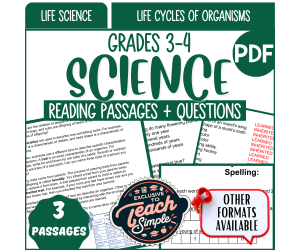
Science Reading Comprehension: Life Cycles of Organisms (PDF)
ELA, Reading, Reading Comprehension, Science, Life Sciences, Biology, Common Core, Animals, Human Body, Grade 2, 3, 4, Worksheets & Printables, Worksheets, Assessments, Teacher Tools, Tests, Quizzes and Tests
Reading Passages on Life Cycles of Organisms for Life Science (Biology) Life Cycles of Organisms: Reading Passages Life Science (Biology): Whether you're aiming to introduce your students to the world of science or simply seeking an uncomplicated reading resource, this no-prep package is a perfect fit. With its colorful design, user-friendly format, and a diverse range of questions and topics, this science reading worksheet set offers a hassle-free and engaging educational experience. Give it a try today to enrich your curriculum effortlessly! What's inside? Part 2 - Life Cycles of Organisms Reading Passage 1: The Life Cycle of Plants Reading Passage 2: The Life Cycle of Animals Reading Passage 3: Heredity Product Info: 18 PAGES (US English with Answers) PDF Version Teaching Duration: 2 Weeks Science Reading Comprehension Outline: Targeted for students in 3rd and 4th grades, these reading passages are enhanced with illustrations and graphs to elucidate critical points. Each lesson aligns with the Common Core State Standards, allowing you to integrate science reading practice effortlessly, knowing that minimal preparation is needed on your part. Each passage comes with a variety of questions in different formats, including multiple-choice formats, data analysis, and fill-in-the-blanks. The topics covered strike a balance between engaging content and core curriculum-based science subjects. Versatile in application, these lessons are suitable for a variety of settings such as whole-class instruction, morning activities, independent desk work, small group discussions, contingency plans for substitute teachers, homework assignments, or even special holiday-themed tasks. FULL CATALOG OF DOWNLOAD LINKS HERE Grade 3/4 Links: Physical Science Part 1 - Properties of Objects and Materials Google Docs/Slides/Forms PDF PPT Word Free Supplementary Pack Accompanying Videos Physical Science Part 2 - Position and Motion of Objects Google Docs/Slides/Forms PDF PPT Word Free Supplementary Pack Accompanying Videos Physical Science Part 3 - Light, Heat, Electricity, Magnetism Google Docs/Slides/Forms PDF PPT Word Free Supplementary Pack Accompanying Videos Life Science Part 1 - Characteristics of Organisms Google Docs/Slides/Forms PDF PPT Word Free Supplementary Pack Accompanying Videos Life Science Part 2 - Life Cycles of Organisms Google Docs/Slides/Forms PDF PPT Word Free Supplementary Pack Accompanying Videos Life Science Part 3 - Organisms and Environments Google Docs/Slides/Forms PDF PPT Word Free Supplementary Pack Accompanying Videos Earth Science Part 1 - Properties of Earth Materials Google Docs/Slides/Forms PDF PPT Word Free Supplementary Pack Accompanying Videos Earth Science Part 2 - Changes in the Earth and Sky Google Docs/Slides/Forms PDF PPT Word Free Supplementary Pack Accompanying Videos Earth Science Part 3 - Objects in the Sky Google Docs/Slides/Forms PDF PPT Word Free Supplementary Pack Accompanying Videos For similar products and other frees, do check out Cored Group on TeachSimple .
Author Cored Education
Rating
Tags Science, Elementary, Reading, Comprehension, Vocabulary, Life Science, Biology, Science Assessments, Reading Comprehension Assessments, Vocabulary Assessments

Science Reading Comprehension Changes in the Earth & Sky Google Drive
ELA, Reading, Reading Comprehension, Common Core, Earth Sciences, Earth and Environmental Sciences, Science, Space, Grade 2, 3, 4, Centers, Activities, Diagrams, Teacher Tools, Assessments, Presentations, Tests, Quizzes and Tests, Worksheets, Worksheets & Printables
Science Reading Comprehension - Changes in the Earth and Sky for Earth Science Changes in the Earth and Sky: Reading Passages Earth Science: Elevate your classroom experience with this captivating science reading pack, designed to infuse the joy of science into your lessons. While the pack provides an entertaining approach, it also serves as an effective tool to gauge your students' comprehension of informational texts. Adorned with vibrant colors and themes, and aligned with the Common Core State Standards (CCSS), it covers intriguing topics such as the atmosphere, weather, and air pressure, ensuring both learning and enjoyment go hand in hand. What's inside? Part 2 - Changes in the Earth and Sky Reading Passage 1: Slow Changes to the Earth's Surface Reading Passage 2: Fast Changes to the Earth's Surface Reading Passage 3: The Atmosphere and Weather Reading Passage 4: Measuring Temperature, Air Pressure, and Humidity Reading Passage 5: The Motion of Objects in the Universe Product Info: 29 PAGES (Docs Version: US English with Answers) 5 FORMS (Self-Grading) 148 SLIDES Teaching Duration: 2 Weeks Science Reading Comprehension Outline: Targeted for students in 3rd and 4th grades, these reading passages are enhanced with illustrations and graphs to elucidate critical points. Each lesson aligns with the Common Core State Standards, allowing you to integrate science reading practice effortlessly, knowing that minimal preparation is needed on your part. Each passage comes with a variety of questions in different formats, including multiple-choice formats, data analysis, and fill-in-the-blanks. The topics covered strike a balance between engaging content and core curriculum -based science subjects. Versatile in application, these lessons are suitable for a variety of settings such as whole-class instruction, morning activities, independent desk work, small group discussions, contingency plans for substitute teachers, homework assignments, or even special holiday-themed tasks. FULL CATALOG OF DOWNLOAD LINKS HERE Grade 3/4 Links: Physical Science Part 1 - Properties of Objects and Materials Google Docs/Slides/Forms PDF PPT Word Free Supplementary Pack Accompanying Videos Physical Science Part 2 - Position and Motion of Objects Google Docs/Slides/Forms PDF PPT Word Free Supplementary Pack Accompanying Videos Physical Science Part 3 - Light, Heat, Electricity, Magnetism Google Docs/Slides/Forms PDF PPT Word Free Supplementary Pack Accompanying Videos Life Science Part 1 - Characteristics of Organisms Google Docs/Slides/Forms PDF PPT Word Free Supplementary Pack Accompanying Videos Life Science Part 2 - Life Cycles of Organisms Google Docs/Slides/Forms PDF PPT Word Free Supplementary Pack Accompanying Videos Life Science Part 3 - Organisms and Environments Google Docs/Slides/Forms PDF PPT Word Free Supplementary Pack Accompanying Videos Earth Science Part 1 - Properties of Earth Materials Google Docs/Slides/Forms PDF PPT Word Free Supplementary Pack Accompanying Videos Earth Science Part 2 - Changes in the Earth and Sky Google Docs/Slides/Forms PDF PPT Word Free Supplementary Pack Accompanying Videos Earth Science Part 3 - Objects in the Sky Google Docs/Slides/Forms PDF PPT Word Free Supplementary Pack Accompanying Videos For similar products and other frees, do check out Cored Group on TeachSimple .
Author Cored Education
Rating
Tags Science, Elementary, Reading, Comprehension, Vocabulary, Science Assessments, Reading Comprehension Assessments, Vocabulary Assessments, Earth Science, Self Assessment

Guided Reading Level B: Clouds You Can Spot
ELA, Resources for Teachers, Reading Comprehension, Reading, Science, Language Development, Pre-Reading, Vocabulary, Earth and Environmental Sciences, Earth Sciences, Kindergarten, Preschool, Grade 1, Worksheets & Printables, Worksheets, Teacher Tools, Centers, Activities, Literacy Readers, Quizzes, Quizzes and Tests, Assessments
This Guided Reading Book - Clouds You Can Spot (Level B) includes: Guided Reading Color Label (front cover x1) This is a quick way to match the book’s demands to what students can generally handle.. The overall goal is to use the level/color to pick books for several smaller groups. To qualify for a certain level, a student is expected to read a book from that level with about 90–94% accuracy. If a student is consistently accurate and understands, move up a level. If the student is struggling at that level, drop down and add more support. Each student will improve at completely different rates, but it is generally one of the best ways to check progress across the class. DOWNLOAD THE CATALOG TO VIEW ALL GUIDED READING BOOKS AVAILABLE (SORTED LEVELS A-Z) Pre-Reading Question (x1) Teacher asks the prompt aloud, can be while showing the cover or first page. Students share what they already know, or make educated guesses from the cover. Prompt them to use the target vocabulary. Write some of their responses on the board to look back at during the reading. Vocabulary Words (x5) Introduce the five words, best doing it one at a time. Start by saying it, while students repeat and then see if anyone knows what it means before reading further. Read through the meaning and try to briefly connect each word to a picture or gesture so it’s meaningful. Ask students to flip through the book pages and point to where they see each of the vocabulary words. While reading the book pause upon coming across one of the vocab words or read the sentence twice to make sure students understand the word has appeared. Optional: Ask students to raise hands whenever they see/hear one of the new words. Guided Reading Pages (x10) Check the book snapshot (below) for: primary topic - do you need to prep extra reading or intro materials on this? what is taught best - decide on 1-2 bullets to focus on, use the prompt or words provided here for best results. learning goals - what you are checking for students to be able to do after the session, elicit answers using prompts or words provided. key vocabulary (see section above). questions overview - so you know what is coming up and if you need to prep extra materials to assist understanding. Run the lesson You may have already looked at a few of the pages together, but you can show them some of the pictures again first to set meaning. Depending on how much time you have and how familiar your students are with guided reading class, you may want to read the book aloud first with the group first. Students whisper or partner read, while you listen in. If time, do it as a group, one student reading a page each. Use the guided page’s prompts to coach: “Check the picture / does it make sense?” “Point under the words / try the first sound” “Reread the sentence smoothly”. Try to focus more on one student per session (rotating every time), so you can work out if they are ready to move up or need to move down a level. Comprehension Questions (back cover x3) This is your way to check that students didn’t just say the words, but actually understood the text. First, let students answer by pointing to the page/picture and saying a short sentence. After any answer, follow with: “Show me where you found that in the text.” In bigger groups, have partners answer first (10–20 seconds), then call on 2–3 students to share. Differentiation tips: Emerging speakers/struggling readers: oral + pointing On-level: oral in a full sentence Higher: one written sentence or draw + label Book Snapshot Title: Clouds You Can Spot Genre: Nonfiction (informational) Subject: Earth Science (Weather) / Early Literacy Primary Topic: Observing clouds using simple describing words Estimated Guided Reading Level (A–Z): B What This Book Teaches Best Builds early nonfiction observation language by naming what you can see in the sky (sun, clouds, sky). Teaches describing words (adjectives) for clouds: big/small, white/grey, high/low, and “rain clouds.” Supports patterned reading and fluency through repeated sentence structure: “See the ____.” Encourages compare/contrast thinking using paired opposites (big vs. small; high vs. low; white vs. grey). Learning Goals Students will identify things the book says you can see (sun, clouds, sky). Students will describe clouds using words from the text (big, small, white, grey, high, low, rain). Students will retell the book’s sequence using the repeated pattern “See the ____.” Students will compare two cloud descriptions from the book (such as high/low or big/small). Students will answer simple questions about what the book tells the reader to see. Key Vocabulary From the Text clouds — white or grey puffs you see in the sky grey — a color between white and black high — up far above you low — down close to the ground rain — water that falls from clouds Discussion Prompts Pre-reading question: What do you think you might see when you look up at the sky? Comprehension questions: What is the first thing the book says to see? Comprehension questions: What are two different kinds of clouds the book tells you to see? Comprehension questions: What is the last thing the book says to see? Printing Tips 1. Best Printing Method (Recommended) “Booklet” Printing (Best if Available) If your printer or PDF viewer supports Booklet Printing , use this. Settings to use: Print mode: Booklet Paper size: Letter or A4 (either works) Orientation: Landscape Print on both sides: Yes Flip on: Short edge Scaling: Fit to printable area Booklet subset: First test: Front sides only Then: Back sides only This will automatically: Pair pages correctly Put the cover on the outside Align everything for folding After printing, fold in half and staple along the spine . 2. If “Booklet” Printing Is NOT Available You can still print this correctly with manual duplex printing . Step-by-step: Open the PDF. Choose Print . Set: Orientation: Landscape Pages per sheet: 1 Print on both sides: Yes Flip on: Short edge Print all pages . Because each PDF page already contains two facing book pages, the result will still fold cleanly into a book. Thousands of Cored Education products are included with your TeachSimple membership. Download links and encyclopedia index available here.
Author Cored Education
Rating
Tags Vocabulary, Reading Comprehension, Reading Passages, Literacy Readers, Leveled Reading, Nonfiction, Reading, Guided Reading, Earth Science, Clouds

Earphones Reading Comprehension Passage - Cored Ed Encyclopedia
ELA, Language Development, Resources for Teachers, Reading Comprehension, Reading, Pre-Reading, Writing, Science, Physics, Strategies, Grade 2, 3, 4, 5, Worksheets & Printables, Worksheets, Teacher Tools, Centers, Activities, Writing Prompts, Assessments, Tests, Quizzes and Tests, Quizzes
This earphones reading comprehension contains the following: Pre-Reading Trivia Students will write down one thing they already know about the subject and then read five more facts and discuss. These facts are fun, and the students will enjoy learning about the subject before reading more. Reading Passage The text is a high-interest reading passage with set paragraphs, roughly three to four paragraphs long. It contains a variety of themes about the topic, anywhere from history to technology. The passage is between 250 and 350 words in length. Mixed Questions The first question page contains four multiple-choice questions, each with a choice of four answers, and three written response questions that require a sentence or two from the student. Creative Writing In this question, the student will be required to write a five to eight sentence paragraph on a question related to the topic. Extension Activities This page is optional for fast finishers. If there are five to ten minutes left at the end of the lesson, the student can choose one of three activities, each one requiring a different skill. Answer Key There are answers for the multiple-choice questions and three written response questions have sample answers. FULL CATALOG OF DOWNLOAD LINKS AND ENCYCLOPEDIA INDEX HERE Cored Ed Encyclopedia Overview The Cored Ed Encyclopedia is a weekly series of lessons that you can pick up and use right away. These short readings fit into whatever time you have available. Each one includes a warm-up, a reading, and a set of questions, but it’s flexible — you can do just the reading, the full lesson, or skip the writing section if you need to. Each lesson focuses on a single topic so students don’t get lost. The writing is clear but never childish, making it perfect for grades two through five. Topics range from animals and science to history, inventions, and everyday things. No matter the level of the student, everyone should take away at least one new idea or fact from each lesson. The materials are easy to print, easy to explain, and require no setup. They work well for whole-class teaching, partner work, or independent study.
Author Cored Education
Rating
Tags Vocabulary, Spelling, Reading Comprehension, Reading Passages, Cored Encyclopedia, Facts, Reading, Creative Writing, Earphones, Physcial Science
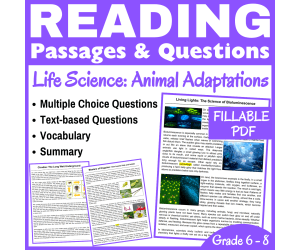
Bioluminescence and Insects : Science Reading passages (FILLABLE PDF)
Science, ELA, Reading, Reading Comprehension, Strategies, Resources for Teachers, Life Sciences, Animals, Insects, Nature & Plants, Grade 6, 7, 8, 9, Writing Prompts, Worksheets & Printables, Centers, Activities, Teacher Tools, Assessments, Quizzes and Tests, Quizzes, Tests
Bioluminescence and Insects: Reading Comprehension Passages and Questions (FILLABLE PDF) This very engaging and fillable collection of life science reading passages about Bioluminescence and Insects is designed to bridge the gap between science and literacy through strengthening reading comprehension and sparking scientific curiosity in middle school students. Each passage blends English Language Arts skills with accurate science content that supports NGSS classroom practice. Ideal for interdisciplinary learning in ELA and Science. Suitable for Grade 9 review, too! These worksheets are designed as fillable PDFs , which means students can type their answers directly into the document on any computer or tablet . Each page includes highlighted text fields that show them exactly where to type! What Is Included? There are (3) informational passages: Living Lights: The Science of Bioluminescence Cicadas: The Long Wait Underground Masters of Disguise: How Insects Hide and Imitate Student Tasks for Each Passage: 5 multiple-choice questions targeting main idea, key details, inference, vocabulary in context, and use of evidence 5 vocabulary matching items with clear, student-friendly definitions 5 text-based questions that require citing specific lines or facts 1 summary prompt that asks students to condense central ideas accurately Full answer key for every section Available Formats for this Resource Word Docs Google Docs FULL CATALOG OF DOWNLOADING LINKS HERE Reading Passage Links: Astronomy & Space Science PDF Word Docs Google Docs Volcanoes, Rocks, & Mountains PDF Word Docs Google Docs Rock Cycle, Soil, & Sinkholes PDF Word Docs Google Docs Mars, Glaciers, & Antarctica PDF Word Docs Google Docs Water Cycle, Acid Rain, & Wastewater PDF Word Docs Google Docs Insects, Animals, & Ecosystems PDF Word Docs Google Docs Bioluminescence & Insects PDF Word Docs Google Docs Animal Skin, Cats, & T. Rex PDF Word Docs Google Docs Human Body and Senses PDF Word Docs Google Docs Health & Applied Bioscience PDF Word Docs Google Docs Waves, Light, & Imaging PDF Word Docs Google Docs Electricity & Energy PDF Word Docs Google Docs Motion & Materials PDF Word Docs Google Docs Chemistry and Materials Science PDF Word Docs Google Docs How to Use These PDFs Click on the highlighted area to start typing your answer. Move to the next question by clicking in the next highlighted box. When you are finished, close the document and select SAVE so your answers stay recorded. If you want to keep a blank copy for later, choose Save As and give your completed version a new name. Product Details Length: 14 pages total Grades: 6–8, also suitable for Grade 9 review Use cases: close reading, stations, homework, intervention, test prep, and sub plans Standards support: reinforces informational-text skills and supports NGSS-style sense making through observation, modeling, and clear use of claim, evidence, and reasoning Why Teachers Choose This Set Authentic science content paired with rigorous literacy practice Consistent task structure across all passages for easier planning and smoother student routines Clear, age-appropriate writing that builds confidence without oversimplifying Use this set to reinforce ELA skills in science, to add literacy to your lessons, or to support independent work. The passages strengthen main idea, evidence use, vocabulary in context, inference, cause and effect, and summary writing. With ready-to-use assessments and complete answer keys, you can provide focused practice that is simple to run and fast to review.
Author CORED Education - Middle & High School
Rating
Tags Middle School, Reading Comprehension, Reading Strategies, ELA, Centers, Reading Passage, Assessments, Vocabulary, Life Science, Insects

Science Revision for Grade 12
Science, Grade 12, Activities, Worksheets & Printables, Assessments, Teacher Tools
This Grade 12 Science Worksheet ebook is perfect for busy teachers. It includes 30 ready-to-use activities that cover key topics in biology, chemistry, and physics. Students can complete all tasks on the worksheet. No extra materials are needed. Each section helps students review and practice important science concepts. You’ll find labeling diagrams , multiple-choice questions , short answers , fill-in-the-blanks , matching , and calculation problems . The variety keeps students engaged and helps them learn in different ways. All answers are included at the end of the ebook, so you can save time when checking work. Use it for classwork, homework, revision , or test prep . It’s great for independent work or group activities. The language is clear. The layout is student-friendly. You don’t need to plan anything—just print and go! This ebook helps students build confidence and prepare for exams. It also supports curriculum goals. If you teach Grade 12 Science, this is a must-have resource. Keep your lessons simple, effective, and fun with this helpful tool!
Author Bright Classroom Ideas Marketplace
Rating
Tags Science, Grade 12, Revision
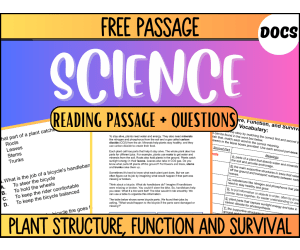
Free Reading Passage: Plant Structure, Function, and Survival (Docs)
ELA, Reading, Reading Comprehension, Science, Life Sciences, Biology, Common Core, Grade 2, 3, 4, Centers, Activities, Worksheets, Worksheets & Printables, Assessments, Teacher Tools, Tests, Quizzes and Tests
Free Reading Passage on Plant Structure, Function, and Survival for Life Science What's inside this free product? Science Reading Comprehension Passage19 : Plant Structure, Function, and Survival Independent Google Docs Version: This is the independent Google Docs version containingone lesson with full answer keys. Product Info: 6 PAGES (US English with Answers) Google Docs Version Teaching Duration: 90 Minutes Science Reading Comprehension Outline: Targeted for students in 3rd and 4th grades, these reading passages are enhanced with illustrations and graphs to elucidate critical points. Each lesson aligns with the Common Core State Standards, allowing you to integrate science reading practice effortlessly, knowing that minimal preparation is needed on your part. Each passage comes with a variety of questions in different formats, including multiple-choice formats, data analysis, and fill-in-the-blanks. The topics covered strike a balance between engaging content and core curriculum-based science subjects. Versatile in application, these lessons are suitable for a variety of settings such as whole-class instruction, morning activities, independent desk work, small group discussions, contingency plans for substitute teachers, homework assignments, or even special holiday-themed tasks. FULL CATALOG OF DOWNLOAD LINKS HERE Grade 3/4 Links: Physical Science Part 1 - Properties of Objects and Materials Google Docs/Slides/Forms PDF PPT Word Free Supplementary Pack Accompanying Videos Physical Science Part 2 - Position and Motion of Objects Google Docs/Slides/Forms PDF PPT Word Free Supplementary Pack Accompanying Videos Physical Science Part 3 - Light, Heat, Electricity, Magnetism Google Docs/Slides/Forms PDF PPT Word Free Supplementary Pack Accompanying Videos Life Science Part 1 - Characteristics of Organisms Google Docs/Slides/Forms PDF PPT Word Free Supplementary Pack Accompanying Videos Life Science Part 2 - Life Cycles of Organisms Google Docs/Slides/Forms PDF PPT Word Free Supplementary Pack Accompanying Videos Life Science Part 3 - Organisms and Environments Google Docs/Slides/Forms PDF PPT Word Free Supplementary Pack Accompanying Videos Earth Science Part 1 - Properties of Earth Materials Google Docs/Slides/Forms PDF PPT Word Free Supplementary Pack Accompanying Videos Earth Science Part 2 - Changes in the Earth and Sky Google Docs/Slides/Forms PDF PPT Word Free Supplementary Pack Accompanying Videos Earth Science Part 3 - Objects in the Sky Google Docs/Slides/Forms PDF PPT Word Free Supplementary Pack Accompanying Videos For similar products and other frees, do check out Cored Group on TeachSimple .
Author Cored Education
Tags Science, Elementary, Reading, Comprehension, Vocabulary, Answers, Physics, Physical Science, Ccss, Common Core
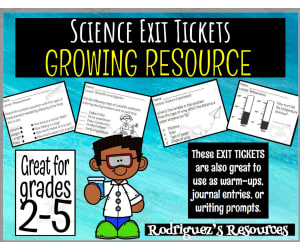
Exit Tickets: Science Growing Resource
Science, Basic Science, Grade 2, 3, 4, 5, Teacher Tools, Assessments
Exit Tickets: Science Growing Resources is a wonderful resource to assess learning of different science topics. This resource can also be used as warm-ups, journal entries, or writing prompts .
Author Rodriguez's Resources
Tags Science Exit Ticket, Life Cycle Exit Ticket, Exit Ticket, Scientific Method
Animal Skin, Cats, & T. Rex: Reading Comprehension passages (Docs)
Science, ELA, Reading, Reading Comprehension, Strategies, Resources for Teachers, Life Sciences, Animals, Insects, Nature & Plants, Grade 6, 7, 8, 9, Writing Prompts, Worksheets & Printables, Centers, Activities, Teacher Tools, Assessments, Quizzes and Tests, Quizzes, Tests
Animal Skin, Cats, & T. Rex: Reading Comprehension Passages (Docs) This very engaging collection of life science reading passages about Animal Skin, Cats, & T. Rex is designed to bridge the gap between science and literacy through strengthening reading comprehension and sparking scientific curiosity in middle school students. Each passage blends English Language Arts skills with accurate science content that supports NGSS classroom practice. Ideal for interdisciplinary learning in ELA and Science. Suitable for Grade 9 review, too! What Is Included? There are (3) informational passages: Tyrannosaurus rex: The Tyrant Lizard King Step into the late Cretaceous and see T. rex up close, from its towering build and crushing bite to the clues fossils give about speed and feeding. CT scans, trackways, and healed injuries help scientists piece together how this predator lived. Cats and Sweetness: A Taste They Don’t Have A small change in a taste receptor means cats do not detect sugar. This trait fits a meat-first diet and helps explain why scent, texture, fats, and proteins matter more than sweetness. Animal Skin: A Tool for Survival Skin works as armor, thermostat, camouflage, warning, and display. Examples include the hippo’s natural sunscreen, zebra stripes that confuse attackers, and king snakes that copy coral snake colors to stay safe. Student Tasks for Each Passage: 5 multiple-choice questions targeting main idea, key details, inference, vocabulary in context, and use of evidence 5 vocabulary matching items with clear, student-friendly definitions 5 text-based questions that require citing specific lines or facts 1 summary prompt that asks students to condense central ideas accurately Full answer key for every section Available Formats for this Resource PDF Word Docs FULL CATALOG OF DOWNLOADING LINKS HERE Reading Passage Links: Astronomy & Space Science PDF Word Docs Google Docs Volcanoes, Rocks, & Mountains PDF Word Docs Google Docs Rock Cycle, Soil, & Sinkholes PDF Word Docs Google Docs Mars, Glaciers, & Antarctica PDF Word Docs Google Docs Water Cycle, Acid Rain, & Wastewater PDF Word Docs Google Docs Insects, Animals, & Ecosystems PDF Word Docs Google Docs Bioluminescence & Insects PDF Word Docs Google Docs Animal Skin, Cats, & T. Rex PDF Word Docs Google Docs Product Details Length: 1e pages total Grades: 6–8, also suitable for Grade 9 review Use cases: close reading, stations, homework, intervention, test prep, and sub plans Standards support: reinforces informational-text skills and supports NGSS-style sense making through observation, modeling, and clear use of claim, evidence, and reasoning Why Teachers Choose This Set Authentic science content paired with rigorous literacy practice Consistent task structure across all passages for easier planning and smoother student routines Clear, age-appropriate writing that builds confidence without oversimplifying Use this set to reinforce ELA skills in science, to add literacy to your lessons, or to support independent work. The passages strengthen main idea, evidence use, vocabulary in context, inference, cause and effect, and summary writing. With ready-to-use assessments and complete answer keys, you can provide focused practice that is simple to run and fast to review.
Author CORED Education - Middle & High School
Rating
Tags Middle School, Reading Comprehension, Reading Strategies, ELA, Centers, Reading Passage, Assessments, Vocabulary, Life Science, Dinosaurs

Renewable Energy Experiments & Design Challenge Pack
Science, Life Sciences, Earth and Environmental Sciences, Earth Sciences, Environmental Science, Geology, Space, Biology, Nature & Plants, Technology, Grade 6, 7, 8, 9, 10, 11, 12, Worksheets & Printables, Workbooks, Worksheets, Word Searches, Teacher Tools, Assessments, Lesson Plans, Quizzes and Tests, Quizzes, Tests
Using the Renewable Energy Experiments and Design Challenge Kit – A rigorous classroom-tested STEM Curriculum that combines Physics, Environmental Science and Engineering Design – will allow you to help your students think like engineers in their development of renewable energy solutions. This kit provides all of the resources necessary for a 4–6 week exploration of renewable technologies related to our decarbonized future, from the quantum principles behind photovoltaic cell technology to the fluid dynamics governing how hydroelectric turbine work. Each of following modules combines a conceptual theory with supplemental worksheets to enhance learning through hands-on experience. The culmination of each module will be students participating in a high-stakes design challenge (Zero-Emission Island) to develop a resilient microgrid that integrates the use of solar, wind, pumped hydroelectric, biogas and battery storage energy. In addition to individual student worksheet documents, this kit includes a comprehensive teacher implementation guide, timeline for pacing to meet state or national standards (NGSS & AP), student use rubrics, lab setup instructions that outline acceptable ranges for outcome data variation, and a complete answer key for ALL (10) worksheets included in this kit. Additionally, this kit includes multiple real-life case studies of renewable energy technologies (i.e., Hornsdale Power Reserve, Hywind Tampen Floating Wind Farm, Agrivoltaics at Jack’s Solar Garden) that provide students with practical applications of the theoretical concepts they have studied. As such, regardless of the type of renewable energy unit you teach (i.e. AP Environmental Science Course, Physics Elective or Engineering Pathway) through the depth of the 10 different renewable energy modules offered within this kit along with the flexibility within the teacher implementation guide and provided assessment tools, making this pack is perfect to help you deliver an unforgettable renewable energy experience for your students. Highlights: 10 complete modules (solar, wind, water/ocean, geothermal, biomass, storing energy, combined energy and grid, life cycle analysis, and LCOE economics) culminating with an island design challenge, Worksheets for students with practice, data analysis, and critical thinking skills, Answer key fully worked out with all qualitative explanations, Teacher's guide (nightly admin book, where applicable) with pacing, aligned to standards (NGSS HS-PS2-1, HS-PS3-3 and HS-ETS1-2) by common failure points, with tolerances in lab wiring, Visuals of energy flow paths, how turbines work, and the engineering process Target audience: Advanced Placement / International Baccalaureate (IB), Grades 9-12 and Entry Level College Environmental or Engineering Class. Reasons Schools & Parents Like It : Ready-made curriculum based on set of standards saves the teacher lots of time (many hours), so everything needed for a complete lesson (worksheets, labs, rubric) are able to be printed out, or assigned electronically. Real live examples of real live engineering solutions to energy issues for 2021 (Hornsdale battery, floating offshore wind turbines, agrivoltaics) will be shown through very useful case studies. Higher order thinking will develop as the students no longer use simply memorization, but will be able to calculate efficiencies, design systems, troubleshoot failure, and validate their choice with data. All instructor is given with teaching easiness through complete instructor support: flags common mistakes with students, lab data tolerance ranges, and answer keys for each piece of lab to help less knowledgeable (or skilled) instructors teach well. Materials can be flexible and modular - they are usable to complete a full 4 or 6 week unit or to supplement or complement an existing unit. Also will work in each of the 3 delivery formats - in-person, hybrid, or remote. Classes to Target By Grade Level: Using mathematics (cubic wind power law, LCOE, Betz efficiency, potential energy equations) as well as laboratory analyses and synthesis tasks this PDF would serve as a perfect fit for: 10–12 Grade (Primarily); 9th Grade Advanced STEM or Honors (with some exceptions); AP Environmental Science; AP Physics I or II (or both); IB Physics or Environmental Systems & Society; High School Engineering OR PLTW (Project Lead the Way); Introduction To Renewable Energy OR Sustainability Engineering In College; Homeschool High School Science Curriculum; STEM Areas In General. Copyright/Terms of Use: This book by Syed Hammad Rizvi is copyrighted. This product can be used for personal use and in one classroom. It cannot be altered, shared or sold. Simply, do not place it online to be publically available and/or downloaded. If you would like to share this with your colleagues, you should purchase additional licenses through Teachsimple and we appreciate your cooperation. This product was created by Syed Hammad Rizvi.
Author Creative Book Store
Rating
Tags SolarEnergy , WindEnergy , Hydroelectric , Geothermal , Biomass , EnergyStorage , GridIntegration , BatteryTechnology , LCOE , LifecycleAnalysis

Yogurt Reading Comprehension Passage - Cored Ed Encyclopedia
ELA, Language Development, Reading Comprehension, Reading, Life Sciences, Science, Physics, Social Studies, History, Technology, Grade 2, 3, 4, 5, Worksheets & Printables, Worksheets, Teacher Tools, Centers, Activities, Writing Prompts, Assessments, Quizzes and Tests, Quizzes, Lesson Plans
This yogurt reading comprehension with lesson plan includes: Visualization (on the front cover) Start your lesson by taking a minute to think and share something about the topic. Read the script aloud (slowly), perhaps prepare some music or sound effects. Student close their eyes and let their imaginations wander. Students open their eyes, read the question aloud and give them a few minutes to complete. Ask a few students to share or keep answers until the end to compare with what they learn in the passage. Quick pause—thousands of Cored Education products are included with your TeachSimple membership. Download links and encyclopedia index available here. Pre-Reading Trivia Students will write down one thing they already know about the subject and then read five more facts and discuss. These facts are fun, and the students will enjoy learning about the subject before reading more. Give 1 minute for students to write what they already know (no pressure—best guess is fine). Read the five facts together. After each fact, do ask a student for their opinion, was it surprising? Set a purpose by asking students to highlight/underline one fact they want to learn more about during the reading. Reading Passage The text is a high-interest reading passage with set paragraphs, roughly three to four paragraphs long. It contains a variety of themes about the topic, anywhere from history to technology. The passage is between 250 and 350 words in length. First, ask students to look at the headings and see what they’ll learn about today. What do they know about the topic/heading? First read options: Teacher read-aloud (best for support). Partner reading (paragraph by paragraph). While reading, students underline important details, and vocabulary words they think may come up in the questions section. Mixed Questions The first question page contains four multiple-choice questions, each with a choice of four answers, and three written response questions that require a sentence or two from the student. Students complete the mcqs first independently, then review quickly as a class. For the 3 written responses, try to get students giving the answer with some form of evidence: “I think ___ because the text says ___.” If students get stuck, send them back to check the passage. Vocabulary Questions Practice seven key words from the text in this section across two activities. First section is scrambled words where students will unscramble three words given a clue for each. The second section is a word to meaning matching activity. Before starting, have some students read out words they underlined in the passage. Ask students to say the word and read aloud the sentence(s) around each word. Ask students to do scrambled words and the matching exercise in pairs then go through answers as a class. For the scrambled spelling task, get four pairs to come up to the board and write the words for extra practice with the other student reading out the clue. For the matching task, prompt students to give full sentences: “I matched ___ with ___ because ___.” Creative Writing In this question, the student will be required to write a five to eight sentence paragraph on a question related to the topic. Before starting, ask students write down 3 key ideas they are going to include in their piece. Ask students for ideas to share around the class to help those struggling. Pro writing expectations: 5–8 sentences At least 2 facts or details from the passage At least 2 vocabulary words from the previous page Students read their paragraphs while classmates listen for facts and vocabulary words. Extension Activities This page is optional for fast finishers or to take home. There are several activities, each one requiring a different skill. Do some, do none, do all, completely optional - but you will feel reassured knowing every possibility is planned for. Includes summary writting question. Answer Key There are answers for the multiple-choice questions, written response questions have sample answers, vocabulary answers and if there is a summary question then a sample summary will be provided as well. Lesson Plan Included Customized lesson plan for this lesson is included. Lesson Snapshot Title: Yogurt Genre: Nonfiction (informational text) Subject: Science (food science/microbiology) & Informational Reading Primary Topic: How yogurt forms, bacteria “helpers,” and history Estimated Guided Reading Level (A–Z): R What This Lesson Teaches Best Explains that warm milk can change during travel , becoming thicker and a little sour, and people learned this new food could last longer than fresh milk. Teaches the science of yogurt-making: tiny bacteria eat sugar in milk and make lactic acid , which helps milk proteins clump so yogurt turns thick and creamy. Shows why warmth matters : keeping milk warm for several hours gives the tiny workers time to do their job. Builds a brief history of how yogurt was studied and spread, including a 1905 observation by Stamen Grigorov and later interest from Ilya Metchnikov that helped it become better known in Europe. Connects history to modern life by describing how Isaac Carasso began selling yogurt in Barcelona and how yogurt comes in many styles today, including fruit-mixed cups and thick strained kinds. Learning Goals Students will describe how yogurt may have been discovered when milk changed during a journey. Students will explain how bacteria help milk turn thick and creamy, using details from the passage. Students will identify why keeping milk warm is important for making yogurt, according to the text. Students will describe what the passage says happened in 1905 that helped people understand yogurt better. Students will sequence key events about yogurt over time (long ago, 1905, 1919) using information from the text. Students will describe a simple home method for making yogurt that is stated in the passage. Key Vocabulary From the Text bacteria — tiny helpers you cannot see without a microscope. lactic acid — an acid bacteria make that changes milk. proteins — milk parts that clump together as yogurt thickens. microscope — a tool used to see tiny living things. cultures — live helpers added to start yogurt thickening. FULL CATALOG OF DOWNLOAD LINKS AND ENCYCLOPEDIA INDEX HERE
Author Cored Education
Rating
Tags Vocabulary, Reading Comprehension, Reading Passages, Lesson Plans, Ela Lesson Plans, Reading Comprehension Lesson Plans, Pre-reading, Life Science, Science Lesson Plans, History
Bioluminescence & Insects : Reading Comprehension passages (PDF)
Science, ELA, Reading, Reading Comprehension, Strategies, Resources for Teachers, Life Sciences, Animals, Insects, Nature & Plants, Grade 6, 7, 8, 9, Writing Prompts, Worksheets & Printables, Centers, Activities, Teacher Tools, Assessments, Quizzes and Tests, Quizzes, Tests
Bioluminescence & Insects: Reading Comprehension Passages (PDF) This very engaging collection of life science reading passages about Bioluminescence & Insects is designed to bridge the gap between science and literacy through strengthening reading comprehension and sparking scientific curiosity in middle school students. Each passage blends English Language Arts skills with accurate science content that supports NGSS classroom practice. Ideal for interdisciplinary learning in ELA and Science. Suitable for Grade 9 review, too! What Is Included? There are (3) informational passages: Living Lights: The Science of Bioluminescence Explains how organisms produce “cold light” with luciferin and luciferase, and shows why they glow for signaling, hunting, and protection. Cicadas: The Long Wait Underground Covers the long underground nymph stage, synchronized emergence, molting, loud calls, and how this life cycle supports survival and reproduction. Masters of Disguise: How Insects Hide and Imitate Distinguishes camouflage from mimicry with clear examples, highlighting how color, shape, and behavior help insects avoid predators and capture prey. Student Tasks for Each Passage: 5 multiple-choice questions targeting main idea, key details, inference, vocabulary in context, and use of evidence 5 vocabulary matching items with clear, student-friendly definitions 5 text-based questions that require citing specific lines or facts 1 summary prompt that asks students to condense central ideas accurately Full answer key for every section Available Formats for this Resource Word Docs Google Docs FULL CATALOG OF DOWNLOADING LINKS HERE Reading Passage Links: Astronomy & Space Science PDF Word Docs Google Docs Volcanoes, Rocks, & Mountains PDF Word Docs Google Docs Rock Cycle, Soil, & Sinkholes PDF Word Docs Google Docs Mars, Glaciers, & Antarctica PDF Word Docs Google Docs Water Cycle, Acid Rain, & Wastewater PDF Word Docs Google Docs Insects, Animals, & Ecosystems PDF Word Docs Google Docs Bioluminescence & Insects PDF Word Docs Google Docs Animal Skin, Cats, & T. Rex PDF Word Docs Google Docs Product Details Length: 14 pages total Grades: 6–8, also suitable for Grade 9 review Use cases: close reading, stations, homework, intervention, test prep, and sub plans Standards support: reinforces informational-text skills and supports NGSS-style sense making through observation, modeling, and clear use of claim, evidence, and reasoning Why Teachers Choose This Set Authentic science content paired with rigorous literacy practice Consistent task structure across all passages for easier planning and smoother student routines Clear, age-appropriate writing that builds confidence without oversimplifying Use this set to reinforce ELA skills in science, to add literacy to your lessons, or to support independent work. The passages strengthen main idea, evidence use, vocabulary in context, inference, cause and effect, and summary writing. With ready-to-use assessments and complete answer keys, you can provide focused practice that is simple to run and fast to review.
Author CORED Education - Middle & High School
Rating
Tags Middle School, Reading Comprehension, Reading Strategies, ELA, Centers, Reading Passage, Assessments, Vocabulary, Life Science, Insects

Egypt The Gift of the Nile: Guided Reading Level R with Lesson Plan
ELA, Resources for Teachers, Reading Comprehension, Reading, Science, Geography, Social Studies, History, Earth and Environmental Sciences, Technology, Grade 3, 4, 5, Worksheets & Printables, Worksheets, Teacher Tools, Centers, Activities, Literacy Readers, Quizzes, Quizzes and Tests, Assessments, Lesson Plans
This Egypt: The Gift of the Nile (level r) guided reading book with lesson plan includes: Guided Reading Color Label (front cover x1) This is a quick way to match the book’s demands to what students can generally handle.. The overall goal is to use the level/color to pick books for several smaller groups. To qualify for a certain level, a student is expected to read a book from that level with about 90–94% accuracy. If a student is consistently accurate and understands, move up a level. If the student is struggling at that level, drop down and add more support. Each student will improve at completely different rates, but it is generally one of the best ways to check progress across the class. DOWNLOAD THE CATALOG TO VIEW ALL GUIDED READING BOOKS AVAILABLE (SORTED LEVELS A-Z) Pre-Reading Question (x1) Teacher asks the prompt aloud, can be while showing the cover or first page. Students share what they already know, or make educated guesses from the cover. Prompt them to use the target vocabulary. Write some of their responses on the board to look back at during the reading. Vocabulary Words (x5) Introduce the five words, best doing it one at a time. Start by saying it, while students repeat and then see if anyone knows what it means before reading further. Read through the meaning and try to briefly connect each word to a picture or gesture so it’s meaningful. Ask students to flip through the book pages and point to where they see each of the vocabulary words. While reading the book pause upon coming across one of the vocab words or read the sentence twice to make sure students understand the word has appeared. Optional: Ask students to raise hands whenever they see/hear one of the new words. Guided Reading Pages (x10) Check the book snapshot (below) for: primary topic - do you need to prep extra reading or intro materials on this? what is taught best - decide on 1-2 bullets to focus on, use the prompt or words provided here for best results. learning goals - what you are checking for students to be able to do after the session, elicit answers using prompts or words provided. key vocabulary (see section above). questions overview - so you know what is coming up and if you need to prep extra materials to assist understanding. Run the lesson You may have already looked at a few of the pages together, but you can show them some of the pictures again first to set meaning. Depending on how much time you have and how familiar your students are with guided reading class, you may want to read the book aloud first with the group first. Students whisper or partner read, while you listen in. If time, do it as a group, one student reading a page each. Use the guided page’s prompts to coach: “Check the picture / does it make sense?” “Point under the words / try the first sound” “Reread the sentence smoothly”. Try to focus more on one student per session (rotating every time), so you can work out if they are ready to move up or need to move down a level. Comprehension Questions (back cover x3) This is your way to check that students didn’t just say the words, but actually understood the text. First, let students answer by pointing to the page/picture and saying a short sentence. After any answer, follow with: “Show me where you found that in the text.” In bigger groups, have partners answer first (10–20 seconds), then call on 2–3 students to share. Differentiation tips: Emerging speakers/struggling readers: oral + pointing On-level: oral in a full sentence Higher: one written sentence or draw + label Book Snapshot Title: Egypt: The Gift of the Nile Genre: Nonfiction Subject: Social Studies (Geography/History) Primary Topic: How the Nile shaped ancient and modern Egypt Estimated Guided Reading Level (A–Z): R What This Book Teaches Best How Egypt’s desert environment (Sahara Desert, little rain) made a single water source essential for a thriving civilization. Why the Nile River’s yearly floods mattered, including how receding water left fertile silt for growing food. Major symbols of ancient Egypt and what the text says they were for or represented (Great Pyramid of Giza; Great Sphinx). Key beliefs and systems of ancient Egypt, including pharaohs, the afterlife, hieroglyphics, and mummification. Connections between past and present by describing modern Cairo, the Suez Canal, tourism, and archaeologists’ discoveries. Learning Goals Students will describe Egypt’s location and explain how the Sahara Desert affects the land. Students will explain how Nile floods helped farmers grow food by using the text’s details about silt. Students will identify what the Great Pyramid of Giza was built for and describe one detail about its construction. Students will describe how ancient Egyptians recorded history and managed government using hieroglyphics and scribes. Students will explain why mummification was developed and describe what the text says happened during the process. Students will describe two details that show Egypt is a modern nation today (for example, Cairo and the Suez Canal). Key Vocabulary From the Text receded — moved back after being higher. silt — rich dark soil left by water. monumental — very large and important. hieroglyphics — picture symbols used as a writing system. mummification — preserving a body by drying and wrapping. Discussion Prompts Pre-reading question: How might a river help people live and farm in a desert place? Comprehension questions: What did the Nile River’s floods leave behind when the water receded, and why did that help farmers? Comprehension questions: What does the text say the Great Pyramid of Giza was built for? Comprehension questions: What two details from the text show Egypt is a modern nation today? Printing Tips 1. Best Printing Method (Recommended) “Booklet” Printing (Best if Available) If your printer or PDF viewer supports Booklet Printing , use this. Settings to use: Print mode: Booklet Paper size: Letter or A4 (either works) Orientation: Landscape Print on both sides: Yes Flip on: Short edge Scaling: Fit to printable area Booklet subset: First test: Front sides only Then: Back sides only This will automatically: Pair pages correctly Put the cover on the outside Align everything for folding After printing, fold in half and staple along the spine . 2. If “Booklet” Printing Is NOT Available You can still print this correctly with manual duplex printing . Step-by-step: Open the PDF. Choose Print . Set: Orientation: Landscape Pages per sheet: 1 Print on both sides: Yes Flip on: Short edge Print all pages . Because each PDF page already contains two facing book pages, the result will still fold cleanly into a book. Thousands of Cored Education products are included with your TeachSimple membership. Download links and encyclopedia index available here.
Author Cored Education
Rating
Tags Reading Comprehension, Reading Passages, Reading, Guided Reading, Guided Reading Lesson Plan, Guided Reading Activity, Pre-reading, Social Studies, Geography, History

Equator Reading Comprehension Passage - Cored Ed Encyclopedia
ELA, Reading Comprehension, Reading, Science, Technology, Language Development, History, Social Studies, Earth and Environmental Sciences, Geography, Grade 2, 3, 4, 5, Worksheets & Printables, Worksheets, Teacher Tools, Centers, Activities, Writing Prompts, Assessments, Quizzes and Tests, Quizzes, Lesson Plans
This Equator reading comprehension with lesson plan includes: Visualization (on the front cover) Start your lesson by taking a minute to think and share something about the topic. Read the script aloud (slowly), perhaps prepare some music or sound effects. Student close their eyes and let their imaginations wander. Students open their eyes, read the question aloud and give them a few minutes to complete. Ask a few students to share or keep answers until the end to compare with what they learn in the passage. Quick pause—thousands of Cored Education products are included with your TeachSimple membership. Download links and encyclopedia index available here. Pre-Reading Trivia Students will write down one thing they already know about the subject and then read five more facts and discuss. These facts are fun, and the students will enjoy learning about the subject before reading more. Give 1 minute for students to write what they already know (no pressure—best guess is fine). Read the five facts together. After each fact, do ask a student for their opinion, was it surprising? Set a purpose by asking students to highlight/underline one fact they want to learn more about during the reading. Reading Passage The text is a high-interest reading passage with set paragraphs, roughly three to four paragraphs long. It contains a variety of themes about the topic, anywhere from history to technology. The passage is between 250 and 350 words in length. First, ask students to look at the headings and see what they’ll learn about today. What do they know about the topic/heading? First read options: Teacher read-aloud (best for support). Partner reading (paragraph by paragraph). While reading, students underline important details, and vocabulary words they think may come up in the questions section. Mixed Questions The first question page contains four multiple-choice questions, each with a choice of four answers, and three written response questions that require a sentence or two from the student. Students complete the mcqs first independently, then review quickly as a class. For the 3 written responses, try to get students giving the answer with some form of evidence: “I think ___ because the text says ___.” If students get stuck, send them back to check the passage. Vocabulary Questions Practice seven key words from the text in this section across two activities. First section is scrambled words where students will unscramble three words given a clue for each. The second section is a word to meaning matching activity. Before starting, have some students read out words they underlined in the passage. Ask students to say the word and read aloud the sentence(s) around each word. Ask students to do scrambled words and the matching exercise in pairs then go through answers as a class. For the scrambled spelling task, get four pairs to come up to the board and write the words for extra practice with the other student reading out the clue. For the matching task, prompt students to give full sentences: “I matched ___ with ___ because ___.” Creative Writing In this question, the student will be required to write a five to eight sentence paragraph on a question related to the topic. Before starting, ask students write down 3 key ideas they are going to include in their piece. Ask students for ideas to share around the class to help those struggling. Pro writing expectations: 5–8 sentences At least 2 facts or details from the passage At least 2 vocabulary words from the previous page Students read their paragraphs while classmates listen for facts and vocabulary words. Extension Activities This page is optional for fast finishers or to take home. There are several activities, each one requiring a different skill. Do some, do none, do all, completely optional - but you will feel reassured knowing every possibility is planned for. Includes summary writting question and additional facts. Answer Key There are answers for the multiple-choice questions, written response questions have sample answers, vocabulary answers and if there is a summary question then a sample summary will be provided as well. Lesson Plan Included Customized lesson plan for this lesson is included. Lesson Snapshot Title: Equator Genre: Nonfiction (Informational Text) Subject: Social Studies (Geography) / Science (Earth Science) / Reading (Informational Text) Primary Topic: Equator, latitude, hemispheres, sunlight, and navigation Estimated Guided Reading Level (A–Z): N What This Lesson Teaches Best Explains the equator as an imaginary line at 0 degrees latitude that circles Earth’s widest part. Shows how the equator splits Earth into the Northern and Southern Hemispheres and acts as a starting line for measuring north and south . Connects observation to science by telling how Eratosthenes compared shadow angles to help estimate Earth’s size long ago. Describes how sunlight near the equator is more direct , helping many equator regions stay warm and keeping day and night close in length. Links geography to modern tools by noting GPS and satellites still begin with the 0-degree equator circle. Learning Goals Students will identify the equator as an imaginary line at 0 degrees latitude . Students will explain how the equator divides Earth into the Northern Hemisphere and Southern Hemisphere . Students will describe how latitude is measured north or south of the equator. Students will explain how shadow angles helped Eratosthenes estimate Earth’s size. Students will describe why sunlight near the equator can feel more direct and how that affects warmth and day/night length. Students will describe how the equator is used as a reference point in GPS and satellites . Key Vocabulary From the Text latitude — degrees north or south of the equator. hemispheres — the two halves of Earth. shadows — dark shapes made when light is blocked. solstice — a day when the Sun’s position is special. satellites — objects in space used to help find locations. FULL CATALOG OF DOWNLOAD LINKS AND ENCYCLOPEDIA INDEX HERE
Author Cored Education
Rating
Tags Vocabulary, Reading Comprehension, Reading Passages, Lesson Plans, Ela Lesson Plans, Reading Comprehension Lesson Plans, Pre-reading, Geography, Earth Science, Science Lesson Plans
Free Science Reading Comprehension Passage: Objects in the Sky PDF
ELA, Reading, Reading Comprehension, Common Core, Language Development, Vocabulary, Earth Sciences, Earth and Environmental Sciences, Science, Space, Grade 2, 3, 4, Worksheets & Printables, Worksheets, Assessments, Teacher Tools, Tests, Quizzes and Tests
Free Reading Passage on Objects in the Sky for Earth Science What's inside this free product? Science Reading Comprehension Passage40 : Objects in the Sky Independent PDF Version: This is the independent PDF version containingone lesson with full answer keys. Product Info: 3 PAGES (US English with Answers) PDF Version Teaching Duration: Approximately 90 Minutes Science Reading Comprehension Outline: Targeted for students in 3rd and 4th grades, these reading passages are enhanced with illustrations and graphs to elucidate critical points. Each lesson aligns with the Common Core State Standards, allowing you to integrate science reading practice effortlessly, knowing that minimal preparation is needed on your part. Each passage comes with a variety of questions in different formats, including multiple-choice formats, data analysis, and fill-in-the-blanks. The topics covered strike a balance between engaging content and core curriculum-based science subjects. Versatile in application, these lessons are suitable for a variety of settings such as whole-class instruction, morning activities, independent desk work, small group discussions, contingency plans for substitute teachers, homework assignments, or even special holiday-themed tasks. FULL CATALOG OF DOWNLOAD LINKS HERE Grade 3/4 Links: Physical Science Part 1 - Properties of Objects and Materials Google Docs/Slides/Forms PDF PPT Word Free Supplementary Pack Accompanying Videos Physical Science Part 2 - Position and Motion of Objects Google Docs/Slides/Forms PDF PPT Word Free Supplementary Pack Accompanying Videos Physical Science Part 3 - Light, Heat, Electricity, Magnetism Google Docs/Slides/Forms PDF PPT Word Free Supplementary Pack Accompanying Videos Life Science Part 1 - Characteristics of Organisms Google Docs/Slides/Forms PDF PPT Word Free Supplementary Pack Accompanying Videos Life Science Part 2 - Life Cycles of Organisms Google Docs/Slides/Forms PDF PPT Word Free Supplementary Pack Accompanying Videos Life Science Part 3 - Organisms and Environments Google Docs/Slides/Forms PDF PPT Word Free Supplementary Pack Accompanying Videos Earth Science Part 1 - Properties of Earth Materials Google Docs/Slides/Forms PDF PPT Word Free Supplementary Pack Accompanying Videos Earth Science Part 2 - Changes in the Earth and Sky Google Docs/Slides/Forms PDF PPT Word Free Supplementary Pack Accompanying Videos Earth Science Part 3 - Objects in the Sky Google Docs/Slides/Forms PDF PPT Word Free Supplementary Pack Accompanying Videos For similar products and other frees, do check out Cored Group on TeachSimple .
Author Cored Education
Rating
Tags Science, Elementary, Reading, Comprehension, Vocabulary, Answers, Physics, Physical Science, Ccss, Common Core
New York NYS Science Practice Test for Grade 8
Science, Grade 8, Assessments, Teacher Tools, Tests, Quizzes and Tests, Worksheets & Printables
Prepare your students for success with this Grade 8 NYS Science Practice Test . This NGSS-aligned resource helps students review key concepts, build confidence, and prepare for state exams using a realistic test format. It is clear, structured, and easy to use. The test includes 60 questions with both multiple-choice and constructed response formats. Students explore important topics across life, Earth and space, and physical science, while also developing scientific reasoning and problem-solving skills. A complete answer key is included with detailed explanations for easy grading. The teacher guide provides standards alignment, pacing, and instructional strategies, making it simple to assess student performance and plan targeted instruction. Teachers can use this resource for full-length test simulations, review sessions, small group intervention, or independent practice. It also works well for homework and sub plans. Students strengthen data analysis, scientific vocabulary, and CER (Claim-Evidence-Reasoning) writing through real test-style questions. Just print and use. This Grade 8 science practice test makes test prep simple and helps students feel confident and ready to succeed on test day.
Author Bright Classroom Ideas Marketplace
Rating
Tags New York, State Test, Nys, Science

Farms and Food: Guided Reading Level N with Lesson Plan
ELA, Resources for Teachers, Reading Comprehension, Reading, Science, Language Development, Geography, Social Studies, Life Sciences, Technology, Grade 2, 3, 4, Worksheets & Printables, Worksheets, Teacher Tools, Centers, Activities, Literacy Readers, Quizzes, Quizzes and Tests, Assessments, Lesson Plans
This Farms and Food (level n) guided reading book with lesson plan includes: Guided Reading Color Label (front cover x1) This is a quick way to match the book’s demands to what students can generally handle.. The overall goal is to use the level/color to pick books for several smaller groups. To qualify for a certain level, a student is expected to read a book from that level with about 90–94% accuracy. If a student is consistently accurate and understands, move up a level. If the student is struggling at that level, drop down and add more support. Each student will improve at completely different rates, but it is generally one of the best ways to check progress across the class. DOWNLOAD THE CATALOG TO VIEW ALL GUIDED READING BOOKS AVAILABLE (SORTED LEVELS A-Z) Pre-Reading Question (x1) Teacher asks the prompt aloud, can be while showing the cover or first page. Students share what they already know, or make educated guesses from the cover. Prompt them to use the target vocabulary. Write some of their responses on the board to look back at during the reading. Vocabulary Words (x5) Introduce the five words, best doing it one at a time. Start by saying it, while students repeat and then see if anyone knows what it means before reading further. Read through the meaning and try to briefly connect each word to a picture or gesture so it’s meaningful. Ask students to flip through the book pages and point to where they see each of the vocabulary words. While reading the book pause upon coming across one of the vocab words or read the sentence twice to make sure students understand the word has appeared. Optional: Ask students to raise hands whenever they see/hear one of the new words. Guided Reading Pages (x10) Check the book snapshot (below) for: primary topic - do you need to prep extra reading or intro materials on this? what is taught best - decide on 1-2 bullets to focus on, use the prompt or words provided here for best results. learning goals - what you are checking for students to be able to do after the session, elicit answers using prompts or words provided. key vocabulary (see section above). questions overview - so you know what is coming up and if you need to prep extra materials to assist understanding. Run the lesson You may have already looked at a few of the pages together, but you can show them some of the pictures again first to set meaning. Depending on how much time you have and how familiar your students are with guided reading class, you may want to read the book aloud first with the group first. Students whisper or partner read, while you listen in. If time, do it as a group, one student reading a page each. Use the guided page’s prompts to coach: “Check the picture / does it make sense?” “Point under the words / try the first sound” “Reread the sentence smoothly”. Try to focus more on one student per session (rotating every time), so you can work out if they are ready to move up or need to move down a level. Comprehension Questions (back cover x3) This is your way to check that students didn’t just say the words, but actually understood the text. First, let students answer by pointing to the page/picture and saying a short sentence. After any answer, follow with: “Show me where you found that in the text.” In bigger groups, have partners answer first (10–20 seconds), then call on 2–3 students to share. Differentiation tips: Emerging speakers/struggling readers: oral + pointing On-level: oral in a full sentence Higher: one written sentence or draw + label Book Snapshot Title: Farms and Food Genre: Nonfiction (informational) Subject: Life Science / Agriculture Primary Topic: How food is grown and gets to consumers Estimated Guided Reading Level (A–Z): N What This Book Teaches Best Explains how healthy soil supports plant growth and why the earth is tested before planting begins. Describes how farms use sunlight, water, and irrigation systems to give crops the moisture they need. Shows how machinery (like tractors and plows) helps farmers prepare land and work large areas efficiently. Introduces major farm products (grains, root vegetables, fruit from orchards, milk, eggs, chicken) and how they are produced or collected. Traces the farm-to-table pathway through harvest (including a combine harvester for grains) and transport , including keeping food at the correct temperature to stay fresh and safe. Learning Goals Students can describe how the book says soil helps plants grow and why soil is tested before planting. Students can explain how irrigation helps crops get the correct amount of moisture. Students can identify ways farm machinery is used during the growing season, including pulling a plow to prepare ground for seeds. Students can describe at least three kinds of foods the book names and how each comes from farms. Students can explain what a combine harvester does during harvest, based on the text. Students can describe why the text says food is kept at the correct temperature during travel. Key Vocabulary From the Text consumed — eaten by people. irrigation — bringing water to crops using systems. machinery — large machines used to do farm work. orchards — places where fruit trees are grown. distribution — delivering goods to different places. Discussion Prompts Pre-reading question: What steps do you think food goes through before it reaches your dinner table? Comprehension questions: Why does the book say the earth is tested before planting begins? Comprehension questions: What does the text say a combine harvester does during harvest? Comprehension questions: According to the text, why is food kept at the correct temperature during travel? Printing Tips 1. Best Printing Method (Recommended) “Booklet” Printing (Best if Available) If your printer or PDF viewer supports Booklet Printing , use this. Settings to use: Print mode: Booklet Paper size: Letter or A4 (either works) Orientation: Landscape Print on both sides: Yes Flip on: Short edge Scaling: Fit to printable area Booklet subset: First test: Front sides only Then: Back sides only This will automatically: Pair pages correctly Put the cover on the outside Align everything for folding After printing, fold in half and staple along the spine . 2. If “Booklet” Printing Is NOT Available You can still print this correctly with manual duplex printing . Step-by-step: Open the PDF. Choose Print . Set: Orientation: Landscape Pages per sheet: 1 Print on both sides: Yes Flip on: Short edge Print all pages . Because each PDF page already contains two facing book pages, the result will still fold cleanly into a book. Thousands of Cored Education products are included with your TeachSimple membership. Download links and encyclopedia index available here.
Author Cored Education
Rating
Tags Reading Comprehension, Reading Passages, Reading, Guided Reading, Guided Reading Lesson Plan, Guided Reading Activity, Pre-reading, Science Lesson Plans, Geography, Life Science