



2,485 products added recently
5th Grade Lesson Plans
Prepare your fifth graders for future challenges with lesson plans that promote higher-order thinking and mastery of key concepts. These resources encourage collaboration and in-depth exploration across subjects. Use them to guide your students toward readiness for middle school.

 Show filters


Deserts Reading Comprehension Passage - Cored Ed Encyclopedia
ELA, Language Development, Reading Comprehension, Reading, Life Sciences, Science, Earth and Environmental Sciences, Technology, Geography, Social Studies, Grade 2, 3, 4, 5, Worksheets & Printables, Worksheets, Teacher Tools, Centers, Activities, Writing Prompts, Assessments, Quizzes and Tests, Quizzes, Lesson Plans
This deserts reading comprehension with lesson plan includes: Visualization (on the front cover) Start your lesson by taking a minute to think and share something about the topic. Read the script aloud (slowly), perhaps prepare some music or sound effects. Student close their eyes and let their imaginations wander. Students open their eyes, read the question aloud and give them a few minutes to complete. Ask a few students to share or keep answers until the end to compare with what they learn in the passage. COMPANION VIDEO NOW AVAILABLE (EMBEDDED AFTER PREVIEW PICTURES IN PRODUCT DESCRIPTION) Quick pause—thousands of Cored Education products are included with your TeachSimple membership. Download links and encyclopedia index available here. Pre-Reading Trivia Students will write down one thing they already know about the subject and then read five more facts and discuss. These facts are fun, and the students will enjoy learning about the subject before reading more. Give 1 minute for students to write what they already know (no pressure—best guess is fine). Read the five facts together. After each fact, do ask a student for their opinion, was it surprising? Set a purpose by asking students to highlight/underline one fact they want to learn more about during the reading. Reading Passage The text is a high-interest reading passage with set paragraphs, roughly three to four paragraphs long. It contains a variety of themes about the topic, anywhere from history to technology. The passage is between 250 and 350 words in length. First, ask students to look at the headings and see what they’ll learn about today. What do they know about the topic/heading? First read options: Teacher read-aloud (best for support). Partner reading (paragraph by paragraph). While reading, students underline important details, and vocabulary words they think may come up in the questions section. Mixed Questions The first question page contains four multiple-choice questions, each with a choice of four answers, and three written response questions that require a sentence or two from the student. Students complete the mcqs first independently, then review quickly as a class. For the 3 written responses, try to get students giving the answer with some form of evidence: “I think ___ because the text says ___.” If students get stuck, send them back to check the passage. Vocabulary Questions Practice seven key words from the text in this section across two activities. First section is scrambled words where students will unscramble three words given a clue for each. The second section is a word to meaning matching activity. Before starting, have some students read out words they underlined in the passage. Ask students to say the word and read aloud the sentence(s) around each word. Ask students to do scrambled words and the matching exercise in pairs then go through answers as a class. For the scrambled spelling task, get four pairs to come up to the board and write the words for extra practice with the other student reading out the clue. For the matching task, prompt students to give full sentences: “I matched ___ with ___ because ___.” Creative Writing In this question, the student will be required to write a five to eight sentence paragraph on a question related to the topic. Before starting, ask students write down 3 key ideas they are going to include in their piece. Ask students for ideas to share around the class to help those struggling. Pro writing expectations: 5–8 sentences At least 2 facts or details from the passage At least 2 vocabulary words from the previous page Students read their paragraphs while classmates listen for facts and vocabulary words. Extension Activities This page is optional for fast finishers or to take home. There are several activities, each one requiring a different skill. Do some, do none, do all, completely optional - but you will feel reassured knowing every possibility is planned for. Includes summary writting question and additional facts. Answer Key There are answers for the multiple-choice questions, written response questions have sample answers, vocabulary answers and if there is a summary question then a sample summary will be provided as well. Lesson Plan Included Customized lesson plan for this lesson is included. Lesson Snapshot Title: Deserts Genre: Nonfiction (informational text with headings) Subject: Earth Science / Life Science / Reading (Informational Text) Primary Topic: Deserts are defined by dryness and survival tricks Estimated Guided Reading Level (A–Z): P What This Lesson Teaches Best Clarifies the key definition: a desert is defined by dryness , not by sand. Explains desert rainfall patterns (often under about 10 inches/25 centimeters per year, sometimes arriving in a quick burst). Builds understanding that deserts can be hot or cold, including Antarctica as the biggest desert on Earth in the passage. Highlights plant and animal adaptations (cacti storing water; plants keeping/curling leaves; rodents getting moisture from seeds; animals hiding in burrows by day and moving at night). Introduces how scientists study deserts today (weather stations, soil samples, satellite pictures) and explains “rain shadow.” Learning Goals Students will explain how the passage defines a desert. Students will describe what the passage says about how much rain many deserts get in a year. Students will identify at least two survival tricks of desert plants from the text. Students will identify at least two survival tricks of desert animals from the text. Students will explain what a “rain shadow” is, using the passage’s description. Students will describe ways deserts are studied today, based on the text. Key Vocabulary From the Text dryness — having very little water or rain. sparse — not many; spread out. burrows — holes in the ground where animals hide. satellite — something in space that takes pictures from above. dunes — hills of sand shaped by wind. FULL CATALOG OF DOWNLOAD LINKS AND ENCYCLOPEDIA INDEX HERE
Author Cored Education
Rating
Tags Vocabulary, Reading Comprehension, Reading Passages, Lesson Plans, Ela Lesson Plans, Reading Comprehension Lesson Plans, Pre-reading, Science Lesson Plans, Earth Science, Geography
Guided Reading Activities and Lesson Plans Nonfiction Set 3 - Mammals
ELA, Reading, Reading Comprehension, Common Core, ESL, Language Development, Pre-Reading, Vocabulary, Resources for Teachers, Grade 4, 5, Worksheets & Printables, Worksheets, Lesson Plans, Teacher Tools, Activities
Guided Reading Activities with Lesson Plans Nonfiction Set 3 Note: This download DOES NOT include the passages themselves. If you have not already done so, download in a format of your choice in the "reading links" section below. Overview The perfect companion materials for Cored Education reading comprehension downloads. This collection provides structured lessons designed to enhance students' reading, comprehension, vocabulary, and creative thinking. Each lesson follows a consistent format that includes pre-reading activities to engage students, vocabulary-building exercises, comprehension checks, creative writing prompts, and discussion topics that promote critical thinking. The lessons are designed to foster active participation, encourage reflection, and develop key literacy skills through interactive and immersive learning experiences. The series is ideal for guided reading sessions, providing teachers with a comprehensive toolkit to engage students in both individual and group activities, enhancing their understanding of text and expanding their language skills. Includes Guided Reading Materials For: 1.Lions 2.Tiger Time 3.All About Horses 4.All About Beavers 5.The Canadian Lynx 6.All About Cheetahs Reading Links: This is the guided reading materials version and DOES NOT include the passages themselves. The passages related to this download are available here in GOOGLE Docs, GOOGLE Forms, GOOGLE Slides. PDF, PPT, WORD. Google Docs Google Forms Google Slides PDF PPT Word Key Features: Engaging Lesson Structure: Each lesson follows a clear and predictable format, which includes pre-reading discussions, vocabulary exercises, reading activities, and creative tasks to maintain student engagement. Vocabulary Development: Focus on introducing and applying new vocabulary in context, helping students internalize new words and use them effectively. Comprehension and Reflection: The lessons include comprehension questions and reflective prompts that encourage students to think critically about the text and its themes. Creative Writing and Discussion: Opportunities for students to express themselves through writing and group discussions, reinforcing their understanding while fostering creativity. Interactive and Student-Centered: The activities are designed to be interactive, allowing students to engage directly with the content and each other, promoting active learning. FULL CATALOG OF DOWNLOAD LINKS HERE Grade 4/5 Links Fiction Set 1 - Animals Google Docs Google Forms Google Slides PDF PPT Word Guided Reading Materials Fiction Set 2 - Family Google Docs Google Forms Google Slides PDF PPT Word Guided Reading Materials Fiction Set 3 - Friends Google Docs Google Forms Google Slides PDF PPT Word Guided Reading Materials Fiction Set 4 - School Google Docs Google Forms Google Slides PDF PPT Word Guided Reading Materials Fiction Set 5 - Sports Google Docs Google Forms Google Slides PDF PPT Word Guided Reading Materials Nonfiction Set 1 - Birds Google Docs Google Forms Google Slides PDF PPT Word Guided Reading Materials Nonfiction Set 2 - Insects Google Docs Google Forms Google Slides PDF PPT Word Guided Reading Materials Nonfiction Set 3 - Mammals Google Docs Google Forms Google Slides PDF PPT Word Guided Reading Materials Nonfiction Set 4 - Nature Google Docs Google Forms Google Slides PDF PPT Word Guided Reading Materials Nonfiction Set 5 - Sea Animals Google Docs Google Forms Google Slides PDF PPT Word Guided Reading Materials Reading Passages Overview Each passage is especially written for Grade 4-5 students, including key vocabulary required for this age group. Topics are varied and are accompanied by colorful graphics. Topics are meant to educate, yet entertain the modern student. These passages are perfect for the modern classroom. Whereas textbooks can become outdated in no time, any changes to technology or the world will result in updates to this product. Mixed Questions The mixed questions section of each lesson includes a variation of five comprehension, vocabulary and math questions. In addition, key reading strategies are frequently covered including cause & effect, summarizing, compare & contrast and making conclusions. Two or three of the questions will be MCQs and other questions will require a written response of some kind. Full answers and example responses appear at the end of the lesson. Spelling & Vocab Each reading passage contains a variety of words and phrases designed for Grade 4-5 students. Spelling and vocab activities provide the opportunity to build fluency with these words. As it can become quite mundane doing the same activities over and over, each lesson in a set will contain a different spelling and vocab activity . Activities include: spelling games, sentence match-ups, mixed-up text and decoding words from the lesson. Writing Prompts Writing prompts are designed to continue the theme or lessons learned in the story. Students are persuaded to write in a variety of ways and each prompt includes several cues to help. As with the spelling/vocab section, writing prompts will vary. This includes research pieces, reading responses, poetry and creative writing prompts. Full Answer Keys Full answer keys and sample responses are provided so no matter how busy you are, you know you're covered! Mixed question answers provide evidence from the text, math questions contain the relevant workings. Answers are designed for use by the teacher, but also suitable as a handout to the student. Just for Fun Each lesson will have a bonus extension exercise. This is something fun to extend the lesson with. You can find these at the end of each lesson, titled Just for Fun. Just for Funs are optional. Some you may like, some you may not. Either way, they are there to do with as you wish. For similar downloads and other frees, do check out Cored Group on TeachSimple.
Author Cored Education
Tags Elementary, Reading, Comprehension, Vocabulary, Answers, Ccss, Guided Reading, Guided Reading Activity, Guided Reading Lesson Plans, Guided Reading Lesson Plan
Synonyms Supplementary Materials Grade 5-6 (PDF)
ELA, Language Development, ESL, Common Core, Resources for Teachers, Vocabulary, Grade 5, 6, 7, Worksheets & Printables, Worksheets, Quizzes and Tests, Teacher Tools, Tests, Assessments, Lesson Plans
Synonyms Supplementary Materials Note: This download DOES NOT include the tests themselves. You can still make use of these materials without them but they are recommended. Download in a format of your choice in the "Links" section below. In the Supplementary Pack Interactive Ice Breakers: Engaging warm-up activities that introduce students to key ELA concepts, such as quick capitalization corrections and punctuation challenges. Guided Practice: Structured teacher-led exercises that reinforce grammar and punctuation rules, helping students identify and apply them correctly in sentences. Group and Partner Tasks: Collaborative activities where students work together to edit sentences, correct capitalization, and improve punctuation through peer discussion and teamwork. Independent Worksheets: Carefully designed worksheets that provide focused practice, allowing students to apply learned concepts and refine their skills independently. Exit Tasks: Quick assessments at the end of each lesson, prompting students to reflect on what they’ve learned and apply their knowledge in writing and editing tasks. Links Nouns Synonyms Verbs Synonyms Adjectives Synonyms Synonyms in a Sentence Google Docs Google Forms Google Slides PDF PPT Word FULL CATALOG OF DOWNLOAD LINKS HERE Grade 5/6 Links: Capitalization & Punctuation Google Docs Google Forms Google Slides PDF PPT Word Free Supplementary Materials Pack Adjectives Google Docs Google Forms Google Slides PDF PPT Word Free Supplementary Materials Pack Nouns Google Docs Google Forms Google Slides PDF PPT Word Free Supplementary Materials Pack Pronouns Google Docs Google Forms Google Slides PDF PPT Word Free Supplementary Materials Pack Verbs Google Docs Google Forms Google Slides PDF PPT Word Free Supplementary Materials Pack Prefixes & Suffixes Google Docs Google Forms Google Slides PDF PPT Word Free Supplementary Materials Pack Sentence Structure Google Docs Google Forms Google Slides PDF PPT Word Free Supplementary Materials Pack Subject Verb Agreement Google Docs Google Forms Google Slides PDF PPT Word Free Supplementary Materials Pack Tenses Google Docs Google Forms Google Slides PDF PPT Word Free Supplementary Materials Pack Context Clues Google Docs Google Forms Google Slides PDF PPT Word Free Supplementary Materials Pack Defining Words Google Docs Google Forms Google Slides PDF PPT Word Free Supplementary Materials Pack Fill in the Blanks Google Docs Google Forms Google Slides PDF PPT Word Free Supplementary Materials Pack Homophones Google Docs Google Forms Google Slides PDF PPT Word Free Supplementary Materials Pack Synonyms Google Docs Google Forms Google Slides PDF PPT Word Free Supplementary Materials Pack ELA Review Questions Overview Questions have three answer choices. There are a handful of pictures on each test for aesthetic purposes, as well as a review sheet covering most of the topics covered in the product. Introduction or Example Sheet Each topic will include an introduction or example sheet to go through first with your students. Full Answer Keys Full answer keys and sample responses are provided so no matter how busy you are, you know you're covered! For More Like This For similar downloads and other frees, do check out Cored Group on TeachSimple.
Author Cored Education
Tags Elementary, Answers, Ccss, Common Core, Tests, Test Prep, Assessment, Grade 5, Grade 6, Vocabulary
Homophones Supplementary Materials Grade 5-6 (PDF)
ELA, Language Development, ESL, Common Core, Resources for Teachers, Vocabulary, Grade 5, 6, 7, Worksheets & Printables, Worksheets, Quizzes and Tests, Teacher Tools, Tests, Assessments, Lesson Plans
Homophones Supplementary Materials Note: This download DOES NOT include the tests themselves. You can still make use of these materials without them but they are recommended. Download in a format of your choice in the "Links" section below. In the Supplementary Pack Interactive Ice Breakers: Engaging warm-up activities that introduce students to key ELA concepts, such as quick capitalization corrections and punctuation challenges. Guided Practice: Structured teacher-led exercises that reinforce grammar and punctuation rules, helping students identify and apply them correctly in sentences. Group and Partner Tasks: Collaborative activities where students work together to edit sentences, correct capitalization, and improve punctuation through peer discussion and teamwork. Independent Worksheets: Carefully designed worksheets that provide focused practice, allowing students to apply learned concepts and refine their skills independently. Exit Tasks: Quick assessments at the end of each lesson, prompting students to reflect on what they’ve learned and apply their knowledge in writing and editing tasks. Links sent, scent, cent accept, except, eccept thru, through, threw, here, ear, hear bored, board, bord they're, their, there day's, days, daze horse, hoarse, oars Google Docs Google Forms Google Slides PDF PPT Word FULL CATALOG OF DOWNLOAD LINKS HERE Grade 5/6 Links: Capitalization & Punctuation Google Docs Google Forms Google Slides PDF PPT Word Free Supplementary Materials Pack Adjectives Google Docs Google Forms Google Slides PDF PPT Word Free Supplementary Materials Pack Nouns Google Docs Google Forms Google Slides PDF PPT Word Free Supplementary Materials Pack Pronouns Google Docs Google Forms Google Slides PDF PPT Word Free Supplementary Materials Pack Verbs Google Docs Google Forms Google Slides PDF PPT Word Free Supplementary Materials Pack Prefixes & Suffixes Google Docs Google Forms Google Slides PDF PPT Word Free Supplementary Materials Pack Sentence Structure Google Docs Google Forms Google Slides PDF PPT Word Free Supplementary Materials Pack Subject Verb Agreement Google Docs Google Forms Google Slides PDF PPT Word Free Supplementary Materials Pack Tenses Google Docs Google Forms Google Slides PDF PPT Word Free Supplementary Materials Pack Context Clues Google Docs Google Forms Google Slides PDF PPT Word Free Supplementary Materials Pack Defining Words Google Docs Google Forms Google Slides PDF PPT Word Free Supplementary Materials Pack Fill in the Blanks Google Docs Google Forms Google Slides PDF PPT Word Free Supplementary Materials Pack Homophones Google Docs Google Forms Google Slides PDF PPT Word Free Supplementary Materials Pack Synonyms Google Docs Google Forms Google Slides PDF PPT Word Free Supplementary Materials Pack ELA Review Questions Overview Questions have three answer choices. There are a handful of pictures on each test for aesthetic purposes, as well as a review sheet covering most of the topics covered in the product. Introduction or Example Sheet Each topic will include an introduction or example sheet to go through first with your students. Full Answer Keys Full answer keys and sample responses are provided so no matter how busy you are, you know you're covered! For More Like This For similar downloads and other frees, do check out Cored Group on TeachSimple.
Author Cored Education
Tags Elementary, Answers, Ccss, Common Core, Tests, Test Prep, Assessment, Grade 5, Grade 6, Vocabulary

Antarctica Reading Comprehension Passage - Cored Ed Encyclopedia
ELA, Language Development, Reading Comprehension, Reading, Social Studies, Writing, Pre-Reading, Vocabulary, Geography, History, Grade 2, 3, 4, 5, Worksheets & Printables, Worksheets, Teacher Tools, Centers, Activities, Writing Prompts, Assessments, Quizzes and Tests, Quizzes, Lesson Plans
This Antarctica reading comprehension with lesson plan includes: Visualization (on the front cover) Start your lesson by taking a minute to think and share something about the topic. Read the script aloud (slowly), perhaps prepare some music or sound effects. Student close their eyes and let their imaginations wander. Students open their eyes, read the question aloud and give them a few minutes to complete. Ask a few students to share or keep answers until the end to compare with what they learn in the passage. COMPANION VIDEO NOW AVAILABLE (EMBEDDED AFTER PREVIEW PICTURES IN PRODUCT DESCRIPTION) Quick pause—thousands of Cored Education products are included with your TeachSimple membership. Download links and encyclopedia index available here. Pre-Reading Trivia Students will write down one thing they already know about the subject and then read five more facts and discuss. These facts are fun, and the students will enjoy learning about the subject before reading more. Give 1 minute for students to write what they already know (no pressure—best guess is fine). Read the five facts together. After each fact, do ask a student for their opinion, was it surprising? Set a purpose by asking students to highlight/underline one fact they want to learn more about during the reading. Reading Passage The text is a high-interest reading passage with set paragraphs, roughly three to four paragraphs long. It contains a variety of themes about the topic, anywhere from history to technology. The passage is between 250 and 350 words in length. First, ask students to look at the headings and see what they’ll learn about today. What do they know about the topic/heading? First read options: Teacher read-aloud (best for support). Partner reading (paragraph by paragraph). While reading, students underline important details, and vocabulary words they think may come up in the questions section. Mixed Questions The first question page contains four multiple-choice questions, each with a choice of four answers, and three written response questions that require a sentence or two from the student. Students complete the mcqs first independently, then review quickly as a class. For the 3 written responses, try to get students giving the answer with some form of evidence: “I think ___ because the text says ___.” If students get stuck, send them back to check the passage. Vocabulary Questions Practice seven key words from the text in this section across two activities. First section is scrambled words where students will unscramble three words given a clue for each. The second section is a word to meaning matching activity. Before starting, have some students read out words they underlined in the passage. Ask students to say the word and read aloud the sentence(s) around each word. Ask students to do scrambled words and the matching exercise in pairs then go through answers as a class. For the scrambled spelling task, get four pairs to come up to the board and write the words for extra practice with the other student reading out the clue. For the matching task, prompt students to give full sentences: “I matched ___ with ___ because ___.” Creative Writing In this question, the student will be required to write a five to eight sentence paragraph on a question related to the topic. Before starting, ask students write down 3 key ideas they are going to include in their piece. Ask students for ideas to share around the class to help those struggling. Pro writing expectations: 5–8 sentences At least 2 facts or details from the passage At least 2 vocabulary words from the previous page Students read their paragraphs while classmates listen for facts and vocabulary words. Extension Activities This page is optional for fast finishers or to take home. There are several activities, each one requiring a different skill. Do some, do none, do all, completely optional - but you will feel reassured knowing every possibility is planned for. Includes summary writting question and additional facts. Answer Key There are answers for the multiple-choice questions, written response questions have sample answers, vocabulary answers and if there is a summary question then a sample summary will be provided as well. Lesson Plan Included Customized lesson plan for this lesson is included. Lesson Snapshot Title: Antarctica Genre: Nonfiction (informational passage) Subject: Science / Geography (Polar environments; exploration & research) Primary Topic: Exploration, South Pole, treaty, and ice core science Estimated Guided Reading Level (A–Z): S Support pages noted in the PDF: visualization and pre-reading trivia (pp. 1–2), mixed questions (p. 4), vocabulary activities (p. 5), creative writing (p. 6), extension activities + summary box (p. 7), answer key (p. 8). Support-page QA notes: The vocabulary activity includes “Expedition,” which does not appear in the passage; one mixed question asks why compasses “spin strangely,” which the passage does not explain. What This Lesson Teaches Best How Antarctica went from a blank spot on maps to a confirmed icy continent described by explorers. Key physical features of the continent: cold, dry, windy conditions; little inland snow; land “high above sea level” like a “frozen plateau.” A short exploration timeline using dates and evidence (1820 reports of ice shelves; 1895 people stepped onto the continent). How journeys toward the South Pole were described (sleds, dogs, strange compasses) and what happened in December 1911 and afterward. Why international science cooperation matters there, including the International Geophysical Year, the Antarctic Treaty, and what ice cores can reveal through layers. Learning Goals Students will describe why early mapmakers could not point to land far south “with certainty.” Students will identify details that describe Antarctica’s inland climate and land shape (dry, windy, little snow; “frozen plateau”). Students will retell key events from the passage’s timeline using dates (1820, 1895, 1911, 1959). Students will explain what ships reported seeing in 1820 and how the author describes the coastal environment. Students will describe what happened when Roald Amundsen reached the South Pole and what Robert Falcon Scott found later. Students will explain what the passage says nations promised in 1959 and why ice cores are compared to a “frozen calendar.” Key Vocabulary From the Text certainty — being sure something is true. plateau — a high, flat area of land. shelves — wide, flat sheets of ice. treaty — an agreement between countries. supplies — needed materials stored for later use. FULL CATALOG OF DOWNLOAD LINKS AND ENCYCLOPEDIA INDEX HERE
Author Cored Education
Rating
Tags Vocabulary, Reading Comprehension, Reading Passages, Lesson Plans, Ela Lesson Plans, Reading Comprehension Lesson Plans, Pre-reading, Geography, Geography Lesson Plans
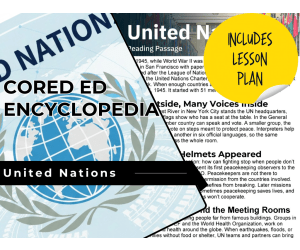
United Nations Reading Comprehension Passage - Cored Ed Encyclopedia
ELA, Language Development, Reading Comprehension, Reading, Pre-Reading, Vocabulary, History, Social Studies, Government, Writing, Grade 2, 3, 4, 5, Worksheets & Printables, Worksheets, Teacher Tools, Centers, Activities, Writing Prompts, Assessments, Quizzes and Tests, Quizzes, Lesson Plans
This United Nations reading comprehension with lesson plan includes: Visualization (on the front cover) Start your lesson by taking a minute to think and share something about the topic. Read the script aloud (slowly), perhaps prepare some music or sound effects. Student close their eyes and let their imaginations wander. Students open their eyes, read the question aloud and give them a few minutes to complete. Ask a few students to share or keep answers until the end to compare with what they learn in the passage. Quick pause—thousands of Cored Education products are included with your TeachSimple membership. Download links and encyclopedia index available here. Pre-Reading Trivia Students will write down one thing they already know about the subject and then read five more facts and discuss. These facts are fun, and the students will enjoy learning about the subject before reading more. Give 1 minute for students to write what they already know (no pressure—best guess is fine). Read the five facts together. After each fact, do ask a student for their opinion, was it surprising? Set a purpose by asking students to highlight/underline one fact they want to learn more about during the reading. Reading Passage The text is a high-interest reading passage with set paragraphs, roughly three to four paragraphs long. It contains a variety of themes about the topic, anywhere from history to technology. The passage is between 250 and 350 words in length. First, ask students to look at the headings and see what they’ll learn about today. What do they know about the topic/heading? First read options: Teacher read-aloud (best for support). Partner reading (paragraph by paragraph). While reading, students underline important details, and vocabulary words they think may come up in the questions section. Mixed Questions The first question page contains four multiple-choice questions, each with a choice of four answers, and three written response questions that require a sentence or two from the student. Students complete the mcqs first independently, then review quickly as a class. For the 3 written responses, try to get students giving the answer with some form of evidence: “I think ___ because the text says ___.” If students get stuck, send them back to check the passage. Vocabulary Questions Practice seven key words from the text in this section across two activities. First section is scrambled words where students will unscramble three words given a clue for each. The second section is a word to meaning matching activity. Before starting, have some students read out words they underlined in the passage. Ask students to say the word and read aloud the sentence(s) around each word. Ask students to do scrambled words and the matching exercise in pairs then go through answers as a class. For the scrambled spelling task, get four pairs to come up to the board and write the words for extra practice with the other student reading out the clue. For the matching task, prompt students to give full sentences: “I matched ___ with ___ because ___.” Creative Writing In this question, the student will be required to write a five to eight sentence paragraph on a question related to the topic. Before starting, ask students write down 3 key ideas they are going to include in their piece. Ask students for ideas to share around the class to help those struggling. Pro writing expectations: 5–8 sentences At least 2 facts or details from the passage At least 2 vocabulary words from the previous page Students read their paragraphs while classmates listen for facts and vocabulary words. Extension Activities This page is optional for fast finishers or to take home. There are several activities, each one requiring a different skill. Do some, do none, do all, completely optional - but you will feel reassured knowing every possibility is planned for. Includes summary writting question. Answer Key There are answers for the multiple-choice questions, written response questions have sample answers, vocabulary answers and if there is a summary question then a sample summary will be provided as well. Lesson Plan Included Customized lesson plan for this lesson is included. Lesson Snapshot Title: United Nations Genre: Nonfiction (Informational text) Subject: Social Studies (Civics/Global Studies) Primary Topic: How the UN began and works for peace Estimated Guided Reading Level (A–Z): P What This Lesson Teaches Best Origins and purpose of the UN: Explains that delegates from 50 countries met in San Francisco in 1945 and signed the United Nations Charter, leading to the UN officially beginning on October 24, 1945. How countries work together in the UN: Describes the UN headquarters in New York City and how member countries speak and vote in the General Assembly, while a smaller group (the Security Council) votes on steps meant to protect peace. Peacekeeping basics: Introduces UN peacekeeping observers (UNTSO) and explains that peacekeepers watch, report, and help keep ceasefires from breaking (and are not there to conquer). Communication across languages: Shows why interpreters matter by explaining that leaders use interpreters in six official languages so the same message can travel across the room. UN help beyond meetings: Notes that UN groups like UNICEF and the World Health Organization work on children’s needs, health, and bringing supplies after earthquakes, floods, or wars. Learning Goals Students will identify key dates and events that led to the UN officially beginning in 1945. Students will describe how the General Assembly and the Security Council are different, using details from the text. Students will explain what the United Nations Charter is and what it was meant to help countries do. Students will summarize what peacekeepers do and why peacekeeping can be hard when countries won’t cooperate. Students will use context clues to determine the meaning of key words such as interpreters and ceasefires . Key Vocabulary From the Text delegates — people chosen to represent a country at a meeting. Charter — a written promise that explains a group’s goals. headquarters — the main building where an organization works. interpreters — people who change speech into another language. ceasefires — times when fighting stops for a while. FULL CATALOG OF DOWNLOAD LINKS AND ENCYCLOPEDIA INDEX HERE
Author Cored Education
Rating
Tags Vocabulary, Reading Comprehension, Reading Passages, Lesson Plans, Ela Lesson Plans, Reading Comprehension Lesson Plans, Pre-reading, Social Studies Lesson Plans, Social Studies, Government
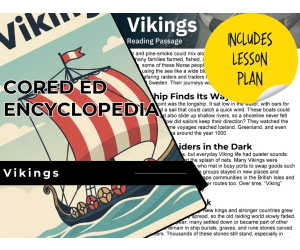
Vikings Reading Comprehension Passage - Cored Ed Encyclopedia
ELA, Language Development, Reading Comprehension, Reading, Pre-Reading, History, Social Studies, History: Europe, History: British, Vocabulary, Grade 2, 3, 4, 5, Worksheets & Printables, Worksheets, Teacher Tools, Centers, Activities, Writing Prompts, Assessments, Quizzes and Tests, Quizzes, Lesson Plans
This Vikings reading comprehension with lesson plan includes: Visualization (on the front cover) Start your lesson by taking a minute to think and share something about the topic. Read the script aloud (slowly), perhaps prepare some music or sound effects. Student close their eyes and let their imaginations wander. Students open their eyes, read the question aloud and give them a few minutes to complete. Ask a few students to share or keep answers until the end to compare with what they learn in the passage. Quick pause—thousands of Cored Education products are included with your TeachSimple membership. Download links and encyclopedia index available here. Pre-Reading Trivia Students will write down one thing they already know about the subject and then read five more facts and discuss. These facts are fun, and the students will enjoy learning about the subject before reading more. Give 1 minute for students to write what they already know (no pressure—best guess is fine). Read the five facts together. After each fact, do ask a student for their opinion, was it surprising? Set a purpose by asking students to highlight/underline one fact they want to learn more about during the reading. Reading Passage The text is a high-interest reading passage with set paragraphs, roughly three to four paragraphs long. It contains a variety of themes about the topic, anywhere from history to technology. The passage is between 250 and 350 words in length. First, ask students to look at the headings and see what they’ll learn about today. What do they know about the topic/heading? First read options: Teacher read-aloud (best for support). Partner reading (paragraph by paragraph). While reading, students underline important details, and vocabulary words they think may come up in the questions section. Mixed Questions The first question page contains four multiple-choice questions, each with a choice of four answers, and three written response questions that require a sentence or two from the student. Students complete the mcqs first independently, then review quickly as a class. For the 3 written responses, try to get students giving the answer with some form of evidence: “I think ___ because the text says ___.” If students get stuck, send them back to check the passage. Vocabulary Questions Practice seven key words from the text in this section across two activities. First section is scrambled words where students will unscramble three words given a clue for each. The second section is a word to meaning matching activity. Before starting, have some students read out words they underlined in the passage. Ask students to say the word and read aloud the sentence(s) around each word. Ask students to do scrambled words and the matching exercise in pairs then go through answers as a class. For the scrambled spelling task, get four pairs to come up to the board and write the words for extra practice with the other student reading out the clue. For the matching task, prompt students to give full sentences: “I matched ___ with ___ because ___.” Creative Writing In this question, the student will be required to write a five to eight sentence paragraph on a question related to the topic. Before starting, ask students write down 3 key ideas they are going to include in their piece. Ask students for ideas to share around the class to help those struggling. Pro writing expectations: 5–8 sentences At least 2 facts or details from the passage At least 2 vocabulary words from the previous page Students read their paragraphs while classmates listen for facts and vocabulary words. Extension Activities This page is optional for fast finishers or to take home. There are several activities, each one requiring a different skill. Do some, do none, do all, completely optional - but you will feel reassured knowing every possibility is planned for. Includes summary writting question. Answer Key There are answers for the multiple-choice questions, written response questions have sample answers, vocabulary answers and if there is a summary question then a sample summary will be provided as well. Lesson Plan Included Customized lesson plan for this lesson is included. Lesson Snapshot Title: Vikings Genre: Nonfiction (Informational text) Subject: Social Studies (History/Culture) Primary Topic: Viking travel, daily life, and lasting clues Estimated Guided Reading Level (A–Z): Q Support pages included: Visualization prompt, pre-reading trivia, mixed questions, vocabulary activities, creative writing, extension activities, and an answer key. QA check on support pages: The questions/vocabulary generally match the passage; the visualization prompt includes extra sensory details (e.g., “carved dragons,” a “small market”) that are not stated in the reading passage. What This Lesson Teaches Best Geography and origins of Viking-age people: Describes rocky coasts of Scandinavia and connects Vikings to places now Denmark, Norway, and Sweden. Why longships mattered for travel: Explains how longships used oars and a sail, crossed open seas, and moved up shallow rivers. Navigation using nature: States that sailors watched the Sun and stars to keep direction. A fuller view of Viking life: Notes that Vikings farmed, crafted, and traded goods (furs, metalwork, silver), and some blended with local people and helped shape communities. How history leaves evidence: Identifies lasting clues such as ship burials, graves, rune stones, and written sagas. Learning Goals Students will describe where Vikings lived and what the passage says the coasts were like. Students will explain how the longship’s design helped Vikings travel to many places. Students will identify how Viking sailors kept direction while traveling. Students will summarize everyday Viking jobs and trade goods named in the text. Students will list evidence the passage says still helps us learn about Vikings today. Key Vocabulary From the Text Scandinavia — a northern European region where many Vikings lived. Norse — people from Scandinavia in the passage. longship — a Viking boat with oars and a sail. Christianity — a religion that spread as times changed. sagas — stories written down from spoken memories. Discussion Prompts Pre-reading question: What details in the passage describe the coasts of Scandinavia? Comprehension questions: When did some Norse people begin traveling farther than neighbors expected? Comprehension questions: How did the longship help Vikings cross seas and travel up rivers? Comprehension questions: What clues does the passage say still remain today to help us learn about Vikings? FULL CATALOG OF DOWNLOAD LINKS AND ENCYCLOPEDIA INDEX HERE
Author Cored Education
Rating
Tags Vocabulary, Reading Comprehension, Reading Passages, Lesson Plans, Ela Lesson Plans, Reading Comprehension Lesson Plans, Pre-reading, History Lesson Plans, European History, British History
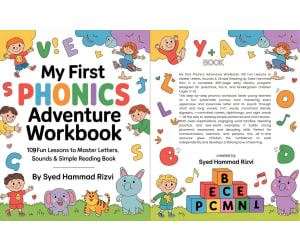
My First Phonics Adventure Workbook 109 Fun Lessons to Master Letters
ELA, Language Development, Literature, Reading, Writing, Phonics, Children’s Literature, Reading Comprehension, Strategies, Creative Writing, Kindergarten, Preschool, Grade 1, 2, 3, 4, 5, Projects, Activities, Teacher Tools, Assessments, Lesson Plans, Presentations, Workbooks, Worksheets & Printables, Literacy Readers, Graphic Organizers
Discover the ultimate preschool and kindergarten phonics workbook called the "My First Phonics Adventure Workbook: 109 fun lessons helping children to master letters, sounds and beginning reading!" This 369-page resource for early literacy education presents a sequentially organized curriculum of phonics skills (i.e., identification of uppercase/lowercase letters; pronunciation of short and long vowel sounds; recognition of CVC words; consonant blend sounds; recognition of diagraph sounds (e.g., "sh," "ch," "th," "wh"); pronunciation of r-controlled vowel sounds; recognition and pronunciation of diphthongs; identification of double consonant letters; recognition and use of sight words; simple sentence/story reading). Written in an easy-to-read and engaging style with many examples of the different types of words for blending activities and everyday application of reading skills, this learn to read workbook provides children with a strong phonemic awareness base and confidence in decoding words when reading. It is great for homeschoolers, teachers, or parents who want to use a comprehensive first-time reader program starting with A-Z letters, and ending with reading comprehension of a whole story; no prior knowledge required; ages 3-6. Improve child reading fluency from an all-inclusive phonics adventure that will support your preschool, Pre-K, or kindergarten child's growth towards success as a reader. Start today by downloading and becoming part of your child's journey toward unlocking the beauty of reading! Why Parents/Teachers Love: Systematic and Comprehensive Coverage — 109 accumulation chapters lead children from single letters to fluent reading of stories — no holes, no additional books needed. Creates True Confidence — Simple explanations with rules of word families and blending activities allow children to independently decode words they have not seen before, providing less frustration to children. Parent and Teacher Friendly — Ready-to-use lessons with examples; works well as a homeschooling, center, or daily practice resource. Proven Early Literacy Base — Phonics standard based and result driven methods that predict long-term success of reading. Affordable and All-in-One Resource – One download replaces more than one costly workbook and offers high quality profession instruction. Target Audience: This workbook is designed for children ages 3–7 in preschool (Pre-K) or early grade 1. Pre-k – Ideal for teaching children to recognize the letters of the alphabet, the sounds they make, and the beginning of their ability to read (Chapters 1-33). Kindergarten – This workbook provides a variety of activities that correlate to the core objectives found in the K-12 English language arts curriculum such as: recognizing and reading short/long vowel sounds, identifying consonant blends/digraphs, and writing simple sentences (Chapters 34-102). Early Grade 1 – This workbook can be used to reinforce and build on skills associated with r-controlled vowels, diphthongs, sight words, and text comprehension (Chapters 103-109). This workbook’s skills are foundational and will assist children who are developing as readers; however, the skills may be too easy for students in 2nd grade and above. Copyright Notice / Terms and Conditions: This Book is owned by Syed Hammad Rizvi. The Book is intended for personal use and only in one classroom. It may not be modified or sold by you, nor may it be distributed over the internet for others to download. If you would like to share the Book with your coworkers, please purchase more licenses for the Book on Teachsimple. Thank you for respecting these terms of use. Syed Hammad Rizvi is pleased to provide you with this product.
Author Creative Book Store
Rating
Tags Phonics, PhonicsFun, PhonicsForKids, PhonicsActivities, EarlyLiteracy, EarlyReading, LearnToRead, ReadingSkills, Literacy, ScienceOfReading

X-Rays Reading Comprehension Passage - Cored Ed Encyclopedia
ELA, Language Development, Reading Comprehension, Reading, Science, Technology, Physics, History, Social Studies, Pre-Reading, Grade 2, 3, 4, 5, Worksheets & Printables, Worksheets, Teacher Tools, Centers, Activities, Writing Prompts, Assessments, Quizzes and Tests, Quizzes, Lesson Plans
This x-rays reading comprehension with lesson plan includes: Visualization (on the front cover) Start your lesson by taking a minute to think and share something about the topic. Read the script aloud (slowly), perhaps prepare some music or sound effects. Student close their eyes and let their imaginations wander. Students open their eyes, read the question aloud and give them a few minutes to complete. Ask a few students to share or keep answers until the end to compare with what they learn in the passage. Quick pause—thousands of Cored Education products are included with your TeachSimple membership. Download links and encyclopedia index available here. Pre-Reading Trivia Students will write down one thing they already know about the subject and then read five more facts and discuss. These facts are fun, and the students will enjoy learning about the subject before reading more. Give 1 minute for students to write what they already know (no pressure—best guess is fine). Read the five facts together. After each fact, do ask a student for their opinion, was it surprising? Set a purpose by asking students to highlight/underline one fact they want to learn more about during the reading. Reading Passage The text is a high-interest reading passage with set paragraphs, roughly three to four paragraphs long. It contains a variety of themes about the topic, anywhere from history to technology. The passage is between 250 and 350 words in length. First, ask students to look at the headings and see what they’ll learn about today. What do they know about the topic/heading? First read options: Teacher read-aloud (best for support). Partner reading (paragraph by paragraph). While reading, students underline important details, and vocabulary words they think may come up in the questions section. Mixed Questions The first question page contains four multiple-choice questions, each with a choice of four answers, and three written response questions that require a sentence or two from the student. Students complete the mcqs first independently, then review quickly as a class. For the 3 written responses, try to get students giving the answer with some form of evidence: “I think ___ because the text says ___.” If students get stuck, send them back to check the passage. Vocabulary Questions Practice seven key words from the text in this section across two activities. First section is scrambled words where students will unscramble three words given a clue for each. The second section is a word to meaning matching activity. Before starting, have some students read out words they underlined in the passage. Ask students to say the word and read aloud the sentence(s) around each word. Ask students to do scrambled words and the matching exercise in pairs then go through answers as a class. For the scrambled spelling task, get four pairs to come up to the board and write the words for extra practice with the other student reading out the clue. For the matching task, prompt students to give full sentences: “I matched ___ with ___ because ___.” Creative Writing In this question, the student will be required to write a five to eight sentence paragraph on a question related to the topic. Before starting, ask students write down 3 key ideas they are going to include in their piece. Ask students for ideas to share around the class to help those struggling. Pro writing expectations: 5–8 sentences At least 2 facts or details from the passage At least 2 vocabulary words from the previous page Students read their paragraphs while classmates listen for facts and vocabulary words. Extension Activities This page is optional for fast finishers or to take home. There are several activities, each one requiring a different skill. Do some, do none, do all, completely optional - but you will feel reassured knowing every possibility is planned for. Includes summary writting question. Answer Key There are answers for the multiple-choice questions, written response questions have sample answers, vocabulary answers and if there is a summary question then a sample summary will be provided as well. Lesson Plan Included Customized lesson plan for this lesson is included. Lesson Snapshot Title: X-Rays Genre: Nonfiction (informational text) Subject: Science (energy, technology, space science) / Informational Reading Primary Topic: Discovering X-rays and how they’re used Estimated Guided Reading Level (A–Z): R Support pages present: Pre-reading trivia; mixed questions; vocabulary page; creative writing; extension activities; answer key What This Lesson Teaches Best How Wilhelm Conrad Röntgen noticed a surprising glow in a dark lab and named the mystery ray “X.” Why X-ray pictures look like “shadow pictures,” with bone and metal stopping rays more than skin and soft tissue. How X-rays help doctors and dentists see inside the body without surgery, and how CT scans use many X-rays from different angles. That X-ray doses are kept as low as possible because X-rays can damage cells. How X-rays are used beyond hospitals, including security scanners and space telescopes on satellites that collect X-rays from hot places near black holes. Learning Goals Students will describe what happened in the lab that made the discovery of X-rays possible. Students will explain why bone and soft tissues show up differently on an X-ray picture. Students will identify how X-rays help doctors or dentists look inside the body without cutting. Students will describe what the text says about safety and why doses are kept low. Students will give an example of an X-ray use outside a doctor’s office found in the passage. Key Vocabulary From the Text invisible — not able to be seen. mystery — something not understood yet. detector — a tool that records the X-rays. tissues — soft parts inside the body. wavelength — the size/length of a wave. FULL CATALOG OF DOWNLOAD LINKS AND ENCYCLOPEDIA INDEX HERE
Author Cored Education
Rating
Tags Vocabulary, Reading Comprehension, Reading Passages, Lesson Plans, Ela Lesson Plans, Reading Comprehension Lesson Plans, Pre-reading, Science Lesson Plans, History Lesson Plans, Physics

Drone Data Detectives:Mastering UAVs for Environmental Mapping
Research, Community Building, Resources for Teachers, Science, Earth and Environmental Sciences, Earth Sciences, Environmental Science, Geology, Space, Life Sciences, Grade 2, 3, 4, 5, 9, 10, 11, 12, Activities, Centers, Experiments, Labs, Assessments, Teacher Tools, Graphic Organizers, Lesson Plans, Outlines, Literacy Readers
Get ready for the ultimate in drones and environmental science with "Drone Data Detectives: Mastering UAVs for Environmental Mapping & Climate Monitoring." The comprehensive high school STEM book on drones deepens the knowledge of teens into the world of Unmanned Aerial Vehicles, making them drone pilots, data analysts, and environmental stewards. This key resource covers everything needed to take raw drone data and develop actional insights in support of climate change monitoring, conservation, agriculture, and disaster response-from the basics in drone piloting and safety regulations to planning flights, and from the advanced sensors that capture aerial data, such as thermal imaging and multispectral cameras, to LiDAR. Packed full of real-world missions, ethical considerations, GIS analysis techniques, machine learning applications, and project-based learning, it is a no-brainer for aspiring scientists interested in remote sensing, photogrammetry, vegetation health metrics, and sustainable technology. This is an ideal textbook for grades 9-12 classrooms, great for homeschooling, or self-study, this book aims to fire up the theoretical teaching with practical skills in order to inspire the next generation of eco-innovators. Keywords: drone education for teens, UAV environmental mapping, climate monitoring drones, STEM books high school, data analysis environmental science, drone piloting guide, remote sensing technology, Why Parents/Schools Love It: Hands-On STEM Activities: Blends theoretical concepts with hands-on drone operations, developing critical thinking and real-world problem-solving capabilities, especially in environmental sectors such as climate change and biodiversity. Future Ready Career Preparation: It delves into areas such as conservation using drones, data science, which matches global career requirements in the field of Green Technology, sustainable development, among others. Encourages Environmental Awareness: Emphasizes responsible use of drones and awareness of global issues that encourage teens to play a role in protecting the planet with technology. Thorough and Readily Available: This text consists of 100 chapters perfectly suited for a classroom setting as it covers topics ranging from fundamental to advanced levels. Safe & Responsible Focus: It is more bent on rules, safety, and risk management, offering reassurance for educational UAV operations. Target Audience : After analyzing the content of the book in entirety—right from the introduction about basic components of drones to aerodynamics, followed by intermediate levels of topics such as sensors and data acquisition, advanced topics of machine learning and analysis of space, to practical implementations in conservation and climate observation—the book has been written for students in grades 9-12 (14-18 years of age), aiming at students expressing interest in the science of tech but gradually increasing in content across: For grade 9 and 10 students, one may focus on the fundamental chapters related to the history of drones, its parts, and the basics of piloting a drone. Grade 11/12 students: Engage with advanced topics such as multi-spectral indices, GIS integration, and photogrammetry. Designed for students who are deeply interested in environment/earth science, technology, and data sciences, and for students of STEM streams such as those in robotics and science clubs. Not designed for middle-school students due to technical complexity such as operations in the electromagnetic spectrum and calculations for NDVI, and nor for college students who would be doing research and hence would require research detail. Copyright/Terms of Use : This book is copied and adapted from Syed Hammad Rizvi. This Work/Way is intended Solely for Private Use. Neither the text nor any part of this Work/Way shall be copied, distributed, or sold. This means that no part of this Work/Way shall be placed on the Internet where it could be publicly accessed. If you want to Share it with your fellow teachers, you can buy additional licenses from Teachsimple. Thank you for Using Responsibly. “This product is happily brought to you by Syed Hammad Rizvi”
Author Creative Book Store
Rating
Tags DroneDataDetectives, MasteringUAVs, EnvironmentalMapping, ClimateMonitoring, UAVTechnology, DroneEducation, STEMBooks, HighSchoolSTEM, EnvironmentalScience, DronePiloting
What is an Insect? | Animated Insect Video Lesson
Science, Life Sciences, Insects, Grade 3, 4, 5, 6, Lesson Plans, Teacher Tools
Teaching Resource: What is an Insect? | Animated Insect Video Lesson Description: An animated video lesson that provides comprehensive information on insects. Ideal for 3rd to 6th graders studying Science, especially the sub-topic of insects. Format: Single MP4 file Detailed Information This 11-minute science video lesson takes a simple yet educational approach to teaching students about different types of insects, their characteristics, and their roles in the ecosystem. The use of easy language and engaging visuals makes this resource extremely accessible to early adolescent learners. Purpose & Use Educational Tool: This video can be used as an introduction or review aid during whole-group instruction in any learning environment. It fits seamlessly into both public school settings and individual homeschooled curriculums where a focus on Science concepts is essential. Homeschooling Aid: Teachers have found success assigning this resource as homework reinforcement, lending students the opportunity to learn at their own pace from home. Catalyst for Group Discussions: Its versatility shines during small group discussions where each student can discuss what they learned from the video - promoting peer interactions and enhancing overall comprehension. In conclusion, "What is an Insect? | Animated Inject Video Lesson" greatly enriches a teacher's resources by combining simplicity with depth. The utilization of visual learning strategies through animation not only keeps it interesting but also ensures effectual understanding among students regardless of their academic level. This resource effortlessly manages to make learning both fun and informative!
Author Educational Voice
Tags Insect Characteristics, Ecosystem Roles, Science Curriculum, Animated Video Lesson, Interactive Learning

Aztecs Reading Comprehension Passage - Cored Ed Encyclopedia
ELA, Language Development, Reading Comprehension, Reading, Social Studies, Writing, Vocabulary, Geography, History, History: Ancient, Grade 2, 3, 4, 5, Worksheets & Printables, Worksheets, Teacher Tools, Centers, Activities, Writing Prompts, Assessments, Quizzes and Tests, Quizzes, Lesson Plans
This Aztecs reading comprehension with lesson plan includes: Visualization (on the front cover) Start your lesson by taking a minute to think and share something about the topic. Read the script aloud (slowly), perhaps prepare some music or sound effects. Student close their eyes and let their imaginations wander. Students open their eyes, read the question aloud and give them a few minutes to complete. Ask a few students to share or keep answers until the end to compare with what they learn in the passage. Quick pause—thousands of Cored Education products are included with your TeachSimple membership. Download links and encyclopedia index available here. Pre-Reading Trivia Students will write down one thing they already know about the subject and then read five more facts and discuss. These facts are fun, and the students will enjoy learning about the subject before reading more. Give 1 minute for students to write what they already know (no pressure—best guess is fine). Read the five facts together. After each fact, do ask a student for their opinion, was it surprising? Set a purpose by asking students to highlight/underline one fact they want to learn more about during the reading. Reading Passage The text is a high-interest reading passage with set paragraphs, roughly three to four paragraphs long. It contains a variety of themes about the topic, anywhere from history to technology. The passage is between 250 and 350 words in length. First, ask students to look at the headings and see what they’ll learn about today. What do they know about the topic/heading? First read options: Teacher read-aloud (best for support). Partner reading (paragraph by paragraph). While reading, students underline important details, and vocabulary words they think may come up in the questions section. Mixed Questions The first question page contains four multiple-choice questions, each with a choice of four answers, and three written response questions that require a sentence or two from the student. Students complete the mcqs first independently, then review quickly as a class. For the 3 written responses, try to get students giving the answer with some form of evidence: “I think ___ because the text says ___.” If students get stuck, send them back to check the passage. Vocabulary Questions Practice seven key words from the text in this section across two activities. First section is scrambled words where students will unscramble three words given a clue for each. The second section is a word to meaning matching activity. Before starting, have some students read out words they underlined in the passage. Ask students to say the word and read aloud the sentence(s) around each word. Ask students to do scrambled words and the matching exercise in pairs then go through answers as a class. For the scrambled spelling task, get four pairs to come up to the board and write the words for extra practice with the other student reading out the clue. For the matching task, prompt students to give full sentences: “I matched ___ with ___ because ___.” Creative Writing In this question, the student will be required to write a five to eight sentence paragraph on a question related to the topic. Before starting, ask students write down 3 key ideas they are going to include in their piece. Ask students for ideas to share around the class to help those struggling. Pro writing expectations: 5–8 sentences At least 2 facts or details from the passage At least 2 vocabulary words from the previous page Students read their paragraphs while classmates listen for facts and vocabulary words. Extension Activities This page is optional for fast finishers or to take home. There are several activities, each one requiring a different skill. Do some, do none, do all, completely optional - but you will feel reassured knowing every possibility is planned for. Includes summary writting question and additional facts. Answer Key There are answers for the multiple-choice questions, written response questions have sample answers, vocabulary answers and if there is a summary question then a sample summary will be provided as well. Lesson Plan Included Customized lesson plan for this lesson is included. Lesson Snapshot Title: Aztecs Genre: Nonfiction (informational passage) Subject: Social Studies (Ancient Civilizations) / Reading (Informational Text) Primary Topic: Building lake-city life and what happened later Estimated Guided Reading Level (A–Z): S What This Lesson Teaches Best How a wandering Nahua group (the Mexica) chose a home based on a sign and began building a city on a lake. How people adapted to living on water using chinampas , canals, and causeways to grow food and move around. How Triple Alliance (between Tenochtitlan , Texcoco , and Tlacopan ) helped the capital grow powerful through victories and tribute. Using headings to track a sequence: founding and growth, alliance and power, then conflict and destruction, and what remains today. Connecting past to present by noting how the eagle-and-cactus story lives on and how archaeologists still uncover remains beneath modern streets. Learning Goals Identify the sign the Mexica saw that helped them choose their home. Describe how builders expanded the island and how chinampas helped crops grow near home. Explain how canals and causeways helped the city get fresh water and connect to the shore. Describe how tribute (examples named in the text) helped the capital grow powerful. Describe what the passage says happened after Spanish explorers arrived, including the year the city fell. Explain what the passage says exists today where the city once stood. Key Vocabulary From the Text chinampas — raised garden beds packed with mud. causeways — broad raised roads that connect land and water. tribute — goods sent to rulers as payment. levees — walls or banks that help stop floods. archaeologists — people who uncover and study the past. FULL CATALOG OF DOWNLOAD LINKS AND ENCYCLOPEDIA INDEX HERE
Author Cored Education
Rating
Tags Vocabulary, Reading Comprehension, Reading Passages, Lesson Plans, Ela Lesson Plans, Reading Comprehension Lesson Plans, Pre-reading, History, History Lesson Plans, Geography
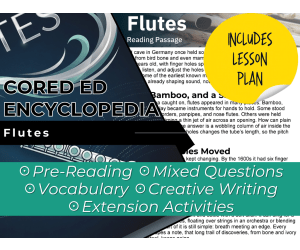
Flutes Reading Comprehension Passage - Cored Ed Encyclopedia
ELA, Reading Comprehension, Reading, Science, Technology, Social Studies, History, Music, Creative Arts, Physics, Grade 2, 3, 4, 5, Worksheets & Printables, Worksheets, Teacher Tools, Centers, Activities, Writing Prompts, Assessments, Quizzes and Tests, Quizzes, Lesson Plans
This flutes reading comprehension with lesson plan includes: Visualization (on the front cover) Start your lesson by taking a minute to think and share something about the topic. Read the script aloud (slowly), perhaps prepare some music or sound effects. Student close their eyes and let their imaginations wander. Students open their eyes, read the question aloud and give them a few minutes to complete. Ask a few students to share or keep answers until the end to compare with what they learn in the passage. Quick pause—thousands of Cored Education products are included with your TeachSimple membership. Download links and encyclopedia index available here. Pre-Reading Trivia Students will write down one thing they already know about the subject and then read five more facts and discuss. These facts are fun, and the students will enjoy learning about the subject before reading more. Give 1 minute for students to write what they already know (no pressure—best guess is fine). Read the five facts together. After each fact, do ask a student for their opinion, was it surprising? Set a purpose by asking students to highlight/underline one fact they want to learn more about during the reading. Reading Passage The text is a high-interest reading passage with set paragraphs, roughly three to four paragraphs long. It contains a variety of themes about the topic, anywhere from history to technology. The passage is between 250 and 350 words in length. First, ask students to look at the headings and see what they’ll learn about today. What do they know about the topic/heading? First read options: Teacher read-aloud (best for support). Partner reading (paragraph by paragraph). While reading, students underline important details, and vocabulary words they think may come up in the questions section. Mixed Questions The first question page contains four multiple-choice questions, each with a choice of four answers, and three written response questions that require a sentence or two from the student. Students complete the mcqs first independently, then review quickly as a class. For the 3 written responses, try to get students giving the answer with some form of evidence: “I think ___ because the text says ___.” If students get stuck, send them back to check the passage. Vocabulary Questions Practice seven key words from the text in this section across two activities. First section is scrambled words where students will unscramble three words given a clue for each. The second section is a word to meaning matching activity. Before starting, have some students read out words they underlined in the passage. Ask students to say the word and read aloud the sentence(s) around each word. Ask students to do scrambled words and the matching exercise in pairs then go through answers as a class. For the scrambled spelling task, get four pairs to come up to the board and write the words for extra practice with the other student reading out the clue. For the matching task, prompt students to give full sentences: “I matched ___ with ___ because ___.” Creative Writing In this question, the student will be required to write a five to eight sentence paragraph on a question related to the topic. Before starting, ask students write down 3 key ideas they are going to include in their piece. Ask students for ideas to share around the class to help those struggling. Pro writing expectations: 5–8 sentences At least 2 facts or details from the passage At least 2 vocabulary words from the previous page Students read their paragraphs while classmates listen for facts and vocabulary words. Extension Activities This page is optional for fast finishers or to take home. There are several activities, each one requiring a different skill. Do some, do none, do all, completely optional - but you will feel reassured knowing every possibility is planned for. Includes summary writting question and additional facts. Answer Key There are answers for the multiple-choice questions, written response questions have sample answers, vocabulary answers and if there is a summary question then a sample summary will be provided as well. Lesson Plan Included Customized lesson plan for this lesson is included. Lesson Snapshot Title: Flutes Genre: Nonfiction (Informational Text) Subject: Music / Science (Sound) / Reading (Informational Text) Primary Topic: How flutes make sound and changed over time Estimated Guided Reading Level (A–Z): Q What This Lesson Teaches Best How very early flutes were made (carved from bird bone and mammoth ivory ) and why these finds matter as early musical instruments. How flutes make a clear note: a thin jet of air across an opening creates a wobbling column of air inside the tube. Cause and effect in instruments: covering or uncovering holes changes the tube’s length, so the pitch goes up or down. How design evolved in Europe, including added holes and keys and Theobald Boehm’s 1800s redesign with tone holes and ring keys . Key features of a modern concert flute (often metal, about 26 inches long, three sections, padded keys, range of a little more than three octaves ). Learning Goals Students will describe what materials some ancient flutes were carved from and how old they were said to be. Students will explain how a flute makes a clear note using the idea of a “column of air” in a tube. Students will explain how covering or uncovering holes changes pitch by changing the tube’s length. Students will summarize how the sideways flute changed over time in Europe, including added holes and keys. Students will identify changes Theobald Boehm made to flute design and how ring keys helped players. Students will describe at least two details of today’s concert flute mentioned in the passage. Key Vocabulary From the Text mammoth — an ancient animal related to today’s elephants. ivory — hard material used for carving. column — a long “tube” shape of air inside. pitch — how high or low a note sounds. octaves — sets of notes higher or lower. FULL CATALOG OF DOWNLOAD LINKS AND ENCYCLOPEDIA INDEX HERE
Author Cored Education
Rating
Tags Vocabulary, Reading Comprehension, Reading Passages, Lesson Plans, Ela Lesson Plans, Reading Comprehension Lesson Plans, Pre-reading, History, Music, Music Lesson Plans
Quiz Shows Reading Comprehension Passage - Cored Ed Encyclopedia
ELA, Language Development, Reading Comprehension, Reading, Pre-Reading, Writing, Strategies, Vocabulary, History, Social Studies, Grade 2, 3, 4, 5, Worksheets & Printables, Worksheets, Teacher Tools, Centers, Activities, Writing Prompts, Assessments, Quizzes and Tests, Quizzes, Lesson Plans
This quiz shows reading comprehension includes: Visualization (on the front cover) Start your lesson by taking a minute to think and share something about the topic. Read the script aloud (slowly), perhaps prepare some music or sound effects. Student close their eyes and let their imaginations wander. Students open their eyes, read the question aloud and give them a few minutes to complete. Ask a few students to share or keep answers until the end to compare with what they learn in the passage. Quick pause—thousands of Cored Education products are included with your TeachSimple membership. Download links and encyclopedia index available here. Pre-Reading Trivia Students will write down one thing they already know about the subject and then read five more facts and discuss. These facts are fun, and the students will enjoy learning about the subject before reading more. Give 1 minute for students to write what they already know (no pressure—best guess is fine). Read the five facts together. After each fact, do ask a student for their opinion, was it surprising? Set a purpose by asking students to highlight/underline one fact they want to learn more about during the reading. Reading Passage The text is a high-interest reading passage with set paragraphs, roughly three to four paragraphs long. It contains a variety of themes about the topic, anywhere from history to technology. The passage is between 250 and 350 words in length. First, ask students to look at the headings and see what they’ll learn about today. What do they know about the topic/heading? First read options: Teacher read-aloud (best for support). Partner reading (paragraph by paragraph). While reading, students underline important details, and vocabulary words they think may come up in the questions section. Mixed Questions The first question page contains four multiple-choice questions, each with a choice of four answers, and three written response questions that require a sentence or two from the student. Students complete the mcqs first independently, then review quickly as a class. For the 3 written responses, try to get students giving the answer with some form of evidence: “I think ___ because the text says ___.” If students get stuck, send them back to check the passage. Vocabulary Questions Practice seven key words from the text in this section across two activities. First section is scrambled words where students will unscramble three words given a clue for each. The second section is a word to meaning matching activity. Before starting, have some students read out words they underlined in the passage. Ask students to say the word and read aloud the sentence(s) around each word. Ask students to do scrambled words and the matching exercise in pairs then go through answers as a class. For the scrambled spelling task, get four pairs to come up to the board and write the words for extra practice with the other student reading out the clue. For the matching task, prompt students to give full sentences: “I matched ___ with ___ because ___.” Creative Writing In this question, the student will be required to write a five to eight sentence paragraph on a question related to the topic. Before starting, ask students write down 3 key ideas they are going to include in their piece. Ask students for ideas to share around the class to help those struggling. Pro writing expectations: 5–8 sentences At least 2 facts or details from the passage At least 2 vocabulary words from the previous page Students read their paragraphs while classmates listen for facts and vocabulary words. Extension Activities This page is optional for fast finishers or to take home. There are several activities, each one requiring a different skill. Do some, do none, do all, completely optional - but you will feel reassured knowing every possibility is planned for. Includes summary writting question. Answer Key There are answers for the multiple-choice questions, written response questions have sample answers, vocabulary answers and if there is a summary question then a sample summary will be provided as well. Lesson Plan Included Customized lesson plan for this lesson is included. Lesson Snapshot Title: Quiz Shows Genre: Nonfiction (informational reading passage) Subject: Reading (Informational Text) / Social Studies (media history) Primary Topic: Quiz shows from radio to TV to podcasts Estimated Guided Reading Level (A–Z): R What This Lesson Teaches Best How quiz shows changed over time, from radio “question games” to television and modern podcasts. Key historical milestones and examples (late 1930s radio programs; 1938 BBC spelling quiz on TV; 1950s U.S. daytime quiz/game shows). Understanding fairness and trust in media (some shows were “rigged,” followed by investigations, hearings, and stronger rules). Text structure practice using section headings to track ideas (early radio → TV era → fairness tested → today). Strong built-in supports that match the passage (questions, vocabulary work, writing prompt, and extensions align to passage details). Learning Goals Students will describe how people participated in quiz shows before TVs were common, using details from the passage. Students will explain how television changed quiz shows, including what it was like for contestants under cameras and lights. Students will explain what “rigged” means in the passage and why quiz shows had to “rebuild trust.” Students will identify ways quiz shows appear today (board, screen at home, or podcast), based on the passage. Students will use the section headings to state the main idea of each section and support it with one detail. Key Vocabulary From the Text contestants — people who compete in a game rigged — secretly fixed so it is not fair producers — people who run and plan a show investigations — careful searches to find out what happened genre — a type or category of show FULL CATALOG OF DOWNLOAD LINKS AND ENCYCLOPEDIA INDEX HERE
Author Cored Education
Rating
Tags Vocabulary, Reading Comprehension, Reading Passages, Reading, Creative Writing, Reading Strategies, Writing Prompts, Lesson Plans, Quiz Shows, History

All About Insects | Animated Animals Video Lesson
Science, Life Sciences, Insects, Grade 3, 4, 5, 6, 7, Lesson Plans, Teacher Tools
All About Insects | Animated Animals Video Lesson Product Description: A comprehensive educational resource specifically designed for science educators and homeschoolers to offer an interactive, immersive learning experience. The tool caters to learners between Grade 3 and Grade 7. This five-minute-long animated video format presents easy-to-understand and accurate scientific information about insects. This digital tool is a valuable addition to any teaching content, from being used as an illustrative aid during lessons or as a resource for homework assignments. Features: Focused animated content on various insect-related topics like life systems, habitats, adaptation mechanisms etc. Intricate animation design for enhanced learner engagement. Pairs visual information with auditory explanations to create multiple learning touchpoints. The product is available in MP4 file format making it compatible across different digital devices - laptops, tablets and even smartphones. Advancements in technology have made any space a potential classroom offering flexible learning scenarios based on each learner's requirements. Potential Usage Scenarios: Educators: A perfect introductory video before starting any new chapter related to animals or insects. Alternatively can be used as review material upon completion of the topic. Homeschoolers/Tutors: Ideal during scheduled science time promoting self-learning methods. Asynchronous learning can be encouraged allowing students learn at their own pace outside typical classroom timings at home leveraging blended education benefits substantially. To conclude, All About Insects | Animated Animals Video Lesson is an adaptable supplemental addition sure to enrich your teaching repertoire providing scientifically accurate data compactly within innovative technology-enhanced education methods.
Author Educational Voice
Tags Insects, Animated Video, Science Education Resource, Homeschooling, Blended Learning, Animated Animals Word Search
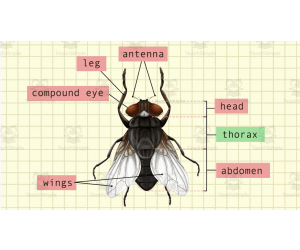
How Insects Move | Animated Insect Video Lesson
Science, Life Sciences, Insects, Grade 3, 4, 5, 6, Lesson Plans, Teacher Tools
This animated science video lesson is all about how insects move. Students will love this engaging and interactive video as they learn more about insects. This video serves as a great introduction or review video for your learners. This is a 14-minute science video lesson.
Author Educational Voice
Tags Insects, Insect Video, Insect Lesson, Science Lesson, Science Video
Radar Reading Comprehension Passage - Cored Ed Encyclopedia
ELA, Language Development, Reading Comprehension, Reading, Pre-Reading, Writing, History, Social Studies, Technology, Science, Grade 2, 3, 4, 5, Worksheets & Printables, Worksheets, Teacher Tools, Centers, Activities, Writing Prompts, Assessments, Quizzes and Tests, Quizzes, Lesson Plans
This radar reading comprehension includes: Visualization (on the front cover) Start your lesson by taking a minute to think and share something about the topic. Read the script aloud (slowly), perhaps prepare some music or sound effects. Student close their eyes and let their imaginations wander. Students open their eyes, read the question aloud and give them a few minutes to complete. Ask a few students to share or keep answers until the end to compare with what they learn in the passage. Quick pause—thousands of Cored Education products are included with your TeachSimple membership. Download links and encyclopedia index available here. Pre-Reading Trivia Students will write down one thing they already know about the subject and then read five more facts and discuss. These facts are fun, and the students will enjoy learning about the subject before reading more. Give 1 minute for students to write what they already know (no pressure—best guess is fine). Read the five facts together. After each fact, do ask a student for their opinion, was it surprising? Set a purpose by asking students to highlight/underline one fact they want to learn more about during the reading. Reading Passage The text is a high-interest reading passage with set paragraphs, roughly three to four paragraphs long. It contains a variety of themes about the topic, anywhere from history to technology. The passage is between 250 and 350 words in length. First, ask students to look at the headings and see what they’ll learn about today. What do they know about the topic/heading? First read options: Teacher read-aloud (best for support). Partner reading (paragraph by paragraph). While reading, students underline important details, and vocabulary words they think may come up in the questions section. Mixed Questions The first question page contains four multiple-choice questions, each with a choice of four answers, and three written response questions that require a sentence or two from the student. Students complete the mcqs first independently, then review quickly as a class. For the 3 written responses, try to get students giving the answer with some form of evidence: “I think ___ because the text says ___.” If students get stuck, send them back to check the passage. Vocabulary Questions Practice seven key words from the text in this section across two activities. First section is scrambled words where students will unscramble three words given a clue for each. The second section is a word to meaning matching activity. Before starting, have some students read out words they underlined in the passage. Ask students to say the word and read aloud the sentence(s) around each word. Ask students to do scrambled words and the matching exercise in pairs then go through answers as a class. For the scrambled spelling task, get four pairs to come up to the board and write the words for extra practice with the other student reading out the clue. For the matching task, prompt students to give full sentences: “I matched ___ with ___ because ___.” Creative Writing In this question, the student will be required to write a five to eight sentence paragraph on a question related to the topic. Before starting, ask students write down 3 key ideas they are going to include in their piece. Ask students for ideas to share around the class to help those struggling. Pro writing expectations: 5–8 sentences At least 2 facts or details from the passage At least 2 vocabulary words from the previous page Students read their paragraphs while classmates listen for facts and vocabulary words. Extension Activities This page is optional for fast finishers or to take home. There are several activities, each one requiring a different skill. Do some, do none, do all, completely optional - but you will feel reassured knowing every possibility is planned for. Includes summary writting question. Answer Key There are answers for the multiple-choice questions, written response questions have sample answers, vocabulary answers and if there is a summary question then a sample summary will be provided as well. Lesson Plan Included Customized lesson plan for this lesson is included. Lesson Snapshot Title: Radar Genre: Nonfiction (informational text with support pages) Subject: Science (Physical Science/Technology) Primary Topic: Using radio waves to find objects Estimated Guided Reading Level (A–Z): R What This Lesson Teaches Best Explains how radar works using radio waves, an “echo,” and a receiver that measures return time. Connects timing to distance (how long the trip takes helps show how far away something is). Builds background knowledge about radar’s development before World War II (tests in the 1930s; June 1935 detection; Chain Home stations). Shows real-world uses after the war (air traffic control, ships in fog, weather radar tracking rain and storms). Includes support pages that match the passage content (questions, vocabulary, writing, and extension activities focus on radio waves, echoes, Chain Home, and the 1935 test). Learning Goals Students can describe radar as a tool that sends out radio waves and listens for the waves that bounce back. Students can explain how a receiver uses the echo’s return time to show distance. Students can describe one early step in radar’s development mentioned in the passage (1930s tests or the June 1935 detection). Students can explain why early-warning stations mattered as World War II was getting closer. Students can identify at least two ways radar is used in everyday life after the war (planes, ships, or weather). Key Vocabulary From the Text receiver — device that listens for the returning signal echo — a returning signal that bounces back pulsing — sending waves in repeated bursts detected — found or noticed something was there vessels — boats or ships FULL CATALOG OF DOWNLOAD LINKS AND ENCYCLOPEDIA INDEX HERE
Author Cored Education
Rating
Tags Vocabulary, Reading Comprehension, Reading Passages, Reading, Creative Writing, Reading Strategies, Writing Prompts, Lesson Plans, History, Radar

All About Fractions | Animated Math Video Lesson
Math, Fractions, Grade 2, 3, 4, 5, Lesson Plans, Teacher Tools
All About Fractions | Animated Math Video Lesson An invaluable resource designed to quickly and effectively introduce fractions to students in grades 2-5 in a captivating way. This interactive animated video simplifies the process of understanding and solving fractional problems, transforming learning into an engaging experience. The use of vivid animation breaks down complex fraction concepts into simpler parts, hence easily accessible for early elementary students and beyond. The video fits perfectly within an 8-minute timeframe promoting effective time management whilst holding the learner's attention. Versatility in Utilisation: Classroom Instruction: A powerful supplement for teachers aiming to diversify their lesson delivery on fractions. Small Group Settings: Can also be utilized where certain skills need emphasis or reinforcement. Homing/Assignment Inclusion: Creating smooth link between school work and at-home reinforcement can be achieved by incorporating it as part of given assignments. This teaching tool comes in MP4 format making it conveniently playable across different digital platforms such as laptops during online tutoring sessions, or even on personal devices during revision intervals. The All About Fractions | Animated Math Video Lesson does more than just instruct - it uses dynamic visuals and memorable formulas to cultivate a deeper understanding about fractions, lessening math anxiety while fostering excitement.
Author Educational Voice
Tags Fractions, Math Video, Animated Lesson, Interactive Learning, Visual Aids
Gunpowder Reading Comprehension Passage - Cored Ed Encyclopedia
ELA, Reading Comprehension, Reading, Science, Technology, Pre-Reading, Language Development, History, Social Studies, Physics, Grade 2, 3, 4, 5, Worksheets & Printables, Worksheets, Teacher Tools, Centers, Activities, Writing Prompts, Assessments, Quizzes and Tests, Quizzes, Lesson Plans
This gunpowder reading comprehension with lesson plan includes: Visualization (on the front cover) Start your lesson by taking a minute to think and share something about the topic. Read the script aloud (slowly), perhaps prepare some music or sound effects. Student close their eyes and let their imaginations wander. Students open their eyes, read the question aloud and give them a few minutes to complete. Ask a few students to share or keep answers until the end to compare with what they learn in the passage. Quick pause—thousands of Cored Education products are included with your TeachSimple membership. Download links and encyclopedia index available here. Pre-Reading Trivia Students will write down one thing they already know about the subject and then read five more facts and discuss. These facts are fun, and the students will enjoy learning about the subject before reading more. Give 1 minute for students to write what they already know (no pressure—best guess is fine). Read the five facts together. After each fact, do ask a student for their opinion, was it surprising? Set a purpose by asking students to highlight/underline one fact they want to learn more about during the reading. Reading Passage The text is a high-interest reading passage with set paragraphs, roughly three to four paragraphs long. It contains a variety of themes about the topic, anywhere from history to technology. The passage is between 250 and 350 words in length. First, ask students to look at the headings and see what they’ll learn about today. What do they know about the topic/heading? First read options: Teacher read-aloud (best for support). Partner reading (paragraph by paragraph). While reading, students underline important details, and vocabulary words they think may come up in the questions section. Mixed Questions The first question page contains four multiple-choice questions, each with a choice of four answers, and three written response questions that require a sentence or two from the student. Students complete the mcqs first independently, then review quickly as a class. For the 3 written responses, try to get students giving the answer with some form of evidence: “I think ___ because the text says ___.” If students get stuck, send them back to check the passage. Vocabulary Questions Practice seven key words from the text in this section across two activities. First section is scrambled words where students will unscramble three words given a clue for each. The second section is a word to meaning matching activity. Before starting, have some students read out words they underlined in the passage. Ask students to say the word and read aloud the sentence(s) around each word. Ask students to do scrambled words and the matching exercise in pairs then go through answers as a class. For the scrambled spelling task, get four pairs to come up to the board and write the words for extra practice with the other student reading out the clue. For the matching task, prompt students to give full sentences: “I matched ___ with ___ because ___.” Creative Writing In this question, the student will be required to write a five to eight sentence paragraph on a question related to the topic. Before starting, ask students write down 3 key ideas they are going to include in their piece. Ask students for ideas to share around the class to help those struggling. Pro writing expectations: 5–8 sentences At least 2 facts or details from the passage At least 2 vocabulary words from the previous page Students read their paragraphs while classmates listen for facts and vocabulary words. Extension Activities This page is optional for fast finishers or to take home. There are several activities, each one requiring a different skill. Do some, do none, do all, completely optional - but you will feel reassured knowing every possibility is planned for. Includes summary writting question and additional facts. Answer Key There are answers for the multiple-choice questions, written response questions have sample answers, vocabulary answers and if there is a summary question then a sample summary will be provided as well. Lesson Plan Included Customized lesson plan for this lesson is included. Lesson Snapshot Title: Gunpowder Genre: Nonfiction (informational text) Subject: Science Primary Topic: How gunpowder was discovered and used over time Estimated Guided Reading Level (A–Z): Q What This Lesson Teaches Best Explains how gunpowder began in China during the Tang dynasty when alchemists mixed ingredients while searching for a life-lasting “elixir.” Identifies the three main powders in gunpowder—charcoal, sulfur, and saltpeter (also called potassium nitrate)—and describes what saltpeter adds to help burning. Describes how gunpowder behaves differently in an open pile versus a tight tube, leading to a strong push of hot gas. Traces how “fire medicine” was used first for celebrations and signals, then developed into fire arrows, bombs, fire lances, and hand cannons by the late 1200s. Shows how ideas travel as gunpowder and stories about rockets reached Europe, and how uses expanded to quarrying rock and digging tunnels, not only fighting. Learning Goals Students will describe how the text says gunpowder was discovered during the Tang dynasty in China. Students will identify the three main powders in gunpowder and explain what saltpeter adds to the burning process. Students will compare what happens when gunpowder burns in an open pile versus in a tight tube. Students will explain how “fire medicine” changed from signals and celebrations to fire arrows and later weapons over time. Students will describe two non-celebration uses of the powder mentioned in the text (quarrying rock and digging tunnels). Students will explain what the author means by “Ideas travel,” using the example of gunpowder reaching Europe. Key Vocabulary From the Text alchemists — people who mixed ingredients while searching for an “elixir.” elixir — a life-lasting drink they searched for. charcoal — powder from burned wood. sulfur — one of the three main powders. saltpeter — a mineral also called potassium nitrate. Discussion Prompts Pre-reading question: What do you think might happen if a powder burns very fast? Comprehension questions: How did the mixture get the name huoyao, or “fire medicine”? Comprehension questions: What role does saltpeter play when a tiny grain is lit? Comprehension questions: How did the uses of “fire medicine” change from celebrations to later tools or weapons? FULL CATALOG OF DOWNLOAD LINKS AND ENCYCLOPEDIA INDEX HERE
Author Cored Education
Rating
Tags Vocabulary, Reading Comprehension, Reading Passages, Lesson Plans, Ela Lesson Plans, Reading Comprehension Lesson Plans, Pre-reading, Science Lesson Plans, Social Studies Lesson Plans, History

Capitalization and Punctuation Supplementary Materials Grade 5-6 (PDF)
ELA, Language Development, ESL, Grammar, Common Core, Resources for Teachers, Grade 5, 6, 7, Worksheets & Printables, Worksheets, Quizzes and Tests, Teacher Tools, Tests, Assessments, Lesson Plans
Capitalization and Punctuation Supplementary Materials Note: This download DOES NOT include the tests themselves. You can still make use of these materials without them but they are recommended. Download in a format of your choice in the "Links" section below. In the Supplementary Pack Interactive Ice Breakers: Engaging warm-up activities that introduce students to key ELA concepts, such as quick capitalization corrections and punctuation challenges. Guided Practice: Structured teacher-led exercises that reinforce grammar and punctuation rules, helping students identify and apply them correctly in sentences. Group and Partner Tasks: Collaborative activities where students work together to edit sentences, correct capitalization, and improve punctuation through peer discussion and teamwork. Independent Worksheets: Carefully designed worksheets that provide focused practice, allowing students to apply learned concepts and refine their skills independently. Exit Tasks: Quick assessments at the end of each lesson, prompting students to reflect on what they’ve learned and apply their knowledge in writing and editing tasks. Links Using Commas Using Quotations Using Possessive Nouns Using Dates Open/Close an Email Google Docs Google Forms Google Slides PDF PPT Word FULL CATALOG OF DOWNLOAD LINKS HERE Grade 5/6 Links: Capitalization & Punctuation Google Docs Google Forms Google Slides PDF PPT Word Free Supplementary Materials Pack Adjectives Google Docs Google Forms Google Slides PDF PPT Word Free Supplementary Materials Pack Nouns Google Docs Google Forms Google Slides PDF PPT Word Free Supplementary Materials Pack Pronouns Google Docs Google Forms Google Slides PDF PPT Word Free Supplementary Materials Pack Verbs Google Docs Google Forms Google Slides PDF PPT Word Free Supplementary Materials Pack Prefixes & Suffixes Google Docs Google Forms Google Slides PDF PPT Word Free Supplementary Materials Pack Sentence Structure Google Docs Google Forms Google Slides PDF PPT Word Free Supplementary Materials Pack Subject Verb Agreement Google Docs Google Forms Google Slides PDF PPT Word Free Supplementary Materials Pack Tenses Google Docs Google Forms Google Slides PDF PPT Word Free Supplementary Materials Pack Context Clues Google Docs Google Forms Google Slides PDF PPT Word Free Supplementary Materials Pack Defining Words Google Docs Google Forms Google Slides PDF PPT Word Free Supplementary Materials Pack Fill in the Blanks Google Docs Google Forms Google Slides PDF PPT Word Free Supplementary Materials Pack Homophones Google Docs Google Forms Google Slides PDF PPT Word Free Supplementary Materials Pack Synonyms Google Docs Google Forms Google Slides PDF PPT Word Free Supplementary Materials Pack ELA Review Questions Overview Questions have three answer choices. There are a handful of pictures on each test for aesthetic purposes, as well as a review sheet covering most of the topics covered in the product. Introduction or Example Sheet Each topic will include an introduction or example sheet to go through first with your students. Full Answer Keys Full answer keys and sample responses are provided so no matter how busy you are, you know you're covered! For More Like This For similar downloads and other frees, do check out Cored Group on TeachSimple.
Author Cored Education
Tags Elementary, Answers, Ccss, Common Core, Grammar, Tests, Test Prep, Assessment, Grade 5, Grade 6
Insect Communication | Animated Insect Video Lesson
Science, Life Sciences, Insects, Grade 3, 4, 5, 6, Lesson Plans, Teacher Tools
This animated science video lesson is all about insect communication. Students will love this engaging and interactive video as they learn more about insects. This video serves as a great introduction or review video for your learners. This is an 11-minute science video lesson.
Author Educational Voice
Tags Insect, Communication Lesson, Science Video, Video Lesson, Science Activity

Insects Reading Comprehension Passage - Cored Ed Encyclopedia
ELA, Reading Comprehension, Reading, Science, Pre-Reading, Language Development, Life Sciences, Insects, Earth and Environmental Sciences, Vocabulary, Grade 2, 3, 4, 5, Worksheets & Printables, Worksheets, Teacher Tools, Centers, Activities, Writing Prompts, Assessments, Quizzes and Tests, Quizzes, Lesson Plans
This Insects reading comprehension with lesson plan includes: Visualization (on the front cover) Start your lesson by taking a minute to think and share something about the topic. Read the script aloud (slowly), perhaps prepare some music or sound effects. Student close their eyes and let their imaginations wander. Students open their eyes, read the question aloud and give them a few minutes to complete. Ask a few students to share or keep answers until the end to compare with what they learn in the passage. Quick pause—thousands of Cored Education products are included with your TeachSimple membership. Download links and encyclopedia index available here. Pre-Reading Trivia Students will write down one thing they already know about the subject and then read five more facts and discuss. These facts are fun, and the students will enjoy learning about the subject before reading more. Give 1 minute for students to write what they already know (no pressure—best guess is fine). Read the five facts together. After each fact, do ask a student for their opinion, was it surprising? Set a purpose by asking students to highlight/underline one fact they want to learn more about during the reading. Reading Passage The text is a high-interest reading passage with set paragraphs, roughly three to four paragraphs long. It contains a variety of themes about the topic, anywhere from history to technology. The passage is between 250 and 350 words in length. First, ask students to look at the headings and see what they’ll learn about today. What do they know about the topic/heading? First read options: Teacher read-aloud (best for support). Partner reading (paragraph by paragraph). While reading, students underline important details, and vocabulary words they think may come up in the questions section. Mixed Questions The first question page contains four multiple-choice questions, each with a choice of four answers, and three written response questions that require a sentence or two from the student. Students complete the mcqs first independently, then review quickly as a class. For the 3 written responses, try to get students giving the answer with some form of evidence: “I think ___ because the text says ___.” If students get stuck, send them back to check the passage. Vocabulary Questions Practice seven key words from the text in this section across two activities. First section is scrambled words where students will unscramble three words given a clue for each. The second section is a word to meaning matching activity. Before starting, have some students read out words they underlined in the passage. Ask students to say the word and read aloud the sentence(s) around each word. Ask students to do scrambled words and the matching exercise in pairs then go through answers as a class. For the scrambled spelling task, get four pairs to come up to the board and write the words for extra practice with the other student reading out the clue. For the matching task, prompt students to give full sentences: “I matched ___ with ___ because ___.” Creative Writing In this question, the student will be required to write a five to eight sentence paragraph on a question related to the topic. Before starting, ask students write down 3 key ideas they are going to include in their piece. Ask students for ideas to share around the class to help those struggling. Pro writing expectations: 5–8 sentences At least 2 facts or details from the passage At least 2 vocabulary words from the previous page Students read their paragraphs while classmates listen for facts and vocabulary words. Extension Activities This page is optional for fast finishers or to take home. There are several activities, each one requiring a different skill. Do some, do none, do all, completely optional - but you will feel reassured knowing every possibility is planned for. Includes summary writting question and additional facts. Answer Key There are answers for the multiple-choice questions, written response questions have sample answers, vocabulary answers and if there is a summary question then a sample summary will be provided as well. Lesson Plan Included Customized lesson plan for this lesson is included. Lesson Snapshot Title: Insects Genre: Nonfiction (informational text) Subject: Reading (Informational Text) / Life Science Primary Topic: Insect body parts, growth, history, and study Estimated Guided Reading Level (A–Z): R What This Lesson Teaches Best Identifies core insect body parts and features (head, thorax, abdomen; six legs; antennae; compound eyes; many have wings). Explains how insects grow using an outside skeleton (exoskeleton) and why molting is needed as they get bigger. Describes butterfly life stages as an example of changing shape in stages (egg, caterpillar, chrysalis, winged adult). Connects insects to deep time and evidence from fossils (oldest known flying insects in the Carboniferous Period; many species today). Introduces how people study and classify insects over time (Aristotle, Carl Linnaeus, and modern entomology). Learning Goals Students will identify the three main insect body parts and describe what each part includes. Students will explain why insects must molt as they grow, using the idea of an exoskeleton. Students will describe the butterfly’s life stages in order, using details from the passage. Students will explain what fossils reveal about early flying insects and how insect groups changed over time. Students will define entomology and describe tools scientists use to study insects. Key Vocabulary From the Text thorax — middle body part where legs attach. abdomen — back body section behind the thorax. antennae — feelers that taste the air. exoskeleton — hard outer coat that works like a skeleton. entomology — the study of insects. FULL CATALOG OF DOWNLOAD LINKS AND ENCYCLOPEDIA INDEX HERE
Author Cored Education
Rating
Tags Vocabulary, Reading Comprehension, Reading Passages, Lesson Plans, Ela Lesson Plans, Reading Comprehension Lesson Plans, Pre-reading, Science Lesson Plans, Life Science, Insects

5th Grade Spelling Unit | Spelling Curriculum | Spelling Lists
ELA, Language Development, Spelling, Grade 5, Lesson Plans, Teacher Tools
Get your 5th graders ready for spelling success! This curriculum focuses on understanding patterns and rules that fifth graders need to know. Each week, students have a list of 10 carefully selected words, plus space to add 5 personalized words. The curriculum covers important spelling patterns like prefixes, suffixes, vowel variations, and syllable breaks. Students will start to understand why words are spelled the way they are. Each week has a colorful poster that highlights the week’s words and spelling pattern, a test sentence call-out sheet, pretest and test templates, and a variety of fun worksheets. The best part? All you need to do is print and go! Spelling Rules and Patterns Included By Week: Week 1- Words that use the suffix -ant Week 2- Words that use the suffix -ent Week 3- Words that use the suffix -able Week 4- Words that use the suffix -ible Week 5- Commonly misspelled words Week 6- Words that have a /shun/ sound spelled with "tion" Week 7- Words that have a /shun/ sound spelled with "tion" Week 8- Homographs Week 9- Homographs Week 10- Commonly misspelled words Week 11- Unusual Plurals Week 12- Unusual Plurals Week 13- Words with double consonants and an -ed ending Week 14- Words with double consonants and an -ing ending Week 15- Commonly misspelled words Week 16- Polysyllabic words ending with -ing Week 17- Polysyllabic words ending with -ing Week 18- Polysyllabic words ending with a suffix ending Week 19- Polysyllabic words ending with a suffix ending Week 20- Commonly misspelled words Week 21- Words with an ad- prefix Week 22- Words with a com- prefix Week 23- Words with a coll- prefix Week 24- Words with a dis- prefix Week 25- Commonly misspelled words Week 26- Words with an in- prefix Week 27- Words with an ob- prefix Week 28- Words with a sub- prefix Week 29- Words with an -ology suffix Week 30- Commonly misspelled words Need Other Levels of Spelling? Check these out: - Kindergarten Spelling Year-Long Curriculum - 1st Grade Spelling Year-Long Curriculum - 2nd Grade Spelling Year-Long Curriculum - 3rd Grade Spelling Year-Long Curriculum - 4th Grade Spelling Year-Long Curriculum - 5th Grade Spelling Year-Long Curriculum - 6th Grade Spelling Year-Long Curriculum - 7th Grade Spelling Year-Long Curriculum - 8th Grade Spelling Year-Long Curriculum Check out other resources from my store: Simply Schoolgirl! I can be contacted for questions and concerns at simplyschoolgirl1@gmail.com
Author Simply Schoolgirl
Tags Spelling Bundle, Spelling Curriculum, Pretest Templates, Spelling Rules, Spelling List, Practice Spelling, Fifth , Spelling Worksheets, Spelling Activities, Printable Spelling
Jails Reading Comprehension Passage - Cored Ed Encyclopedia
ELA, Reading Comprehension, Reading, Pre-Reading, Language Development, Vocabulary, History, Social Studies, Law, Spelling, Grade 2, 3, 4, 5, Worksheets & Printables, Worksheets, Teacher Tools, Centers, Activities, Writing Prompts, Assessments, Quizzes and Tests, Quizzes, Lesson Plans
This Jails reading comprehension with lesson plan includes: Visualization (on the front cover) Start your lesson by taking a minute to think and share something about the topic. Read the script aloud (slowly), perhaps prepare some music or sound effects. Student close their eyes and let their imaginations wander. Students open their eyes, read the question aloud and give them a few minutes to complete. Ask a few students to share or keep answers until the end to compare with what they learn in the passage. Quick pause—thousands of Cored Education products are included with your TeachSimple membership. Download links and encyclopedia index available here. Pre-Reading Trivia Students will write down one thing they already know about the subject and then read five more facts and discuss. These facts are fun, and the students will enjoy learning about the subject before reading more. Give 1 minute for students to write what they already know (no pressure—best guess is fine). Read the five facts together. After each fact, do ask a student for their opinion, was it surprising? Set a purpose by asking students to highlight/underline one fact they want to learn more about during the reading. Reading Passage The text is a high-interest reading passage with set paragraphs, roughly three to four paragraphs long. It contains a variety of themes about the topic, anywhere from history to technology. The passage is between 250 and 350 words in length. First, ask students to look at the headings and see what they’ll learn about today. What do they know about the topic/heading? First read options: Teacher read-aloud (best for support). Partner reading (paragraph by paragraph). While reading, students underline important details, and vocabulary words they think may come up in the questions section. Mixed Questions The first question page contains four multiple-choice questions, each with a choice of four answers, and three written response questions that require a sentence or two from the student. Students complete the mcqs first independently, then review quickly as a class. For the 3 written responses, try to get students giving the answer with some form of evidence: “I think ___ because the text says ___.” If students get stuck, send them back to check the passage. Vocabulary Questions Practice seven key words from the text in this section across two activities. First section is scrambled words where students will unscramble three words given a clue for each. The second section is a word to meaning matching activity. Before starting, have some students read out words they underlined in the passage. Ask students to say the word and read aloud the sentence(s) around each word. Ask students to do scrambled words and the matching exercise in pairs then go through answers as a class. For the scrambled spelling task, get four pairs to come up to the board and write the words for extra practice with the other student reading out the clue. For the matching task, prompt students to give full sentences: “I matched ___ with ___ because ___.” Creative Writing In this question, the student will be required to write a five to eight sentence paragraph on a question related to the topic. Before starting, ask students write down 3 key ideas they are going to include in their piece. Ask students for ideas to share around the class to help those struggling. Pro writing expectations: 5–8 sentences At least 2 facts or details from the passage At least 2 vocabulary words from the previous page Students read their paragraphs while classmates listen for facts and vocabulary words. Extension Activities This page is optional for fast finishers or to take home. There are several activities, each one requiring a different skill. Do some, do none, do all, completely optional - but you will feel reassured knowing every possibility is planned for. Includes summary writting question and additional facts. Answer Key There are answers for the multiple-choice questions, written response questions have sample answers, vocabulary answers and if there is a summary question then a sample summary will be provided as well. Lesson Plan Included Customized lesson plan for this lesson is included. Lesson Snapshot Title: Jails Genre: Nonfiction (informational text) Subject: Social Studies (Civics) / Reading (Informational Text) Primary Topic: What jails are and how they differ from prisons Estimated Guided Reading Level (A–Z): S What This Lesson Teaches Best Explains what a jail is and why people may be there for a short time (waiting for a court date or serving short sentences). Uses history to show how jails were used long ago (England, 1166) and why the spelling “gaol” appeared. Clarifies the difference between “jail” and “prison” in formal American and Canadian English (pretrial custody/shorter sentences vs. longer sentences). Connects jails to community routines and civic values (rules, safety checks, fairness, harm prevention, justice). Builds understanding of how word choice and definitions matter when discussing systems and government roles (counties vs. state/federal). Learning Goals Describe what a jail is and give two reasons people may be held there. Explain how early jails in England were used and what “gaol” means in the passage. Explain what changed in the 1790s in the United States, according to the text. Compare a jail and a prison using details from the passage. Identify examples of routines and rules in jails and explain why they matter. Key Vocabulary From the Text booking — recording a new person in jail. cells — small rooms where people are held. trial — a court process to decide a case. convicted — found guilty of a crime. reform — help someone change for the better. FULL CATALOG OF DOWNLOAD LINKS AND ENCYCLOPEDIA INDEX HERE
Author Cored Education
Rating
Tags Vocabulary, Reading Comprehension, Reading Passages, Lesson Plans, Ela Lesson Plans, Reading Comprehension Lesson Plans, Pre-reading, Social Studies Lesson Plans, History, Jails