



2,810 products added recently
Page 275 - Lesson Plans
Access a wide array of lesson plans designed to support educators in delivering engaging and effective instruction. Covering various subjects and grade levels, these resources provide structured guidance to enrich your curriculum. Utilize these plans to save time and inspire successful learning outcomes.

 Show filters


Data Analysis & Probability: Pictographs - PC Software
Math, Graphing, Kindergarten, Preschool, Grade 1, 2, Teacher Tools, Lesson Plans
Data Analysis & Probability: Pictographs - PC Software The Data Analysis & Probability: Pictographs - PC Software is a thoughtfully designed teaching resource that caters to both public school educators and homeschoolers. A comprehensive chapter on understanding Pictographs sits at its core, making it an integral teaching aid in the study of Data Analysis and Probability. The distinctiveness of this software is derived from a combination of curriculum-based content and hands-on elements, fostering interactivity in learning. The components include: Pre- assessment modules: to gauge learners' initial understanding, Lesson plans: to guide through the section, Real-world word problems: for practical applications, Vigorous timed drill activities:to consolidate knowledge. /ul> Incorporating Additional tools Apart from pictographs, the software integrates exciting math tools into its architecture. This approach caters variously to learner differences ensuring continuance of an engaging comprehension process. With games such as memory matches, board games and even spinner games availed through this application, educators can make lessons fun-filled! Lingular sensivity This product also takes into account language barrier considerations. The software is enabled with voice-over provisions in English/Spanish along with text options in both languages promoting inclusion across linguistic boundaries. Modes Of Delivery And Compatibility The "Data Analysis & Probability: Pictographs - PC Software" delivers electronically via zip file enabling seamless download minus any hustle . However,this product is compatible only with PCs . Scope Of Learning A marvellous mix of structured learning and interactive fun, this software brings real value to the table in teaching Mathematics specifically Graphing. It caters well to preschool or kindergarten, first or second grade.
Author Classroom Complete Press
Tags Digital Math, Digital Graphs, Pictographs, Data, Probability

I WONDER - What Happens When The Liver Gets Damaged | Animated Video
Biology, Life Sciences, Science, Human Body, STEM, Grade 5, 6, 7, 8, 9, 10, 11, Lesson Plans, Teacher Tools
Video Overview The human body is full of fascinating wonders to learn. This video is created to help the students recognize the anatomy and the job of the human body. I WONDER - What Happens When The Liver Gets Damaged | Animated Video Lesson Every part and organ in our human body is vital so let's see how important they are. Have you ever imagined how we look like if we didn't have a skeleton? Did you know that because we have our amazing muscles we can stand! Do you know how many teeth do we have? Have you ever wondered about the food journey inside our body? Can you name all the glands in our body? Why do we have skin? Our nervous system is really good at sending signals. Can you tell us more about it? Are you really good at Mathematics, painting, or any other thing? You should really thank your brain about it! The famous five senses are really doing a great work? Can you explain how every sense works? I WONDER - What Happens When The Liver Gets Damaged | Animated Video Lesson The video is perfect for encouraging the researching skills for the students, while learning more about our fantastic human body. I WONDER - What Happens When The Liver Gets Damaged | Animated Video Lesson This friendly designed video is suitable for students at school, homeschooling, and as a group activity. Format Available in MP4 format.
Author Educational Voice
Tags What Happens When The Liver Gets Damaged, What Happens When The Liver Gets Damaged Video, Liver, Liver Facts, Liver Facts For Kids, Liver Video, Liver Video For Kids, Liver Damaged, Liver Damaged Facts

I WONDER - Why Is Saturn Special | Animated Video Lesson
Space, Earth and Environmental Sciences, Science, Grade 6, 7, 8, 9, 10, 11, 12, Lesson Plans, Teacher Tools
Video Introduction An amazing video designed for the students to learn more about space facts. I WONDER - Why Is Saturn Special | Animated Video Lesson Do you like reading about space? If yes, what is your favorite topic? What do you know about our solar system? What is the smallest planet in our solar system? What is the biggest planet in our solar system? What is the hottest planet in our solar system? And what is the coldest one? Do you think there are aliens? If yes, what do you think they look like? What do they eat and how they speak to each other? Where do they live? What is a galaxy? And what is a milky way? Have you recently saw a shooting star? If yes, tell us more about it, like when did it happen and where? What is a blackhole? Can a blackhole gets bigger by time? Do you like counting the stars? What do you think a star is made of? I WONDER - Why Is Saturn Special | Animated Video Lesson The video is perfect for encouraging the researching skills for the students, while learning more about the fantastic space. I WONDER - Why Is Saturn Special | Animated Video Lesson This friendly designed video is suitable for students at school, homeschooling, and as a group activity. Format Available in MP4 format.
Author Educational Voice
Tags Why Is Saturn Special, Why Is Saturn Special Video, Saturn, Saturn Facts, Saturn Facts For Kids, Saturn Video, Saturn Video For Kids, Planet, Planets Video, Space

3rd Grade Math Exit Slip Journal | Unit 6 Math Expressions
, Grade 3, Lesson Plans, Teacher Tools
This resource is a 3rd Grade Math Exit Slip Journal. This journal is for Unit 6 Math Expressions. Print and set-up instructions are included. Books are printed 2 per page. This journal comes with a cover page and it will walk through each skill taught during this unit . This is a great way to formatively assess your math students.
Author Sarah Sorensen
Tags Equations, Word Problems, Expressions, Exit Slips, Math Journal
Number of the Week Unit: All About Number 18
Math, Numbers, Kindergarten, Preschool, Lesson Plans, Teacher Tools
Number of the Week Unit: All About Number 18 The teaching resource titled 'All About Number 18' provides a versatile bundle that offers an expansive selection of activities exclusively crafted to teach the number 18. Perfect for teaching preschoolers and kindergarteners, this resource is downloadable and printable with zero preparation required! Mazes, Dot Painting, Sorting: Engage your students in a diverse range of exercises that blend creativity and learning. Vibrant Worksheets: Both color coded worksheets with captivating clipart illustrations as well as black-and-white versions ensure varied yet consistent learning practices. Educational Posters: With over 40 posters designed for bulletin boards to immersive classroom environment. 'Real World' Pictures & Puzzle : Incorporating photos in groups of 18 inculcates real-world context while puzzles enhance interactivity. This includes four Counting snacks mats. An integral part of this package showcases ten pictures depicting groups of eighteen – allowing children to relate numbers with everyday objects they encounter around them - providing an interactive aspect across over two dozen exclusive worksheets. Purpose-Built Versatility:- Ideal for targeted small group lessons or comprehensive whole-group instruction - it's designed to be adaptable for each context. Can also function as homework assignment material due to its user-friendly structuring. The unit comes together neatly within a convenient digital format - A single PDF file spanning across a hundred pages chock-full with requisite materials catering all about 'Number Eighteen'. Download today and redefine your approach towards teaching numbers!
Author Simply Schoolgirl
Tags Numbers, Numeracy, Preschool, Kindergarten, Teaching Resource

Sound and Light
Science, Physics, Grade 5, Teacher Tools, Lesson Plans
Sound and Light: Teaching Resource for Grade 5 Science Sound and Light is a meticulously designed teaching resource, specifically tailored for Grade 5 Science teachers. This aid centers around Physics, focusing on enriching students' understanding of sound and light in an engaging manner. Understanding Sound Waves The resource starts with a comprehensive guide about sound waves, simplifying key concepts. Informs that sound is essentially a vibration that moves in waves, making this concept accessible for young learners. Covers vital elements like frequency and amplitude to help define the pitch as well as the impact of loudness or softness on audibility. Exploring The Properties Of Light Delves into properties of light, emphasizing how it travels from source to our eye. Fosters curiosity by explaining how light can be obstructed to form shadows or can bounce off reflective surfaces such as mirrors. 'Light And Color' A detailed guide about 'Light and Color', introducing color spectrum in light along with relationships between color intensities under different lighting conditions—a valuable knowledge base for budding artists! 'Movement Of Light Energy' A deep dive into 'Movement of Light Energy', providing insights on visible light spectrum while exploring various ways through which light can be reflected, refracted or absorbed. The teaching guide comes as a downloadable PDF file supporting transmission over multiple platforms thus offering diverse usage possibilities: whole class instruction; small group work; station activities; independent study sessions or homework assignments! In summary , Sound & Light aims to simplify complex scientific phenomena in cognitively appropriate ways, making learning more concrete than ever before! An all-encompassing exploration for your Grade 5 science curriculum needs.
Author Classroom Complete Press
Tags PDF

Let's Chat Conversation Cards | "Instead of Judgment, See Perspective"
Special Resources, Social Emotional Learning (SEL), Grade 6, 7, 8, 9, 10, 11, 12, Teacher Tools, Lesson Plans
Let's Chat Conversation Cards for "Instead of Judgment, See Perspective" is a social-emotional learning resource that facilitates meaningful discussions to build empathy and understanding between students. The conversation prompts encourage students to explore different perspectives, share stories, and make connections. Implement as a whole class community building activity or in small groups. Matches other Respectful Ways SEL resources for a comprehensive program aligned with PBIS frameworks. Developed by educators and trauma-informed experts to positively impact school climate. Panorama data from partner districts showed improved GPAs, attendance, and fewer referrals. Contact Pam@RespectfulWays.com for more details or to customize professional development workshops utilizing your school's climate data.
Author Respectful Ways
Tags SEL Lesson Plan, Conversation Cards, Spanish, Respectful Ways, Perspective, Let's Chat, Compassion, Character Education, Trauma-informed, Instead Of Judgment
Let's Chat Conversation Cards | "Look on the Bright Side"
Special Resources, Social Emotional Learning (SEL), Kindergarten, Preschool, Grade 1, 2, Teacher Tools, Lesson Plans
Let's Chat Conversation Cards for "Listening and Learning." The “Let’s Chat Conversation Cards is a wonderful resource to help students build a positive mindset. This resource is part of a whole program that works towards having students believe they can be compassionate, have perseverance, respect, and responsibility and through it all, achieve great things! Let’s Chat Conversation Cards allows for real conversations through which students may learn of different perspectives and strengthen friendships through truly understanding each other. This resource is a set of Let's Chat Conversation Cards for "Listening and Learning." This activity packet is available in English and Spanish to be as accessible as possible for as many families as possible. Included: - Printable cards - Promise Pledge - Lesson Plan - Standards - Printable student award - Home Connects in English and Spanish
Author Respectful Ways
Tags Emotional, SEL Lesson Plan, Conversation Cards, Respectful Ways, Bright Side

Conservation: Waterway Habitat Resources: Conservation: What We Can Do Gr. 5-8
Science, Earth and Environmental Sciences, Environmental Science, Grade 5, 6, 7, 8, Teacher Tools, Lesson Plans
Conservation: Waterway Habitat Resources: What We Can Do Gr. 5-8 is a chapter slice from the complete lesson plan, Conservation: Waterway Habitat Resources. This resource has been specifically designed for the learning needs of students in grades 5 to 8, with a focus on environmental science. This teaching tool aims to enlighten students about various global aquatic ecosystems that are witnessing significant changes due to human activities and climate change. The learners become ecologists identifying factors, both biotic and abiotic, affecting these delicate ecosystems. Main Themes: The impact of climate change and human activities on aquatic ecosystems. The role of local environments in shaping these systems. The adaptability struggles faced by organisms within a changing climate. This resource encourages learners to explore their local environments by visiting nearby aquatic bodies, making observations, and gaining insights into their dynamics. The course has also been designed such that it allows them an opportunity to appreciate underwater life at their local aquariums thereby aiding understanding at a micro-level. A Look at what's Included: An insight into the alarming extinction rate among marine species. A discussion framework around possible solutions for rejuvenating 'aquatic dead zones'. An impressive list comprising 30 ready-to-print pages replete with lessons plans; group assignments; interactive homework activities; numerous hands-on tasks as per Bloom's Taxonomy directives along with STEAM initiatives Plethora of supplementary materials encompassing graphic organizers; crosswords; word searches; comprehension quizzes accompanied by answer keys supporting holistic learning across domains while nurturing curiosity towards our planet's underwater treasures. </ol
Author Classroom Complete Press
Tags Habitats, Conservation, Environmental, Science, Science Passage
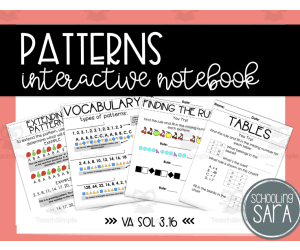
Patterns Math Interactive Notebook (VA SOL 3.16)
Math, Patterns, Grade 2, 3, 4, Teacher Tools, Lesson Plans
This product covers the 2016 Virginia (VA) Standards of Learning (SOL) 3.16: The student will identify, describe, create, and extend patterns found in objects, pictures, numbers and tables. (note that this will also work for the 2023 VA SOL 3.PFA.1: The student will identify, describe, extend, and create increasing and decreasing patterns (limited to addition and subtraction of whole numbers), including those in context, using various representations.) It contains notes pages on identifying patterns, the different types of patterns, extending patterns, repeating patterns, growing (or increasing and decreasing) patterns, and table patterns. Students are asked to identify the rules, fill in missing numbers, or replicate patterns throughout the unit to build a better understanding of the topic. There are practice pages for each topic, with an answer key included. The notes pages come in two sizes. The first size is a full-page size. You can print them as-is, or you can print them two to a pages. This is what I do as it saves on paper and the sheets will fit in a notebook. The second size is formatted to fit on a standard composition notebook page. Additionally, there are two links included in the pdf: one which opens a digital version of the notes, and another that opens a slide show version, optimized for a projector or interactive board. In both cases, which you click the link, you will be prompted to make a copy, which you can then use with Google Slides or download and use with Keynote or PowerPoint. What's included? Patterns Vocabulary Identifying Patterns Types of Patterns Extending Patterns Finding the Rule of Repeating Patterns Finding the Rule of Growing Patterns (sometimes referred to as "increasing/decreasing" patterns) Missing Item Patterns Patterns Quick Check Input/Output Tables Input/Output Tables Quick Check For more no and low-prep activities, check these out: October No-Prep Math Activities No Prep Spiral Math Daily Review and Quizzes Comparing Money Practice 1 Identifying Money Practice Area and Perimeter Digital Activity Counting Money Practice
Author SchoolingSara
Tags Patterns, Math Education, Interactive Notebook, Virginia SOL 316, Digital Learning

12 Election Terms for Middle & High School- Vocabulary Strategies
Social Studies, Government, Grade 7, 8, 9, Teacher Tools, Lesson Plans
The 17-page resource, 12 Essential Election Terms for Middle and High School-Vocabulary Strategies provides students with opportunities to explore essential vocabulary so that they can begin to build their knowledge as they delve more deeply into the election. The resource includes an inventive road signs metaphor to help students identify their level of familiarity with various election terms. It establishes a knowledge base from which they can dive into nuanced meanings of these words. The unique K.I.M Vocabulary strategy is used to explore different aspects of each word, including word families, roots, etc., further strengthening students’ understanding. The resource includes the following: About this Resource: a handy guide to orient teachers to the Essential Question, Guiding questions, standards, objectives, and learning targets, list of resources, preparation and time frame, and includes a link to a force copy for the Google Doc which makes the resource editable. Understanding Essential Election Vocabulary (Road Signs to Understanding Vocabulary) K.I.M. Vocabulary for Essential Election Terms and Key K.I.M. Vocabulary for Essential Election Terms Key Essential Election Vocabulary Quiz and Key The 12 words are: ballot, candidate, democracy, election, government, political parties, politics, propaganda, proposition, representative democracy, and vote. Once students have a clear understanding of the terms, teachers can assess their understanding through the quiz . The quiz includes 2 parts: a matching the definition with the word and answering questions about the words that will allow them to show their understanding. The Essential Question: "How do key election terms shape our understanding of democratic processes, and what strategies can we employ to navigate and utilize them effectively?" and the 3 Guiding Questions: "How do citizens engage with the democratic process through terms like "ballot," "candidate," and "vote," and what role do these terms play in ensuring representative governance?" "What strategies can individuals employ to critically evaluate the influence of "propaganda" and "political parties" in elections, and how do these terms impact the formation of informed civic choices?" "In what ways do concepts like "representative democracy" and "citizen" shape our understanding of government structures and the responsibilities of individuals within a democratic society?" encourages students to critically think about both the meaning and the impact of these words, not just on themselves, but also on our election cycle and our electoral system. Every four years, citizens of our nation get to choose our next president. Middle School and High School students are at the age where they begin to think of themselves as members of this country. Many of them witness their relatives voting, but many do not, either because their relatives are not citizens or because their relatives are disengaged from the electoral process. It is our duty as Social Studies teachers to engage our students in the electoral process so that they understand how our electoral system works and so that they see the value in participating in our democracy through voting.
Author Intentional Teaching and Learning
Tags Election Terms, Democracy, Civic Duty, Government, Election, Discussion, Reflection, Civics, U.S. History, Vocabulary Strategies

Lesson 7.2 - The Periodic Table
Science, Chemistry, Physics, Grade 6, 7, 8, 9, 10, 11, 12, Lesson Plans, Teacher Tools
Unit 7: The Atom & the Nucleus - Whole Unit Description This resource provides educators with comprehensive materials for teaching atomic and nuclear concepts. Ideal for middle and high school science teachers handling chemistry and physics topics, these resources encourage fun, student-oriented instruction. Subatomic Particles Lessons The unit begins with lessons on three subatomic particles: proton, neutron, and electron. Included are '7.1 Atomic Structure Notes' which contain details about their properties and location within the atom. A version complete with blanks for in-class participation A filled-out version for reference Interactive Practice Session '7.1 Subatomic Particle Matching Practice' features printable cards with facts about each subatomic particle that students can group accordingly—perfect for group or paired activities. Offline Learning Experience 'World's Smallest Movie Reading' assignment promotes independent exploration outside class hours through an IBM mini-movie created using stop-motion photography of individual atoms. Brief summary writing exercise to improve recall plan attached. PowerPoint Presentations: Filled with Starter Questions The Periodic Table notes touch briefly on history Data from including an exciting scavenger hunt activity Nuclear Energy Lessons & Computer Simulations Sensational computer simulations bring construction of atoms or nuclear fission principles to life while promoting classroom collaboration. Various exercises foster: Critical thinking skills via assorted readings on nuclear energy pros/cons Navigating the various debates surrounding its use Mastery Test The comprehensive test with differing question types ensures understanding of all concepts discussed in this unit: True/False and matching questions Short essay questions A recovery quiz helps boost any underwhelming scores whilst also acting as an additional review process. All materials meet essential Integrated Chemistry & Physics State Standards beyond Indiana’s curricular requirements and are editable in .docx or.pptx formats for easy customization. *You should have a word processor that supports .docx file type and similar presentation software to support the .pptx format for accessing these files.
Author Integrated Chemistry and Physics
Tags Subatomic Particles, Atomic Structure, Periodic Table, Nuclear Energy, Interactive Simulations

Stop the Sun text by Gary Paulson
ELA, Reading, Grade 8, 9, 10, 11, Teacher Tools, Lesson Plans
This resource will give you everything you need to complete a full, comprehensive reading lesson plan for Stop the Sun text by Gary Paulson. Files are offered as PDFs and Word documents. Included: -Stop the Sun Lesson Plan -Stop the Sun Worksheet -Stop the Sun Answer Key Graphic Organizers: Author’s Purpose Characterization Chart Figurative Language Chart Historical Analysis Chart Imagery Chart Peer Evaluation Sheet Plot Diagram Read for Detail Setting Style Chart Symbol Chart Symbolism Chart Theme Diagram Tone and Mood Diagram Universal Plot Diagram Venn Diagram PowerPoints: Characterization Imagery, Voice, and Persona Irony and Ambiguity Narrator and Voice Plot Structure Symbolism and Allegory Theme - How to Interpret Theme Thank You Bonus Stuff!
Author Quality Teaching Products
Tags Plot Structure, Theme Lesson, Stop The Sun, Reading Lesson Plan, Gary Paulson

I WONDER - How Does Biodiversity Affect What We Eat | Animated Video
Environmental Science, Earth and Environmental Sciences, Science, Earth Sciences, Nature & Plants, Life Sciences, Insects, Biology, Animals, Human Body, Grade 4, 5, 6, 7, 8, 9, 10, Lesson Plans, Teacher Tools
Video Introduction An amazing video designed for the students to learn more about STEM. I WONDER - How Does Biodiversity Affect What We Eat | Animated Video Lesson Do you like STEM subjects? what is your favorite one? Have you ever tried to plant a seed? If yes, tell us more about it. Or have you ever tried to invent something? If yes, tell us more about it. And how do you think it will help us? Have you ever seen a microorganism under a microscope? What was it? And how it looked like? Mathematics is a marvelous subject. Let' sharpen our brains and solve some equations. Do you like timetable tricks? What is your favorite one? Do you know how to code? Have you ever created an app or a game before? If yes, how was it like? I WONDER - How Does Biodiversity Affect What We Eat | Animated Video Lesson The video is perfect for encouraging the researching skills for the students, while learning more about this fantastic topic. I WONDER - How Does Biodiversity Affect What We Eat | Animated Video Lesson This friendly designed video is suitable for students at school, homeschooling, and as a group activity. Format Available in MP4 format.
Author Educational Voice
Tags How Does Biodiversity Affect What We Eat, How Does Biodiversity Affect What We Eat Video, Biodiversity, Biodiversity Facts, Biodiversity Facts Video, Biodiversity Facts For Kids, Biodiversity Video For Kids
William Shakespeare | Reading Comprehension Deck | Interactive Lesson
Social Studies, Biographies, Grade 9, 10, 11, 12, Teacher Tools, Lesson Plans
This reading comprehension deck is the perfect accessory to your Social Studies instruction! This digital slideshow presents William Shakespeare. Within this slideshow, you will receive: -Video Lesson -Reading Passage w/ Audio -Close Reading -Quick Write The informational texts included in this resource alongside the informal assessments will keep your students engaged from beginning to end.
Author Teach Me This
Tags Interactive Lesson, Social Studies Lesson, Poetry, William Shakespeare, Reading Passage
Waste: At the Source: Post-Consumer Waste Gr. 5-8
Science, Earth and Environmental Sciences, Environmental Science, Common Core, Grade 5, 6, 7, 8, Teacher Tools, Lesson Plans
Waste: At the Source: Post-Consumer Waste Gr. 5-8 An educational resource designed to provide students in grade 5 through 8 with a comprehensive understanding of ambient waste and its origins. This teaching resource is focused on the "Post-Consumer Waste," chapter from the "Waste: At The Source" lesson plan. Key Elements: A focus on environmental matters, aimed at stimulating student inquisitiveness. Detailed study into pre-consumer waste, raw materials, natural resources, and post-consumer waste. Insight into product packaging's impact, consumable products versus durable goods. Practical comprehension of landfill management for solid and toxic wastes. Main Attributes: Broadens learner's knowledge by explaining how pollution affects people, wildlife, ecosystems across lands and oceans. Use of simplified language for easy understanding by children at that age level. Ideal for whole group classroom experiences or small group sessions for personalized attention or flipped-learning homework assignments that continue education beyond school hours. Incorporation into Curriculum This content serves as a beneficial tool for both environmental science educators or homeschoolers trying to incorporate details-oriented material into their curriculum design process. Included Learning Tools: An engaging range of student activities along with colorful mini posters facilitate engagement while simultaneously enhancing visual cognition within learners. . Crossword puzzles and word searches aimed at reinforcing subject-related vocabulary in an interactive manner are included along with standard comprehension quizzes designed to assess content retention progressively.. (In particular, a preparatory test module aligned with specific State Standards incorporating Bloom's Taxonomy approaches is included for ensuring not only local relevance but also systematic learning pathway development in learners’ academic journey.) In Short: Engage your students in comprehensively deciphering waste origins while indirectly imbibing them nuanced awareness about never-discussed-before aspects like post-consumer waste using these thoroughly designed contents suiting grade levels 5 to 8.
Author Classroom Complete Press
Tags PDF

I WONDER - Is The Skin Made Of Layers | Animated Video Lesson
Biology, Life Sciences, Science, Human Body, Grade 4, 5, 6, 7, 8, 9, 10, Lesson Plans, Teacher Tools
Video Overview The human body is full of fascinating wonders to learn. This video is created to help the students recognize the anatomy and the job of the human body. I WONDER - Is The Skin Made Of Layers | Animated Video Lesson Every part and organ in our human body is vital so let's see how important they are. Have you ever imagined how we look like if we didn't have a skeleton? Did you know that because we have our amazing muscles we can stand! Do you know how many teeth do we have? Have you ever wondered about the food journey inside our body? Can you name all the glands in our body? Why do we have skin? Our nervous system is really good at sending signals. Can you tell us more about it? Are you really good at Mathematics, painting, or any other thing? You should really thank your brain about it! The famous five senses are really doing a great work? Can you explain how every sense works? I WONDER - Is The Skin Made Of Layers | Animated Video Lesson The video is perfect for encouraging the researching skills for the students, while learning more about our fantastic human body. I WONDER - Is The Skin Made Of Layers | Animated Video Lesson This friendly designed video is suitable for students at school, homeschooling, and as a group activity. Format Available in MP4 format.
Author Educational Voice
Tags Is The Skin Made Of Layers, Is The Skin Made Of Layers Video, Skin Layers, Skin Layers Facts, Skin Layers Facts For Kids, Skin Layers Video, Skin Layers Video For Kids, Skin, Skin Facts, Skin Facts For Kids
Tuck Everlasting No Prep, Figurative Language Unit
ELA, Literature, Grade 5, 6, 7, 8, Lesson Plans, Teacher Tools
NO PREP!!!! Print and teach!!! This unit includes everything you need to read "Tuck Everlasting" with your middle school students. Aligned with the common core, this unit digs deeper into the figurative meanings behind this enchanting tale. My students love this book, and this unit is FUN and we always laugh (a lot!) during these lessons!
Author Golden Ticket Teacher
Tags Tuck Everlasting, Figurative Language, No Prep, Novel Study, Read

I WONDER - Are There Different Types Of Tea | Animated Video Lesson
Nature & Plants, Life Sciences, Science, Grade 6, 7, 8, 9, 10, 11, 12, Lesson Plans, Teacher Tools
Video Introduction An amazing activity designed for the students to learn more about STEM. I WONDER - Are There Different Types Of Tea | Animated Video Lesson Do you like STEM subjects? what is your favorite one? Have you ever tried to plant a seed? If yes, tell us more about it. Or have you ever tried to invent something? If yes, tell us more about it. And how do you think it will help us? Have you ever seen a microorganism under a microscope? What was it? And how it looked like? Mathematics is a marvelous subject. Let' sharpen our brains and solve some equations. Do you like timetable tricks? What is your favorite one? Do you know how to code? Have you ever created an app or a game before? If yes, how was it like? I WONDER - Are There Different Types Of Tea | Animated Video Lesson The video is perfect for encouraging the researching skills for the students, while learning more about this fantastic topic. I WONDER - Are There Different Types Of Tea | Animated Video Lesson This friendly designed video is suitable for students at school, homeschooling, and as a group activity. Format Available in MP4 format.
Author Educational Voice
Tags Are There Different Types Of Tea, Are There Different Types Of Tea Video, Types Of Tea, Types Of Tea Facts, Types Of Tea Facts For Kids, Types Of Tea Video, Types Of Tea Video For Kids, Types Of Tea Facts Video

I WONDER - What Is Wildlife Conservation | Animated Video Lesson
Environmental Science, Earth and Environmental Sciences, Science, Animals, Life Sciences, Nature & Plants, Insects, Grade 6, 7, 8, 9, 10, 11, 12, Lesson Plans, Teacher Tools
Video Introduction An amazing video designed for the students to learn more about STEM. I WONDER - What Is Wildlife Conservation | Animated Video Lesson Do you like STEM subjects? what is your favorite one? Have you ever tried to plant a seed? If yes, tell us more about it. Or have you ever tried to invent something? If yes, tell us more about it. And how do you think it will help us? Have you ever seen a microorganism under a microscope? What was it? And how it looked like? Mathematics is a marvelous subject. Let' sharpen our brains and solve some equations. Do you like timetable tricks? What is your favorite one? Do you know how to code? Have you ever created an app or a game before? If yes, how was it like? I WONDER - What Is Wildlife Conservation | Animated Video Lesson The video is perfect for encouraging the researching skills for the students, while learning more about this fantastic topic. I WONDER - What Is Wildlife Conservation | Animated Video Lesson This friendly designed video is suitable for students at school, homeschooling, and as a group activity. Format Available in MP4 format.
Author Educational Voice
Tags What Is Wildlife Conservation, What Is Wildlife Conservation Video, Wildlife Conservation, Wildlife Conservation Video, Wildlife Conservation Video For Kids, Wildlife Conservation Facts, Wildlife Conservation Facts For Kids

I WONDER - Where Did Name Ireland Come From | Animated Video Lesson
Geography, Social Studies, History: Europe, History, History: Ancient, Grade 3, 4, 5, 6, 7, 8, 9, Lesson Plans, Teacher Tools
Video Introduction An amazing video designed for the students to learn more about history. I WONDER - Where Did Name Ireland Come From | Animated Video Lesson Do you like history? Which topic do you really enjoy about history? Have you ever read an interesting fact about the Vikings? If yes, can you mention them? What do you like most about the Victorian era? Can you name all the Tudors? Have you ever wondered how people used to live in ancient Japan and ancient China? Do you know any interesting facts about ancient Egyptians and the Pharaohs? Have you ever visited South America? What do you know about Incas and Aztecs? Celtic culture was really one of a kind, can you name any of the places that Celts used to live in? Imagine yourself living during the ancient Roman empire, how your life will look like? Ancient Greece was an amazing place to live in. What do you know about ancient Greek life? I WONDER - Where Did Name Ireland Come From | Animated Video Lesson The video is perfect for encouraging the researching skills for the students, while learning more about history. I WONDER - Where Did Name Ireland Come From | Animated Video Lesson This friendly designed video is suitable for students at school, homeschooling, and as a group activity. Format Available in MP4 format.
Author Educational Voice
Tags Where Did Name Ireland Come From, Where Did Name Ireland Come From Video, Ireland, Ireland Facts, Ireland Facts For Kids, Ireland Video, Ireland Video For Kids, Ireland History, Irish History

I WONDER - What Causes Tides | Animated Video Lesson
Earth Sciences, Earth and Environmental Sciences, Science, Grade 4, 5, 6, 7, 8, 9, 10, Lesson Plans, Teacher Tools
video Introduction An amazing video designed for the students to learn more about famous phenomena in different countries. I WONDER - What Causes Tides | Animated Video Lesson What do you know about this phenomenon? Where it happens? When it happens? What are the safety measures that we should take to be safe during this phenomenon? Are there any other places in the world that experienced this phenomenon? If yes, tell us more about them. Why do you think it happens? Do you like reading about Geography? What is your favorite country in the whole world? I WONDER - What Causes Tides | Animated Video Lesson The video is perfect for encouraging the researching skills for the students, while learning more about this fantastic phenomenon. I WONDER - What Causes Tides | Animated Video Lesson The video is perfect for encouraging the researching skills for the students, while learning more about this fantastic phenomenon. Format Available in a PDF format.
Author Educational Voice
Rating
Tags What Causes Tides, What Causes Tides Video, Tides, Tides Facts, Tides Video, Tides Video For Kids, Tides Facts For Kids, Tide, Weather, Weather Facts
Reducing Your Community's Carbon Footprint: Reduce, Reuse, Recycle, and Plant Gr. 5-8
Science, Earth and Environmental Sciences, Environmental Science, Grade 5, 6, 7, 8, Teacher Tools, Lesson Plans
Reducing Your Communitys Carbon Footprint: Reduce, Reuse, Recycle and Plant Gr. 5-8 An engaging educational resource, designed primarily for grades 5 to 8 students. It aims to enhance environmental consciousness by offering profound insights into the community's carbon footprint and its effect on global climate change. Evaluation of cause-and-effect incidents: The resource encourages learners to assess the sequence of events that stem from simple routines like commuting to work or substantial implications like reducing island size. Versatile usage: This material is adaptable across different learning environments - ideal not only for whole-group instructions in conventional classrooms but also for small group activities, homework assignments and interactive online sessions. Inspiring transformations: Beyond highlighting the adverse consequences of climate change, this curriculum narrates how Cubans adopted a completely fossil fuel-free farming system within a decade and discusses urban heat island effects caused by urbanization with fact-based analyses. Bloom’s Taxonomy and STEAM initiatives guidelines compliance: This resource marries enlightenment with engagement through crossword puzzles, quizzes which offer self- assessment opportunities with carbon footprint calculators as per Bloom’s Taxonomy guidelines. The curriculum is available as a downloadable PDF format file ensuring easy access and adaptable printing choices whether you wish to use it remotely or in a physical classroom environment. Specially formulated for Environmental Science subject under Science courses, Reducing Your Communitys Carbon Footprint: Reduce, Reuse, Recycle, and Plant Gr. 5-8 offers an intriguing yet pragmatic perspective on environmental conservation promoting sustainable lifestyle habits ensuring us all a healthier future.
Author Classroom Complete Press
Tags PDF
I WONDER - Where Did Ancient Greeks Eat | Animated Video Lesson
History, Social Studies, History: Europe, History: Ancient, Grade 3, 4, 5, 6, 7, 8, 9, Lesson Plans, Teacher Tools
Video Introduction An amazing video designed for the students to learn more about history. I WONDER - Where Did Ancient Greeks Eat | Animated Video Lesson Do you like history? Which topic do you really enjoy about history? Have you ever read an interesting fact about the Vikings? If yes, can you mention them? What do you like most about the Victorian era? Can you name all the Tudors? Have you ever wondered how people used to live in ancient Japan and ancient China? Do you know any interesting facts about ancient Egyptians and the Pharaohs? Have you ever visited South America? What do you know about Incas and Aztecs? Celtic culture was really one of a kind, can you name any of the places that Celts used to live in? Imagine yourself living during the ancient Roman empire, how your life will look like? Ancient Greece was an amazing place to live in. What do you know about ancient Greek life? I WONDER - Where Did Ancient Greeks Eat | Animated Video Lesson The video is perfect for encouraging the researching skills for the students, while learning more about history. I WONDER - Where Did Ancient Greeks Eat | Animated Video Lesson This friendly designed video is suitable for students at school, homeschooling, and as a group activity. Format Available in MP4 format.
Author Educational Voice
Tags Ancient Greek Food, Ancient Greek Food Facts, Ancient Greek Food Facts For Kids, Ancient Greek Food Video, Ancient Greek Food Video For Kids, Where Did Ancient Greeks Eat, Where Did Ancient Greeks Eat Video