Development & personality
Developmental Psychology: Adolescence Lecture Slides
A brief lecture slide deck introducing adolescence in developmental psychology, covering physical, cognitive, and moral development during the adolescent period.




Classroom resources
Teach psychology with lecture slides and guided classroom activities covering development, cognition, social behavior and mental health. Find focused lessons and broader units with presentation materials.
Browse by lesson focus
Choose the topic or kind of practice you need.
Showing 1–24 of 28 resources

 Show filters
 A brief lecture slide deck introducing adolescence in developmental psychology, covering physical, cognitive, and moral development during the adolescent period.

A multi-part behavioral economics unit (IB-level) covering how psychology challenges rational-choice assumptions, including bounded rationality, biases, and nudge theory, with a slide deck, definitions worksheet, video question sheet, and practical-application essay questions.

Provide a unit-length lecture presentation on abnormal psychology, covering the history, definition, and diagnosis of psychological disorders, beginning with anxiety disorders.
A lecture slide deck teaching the structures and functions of the human brain and how they relate to behavior and mental processes, aligned to AP Psychology content standards.

A memory/eyewitness-testimony lesson (slide deck plus student notes handout) that has students role-play as an eyewitness to a staged 'crime' (a stolen laptop), then teaches the three types of memory and the encoding-storage-retrieval process, and uses statistics and classic psychology studies (Loftus & Palmer, Wells & Olson) to show…
A social-studies/psychology unit resource teaching human language acquisition and developmental stages (phonemes, morphemes, grammar; reflexive communication through complex sentences) alongside a video-companion note-taking activity.

Introduce middle/high school students to Sigmund Freud's theories of personality and psychology, including the id, ego, and superego, repression, Freudian slips, defense mechanisms, and psychosexual development, via a slide presentation with an accompanying follow-along notes handout.
An AP Psychology unit bundle covering the genetics/biological basis of behavior (heredity, epigenetics, evolutionary perspective, twin/family/adoption studies) plus related biopsychology and cognition review activities.

Introduce AP Psychology students to social psychology concepts around attribution theory and person perception.

Introduce middle/high school students to Sigmund Freud's theories of personality and psychology, including the id, ego, and superego, repression, Freudian slips, defense mechanisms, and psychosexual development, via a slide presentation with an accompanying follow-along/guided notes handout.

A high-school psychology lecture presentation introducing behavior genetics, nature vs. nurture, and evolutionary psychology's explanation of human behavior.
A sociology/psychology lesson (slides plus a worksheet) exploring power, obedience, and conformity through classic social psychology experiments: the Stanford Prison Experiment, the Milgram Shock Experiment, and the Asch Line/Conformity Study, plus the concept of fundamental attribution error.

Introduce AP Psychology students to key parenting/attachment theories and theorists.
Teaches middle/high school students responsible consumer skills and habits, covering consumer protections, intentional purchasing, installment payments, consumer psychology, and responsible/sustainable consumption.

This presentation moves from historical and cultural views of intelligence to theories associated with Spearman, Sternberg, Goleman and Gardner. Later slides introduce heredity and environment, test use, and the concepts of standardization, reliability and validity. Use the slides to guide a lecture and pause at the theory-review prompt for students to compare the models they have studied.
A secondary-level presentation introducing students to the field of positive psychology: its origins, core principles (positive experiences, character strengths, flow, PERMA), plus an accompanying student worksheet.

AP Psychology unit bundle covering cognition and intelligence: a free-response exam applying memory/cognition concepts to a scenario, and lecture slides on intelligence testing and its use in death-penalty legal cases.
Explores the psychology of social media and phone use - covering usage statistics and negative effects such as anxiety, loneliness, FOMO, addiction, and attention/academic impacts - and guides students through a personal screen-time tracking experiment.
Introduces the psychology of sensation, focusing on vision and audition (hearing): how sense organs transduce stimuli into neural signals, feature detection and parallel processing, color vision theories, color blindness, and the anatomy of the eye and ear.
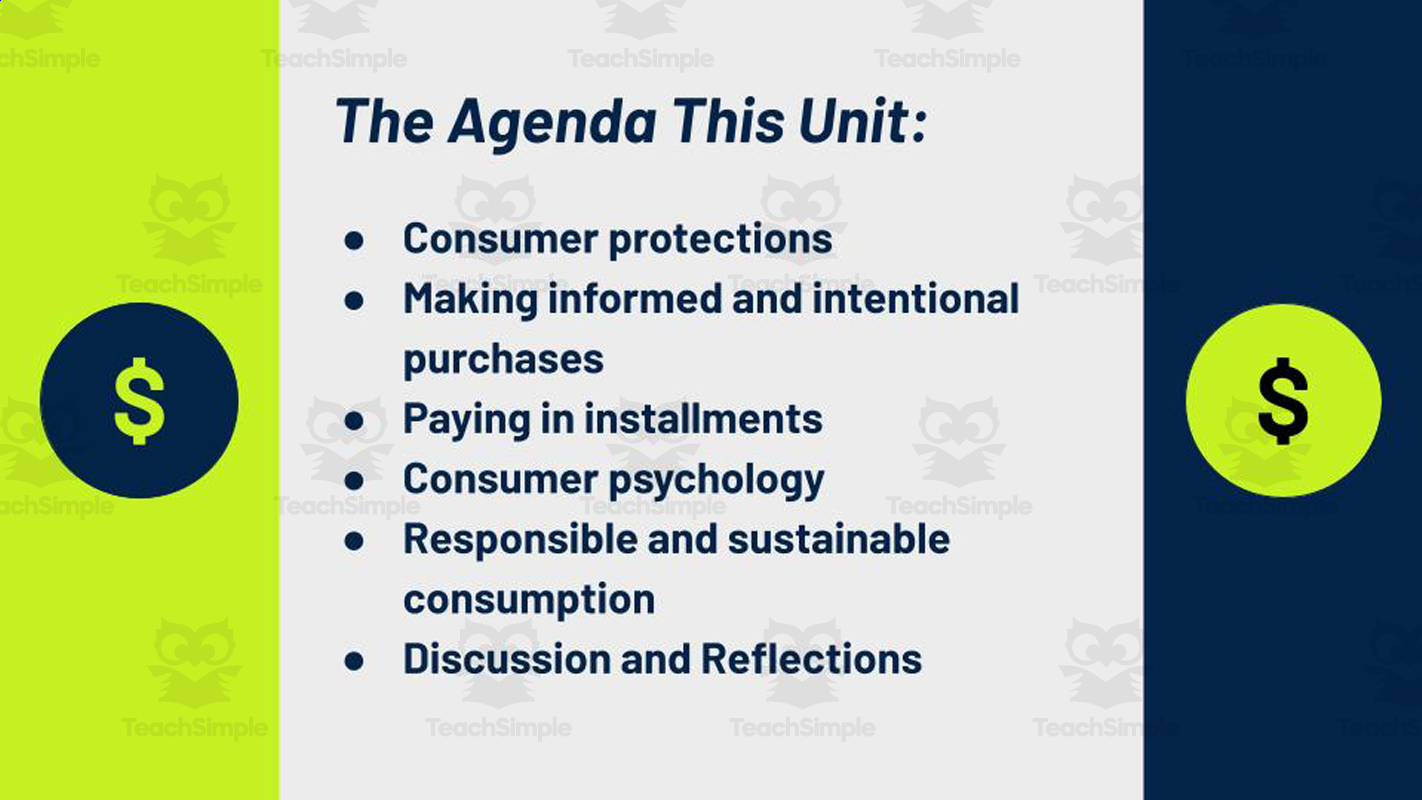
Teaches students consumer skills and habits: consumer rights/protections, making informed purchases, paying in installments, consumer psychology, and responsible/sustainable consumption.
AP Psychology lecture-slide bundle covering three topics: memory, emotion, and thinking and language.
A high-school presentation with guided notes introducing students to positive psychology: its origins, core principles (positive experiences, character strengths, flow, PERMA).
A psychology lesson package teaching operant and classical conditioning through a 24-slide presentation, an introductory class activity, embedded video prompts, and two note-taking worksheets.
A psychology lesson package on how human memory works: sensory, short-term, and long-term memory, encoding/storage/retrieval, the Clive Wearing case study, and memory distortion effects (primacy/recency, flashbulb memories).