



2,626 products added recently
1st Grade Worksheets
Nurture your first graders' love for learning with worksheets designed specifically for their level. Covering reading, math, science, and more, these resources make learning interactive and enjoyable. Use them to reinforce lessons and support skill development in young students.

 Show filters


CVC Words | Short Vowel Phonics | Word Families for K- 2nd Grade
ELA, Language Development, Pre-Reading, Grammar, Phonics, Reading, Spelling, Kindergarten, Grade 1, 2, Teacher Tools, Lesson Plans, Worksheets & Printables, Worksheets
This CVC Words | Short Vowel Phonics | Word Families Activity is for Kindergarten, First Grade, and Second Grade These worksheets are fun and engaging with a fun ocean / beach setting! Students will read, cut, sort, and paste each fish with the CVC words onto the ocean / beach background that is identified in each word family. The fish with the CVC word that is NOT included for that sound is placed on the hook. This helps students read all the words as they sort out which sound that belongs in that family. There are 23 pages included in all for many CVC words. Fun activity for each sound. Perfect for whole group, individual work, and homework. 23 Pages included. Students will read, sort, cut and paste onto an Ocean / Beach background for the Word Family: AN Students will read, sort, cut and paste onto an Ocean / Beach background for the Word Family: AD Students will read, sort, cut and paste onto an Ocean / Beach background for the Word Family: AP Students will read, sort, cut and paste onto an Ocean / Beach background for the Word Family: ET Students will read, sort, cut and paste onto an Ocean / Beach background for the Word Family: ED Students will read, sort, cut and paste onto an Ocean / Beach background for the Word Family: EN Students will read, sort, cut and paste onto an Ocean / Beach background for the Word Family: IN Students will read, sort, cut and paste onto an Ocean / Beach background for the Word Family: IP Students will read, sort, cut and paste onto an Ocean / Beach background for the Word Family: IT Students will read, sort, cut and paste onto an Ocean / Beach background for the Word Family: OG Students will read, sort, cut and paste onto an Ocean / Beach background for the Word Family: OT Students will read, sort, cut and paste onto an Ocean / Beach background for the Word Family: OP Students will read, sort, cut and paste onto an Ocean / Beach background for the Word Family: UN Students will read, sort, cut and paste onto an Ocean / Beach background for the Word Family: UM Students will read, sort, cut and paste onto an Ocean / Beach background for the Word Family: UG For a list of other phonics and grammar activities, click on the following links: CVC Word Families for Beginning Readers: Stamp it, Make it, Trace it, and Write it CVC Words | Short Vowel Phonics | Word Families for K- 2nd Grade Phonics for 1st and 2nd Grade: Help Students Learn Long A Words: AY, AI, A_E, EIGH, EY, and EA Phonics for 1st and 2nd Grade: Help Students Learn Long E Words: EE, EA, E_E, and Y Phonics for 1st and 2nd Grade: Help Students Learn Long I Words: I_E, IE, IGH, and Y Phonics for 1st and 2nd Grade: Help Students Learn Long O Words: O_E, OA, OW, OE, and OUGH Phonics for 1st and 2nd Grade: Help Students Learn Long U Words: U_E, EW, OO, UE, UI and OU Phonics / Digraphs for 1st and 2nd Grade: Beginning, Middle, and Ending Sounds Phonics / Digraphs for 1st -2nd: Ending Sounds: CK, NG, SH, TH, and NK Phonics / Digraphs for 1st and 2nd Grade: Beginning Sounds: SH, TH, WH and PH Phonics: R-Controlled Words for 1st and 2nd Grade and Early Readers
Author K-5 Treasures
Tags CVC Words, CVC, Phonics, Reading, Learning To Read, Short Vowels, Kindergarten Worksheets, 1st Grade Worksheets, Short Vowel Words, Word Families

Adaptive Executive Functioning Mastery: A K-Adult Scaffolding Frame
ELA, Resources for Teachers, Classroom Management, Community Building, Social Emotional Learning (SEL), Special Resources, Life Skills, Social Skills, Special Education Needs (SEN), Speech Therapy, Grade 1, 2, 3, 4, 5, 10, 11, Worksheets & Printables, Worksheets, Workbooks, Teacher Tools, Assessments, Diagrams, Lesson Plans, Presentations, Outlines, Literacy Readers
The Adaptive Executive Functioning Mastery: A K-Adult Scaffolding Framework contains everything needed for educators to implement effective executive functioning (working memory, inhibitory control, cognitive flexibility, task initiation, time blindness, metacognition, etc.) in all levels of education from kindergarten through adult. The workbook comprises: • In-depth theory chapters on cognitive load, dynamic scaffolding, and the function of the prefrontal cortex. • 10 fillable student worksheets with real life case studies. • Teacher/facilitator implementation guide with teacher supports such as fading protocols. • Printable visuals (Neuro-Developmental Continuum; Adaptive Scaffolding Matrix; Emotional Regulation Loop). • Answer Key for assessments. An essential part of this workbook is that it will help to reduce environmental friction and support the autonomous development of exobrains that fade into an internal mastery. It is suitable for use in special education, general education, homeschooling, college support programs, and/or in the coaching of adults. This digital download is immediately available via PDF format as well as in a format that may be accessed using Notion. No preparation required. Why Parents and Schools Are Fans : Evidence-based but usable immediately: Break down the latest neuroscience (prefrontal cortex, cognitive load theory, Vygotsky ZPD) into zero-prep, easy-to-use worksheets and visuals for teachers to use on Monday. Neuro-affirmative and compassionate: Replace "laziness" and "try harder" with practical scaffolding that respects how the brain is wired so that the number of meltdowns, anxiety, and learned helplessness decreases. Built-in fading and autonomy: The Bridge-and-Fade Protocol has 4 phases with clearly defined transitional points will reduce dependence on the scaffolding of adults for each student to develop independence and report the skill as internalized. Saves time in planning: Diagnostic answer keys, visual resources, and Notion/PDF hybrid options will save teachers hours of planning for busy IEPs, 504s, and RTI meetings. Versatile across the lifespan: One purchase will allow the entire school to utilize the tools (PreK-12 and adult transitions) or a family will be able to use the tools with their child from kindergarten through college and into their career. Target Audiences and Student Classifications : This Framework has been purposely created for life cycle growth from beginning of time with K-Adult. This Framework identifies all target audiences as follows: Early Childhood/Primary (ages 4-9): Pre-K-3 Special ed., and needs-based learning support. Elementary to Middle Schools (Ages 6-13): 4-8 Special Needs, RtI 2nd/3rd Tier (Academic Interventions) Classrooms, ADHD/Autism support classrooms. High Schools (Ages 14-18): 9-12 Intervention Support Classrooms, Study Skills classrooms, Transition to College programs. Adults & College Students (ages 19+) - Univesity Disability Services, Adult ADHD Coaches, Workplace Executive Skill Training, Homeschool High School/College Preparation. Cross-setting Users: Special Needs and General Education Teachers working with Neurodivergent Students, School Guidance Counselors, Occupational/Physical Therapists, Parents of Neurodivergent Students, Corporate Neurodiversity Trainers/Service Providers. Copyright / Terms of Use: Syed Hammad Rizvi holds copyrights to this book. This resource is for personal use only and may only be used in one classroom at a time. You may not modify, redistribute or sell any part of this resource. In other words, you cannot upload this resource to the Internet for others to find and download publicly. If you would like to share this resource with other educators, you must purchase additional licenses through Teachsimple. Thank you for being respectful of these terms of use. Syed Hammad Rizvi is excited to offer this product.
Author Creative Book Store
Rating
Tags ExecutiveFunctioning, ADHDResources, Neurodivergent, SpecialEducation, ExecutiveFunction, ADHDWorksheets, TeacherResources, IEPTools, 504Plan, Neurodiversity

Letter L of the Week Alphabet Activities Hands On Phonics Printables
Common Core, ELA, Phonics, Language Development, Pre-Reading, Homeschool Curriculum, Homeschool Templates, Kindergarten, Preschool, Grade 1, Activities, Centers, Crafts, Worksheets & Printables, Worksheets, Coloring Pages, Crosswords Puzzles, Dot To Dots, Mazes, Word Searches
Looking for fun, hands-on ways to teach the Letter L ? This Letter of the Week resource is packed with engaging activities that help preschool and kindergarten learners build confidence in letter recognition, handwriting, and phonics for both uppercase and lowercase L . With 80 printable worksheets and 31 interactive Boom Cards , this resource makes it easy to plan meaningful alphabet instruction without the prep stress. Whether you're in the classroom or supporting learning at home, these activities are designed to reinforce key skills through play, movement, and creativity. ✏️ What’s Inside: 📄 Printable Activities (Available in US & British English) Letter L Poster + 6 Visual Vocabulary Cards Booklet Cover + “About Me” Page Tracing and Writing Uppercase & Lowercase L Sorting, Spinning, Finding & Drawing Letter L Sound Recognition (initial sounds including /l/) Mazes, Puzzles, Connect-the-Dots Dab-the-Dots & Color-by-Code Activities Visual Cutouts & Geoboard Practice Reading Practice Sheets Summary Sheet for Review 🎨 Crafts & Literacy Extensions “I’m a Letter L Champ” Crown & Bracelet Mini Flipbook for Letter L Words & Visuals One-Page Booklet for Independent Practice Letter L Word Wheel (6 Vocabulary Sections) Lion-Themed Finger Puppets (6 per page) Matching Stick Puppet Templates (4 per page) 💻 Boom Cards – 31 Digital Activities Uppercase and Lowercase L Formation & Recognition Letter L Name and Sound Practice Puzzle Matching (Uppercase vs Lowercase) Drag-and-Drop Sorting for Capital and Lowercase L Visual Reveal Game for Letter L Pictures Sentence Practice: Capital L vs Lowercase l 🎯 Perfect For: Letter of the Week Phonics Programs Literacy Centers & Morning Work Fine Motor Practice Small Group Instruction Homework or At-Home Support ⭐ Includes separate files with US and British English spellings to suit your classroom needs. Make learning the Letter L fun, focused, and full of variety with this complete alphabet activity pack—perfect for early learners building strong foundations in reading and writing.
Author Teach2Tell
Rating
Tags Letter L Activities, Letter Of The Week Letter L, Alphabet Worksheets Letter L, Uppercase And Lowercase Letter L, Preschool Letter L Printables, Kindergarten Letter L Activities, Phonics Practice Letter L, Letter L Boom Cards, Letter L Crafts For Kids, Letter L Themed Activities
Proprioceptive Power-Ups: A Gamified Physical Therapy & Sensory
Research, Resources for Teachers, Classroom Management, Community Building, Special Resources, Life Skills, Social Emotional Learning (SEL), Social Skills, Special Education Needs (SEN), Speech Therapy, Grade 1, 2, 3, 4, 5, 6, 7, 8, Worksheets & Printables, Workbooks, Worksheets, Word Searches, Teacher Tools, Assessments, Graphic Organizers, Lesson Plans, Presentations, Outlines
With Proprioceptive Power-Ups, you can turn dysregulated classrooms into focused learners. This complete, evidence-based, gamified sensory regulation program takes ‘heavy work’ and transforms it into new fun, student-led Power-Ups. The 27-page digital PDF resource is designed to provide occupational therapy, physical therapy, and real-world classroom viability for students in kindergarten through eighth grade. Using Sensory Integration Theory, Self-Determination Theory (SDT), and micro-learning protocols, Proprioceptive Power-Ups provide sensory seekers with 3-5 minute ‘bursts’ of proprioceptive and vestibular input that calm those under-responding to sensations at the same time dramatically improving attention, motor planning skills, emotional regulation, and other important areas of development. The following features are provided within Proprioceptive Power-Ups: Comprehensive theoretical underpinning (neurobiology of proprioception, tripartite circuit architecture, integration within an MTSS Tier 1-3 model) 10 student workbook worksheets with fill-in-the-blank self-reflection and data tracking to complete before beginning a new series of Power-Ups. Age-divided choice board usages for example K-2 use an imagination engine; 3-5 uses a mission protocol; 6-8 uses biometric optimization. Full-color diagrams, schematics include but are not limited to: Neurological Processing Pathway; 3-Phase Sensory Circuit; Gamification Mechanics Matrix. Examples of IEP goals, tools for collecting data, and case studies demonstrating an overall reduction of 60-78% in both elopement and disruption of classroom activities as compared to pre-Proprioceptive Power-Ups implementation. Instant digital download of entire resource, no preparation required! Proprioceptive Power-Ups are ideal for teachers, occupational therapy specialists (OT), physical therapy specialists (PT), special education teachers/special instructors, and parents who are serving students with or without ADHD, developmental coordination disorder (DCD), autism spectrum disorder (ASD), or other classroom sensory processing disorder(s). Why Schools & Parents Are So Happy About It 1. Effectively Calms & Focuses Students: With instant self-regulation through 3–5 minutes of gamified “heavy work” activities, elopement, meltdown, and verbal disruptions have been reduced by as much as 78% in real case study examples. 2. Zero Lesson Prep but Maximum Engagement for the Students: Therapy is turned into play, through Choice Boards and avatar style Power-Ups - giving students choice and control, and saving teachers time while providing maximum engagement for the students in busy classroom settings and for kids on their IEP. 3. Evidence Based and Measured Progress: Easy access to the “whole brain” theory of neuroscience with pre/post data tracking tools and IEP goal templates providing easy documentation of progress to parents and administrators. 4. Age Appropriate From K to 8th Grade: There are differentiated stations and language to keep even the youngest kids excited about (and the oldest kids “cool” about) participating in activities in the same room without being segregated by age. 5. Proven Return On Investment: High impact proprioceptive input (replacing ineffective fidgety tools) will continue to improve time on task, enhance writing skills, and improve working/executive function without the need to sacrifice time during instruction. Target Students and Grade Levels: The resource is geared toward kindergarten through 8th grade (K-8) students. The children that will benefit from this program demonstrate an under-stimulated or dysregulated proprioceptive and vestibular system, including: Sensory Seekers (i.e., crashing, chewing, and pressing too hard); Sensory Under-Responders (i.e., lethargic, floppy, and having low muscle tone); Students with Attention-Deficit/Hyperactivity Disorder (ADHD) - Combined Type; Autism Spectrum Disorder (ASD); Developmental Coordination Disorder (DCD); Dyspraxia .A general education classroom using a Multi-Tiered System of Support (MTSS) Tier 1 (i.e., universal brain breaks), Tier 2 (i.e., targeted small groups), and Tier 3 (i.e., Individualized Education Plan-specific on Circuit) will also utilize the program as needed. There is built-in scaffolding provided within the program through the following: narrative/imaginative play for grades K-2; challenge-based missions for grades 3-5; and more mature "biometric optimization" language for middle school (grades 6-8) to assist in securing the dignity of the adolescent population. Copyright / Terms of Use This Book is copyright protected by Syed Hammad Rizvi. You may only use this resource for your own personal use and for use by one class within your own classroom. You may not change this resource or redistribute or sell any part of the resource. In other words, you may not post this resource on the internet where it would be easily accessible and/or downloadable by others. If you would like to share this resource with other teachers, kindly purchase additional licenses to use this resource from Teachsimple. Thank you for complying with the terms of use for this resource. Thank you from all of us at Syed Hammad Rizvi for purchasing this product!
Author Creative Book Store
Rating
Tags ProprioceptiveInput, HeavyWorkActivities, HeavyWork, JointCompression, DeepPressure, SensoryCircuit, SensoryIntegration, SensoryProcessingDisorder, SensoryProcessing, SensoryDiet

Beginner AI Chatbot Safety & Prompt Practice Worksheets
Resources for Teachers, Classroom Management, Community Building, Technology, Science, Computer Science, Engineering, Research, Special Resources, Social Emotional Learning (SEL), Preschool, Grade 1, 2, 3, 4, 5, 6, Teacher Tools, Lesson Plans, Presentations, Assessments, Worksheets & Printables, Flashcards, Worksheets, Word Searches, Writing Prompts, Workbooks
This professionally designed 36-page AI Chatbot Safety and Prompt Practice Workbook provides educators and parents with the comprehensive guidance needed to help their 6–9 year-old students develop literacy skills while learning how to safely work with AI chatbots as powerful tools rather than friends, maintain safe digital boundaries, protect their personal identifiable information (PII), create clear and effective prompts using the “Three-Part Recipe”, practice digital kindness, verify the accuracy of AI-generated content, and develop strong literacy skills through the use of iterative questioning. This resource can be used in any learning environment including traditional classrooms, homeschooling, after-school programs, or family time on electronics. Key features include: - Aligned with the Piaget and Vygotsky constructivist theory and early literacy standards - Ten printable worksheets (e.g. fill-in-the-blank, matching, true/false, scenario) - Teacher/parent guide with theory, case studies, and strategies for implementation - Visual aids (e.g. mind maps, flowcharts), and the "Digital Safety Ecosystem" infographic - Complete answer key for easy assessment - No-prep, print-and-go format (PDF) - Ideal for introducing safe use of ChatGPT/AI tools, prompt engineering, and digital citizenship prior to students' access to full AI tools. Why Parents and Schools Are Interested To Use It : -Creates a lifetime of Real World safety habits around Digital use by teaching children to never share names, addresses, schools or emotions with AI preventing privacy issues before they happen. -Allows for Literacy development through AI use. Making writing Prompts fun iterative writing exercises will enhance vocabulary, specificity, sentence structure and critical thinking. -Cost effective for busy parents and teachers who can print everything out with a simple to follow directions, pictures and answer key - great for morning work, tech centers S.E.L. lessons or home school tech units. -Removes worries about AI in the classroom by providing a structured researched based blueprint for educators and families to use to introduce chat-bots without the fear of misuse or becoming overly reliant upon. -Fun and easy for children to learn about safety through stories, fun Prompts and activities, "Digital Detective" activity, so they will actually look forward to learning and following safe and responsible use of digital technology. Target Audience / Students Grades : Kindergarten & 4th/5th Grades are not targeted (English). The curriculum is developed with 1st through 3rd grade (ages 6-9) only - early elementary children who are in the concrete operational cognitive development stage; therefore, the curriculum utilizes concrete metaphors (e.g.; recipe, blueprint, vault, shield), large print for worksheets, and has scenarios appropriate for a given age, such as bats/frogs/knights/dinosaurs. This is not appropriate for kindergarten or 4th grade and beyond as the language and activity levels are too elementary for 4th and older students, and also too advanced for pre-k. Copyright/Terms and Use : The content of these pages is under copyright by Syed Hammad Rizvi, and it is for your personal use or classroom use only (meaning only one person will use it) You may not change or share any portion of these pages with anyone else or post them online for others to find and download. If you would like to share this resource with someone else or would like to share it with your colleagues, please purchase an additional license from Teachsimple. Your compliance with this Copyright/Terms of Use will greatly help us in continuing to provide content/resources. Syed Hammad Rizvi would like to express his thanks for purchasing these products.
Author Creative Book Store
Rating
Tags Ages6to9, Grades1to3, AISafetyForKids, ChatGPTForKids, AIForElementary, PromptEngineeringForKids, KidsAged6to9, AIForAges6to9, EarlyElementaryAI, DigitalLiteracyWorksheets

Letter ULetter of the Week Letter U Alphabet Worksheets & Boom Cards
Common Core, Phonics, Language Development, ELA, Pre-Reading, Homeschool Curriculum, Kindergarten, Preschool, Homeschool Templates, Grade 1, Centers, Activities, Crafts, Coloring Pages, Worksheets, Worksheets & Printables, Crosswords Puzzles, Dot To Dots, Mazes, Word Searches
Looking for an effective way to teach the Letter U ? This comprehensive Letter of the Week Letter U Pack is loaded with 87 printable worksheets and 30 interactive Boom Cards , designed to help preschool and kindergarten learners master uppercase and lowercase U through a variety of hands-on, phonics-based activities. Perfect for classroom use, homeschool instruction, or distance learning, this bundle includes everything from tracing and sorting to crafts, puzzles, and digital games—making alphabet learning both fun and meaningful! ✏️ What’s Included: 📄 Printable Worksheets Letter U Poster + 6 Visual Vocabulary Cards Booklet Cover + ‘About Me’ Page Tracing and Writing Uppercase and Lowercase U Letter U Sorting, Spinning, Finding & Drawing Sound Identification: Including /u/ and review sounds Mazes, Puzzles, Connect-the-Dots Dab-the-Dots, Color by Code, Geoboard Activity Visual Cutouts for Interactive Letter Learning Reading Practice Sheets Summary Sheet for Review 🎨 Crafts & Extra Activities “I’m a Letter U Champ” Crown & Bracelet Mini Flipbook on Letter U Words & Visuals One-Page Visual Booklet Sight Word Flipbook Unicorn-Themed Finger Puppets (6 per page) Matching Stick Puppet Templates (4 per page) Letter U Word Wheel (6 Vocabulary Sections) 💻 Boom Cards – 30 Digital Activities Uppercase & Lowercase Letter U Formation and Recognition Letter U Sound and Name Practice Puzzle Matching for Uppercase/Lowercase U Drag-and-Drop Sorting (Uppercase vs Lowercase) Visual Reveal Game with Letter U Pictures Capital vs Lowercase U Usage in Sentences ✅ How to Use the Boom Cards: Simply click the link in the PDF to access the deck. A free Boom Learning account allows you to assign cards via Fast Pin or Hyperplay link. Full tracking requires a paid Boom subscription. 🎯 Perfect For: Letter of the Week Instruction Literacy Centers & Fine Motor Practice Small Group or 1:1 Support Morning Work & Homework In-Class or Remote Learning ⭐ Bonus: Separate printable files with US and British English spellings included! Make learning the Letter U unforgettable with this fun, flexible, and phonics-rich resource your students will love!
Author Teach2Tell
Rating
Tags Letter U Activities, Letter Of The Week Letter U, Alphabet Worksheets Letter U, Preschool Letter U Printables, Kindergarten Letter U Activities, Uppercase And Lowercase Letter U, Phonics Practice Letter U, Unicorn Letter U Craft, Interactive Letter U Phonics Activities, Letter U Recognition Worksheets
Prefixes and Suffixes Supplementary Materials - Grades 1-2 (PDF)
ELA, Language Development, ESL, Grammar, Common Core, Resources for Teachers, Grade 1, 2, Teacher Tools, Lesson Plans, Outlines, Quizzes, Quizzes and Tests, Tests, Assessments, Worksheets & Printables, Worksheets
Prefixes and Suffixes Supplementary Materials Note: This download DOES NOT include the tests themselves. You can still make use of these materials without them but they are recommended. Download in a format of your choice in the "Links" section below. In the Supplementary Pack Interactive Ice Breakers: Fun, hands-on activities that get students thinking about adjectives right from the start. Guided Practice: Teacher-led exercises that reinforce the day’s lesson, ensuring students can confidently identify and use adjectives. Group and Partner Tasks: Collaborative activities that allow students to work together to solve problems, categorize adjectives, and create descriptive sentences. Independent Worksheets: Structured worksheets that provide individual practice and help solidify understanding of key concepts. Exit Tasks: Quick, reflective activities at the end of each lesson that assess understanding and encourage students to apply what they’ve learned. Links: Includes: Intro to Prefixes Intro to Suffixes Forming Suffixes Determining Affix Word Meaning Google Docs Google Forms Google Slides PDF PPT Word FULL CATALOG OF DOWNLOAD LINKS HERE Grade 1/2 Links: Capitalization and Punctuation Google Docs Google Forms Google Slides PDF PPT Word Free Supplementary Materials Pack Adjectives Google Docs Google Forms Google Slides PDF PPT Word Free Supplementary Materials Pack Nouns Google Docs Google Forms Google Slides PDF PPT Word Free Supplementary Materials Pack Pronouns Google Docs Google Forms Google Slides PDF PPT Word Free Supplementary Materials Pack Verbs Google Docs Google Forms Google Slides PDF PPT Word Free Supplementary Materials Pack Prefixes & Suffixes Google Docs Google Forms Google Slides PDF PPT Word Free Supplementary Materials Pack Sentence Structure Google Docs Google Forms Google Slides PDF PPT Word Free Supplementary Materials Pack Subject-Verb Agreement Google Docs Google Forms Google Slides PDF PPT Word Free Supplementary Materials Pack ELA Review Questions Overview Questions have three answer choices. There are a handful of pictures on each test for aesthetic purposes, as well as a review sheet covering most of the topics covered in the product. Introduction or Example Sheet Each topic will include an introduction or example sheet to go through first with your students. Full Answer Keys Full answer keys and sample responses are provided so no matter how busy you are, you know you're covered! In the Supplementary Pack Interactive Ice Breakers: Fun, hands-on activities that get students thinking about adjectives right from the start. Guided Practice: Teacher-led exercises that reinforce the day’s lesson, ensuring students can confidently identify and use adjectives. Group and Partner Tasks: Collaborative activities that allow students to work together to solve problems, categorize adjectives, and create descriptive sentences. Independent Worksheets: Structured worksheets that provide individual practice and help solidify understanding of key concepts. Exit Tasks: Quick, reflective activities at the end of each lesson that assess understanding and encourage students to apply what they’ve learned. For similar downloads and other frees, do check out Cored Group on TeachSimple.
Author Cored Education
Tags Elementary, Reading, Comprehension, Vocabulary, Answers, Ccss, Common Core, Spelling, Writing, Passages
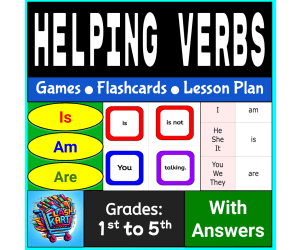
Helping Verbs Worksheets: Use of is, am, & are - Lesson Plan
ELA, Language Development, Grammar, ESL, Grade 1, 2, 3, 4, 5, Centers, Activities, Games, Flashcards, Worksheets & Printables, Worksheets
Helping Verbs: is, am, & are Lesson Plan, Worksheets, Flashcards, and Fun Games Do your students mix up "is," "am," and "are"? It's a tricky spot for young students and English learners! This resource gives you everything you need to teach these 'Helping Verbs' easily. It makes learning hands-on and fun for kids in early grades or in ESL/EFL classrooms. Are you tired of correcting "He am going" or "They is sad"? This resource will help you a lot to fix this mistake and help your students learn a lot about the helping verbs. Your students will master the verb "to be" easily with the help of this resource. Teaching grammar is one of the biggest challenges in early elementary grades and ESL classes (Beginner level)! I designed this all in one lesson plan to make the confusing world of is, am, and are fun, hands-on, and memorable. This resource is perfect for early learners, ESL/EFL students, and anyone who needs to solidify their grammar foundations. This resource has everything you need to teach, practice, and assess this vital skill - all just a download away. What’s included in this resource? A clear and ready to use lesson plan that explains how to teach is, am, and are in both affirmative and negative forms (is not, am not, are not). Printable flashcards to support visual learners and make their practice more interactive. Anchor charts - you can hang these in your classroom, or pin them to a bulletin board, or add these to student binders for quick reminders. Example sentences related to these verbs. Worksheets with answer keys for guided work, independent practice, or review. Classroom game ideas that get students moving and learning at the same time. Homework and assessment suggestions to reinforce the lesson beyond class time. Resource features: A simple yet structured lesson plan with clear objectives and step by step teaching ideas. Bright and vibrant flashcards that help students remember the correct verb forms. A fun game idea that makes grammar practice feel like play instead of work. Answer keys for quick checking and stress-free grading. This pack is perfect for ESL/EFL lessons, ELA classrooms, tutoring sessions, and early literacy support. How to use this resource? Start the lesson with the anchor charts to introduce the helping verbs. Follow the lesson plan to model the concept and guide students through practice. Use flashcards for partner activities, whole class games, or warm-ups. Encourage students to talk, move, and build sentences using is, am, and are . Finish with the worksheets or assign them as homework for extra reinforcement. How it is useful for teachers and students? This pack will save their planning time while still giving learners a meaningful and hands-on experience. The visuals, examples, worksheets, and games will help students understand grammar naturally. This resource is well suited for early grades, ESL groups, intervention sessions, or quick grammar refreshers. Students will enjoy the mix of activities. Teachers may love seeing their confidence grow. English Grammar, Helping Verbs, Verb To Be, Is Am Are, Affirmative and Negative Sentences, Grammar Worksheets, Lesson Plan, Flashcards, Classroom Games, Anchor Charts, ESL, EFL, ELA, ELL, Interactive Learning, Visual Aids, Grammar Practice, Early Literacy, Printable Resources, Teacher Materials
Author FlashKart
Rating
Tags Grammar, Language Arts, Helping Verbs, Flashcards, Esl, Efl, Basic Grammar Skills, Games, Worksheets, Elementary
UK/Aus Spelling Captitalisation and Punctuation Practice Year 2-3: PDF
ELA, Language Development, ESL, Grammar, Common Core, Resources for Teachers, Grade 1, 2, Worksheets & Printables, Worksheets, Assessments, Teacher Tools, Tests, Quizzes and Tests, Quizzes
THIS IS THE UK/AUS ENGLISH SPELLING VERSION. CHECK THE CATALOG FOR THE ORIGINAL AMERICAN ENGLISH VERSION. Capitalisation and Punctuation Grammar Practice MCQs: 10 Lessons, 150 MCQs, 43 Pages ELA MCQs Overview: This grammar resource gives students plenty of focused practice with two essential writing skills: capitalisation and punctuation. Across 10 lessons and 150 multiple-choice questions, students work through clear, manageable practice that helps them spot mistakes, improve accuracy, and build real confidence over time. The lessons are designed to feel structured without becoming dry or repetitive. Each one builds naturally on the previous lesson, giving students the chance to review, strengthen, and apply what they have learned. With a mix of direct teaching, group work, and independent practice, the resource works well for whole-class lessons, revision, homework, or extra support. This UK/Aus English version is especially useful for schools, teachers, and families working with British-based spelling and language conventions. It is a helpful option for classrooms using UK curriculum expectations, international programmes influenced by British English, or any setting where learners need to practise the correct capitalisation and punctuation forms for that version of English. Captitalisation and Punctuation Overview: Includes: Proper Nouns Opening/Closing Letters Uppercase/Lowercase Dates Punctuation Practice PDF Version This is the PDF uneditable version. This download is available in GOOGLE Docs, GOOGLE Forms, GOOGLE Slides. PDF, PPT, WORD, check the links below for more details. FULL CATALOG OF DOWNLOAD LINKS HERE ELA Review Questions Overview Each review test includes three answer choices for every question. The format is clear and easy for students to follow. A small number of pictures are included on each test to make the pages feel more welcoming and less plain. A review sheet is also included to help students go back over many of the main skills covered in the product. Introduction or Example Sheet Each topic includes an introduction or example sheet to use before students begin. This gives students a clear starting point. It also helps refresh key ideas before they move into the practice. Full Answer Keys Full answer keys are included for easy checking. Sample responses are also provided where needed. This helps save time and makes the resource easier to use, even on busy days. In the Supplementary Pack Interactive Ice Breakers: Simple hands-on activities to help students start thinking about the topic. Guided Practice: Teacher-led work that helps students build understanding before working alone. Group and Partner Tasks: Activities that encourage discussion, shared ideas, and teamwork. Independent Worksheets: Extra practice pages for students to complete by themselves. Exit Tasks: Short end-of-lesson activities to check understanding and review learning. For similar downloads and other frees, do check out Cored Group on TeachSimple.
Author Cored Education
Rating
Tags Elementary, Answers, Test, Mcq, Test Prep, Language Arts, Ela, Grammar, Primary, British English

Our 5 Senses Lesson, Flashcards, & Conversation For Kindergarten & 1st
Language Development, ELA, Vocabulary, Montessori, Science, Life Sciences, Human Body, Kindergarten, Preschool, Grade 1, 2, Centers, Activities, Bulletin Boards, Classroom Decor, Posters, Anchor Charts, Teacher Tools, Worksheets & Printables, Flashcards, Worksheets
Exploring Our Five Senses Through Seasons Lesson Plans, Worksheets, Flashcards & Conversation Cards Kindergarten - Grade 2 Make learning about the five senses and the seasons fun, interactive, and meaningful with this complete early-years teaching resource. I designed it for kindergarten, 1st, and 2nd grade. This pack includes lesson plans, worksheets, flash cards, and conversation cards to support hands-on learning, discussion, and vocabulary development. I created it to help young learners explore how they experience the world through their senses while understanding the changes that happen throughout the seasons. It’s ideal for classroom use, homeschooling, and at-home reinforcement. What’s inside? Five Senses anchor charts Five Senses poem Five Senses lesson plan Related picture cards Seasons of the Year flash cards Seasons of the year lesson plan Conversation starter cards Conversation expanders Vocabulary revision and repetition activities Simon Says movement game Five Senses worksheets 2 simple at-home projects Resource features: Complete Coverage: This resource introduces all five senses and the four seasons in a clear yet age-appropriate way to young learners. Visual & Interactive: Anchor charts, flash cards, and images help make abstract ideas easy to understand. All these things make this resource engaging and interactive. Language-Rich Activities: Conversation cards and games encourage speaking, listening, and vocabulary growth. It is a good tool to support ESL/EFL/ELL students. Flexible Use: This resource is suitable for whole-group lessons, small groups, centers, homeschooling, and home practice. It is a versatile resource. How to use it? Introduce the Five Senses: Start with anchor charts and the poem, then follow the lesson plan and picture cards to explore each sense. Learn About the Seasons: Use the seasonal flash cards alongside the lesson plan to discuss weather, clothing, and changes in nature. Build Speaking Skills: Encourage students to share their experiences using the conversation starter cards, then deepen responses with conversation expanders. Get Moving: Reinforce sensory vocabulary with the Simon Says game. Hands-On Practice: Worksheets inside support learning and review. Moreover, at-home projects encourage real-world observation. This resource is perfect for Teachers: Easy to use lessons that support early science and language goals. All this makes this resource useful for teachers. For Homeschoolers it is a structured yet flexible way to teach senses and seasons at home. Parents: Fun and meaningful activities that support learning beyond the classroom will help parents a lot to engage with their kids in a game/activity format. This engaging resource introduces children to the five senses and the seasons through discussion, movement, visuals, and hands-on activities. It supports early language development and helps children build a strong foundation in understanding the natural world. Recommended for: Preschool, Montessori, Kindergarten, Grade 1, and Grade 2.
Author FlashKart
Rating
Tags Our 5 Senses, Sense Organs, Seasons, Fall, Winter, Summer, Spring, Rainy, Conversation Starters, Lesson Plan
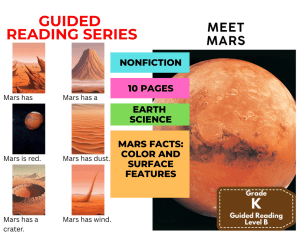
Guided Reading Level B: Meet Mars
ELA, Resources for Teachers, Reading Comprehension, Reading, Science, Language Development, Pre-Reading, Vocabulary, Earth and Environmental Sciences, Space, Kindergarten, Preschool, Grade 1, Worksheets & Printables, Worksheets, Teacher Tools, Centers, Activities, Literacy Readers, Quizzes, Quizzes and Tests, Assessments
This Guided Reading Book - Meet Mars (Level B) includes: Guided Reading Color Label (front cover x1) This is a quick way to match the book’s demands to what students can generally handle.. The overall goal is to use the level/color to pick books for several smaller groups. To qualify for a certain level, a student is expected to read a book from that level with about 90–94% accuracy. If a student is consistently accurate and understands, move up a level. If the student is struggling at that level, drop down and add more support. Each student will improve at completely different rates, but it is generally one of the best ways to check progress across the class. DOWNLOAD THE CATALOG TO VIEW ALL GUIDED READING BOOKS AVAILABLE (SORTED LEVELS A-Z) COMPANION VIDEO NOW AVAILABLE (EMBEDDED AFTER PREVIEW PICTURES IN PRODUCT DESCRIPTION) Pre-Reading Question (x1) Teacher asks the prompt aloud, can be while showing the cover or first page. Students share what they already know, or make educated guesses from the cover. Prompt them to use the target vocabulary. Write some of their responses on the board to look back at during the reading. Vocabulary Words (x5) Introduce the five words, best doing it one at a time. Start by saying it, while students repeat and then see if anyone knows what it means before reading further. Read through the meaning and try to briefly connect each word to a picture or gesture so it’s meaningful. Ask students to flip through the book pages and point to where they see each of the vocabulary words. While reading the book pause upon coming across one of the vocab words or read the sentence twice to make sure students understand the word has appeared. Optional: Ask students to raise hands whenever they see/hear one of the new words. Guided Reading Pages (x10) Check the book snapshot (below) for: primary topic - do you need to prep extra reading or intro materials on this? what is taught best - decide on 1-2 bullets to focus on, use the prompt or words provided here for best results. learning goals - what you are checking for students to be able to do after the session, elicit answers using prompts or words provided. key vocabulary (see section above). questions overview - so you know what is coming up and if you need to prep extra materials to assist understanding. Run the lesson You may have already looked at a few of the pages together, but you can show them some of the pictures again first to set meaning. Depending on how much time you have and how familiar your students are with guided reading class, you may want to read the book aloud first with the group first. Students whisper or partner read, while you listen in. If time, do it as a group, one student reading a page each. Use the guided page’s prompts to coach: “Check the picture / does it make sense?” “Point under the words / try the first sound” “Reread the sentence smoothly”. Try to focus more on one student per session (rotating every time), so you can work out if they are ready to move up or need to move down a level. Comprehension Questions (back cover x3) This is your way to check that students didn’t just say the words, but actually understood the text. First, let students answer by pointing to the page/picture and saying a short sentence. After any answer, follow with: “Show me where you found that in the text.” In bigger groups, have partners answer first (10–20 seconds), then call on 2–3 students to share. Differentiation tips: Emerging speakers/struggling readers: oral + pointing On-level: oral in a full sentence Higher: one written sentence or draw + label Book Snapshot Title: Meet Mars Genre: Nonfiction (simple informational) Subject: Science Primary Topic: Mars facts: color and surface features Estimated Guided Reading Level (A–Z): B What This Book Teaches Best Identifying basic facts about Mars (e.g., “Mars is red.” and “Mars is in space.”). Naming features Mars “has” (dust, rocks, a mountain, a crater, wind, ice, moons, the sun). Using repeated sentence patterns (“Mars is…” / “Mars has…”) to support early fluency. Connecting key science words to meaning through simple, concrete statements. Learning Goals Students will state one fact about Mars using evidence from the text. Students will name at least three things Mars has, as described in the book. Students will answer simple who/what/where questions using the book’s sentences. Students will use the repeated sentence frame “Mars has ___” to retell information from the text. Students will explain the meaning of selected Mars words using the context of the sentences. Key Vocabulary From the Text dust — tiny bits of dirt. mountain — a very tall hill. crater — a big round hole. moons — round objects near Mars. space — far above Earth. Discussion Prompts Pre-reading question: What do you think you will learn about Mars in this book? Comprehension questions: What color is Mars? Name one thing Mars has. Where is Mars? Printing Tips 1. Best Printing Method (Recommended) “Booklet” Printing (Best if Available) If your printer or PDF viewer supports Booklet Printing , use this. Settings to use: Print mode: Booklet Paper size: Letter or A4 (either works) Orientation: Landscape Print on both sides: Yes Flip on: Short edge Scaling: Fit to printable area Booklet subset: First test: Front sides only Then: Back sides only This will automatically: Pair pages correctly Put the cover on the outside Align everything for folding After printing, fold in half and staple along the spine . 2. If “Booklet” Printing Is NOT Available You can still print this correctly with manual duplex printing . Step-by-step: Open the PDF. Choose Print . Set: Orientation: Landscape Pages per sheet: 1 Print on both sides: Yes Flip on: Short edge Print all pages . Because each PDF page already contains two facing book pages, the result will still fold cleanly into a book. Thousands of Cored Education products are included with your TeachSimple membership. Download links and encyclopedia index available here.
Author Cored Education
Rating
Tags Vocabulary, Reading Comprehension, Reading Passages, Leveled Reading, Nonfiction, Reading, Guided Reading, Earth Science, Space, Mars

Quest for 100 Powered Interactive Classroom Journey & Milestone
Math, Early Math, Addition and Subtraction, Algebra, Calculus, Decimals, Basic Operations, Counting, Fact Families, Numbers, Infant, Toddler, Grade 1, 2, 3, 4, 5, Teacher Tools, Anchor Charts, Assessments, Charts, Diagrams, Graphic Organizers, Lesson Plans, Worksheets & Printables, Workbooks, Worksheets
Celebrate the 100th Day of School with this one-stop-shop, AI-powered interactive classroom kit! This resource is designed for students in Kindergarten through 5th grade, helping you turn what is traditionally just a celebration into an interactive educational experience that develops number sense and is easily integrated with your lesson plans. This is what you get in this PDF Bundle: Annotating Available Apricot PHASE 1: Core Teacher Guide Grounded in education literature, this guide explores the educational significance of tracking milestones, design principles for young students, and lesson plans for using AI (Canva AI) to produce high-quality “100 Days of School” posters. PHASE 2: Ready-to-Print Student Workbook – 10 engaging worksheets that make the journey to 100 days interactive! Activities include: Counting and Number Sense Challenges Challenges in Personal Reflections and Self-Improvement Journals Creative Writing & Storytelling Tasks Math calculations or problems using 100 Thinking about the Future and Planning Celebrations PHASE 3: Visual Resources & Teacher Keys - Comes with SVG concept illustrations for implementation in the classrooms, differentiated activity packets (K-1, 2-3, 4-5), and an answer key to make implementation smooth. Why This Kit is a Game-Changer: Powered Customization: See how you can use generate themes, icons, or prompts to make a personalized poster each year. Standards-Aligned: Direct support for the CCSS Math Standards (K.CC.A.1, 1.NBT.A.1, 2 Saves Hours of Planning: From theory to print-ready activities, it all is provided for a rich, educational celebration. Differentiated for All Elementary Grades: Activities are leveled to reach both younger and older students in elementary school. It is perfect for teachers, homeschooling parents, or school-wide events that aim to make the 100th day more significant and interactive as a learning experience. FORMAT: Instant Digital Download (PDF) Pages: More than 30 pages of professional material Grades: K, 1, 2, 3, 4, 5 Disciplines: Math, Writing, Holidays/Seasons, Back to School, All Subjects Resource Type: Activities, Posters, Lesson, Printables 3. Why Parents/Schools Love It Saves Teacher Time: “It offers everything you need for a full 100th Day celebration without searching for ideas or preparing materials by hand.” Boosts Creativity: Equips teachers with the ability to create customized posters for their classrooms so that each year's event is special. Academically Rigorous & Fun: Strives to do more than crafts by integrating authentic math, writing, and SEL skills into their celebratory activities, meeting K-5 standards. Fosters Classroom Community: Class activities such as the interactive poster emphasize the creation of an excellent learning environment that encourages high self-esteem. Differentiated & Flexible: It is a flexible resource that can be used for students of multiple grade levels since it contains activities for K-5. PDF Analysis & Target Audience : Content Summary: This is a total educational kit that is professionally made for educational purposes, entitled "Quest for 100: Powered Interactive Classroom Journey & Milestone Display Kit – 100 Days of School Poster Edition." This is a three-in-one educational resource that can be utilized by teachers, homeschooling parents, or school administrators: Part 1: Teacher’s Guide & Theoretical Foundation Covers the pedagogy related to celebrating the 100th day of school, the principles of effective posters, and ways to make use of software such as for creating customized posters and activities. Part 2: Student Workbook: This package contains 10 ready-to-use student workbooks that include exercises on math, reflection, creative writing, vocabulary, and project-based learning related to the number 100. Part 3: Visuals & Teacher Resources- This part covers concepts of SVG Diagrams, Answer Keys, and Differentiated Activity Sets for K-5 with emphasis on integrating interactive posters and AI prompt tasks. Primary Target Audience (By Grade): K-5 Teachers-Kindergarten through 5th grade It is differentiated learning material that is specifically tied back to K-5 Common Core Math Standards and Social-Emotional Learning Skills. Activities are tiered by complexity, allowing it to be used for a broad range of elementary-aged children. Secondary Audience: Homeschooling parents seeking organized activities to commemorate milestones. School administrators or curriculum coordinators who are looking for resources to celebrate the 100th day of school Teacher students and educational resource creators. Copyright/Terms : Use This Book is copyrighted by Syed Hammad Rizvi. This material is for personal and classroom use only. You cannot modify it, distribute it, or sell it in any form or manner. This means that you cannot upload it onto the Internet for public download. This is plagiarism. You cannot plagiarize your own work. If you would like to share this resource with your colleagues, you are encouraged to purchase additional licenses through the Teachsimple website. Thank you for observing the terms of use. This product is gladly brought to you by Syed Hammad Rizvi
Author Creative Book Store
Rating
Tags Math, Writing, Holidays/Seasonal, Back To School, For All Subjects, 100 Days Of School Poster, Posters, 100's Day, Activities, Lesson
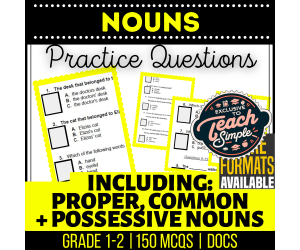
Nouns Practice Questions - Grades 1-2 Grammar (Docs)
ELA, Language Development, ESL, Grammar, Common Core, Resources for Teachers, Grade 1, 2, Worksheets & Printables, Worksheets, Assessments, Teacher Tools, Tests, Quizzes and Tests, Centers, Activities
Nouns Grammar Practice MCQS: 10 lessons, 150 MCQS, 43 pages ELA MCQS Overview: In this series of lessons, students will embark on an engaging exploration of the grammar skills that bring our language to life. These lessons are designed to help students identify, understand, and effectively use language arts skills in their writing and speech. Used with the free supplementary materials available for all topics, each lesson builds on the last, offering a mix of direct instruction, interactive group activities, and independent practice. Through fun and creative tasks, students will learn how to recognize grammar in sentences, understand their role in sentences and use them to enhance their own writing and speech. Nouns Overview: Includes: Common Nouns Proper Nouns Irregular Plurals Possessive Nouns Collective Nouns Docs Version This is the Docs editable and fillable version. This download is available in GOOGLE Docs, GOOGLE Forms, GOOGLE Slides. PDF, PPT, WORD, check the links below for more details. FULL CATALOG OF DOWNLOAD LINKS HERE Grade 1/2 Links: Capitalization and Punctuation Google Docs Google Forms Google Slides PDF PPT Word Free Supplementary Materials Pack Adjectives Google Docs Google Forms Google Slides PDF PPT Word Free Supplementary Materials Pack Nouns Google Docs Google Forms Google Slides PDF PPT Word Free Supplementary Materials Pack Pronouns Google Docs Google Forms Google Slides PDF PPT Word Free Supplementary Materials Pack Verbs Google Docs Google Forms Google Slides PDF PPT Word Free Supplementary Materials Pack Prefixes & Suffixes Google Docs Google Forms Google Slides PDF PPT Word Free Supplementary Materials Pack Sentence Structure Google Docs Google Forms Google Slides PDF PPT Word Free Supplementary Materials Pack Subject-Verb Agreement Google Docs Google Forms Google Slides PDF PPT Word Free Supplementary Materials Pack ELA Review Questions Overview Questions have three answer choices. There are a handful of pictures on each test for aesthetic purposes, as well as a review sheet covering most of the topics covered in the product. Introduction or Example Sheet Each topic will include an introduction or example sheet to go through first with your students. Full Answer Keys Full answer keys and sample responses are provided so no matter how busy you are, you know you're covered! In the Supplementary Pack Interactive Ice Breakers: Fun, hands-on activities that get students thinking about adjectives right from the start. Guided Practice: Teacher-led exercises that reinforce the day’s lesson, ensuring students can confidently identify and use adjectives. Group and Partner Tasks: Collaborative activities that allow students to work together to solve problems, categorize adjectives, and create descriptive sentences. Independent Worksheets: Structured worksheets that provide individual practice and help solidify understanding of key concepts. Exit Tasks: Quick, reflective activities at the end of each lesson that assess understanding and encourage students to apply what they’ve learned. For similar downloads and other frees, do check out Cored Group on TeachSimple.
Author Cored Education
Tags Elementary, Reading, Comprehension, Vocabulary, Answers, Ccss, Common Core, Spelling, Writing, Passages

1st grade Coronavirus / Covid-19 Facts
P.E. & Health, Health, Special Resources, Life Skills, Social Emotional Learning (SEL), Social Skills, Kindergarten, Grade 1, Teacher Tools, Lesson Plans, Worksheets & Printables, Worksheets
First Grade Coronavirus Facts simplifies a complex topic for young learners. This informative lesson teaches essential information about COVID-19, including what it is, how it spreads, and how to stay safe. Presented in straightforward language, it covers the virus's origins and transmission. Students gain key understandings like hand washing, mask wearing, and social distancing. Educators can facilitate rich discussions to build health awareness. The material suits whole-group instruction or independent learning centers. This timely resource equips first grade classrooms with age-appropriate details about the coronavirus pandemic. Included are a total of 13 pages with lots of activities for young learners. There are seven units that cover all the health requirements for first grade. Here are the links to other health units: Health 1st Grade Unit 1: Personal Health by Teach Simple Health 1st Grade Unit 2: Growth and Development by Teach Simple Health 1st Grade Unit 3: Nutrition and Physical Activity by Teach Simple Health 1st Grade Unit 4: Substance Use and Abuse by Teach Simple Health 1st Grade Unit 5: Injury / Violence Prevention and Safety by Teach Simple Health 1st Grade Unit 6: Prevention / Control of Disease by Teach Simple Health 1st Grade Unit 7: Environmental / Consumer Health by Teach Simple You can also teach your students about keeping yourself safe by studying about the Coronavirus, where and when it started and facts that plagued our world with this virus. 1st grade Coronavirus / Covid-19 Facts by Teach Simple This unit meets Common Core Standards.
Author K-5 Treasures
Tags Coronavirus, Covid-19 Facts, Pandemic, Spread Of Virus, 1st Grade Health, First Grade Health, Health Resources , Health Worksheets, Worksheets On Health, Worksheets On Covid

Ocean Animal Research Writing Project on the SHELLFISH for K-2nd Grade
Life Studies, ELA, Writing, Creative Writing, Reading, Science, Life Sciences, Animals, Research, Preschool, Grade 1, 2, Lesson Plans, Teacher Tools, Coloring Pages, Worksheets, Worksheets & Printables, Writing Prompts
Animal Research Writing Project on Shellfish for K-2nd Grade. Students will learn about shellfish through reading, writing, coloring, and drawing activities in this 19-page packet. After examining photos of real shellfish, students will read factual information presented in a color-coded key for easy comprehension. Next, they will color their own shellfish drawings and create habitat scenes. Two differentiated writing organizers help students take notes and sort information. The writing portion includes leveled writing pages so students of all abilities can succeed composing paragraphs on shellfish. A self-checking writing page assists developing writers. This engaging project promotes creativity, reading, writing, and science skills. Use it for whole-group, small-group, independent, or homework assignments. Click the author links above for other animal research units spanning land and sea creatures. Here are even more informational resources on report writing for OCEAN ANIMALS. Click on the links below: Animal Research Writing Project on WHALES for K-2nd Grade Animal Research Writing Project on the OCTOPUS for K-2nd Grade Animal Research Writing Project on SEA TURTLES for K-2nd Grade Animal Research Writing Project on ORCAS for K-2nd Grade Animal Research Writing Project on the SHELLFISH for K-2nd Grade Animal Research Writing Project on DOLPHINS for K-2nd Grade Animal Research Writing Project on SEALS for K-2nd Grade Want to teach your students all about Zoo Animals? Check out all these interesting facts about these favorite zoo animals. With the same great photos, facts, habitat drawings, and more. It is a great way to help students to get interested in writing. For Zoo Animal reports, click on the following links below: Animal Research Writing Project on TIGERS for K-2nd Grade Animal Research Writing Project on MONKEYS for K-2nd Grade Animal Research Writing Project on PANDAS for K-2nd Grade Animal Research Writing Project on HIPPOS for K-2nd Grade Animal Research Writing Project on ELEPHANTS for K-2nd Grade Animal Research Writing Project on GIRAFFES for K-2nd Grade
Author K-5 Treasures
Tags Informational Writing, Writing Report, 1st Grade Writing, 2nd Grade Writing, Ocean Animals, Ocean Animal Research, Shellfish, Report On Shellfish, Report On Lobsters, Report On Crabs

Zoo Animal Research Writing Project on TIGERS for K-2nd Grade
Life Studies, ELA, Writing, Creative Writing, Reading, Science, Life Sciences, Animals, Research, Kindergarten, Grade 1, 2, Teacher Tools, Worksheets & Printables, Lesson Plans, Worksheets, Writing Prompts, Coloring Pages
This Animal Research Project on Tigers is for Kindergarten, 1st Grade and 2nd Grade. This 19-page informational writing resource guide will enhance student's learning about these amazing zoo animals: Tigers! Differentiated materials make it perfect for various ability levels. Students will read tiger facts, color tiger pictures, examine photos, draw a habitat, organize information, and write using scaffolded writing pages. Higher-level students can write paragraphs while struggling writers use sentence frames. When complete, pages can be compiled into a printed book. This engaging project promotes creativity, reading, writing, and science skills. Pair with other animal units or use independently to motivate young learners. Check out companion resources on hippos, elephants, monkeys, pandas, giraffes, dolphins, octopus, orcas, seals, shellfish, sea turtles, and whales. For more Zoo Animal reports, click on the following links below: Animal Research Writing Project on TIGERS for K-2nd Grade Animal Research Writing Project on MONKEYS for K-2nd Grade Animal Research Writing Project on PANDAS for K-2nd Grade Animal Research Writing Project on HIPPOS for K-2nd Grade Animal Research Writing Project on ELEPHANTS for K-2nd Grade Animal Research Writing Project on GIRAFFES for K-2nd Grade Want to teach your students all about Ocean Animals? Check out all these interesting facts about these favorite Ocean animals. With the same great photos, facts, habitat drawings, and more. It is a great way to help students to get interested in writing. Here are even more informational resources on report writing for OCEAN ANIMALS. Click on the links below: Animal Research Writing Project on WHALES for K-2nd Grade Animal Research Writing Project on the OCTOPUS for K-2nd Grade Animal Research Writing Project on SEA TURTLES for K-2nd Grade Animal Research Writing Project on ORCAS for K-2nd Grade Animal Research Writing Project on the SHELLFISH for K-2nd Grade Animal Research Writing Project on DOLPHINS for K-2nd Grade Animal Research Writing Project on SEALS for K-2nd Grade
Author K-5 Treasures
Tags Animal Research, Informational Writing, Writing Report, Zoo Animals, Report On Animals, Report On Zoo Animals, 1st Grade Writing, 2nd Grade Writing, Tigers, Report On Tigers

Letter of the Week Letter H Printables Phonics Activities Pack
Phonics, Language Development, ELA, Pre-Reading, Kindergarten, Preschool, Homeschool Curriculum, Homeschool Templates, Grade 1, Centers, Activities, Crafts, Coloring Pages, Worksheets, Worksheets & Printables, Crosswords Puzzles, Dot To Dots, Mazes, Word Searches
Make learning the Letter H a hands-on adventure with this fun, no-prep phonics resource! Designed for preschool and kindergarten students, this Letter of the Week Letter H Pack features a mix of print-and-go worksheets and interactive Boom Cards that build early literacy and fine motor skills. With 78 printable pages and 31 digital Boom Cards , students will practice identifying, tracing, and using uppercase and lowercase H through movement, play, and visual learning. ✏️ What’s Included: 📄 Printable Worksheets Letter H Poster + 6 Visual Vocabulary Cards Booklet Cover + ‘About Me’ Page Tracing & Writing Uppercase and Lowercase H Letter H Sorting, Spinning (with review: I, C, K), and Finding Activities Drawing & Coloring the Letter H Sound Recognition for /a/, /s/, /t/, /n/, /p/, /i/, /c/ Mazes, Dot-to-Dot, Dab the Dots, Geoboard & Color by Code Visual Cutouts for Letter H Nursery Rhyme Link: Hickory Dickory Dock Word Family Practice Sheets: -an, -at, -ap, -in, -it, -ip Summary Sheet for Review 🎨 Crafts & Literacy Extras “I’m a Letter H Champ” Crown & Bracelet Mini Flipbook with Letter H Words & Visuals One-Page Visual Word Booklet Sight Word Flipbook Horse-Themed Finger Puppets (6 per page) Matching Stick Puppet Templates (4 per page) Letter H Word Wheel (6 Visual Vocabulary Sections) 💻 Boom Cards – 31 Digital Activities Uppercase and Lowercase H Formation & Recognition Letter H Name and Sound Practice Puzzle Matching: Uppercase and Lowercase H Drag-and-Drop Sorting Activities Visual Reveal Game (Letter H Pictures) Sentence Usage Practice: Capital H vs Lowercase h 🎯 Perfect For: Letter of the Week Curriculum Phonics & Fine Motor Practice Literacy Centers & Morning Work Small Group & Individual Support Homework or Home Learning ⭐ Bonus: Includes both US and British English spelling versions to support diverse classrooms. Give your students a strong start with this Letter H phonics and handwriting pack —designed to make early literacy fun, effective, and engaging!
Author Teach2Tell
Rating
Tags Letter H Activities, Lowercase Letters, Uppercase Letters, Letter Of The Week Letter H, Alphabet Worksheets Letter H, Preschool Letter H Printables, Kindergarten Letter H Activities, Phonics Practice Letter H, Uppercase And Lowercase Letter H, Horse Letter H Craft
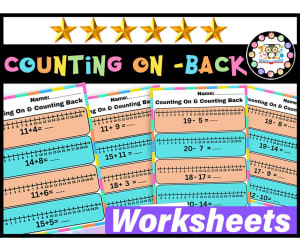
Counting On & Back Addition Subtraction Number Line Worksheets
Math, Addition and Subtraction, Addition, Subtraction, Counting, Early Math, Basic Operations, Kindergarten, Preschool, Grade 1, 2, 3, Worksheets & Printables, Worksheets, Workbooks, Activities, Centers, Experiments
This interactive and attractive setCounting On & Back Addition Subtraction Number Line Worksheets Pages learners develop their original Counting On & Back Addition Subtraction Number Line Worksheets this set contains 79 pages in this set, each in each a different Digraphs Counting On & Back Addition Subtraction Number Line Worksheets of dedicated Counting On & Back Addition Subtraction Number Line Worksheets Pagesto ensure a fun and structured approach to using a fun and type of work that useful; Each card is fun this edited set ofCounting On & Back Addition Subtraction Number Line Worksheets is built in an elegant style that attracts attention this interactive and attractive set of Counting On & Back Addition Subtraction Number Line Worksheetsdesigned to help young learners develop their originalCounting On & Back Addition Subtraction Number Line Worksheets skills through Counting On & Back Addition Subtraction Number Line Worksheets sexercises This set contains 79 pages. these printable Worksheets offer useful courses, this provides a useful course-rich practice, it is designed to help using resource grade 2 easily to learn about activities Counting On & Back Addition Subtraction Number Line Worksheets a fun and interactive manner. A collaborative learning activity added students. PDF format
Author LAMO
Rating
Tags Activities, Centers, Worksheets, Math, Basic Operations, Homework
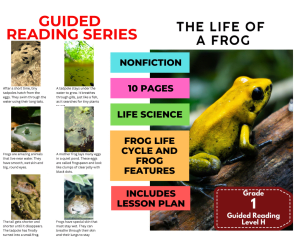
Guided Reading Level H - The Life of a Frog (with Lesson Plan)
ELA, Resources for Teachers, Reading Comprehension, Reading, Science, Animals, Life Sciences, Pre-Reading, Language Development, Vocabulary, Grade 1, 2, 3, Worksheets & Printables, Worksheets, Teacher Tools, Centers, Activities, Literacy Readers, Quizzes, Quizzes and Tests, Assessments, Lesson Plans
This Guided Reading Book - The Life of a Frog (Level H) with lesson plan includes: Guided Reading Color Label (front cover x1) This is a quick way to match the book’s demands to what students can generally handle.. The overall goal is to use the level/color to pick books for several smaller groups. To qualify for a certain level, a student is expected to read a book from that level with about 90–94% accuracy. If a student is consistently accurate and understands, move up a level. If the student is struggling at that level, drop down and add more support. Each student will improve at completely different rates, but it is generally one of the best ways to check progress across the class. DOWNLOAD THE CATALOG TO VIEW ALL GUIDED READING BOOKS AVAILABLE (SORTED LEVELS A-Z) Pre-Reading Question (x1) Teacher asks the prompt aloud, can be while showing the cover or first page. Students share what they already know, or make educated guesses from the cover. Prompt them to use the target vocabulary. Write some of their responses on the board to look back at during the reading. Vocabulary Words (x5) Introduce the five words, best doing it one at a time. Start by saying it, while students repeat and then see if anyone knows what it means before reading further. Read through the meaning and try to briefly connect each word to a picture or gesture so it’s meaningful. Ask students to flip through the book pages and point to where they see each of the vocabulary words. While reading the book pause upon coming across one of the vocab words or read the sentence twice to make sure students understand the word has appeared. Optional: Ask students to raise hands whenever they see/hear one of the new words. Guided Reading Pages (x10) Check the book snapshot (below) for: primary topic - do you need to prep extra reading or intro materials on this? what is taught best - decide on 1-2 bullets to focus on, use the prompt or words provided here for best results. learning goals - what you are checking for students to be able to do after the session, elicit answers using prompts or words provided. key vocabulary (see section above). questions overview - so you know what is coming up and if you need to prep extra materials to assist understanding. Run the lesson You may have already looked at a few of the pages together, but you can show them some of the pictures again first to set meaning. Depending on how much time you have and how familiar your students are with guided reading class, you may want to read the book aloud first with the group first. Students whisper or partner read, while you listen in. If time, do it as a group, one student reading a page each. Use the guided page’s prompts to coach: “Check the picture / does it make sense?” “Point under the words / try the first sound” “Reread the sentence smoothly”. Try to focus more on one student per session (rotating every time), so you can work out if they are ready to move up or need to move down a level. Comprehension Questions (back cover x3) This is your way to check that students didn’t just say the words, but actually understood the text. First, let students answer by pointing to the page/picture and saying a short sentence. After any answer, follow with: “Show me where you found that in the text.” In bigger groups, have partners answer first (10–20 seconds), then call on 2–3 students to share. Differentiation tips: Emerging speakers/struggling readers: oral + pointing On-level: oral in a full sentence Higher: one written sentence or draw + label Book Snapshot Title: The Life of a Frog Genre: Nonfiction (informational life cycle) Subject: Life Science + Reading (Informational Text) Primary Topic: Frog life cycle and frog features Estimated Guided Reading Level (A–Z): H What This Book Teaches Best Explains where frogs live and describes basic frog traits (smooth, wet skin; big, round eyes; living near water). Teaches the frog life cycle in clear steps: eggs (frogspawn) → tadpoles → legs grow → tail disappears → small frog. Shows how a tadpole lives and grows in water, including breathing through gills and eating tiny plants. Describes how frogs breathe (through skin and lungs) and how they get food (long, sticky tongue catching insects). Connects body parts to movement (strong back legs help frogs hop and jump high). Learning Goals Students will describe where frogs live and name physical traits the text mentions. Students will explain what frog eggs are called and describe what they look like. Students will retell the main stages of a frog’s life from eggs to a small frog. Students will describe how tadpoles move, breathe, and find food in the water. Students will explain how the frog’s body changes as legs grow and the tail disappears. Students will use text details to describe how a frog hunts and how it jumps. Key Vocabulary From the Text frogspawn — frog eggs that look like jelly. tadpoles — baby frogs that live in water and have tails. gills — body parts that help an animal breathe underwater. lungs — body parts used for breathing air. insects — small animals a frog can catch and eat. Discussion Prompts Pre-reading question: What changes do you think happen as a tadpole grows into a frog? Comprehension questions: Where does a mother frog lay many eggs, according to the text? Comprehension questions: What do tiny tadpoles use to swim through the water? Comprehension questions: What happens to the tadpole’s tail as it turns into a small frog? Printing Tips 1. Best Printing Method (Recommended) “Booklet” Printing (Best if Available) If your printer or PDF viewer supports Booklet Printing , use this. Settings to use: Print mode: Booklet Paper size: Letter or A4 (either works) Orientation: Landscape Print on both sides: Yes Flip on: Short edge Scaling: Fit to printable area Booklet subset: First test: Front sides only Then: Back sides only This will automatically: Pair pages correctly Put the cover on the outside Align everything for folding After printing, fold in half and staple along the spine . 2. If “Booklet” Printing Is NOT Available You can still print this correctly with manual duplex printing . Step-by-step: Open the PDF. Choose Print . Set: Orientation: Landscape Pages per sheet: 1 Print on both sides: Yes Flip on: Short edge Print all pages . Because each PDF page already contains two facing book pages, the result will still fold cleanly into a book. Thousands of Cored Education products are included with your TeachSimple membership. Download links and encyclopedia index available here.
Author Cored Education
Rating
Tags Reading Comprehension, Reading Passages, Reading, Guided Reading, Guided Reading Lesson Plan, Guided Reading Activity, Pre-reading, Science Lesson Plans, Animals, Frog Life Cycle
Guided Reading Level H - What Happens to Recyclables
ELA, Resources for Teachers, Reading Comprehension, Reading, Science, Pre-Reading, Language Development, Earth and Environmental Sciences, Engineering, Technology, Kindergarten, Grade 1, 2, Worksheets & Printables, Worksheets, Teacher Tools, Centers, Activities, Literacy Readers, Quizzes, Quizzes and Tests, Assessments
This Guided Reading Book - What Happens to Recyclables (Level H) includes: Guided Reading Color Label (front cover x1) This is a quick way to match the book’s demands to what students can generally handle.. The overall goal is to use the level/color to pick books for several smaller groups. To qualify for a certain level, a student is expected to read a book from that level with about 90–94% accuracy. If a student is consistently accurate and understands, move up a level. If the student is struggling at that level, drop down and add more support. Each student will improve at completely different rates, but it is generally one of the best ways to check progress across the class. DOWNLOAD THE CATALOG TO VIEW ALL GUIDED READING BOOKS AVAILABLE (SORTED LEVELS A-Z) Pre-Reading Question (x1) Teacher asks the prompt aloud, can be while showing the cover or first page. Students share what they already know, or make educated guesses from the cover. Prompt them to use the target vocabulary. Write some of their responses on the board to look back at during the reading. Vocabulary Words (x5) Introduce the five words, best doing it one at a time. Start by saying it, while students repeat and then see if anyone knows what it means before reading further. Read through the meaning and try to briefly connect each word to a picture or gesture so it’s meaningful. Ask students to flip through the book pages and point to where they see each of the vocabulary words. While reading the book pause upon coming across one of the vocab words or read the sentence twice to make sure students understand the word has appeared. Optional: Ask students to raise hands whenever they see/hear one of the new words. Guided Reading Pages (x10) Check the book snapshot (below) for: primary topic - do you need to prep extra reading or intro materials on this? what is taught best - decide on 1-2 bullets to focus on, use the prompt or words provided here for best results. learning goals - what you are checking for students to be able to do after the session, elicit answers using prompts or words provided. key vocabulary (see section above). questions overview - so you know what is coming up and if you need to prep extra materials to assist understanding. Run the lesson You may have already looked at a few of the pages together, but you can show them some of the pictures again first to set meaning. Depending on how much time you have and how familiar your students are with guided reading class, you may want to read the book aloud first with the group first. Students whisper or partner read, while you listen in. If time, do it as a group, one student reading a page each. Use the guided page’s prompts to coach: “Check the picture / does it make sense?” “Point under the words / try the first sound” “Reread the sentence smoothly”. Try to focus more on one student per session (rotating every time), so you can work out if they are ready to move up or need to move down a level. Comprehension Questions (back cover x3) This is your way to check that students didn’t just say the words, but actually understood the text. First, let students answer by pointing to the page/picture and saying a short sentence. After any answer, follow with: “Show me where you found that in the text.” In bigger groups, have partners answer first (10–20 seconds), then call on 2–3 students to share. Differentiation tips: Emerging speakers/struggling readers: oral + pointing On-level: oral in a full sentence Higher: one written sentence or draw + label Book Snapshot Title: What Happens to Recyclables Genre: Nonfiction (informational) Subject: Science (Environmental Science) Primary Topic: How recyclables are collected, sorted, and reused Estimated Guided Reading Level (A–Z): H What This Book Teaches Best How recycling begins at home: people put materials in blue bins for a special truck. What happens at a Material Recovery Facility (MRF), including the “tipping floor” and conveyor belts. How workers and machines separate materials (sorting workers, a magnetic separator, optical sorters using infrared light, and star screens). What happens after sorting: materials are crushed into bales, moved by forklifts, taken to factories, and made into new products. Learning Goals Describe how recyclables get from blue bins to a truck and are hauled away. Explain what the book says happens when a truck arrives at a Material Recovery Facility (MRF). Identify what sorting workers remove from the conveyor belts and give examples from the text. Explain how a magnetic separator changes what stays on the line and what gets pulled away. Describe how optical sorters use infrared light and air to separate plastic bottles. Describe what happens to sorted materials after they are made into bales and sent to factories. Key Vocabulary From the Text sanitation — keeping places clean by picking up trash and recyclables. facility — a place or building where work happens. conveyor — a moving belt that carries things from one place to another. separator — something that pulls different materials apart. infrared — a kind of light machines can use to tell things apart. Printing Tips 1. Best Printing Method (Recommended) “Booklet” Printing (Best if Available) If your printer or PDF viewer supports Booklet Printing , use this. Settings to use: Print mode: Booklet Paper size: Letter or A4 (either works) Orientation: Landscape Print on both sides: Yes Flip on: Short edge Scaling: Fit to printable area Booklet subset: First test: Front sides only Then: Back sides only This will automatically: Pair pages correctly Put the cover on the outside Align everything for folding After printing, fold in half and staple along the spine . 2. If “Booklet” Printing Is NOT Available You can still print this correctly with manual duplex printing . Step-by-step: Open the PDF. Choose Print . Set: Orientation: Landscape Pages per sheet: 1 Print on both sides: Yes Flip on: Short edge Print all pages . Because each PDF page already contains two facing book pages, the result will still fold cleanly into a book. Thousands of Cored Education products are included with your TeachSimple membership. Download links and encyclopedia index available here.
Author Cored Education
Rating
Tags Vocabulary, Reading Comprehension, Reading Passages, Leveled Reading, Nonfiction, Reading, Guided Reading, Technology, Engineering, Recycling
SEL Presentation-The Core Four
Special Resources, Social Emotional Learning (SEL), Social Skills, Special Education Needs (SEN), Life Skills, Kindergarten, Preschool, Grade 1, 2, Worksheets & Printables, Worksheets, Teacher Tools, Lesson Plans, Presentations
In this SEL presentation, students will learn about the "core four" as a way to figure out how someone else is feeling. This is the building block of empathy and understanding how someone is feeling. This product has a 12 slide Google Slides Presentation with the last 4 slides as handouts and activities for the lesson plan. Students will understand that the core four is looking at the key 4 body parts; the eyes, eyebrows, mouth and hands. They will analyze 4 pictures of real people and guess how they are feeling based on the core four. After they analyze the real children, they will play a game of charades with partners or in groups. There are 6 different emotions to act out-each have an emoji as well as the feeling word. No reading is required. Then there are 2 extension SEL worksheets. One is identifying what people are feeling in a picture, they will circle the feeling word and write down which part of the core four helped them figure it out. The next handout is a fun Find the 9 Differences in an emoji picture. The answer is on the following slide. This lesson is good for pre-k, kindergarten, first and second grades. If you are interested in more SEL products, please feel free to visit my SEL store here: https://teachsimple.com/contributor/jennifer-moyer-taylor For more products teaching students about feelings, emotions and SEL skills, check out these products: https://teachsimple.com/product/guess-the-emotion-sel-game (This is a fun lesson kind of like the game Cranium where students get to use play dough, writing, charades or talking to give clues about what feeling card they get.) https://teachsimple.com/product/betsy-the-top-banana-boom-cards-a-story-about-cliques-plus-task-cards-on-excluding-and-including-others-with-audio-plus-extension-activity (This is a combination Boom Cards activity as well as a fruit salad activity to discuss inclusivity with others.) https://teachsimple.com/product/sel-flashcards-for-social-emotional-learning-with-sel-coloring-pages (social emotional flashcards showcasing 16 different feelings. They are black and white as well as in color so students could color them in themselves. You can play memory, go Fish and other games with these flashcards.)
Author Jennifer Moyer Taylor
Tags SEL Presentation, Feelings, Emotions, Sel, Social Emotional Learning, School Counseling, Sen, Special Education Needs, Social Skills

Silly Dragon Crafts - Coloring - Bookmarks - Geometric Designs
Creative Arts, Geometry, Math, Shapes, Early Math, Patterns, Kindergarten, Preschool, Grade 1, 2, 3, Crafts, Activities, Centers, Projects, Coloring Pages, Worksheets, Worksheets & Printables
These dragons are so silly and so much fun for kids to color. As is this entire dragon crafts activity pack. Kids absolutely love these dragons as well with their simple, thick outlines, they are a great way to give your students a break from their work and also be used as a reward for good behavior and an assignment done well. Since so many kids nowadays love dinosaurs and dragons, I thought it would be fun to create a dragon crafts activity pack. The simple drawings are perfect for preschoolers and prereaders. The bookmark designs, which are smaller and more complex, can be enjoyed by older students as well. There are five different dragons on 8.5 x 11 for a total of 10 posters - 5 of the dragons contain a colored example that children can follow to help with color recognition. These do not have a color border. The other 5 dinosaurs are black and white by themselves and contain a colored border. Once colored, the posters can be used to decorate bulletin boards, classrooms, and home refrigerators. They could even be framed and given as gifts! They can be printed and used again and again! In addition, there are 6 double-sided bookmarks with different geometric designs, patterns, and dragon pictures for coloring and printing. Geometry is math, so without realizing it, when your students color in the geometric designs, they are in essence practicing math skills. You can ask your students to identify the shapes and patterns on the bookmarks while they are coloring. You can also teach about shapes and patterns while they are keeping their hands busy coloring them. This can be super helpful in reducing distractibility. The geometric designs are great for developing familiarity with shapes and patterns. Plus, bookmarks make great gifts and encourage reading. The format is pdf downloadable and there are 15 pages, including the cover page. There is no need for an answer key as this dragon craft activity pack is pure fun with a little arts and crafts and math snuck in.
Author Homeschooling Dietitian Mom
Tags Dragon, Dragon Craft, Geometry, Dragon Coloring Sheet, Color Poster, Math, Crafts, Craft Activities, Cute Bulletin Board, Groovy Bulletin Board
Guided Reading Level G - Amazing Inventions (with Lesson Plan)
ELA, Resources for Teachers, Reading Comprehension, Reading, Science, Engineering, Technology, Language Development, Pre-Reading, Vocabulary, Grade 1, 2, 3, Worksheets & Printables, Worksheets, Teacher Tools, Centers, Activities, Literacy Readers, Quizzes, Quizzes and Tests, Assessments, Lesson Plans
This Guided Reading Book - Amazing Inventions (Level G) with lesson plan includes: Guided Reading Color Label (front cover x1) This is a quick way to match the book’s demands to what students can generally handle.. The overall goal is to use the level/color to pick books for several smaller groups. To qualify for a certain level, a student is expected to read a book from that level with about 90–94% accuracy. If a student is consistently accurate and understands, move up a level. If the student is struggling at that level, drop down and add more support. Each student will improve at completely different rates, but it is generally one of the best ways to check progress across the class. DOWNLOAD THE CATALOG TO VIEW ALL GUIDED READING BOOKS AVAILABLE (SORTED LEVELS A-Z) Pre-Reading Question (x1) Teacher asks the prompt aloud, can be while showing the cover or first page. Students share what they already know, or make educated guesses from the cover. Prompt them to use the target vocabulary. Write some of their responses on the board to look back at during the reading. Vocabulary Words (x5) Introduce the five words, best doing it one at a time. Start by saying it, while students repeat and then see if anyone knows what it means before reading further. Read through the meaning and try to briefly connect each word to a picture or gesture so it’s meaningful. Ask students to flip through the book pages and point to where they see each of the vocabulary words. While reading the book pause upon coming across one of the vocab words or read the sentence twice to make sure students understand the word has appeared. Optional: Ask students to raise hands whenever they see/hear one of the new words. Guided Reading Pages (x10) Check the book snapshot (below) for: primary topic - do you need to prep extra reading or intro materials on this? what is taught best - decide on 1-2 bullets to focus on, use the prompt or words provided here for best results. learning goals - what you are checking for students to be able to do after the session, elicit answers using prompts or words provided. key vocabulary (see section above). questions overview - so you know what is coming up and if you need to prep extra materials to assist understanding. Run the lesson You may have already looked at a few of the pages together, but you can show them some of the pictures again first to set meaning. Depending on how much time you have and how familiar your students are with guided reading class, you may want to read the book aloud first with the group first. Students whisper or partner read, while you listen in. If time, do it as a group, one student reading a page each. Use the guided page’s prompts to coach: “Check the picture / does it make sense?” “Point under the words / try the first sound” “Reread the sentence smoothly”. Try to focus more on one student per session (rotating every time), so you can work out if they are ready to move up or need to move down a level. Comprehension Questions (back cover x3) This is your way to check that students didn’t just say the words, but actually understood the text. First, let students answer by pointing to the page/picture and saying a short sentence. After any answer, follow with: “Show me where you found that in the text.” In bigger groups, have partners answer first (10–20 seconds), then call on 2–3 students to share. Differentiation tips: Emerging speakers/struggling readers: oral + pointing On-level: oral in a full sentence Higher: one written sentence or draw + label Book Snapshot Title: Amazing Inventions Genre: Nonfiction (informational text) Subject: Science/Technology + Reading (Informational Text) Primary Topic: Inventions and how they help people Estimated Guided Reading Level (A–Z): G What This Book Teaches Best Introduces common inventions (wheel, lightbulb, telephone, computer, camera, airplane, refrigerator, clock, robot) and what each one does. Explains how inventions help people in everyday life (moving heavy things, seeing in the dark, connecting over distances, doing work quickly, keeping food cold, telling time, doing chores). Builds understanding of technology as something that changes, with “new things… invented every day to help people.” Supports describing key details from short informational passages paired with clear photos. Learning Goals Identify several inventions named in the book and tell what each helps people do. Describe how a wheel helps move heavy things from place to place. Explain how a lightbulb helps people see when it is dark outside. Tell how a telephone connects people who are far apart. Describe one way computers help people work quickly and what they can do. Explain what the book says about technology changing and new inventions helping people. Key Vocabulary From the Text invention — something made for the first time to help people. electricity — power that runs lights and machines. distances — how far apart places are. refrigerator — a machine that keeps food cold. sensors — parts that help a machine notice what is around it. Discussion Prompts Pre-reading question: What inventions do you use, and how do they help you? Comprehension questions: How do wheels help move heavy things from place to place? Comprehension questions: What does a lightbulb help people do when it is dark outside? Comprehension questions: What does the book say about new technology and how it helps people? Printing Tips 1. Best Printing Method (Recommended) “Booklet” Printing (Best if Available) If your printer or PDF viewer supports Booklet Printing , use this. Settings to use: Print mode: Booklet Paper size: Letter or A4 (either works) Orientation: Landscape Print on both sides: Yes Flip on: Short edge Scaling: Fit to printable area Booklet subset: First test: Front sides only Then: Back sides only This will automatically: Pair pages correctly Put the cover on the outside Align everything for folding After printing, fold in half and staple along the spine . 2. If “Booklet” Printing Is NOT Available You can still print this correctly with manual duplex printing . Step-by-step: Open the PDF. Choose Print . Set: Orientation: Landscape Pages per sheet: 1 Print on both sides: Yes Flip on: Short edge Print all pages . Because each PDF page already contains two facing book pages, the result will still fold cleanly into a book. Thousands of Cored Education products are included with your TeachSimple membership. Download links and encyclopedia index available here.
Author Cored Education
Rating
Tags Reading Comprehension, Reading Passages, Reading, Guided Reading, Guided Reading Lesson Plan, Guided Reading Activity, Pre-reading, Science Lesson Plans, Technology, Engineering

ABC Punch Cards
ELA, Language Development, Pre-Reading, Preschool, Kindergarten, Grade 1, Worksheets & Printables, Worksheets
Worksheets designed to help students strengthen muscles and practice letter recognition, as well as phonics recognition. With the help of a hole puncher (or just a marker), students mark the letters matching pictures or the letters in the center.
Author Cherry Workshop
Tags Letter Recognition, Punch Cards, Phonic Practice, Muscle Strengthening, Occupational Therapy