Long Vowel Worksheets: U_E Split Digraph




About This Product
Long vowel worksheets
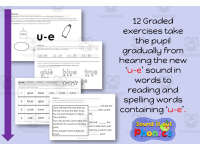
This is a pack of 23 phonic worksheets for the Long Vowel U-E (as in true and tune) specially designed for those with special needs, including those with dyslexia or who may be suspected of being dyslexic but will work equally well with young learners in Kindergarten/EYFS/Y1.
A pack of 23 worksheets with a variety of exercises to help build phonemic awareness and reading fluency.
These sheets are LETRS and UK GOV requirements aligned.
These worksheets also align with the most popular phonic programmes, including RWI and Letters and Sounds.
What is included?
30 worksheets for the sound EA taking pupils from hearing the sounds in words to reading and spelling them at word and sentence level. all following my special method devised as I privately tutor children of all ages with profound special needs.
Your phonics lessons are covered! Tracking, fluency triangles, spelling, reading, games, comprehension exercises....and more!
Who are these worksheets for?
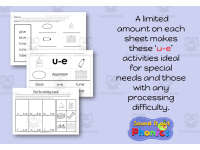
I have written them for pupils who struggle with processing information - especially sounds. This includes children who are DYSLEXIC or have ANY other kind of processing disorder.
Such children may have failed with other methods of teaching phonics.
Such pupils need activities that:
· are highly structured - one tiny step at a time building on the one before using only a limited number of words to start with and only using words that the child has already learnt to sound out, with no nasty surprises.
· Have only a little on each page as these pupils tire easily.
What makes these worksheets special?
I have a powerful three-step process which I use with my special needs pupils, which is worked out over the course of the 23 worksheets:
1. See it! where we focus on becoming aware of the new sound in words. This involves first hearing the new sound in words and then seeing it in words (tracking).
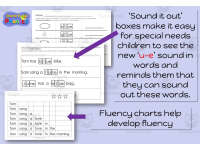
2. Sound-it-out! Having learnt to see the new sound in words, we learn to sound out these words to read and write them.
We begin by using sound-it-out boxes for reading and spelling which help the child to segment the word prior to blending the sounds together.
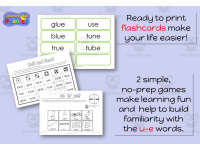
Once the child can read and write individual words, we work on fluency by building familiarity with the common words in the new sound family.
Once the child can sound the words out to read and spell confidently, we move on to recognising them/using them in longer reading and dictation passages, as soon as the child is able.
I provide 2 reading passages with comprehension exercises and one dictation passage, with a page in the workbook dedicated to it, with room for a picture, which again cements understanding.
3. Write it!
Incorporated into the above two steps, we constantly write the new sound. This adds a multi-sensory dimension to our work - we see with our eyes, we sound it with our mouth parts and voice, and then we move by writing.
All three steps work together to help the child feel in control of his/her learning and to become a successful, confident learner.
We finish each sound with a dictation which culminates our work before we move on to the next sound. I try to give the dictation a week after we finish the work on the EA sound to act as revision.
The dictation: Read this passage to your pupil, who should write it. Have the child read his/her work and check for errors. Make sure the writing is completely accurate before saying the child has finished, including full stops and capital letters correctly used.
Flashcards are included of some common EA words.
What is included?
1 PDF with flashcards and 23 worksheets
Resource Tags
0 Reviews
Check out these other great products