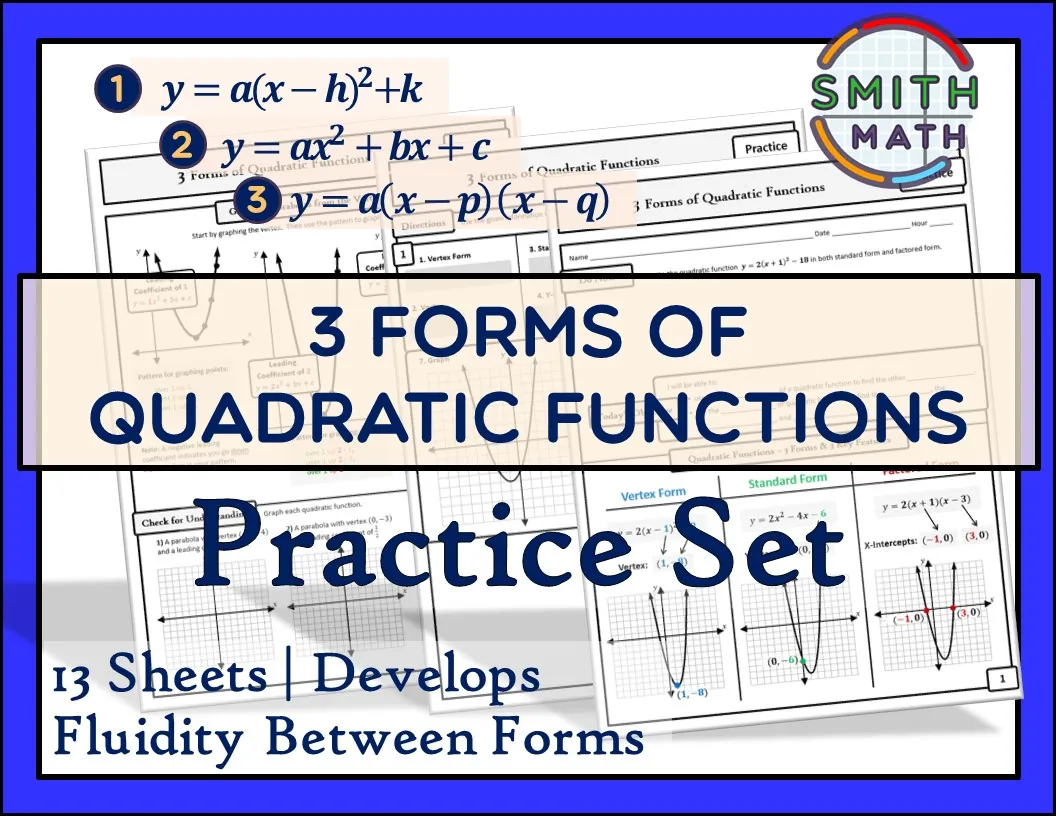
3 Forms of Quadratic Functions – Practice Set
- Grades
- High School
- File type
- Answer key
- Included


- Subject
- Math, Algebra
- Topic
- Standard form, Vertex form
- Answer key
- Included
- Standards
- HSF-IF.C.8
Product description
From the author
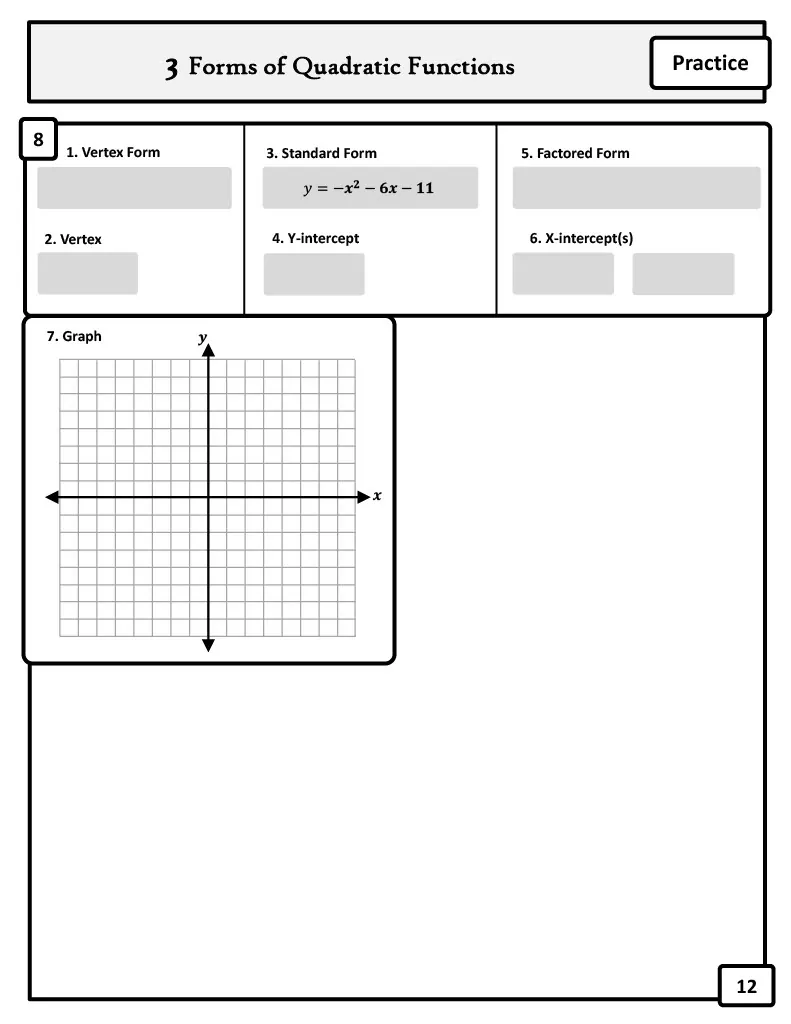
If you are a high school math teacher, finding resources that best serve for your students is of the utmost importance! This is a 3 Forms of Quadratic Functions Practice Set that is filled with purposeful practice that your students can use right away.
This practice set assumes students have already learned Vertex Form, Standard Form, and Factored/Intercept Form for Quadratic Functions.
The objectives of the practice set are for students to be able to:
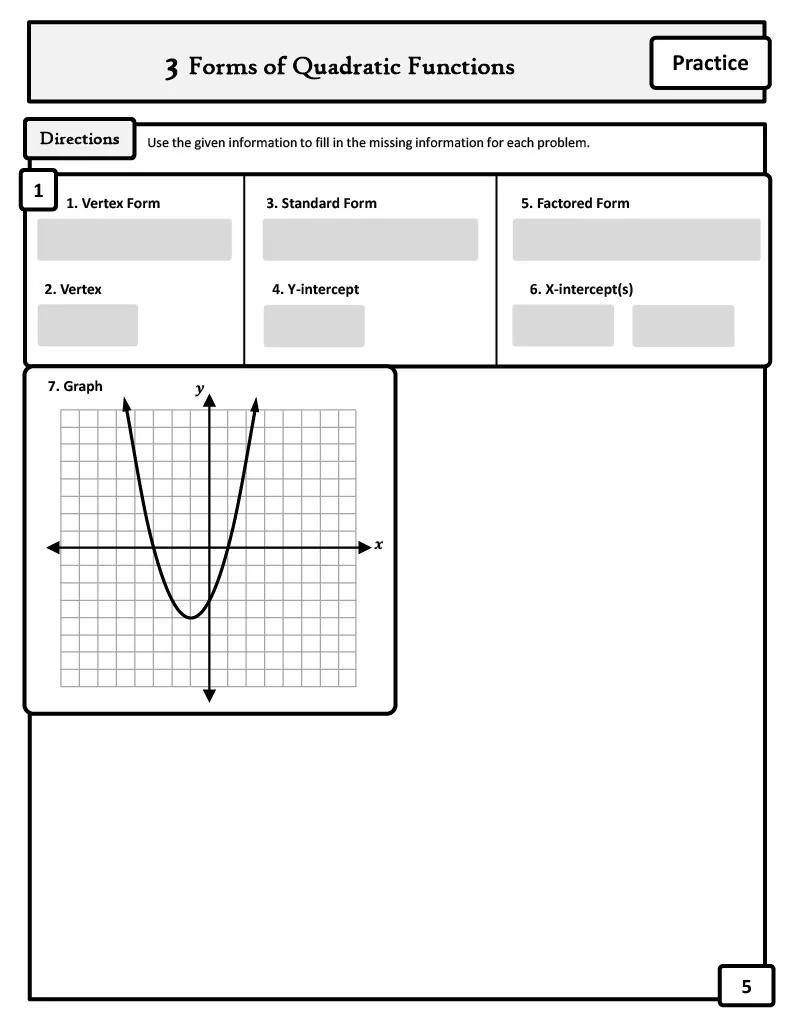
--Use any form of a quadratic function to find the other 2 forms.
--Use the 3 forms of quadratic functions to find the vertex, the y-intercept, and the x-intercepts.
Students will practice:
--Rewriting Quadratic Functions in 3 forms
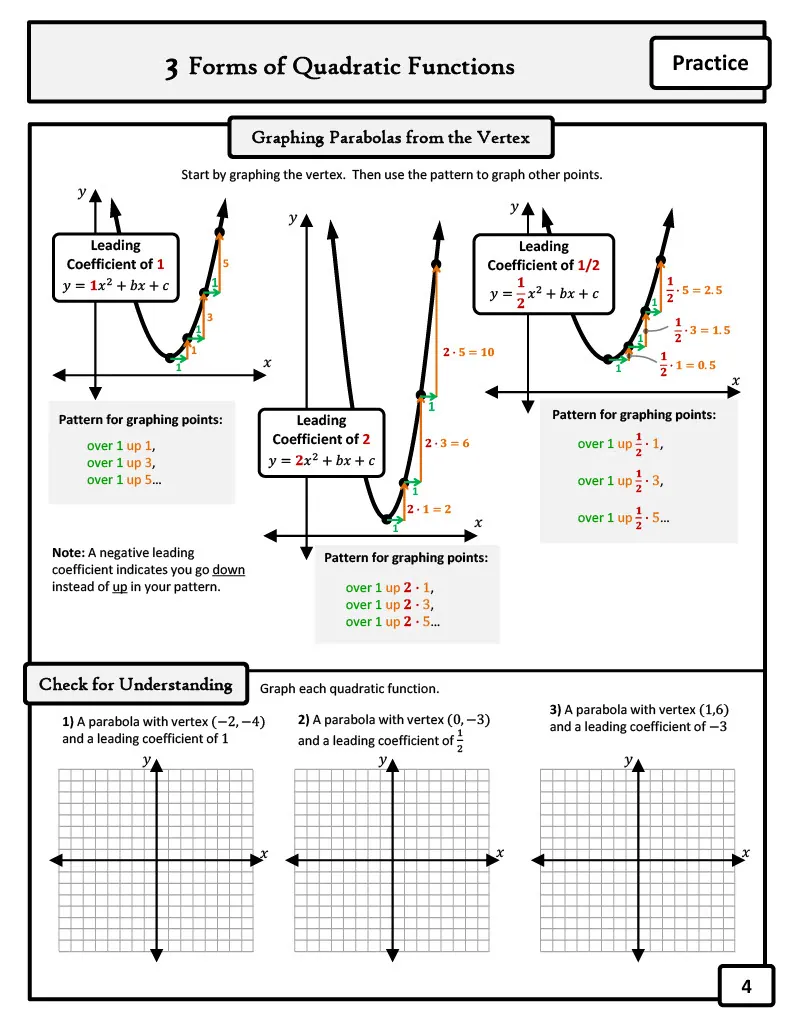
--Graphing Parabolas from the Vertex
There are 13 sheets that develop fluidity between forms. Answer keys are included.
You can use these practice sheets for in-class independent work, homework, or self-checking early finisher tasks.
Students could also complete some of the practice sets together in partner work or small groups.
I hope you enjoy!
Here are other similar resources for you to enjoy:
Related resources
More resources teachers may find useful
24 related resources were found using this product's title, contributor, categories and tags.


In the classroom
Teaching tips & learning objectives

Learning objectives
Convert a quadratic function among vertex form, standard form, and factored form.
Identify a quadratic function's vertex, y-intercept, and x-intercepts from each of its three forms.
Determine directly from an equation's form whether its vertex and y-intercept (or vertex and x-intercept) coincide, or whether it has no real x-intercepts.

Teaching tips
Work through the three fully worked examples as guided notes before assigning the 8 independent practice problems, since the set assumes prior knowledge of all three forms individually.
Use the reflection questions as a discussion after problems 5-8, since they ask students to reason about vertex/intercept coincidence and non-real roots without doing full conversions.
Reference the answer key's completed graphs and forms to check both the algebra and the graphing steps, since each problem asks for both.

Skills covered
Expanding vertex or factored form into standard form
Factoring a quadratic when real factors exist
Relating equation forms to intercepts and graphs
Good to know
Questions teachers ask about this resource
Does the set introduce all three forms from scratch?
It assumes students have already learned vertex, standard and factored forms, then provides examples and practice moving between them.
Can every quadratic be written with real linear factors?
No. A quadratic with no real x-intercepts has no real linear factorization. The set includes examples with no real x-intercepts.

No reviews yet
Downloaded this resource? Tell other teachers how it went.
Curriculum
Standards, concepts & topics
Standards
 Standards
- HSF-IF.C.8 — Write a function defined by an expression in different but equivalent forms to reveal and explain different properties of the function. a. Use the process of factoring and completing the square in a quadratic function to show zeros, extreme values, and symmetry of the graph, and interpret these in terms of a context. b. Use the properties of exponents to interpret expressions for exponential functions. For example, identify percent rate of change in functions such as y = (1.02)t , y = (0.97)t , y = (1.01)12t, y = (1.2)t/10, and classify them as representing exponential growth or decay
Core concepts
 Core concepts
Quadratic functions
Vertex form
Standard form
Factored form
Parabola graphing
 Topics
More to explore
You may also like