Quadratic Equations – Converting Forms Worksheet
- Grades
- High School
- Pages
- 4
- File type
- Answer key
- Included


- Subject
- Math, Algebra
- Topic
- Quadratic forms, Vertex form
- Resource types
- Worksheets
- Answer key
- Included
- Standards
- HSF-IF.C.8
Product description
From the author
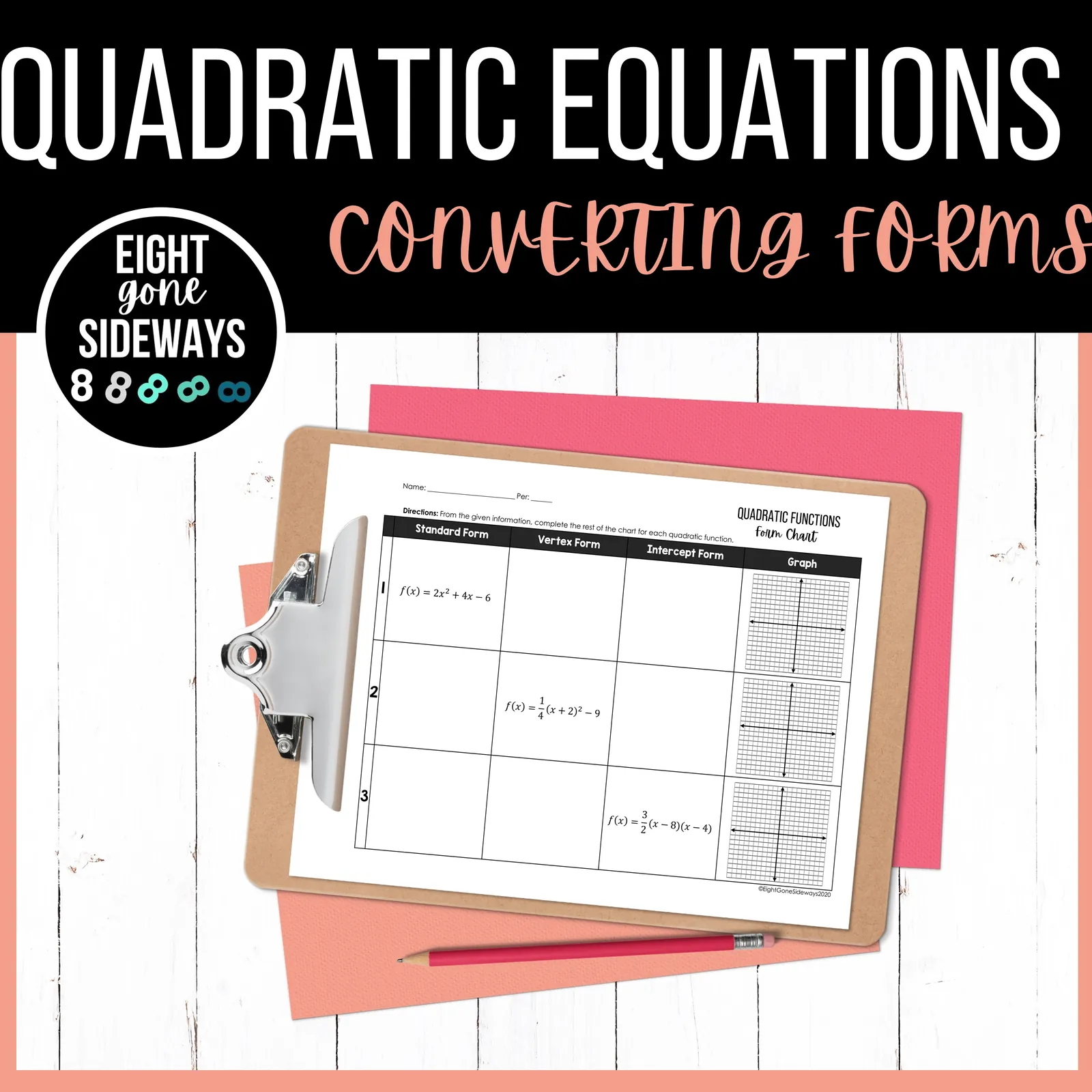
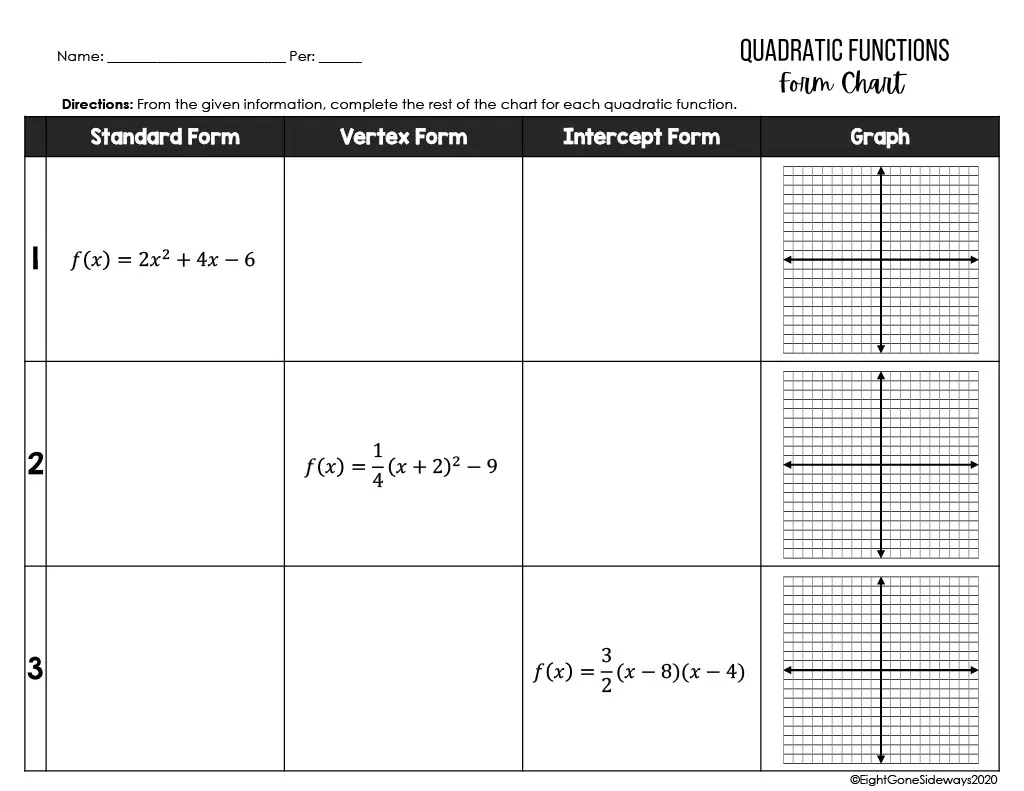
This is a Quadratic Equations Worksheet that will give students practice with converting forms.
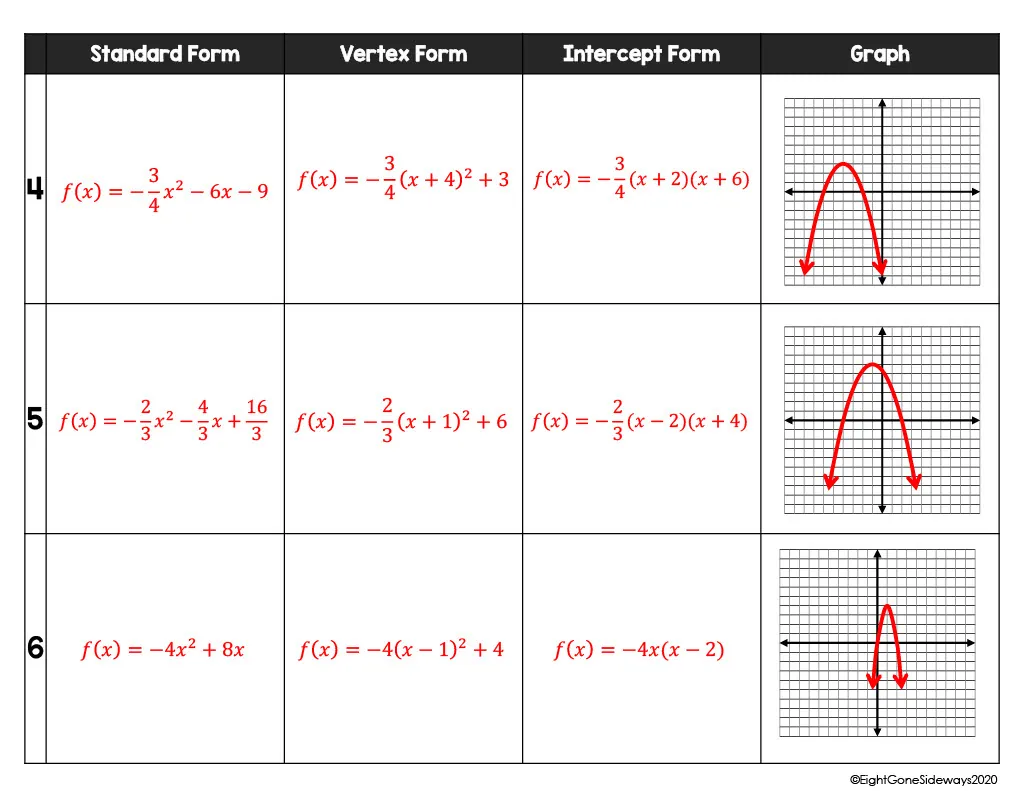
There are 6 problems - 3 per page.
Students will explore standard form, vertex form, intercept form and graphing.
Related resources
More resources teachers may find useful
24 related resources were found using this product's title, contributor, categories and tags.



In the classroom
Teaching tips & learning objectives

Learning objectives
Convert a quadratic function from standard form to vertex form.
Convert a quadratic function from standard form to intercept (factored) form.
Graph a quadratic function represented in any of the three forms.

Teaching tips
Point out which form is already given in each row before students start, since the required conversion path changes function to function.
Review completing the square before assigning rows that start in standard form, since that is the typical route to vertex form.
Use the completed answer chart to spot-check factoring or expansion errors before students move to the graphing column.

Skills covered
Standard-to-vertex conversion — students complete the square to rewrite standard-form functions such as f(x) = 2x² + 4x − 6 in vertex form.
Standard-to-intercept conversion — students factor standard-form functions to find their intercept (factored) form.
Graphing from multiple representations — students sketch each function's graph after determining all three algebraic forms.
Good to know
Questions teachers ask about this resource
Does every function start from the same form?
No — the given form rotates row by row: some functions start in standard form, others in vertex form or intercept form, so students practice conversions in every direction rather than one repeated pattern.
Are negative or fractional leading coefficients included?
Yes — several functions use negative or fractional coefficients, for example f(x) = -2/3x² - 4/3x + 16/3, so the practice goes beyond simple integer quadratics.

No reviews yet
Downloaded this resource? Tell other teachers how it went.
Curriculum
Standards, concepts & topics
Standards
 Standards
- HSF-IF.C.8
Core concepts
 Core concepts
Standard form
Vertex form
Intercept form
Quadratic functions
Completing the square
 Topics
Explore more
Categories this resource belongs to
Explore related searches
More to explore
You may also like