Quadratic Functions Worksheet – Vertex Form Practice
- Grades
- Grades 9–12, High School
- Pages
- 4
- File type
- Answer key
- Included


- Subject
- Math, Algebra
- Topic
- graphing, algebra
- Resource types
- Worksheets & Printables, Worksheets
- Answer key
- Included
About this resource
What's inside this resource
Related resources
More resources teachers may find useful
24 related resources were found using this product's title, contributor, categories and tags.


In the classroom
Teaching tips & learning objectives

Learning objectives
State the domain and range of a quadratic function in interval notation, using a closed bracket at the vertex value and an open bracket at infinity
Read x-intercepts, the y-intercept and the vertex from a parabola's graph and write each as an ordered pair
Identify the increasing and decreasing intervals of a parabola and express them as intervals split at the axis of symmetry

Teaching tips
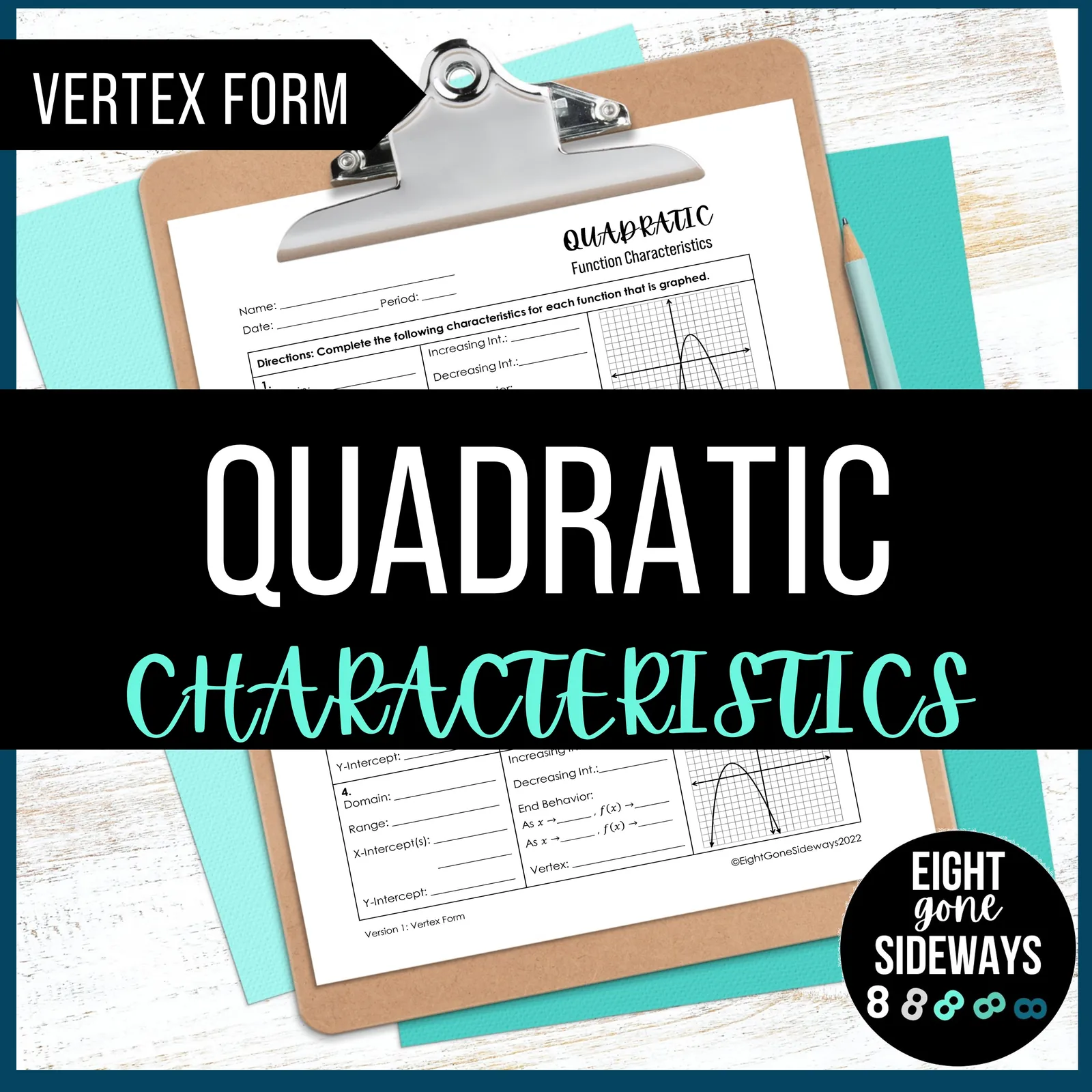
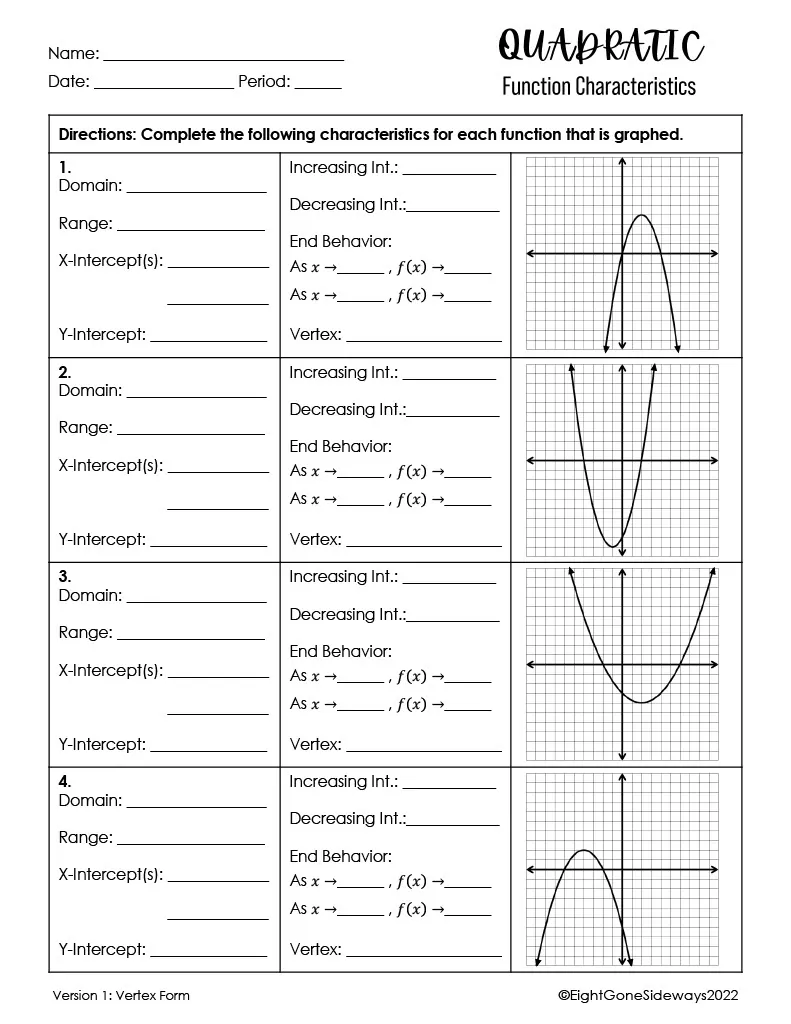
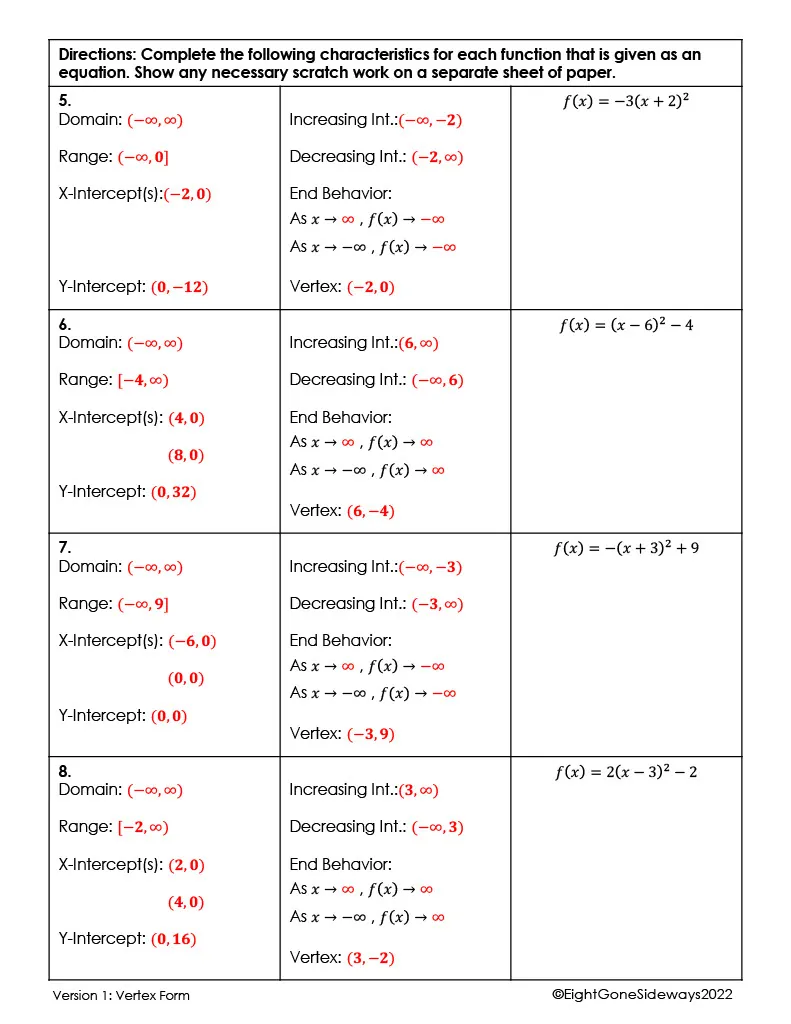
Page 1 and page 2 test the same nine characteristics from opposite starting points, so working page 1 first gives students the graphical picture they then have to reconstruct mentally on page 2
The vertex is the pivot for four of the nine blanks — range, increasing interval, decreasing interval and vertex itself — so establishing it before anything else shortens each problem considerably
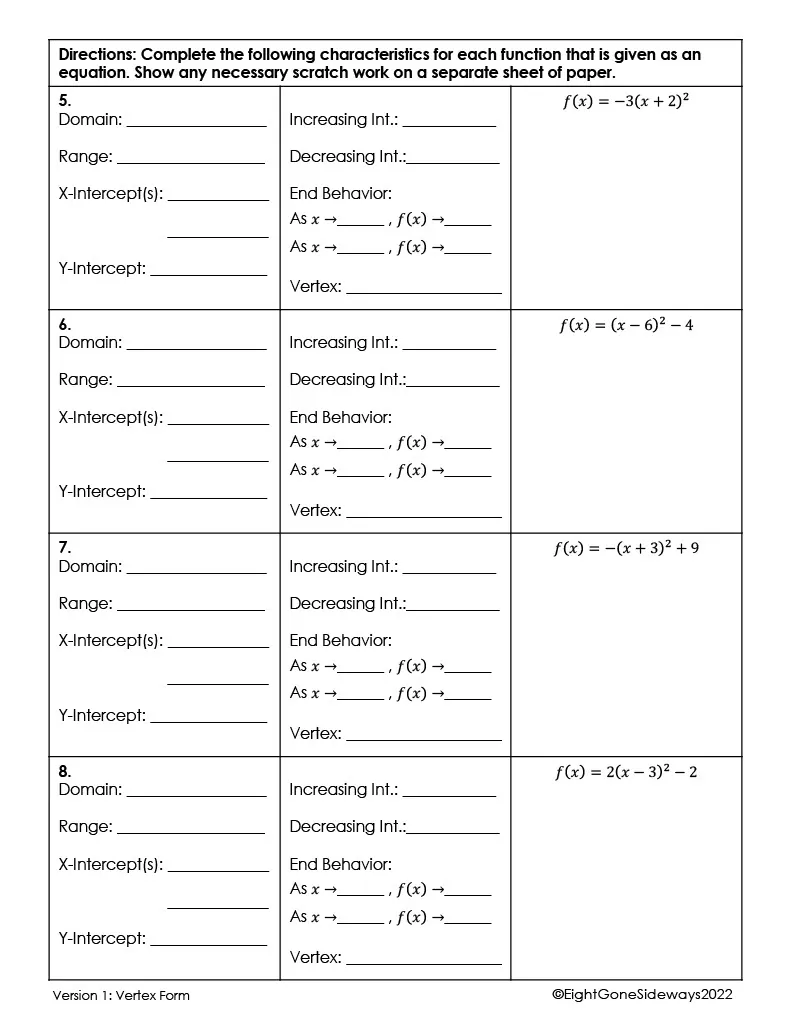
Two of the four equations open downward (−3(x+2)² and −(x+3)²+9) and two open upward, which makes the set usable as a sorting task on the sign of a before any calculation begins

Skills covered
Reading key features from a parabola — students take domain, range, both intercepts and the vertex directly off four graphed quadratics on page 1.
Writing intervals in interval notation — solutions such as Range (−∞, 4], Range [−9, ∞) and Increasing Int. (−∞, 2) require the correct choice between round and square brackets.
Describing end behaviour — each problem carries the paired prompts "As x → ______, f(x) → ______", so students state the limit in both directions and match it to the parabola's orientation.
Good to know
Questions teachers ask about this resource
How are the eight problems presented to students?
In two halves. Problems 1-4 supply a graph and ask for its characteristics; problems 5-8 supply only the equation in vertex form, such as f(x) = 2(x−3)²−2, under the direction "Show any necessary scratch work on a separate sheet of paper".
What has to be filled in for each function?
Nine entries every time: domain, range, x-intercept(s), y-intercept, increasing interval, decreasing interval, two end-behaviour limits and the vertex. The layout is identical for all eight problems.
Which notation do the worked solutions use?
Interval notation with the bracket distinction observed — Domain (−∞, ∞), Range (−∞, 4] for a downward parabola and [−9, ∞) for an upward one — while intercepts and vertices are written as ordered pairs such as (−4, 2) and (0, −9).

No reviews yet
Downloaded this resource? Tell other teachers how it went.
Resource details
Concepts & topics
Core concepts
 Core concepts
Quadratic functions
Vertex form
Domain and range
End behavior
Intercepts
Topics
 Topics
Explore more
Categories this resource belongs to
Explore related searches
More to explore
You may also like