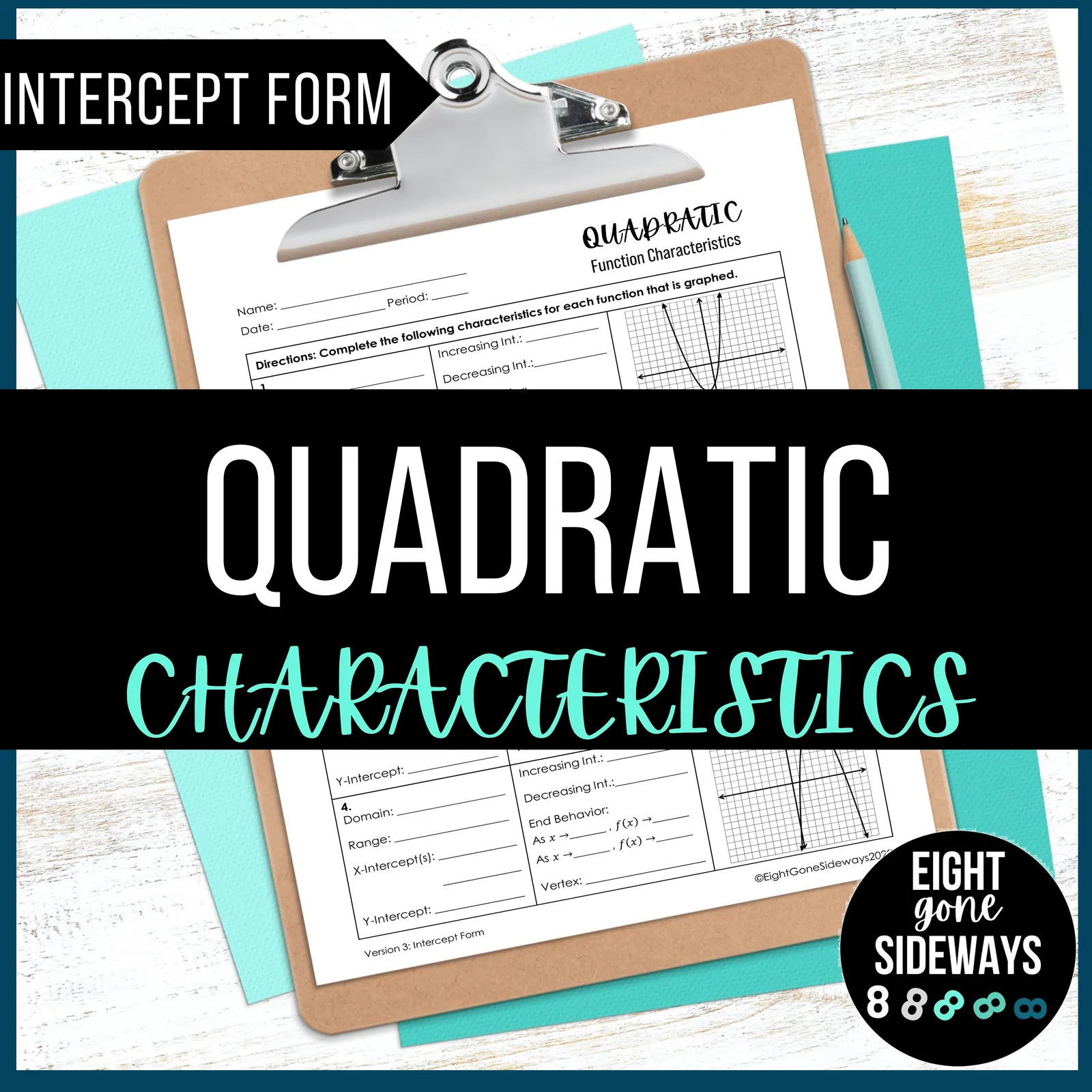
Quadratic Characteristics Worksheet – Intercept Form
- Grades
- Grades 9–12, High School
- File type
- Preparation
- Print ready


- Subject
- Math, Algebra
- Topic
- intercept form, standard form
- Resource types
- Worksheets & Printables, Worksheets
- Preparation
- Print ready
About this resource
What's inside this resource
Related resources
More resources teachers may find useful
24 related resources were found using this product's title, contributor, categories and tags.


In the classroom
Teaching tips & learning objectives

Learning objectives
Read domain, range, intercepts and vertex directly from the graph of a parabola
Find the same characteristics from an equation written in intercept form, using the factors to locate the x-intercepts and the midpoint between them to locate the vertex
Write intervals of increase and decrease in interval notation, split at the vertex

Teaching tips
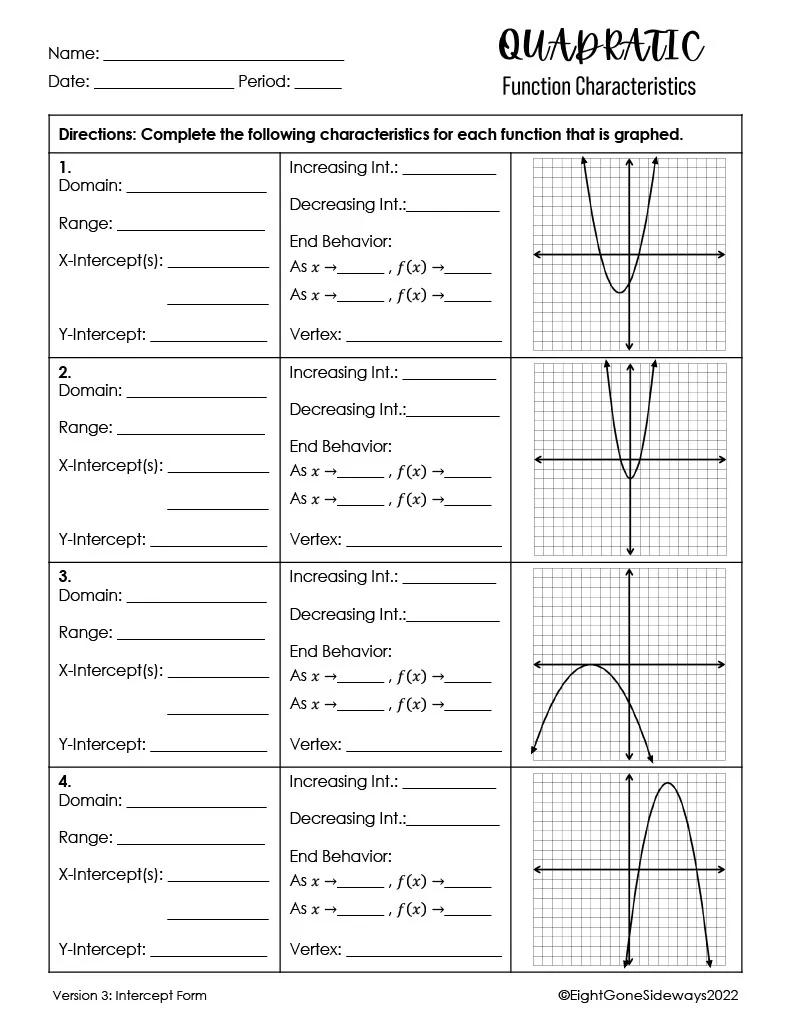
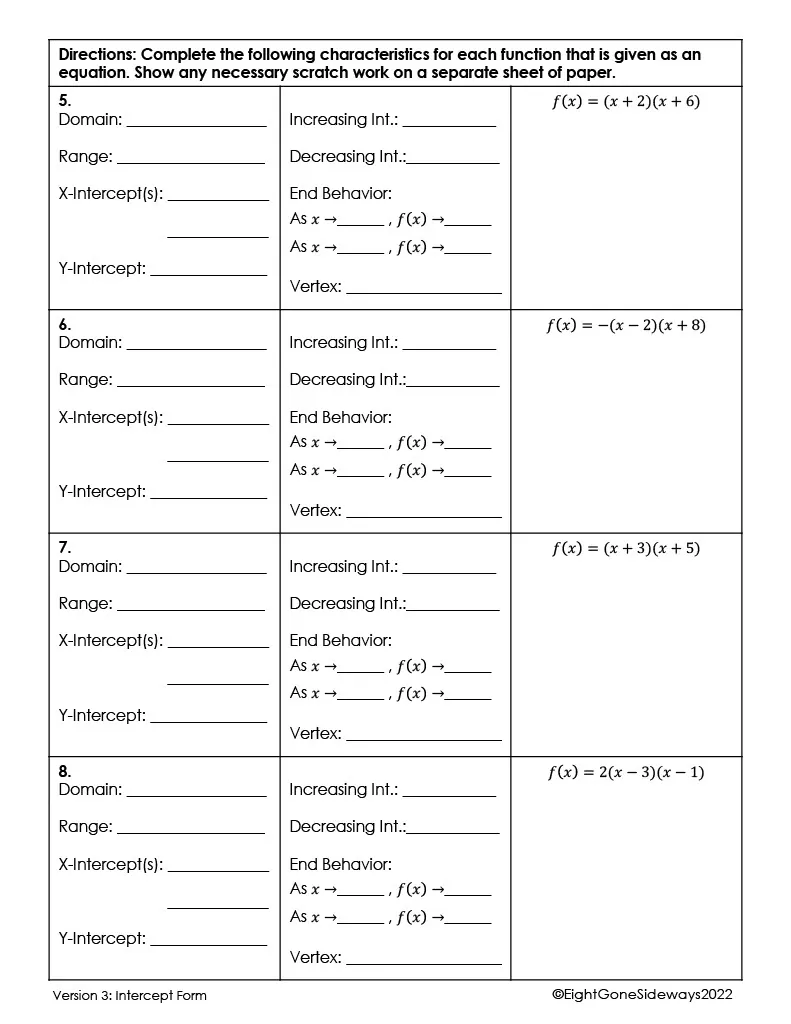
The two pages are a deliberate pair: page 1 reads characteristics off a picture, page 2 derives the same nine from symbols, so setting page 1 first gives students the vocabulary before the algebra
Problem 6, f(x) = −(x − 2)(x + 8), is the only one with a negative leading coefficient, which flips the range, the end behaviour and the order of the increasing and decreasing intervals — a good problem to work together
Answers are written in interval notation throughout, including square brackets on a closed endpoint such as [−4, ∞), so the convention is worth settling before the sheet is handed out. Compare the forms of a quadratic using a vertex form worksheet alongside this practice.

Skills covered
Reading a parabola's features from its graph — the first four problems ask for domain, range, both intercepts and the vertex from a picture alone.
Working from intercept form — the factored equations give the x-intercepts directly, as in f(x) = 2(x − 3)(x − 1) crossing at (1, 0) and (3, 0).
Locating a vertex by symmetry — the turning point sits midway between the two roots, so f(x) = (x + 2)(x + 6) has its vertex at x = −4 and value −4.
Good to know
Questions teachers ask about this resource
How do the two student pages differ?
By what students start from. The first gives four parabolas as graphs and asks for the nine characteristics to be read off; the second gives four equations already in factored intercept form and asks for the same nine to be derived, with scratch work on a separate sheet.
Which notation do the answers use?
Interval notation for domains, ranges and intervals of increase or decrease, and ordered pairs for intercepts and vertices. The marking pages show Domain (−∞, ∞), Range [−4, ∞) with a square bracket at the closed endpoint, Increasing Int. (−1, ∞) and Vertex (−1, −4).
What does "Version 3: Intercept Form" in the footer mean?
That this sheet is one form of a repeated layout. The same nine-characteristic template is numbered as a version and labelled by the algebraic form it uses, so a class can meet the identical task written for a different quadratic form without learning a new page.

No reviews yet
Downloaded this resource? Tell other teachers how it went.
Resource details
Concepts & topics
Core concepts
 Core concepts
Quadratic functions
Intercept form
Domain and range
End behavior
Interval notation
 Topics
Explore more
Categories this resource belongs to
Explore related searches
More to explore
You may also like