Quadratic Functions Vertex Form – Notes & Homework
- Grades
- Grades 8–12, Middle School, High School
- Pages
- 6
- File type
- Answer key
- Included


- Subject
- Math, Algebra
- Topic
- Graphing, Math homework
- Resource types
- Worksheets, Worksheets & Printables
- Answer key
- Included
- Standards
- HSF-IF.C.7
Product description
From the author
Quadratic Functions: Vertex Form Guided Notes + Homework Set
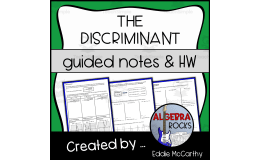
This teaching resource helps students further their understanding of quadratic functions in vertex form. The informative guided notes allow learners to actively acquire knowledge on this algebra skill as they walk through examples and questions that promote comprehension. Educators can utilize the accompanying homework assignment in various ways such as individual practice, a small group activity, or a whole class lesson to assess and extend student learning. With an answer key included, this concise and grade-appropriate resource supports teachers in effectively explaining a key component of graphing quadratic functions. The guided notes and homework provide an engaging way for grade 7-10 math students to grasp the concept of vertex form.
Related resources
More resources teachers may find useful
24 related resources were found using this product's title, contributor, categories and tags.


In the classroom
Teaching tips & learning objectives

Learning objectives
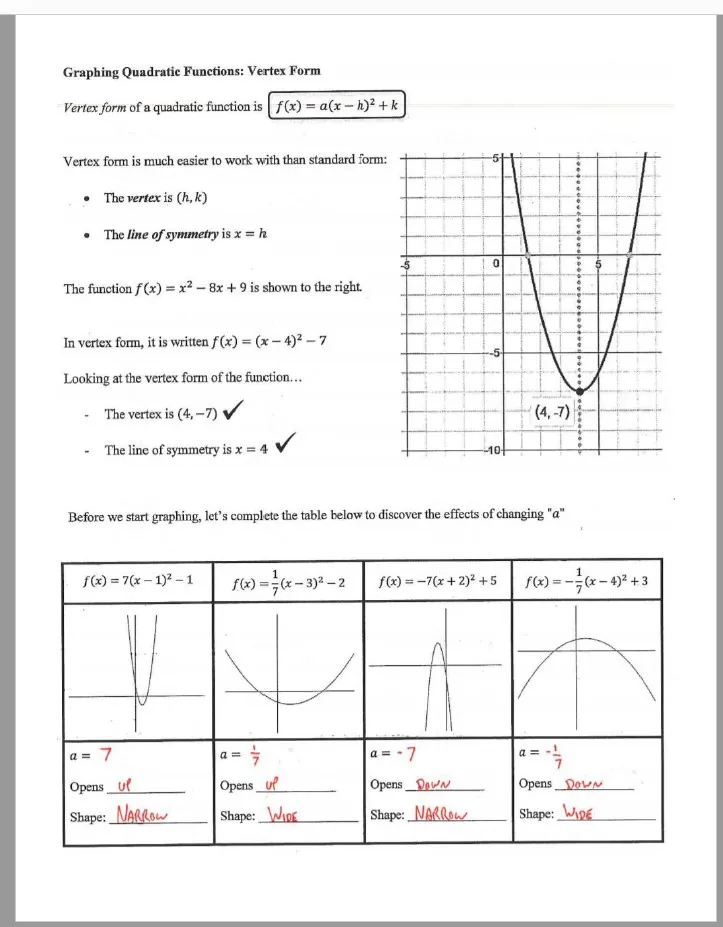
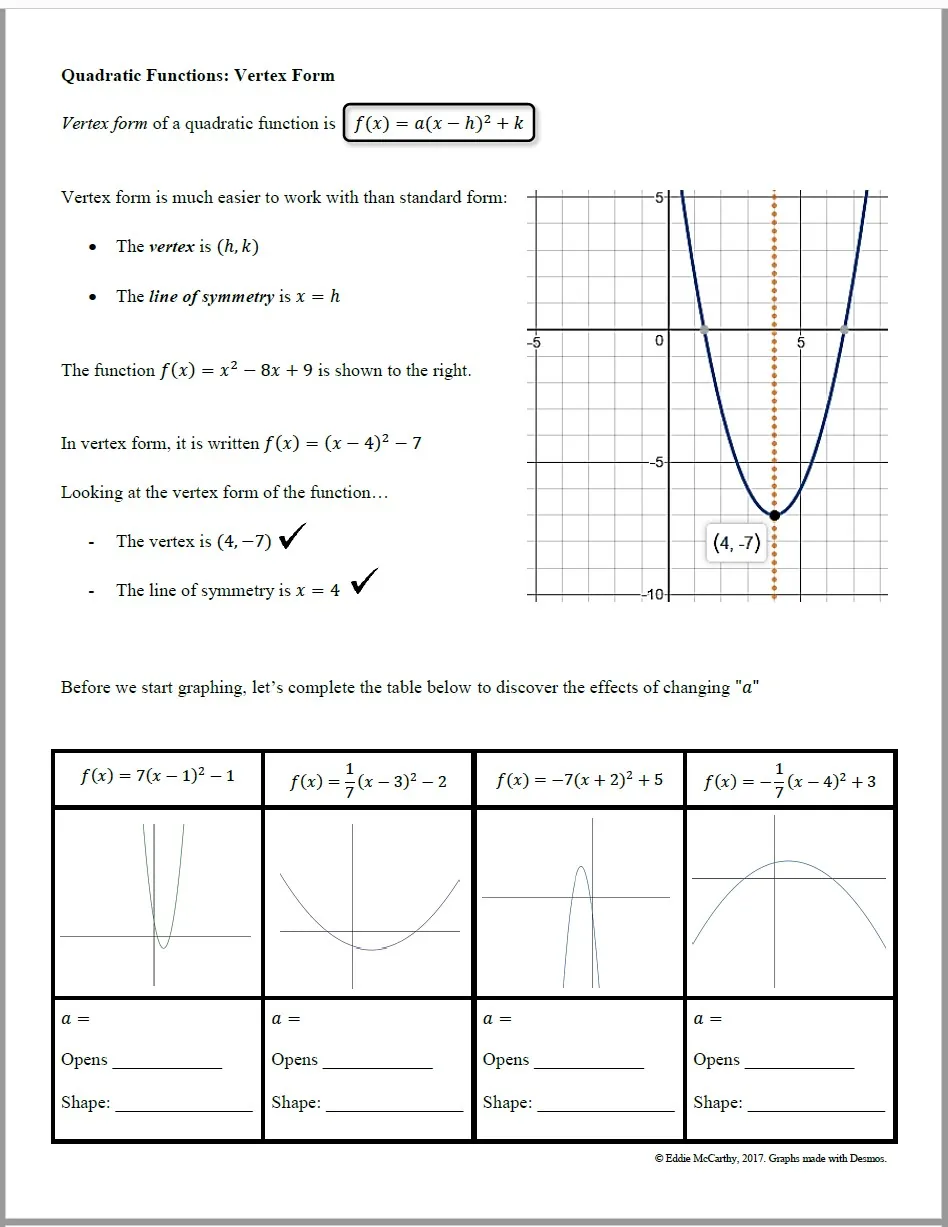
Identify the vertex and line of symmetry of a quadratic function written in vertex form.
Determine whether a quadratic function has a maximum or minimum value from its vertex form.
Compare the standard-form and vertex-form expressions shown for one quadratic function.

Teaching tips
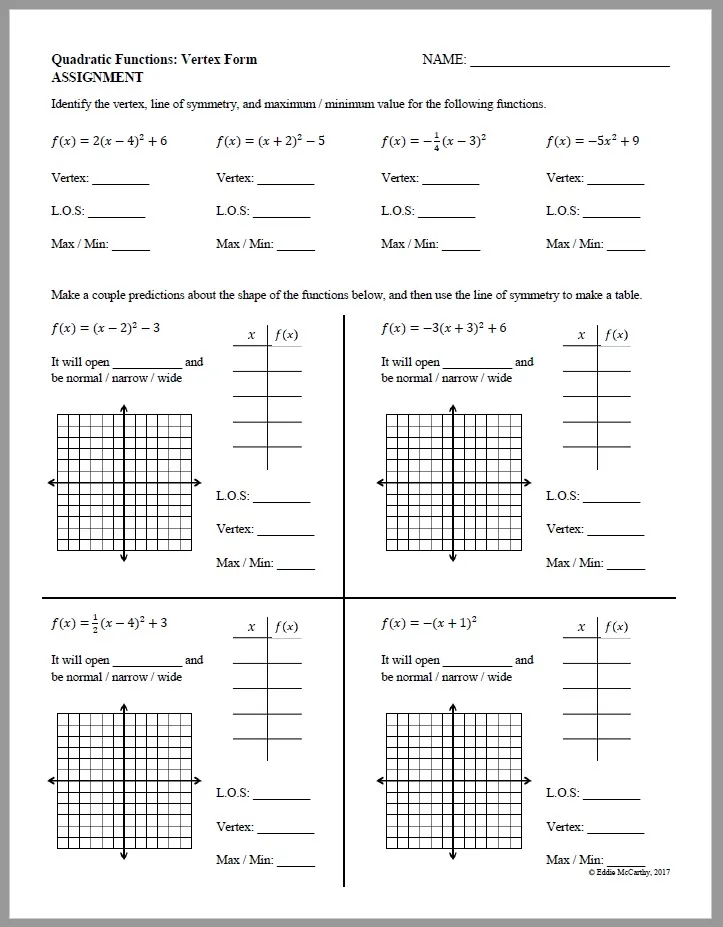
Work through the guided notes as a class before assigning the homework, since the homework repeats the same four question types (vertex, line of symmetry, max/min, and graph prediction) with new functions.
Have students complete the a-value table on the first guided-notes page before graphing, so they connect the sign and size of a to the parabola's direction and width ahead of sketching.
Model using symmetry to build a value table before students work through the four function-prediction tasks in the assignment.

Skills covered
Vertex identification — students read the vertex (h, k) directly from functions written in vertex form such as f(x) = 2(x - 4)^2 + 6.
Line-of-symmetry and extrema reasoning — students state the line of symmetry x = h and classify each vertex as a maximum or minimum.
Graphing from vertex form — students sketch parabolas by first predicting shape and direction, then building a table of values around the line of symmetry.
Good to know
Questions teachers ask about this resource
Do the guided notes and the homework use the same functions?
No, the two documents use different functions throughout, so the homework gives students fresh practice rather than repeating the worked examples from the notes.

No reviews yet
Downloaded this resource? Tell other teachers how it went.
Curriculum
Standards, concepts & topics
Standards
 Standards
- HSF-IF.C.7
Core concepts
 Core concepts
Vertex form
Line of symmetry
Maximum and minimum values
Parabola shape and direction
 Topics
Explore more
Categories this resource belongs to
Explore related searches
More to explore
You may also like