8 Tips to Help Students Build Better Reading Skills - Visual Mind Map
- Grades
- Not Grade Specific
- File type
- Multiple File Types


- Subject
- Special Resources, Life Studies, Social Emotional Learning (SEL), Special Education Needs (SEN), Life Skills, Coaching, Business, Career, Creative Arts, Art
- Topic
- reading skills, teaching resource
- Resource types
- Diagrams, Teacher Tools
About this resource
What's inside this resource
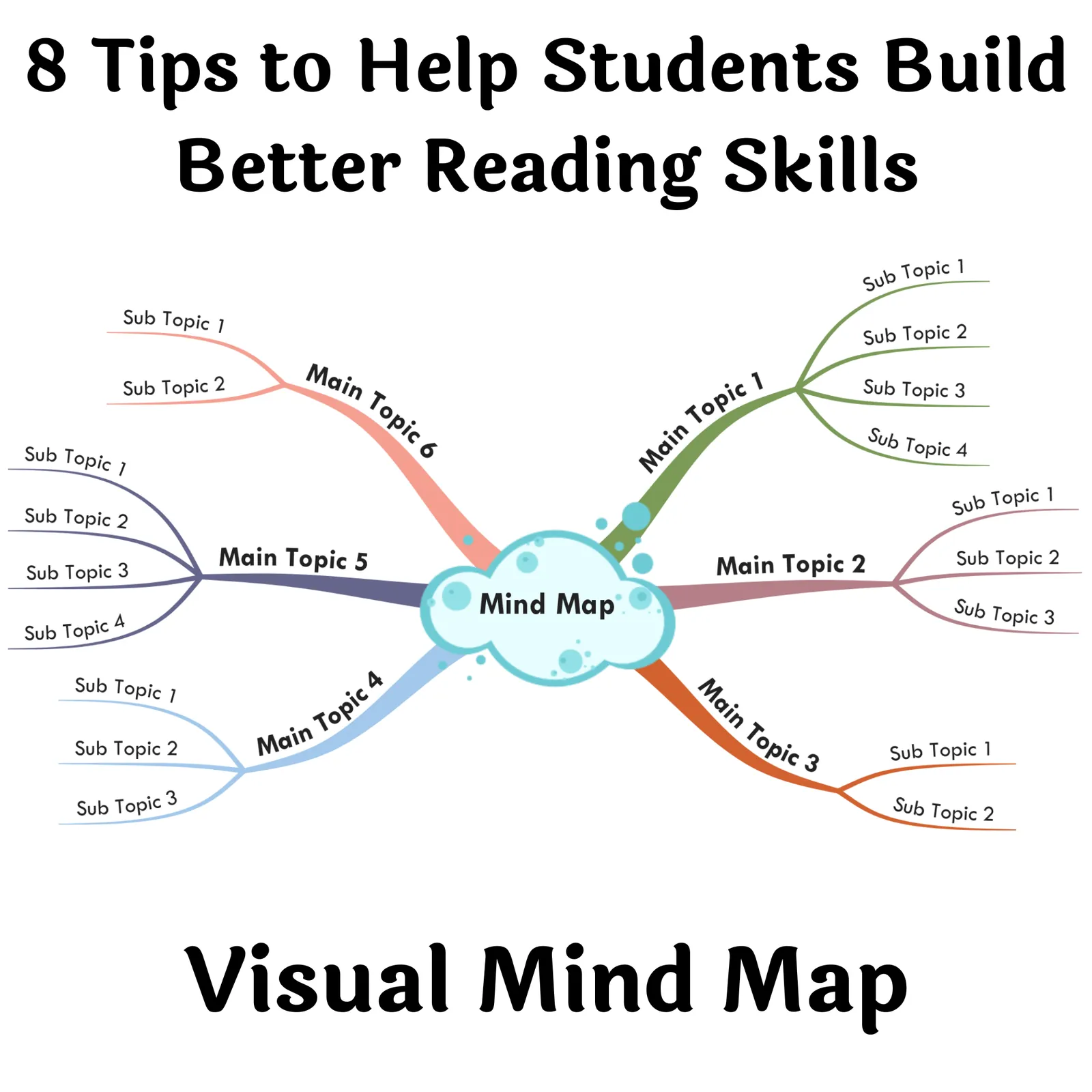
Visual Mind Map, a teaching resource suitable for educators and homeschool parents, is designed to enhance students' reading skills. The primary focus is on making reading enjoyable which facilitates comprehension and engagement with the curriculum.
The tool offers eight key suggestions combining activities like reading aloud, note-taking, and dictionary usage, thereby promoting deeper understanding. It encourages students to read varied materials such as newspapers, fiction/non-fiction books, and magazines– leading them to exposure of a broad range of vocabulary and ideas.
Key components of this visual mind map:
- The layout design mirrors the brain's flow by encapsulating information via short phrases, keywords, icons or images.
- The structure supports rapid jotting down of ideas due to its intuitive layout.
Benefits of Mind Maps:
Mind maps allow teachers or mentors to visually present subjects irrespective of their complexity; they convert chaotic concepts into an understandable format highlighting relationships between different concepts in a way that helps readers comprehend the 'bigger picture'. Notably known for fostering creativity because they utilize images in conjunction with keywords allowing one's brain make new associations swiftly.
This method is suitable across all grade levels; universally applicable- Social Emotional Learning (SEL), Special Education Needs (SEN), Life Skills Coaching etc., where it’s proven usefulness ranges from aiding exam preparation for students to assisting adults like entrepreneurs in visualizing business plans etc., thus supporting creative problem solving anytime anywhere!
A comprehensive package includes:
- A downloadable files system providing benefits along two versions
- Classic Mind Map
- Right Aligned Mind Map
The mind maps are optimized for viewing on any web browser—Google Chrome / Mozilla Firefox / Safari / Opera etc. It is recommended to view on a desktop/laptop, zooming onto specific branches for the best view.
Related resources
More resources teachers may find useful
24 related resources were found using this product's title, contributor, categories and tags.

In the classroom
Teaching tips & learning objectives

Teaching tips
Introduce one branch at a time (e.g. 'Set reading goals' one week, 'Read in portions' the next) rather than presenting all eight strategies at once.
Pair branch 4 (incorporate more senses) with an actual read-aloud session, since the map specifically suggests students take turns reading out loud and annotating with a pen or pencil.
Use branch 6 (set reading goals) at the start of a unit and branch 5 (understand common themes) at the end, since the map's own ordering moves from individual goal-setting toward thematic analysis.

Skills covered
Text annotation instruction — the 'Annotate and highlight text' branch gives a teacher a concrete routine (underline key information, write notes and questions in the margin) to model for students.
Differentiated reading pacing — the 'Read in portions' and 'Let students guide their reading' branches give a teacher two specific ways to break long or complex text into more manageable pieces.
Goal-setting instruction — the 'Set reading goals' branch outlines how a teacher can have each student set an individual, trackable reading goal.
Good to know
Questions teachers ask about this resource
How are the two included mind map layouts different from each other?
One arranges the eight strategy branches from a centered starting point ('Classic'); the other reads outward from a right-aligned starting point. Both cover the identical eight strategies and elaboration points.

No reviews yet
Downloaded this resource? Tell other teachers how it went.
Resource details
Concepts & topics
Core concepts
 Core concepts
reading comprehension strategy
mind mapping
differentiated reading instruction
 Topics
Explore more
Categories this resource belongs to
Explore related searches
More to explore
You may also like