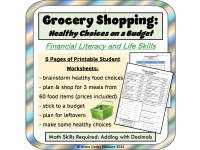
Grocery Shopping on a Budget – Financial Literacy

- Grades
- Grades 4–6
- Pages
- 7
- File type
- Answer key
- Included


- Subject
- Math, Life Skills
- Topic
- Grocery budget, Decimal addition
- Resource types
- Worksheets
- Answer key
- Included
- Standards
- 5.NBT.B.7
Product description
From the author
Healthy eating and budgeting are key life skills that need to be taught to our middle school students in grades 5-8. Here's a fun, interactive lesson that can do just that!
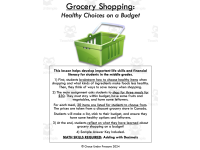
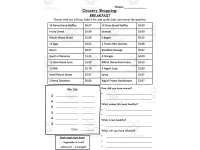
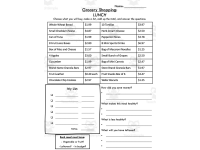
Students are tasked with creating a personalized meal plan using a $30 budget for the day. They are given 20 food options for each of three meals (breakfast, lunch, and dinner) with the prices provided (based on a Canadian discount food store). They plan which items they will buy for each meal while following some healthy and budget-friendly rules:
each meal must include a vegetable or fruit
each meal must make some leftovers to be eaten another day
all three meals must not exceed the $30 budget
Students can approach this task in different ways. They might decide to use $10 for each meal, or plan two cheaper meals to be able to have one that is more expensive. They might have to change their plan as they go, put back a sweet treat they don't really need, or switch to a cheaper option to stay in budget. These are all helpful, real-life math and life skills!
What's Included:
Teacher Handout with instructions on how to use the lesson.
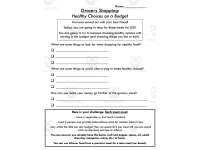
Student Handout to brainstorm ideas for healthy shopping and staying on budget.
3 Pages of Worksheets: Breakfast, Lunch, and Dinner: Each with 20 food options, a shopping list, place to add up the total cost of the meal, and some reflection questions.
Final Budget Page: Students add up the cost of all three meals and write a paragraph to reflect on the shopping for healthy choices on a budget process.
Grades to Use With:
This lesson is perfect for students in grades 5-8 who are learning decimal operations and starting to learn about life skills. It could also be used in a high school special education classroom if the students are able to complete decimal operations (calculators can be used).
Related resources
More resources teachers may find useful
24 related resources were found using this product's title, contributor, categories and tags.


In the classroom
Teaching tips & learning objectives

Learning objectives
Build three meals from priced lists while keeping the combined cost inside a $30 budget
Add decimal prices accurately to reach a meal total and then a day total
Check each meal against three set conditions - a vegetable or fruit, leftovers, and the budget

Teaching tips
Run the brainstorm page before the meal pages - the sample responses treat it as the source of the criteria students then use to judge their own choices
Prices come from a discount grocery store in Canada, so a short conversation about how local prices compare is worth having before students start choosing
The worked sample lands at $29.67 across three meals, close enough to the limit to be worth showing after students have attempted it themselves rather than before

Skills covered
Adding decimals in context - students total the prices they choose for each meal and then add the three meal totals on the summary table; the overview names adding with decimals as the maths skill required.
Budgeting to a constraint - a $30 limit for three meals, which may be split evenly at $10 each or spent unevenly, forces trade-offs across the twenty options on each page.
Reflecting on decisions - the closing page asks what was learned about healthy eating, shopping on a budget and using leftovers, and what was fun or challenging about planning the meals.
Good to know
Questions teachers ask about this resource
Where do the prices come from?
The source names a Canadian discount grocery store. Use the printed figures as classroom examples, not current store prices. The items themselves travel well - store brand against name brand, a large bag of rice against an instant pouch - but a class elsewhere will be working with prices that differ from their own shops.
What has to be true of every meal a student builds?
Three things, printed on each meal page: a vegetable or fruit, enough to feed two people with some left over for another meal or day, and a total that keeps the whole day inside $30. The budget may be split evenly at $10 a meal or spent unevenly across the three.

No reviews yet
Downloaded this resource? Tell other teachers how it went.
Curriculum
Standards, concepts & topics
Standards
 Standards
- 5.NBT.B.7 — Add, subtract, multiply, and divide decimals to hundredths, using concrete models or drawings and strategies based on place value, properties of operations, and/or the relationship between addition and subtraction; relate the strategy to a written method and explain the reasoning used.
Core concepts
 Core concepts
Budgeting
Adding decimals
Healthy eating
Meal planning
Financial literacy
 Topics
Explore related searches
More to explore
You may also like