IB PYP - HOW WE ORGANIZE OURSELVES - COMMUNITIES -PLANNER & RESOURCES
- Grades
- Grades 1–6, Elementary, Middle School
- File type
- Preparation
- Print ready


- Topic
- International Baccalaureate, Unit Plans
- Resource types
- Teacher Tools, Lesson Plans
- Preparation
- Print ready
About this resource
What's inside this resource
Related resources
More resources teachers may find useful
9 related resources were found using this product's title, contributor, categories and tags.
In the classroom
Teaching tips & learning objectives

Learning objectives
State class rules and norms needed for a group to function, and follow shared essential agreements
Compare one's roles and responsibilities as a student and as a family member
Distinguish actions a good citizen does and does not take, and express the distinction in writing

Teaching tips
Run the organization role play as the unit provocation — the listed settings (police station, salon, hospital, bank, fire station, mall, club) let every group take a different community organization
Let students derive the central idea themselves through the mind-map brainstorm on responsibility, harmony, and community before revealing the planner's wording
Prepare picture cards in advance for the good-citizen sort and the rights-and-responsibilities match — the instructions assume sortable pictures

Skills covered
Inquiry and discussion — students brainstorm, mind-map, and build the unit's central idea as a class.
Role play and presentation — groups pretend to run a community organization, assign internal roles, and present to peers.
Categorizing and reasoning — picture sorts separate good-citizen actions from poor ones, and rights are matched to responsibilities.
Good to know
Questions teachers ask about this resource
How does the unit build toward student action?
It moves from play and reflection (running a pretend organization, examining a disorganized classroom) through personal responsibility work (agreements, T-charts, citizen sorts, posters) into research (family and school interviews about rules), ending with groups identifying a real civic issue, weighing solutions on a graphic organizer, and acting on one.
How is learning assessed in this unit?
Through anecdotal records — the planner specifies anecdotal-type notes with photos rather than a quiz or test, which fits the discussion- and project-based activities.
Which IB PYP elements are spelled out for the planner?
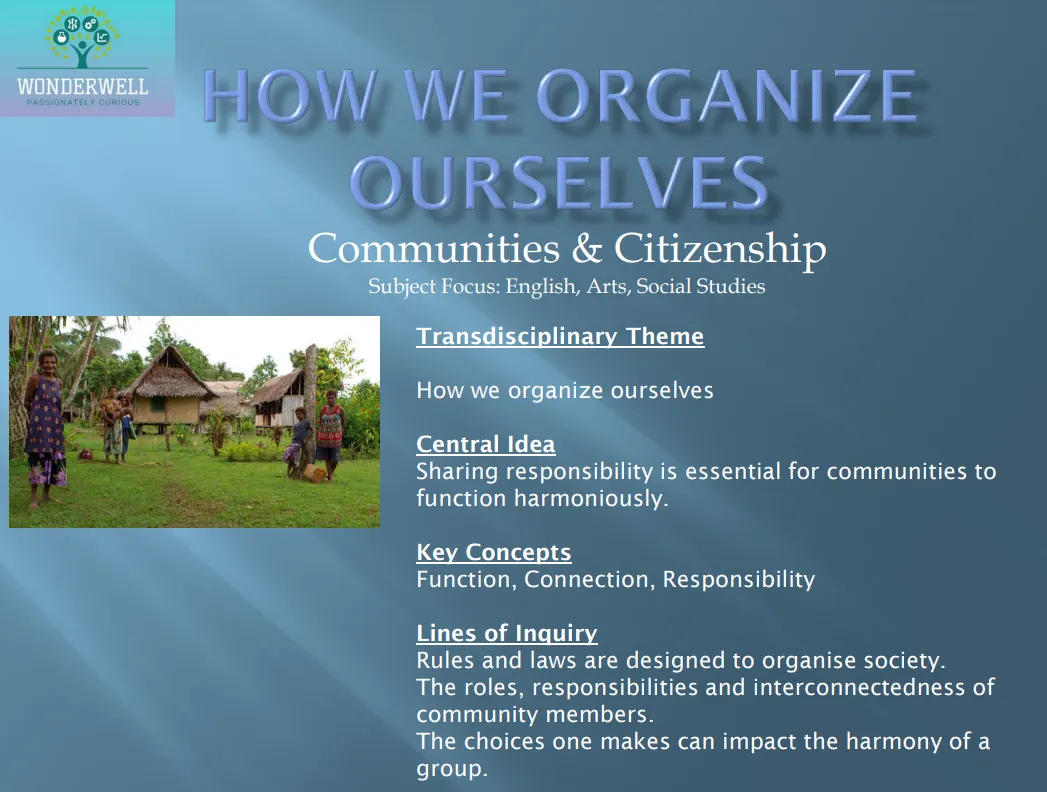
The transdisciplinary theme (How We Organize Ourselves), a central idea on shared responsibility, the key concepts function, connection, and responsibility, three lines of inquiry covering rules and laws, community roles, and personal choices, and a set of Approaches to Learning spanning communication, listening, consensus-building, and cooperative play.

No reviews yet
Downloaded this resource? Tell other teachers how it went.
Resource details
Concepts & topics
Core concepts
 Core concepts
Communities
Responsibility
Citizenship
IB PYP inquiry
Rules and norms
 Topics
Explore more
Categories this resource belongs to
Explore related searches
More to explore
You may also like