Multiplication and Division on a Number Line Task Cards


- Grades
- Grades 3–4
- Pages
- 16
- File type
- Answer key
- Included


- Subject
- Math, Multiplication and Division
- Topic
- Number lines, Multiplication facts
- Resource types
- Task Cards
- Answer key
- Included
Product description
From the author
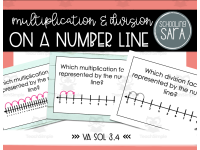
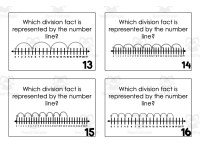
One of the ares students struggle with the most with multiplication is multiplication on a number line. There are 20 task cards in this product, 10 on multiplication and 10 on division. They come in a full color version and printer-friendly black and white version. There is also a student answer sheet and an answer key.
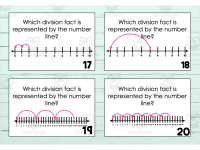
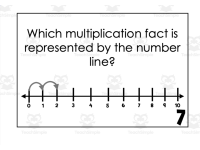
In this product, we follow the idea that a number line is how many jumps x how far each = landing spot. So three large jumps of 5 spaces each is 3x5=15. The way to tell the difference between the multiplication cards and the division cards is the direction of the number line. Pointing to the right is multiplication, pointing to the left is division.
Included is also a link to a digital version for presenting these whole group on a screen/projector, or for paperless or virtual classrooms.
These task cards cover the Virginia Math SOL 3.4 The student will a) represent multiplication and division through 10 × 10, using a variety of approaches and models;
The will also cover the 2023 Virginia Math SOL 3.CE.2 The student will recall with automaticity multiplication and division facts through 10 × 10; and represent, solve, and justify solutions to single-step contextual problems using multiplication and division with whole numbers. a)Represent multiplication and division of whole numbers through 10 × 10, including in a contextual situation, using a variety of approaches and models (e.g., repeated addition/subtraction, equal-sized groups/sharing, arrays, equal jumps on a number line, using multiples to skip count).
Need more multiplication or computation notes? Check these out:
Solving Word Problems (VA SOL 3.3)
Multiplication and Division (VA SOL 3.4)
Need more low-prep or no-prep math activities? Check these out:
No Prep Spiral Math Daily Review and Quizzes
Area and Perimeter Digital Activity
Related resources
More resources teachers may find useful
24 related resources were found using this product's title, contributor, categories and tags.


In the classroom
Teaching tips & learning objectives

Learning objectives
Read equal jumps on a number line as a multiplication fact, counting how many jumps and how far each one travels
Connect a multiplication fact to its matching division fact, recognising 3 × 6 = 18 and 18 ÷ 3 = 6 as the same picture
Record twenty answers in order on a numbered sheet while moving between cards

Teaching tips
Run the twenty cards as a scoot: the recording sheet is numbered 1 to 20, so students only need the card number to know which box to fill in.
Pair card 1 with card 11, card 4 with card 14 and so on for a fact-family discussion; each division card reuses the numbers of the multiplication card ten places earlier.
Point out that the number lines are not all the same length — some stop at 10, others run to 21, 22 or 29 — so students must read the scale before counting jumps.

Skills covered
Number-line models of multiplication — students count equal jumps and jump size to name facts such as 5 × 4 = 20 and 9 × 2 = 18.
Number-line models of division — the same jump pattern read as equal-jump division gives 20 ÷ 4 = 5 and 18 ÷ 9 = 2 on the second half of the deck.
Inverse-operation reasoning — every division card restates a multiplication card from earlier in the deck, so students meet both directions of the same fact.
Good to know
Questions teachers ask about this resource
How do the multiplication and division cards relate?
The second ten cards revisit the facts from the first ten as division relationships, allowing paired multiplication-and-division practice.
Are all twenty number lines the same length?
No. Number-line scales vary by fact, so students need to check each scale before counting jumps.

No reviews yet
Downloaded this resource? Tell other teachers how it went.
Curriculum
Standards, concepts & topics
Standards
 Standards
- 3.OA.A.1
- 3.OA.A.2
Core concepts
 Core concepts
Multiplication on a number line
Division on a number line
Inverse operations
Fact families
 Topics
Explore more
Categories this resource belongs to
Explore related searches
More to explore
You may also like