


Search results for Analysis
Results use exact search terms from the released United Kingdom inventory.


Animal Farm Ch 9: Eulogy for Boxer's funeral Creative Writing + rubric Google
, Not Grade Specific,
After reading Chapter 9 of Animal Farm, students write a eulogy for Boxer as a short narrative paragraph or a poem, speaking from a farm animal's point of view or, for a greater challenge, one of the pigs. The assignment requires a personal story establishing the writer's relationship to Boxer, his noteworthy traits and values, at least two annotated literary devices, and one integrated quotation from the text. Two model eulogies built on other well-known texts — Shirley Jackson's 'The Lottery' and Poe's 'The Cask of Amontillado' — demonstrate the narrative and poetic formats before students draft their own. A five-criteria rubric scores voice/point of view, personal story and traits, opening and closing statements, literary-device use, and quotation integration.
Author The Red-Haired Reader
Rating
Tags Eulogy, Writing, Creative, Character, Analysis, Synthesis, Assignment

Animal Farm Post-Reading Creative Writing Assignment: What Would Old Major say?
, Not Grade Specific,
George Orwell's Old Major returns from the dead to react to the other animals' chapter-10 outcome in this creative writing assignment, letting students choose a letter, song, podcast, journal entry, or poem.
Author The Red-Haired Reader
Rating
Tags Creative Writing, Character Analysis

Capitalism vs Communism – Reading + Video Analysis
, Not Grade Specific,
A ten-item agree/disagree survey, two paired readings, a five-row comparison chart, and a video-linked reflection question walk students through capitalism and communism side by side.
Author EduPal Learning
Rating
Tags Capitalism, Communism, World History, Activities, Economics, Social Studies
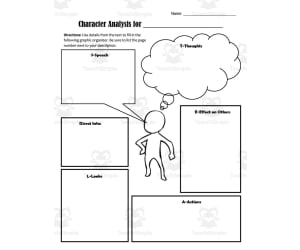
Character Analysis Graphic Organisers – STEAL Method
, Not Grade Specific,
Students fill in a STEAL organiser — speech, thoughts, effect on others, actions and looks — then build an evidence-based character sketch on a second worksheet.
Author Time Thrifty Teacher
Rating
Tags Character, Analysis, Graphic Organizers, Character Traits

Character Analysis Worksheet
, Not Grade Specific,
Help students understand a story character through their thoughts, feelings and actions.
Author CraftEdPrints
Rating
Tags Character Analysis, Character Traits, Reading Response, Graphic Organizer

DIBELS (8th edition) Class Analysis & Auto composite (All Year Groups)
, Not Grade Specific,
Save time by instantly calculating the composite scores for a classroom. Subtest scores are colour-coded and sortable, and aligned with DIBELS risk categories: Blue = Negligible risk (core support) Green = Minimal risk (core support) Yellow = Some risk (strategic support) Red = At risk (intensive support) Filter all of your class results by teacher, subtest, or category (Sp. Ed, ELL, etc.) and see colour coded performance indicators for your entire class. This resource will save you a lot of busy-work by automatically finding the composite for each student, and will help with grouping and instructional decisions. For example, does most of your entire class have low fluency scores but high foundational reading scores (Letter naming, phonemic segmentation, nonsense words, etc.)? That would suggest that a class-wide intervention such as repeated reading or sentence repetition might be beneficial. Does the analysis section show that the class is struggling with phonemic segmentation? That would suggest easy bell-ringer activities like the Michael Heggarty books or rhyming, initial / middle / final sound identification, or even phonological awareness skills like compound word segmentation or phonemic segmentation. The colour coding feature will help with instructional groupings because you can quickly see which students struggle with which foundational reading skill. It also helps indicate what level of support is needed. If less than half of the class is proficient, is suggests classwide interventions should be a priority. Otherwise, maybe Tier 2 or Tier 3 interventions are a better use of your time depending on the severity of the assessment difficulty and how many instructional resources your have at your disposal. You don't need to waste your valuable time by looking up norms tables or calculating composite scores by hand, because this tool will automatically do all of that for you. Instant calculations, colour coding, sorting, and filtering will make your screening data much easier to work with.
Author Helix Forms LLC
Rating
Tags DIBELS, Spreadsheets, Time Saving, Literacy, Phonics, Early Literacy, Automated

Dimensional Analysis Worksheet - 20 Conversion Problems
, Not Grade Specific,
Twenty real-world word problems require converting between units of time, distance, volume, mass, and money using dimensional analysis, with a fully worked answer key.
Author Schrim's Chem
Rating
Tags Dimensional Anaylsis, Conversions, Mass, Time, Volume, Practice Unit Conversions, Analysis, Chemistry, Questions, Word Problems, Word, Answers, Chemistry Practice, Real World Math

ESL Movie Guide Worksheets on "Jurassic Park"
, Not Grade Specific,
A post-viewing guide for 'Jurassic Park' has students log film details, new vocabulary, ten character profiles, a movie timeline, a review, and a three-day diary from a character's point of view.
Author Learning with Alan
Rating
Tags ESL, English Second Language, English, Movie Guides, Films, Worksheets, Printable, Writing Activity, Dinosaurs, Narrative Writing, Character Analysis
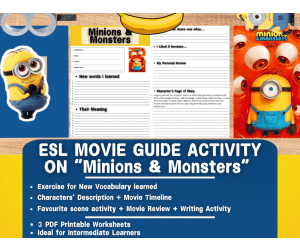
ESL Movie Guide Worksheets on "Minions & Monsters"
, Not Grade Specific,
A film-viewing worksheet has students log new vocabulary, describe eight named characters, and write a personal review plus a three-day character diary.
Author Learning with Alan
Rating
Tags ESL, English Second Language, English, Movie Guide, Films, Monsters, Character Analysis, Creative Writing, Vocabulary Building

For Substitutes: Dickinson's Poem
, Not Grade Specific,
Cover-lesson poetry worksheet on Emily Dickinson's 'The Bustle in a House': students name the poet, define five words from the poem and explain its meaning in writing, with an optional drawing.
Author The Education Lab
Rating
Tags Poetry Analysis, Language Skills, Vocabulary Building, Emily Dickinson, Substitute Lesson
Foreshadowing
, Not Grade Specific,
Foreshadowing chart for any book students are reading: for each entry they record a major event, the clue that hinted it was coming and the page number.
Author The Teacher Team
Rating
Tags Foreshadowing, Literary Analysis, Centers, ELA Stations, ELL, Foreshadowing In Spanish

French Revolution Political Cartoon – 3 Estates
, Not Grade Specific,
Students interpret a political cartoon about France’s Three Estates and explain its message in full sentences. Editable student pages and teacher models support four written responses.
Author DrDrew
Rating
Tags Social Studies, Government, World History

GCSE Literature: An Inspector Calls | Act 1 - Mr. Birling and the Inspector Analysis Worksheet
, Not Grade Specific,
Mr Birling's speeches and the Inspector's arrival in Act 1 are the focus of this three-page An Inspector Calls worksheet, which moves from note-making on Birling's views to quotation tables and analytical paragraphs.
Author Flynn's Educational
Rating
Tags English Worksheet, Characters, Play, Literature, Character Analysis
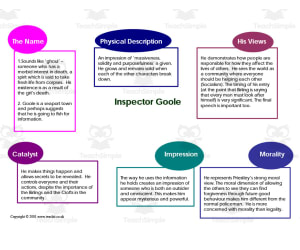
An Inspector Calls – Inspector Goole Analysis Map
, Not Grade Specific,
Inspector Goole Analysis Map organises six dimensions of the character around one central title. Notes connect his physical solidity and controlled speech with the effect he has on the Birlings, then trace responsibility, community, socialism, revelation, audience judgement, and the play's moral warning. The layout is a completed reference map, not a question sheet, so learners can compare how Priestley combines description, action, theme, and dramatic function.
Author Flynn's Educational
Rating
Tags Character, Character Analysis, Literature Handout, Chart, Graphic Organizer, Character Map Literature, An Inspector Calls Characters, Inspector Calls Characters

GCSE Literature: An Inspector Calls | Character Analysis Worksheet
, Not Grade Specific,
Character and ideology tasks for An Inspector Calls: students choose their top three interpretations of the Inspector with evidence, assign an ideology to each character and sort characters by class and politics.
Author Flynn's Educational
Rating
Tags English Worksheet, Literature Worksheet, Characters, Graphic Organizers, Character Analysis, Literature Analysis Worksheet

GCSE Literature: An Inspector Calls | Mr. Birling Worksheet
, Not Grade Specific,
Quotation analysis drives this two-column An Inspector Calls worksheet: across two pages, students take printed lines spoken by Mr Birling and explain who he is addressing and what each line reveals about him.
Author Flynn's Educational
Rating
Tags Character, Analysis, Worksheet, Literature, Quotations

Half-Past Two Poem Lesson - U A Fanthorpe
, Not Grade Specific,
U.A. Fanthorpe's poem "Half-Past Two" is analysed stanza by stanza in a GCSE English literature lesson covering context, key devices, and a PETAL paragraph-writing task.
Author Flynn's Educational
Rating
Tags GCSE Poetry, Half-Past Two, U A Fanthorpe, Poetry Analysis, Language Devices

GCSE Poetry Lesson: ‘Loves Dog’ by Jen Hadfield
, Not Grade Specific,
Jen Hadfield's 'Loves Dog' and its picture of the gifts and curses of a close relationship are unpacked in an editable 18-slide GCSE PowerPoint with a glossary of literary terms and a PETAL writing task.
Author Flynn's Educational
Rating
Tags GCSE Poetry, Loves Dog, Jen Hadfield, Romance, Poetic Analysis

Nettles Poem Lesson - Vernon Scannell
, Not Grade Specific,
An eighteen-slide GCSE poetry lesson on Vernon Scannell's 'Nettles' guides students through tone, language, and structure analysis into a PETAL paragraph-writing task.
Author Flynn's Educational
Rating
Tags GCSE Poetry, Nettles, Vernon Scannell, Parental Protection, Poetry Analysis
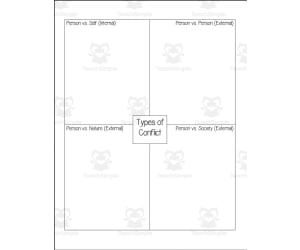
Graphic Organiser: Conflict
, Not Grade Specific,
Four types of literary conflict — Person vs. Self, Person vs. Person, Person vs. Nature, and Person vs. Society — are arranged in a labelled quadrant chart for students to complete.
Author Reading in the Middle Grade
Rating
Tags Graphic Organizer, Conflict, Types Of Conflict, Literature Analysis

How to Determine Theme – Student Handout
, Not Grade Specific,
The one-page visual breaks theme analysis into a staged process. It begins by asking readers to notice major topics, offers a broad bank of recurring literary ideas, and then directs attention to the text's main idea before developing theme. The compact format works as a reference during close reading, a presentation visual, or a scaffold beside a written response. It supports reasoning without supplying a theme for any specific text.
Author Gerald's Gem
Rating
Tags Language Arts, Literary Themes, Teaching Resource, Strategy Development, Literature Analysis

How to Eat A Poem | Poetry Analysis Guide
, Not Grade Specific,
Poetry analysis follows an ice cream cone metaphor: students read a poem aloud, mark punctuation and unfamiliar words, reread for flow, then underline literary devices and paraphrase the poem in chunks.
Author Time Thrifty Teacher
Rating
Tags Poetry, Analysis, Reading Poster, Graphics, Poems, Poem Study Guides, Analyzing Poetry Worksheet, Analyzing A Poem Worksheet

Introduction to Poetry | Vocabulary for Poetry Analysis Worksheet
, Not Grade Specific,
Analytical word banks and sentence stems help students discuss implied meaning and poetic technique, then apply them in eight tasks on Brian Patten's poem Remembering Snow.
Author Flynn's Educational
Rating
Tags Vocabulary, Poetry, Language Arts Worksheet, Poems, Adjectives, Poetry Analysis Worksheet, Poem Analysis Worksheet

KS4 Literature: (10) ‘The Tempest’ – The Epilogue
, Not Grade Specific,
Closing PowerPoint lesson in a Tempest series that centres on Prospero's epilogue, as students analyse the speech, discuss whether Prospero or Shakespeare is asking to be set free, and write a PETAL paragraph.
Author Flynn's Educational
Rating
Tags Shakespeare, Literature Analysis, Epilogue, Critical Thinking Skills, Vocabulary Development