



3,911 products added recently
Page 3 - Guided Reading Activity
Enhance your guided reading sessions with activities that support students at various reading levels. This collection provides structured resources, including question prompts, discussion guides, and comprehension exercises. By incorporating these guided reading activities into your lessons, you can facilitate deeper understanding and encourage critical thinking among your students.

 Show filters


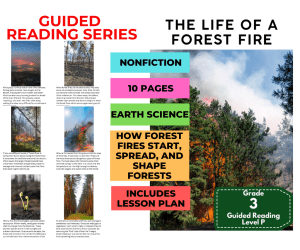
The Life of a Forest Fire: Guided Reading Level P with Lesson Plan
ELA, Resources for Teachers, Reading Comprehension, Reading, Science, Language Development, Life Sciences, Earth and Environmental Sciences, Physics, Technology, Grade 2, 3, 4, Worksheets & Printables, Worksheets, Teacher Tools, Centers, Activities, Literacy Readers, Quizzes, Quizzes and Tests, Assessments, Lesson Plans
This The Life of a Forest Fire (level p) guided reading book with lesson plan includes: Guided Reading Color Label (front cover x1) This is a quick way to match the book’s demands to what students can generally handle.. The overall goal is to use the level/color to pick books for several smaller groups. To qualify for a certain level, a student is expected to read a book from that level with about 90–94% accuracy. If a student is consistently accurate and understands, move up a level. If the student is struggling at that level, drop down and add more support. Each student will improve at completely different rates, but it is generally one of the best ways to check progress across the class. DOWNLOAD THE CATALOG TO VIEW ALL GUIDED READING BOOKS AVAILABLE (SORTED LEVELS A-Z) Pre-Reading Question (x1) Teacher asks the prompt aloud, can be while showing the cover or first page. Students share what they already know, or make educated guesses from the cover. Prompt them to use the target vocabulary. Write some of their responses on the board to look back at during the reading. Vocabulary Words (x5) Introduce the five words, best doing it one at a time. Start by saying it, while students repeat and then see if anyone knows what it means before reading further. Read through the meaning and try to briefly connect each word to a picture or gesture so it’s meaningful. Ask students to flip through the book pages and point to where they see each of the vocabulary words. While reading the book pause upon coming across one of the vocab words or read the sentence twice to make sure students understand the word has appeared. Optional: Ask students to raise hands whenever they see/hear one of the new words. Guided Reading Pages (x10) Check the book snapshot (below) for: primary topic - do you need to prep extra reading or intro materials on this? what is taught best - decide on 1-2 bullets to focus on, use the prompt or words provided here for best results. learning goals - what you are checking for students to be able to do after the session, elicit answers using prompts or words provided. key vocabulary (see section above). questions overview - so you know what is coming up and if you need to prep extra materials to assist understanding. Run the lesson You may have already looked at a few of the pages together, but you can show them some of the pictures again first to set meaning. Depending on how much time you have and how familiar your students are with guided reading class, you may want to read the book aloud first with the group first. Students whisper or partner read, while you listen in. If time, do it as a group, one student reading a page each. Use the guided page’s prompts to coach: “Check the picture / does it make sense?” “Point under the words / try the first sound” “Reread the sentence smoothly”. Try to focus more on one student per session (rotating every time), so you can work out if they are ready to move up or need to move down a level. Comprehension Questions (back cover x3) This is your way to check that students didn’t just say the words, but actually understood the text. First, let students answer by pointing to the page/picture and saying a short sentence. After any answer, follow with: “Show me where you found that in the text.” In bigger groups, have partners answer first (10–20 seconds), then call on 2–3 students to share. Differentiation tips: Emerging speakers/struggling readers: oral + pointing On-level: oral in a full sentence Higher: one written sentence or draw + label Book Snapshot Title: The Life of a Forest Fire Genre: Nonfiction (informational) Subject: Earth & Environmental Science Primary Topic: How forest fires start, spread, and shape forests Estimated Guided Reading Level (A–Z): P What This Book Teaches Best Explains common natural causes of forest fires , including how lightning can ignite dry wood and start a blaze. Teaches the Fire Triangle (heat, fuel, oxygen) and applies it to forest conditions like pine needles, branches, and grass as fuel. Compares types of forest fires (surface fires vs. crown fires) using clear, text-based differences in location, intensity, and damage. Shows how wind affects fire behavior , including carrying embers ahead of the fire and starting new fires through “spotting.” Describes fire’s ecological role and forest recovery , including nutrients returning to soil, new plant growth, and succession over time. Learning Goals Students can explain how a forest fire can begin in nature using details from the text (spark/lightning/heat on dry wood). Students can identify and describe the three parts of the Fire Triangle and explain why each is needed for a fire to keep burning. Students can compare a surface fire and a crown fire by describing where each burns and what the text says it can damage. Students can describe how wind changes a fire’s spread, including what “spotting” means in the text. Students can explain ways fire can help a forest over time (clearing debris, returning nutrients, creating open spaces for sunlight). Students can describe what happens after a fire during succession, using the sequence of changes described in the book. Key Vocabulary From the Text ecosystems — places where living things and land work together. ignite — to start burning. oxygen — a gas in air that fire needs. embers — small burning pieces carried ahead of a fire. succession — how a forest grows back after a fire. Discussion Prompts Pre-reading question: What are some natural ways a forest fire might start? Comprehension questions: What three elements does the text say a fire needs to exist? Comprehension questions: How does the text describe a surface fire as different from a crown fire? Comprehension questions: According to the text, what happens to the forest after a fire during succession? Printing Tips 1. Best Printing Method (Recommended) “Booklet” Printing (Best if Available) If your printer or PDF viewer supports Booklet Printing , use this. Settings to use: Print mode: Booklet Paper size: Letter or A4 (either works) Orientation: Landscape Print on both sides: Yes Flip on: Short edge Scaling: Fit to printable area Booklet subset: First test: Front sides only Then: Back sides only This will automatically: Pair pages correctly Put the cover on the outside Align everything for folding After printing, fold in half and staple along the spine . 2. If “Booklet” Printing Is NOT Available You can still print this correctly with manual duplex printing . Step-by-step: Open the PDF. Choose Print . Set: Orientation: Landscape Pages per sheet: 1 Print on both sides: Yes Flip on: Short edge Print all pages . Because each PDF page already contains two facing book pages, the result will still fold cleanly into a book. Thousands of Cored Education products are included with your TeachSimple membership. Download links and encyclopedia index available here.
Author Cored Education
Rating
Tags Reading Comprehension, Reading Passages, Reading, Guided Reading, Guided Reading Lesson Plan, Guided Reading Activity, Pre-reading, Science Lesson Plans, Earth Science, Physics
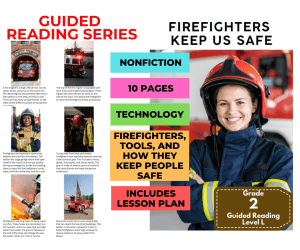
Guided Reading Level L - Firefighters Keep Us Safe (with Lesson Plan)
ELA, Resources for Teachers, Reading Comprehension, Reading, Pre-Reading, Language Development, Science, Engineering, Technology, Vocabulary, Grade 1, 2, 3, Worksheets & Printables, Worksheets, Teacher Tools, Centers, Activities, Literacy Readers, Quizzes, Quizzes and Tests, Assessments
This Guided Reading Book - Firefighters Keep Us Safe (Level L) with lesson plan includes: Guided Reading Color Label (front cover x1) This is a quick way to match the book’s demands to what students can generally handle.. The overall goal is to use the level/color to pick books for several smaller groups. To qualify for a certain level, a student is expected to read a book from that level with about 90–94% accuracy. If a student is consistently accurate and understands, move up a level. If the student is struggling at that level, drop down and add more support. Each student will improve at completely different rates, but it is generally one of the best ways to check progress across the class. DOWNLOAD THE CATALOG TO VIEW ALL GUIDED READING BOOKS AVAILABLE (SORTED LEVELS A-Z) Pre-Reading Question (x1) Teacher asks the prompt aloud, can be while showing the cover or first page. Students share what they already know, or make educated guesses from the cover. Prompt them to use the target vocabulary. Write some of their responses on the board to look back at during the reading. Vocabulary Words (x5) Introduce the five words, best doing it one at a time. Start by saying it, while students repeat and then see if anyone knows what it means before reading further. Read through the meaning and try to briefly connect each word to a picture or gesture so it’s meaningful. Ask students to flip through the book pages and point to where they see each of the vocabulary words. While reading the book pause upon coming across one of the vocab words or read the sentence twice to make sure students understand the word has appeared. Optional: Ask students to raise hands whenever they see/hear one of the new words. Guided Reading Pages (x10) Check the book snapshot (below) for: primary topic - do you need to prep extra reading or intro materials on this? what is taught best - decide on 1-2 bullets to focus on, use the prompt or words provided here for best results. learning goals - what you are checking for students to be able to do after the session, elicit answers using prompts or words provided. key vocabulary (see section above). questions overview - so you know what is coming up and if you need to prep extra materials to assist understanding. Run the lesson You may have already looked at a few of the pages together, but you can show them some of the pictures again first to set meaning. Depending on how much time you have and how familiar your students are with guided reading class, you may want to read the book aloud first with the group first. Students whisper or partner read, while you listen in. If time, do it as a group, one student reading a page each. Use the guided page’s prompts to coach: “Check the picture / does it make sense?” “Point under the words / try the first sound” “Reread the sentence smoothly”. Try to focus more on one student per session (rotating every time), so you can work out if they are ready to move up or need to move down a level. Comprehension Questions (back cover x3) This is your way to check that students didn’t just say the words, but actually understood the text. First, let students answer by pointing to the page/picture and saying a short sentence. After any answer, follow with: “Show me where you found that in the text.” In bigger groups, have partners answer first (10–20 seconds), then call on 2–3 students to share. Differentiation tips: Emerging speakers/struggling readers: oral + pointing On-level: oral in a full sentence Higher: one written sentence or draw + label Book Snapshot Title: Firefighters Keep Us Safe Genre: Nonfiction (informational) Subject: Social Studies (Community Helpers) / Health & Safety / Reading Primary Topic: Firefighters, tools, and how they keep people safe Estimated Guided Reading Level (A–Z): L What This Book Teaches Best How firefighters are community helpers who work at a fire station and respond to an emergency call. Why firefighters wear turnout gear and how it protects them from heat and smoke (layers resist flames and keep them cool). What a fire engine carries and how sirens and flashing lights help firefighters reach emergencies quickly (drivers move to the side). How key equipment works: hoses connect to a hydrant , nozzles change the water spray, and long ladders help with rescue and spraying from above. Firefighters’ jobs go beyond fires: they help in car accidents and medical emergencies , and training and dedication help keep the community safe. Learning Goals Students will explain how firefighters help keep a community safe using details from the text. Students will describe what turnout gear is and why firefighters wear it. Students will identify what a fire engine carries and how sirens and flashing lights help on the road. Students will describe how hoses, hydrants, and nozzles help firefighters spray water on a fire. Students will explain why firefighters use masks and air tanks in smoky buildings. Students will describe why firefighters train daily and how dedication connects to safety. Key Vocabulary From the Text community — people who live and work in the same place. emergency — a sudden problem that needs help right away. protective — made to help keep someone safe from harm. hydrant — a street pipe where firefighters can get water. dedication — working hard and not giving up. Discussion Prompts Pre-reading question: What do you think firefighters need to do their jobs safely? Comprehension questions: What is turnout gear, and how does it help firefighters around heat and smoke? What do the sirens and flashing lights on a fire engine tell other drivers to do? Why do firefighters wear a special mask and an air tank in a smoky building? Printing Tips 1. Best Printing Method (Recommended) “Booklet” Printing (Best if Available) If your printer or PDF viewer supports Booklet Printing , use this. Settings to use: Print mode: Booklet Paper size: Letter or A4 (either works) Orientation: Landscape Print on both sides: Yes Flip on: Short edge Scaling: Fit to printable area Booklet subset: First test: Front sides only Then: Back sides only This will automatically: Pair pages correctly Put the cover on the outside Align everything for folding After printing, fold in half and staple along the spine . 2. If “Booklet” Printing Is NOT Available You can still print this correctly with manual duplex printing . Step-by-step: Open the PDF. Choose Print . Set: Orientation: Landscape Pages per sheet: 1 Print on both sides: Yes Flip on: Short edge Print all pages . Because each PDF page already contains two facing book pages, the result will still fold cleanly into a book. Thousands of Cored Education products are included with your TeachSimple membership. Download links and encyclopedia index available here.
Author Cored Education
Rating
Tags Reading Comprehension, Reading Passages, Reading, Guided Reading, Guided Reading Lesson Plan, Guided Reading Activity, Pre-reading, Vocabulary, Technology, Engineering
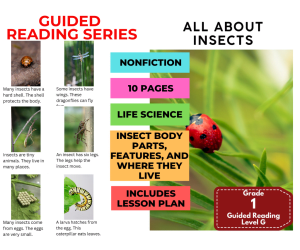
All About Insects: Guided Reading Level G with Lesson Plan
ELA, Resources for Teachers, Reading Comprehension, Reading, Science, Language Development, Vocabulary, Pre-Reading, Insects, Life Sciences, Kindergarten, Grade 1, 2, Worksheets & Printables, Worksheets, Teacher Tools, Centers, Activities, Literacy Readers, Quizzes, Quizzes and Tests, Assessments, Lesson Plans
This All About Insects (level g) guided reading book with lesson plan includes: Guided Reading Color Label (front cover x1) This is a quick way to match the book’s demands to what students can generally handle.. The overall goal is to use the level/color to pick books for several smaller groups. To qualify for a certain level, a student is expected to read a book from that level with about 90–94% accuracy. If a student is consistently accurate and understands, move up a level. If the student is struggling at that level, drop down and add more support. Each student will improve at completely different rates, but it is generally one of the best ways to check progress across the class. DOWNLOAD THE CATALOG TO VIEW ALL GUIDED READING BOOKS AVAILABLE (SORTED LEVELS A-Z) Pre-Reading Question (x1) Teacher asks the prompt aloud, can be while showing the cover or first page. Students share what they already know, or make educated guesses from the cover. Prompt them to use the target vocabulary. Write some of their responses on the board to look back at during the reading. Vocabulary Words (x5) Introduce the five words, best doing it one at a time. Start by saying it, while students repeat and then see if anyone knows what it means before reading further. Read through the meaning and try to briefly connect each word to a picture or gesture so it’s meaningful. Ask students to flip through the book pages and point to where they see each of the vocabulary words. While reading the book pause upon coming across one of the vocab words or read the sentence twice to make sure students understand the word has appeared. Optional: Ask students to raise hands whenever they see/hear one of the new words. Guided Reading Pages (x10) Check the book snapshot (below) for: primary topic - do you need to prep extra reading or intro materials on this? what is taught best - decide on 1-2 bullets to focus on, use the prompt or words provided here for best results. learning goals - what you are checking for students to be able to do after the session, elicit answers using prompts or words provided. key vocabulary (see section above). questions overview - so you know what is coming up and if you need to prep extra materials to assist understanding. Run the lesson You may have already looked at a few of the pages together, but you can show them some of the pictures again first to set meaning. Depending on how much time you have and how familiar your students are with guided reading class, you may want to read the book aloud first with the group first. Students whisper or partner read, while you listen in. If time, do it as a group, one student reading a page each. Use the guided page’s prompts to coach: “Check the picture / does it make sense?” “Point under the words / try the first sound” “Reread the sentence smoothly”. Try to focus more on one student per session (rotating every time), so you can work out if they are ready to move up or need to move down a level. Comprehension Questions (back cover x3) This is your way to check that students didn’t just say the words, but actually understood the text. First, let students answer by pointing to the page/picture and saying a short sentence. After any answer, follow with: “Show me where you found that in the text.” In bigger groups, have partners answer first (10–20 seconds), then call on 2–3 students to share. Differentiation tips: Emerging speakers/struggling readers: oral + pointing On-level: oral in a full sentence Higher: one written sentence or draw + label Book Snapshot Title: All About Insects Genre: Nonfiction (informational) Subject: Science (Life Science) Primary Topic: Insect body parts, features, and where they live Estimated Guided Reading Level (A–Z): G What This Book Teaches Best Explains what insects are by stating they are tiny animals that live in many places . Teaches basic insect anatomy: insects have six legs and three body parts (head, thorax, abdomen). Connects structures to functions: legs help the insect move and antennae are used to smell things . Describes common insect features: some have a hard shell that protects the body , and some have wings (dragonflies can fly fast ). Introduces early life stages: many insects come from eggs , and a larva hatches from an egg. Learning Goals Students will describe insects as tiny animals that live in many places. Students will identify that an insect has six legs that help it move. Students will name the three body parts of an insect: head, thorax, and abdomen. Students will explain that most insects have two antennae used to smell things. Students will describe details from the text about insect features (shells, wings) and how insects begin life (eggs, larva). Key Vocabulary From the Text thorax — the middle part of an insect’s body. abdomen — the back part of an insect’s body. antennae — body parts insects use to smell things. larva — a young insect that hatches from an egg. dragonflies — insects that can fly fast. Discussion Prompts Pre-reading question: Where have you seen insects living before? Comprehension questions: What does the book say insects are? Comprehension questions: How many legs does an insect have? Comprehension questions: Where does the book tell you to look to find an insect? Printing Tips 1. Best Printing Method (Recommended) “Booklet” Printing (Best if Available) If your printer or PDF viewer supports Booklet Printing , use this. Settings to use: Print mode: Booklet Paper size: Letter or A4 (either works) Orientation: Landscape Print on both sides: Yes Flip on: Short edge Scaling: Fit to printable area Booklet subset: First test: Front sides only Then: Back sides only This will automatically: Pair pages correctly Put the cover on the outside Align everything for folding After printing, fold in half and staple along the spine . 2. If “Booklet” Printing Is NOT Available You can still print this correctly with manual duplex printing . Step-by-step: Open the PDF. Choose Print . Set: Orientation: Landscape Pages per sheet: 1 Print on both sides: Yes Flip on: Short edge Print all pages . Because each PDF page already contains two facing book pages, the result will still fold cleanly into a book. Thousands of Cored Education products are included with your TeachSimple membership. Download links and encyclopedia index available here.
Author Cored Education
Rating
Tags Reading Comprehension, Reading Passages, Reading, Guided Reading, Guided Reading Lesson Plan, Guided Reading Activity, Pre-reading, Science Lesson Plans, Life Science, Insects
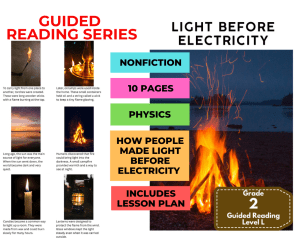
Guided Reading Level L - Light Before Electricity (with Lesson Plan)
ELA, Resources for Teachers, Reading Comprehension, Reading, Science, Engineering, Technology, Physics, History, Social Studies, Grade 1, 2, 3, Worksheets & Printables, Worksheets, Teacher Tools, Centers, Activities, Literacy Readers, Quizzes, Quizzes and Tests, Assessments
This Guided Reading Book - Light Before Electricity (Level L) with lesson plan includes: Guided Reading Color Label (front cover x1) This is a quick way to match the book’s demands to what students can generally handle.. The overall goal is to use the level/color to pick books for several smaller groups. To qualify for a certain level, a student is expected to read a book from that level with about 90–94% accuracy. If a student is consistently accurate and understands, move up a level. If the student is struggling at that level, drop down and add more support. Each student will improve at completely different rates, but it is generally one of the best ways to check progress across the class. DOWNLOAD THE CATALOG TO VIEW ALL GUIDED READING BOOKS AVAILABLE (SORTED LEVELS A-Z) Pre-Reading Question (x1) Teacher asks the prompt aloud, can be while showing the cover or first page. Students share what they already know, or make educated guesses from the cover. Prompt them to use the target vocabulary. Write some of their responses on the board to look back at during the reading. Vocabulary Words (x5) Introduce the five words, best doing it one at a time. Start by saying it, while students repeat and then see if anyone knows what it means before reading further. Read through the meaning and try to briefly connect each word to a picture or gesture so it’s meaningful. Ask students to flip through the book pages and point to where they see each of the vocabulary words. While reading the book pause upon coming across one of the vocab words or read the sentence twice to make sure students understand the word has appeared. Optional: Ask students to raise hands whenever they see/hear one of the new words. Guided Reading Pages (x10) Check the book snapshot (below) for: primary topic - do you need to prep extra reading or intro materials on this? what is taught best - decide on 1-2 bullets to focus on, use the prompt or words provided here for best results. learning goals - what you are checking for students to be able to do after the session, elicit answers using prompts or words provided. key vocabulary (see section above). questions overview - so you know what is coming up and if you need to prep extra materials to assist understanding. Run the lesson You may have already looked at a few of the pages together, but you can show them some of the pictures again first to set meaning. Depending on how much time you have and how familiar your students are with guided reading class, you may want to read the book aloud first with the group first. Students whisper or partner read, while you listen in. If time, do it as a group, one student reading a page each. Use the guided page’s prompts to coach: “Check the picture / does it make sense?” “Point under the words / try the first sound” “Reread the sentence smoothly”. Try to focus more on one student per session (rotating every time), so you can work out if they are ready to move up or need to move down a level. Comprehension Questions (back cover x3) This is your way to check that students didn’t just say the words, but actually understood the text. First, let students answer by pointing to the page/picture and saying a short sentence. After any answer, follow with: “Show me where you found that in the text.” In bigger groups, have partners answer first (10–20 seconds), then call on 2–3 students to share. Differentiation tips: Emerging speakers/struggling readers: oral + pointing On-level: oral in a full sentence Higher: one written sentence or draw + label Book Snapshot Title: Light Before Electricity Genre: Nonfiction (informational) Subject: Science (Technology) / Social Studies (Past and Present) Primary Topic: How people made light before electricity Estimated Guided Reading Level (A–Z): L What This Book Teaches Best The sun was the main source of light long ago, and it got dark when the sun went down. People discovered fire could bring light into darkness and help them see at night. A clear sequence of lighting tools is explained: torches, oil lamps (with a wick), candles, lanterns, gas lamps, electric lightbulbs, and LED bulbs. How inventions solved problems: lanterns protected flames from wind, gas traveled through pipes to power lamps, and electric lightbulbs were safer because they used no real flame. Past-to-present comparison: lighting changed from “flickering fires” to steady electric light you can turn on with a switch. Learning Goals Students will describe why the sun was the main source of light long ago. Students will explain how fire helped people see at night. Students will identify several light sources from the book and describe how each one made light. Students will explain how lanterns kept light steady when carried outside. Students will explain why the electric lightbulb was safer and brighter than candles in the book. Students will describe how LED bulbs are different from older light sources (cool to the touch, little energy). Key Vocabulary From the Text source — where something comes from. torches — long sticks with a flame used for light. wick — a string that helps a lamp or candle burn. invention — something new that someone creates. flickering — shining in a shaky way, like moving firelight. Discussion Prompts Pre-reading question: What kinds of lights do you use when it is dark? Comprehension questions: What was the main source of light for everyone long ago? How did lanterns protect the flame when people carried them outside? Why did the book say the electric lightbulb was safer than candles? Printing Tips 1. Best Printing Method (Recommended) “Booklet” Printing (Best if Available) If your printer or PDF viewer supports Booklet Printing , use this. Settings to use: Print mode: Booklet Paper size: Letter or A4 (either works) Orientation: Landscape Print on both sides: Yes Flip on: Short edge Scaling: Fit to printable area Booklet subset: First test: Front sides only Then: Back sides only This will automatically: Pair pages correctly Put the cover on the outside Align everything for folding After printing, fold in half and staple along the spine . 2. If “Booklet” Printing Is NOT Available You can still print this correctly with manual duplex printing . Step-by-step: Open the PDF. Choose Print . Set: Orientation: Landscape Pages per sheet: 1 Print on both sides: Yes Flip on: Short edge Print all pages . Because each PDF page already contains two facing book pages, the result will still fold cleanly into a book. Thousands of Cored Education products are included with your TeachSimple membership. Download links and encyclopedia index available here.
Author Cored Education
Rating
Tags Reading Comprehension, Reading Passages, Reading, Guided Reading, Guided Reading Lesson Plan, Guided Reading Activity, Pre-reading, Vocabulary, Physics, History
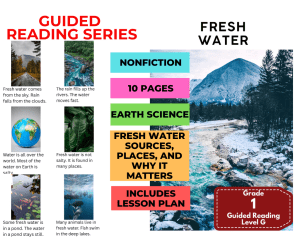
Fresh Water: Guided Reading Level G with Lesson Plan
ELA, Resources for Teachers, Reading Comprehension, Reading, Science, Language Development, Life Sciences, Geography, Social Studies, Earth and Environmental Sciences, Kindergarten, Grade 1, 2, Worksheets & Printables, Worksheets, Teacher Tools, Centers, Activities, Literacy Readers, Quizzes, Quizzes and Tests, Assessments, Lesson Plans
This Fresh Water (level g) guided reading book with lesson plan includes: Guided Reading Color Label (front cover x1) This is a quick way to match the book’s demands to what students can generally handle.. The overall goal is to use the level/color to pick books for several smaller groups. To qualify for a certain level, a student is expected to read a book from that level with about 90–94% accuracy. If a student is consistently accurate and understands, move up a level. If the student is struggling at that level, drop down and add more support. Each student will improve at completely different rates, but it is generally one of the best ways to check progress across the class. DOWNLOAD THE CATALOG TO VIEW ALL GUIDED READING BOOKS AVAILABLE (SORTED LEVELS A-Z) Pre-Reading Question (x1) Teacher asks the prompt aloud, can be while showing the cover or first page. Students share what they already know, or make educated guesses from the cover. Prompt them to use the target vocabulary. Write some of their responses on the board to look back at during the reading. Vocabulary Words (x5) Introduce the five words, best doing it one at a time. Start by saying it, while students repeat and then see if anyone knows what it means before reading further. Read through the meaning and try to briefly connect each word to a picture or gesture so it’s meaningful. Ask students to flip through the book pages and point to where they see each of the vocabulary words. While reading the book pause upon coming across one of the vocab words or read the sentence twice to make sure students understand the word has appeared. Optional: Ask students to raise hands whenever they see/hear one of the new words. Guided Reading Pages (x10) Check the book snapshot (below) for: primary topic - do you need to prep extra reading or intro materials on this? what is taught best - decide on 1-2 bullets to focus on, use the prompt or words provided here for best results. learning goals - what you are checking for students to be able to do after the session, elicit answers using prompts or words provided. key vocabulary (see section above). questions overview - so you know what is coming up and if you need to prep extra materials to assist understanding. Run the lesson You may have already looked at a few of the pages together, but you can show them some of the pictures again first to set meaning. Depending on how much time you have and how familiar your students are with guided reading class, you may want to read the book aloud first with the group first. Students whisper or partner read, while you listen in. If time, do it as a group, one student reading a page each. Use the guided page’s prompts to coach: “Check the picture / does it make sense?” “Point under the words / try the first sound” “Reread the sentence smoothly”. Try to focus more on one student per session (rotating every time), so you can work out if they are ready to move up or need to move down a level. Comprehension Questions (back cover x3) This is your way to check that students didn’t just say the words, but actually understood the text. First, let students answer by pointing to the page/picture and saying a short sentence. After any answer, follow with: “Show me where you found that in the text.” In bigger groups, have partners answer first (10–20 seconds), then call on 2–3 students to share. Differentiation tips: Emerging speakers/struggling readers: oral + pointing On-level: oral in a full sentence Higher: one written sentence or draw + label Book Snapshot Title: Fresh Water Genre: Nonfiction Subject: Life Science (Earth science—water) Primary Topic: Fresh water sources, places, and why it matters Estimated Guided Reading Level (A–Z): G What This Book Teaches Best How fresh water differs from salty water (fresh water is not salty). Where fresh water comes from (rain from clouds; snow melting on mountains). Places fresh water is found (rivers, a stream, a pond, deep lakes). How water can move fast or stay still depending on where it is (rivers vs. pond). Why fresh water is important for living things , including plants taking in water through roots. Learning Goals Students can explain that most water on Earth is salty and fresh water is not salty. Students can describe two ways fresh water forms (rain from clouds; snow melting on mountains). Students can name places the book shows fresh water (rivers, stream, pond, lakes). Students can compare how water moves in different places (rivers move fast; pond water stays still). Students can tell why fresh water matters to living things, including plants and trees. Key Vocabulary From the Text salty — tasting like salt. rivers — long, moving water that flows across land. stream — a small river. pond — water that stays in one place. roots — parts under the ground that take in water. Discussion Prompts Pre-reading question: Where do you think fresh water comes from, and where might we find it? Comprehension questions: What does the book say fresh water is not ? Comprehension questions: What are two places the book shows fresh water can be found? Comprehension questions: Why is fresh water important for living things in the book? Printing Tips 1. Best Printing Method (Recommended) “Booklet” Printing (Best if Available) If your printer or PDF viewer supports Booklet Printing , use this. Settings to use: Print mode: Booklet Paper size: Letter or A4 (either works) Orientation: Landscape Print on both sides: Yes Flip on: Short edge Scaling: Fit to printable area Booklet subset: First test: Front sides only Then: Back sides only This will automatically: Pair pages correctly Put the cover on the outside Align everything for folding After printing, fold in half and staple along the spine . 2. If “Booklet” Printing Is NOT Available You can still print this correctly with manual duplex printing . Step-by-step: Open the PDF. Choose Print . Set: Orientation: Landscape Pages per sheet: 1 Print on both sides: Yes Flip on: Short edge Print all pages . Because each PDF page already contains two facing book pages, the result will still fold cleanly into a book. Thousands of Cored Education products are included with your TeachSimple membership. Download links and encyclopedia index available here.
Author Cored Education
Rating
Tags Reading Comprehension, Reading Passages, Reading, Guided Reading, Guided Reading Lesson Plan, Guided Reading Activity, Pre-reading, Science Lesson Plans, Life Science, Geography
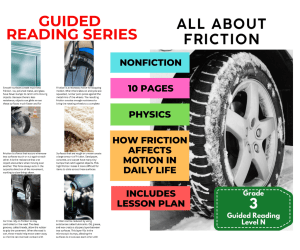
Guided Reading Level N - All About Friction (with Lesson Plan)
ELA, Resources for Teachers, Reading Comprehension, Reading, Language Development, Science, Physics, Engineering, Technology, Pre-Reading, Grade 2, 3, 4, Worksheets & Printables, Worksheets, Teacher Tools, Centers, Activities, Literacy Readers, Quizzes, Quizzes and Tests, Assessments
This Guided Reading Book - All About Friction (Level N) with lesson plan includes: Guided Reading Color Label (front cover x1) This is a quick way to match the book’s demands to what students can generally handle.. The overall goal is to use the level/color to pick books for several smaller groups. To qualify for a certain level, a student is expected to read a book from that level with about 90–94% accuracy. If a student is consistently accurate and understands, move up a level. If the student is struggling at that level, drop down and add more support. Each student will improve at completely different rates, but it is generally one of the best ways to check progress across the class. DOWNLOAD THE CATALOG TO VIEW ALL GUIDED READING BOOKS AVAILABLE (SORTED LEVELS A-Z) Pre-Reading Question (x1) Teacher asks the prompt aloud, can be while showing the cover or first page. Students share what they already know, or make educated guesses from the cover. Prompt them to use the target vocabulary. Write some of their responses on the board to look back at during the reading. Vocabulary Words (x5) Introduce the five words, best doing it one at a time. Start by saying it, while students repeat and then see if anyone knows what it means before reading further. Read through the meaning and try to briefly connect each word to a picture or gesture so it’s meaningful. Ask students to flip through the book pages and point to where they see each of the vocabulary words. While reading the book pause upon coming across one of the vocab words or read the sentence twice to make sure students understand the word has appeared. Optional: Ask students to raise hands whenever they see/hear one of the new words. Guided Reading Pages (x10) Check the book snapshot (below) for: primary topic - do you need to prep extra reading or intro materials on this? what is taught best - decide on 1-2 bullets to focus on, use the prompt or words provided here for best results. learning goals - what you are checking for students to be able to do after the session, elicit answers using prompts or words provided. key vocabulary (see section above). questions overview - so you know what is coming up and if you need to prep extra materials to assist understanding. Run the lesson You may have already looked at a few of the pages together, but you can show them some of the pictures again first to set meaning. Depending on how much time you have and how familiar your students are with guided reading class, you may want to read the book aloud first with the group first. Students whisper or partner read, while you listen in. If time, do it as a group, one student reading a page each. Use the guided page’s prompts to coach: “Check the picture / does it make sense?” “Point under the words / try the first sound” “Reread the sentence smoothly”. Try to focus more on one student per session (rotating every time), so you can work out if they are ready to move up or need to move down a level. Comprehension Questions (back cover x3) This is your way to check that students didn’t just say the words, but actually understood the text. First, let students answer by pointing to the page/picture and saying a short sentence. After any answer, follow with: “Show me where you found that in the text.” In bigger groups, have partners answer first (10–20 seconds), then call on 2–3 students to share. Differentiation tips: Emerging speakers/struggling readers: oral + pointing On-level: oral in a full sentence Higher: one written sentence or draw + label Book Snapshot Title: All About Friction Genre: Nonfiction (informational) Subject: Physical Science Primary Topic: How friction affects motion in daily life Estimated Guided Reading Level (A–Z): N What This Book Teaches Best Defines friction as a force that happens when surfaces touch or rub, and explains it acts against motion to slow things down. Compares rough/uneven surfaces (more friction) and smooth surfaces (less friction), using examples like sandpaper, carpet, ice, metal, and glass. Shows real-world uses of friction for safety, including bicycle brakes, soccer cleats gripping grass, and car tire treads gripping wet roads. Explains how friction can create heat energy and how lubricants reduce friction by forming a slippery layer between surfaces. Extends the idea of friction to air and water as drag/air resistance , and explains why friction makes movement controlled and “predictable.” Learning Goals Students can explain what friction is, using details from the text. Students can compare how rough/uneven surfaces and smooth surfaces affect sliding and distance. Students can describe how friction helps stop motion in the bicycle brake example. Students can explain one way friction is increased for safety or performance (cleats, tire treads). Students can explain how lubricants change what happens when two surfaces touch. Students can describe friction in air or water (drag/air resistance) using the parachute example. Key Vocabulary From the Text resistance — a push-back that makes movement harder. uneven — not smooth; bumpy. treads — deep grooves that help tires grip the road. lubricants — slippery substances that help things slide more easily. microscopic — so tiny you need a microscope to see it. Discussion Prompts Pre-reading question: When have you noticed something slow down because two surfaces rubbed together? Comprehension questions: What does the text say friction is? How does friction help a bicycle come to a complete stop? What do lubricants do between two surfaces to reduce friction? Printing Tips 1. Best Printing Method (Recommended) “Booklet” Printing (Best if Available) If your printer or PDF viewer supports Booklet Printing , use this. Settings to use: Print mode: Booklet Paper size: Letter or A4 (either works) Orientation: Landscape Print on both sides: Yes Flip on: Short edge Scaling: Fit to printable area Booklet subset: First test: Front sides only Then: Back sides only This will automatically: Pair pages correctly Put the cover on the outside Align everything for folding After printing, fold in half and staple along the spine . 2. If “Booklet” Printing Is NOT Available You can still print this correctly with manual duplex printing . Step-by-step: Open the PDF. Choose Print . Set: Orientation: Landscape Pages per sheet: 1 Print on both sides: Yes Flip on: Short edge Print all pages . Because each PDF page already contains two facing book pages, the result will still fold cleanly into a book. Thousands of Cored Education products are included with your TeachSimple membership. Download links and encyclopedia index available here.
Author Cored Education
Rating
Tags Reading Comprehension, Reading Passages, Reading, Guided Reading, Guided Reading Lesson Plan, Guided Reading Activity, Pre-reading, Vocabulary, Science Lesson Plans, Physics

Guided Reading Level N - The Power of the Team (with Lesson Plan)
ELA, Resources for Teachers, Reading Comprehension, Reading, Language Development, P.E. & Health, Sports, Social Emotional Learning (SEL), Special Resources, Physical Education, Grade 2, 3, 4, Worksheets & Printables, Worksheets, Teacher Tools, Centers, Activities, Literacy Readers, Quizzes, Quizzes and Tests, Assessments
This Guided Reading Book - The Power of the Team (Level N) with lesson plan includes: Guided Reading Color Label (front cover x1) This is a quick way to match the book’s demands to what students can generally handle.. The overall goal is to use the level/color to pick books for several smaller groups. To qualify for a certain level, a student is expected to read a book from that level with about 90–94% accuracy. If a student is consistently accurate and understands, move up a level. If the student is struggling at that level, drop down and add more support. Each student will improve at completely different rates, but it is generally one of the best ways to check progress across the class. DOWNLOAD THE CATALOG TO VIEW ALL GUIDED READING BOOKS AVAILABLE (SORTED LEVELS A-Z) Pre-Reading Question (x1) Teacher asks the prompt aloud, can be while showing the cover or first page. Students share what they already know, or make educated guesses from the cover. Prompt them to use the target vocabulary. Write some of their responses on the board to look back at during the reading. Vocabulary Words (x5) Introduce the five words, best doing it one at a time. Start by saying it, while students repeat and then see if anyone knows what it means before reading further. Read through the meaning and try to briefly connect each word to a picture or gesture so it’s meaningful. Ask students to flip through the book pages and point to where they see each of the vocabulary words. While reading the book pause upon coming across one of the vocab words or read the sentence twice to make sure students understand the word has appeared. Optional: Ask students to raise hands whenever they see/hear one of the new words. Guided Reading Pages (x10) Check the book snapshot (below) for: primary topic - do you need to prep extra reading or intro materials on this? what is taught best - decide on 1-2 bullets to focus on, use the prompt or words provided here for best results. learning goals - what you are checking for students to be able to do after the session, elicit answers using prompts or words provided. key vocabulary (see section above). questions overview - so you know what is coming up and if you need to prep extra materials to assist understanding. Run the lesson You may have already looked at a few of the pages together, but you can show them some of the pictures again first to set meaning. Depending on how much time you have and how familiar your students are with guided reading class, you may want to read the book aloud first with the group first. Students whisper or partner read, while you listen in. If time, do it as a group, one student reading a page each. Use the guided page’s prompts to coach: “Check the picture / does it make sense?” “Point under the words / try the first sound” “Reread the sentence smoothly”. Try to focus more on one student per session (rotating every time), so you can work out if they are ready to move up or need to move down a level. Comprehension Questions (back cover x3) This is your way to check that students didn’t just say the words, but actually understood the text. First, let students answer by pointing to the page/picture and saying a short sentence. After any answer, follow with: “Show me where you found that in the text.” In bigger groups, have partners answer first (10–20 seconds), then call on 2–3 students to share. Differentiation tips: Emerging speakers/struggling readers: oral + pointing On-level: oral in a full sentence Higher: one written sentence or draw + label Book Snapshot Title: The Power of the Team Genre: Nonfiction (informational) Subject: SEL / Physical Education / Reading Primary Topic: Teamwork skills that help teams succeed Estimated Guided Reading Level (A–Z): N What This Book Teaches Best Teamwork and shared goals: Teamwork happens when people work together to reach a common goal and play “for the whole group.” Communication in fast-paced play: Players use loud voices or hand signals to share information so everyone knows what to do next. Trust and cooperation through passing: Passing the ball (or puck) makes it harder for the other team to take it and shows teammates trust each other. Support and encouragement: Teammates help each other after mistakes and keep spirits high when things get difficult. Planning, practice, and coordination: Teams use strategy, practice together, and coordinate timing (like passing a relay baton) to perform smoothly. Learning Goals Students will explain what teamwork is and what it helps a team reach, using details from the text. Students will describe how communication helps a team during a fast-paced game. Students will explain why passing is important and what it shows about trust on a team. Students will describe ways teammates support one another with encouragement when someone struggles or makes a mistake. Students will explain how strategy and practice help a team work “like a single machine.” Students will describe how coordination and shared defense help teams succeed. Key Vocabulary From the Text cooperation — working together to reach a goal. vital — very important. encouragement — kind support that helps someone keep trying. strategy — a plan for the best way to play. coordination — moving and working together at the right time. Discussion Prompts Pre-reading question: How can working together help a team do better in a sport? Comprehension questions: What does the text say teamwork helps a group of people reach? According to the text, what do players use to share information during a fast-paced game? What does the text say teamwork teaches people how to be in every game they play? Printing Tips 1. Best Printing Method (Recommended) “Booklet” Printing (Best if Available) If your printer or PDF viewer supports Booklet Printing , use this. Settings to use: Print mode: Booklet Paper size: Letter or A4 (either works) Orientation: Landscape Print on both sides: Yes Flip on: Short edge Scaling: Fit to printable area Booklet subset: First test: Front sides only Then: Back sides only This will automatically: Pair pages correctly Put the cover on the outside Align everything for folding After printing, fold in half and staple along the spine . 2. If “Booklet” Printing Is NOT Available You can still print this correctly with manual duplex printing . Step-by-step: Open the PDF. Choose Print . Set: Orientation: Landscape Pages per sheet: 1 Print on both sides: Yes Flip on: Short edge Print all pages . Because each PDF page already contains two facing book pages, the result will still fold cleanly into a book. Thousands of Cored Education products are included with your TeachSimple membership. Download links and encyclopedia index available here.
Author Cored Education
Rating
Tags Reading Comprehension, Reading Passages, Reading, Guided Reading, Guided Reading Lesson Plan, Guided Reading Activity, Pre-reading, Vocabulary, Sports, P.e. Lesson Plans

Guided Reading Lesson Plan & Activities for Grade 8
Reading, ELA, Grade 8, Activities, Lesson Plans, Teacher Tools
During their final year of middle school, 8th graders engage in preparing for high school by refining and enhancing skills acquired in previous middle school years, while also acquiring new (and frequently more challenging) abilities. In numerous ways, 8th grade serves as a transitional year since students are anticipated to have mastered middle school skills and start evolving into “high-schoolers.” In particular, 8th graders are anticipated to be self-sufficient thinkers and doers, evaluating and articulating what they understand in both their written and spoken communication. In the 8th grade, students further develop various skills acquired in previous grades, particularly focusing on aspects such as text evidence, language, and comparisons across different genres of text. Nonetheless, 8th graders deepen their text analyses by exploring the details and writing structures while evaluating how these aspects influence the text. This ebook contains an in-depth guided reading lesson plan complete with activities, which takes around 90 minutes to complete. Proposed responses are also included.
Author Bright Classroom Ideas Marketplace
Tags Guided, Reading, Lesson, Plan, Activites, Grade 8, Language

Guided Reading Level O - World Harvest Foods (with Lesson Plan)
ELA, Resources for Teachers, Reading Comprehension, Reading, Language Development, Holidays, Holiday & Seasonal, Thanksgiving, Social Studies, Geography, Grade 2, 3, 4, Worksheets & Printables, Worksheets, Teacher Tools, Centers, Activities, Literacy Readers, Quizzes, Quizzes and Tests, Assessments
This Guided Reading Book - World Harvest Foods (Level O) with lesson plan includes: Guided Reading Color Label (front cover x1) This is a quick way to match the book’s demands to what students can generally handle.. The overall goal is to use the level/color to pick books for several smaller groups. To qualify for a certain level, a student is expected to read a book from that level with about 90–94% accuracy. If a student is consistently accurate and understands, move up a level. If the student is struggling at that level, drop down and add more support. Each student will improve at completely different rates, but it is generally one of the best ways to check progress across the class. DOWNLOAD THE CATALOG TO VIEW ALL GUIDED READING BOOKS AVAILABLE (SORTED LEVELS A-Z) Pre-Reading Question (x1) Teacher asks the prompt aloud, can be while showing the cover or first page. Students share what they already know, or make educated guesses from the cover. Prompt them to use the target vocabulary. Write some of their responses on the board to look back at during the reading. Vocabulary Words (x5) Introduce the five words, best doing it one at a time. Start by saying it, while students repeat and then see if anyone knows what it means before reading further. Read through the meaning and try to briefly connect each word to a picture or gesture so it’s meaningful. Ask students to flip through the book pages and point to where they see each of the vocabulary words. While reading the book pause upon coming across one of the vocab words or read the sentence twice to make sure students understand the word has appeared. Optional: Ask students to raise hands whenever they see/hear one of the new words. Guided Reading Pages (x10) Check the book snapshot (below) for: primary topic - do you need to prep extra reading or intro materials on this? what is taught best - decide on 1-2 bullets to focus on, use the prompt or words provided here for best results. learning goals - what you are checking for students to be able to do after the session, elicit answers using prompts or words provided. key vocabulary (see section above). questions overview - so you know what is coming up and if you need to prep extra materials to assist understanding. Run the lesson You may have already looked at a few of the pages together, but you can show them some of the pictures again first to set meaning. Depending on how much time you have and how familiar your students are with guided reading class, you may want to read the book aloud first with the group first. Students whisper or partner read, while you listen in. If time, do it as a group, one student reading a page each. Use the guided page’s prompts to coach: “Check the picture / does it make sense?” “Point under the words / try the first sound” “Reread the sentence smoothly”. Try to focus more on one student per session (rotating every time), so you can work out if they are ready to move up or need to move down a level. Comprehension Questions (back cover x3) This is your way to check that students didn’t just say the words, but actually understood the text. First, let students answer by pointing to the page/picture and saying a short sentence. After any answer, follow with: “Show me where you found that in the text.” In bigger groups, have partners answer first (10–20 seconds), then call on 2–3 students to share. Differentiation tips: Emerging speakers/struggling readers: oral + pointing On-level: oral in a full sentence Higher: one written sentence or draw + label Book Snapshot Title: Harvest Foods Around the World Genre: Nonfiction (informational) Subject: Social Studies (Culture) / Reading Primary Topic: Harvest festivals and foods in different cultures Estimated Guided Reading Level (A–Z): O What This Book Teaches Best What “harvest” means and why it matters: Harvest is when crops are gathered, marking the end of the growing period. Culture and celebration through food: Different cultures celebrate fresh food with festivals, music, and special meals. Global examples of harvest traditions: The text highlights foods and celebrations from multiple places (South Korea, East Asia, Southern India, North America, Germany, Jewish communities, Nigeria/West Africa, Italy). Symbolism in foods: Some foods represent ideas (a mooncake’s center represents the moon; an overflowing Pongal pot symbolizes abundance). Connecting people to nature and community: Harvest foods connect people to the earth and to each other, and help share nature’s bounty in the community. Learning Goals Students will explain what harvest time is using details from the text. Students will identify several harvest celebrations in the book and name a food connected to each one. Students will describe how at least two harvest foods are made or served, using the text’s descriptions. Students will explain what the text says certain foods symbolize (such as abundance or the moon). Students will compare how harvest celebrations are similar and different across regions described in the book. Students will explain how harvest foods connect people, according to the last paragraph. Key Vocabulary From the Text bounty — a large amount of good food or crops. crescent-shaped — shaped like a curved, thin moon. signature — the most special or well-known thing for something. abundance — more than enough; a lot of something. gratitude — feeling thankful. Discussion Prompts Pre-reading question: What foods do you think people might eat to celebrate the harvest in different places? Comprehension questions: What does the book say harvest time is? What does the overflowing pot of Pongal symbolize? In the last paragraph, what do harvest foods connect people to? Printing Tips 1. Best Printing Method (Recommended) “Booklet” Printing (Best if Available) If your printer or PDF viewer supports Booklet Printing , use this. Settings to use: Print mode: Booklet Paper size: Letter or A4 (either works) Orientation: Landscape Print on both sides: Yes Flip on: Short edge Scaling: Fit to printable area Booklet subset: First test: Front sides only Then: Back sides only This will automatically: Pair pages correctly Put the cover on the outside Align everything for folding After printing, fold in half and staple along the spine . 2. If “Booklet” Printing Is NOT Available You can still print this correctly with manual duplex printing . Step-by-step: Open the PDF. Choose Print . Set: Orientation: Landscape Pages per sheet: 1 Print on both sides: Yes Flip on: Short edge Print all pages . Because each PDF page already contains two facing book pages, the result will still fold cleanly into a book. Thousands of Cored Education products are included with your TeachSimple membership. Download links and encyclopedia index available here.
Author Cored Education
Rating
Tags Reading Comprehension, Reading Passages, Reading, Guided Reading, Guided Reading Lesson Plan, Guided Reading Activity, Pre-reading, Vocabulary, Social Studies Lesson Plans, Geography
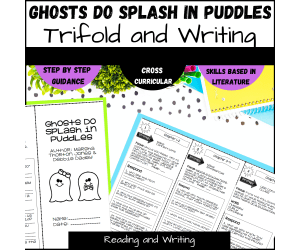
Guided Reading Activity Ghosts Do Splash in Puddles Trifold Book Repor
ELA, Reading, Grade 2, 3, 4, Activities, Projects, Teacher Tools, Graphic Organizers, Novel Studies, Worksheets & Printables
Ghosts Do Splash in Puddles by Marcia Thornton Jones and Debbie Dadey dives into the adventures of the Bailey School Kids as they investigate a mysterious, translucent figure spotted splashing in puddles on a rainy day. With humor and determination, the kids uncover clues and navigate friendships, making this story a delightful choice for young readers. This trifold resource is created to help students practice reading comprehension skills while providing differentiation for various reading levels. This tool can easily be utilized during guided reading, independent seat work, or literature circles. The included writing wrap-up allows for assessing multiple skills in one project, making it perfect for teachers looking for projects that can cover multiple subjects - reading comprehension, reading skills, and writing. What’s Included in This Resource: Each trifold is broken down by chapters or pages and allows chunking of information for easy teacher planning and appropriate student use. In each trifold, the following skills are assessed: Making Connections: Encourage students to relate the story to their own lives, other texts, and the wider world. Making Inferences: Help students combine text evidence with prior knowledge to draw logical conclusions. Using Context Clues: Teach students to deduce the meaning of unfamiliar words using hints from the text. Visualization: Support students in creating mental images of characters, events, and settings. Evaluation: Develop critical thinking by analyzing characters, themes, and the author’s message. Writing Wrap-Up: A writing assessment tool for reflection and deeper understanding. How This Resource Benefits Teachers: ✔ Provides differentiated instruction for diverse learners. ✔ Fosters text engagement and critical thinking with content. ✔ Offers flexibility for grades, seat work, or group discussions. What Teachers Are Saying: ⭐ "This resource made my guided reading groups more organized and productive!" - Rebecca T. ⭐ "Perfect for differentiation and keeping all students engaged at their level." - Larraine C. ⭐ "My students loved the activities, and it worked seamlessly in our literature circles!" - Celia N.
Author Kel's Klass
Tags Reading Strategies, Trifold Project, Guided Reading, Ghosts Do Splash In Puddles, Bailey Kids, Making Connections, Making Inferences, Context Clues, Evaluating, Visualization

Guided Reading Level M - Hidden World of Viruses (with Lesson Plan)
ELA, Resources for Teachers, Reading Comprehension, Reading, Science, Life Sciences, Health, P.E. & Health, Pre-Reading, Language Development, Grade 1, 2, 3, Worksheets & Printables, Worksheets, Teacher Tools, Centers, Activities, Literacy Readers, Quizzes, Quizzes and Tests, Assessments
This Guided Reading Book - The Hidden World of Viruses (Level M) with lesson plan includes: Guided Reading Color Label (front cover x1) This is a quick way to match the book’s demands to what students can generally handle.. The overall goal is to use the level/color to pick books for several smaller groups. To qualify for a certain level, a student is expected to read a book from that level with about 90–94% accuracy. If a student is consistently accurate and understands, move up a level. If the student is struggling at that level, drop down and add more support. Each student will improve at completely different rates, but it is generally one of the best ways to check progress across the class. DOWNLOAD THE CATALOG TO VIEW ALL GUIDED READING BOOKS AVAILABLE (SORTED LEVELS A-Z) Pre-Reading Question (x1) Teacher asks the prompt aloud, can be while showing the cover or first page. Students share what they already know, or make educated guesses from the cover. Prompt them to use the target vocabulary. Write some of their responses on the board to look back at during the reading. Vocabulary Words (x5) Introduce the five words, best doing it one at a time. Start by saying it, while students repeat and then see if anyone knows what it means before reading further. Read through the meaning and try to briefly connect each word to a picture or gesture so it’s meaningful. Ask students to flip through the book pages and point to where they see each of the vocabulary words. While reading the book pause upon coming across one of the vocab words or read the sentence twice to make sure students understand the word has appeared. Optional: Ask students to raise hands whenever they see/hear one of the new words. Guided Reading Pages (x10) Check the book snapshot (below) for: primary topic - do you need to prep extra reading or intro materials on this? what is taught best - decide on 1-2 bullets to focus on, use the prompt or words provided here for best results. learning goals - what you are checking for students to be able to do after the session, elicit answers using prompts or words provided. key vocabulary (see section above). questions overview - so you know what is coming up and if you need to prep extra materials to assist understanding. Run the lesson You may have already looked at a few of the pages together, but you can show them some of the pictures again first to set meaning. Depending on how much time you have and how familiar your students are with guided reading class, you may want to read the book aloud first with the group first. Students whisper or partner read, while you listen in. If time, do it as a group, one student reading a page each. Use the guided page’s prompts to coach: “Check the picture / does it make sense?” “Point under the words / try the first sound” “Reread the sentence smoothly”. Try to focus more on one student per session (rotating every time), so you can work out if they are ready to move up or need to move down a level. Comprehension Questions (back cover x3) This is your way to check that students didn’t just say the words, but actually understood the text. First, let students answer by pointing to the page/picture and saying a short sentence. After any answer, follow with: “Show me where you found that in the text.” In bigger groups, have partners answer first (10–20 seconds), then call on 2–3 students to share. Differentiation tips: Emerging speakers/struggling readers: oral + pointing On-level: oral in a full sentence Higher: one written sentence or draw + label Book Snapshot Title: The Hidden World of Viruses Genre: Nonfiction (informational science text) Subject: Life Science Primary Topic: What viruses are and how they spread Estimated Guided Reading Level (A–Z): M What This Book Teaches Best Viruses are extremely tiny and require powerful microscopes to study. Viruses come in different shapes (round, rod-like, and multi-sided). A virus is not considered fully living and must find a living cell to begin its work. Viruses carry genetic material (DNA or RNA) that provides instructions for how the virus functions. How viruses infect cells, make copies, leave the cell, and how antibodies and vaccines help protect the body. Learning Goals Students will explain why scientists use microscopes to study viruses. Students will describe at least two shapes viruses can have, based on the text. Students will explain why a virus needs a host cell and what happens when it attaches to one. Students will describe how a cell becomes a “biological factory” that produces new viruses. Students will describe how new viruses leave a cell and spread into the surrounding environment. Students will explain how antibodies and vaccines help the body recognize and stop viruses. Key Vocabulary From the Text microscopic — so tiny you need a microscope to see it. particles — very small bits or pieces of something. genetic — related to information inside living things. antibodies — proteins the body makes to help stop viruses. vaccines — help train the body to recognize and stop invaders. Discussion Prompts Pre-reading question: Why might something too small to see still matter a lot to people? Comprehension questions: What does the book say viruses do that makes microscopes necessary for scientists? Comprehension questions: After a virus pushes its genetic material into a cell, what does the message tell the cell to do? Comprehension questions: How do antibodies help keep viruses from entering any more cells? Printing Tips 1. Best Printing Method (Recommended) “Booklet” Printing (Best if Available) If your printer or PDF viewer supports Booklet Printing , use this. Settings to use: Print mode: Booklet Paper size: Letter or A4 (either works) Orientation: Landscape Print on both sides: Yes Flip on: Short edge Scaling: Fit to printable area Booklet subset: First test: Front sides only Then: Back sides only This will automatically: Pair pages correctly Put the cover on the outside Align everything for folding After printing, fold in half and staple along the spine . 2. If “Booklet” Printing Is NOT Available You can still print this correctly with manual duplex printing . Step-by-step: Open the PDF. Choose Print . Set: Orientation: Landscape Pages per sheet: 1 Print on both sides: Yes Flip on: Short edge Print all pages . Because each PDF page already contains two facing book pages, the result will still fold cleanly into a book. Thousands of Cored Education products are included with your TeachSimple membership. Download links and encyclopedia index available here.
Author Cored Education
Rating
Tags Reading Comprehension, Reading Passages, Reading, Guided Reading, Guided Reading Lesson Plan, Guided Reading Activity, Pre-reading, Vocabulary, Science Lesson Plans, Life Science
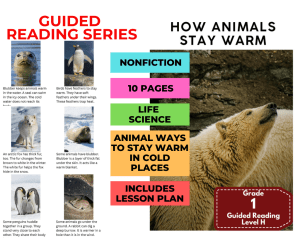
Guided Reading Level H - How Animals Stay Warm (with Lesson Plan)
ELA, Resources for Teachers, Reading Comprehension, Reading, Animals, Life Sciences, Science, Pre-Reading, Language Development, Vocabulary, Kindergarten, Grade 1, 2, Worksheets & Printables, Worksheets, Teacher Tools, Centers, Activities, Literacy Readers, Quizzes, Quizzes and Tests, Assessments
This Guided Reading Book - How Animals Stay Warm (Level H) with lesson plan includes: Guided Reading Color Label (front cover x1) This is a quick way to match the book’s demands to what students can generally handle.. The overall goal is to use the level/color to pick books for several smaller groups. To qualify for a certain level, a student is expected to read a book from that level with about 90–94% accuracy. If a student is consistently accurate and understands, move up a level. If the student is struggling at that level, drop down and add more support. Each student will improve at completely different rates, but it is generally one of the best ways to check progress across the class. DOWNLOAD THE CATALOG TO VIEW ALL GUIDED READING BOOKS AVAILABLE (SORTED LEVELS A-Z) Pre-Reading Question (x1) Teacher asks the prompt aloud, can be while showing the cover or first page. Students share what they already know, or make educated guesses from the cover. Prompt them to use the target vocabulary. Write some of their responses on the board to look back at during the reading. Vocabulary Words (x5) Introduce the five words, best doing it one at a time. Start by saying it, while students repeat and then see if anyone knows what it means before reading further. Read through the meaning and try to briefly connect each word to a picture or gesture so it’s meaningful. Ask students to flip through the book pages and point to where they see each of the vocabulary words. While reading the book pause upon coming across one of the vocab words or read the sentence twice to make sure students understand the word has appeared. Optional: Ask students to raise hands whenever they see/hear one of the new words. Guided Reading Pages (x10) Check the book snapshot (below) for: primary topic - do you need to prep extra reading or intro materials on this? what is taught best - decide on 1-2 bullets to focus on, use the prompt or words provided here for best results. learning goals - what you are checking for students to be able to do after the session, elicit answers using prompts or words provided. key vocabulary (see section above). questions overview - so you know what is coming up and if you need to prep extra materials to assist understanding. Run the lesson You may have already looked at a few of the pages together, but you can show them some of the pictures again first to set meaning. Depending on how much time you have and how familiar your students are with guided reading class, you may want to read the book aloud first with the group first. Students whisper or partner read, while you listen in. If time, do it as a group, one student reading a page each. Use the guided page’s prompts to coach: “Check the picture / does it make sense?” “Point under the words / try the first sound” “Reread the sentence smoothly”. Try to focus more on one student per session (rotating every time), so you can work out if they are ready to move up or need to move down a level. Comprehension Questions (back cover x3) This is your way to check that students didn’t just say the words, but actually understood the text. First, let students answer by pointing to the page/picture and saying a short sentence. After any answer, follow with: “Show me where you found that in the text.” In bigger groups, have partners answer first (10–20 seconds), then call on 2–3 students to share. Differentiation tips: Emerging speakers/struggling readers: oral + pointing On-level: oral in a full sentence Higher: one written sentence or draw + label Book Snapshot Title: How Animals Stay Warm Genre: Nonfiction (informational) Subject: Life Science Primary Topic: Animal ways to stay warm in cold places Estimated Guided Reading Level (A–Z): H What This Book Teaches Best Animals must stay warm to live in places with snow and ice. Body coverings can help animals stay warm (thick fur and feathers that trap heat). Some animals use body fat for warmth (blubber acts like a “warm blanket” and keeps cold water from reaching the body). Animals can use behaviors to stay warm (penguins huddle close and share body heat; some animals go underground; some sit in the sun). Learning Goals Explain why animals must stay warm to live in snow and ice. Describe how thick fur helps keep warm air near an animal’s skin. Describe how blubber helps animals stay warm, including in icy water. Describe how feathers help birds stay warm by trapping heat. Identify actions animals take to stay warm (huddling, going into a burrow, sitting in the sun). Key Vocabulary From the Text arctic — very cold, snowy place. blubber — thick fat under skin that helps keep warm. feathers — soft bird covering that helps trap heat. huddle — stand very close together in a group. burrow — a deep hole an animal digs to go underground. Discussion Prompts Pre-reading question: What are some ways animals might stay warm when it is very cold? Comprehension questions: Why must animals stay warm to live in snow and ice? Comprehension questions: How does blubber help a seal swim in the icy ocean? Comprehension questions: What do penguins do in a group to stay warm? Printing Tips 1. Best Printing Method (Recommended) “Booklet” Printing (Best if Available) If your printer or PDF viewer supports Booklet Printing , use this. Settings to use: Print mode: Booklet Paper size: Letter or A4 (either works) Orientation: Landscape Print on both sides: Yes Flip on: Short edge Scaling: Fit to printable area Booklet subset: First test: Front sides only Then: Back sides only This will automatically: Pair pages correctly Put the cover on the outside Align everything for folding After printing, fold in half and staple along the spine . 2. If “Booklet” Printing Is NOT Available You can still print this correctly with manual duplex printing . Step-by-step: Open the PDF. Choose Print . Set: Orientation: Landscape Pages per sheet: 1 Print on both sides: Yes Flip on: Short edge Print all pages . Because each PDF page already contains two facing book pages, the result will still fold cleanly into a book. Thousands of Cored Education products are included with your TeachSimple membership. Download links and encyclopedia index available here.
Author Cored Education
Rating
Tags Reading Comprehension, Reading Passages, Reading, Guided Reading, Guided Reading Lesson Plan, Guided Reading Activity, Pre-reading, Vocabulary, Animals, Life Science

Germany: The Heart of Europe: Guided Reading Level R with Lesson Plan
ELA, Resources for Teachers, Reading Comprehension, Reading, Science, Geography, Social Studies, History, Earth and Environmental Sciences, Technology, Grade 3, 4, 5, Worksheets & Printables, Worksheets, Teacher Tools, Centers, Activities, Literacy Readers, Quizzes, Quizzes and Tests, Assessments, Lesson Plans
This Germany: The Heart of Europe (level r) guided reading book with lesson plan includes: Guided Reading Color Label (front cover x1) This is a quick way to match the book’s demands to what students can generally handle.. The overall goal is to use the level/color to pick books for several smaller groups. To qualify for a certain level, a student is expected to read a book from that level with about 90–94% accuracy. If a student is consistently accurate and understands, move up a level. If the student is struggling at that level, drop down and add more support. Each student will improve at completely different rates, but it is generally one of the best ways to check progress across the class. DOWNLOAD THE CATALOG TO VIEW ALL GUIDED READING BOOKS AVAILABLE (SORTED LEVELS A-Z) Pre-Reading Question (x1) Teacher asks the prompt aloud, can be while showing the cover or first page. Students share what they already know, or make educated guesses from the cover. Prompt them to use the target vocabulary. Write some of their responses on the board to look back at during the reading. Vocabulary Words (x5) Introduce the five words, best doing it one at a time. Start by saying it, while students repeat and then see if anyone knows what it means before reading further. Read through the meaning and try to briefly connect each word to a picture or gesture so it’s meaningful. Ask students to flip through the book pages and point to where they see each of the vocabulary words. While reading the book pause upon coming across one of the vocab words or read the sentence twice to make sure students understand the word has appeared. Optional: Ask students to raise hands whenever they see/hear one of the new words. Guided Reading Pages (x10) Check the book snapshot (below) for: primary topic - do you need to prep extra reading or intro materials on this? what is taught best - decide on 1-2 bullets to focus on, use the prompt or words provided here for best results. learning goals - what you are checking for students to be able to do after the session, elicit answers using prompts or words provided. key vocabulary (see section above). questions overview - so you know what is coming up and if you need to prep extra materials to assist understanding. Run the lesson You may have already looked at a few of the pages together, but you can show them some of the pictures again first to set meaning. Depending on how much time you have and how familiar your students are with guided reading class, you may want to read the book aloud first with the group first. Students whisper or partner read, while you listen in. If time, do it as a group, one student reading a page each. Use the guided page’s prompts to coach: “Check the picture / does it make sense?” “Point under the words / try the first sound” “Reread the sentence smoothly”. Try to focus more on one student per session (rotating every time), so you can work out if they are ready to move up or need to move down a level. Comprehension Questions (back cover x3) This is your way to check that students didn’t just say the words, but actually understood the text. First, let students answer by pointing to the page/picture and saying a short sentence. After any answer, follow with: “Show me where you found that in the text.” In bigger groups, have partners answer first (10–20 seconds), then call on 2–3 students to share. Differentiation tips: Emerging speakers/struggling readers: oral + pointing On-level: oral in a full sentence Higher: one written sentence or draw + label Book Snapshot Title: Germany: The Heart of Europe Genre: Nonfiction Subject: Social Studies (Geography/Culture/History) Primary Topic: Germany’s geography, history, culture, and modern life Estimated Guided Reading Level (A–Z): R What This Book Teaches Best Germany’s central location in Europe and how that makes it a crossroads for trade, travel, and cultural exchange. Physical geography and waterways , including the Bavarian Alps and the Rhine River’s role in transportation. History meeting modern life through Berlin’s past division (Berlin Wall) and the Brandenburg Gate as a symbol of reunification. Cultural traditions , including long-held festivals, music (Bach and Beethoven), and traditional clothing like lederhosen and dirndls. Modern strengths and priorities , such as engineering/technology, renewable energy, public transportation, and environmental conservation. Learning Goals Students will describe where Germany is located in Europe and explain why its location matters in the text. Students will identify major physical features of Germany (plains, mountains, or the Bavarian Alps) using details from the text. Students will explain why the text says rivers like the Rhine are important for moving goods between cities. Students will describe Berlin as the capital and explain one way the text shows history and modern life together there. Students will describe what the text says about castles from the Middle Ages and what they are used for today. Students will identify examples of Germany today (technology/engineering, renewable energy, conservation, education, or democracy) using text evidence. Key Vocabulary From the Text crossroads — central meeting place where routes and people connect. metropolis — a very large, busy city. reunification — joining back together after being separated. renewable — energy source replaced naturally, like wind or sun. conservation — protecting nature so it stays healthy for the future. Discussion Prompts Pre-reading question: What kinds of facts do you think a book about Germany might teach you? Comprehension questions: Why does the text say Germany is a major crossroads within the European Union? Comprehension questions: What does the text say the Brandenburg Gate represents today? Comprehension questions: What is one way the text says Germany works to protect the climate? Printing Tips 1. Best Printing Method (Recommended) “Booklet” Printing (Best if Available) If your printer or PDF viewer supports Booklet Printing , use this. Settings to use: Print mode: Booklet Paper size: Letter or A4 (either works) Orientation: Landscape Print on both sides: Yes Flip on: Short edge Scaling: Fit to printable area Booklet subset: First test: Front sides only Then: Back sides only This will automatically: Pair pages correctly Put the cover on the outside Align everything for folding After printing, fold in half and staple along the spine . 2. If “Booklet” Printing Is NOT Available You can still print this correctly with manual duplex printing . Step-by-step: Open the PDF. Choose Print . Set: Orientation: Landscape Pages per sheet: 1 Print on both sides: Yes Flip on: Short edge Print all pages . Because each PDF page already contains two facing book pages, the result will still fold cleanly into a book. Thousands of Cored Education products are included with your TeachSimple membership. Download links and encyclopedia index available here.
Author Cored Education
Rating
Tags Reading Comprehension, Reading Passages, Reading, Guided Reading, Guided Reading Lesson Plan, Guided Reading Activity, Pre-reading, Social Studies, Geography, History

Guided Reading Level B: Clouds You Can Spot
ELA, Resources for Teachers, Reading Comprehension, Reading, Science, Language Development, Pre-Reading, Vocabulary, Earth and Environmental Sciences, Earth Sciences, Kindergarten, Preschool, Grade 1, Worksheets & Printables, Worksheets, Teacher Tools, Centers, Activities, Literacy Readers, Quizzes, Quizzes and Tests, Assessments
This Guided Reading Book - Clouds You Can Spot (Level B) includes: Guided Reading Color Label (front cover x1) This is a quick way to match the book’s demands to what students can generally handle.. The overall goal is to use the level/color to pick books for several smaller groups. To qualify for a certain level, a student is expected to read a book from that level with about 90–94% accuracy. If a student is consistently accurate and understands, move up a level. If the student is struggling at that level, drop down and add more support. Each student will improve at completely different rates, but it is generally one of the best ways to check progress across the class. DOWNLOAD THE CATALOG TO VIEW ALL GUIDED READING BOOKS AVAILABLE (SORTED LEVELS A-Z) Pre-Reading Question (x1) Teacher asks the prompt aloud, can be while showing the cover or first page. Students share what they already know, or make educated guesses from the cover. Prompt them to use the target vocabulary. Write some of their responses on the board to look back at during the reading. Vocabulary Words (x5) Introduce the five words, best doing it one at a time. Start by saying it, while students repeat and then see if anyone knows what it means before reading further. Read through the meaning and try to briefly connect each word to a picture or gesture so it’s meaningful. Ask students to flip through the book pages and point to where they see each of the vocabulary words. While reading the book pause upon coming across one of the vocab words or read the sentence twice to make sure students understand the word has appeared. Optional: Ask students to raise hands whenever they see/hear one of the new words. Guided Reading Pages (x10) Check the book snapshot (below) for: primary topic - do you need to prep extra reading or intro materials on this? what is taught best - decide on 1-2 bullets to focus on, use the prompt or words provided here for best results. learning goals - what you are checking for students to be able to do after the session, elicit answers using prompts or words provided. key vocabulary (see section above). questions overview - so you know what is coming up and if you need to prep extra materials to assist understanding. Run the lesson You may have already looked at a few of the pages together, but you can show them some of the pictures again first to set meaning. Depending on how much time you have and how familiar your students are with guided reading class, you may want to read the book aloud first with the group first. Students whisper or partner read, while you listen in. If time, do it as a group, one student reading a page each. Use the guided page’s prompts to coach: “Check the picture / does it make sense?” “Point under the words / try the first sound” “Reread the sentence smoothly”. Try to focus more on one student per session (rotating every time), so you can work out if they are ready to move up or need to move down a level. Comprehension Questions (back cover x3) This is your way to check that students didn’t just say the words, but actually understood the text. First, let students answer by pointing to the page/picture and saying a short sentence. After any answer, follow with: “Show me where you found that in the text.” In bigger groups, have partners answer first (10–20 seconds), then call on 2–3 students to share. Differentiation tips: Emerging speakers/struggling readers: oral + pointing On-level: oral in a full sentence Higher: one written sentence or draw + label Book Snapshot Title: Clouds You Can Spot Genre: Nonfiction (informational) Subject: Earth Science (Weather) / Early Literacy Primary Topic: Observing clouds using simple describing words Estimated Guided Reading Level (A–Z): B What This Book Teaches Best Builds early nonfiction observation language by naming what you can see in the sky (sun, clouds, sky). Teaches describing words (adjectives) for clouds: big/small, white/grey, high/low, and “rain clouds.” Supports patterned reading and fluency through repeated sentence structure: “See the ____.” Encourages compare/contrast thinking using paired opposites (big vs. small; high vs. low; white vs. grey). Learning Goals Students will identify things the book says you can see (sun, clouds, sky). Students will describe clouds using words from the text (big, small, white, grey, high, low, rain). Students will retell the book’s sequence using the repeated pattern “See the ____.” Students will compare two cloud descriptions from the book (such as high/low or big/small). Students will answer simple questions about what the book tells the reader to see. Key Vocabulary From the Text clouds — white or grey puffs you see in the sky grey — a color between white and black high — up far above you low — down close to the ground rain — water that falls from clouds Discussion Prompts Pre-reading question: What do you think you might see when you look up at the sky? Comprehension questions: What is the first thing the book says to see? Comprehension questions: What are two different kinds of clouds the book tells you to see? Comprehension questions: What is the last thing the book says to see? Printing Tips 1. Best Printing Method (Recommended) “Booklet” Printing (Best if Available) If your printer or PDF viewer supports Booklet Printing , use this. Settings to use: Print mode: Booklet Paper size: Letter or A4 (either works) Orientation: Landscape Print on both sides: Yes Flip on: Short edge Scaling: Fit to printable area Booklet subset: First test: Front sides only Then: Back sides only This will automatically: Pair pages correctly Put the cover on the outside Align everything for folding After printing, fold in half and staple along the spine . 2. If “Booklet” Printing Is NOT Available You can still print this correctly with manual duplex printing . Step-by-step: Open the PDF. Choose Print . Set: Orientation: Landscape Pages per sheet: 1 Print on both sides: Yes Flip on: Short edge Print all pages . Because each PDF page already contains two facing book pages, the result will still fold cleanly into a book. Thousands of Cored Education products are included with your TeachSimple membership. Download links and encyclopedia index available here.
Author Cored Education
Rating
Tags Vocabulary, Reading Comprehension, Reading Passages, Literacy Readers, Leveled Reading, Nonfiction, Reading, Guided Reading, Earth Science, Clouds

Guided Reading Lesson Plan & Activities for Grade 9
Reading, ELA, Grade 9, Activities, Lesson Plans, Teacher Tools
A standard curriculum for 9th grade English language arts will feature a range of literary pieces from diverse cultures globally. Ninth graders typically do book reports, which enhance their reading comprehension and writing abilities, while also building upon the writing skills they developed in earlier grades. A few of the language arts tasks for 9th graders that your student should engage in are: - Understand how to recognize the characteristics and intentions of myths, along with comparing myths from various cultures. - Discover how to understand similes, dissect figurative language, and apply previous knowledge to forecast outcomes. - Investigating and composing on legendary figures. - Investigate the various thematic connections in the texts they read, including love, beauty, family, freedom, friendship, and the essence of human nature. - Read and comprehend progressively difficult texts that enhance knowledge in history, science, and various other subjects. - Write texts that showcase various perspectives. - Carry out research and gather data from various sources to back their claims. This comprehensive lesson outline features guided reading tasks for ninth grade that take around 90 minutes. Suggested answers are also included.
Author Bright Classroom Ideas Marketplace
Tags Guided, Reading, Lesson, Plan, Activities, Grade 9, Language
Guided Reading Level E - Safe in a Storm
ELA, Resources for Teachers, Reading Comprehension, Reading, Language Development, Pre-Reading, Vocabulary, Science, Earth and Environmental Sciences, Physics, Kindergarten, Grade 1, 2, Worksheets & Printables, Worksheets, Teacher Tools, Centers, Activities, Literacy Readers, Quizzes, Quizzes and Tests, Assessments
This Guided Reading Book - Safe in a Storm (Level E) includes: Guided Reading Color Label (front cover x1) This is a quick way to match the book’s demands to what students can generally handle.. The overall goal is to use the level/color to pick books for several smaller groups. To qualify for a certain level, a student is expected to read a book from that level with about 90–94% accuracy. If a student is consistently accurate and understands, move up a level. If the student is struggling at that level, drop down and add more support. Each student will improve at completely different rates, but it is generally one of the best ways to check progress across the class. DOWNLOAD THE CATALOG TO VIEW ALL GUIDED READING BOOKS AVAILABLE (SORTED LEVELS A-Z) Pre-Reading Question (x1) Teacher asks the prompt aloud, can be while showing the cover or first page. Students share what they already know, or make educated guesses from the cover. Prompt them to use the target vocabulary. Write some of their responses on the board to look back at during the reading. Vocabulary Words (x5) Introduce the five words, best doing it one at a time. Start by saying it, while students repeat and then see if anyone knows what it means before reading further. Read through the meaning and try to briefly connect each word to a picture or gesture so it’s meaningful. Ask students to flip through the book pages and point to where they see each of the vocabulary words. While reading the book pause upon coming across one of the vocab words or read the sentence twice to make sure students understand the word has appeared. Optional: Ask students to raise hands whenever they see/hear one of the new words. Guided Reading Pages (x10) Check the book snapshot (below) for: primary topic - do you need to prep extra reading or intro materials on this? what is taught best - decide on 1-2 bullets to focus on, use the prompt or words provided here for best results. learning goals - what you are checking for students to be able to do after the session, elicit answers using prompts or words provided. key vocabulary (see section above). questions overview - so you know what is coming up and if you need to prep extra materials to assist understanding. Run the lesson You may have already looked at a few of the pages together, but you can show them some of the pictures again first to set meaning. Depending on how much time you have and how familiar your students are with guided reading class, you may want to read the book aloud first with the group first. Students whisper or partner read, while you listen in. If time, do it as a group, one student reading a page each. Use the guided page’s prompts to coach: “Check the picture / does it make sense?” “Point under the words / try the first sound” “Reread the sentence smoothly”. Try to focus more on one student per session (rotating every time), so you can work out if they are ready to move up or need to move down a level. Comprehension Questions (back cover x3) This is your way to check that students didn’t just say the words, but actually understood the text. First, let students answer by pointing to the page/picture and saying a short sentence. After any answer, follow with: “Show me where you found that in the text.” In bigger groups, have partners answer first (10–20 seconds), then call on 2–3 students to share. Differentiation tips: Emerging speakers/struggling readers: oral + pointing On-level: oral in a full sentence Higher: one written sentence or draw + label Book Snapshot Title: Safe in a Storm Genre: Nonfiction (informational safety) Subject: Science / Health & Safety Primary Topic: Staying safe before, during, after storms Estimated Guided Reading Level (A–Z): E What This Book Teaches Best Recognizing signs that a storm is near (dark clouds, wind, lightning, thunder). Knowing the safest place to be when thunder roars (inside a sturdy building). Following indoor safety steps during storms (stay away from windows; sit in the middle of a room). Making safe choices when power goes out and after storms (use a flashlight; avoid floodwater; return outside when it is safe). Understanding storm-related dangers involving electricity and water (avoid plugged-in devices; stay away from water). Learning Goals Students will identify at least two signs that a storm is near using details from the text. Students will explain where the book says to be when thunder roars. Students will describe two ways to stay safe inside during a storm, based on the text. Students will explain why the book says to stay away from water during a storm. Students will retell safety steps from the book in order (before/during/after the storm). Key Vocabulary From the Text lightning — a bright flash in the sky. sturdy — strong and not easy to break. flashlight — a small light you can hold. electricity — power that runs lights and devices. floodwater — water covering land after heavy rain. Discussion Prompts Pre-reading question: What do you do at home to stay safe when a storm is coming? Comprehension questions: What are two signs the book says can tell you a storm is near? Where does the book say is the best place to be when thunder roars? Why does the book say to stay away from water during a storm? Printing Tips 1. Best Printing Method (Recommended) “Booklet” Printing (Best if Available) If your printer or PDF viewer supports Booklet Printing , use this. Settings to use: Print mode: Booklet Paper size: Letter or A4 (either works) Orientation: Landscape Print on both sides: Yes Flip on: Short edge Scaling: Fit to printable area Booklet subset: First test: Front sides only Then: Back sides only This will automatically: Pair pages correctly Put the cover on the outside Align everything for folding After printing, fold in half and staple along the spine . 2. If “Booklet” Printing Is NOT Available You can still print this correctly with manual duplex printing . Step-by-step: Open the PDF. Choose Print . Set: Orientation: Landscape Pages per sheet: 1 Print on both sides: Yes Flip on: Short edge Print all pages . Because each PDF page already contains two facing book pages, the result will still fold cleanly into a book. Thousands of Cored Education products are included with your TeachSimple membership. Download links and encyclopedia index available here.
Author Cored Education
Rating
Tags Vocabulary, Reading Comprehension, Reading Passages, Leveled Reading, Nonfiction, Reading, Guided Reading, Earth Science, Storms, Physics
Guided Reading Level N - Swimming (with Lesson Plan)
ELA, Resources for Teachers, Reading Comprehension, Reading, Health, P.E. & Health, Pre-Reading, Language Development, Sports, Physical Education, Grade 2, 3, 4, Worksheets & Printables, Worksheets, Teacher Tools, Centers, Activities, Literacy Readers, Quizzes, Quizzes and Tests, Assessments
This Guided Reading Book - Swimming (Level N) with lesson plan includes: Guided Reading Color Label (front cover x1) This is a quick way to match the book’s demands to what students can generally handle.. The overall goal is to use the level/color to pick books for several smaller groups. To qualify for a certain level, a student is expected to read a book from that level with about 90–94% accuracy. If a student is consistently accurate and understands, move up a level. If the student is struggling at that level, drop down and add more support. Each student will improve at completely different rates, but it is generally one of the best ways to check progress across the class. DOWNLOAD THE CATALOG TO VIEW ALL GUIDED READING BOOKS AVAILABLE (SORTED LEVELS A-Z) Pre-Reading Question (x1) Teacher asks the prompt aloud, can be while showing the cover or first page. Students share what they already know, or make educated guesses from the cover. Prompt them to use the target vocabulary. Write some of their responses on the board to look back at during the reading. Vocabulary Words (x5) Introduce the five words, best doing it one at a time. Start by saying it, while students repeat and then see if anyone knows what it means before reading further. Read through the meaning and try to briefly connect each word to a picture or gesture so it’s meaningful. Ask students to flip through the book pages and point to where they see each of the vocabulary words. While reading the book pause upon coming across one of the vocab words or read the sentence twice to make sure students understand the word has appeared. Optional: Ask students to raise hands whenever they see/hear one of the new words. Guided Reading Pages (x10) Check the book snapshot (below) for: primary topic - do you need to prep extra reading or intro materials on this? what is taught best - decide on 1-2 bullets to focus on, use the prompt or words provided here for best results. learning goals - what you are checking for students to be able to do after the session, elicit answers using prompts or words provided. key vocabulary (see section above). questions overview - so you know what is coming up and if you need to prep extra materials to assist understanding. Run the lesson You may have already looked at a few of the pages together, but you can show them some of the pictures again first to set meaning. Depending on how much time you have and how familiar your students are with guided reading class, you may want to read the book aloud first with the group first. Students whisper or partner read, while you listen in. If time, do it as a group, one student reading a page each. Use the guided page’s prompts to coach: “Check the picture / does it make sense?” “Point under the words / try the first sound” “Reread the sentence smoothly”. Try to focus more on one student per session (rotating every time), so you can work out if they are ready to move up or need to move down a level. Comprehension Questions (back cover x3) This is your way to check that students didn’t just say the words, but actually understood the text. First, let students answer by pointing to the page/picture and saying a short sentence. After any answer, follow with: “Show me where you found that in the text.” In bigger groups, have partners answer first (10–20 seconds), then call on 2–3 students to share. Differentiation tips: Emerging speakers/struggling readers: oral + pointing On-level: oral in a full sentence Higher: one written sentence or draw + label Book Snapshot Title: Swimming Genre: Nonfiction (informational) Subject: Physical Education / Health Primary Topic: Swimming safety, gear, strokes, and racing Estimated Guided Reading Level (A–Z): N What This Book Teaches Best How swimming uses arms and legs as a full-body exercise that builds strength and endurance. How competitive swimming pools are organized with lanes and lane lines to help swimmers stay in their own path. Why safety matters in swimming and what lifeguards do to keep swimmers safe. How gear (goggles and swim caps) helps swimmers see clearly and reduce drag/resistance in the water. Key features of the four competitive strokes (freestyle, backstroke, breaststroke, butterfly) and how races begin. Learning Goals Students will describe where people can swim and why people swim (fun, health, competition). Students will explain how lane lines help swimmers during a race. Students will describe how lifeguards help keep swimmers safe and support swimmers who have trouble. Students will explain how goggles and swim caps help swimmers in the water. Students will describe what “floating” is and why it is an essential beginner skill. Students will compare the four competitive strokes by identifying a key movement for each. Key Vocabulary From the Text endurance — being able to keep going for a long time. competitive — about contests where people try to win. priority — something that is most important. efficiently — using less time or effort to do something. horizontal — flat and level, not standing upright. Discussion Prompts Pre-reading question: What do you think swimmers must do to stay safe in the water? Comprehension questions: How do lane lines help swimmers during a race in a pool? Comprehension questions: What two jobs does the text say lifeguards do at the pool? Comprehension questions: Why is floating an essential skill for swimmers, according to the text? Printing Tips 1. Best Printing Method (Recommended) “Booklet” Printing (Best if Available) If your printer or PDF viewer supports Booklet Printing , use this. Settings to use: Print mode: Booklet Paper size: Letter or A4 (either works) Orientation: Landscape Print on both sides: Yes Flip on: Short edge Scaling: Fit to printable area Booklet subset: First test: Front sides only Then: Back sides only This will automatically: Pair pages correctly Put the cover on the outside Align everything for folding After printing, fold in half and staple along the spine . 2. If “Booklet” Printing Is NOT Available You can still print this correctly with manual duplex printing . Step-by-step: Open the PDF. Choose Print . Set: Orientation: Landscape Pages per sheet: 1 Print on both sides: Yes Flip on: Short edge Print all pages . Because each PDF page already contains two facing book pages, the result will still fold cleanly into a book. Thousands of Cored Education products are included with your TeachSimple membership. Download links and encyclopedia index available here.
Author Cored Education
Rating
Tags Reading Comprehension, Reading Passages, Reading, Guided Reading, Guided Reading Lesson Plan, Guided Reading Activity, Pre-reading, Health Lesson Plans, Sports, P.e.

Guided Reading Level D: Dens, Nests and Burrows
ELA, Resources for Teachers, Reading Comprehension, Reading, Language Development, Pre-Reading, Vocabulary, Animals, Life Sciences, Science, Kindergarten, Grade 1, 2, Worksheets & Printables, Worksheets, Teacher Tools, Centers, Activities, Literacy Readers, Quizzes, Quizzes and Tests, Assessments
This Guided Reading Book - Dens, Nests and Burrows (Level D) includes: Guided Reading Color Label (front cover x1) This is a quick way to match the book’s demands to what students can generally handle.. The overall goal is to use the level/color to pick books for several smaller groups. To qualify for a certain level, a student is expected to read a book from that level with about 90–94% accuracy. If a student is consistently accurate and understands, move up a level. If the student is struggling at that level, drop down and add more support. Each student will improve at completely different rates, but it is generally one of the best ways to check progress across the class. DOWNLOAD THE CATALOG TO VIEW ALL GUIDED READING BOOKS AVAILABLE (SORTED LEVELS A-Z) Pre-Reading Question (x1) Teacher asks the prompt aloud, can be while showing the cover or first page. Students share what they already know, or make educated guesses from the cover. Prompt them to use the target vocabulary. Write some of their responses on the board to look back at during the reading. Vocabulary Words (x5) Introduce the five words, best doing it one at a time. Start by saying it, while students repeat and then see if anyone knows what it means before reading further. Read through the meaning and try to briefly connect each word to a picture or gesture so it’s meaningful. Ask students to flip through the book pages and point to where they see each of the vocabulary words. While reading the book pause upon coming across one of the vocab words or read the sentence twice to make sure students understand the word has appeared. Optional: Ask students to raise hands whenever they see/hear one of the new words. Guided Reading Pages (x10) Check the book snapshot (below) for: primary topic - do you need to prep extra reading or intro materials on this? what is taught best - decide on 1-2 bullets to focus on, use the prompt or words provided here for best results. learning goals - what you are checking for students to be able to do after the session, elicit answers using prompts or words provided. key vocabulary (see section above). questions overview - so you know what is coming up and if you need to prep extra materials to assist understanding. Run the lesson You may have already looked at a few of the pages together, but you can show them some of the pictures again first to set meaning. Depending on how much time you have and how familiar your students are with guided reading class, you may want to read the book aloud first with the group first. Students whisper or partner read, while you listen in. If time, do it as a group, one student reading a page each. Use the guided page’s prompts to coach: “Check the picture / does it make sense?” “Point under the words / try the first sound” “Reread the sentence smoothly”. Try to focus more on one student per session (rotating every time), so you can work out if they are ready to move up or need to move down a level. Comprehension Questions (back cover x3) This is your way to check that students didn’t just say the words, but actually understood the text. First, let students answer by pointing to the page/picture and saying a short sentence. After any answer, follow with: “Show me where you found that in the text.” In bigger groups, have partners answer first (10–20 seconds), then call on 2–3 students to share. Differentiation tips: Emerging speakers/struggling readers: oral + pointing On-level: oral in a full sentence Higher: one written sentence or draw + label Book Snapshot Title: Dens, Nests and Burrows Genre: Nonfiction Subject: Science Primary Topic: Animal homes: nests, burrows, dens, lodges Estimated Guided Reading Level (A–Z): D What This Book Teaches Best Animals live in different kinds of homes to stay safe, rest, and stay hidden from weather or danger. Bird nests: what they’re made of and why many are built high in trees (to keep eggs safe from animals on the ground). Burrows and tunnels: animals dig in the ground for cool, dark places to sleep, and some burrows can be large with special rooms. Dens: a den is described as a hidden shelter, including where some animals find dens and why they use them. How animal homes can also be built in water (beaver lodges) and how an underwater entrance helps keep a family safe. Learning Goals Students will explain how an animal home helps an animal (safe from weather, resting, staying hidden) using details from the text. Students will identify and describe three kinds of animal homes named in the book (nests, burrows, dens, lodges). Students will describe why some nests are built high in trees based on the text. Students will describe what a burrow is and why animals dig burrows, using the book’s wording. Students will tell what a den is according to the book and give one place an animal might find a den. Students will describe one feature of a beaver lodge that helps keep the family safe. Key Vocabulary From the Text burrow — a hole or tunnel in the ground. tunnel — a long passage under something. den — a hidden shelter for an animal. lodges — homes beavers build from sticks and mud. dreys — squirrel nests made with leaves and twigs. Discussion Prompts Pre-reading question: Where do you think animals might live to stay safe and hidden? Comprehension questions: What does a home help an animal do? What is a burrow? Where is the entrance to a beaver lodge? Printing Tips 1. Best Printing Method (Recommended) “Booklet” Printing (Best if Available) If your printer or PDF viewer supports Booklet Printing , use this. Settings to use: Print mode: Booklet Paper size: Letter or A4 (either works) Orientation: Landscape Print on both sides: Yes Flip on: Short edge Scaling: Fit to printable area Booklet subset: First test: Front sides only Then: Back sides only This will automatically: Pair pages correctly Put the cover on the outside Align everything for folding After printing, fold in half and staple along the spine . 2. If “Booklet” Printing Is NOT Available You can still print this correctly with manual duplex printing . Step-by-step: Open the PDF. Choose Print . Set: Orientation: Landscape Pages per sheet: 1 Print on both sides: Yes Flip on: Short edge Print all pages . Because each PDF page already contains two facing book pages, the result will still fold cleanly into a book. Thousands of Cored Education products are included with your TeachSimple membership. Download links and encyclopedia index available here.
Author Cored Education
Rating
Tags Vocabulary, Reading Comprehension, Reading Passages, Leveled Reading, Nonfiction, Reading, Guided Reading, Life Science, Animals, Nests

Guided Reading Level H - Reading Labels and Names
ELA, Resources for Teachers, Reading Comprehension, Reading, Health, P.E. & Health, Special Resources, Life Skills, Language Development, Vocabulary, Kindergarten, Grade 1, 2, Worksheets & Printables, Worksheets, Teacher Tools, Centers, Activities, Literacy Readers, Quizzes, Quizzes and Tests, Assessments
This Guided Reading Book - Reading Labels and Names (Level H) includes: Guided Reading Color Label (front cover x1) This is a quick way to match the book’s demands to what students can generally handle.. The overall goal is to use the level/color to pick books for several smaller groups. To qualify for a certain level, a student is expected to read a book from that level with about 90–94% accuracy. If a student is consistently accurate and understands, move up a level. If the student is struggling at that level, drop down and add more support. Each student will improve at completely different rates, but it is generally one of the best ways to check progress across the class. DOWNLOAD THE CATALOG TO VIEW ALL GUIDED READING BOOKS AVAILABLE (SORTED LEVELS A-Z) Pre-Reading Question (x1) Teacher asks the prompt aloud, can be while showing the cover or first page. Students share what they already know, or make educated guesses from the cover. Prompt them to use the target vocabulary. Write some of their responses on the board to look back at during the reading. Vocabulary Words (x5) Introduce the five words, best doing it one at a time. Start by saying it, while students repeat and then see if anyone knows what it means before reading further. Read through the meaning and try to briefly connect each word to a picture or gesture so it’s meaningful. Ask students to flip through the book pages and point to where they see each of the vocabulary words. While reading the book pause upon coming across one of the vocab words or read the sentence twice to make sure students understand the word has appeared. Optional: Ask students to raise hands whenever they see/hear one of the new words. Guided Reading Pages (x10) Check the book snapshot (below) for: primary topic - do you need to prep extra reading or intro materials on this? what is taught best - decide on 1-2 bullets to focus on, use the prompt or words provided here for best results. learning goals - what you are checking for students to be able to do after the session, elicit answers using prompts or words provided. key vocabulary (see section above). questions overview - so you know what is coming up and if you need to prep extra materials to assist understanding. Run the lesson You may have already looked at a few of the pages together, but you can show them some of the pictures again first to set meaning. Depending on how much time you have and how familiar your students are with guided reading class, you may want to read the book aloud first with the group first. Students whisper or partner read, while you listen in. If time, do it as a group, one student reading a page each. Use the guided page’s prompts to coach: “Check the picture / does it make sense?” “Point under the words / try the first sound” “Reread the sentence smoothly”. Try to focus more on one student per session (rotating every time), so you can work out if they are ready to move up or need to move down a level. Comprehension Questions (back cover x3) This is your way to check that students didn’t just say the words, but actually understood the text. First, let students answer by pointing to the page/picture and saying a short sentence. After any answer, follow with: “Show me where you found that in the text.” In bigger groups, have partners answer first (10–20 seconds), then call on 2–3 students to share. Differentiation tips: Emerging speakers/struggling readers: oral + pointing On-level: oral in a full sentence Higher: one written sentence or draw + label Book Snapshot Title: Reading Labels and Names Genre: Nonfiction (informational) Subject: Reading / Life Skills Primary Topic: Labels give facts and clues in daily life Estimated Guided Reading Level (A–Z): H What This Book Teaches Best Labels are “like a clue” that give “important information” and “facts about an object.” Labels tell what is inside or what something is (e.g., a box labeled “Orange,” a jar labeled “strawberry jam”). Labels and names help people stay organized and find the right item (a bin labeled “Toys,” a library label that says “Fiction.”). Labels can keep people safe and help them make careful choices (a sign that says “Wet Floor.”). Reading labels helps every day because labels “give facts and solve mysteries.” Learning Goals Students will explain what the book says a label is like and what it gives (clues, information, facts). Students will describe how a label tells what is inside an object using an example from the text. Students will identify how labels help keep spaces organized and clean using details from the text. Students will explain how a label can help keep people safe, using the “Wet Floor” sign example. Students will describe how names on items (like an envelope) help people know who something is for. Key Vocabulary From the Text clue — something that helps you figure something out. information — facts that help you know something. object — a thing you can see or touch. envelope — paper cover that holds a letter. mysteries — things you are trying to figure out. Discussion Prompts Pre-reading question: What labels do you notice that give you important information? Comprehension questions: What does the book say a label is like? Which label in the book helps keep the room clean? According to the book, how do labels help every day? Printing Tips 1. Best Printing Method (Recommended) “Booklet” Printing (Best if Available) If your printer or PDF viewer supports Booklet Printing , use this. Settings to use: Print mode: Booklet Paper size: Letter or A4 (either works) Orientation: Landscape Print on both sides: Yes Flip on: Short edge Scaling: Fit to printable area Booklet subset: First test: Front sides only Then: Back sides only This will automatically: Pair pages correctly Put the cover on the outside Align everything for folding After printing, fold in half and staple along the spine . 2. If “Booklet” Printing Is NOT Available You can still print this correctly with manual duplex printing . Step-by-step: Open the PDF. Choose Print . Set: Orientation: Landscape Pages per sheet: 1 Print on both sides: Yes Flip on: Short edge Print all pages . Because each PDF page already contains two facing book pages, the result will still fold cleanly into a book. Thousands of Cored Education products are included with your TeachSimple membership. Download links and encyclopedia index available here.
Author Cored Education
Rating
Tags Vocabulary, Reading Comprehension, Reading Passages, Leveled Reading, Nonfiction, Reading, Guided Reading, Health, Life Skills, Labels

Guided Reading Level K - A Guide to Camping (with Lesson Plan)
ELA, Resources for Teachers, Reading Comprehension, Reading, Science, Earth and Environmental Sciences, Geography, Social Studies, Health, P.E. & Health, Grade 1, 2, 3, Worksheets & Printables, Worksheets, Teacher Tools, Centers, Activities, Literacy Readers, Quizzes, Quizzes and Tests, Assessments
This Guided Reading Book - A Guide to Camping (Level K) with lesson plan includes: Guided Reading Color Label (front cover x1) This is a quick way to match the book’s demands to what students can generally handle.. The overall goal is to use the level/color to pick books for several smaller groups. To qualify for a certain level, a student is expected to read a book from that level with about 90–94% accuracy. If a student is consistently accurate and understands, move up a level. If the student is struggling at that level, drop down and add more support. Each student will improve at completely different rates, but it is generally one of the best ways to check progress across the class. DOWNLOAD THE CATALOG TO VIEW ALL GUIDED READING BOOKS AVAILABLE (SORTED LEVELS A-Z) Pre-Reading Question (x1) Teacher asks the prompt aloud, can be while showing the cover or first page. Students share what they already know, or make educated guesses from the cover. Prompt them to use the target vocabulary. Write some of their responses on the board to look back at during the reading. Vocabulary Words (x5) Introduce the five words, best doing it one at a time. Start by saying it, while students repeat and then see if anyone knows what it means before reading further. Read through the meaning and try to briefly connect each word to a picture or gesture so it’s meaningful. Ask students to flip through the book pages and point to where they see each of the vocabulary words. While reading the book pause upon coming across one of the vocab words or read the sentence twice to make sure students understand the word has appeared. Optional: Ask students to raise hands whenever they see/hear one of the new words. Guided Reading Pages (x10) Check the book snapshot (below) for: primary topic - do you need to prep extra reading or intro materials on this? what is taught best - decide on 1-2 bullets to focus on, use the prompt or words provided here for best results. learning goals - what you are checking for students to be able to do after the session, elicit answers using prompts or words provided. key vocabulary (see section above). questions overview - so you know what is coming up and if you need to prep extra materials to assist understanding. Run the lesson You may have already looked at a few of the pages together, but you can show them some of the pictures again first to set meaning. Depending on how much time you have and how familiar your students are with guided reading class, you may want to read the book aloud first with the group first. Students whisper or partner read, while you listen in. If time, do it as a group, one student reading a page each. Use the guided page’s prompts to coach: “Check the picture / does it make sense?” “Point under the words / try the first sound” “Reread the sentence smoothly”. Try to focus more on one student per session (rotating every time), so you can work out if they are ready to move up or need to move down a level. Comprehension Questions (back cover x3) This is your way to check that students didn’t just say the words, but actually understood the text. First, let students answer by pointing to the page/picture and saying a short sentence. After any answer, follow with: “Show me where you found that in the text.” In bigger groups, have partners answer first (10–20 seconds), then call on 2–3 students to share. Differentiation tips: Emerging speakers/struggling readers: oral + pointing On-level: oral in a full sentence Higher: one written sentence or draw + label Book Snapshot Title: A Guide to Camping Genre: Nonfiction (informational) Subject: Health / Outdoor Skills & Safety Primary Topic: Camping gear, activities, and outdoor care Estimated Guided Reading Level (A–Z): K What This Book Teaches Best Explains what key camping gear is and what it’s for (tent, sleeping bag, sleeping mat). Describes how a tent works using clear details (waterproof cover, poles, metal stakes). Teaches basic camping safety and purpose for a campfire (warmth/light; stones keep flames in one safe spot). Shows how tools support outdoor activities (portable stove and skillet for cooking; binoculars for seeing distant objects; lantern for light; telescope for moon craters and stars). Emphasizes responsibility in nature by packing all items back into a backpack so nothing is left behind and the forest stays clean for animals. Learning Goals Students can identify camping items from the text and describe what each one is used for. Students can explain how a tent is kept up and kept dry, using details from the book. Students can describe why heavy stones are placed around a campfire, according to the text. Students can describe how tools help campers (stove/skillet, binoculars, lantern, telescope) using information from the book. Students can explain what the book says to do when packing up to keep the forest clean. Key Vocabulary From the Text portable — easy to carry from place to place. waterproof — keeps water out so something stays dry. secured — fastened so it won’t move or fall. binoculars — tools you look through to see far-away things closer. telescope — a tool used to see the moon and stars. Discussion Prompts Pre-reading question: What do you think people need to sleep, cook, and stay safe while camping outside? Comprehension questions: How does the book say a tent is held up and kept in place? Why does the book say a circle of heavy stones is placed around a campfire? What does the book say a camper should do when packing up to keep the forest clean? Printing Tips 1. Best Printing Method (Recommended) “Booklet” Printing (Best if Available) If your printer or PDF viewer supports Booklet Printing , use this. Settings to use: Print mode: Booklet Paper size: Letter or A4 (either works) Orientation: Landscape Print on both sides: Yes Flip on: Short edge Scaling: Fit to printable area Booklet subset: First test: Front sides only Then: Back sides only This will automatically: Pair pages correctly Put the cover on the outside Align everything for folding After printing, fold in half and staple along the spine . 2. If “Booklet” Printing Is NOT Available You can still print this correctly with manual duplex printing . Step-by-step: Open the PDF. Choose Print . Set: Orientation: Landscape Pages per sheet: 1 Print on both sides: Yes Flip on: Short edge Print all pages . Because each PDF page already contains two facing book pages, the result will still fold cleanly into a book. Thousands of Cored Education products are included with your TeachSimple membership. Download links and encyclopedia index available here.
Author Cored Education
Rating
Tags Reading Comprehension, Reading Passages, Reading, Guided Reading, Guided Reading Lesson Plan, Guided Reading Activity, Pre-reading, Vocabulary, Science Lesson Plans, Geography Lesson Plans
Guided Reading Level H - What Happens to Recyclables
ELA, Resources for Teachers, Reading Comprehension, Reading, Science, Pre-Reading, Language Development, Earth and Environmental Sciences, Engineering, Technology, Kindergarten, Grade 1, 2, Worksheets & Printables, Worksheets, Teacher Tools, Centers, Activities, Literacy Readers, Quizzes, Quizzes and Tests, Assessments
This Guided Reading Book - What Happens to Recyclables (Level H) includes: Guided Reading Color Label (front cover x1) This is a quick way to match the book’s demands to what students can generally handle.. The overall goal is to use the level/color to pick books for several smaller groups. To qualify for a certain level, a student is expected to read a book from that level with about 90–94% accuracy. If a student is consistently accurate and understands, move up a level. If the student is struggling at that level, drop down and add more support. Each student will improve at completely different rates, but it is generally one of the best ways to check progress across the class. DOWNLOAD THE CATALOG TO VIEW ALL GUIDED READING BOOKS AVAILABLE (SORTED LEVELS A-Z) Pre-Reading Question (x1) Teacher asks the prompt aloud, can be while showing the cover or first page. Students share what they already know, or make educated guesses from the cover. Prompt them to use the target vocabulary. Write some of their responses on the board to look back at during the reading. Vocabulary Words (x5) Introduce the five words, best doing it one at a time. Start by saying it, while students repeat and then see if anyone knows what it means before reading further. Read through the meaning and try to briefly connect each word to a picture or gesture so it’s meaningful. Ask students to flip through the book pages and point to where they see each of the vocabulary words. While reading the book pause upon coming across one of the vocab words or read the sentence twice to make sure students understand the word has appeared. Optional: Ask students to raise hands whenever they see/hear one of the new words. Guided Reading Pages (x10) Check the book snapshot (below) for: primary topic - do you need to prep extra reading or intro materials on this? what is taught best - decide on 1-2 bullets to focus on, use the prompt or words provided here for best results. learning goals - what you are checking for students to be able to do after the session, elicit answers using prompts or words provided. key vocabulary (see section above). questions overview - so you know what is coming up and if you need to prep extra materials to assist understanding. Run the lesson You may have already looked at a few of the pages together, but you can show them some of the pictures again first to set meaning. Depending on how much time you have and how familiar your students are with guided reading class, you may want to read the book aloud first with the group first. Students whisper or partner read, while you listen in. If time, do it as a group, one student reading a page each. Use the guided page’s prompts to coach: “Check the picture / does it make sense?” “Point under the words / try the first sound” “Reread the sentence smoothly”. Try to focus more on one student per session (rotating every time), so you can work out if they are ready to move up or need to move down a level. Comprehension Questions (back cover x3) This is your way to check that students didn’t just say the words, but actually understood the text. First, let students answer by pointing to the page/picture and saying a short sentence. After any answer, follow with: “Show me where you found that in the text.” In bigger groups, have partners answer first (10–20 seconds), then call on 2–3 students to share. Differentiation tips: Emerging speakers/struggling readers: oral + pointing On-level: oral in a full sentence Higher: one written sentence or draw + label Book Snapshot Title: What Happens to Recyclables Genre: Nonfiction (informational) Subject: Science (Environmental Science) Primary Topic: How recyclables are collected, sorted, and reused Estimated Guided Reading Level (A–Z): H What This Book Teaches Best How recycling begins at home: people put materials in blue bins for a special truck. What happens at a Material Recovery Facility (MRF), including the “tipping floor” and conveyor belts. How workers and machines separate materials (sorting workers, a magnetic separator, optical sorters using infrared light, and star screens). What happens after sorting: materials are crushed into bales, moved by forklifts, taken to factories, and made into new products. Learning Goals Describe how recyclables get from blue bins to a truck and are hauled away. Explain what the book says happens when a truck arrives at a Material Recovery Facility (MRF). Identify what sorting workers remove from the conveyor belts and give examples from the text. Explain how a magnetic separator changes what stays on the line and what gets pulled away. Describe how optical sorters use infrared light and air to separate plastic bottles. Describe what happens to sorted materials after they are made into bales and sent to factories. Key Vocabulary From the Text sanitation — keeping places clean by picking up trash and recyclables. facility — a place or building where work happens. conveyor — a moving belt that carries things from one place to another. separator — something that pulls different materials apart. infrared — a kind of light machines can use to tell things apart. Printing Tips 1. Best Printing Method (Recommended) “Booklet” Printing (Best if Available) If your printer or PDF viewer supports Booklet Printing , use this. Settings to use: Print mode: Booklet Paper size: Letter or A4 (either works) Orientation: Landscape Print on both sides: Yes Flip on: Short edge Scaling: Fit to printable area Booklet subset: First test: Front sides only Then: Back sides only This will automatically: Pair pages correctly Put the cover on the outside Align everything for folding After printing, fold in half and staple along the spine . 2. If “Booklet” Printing Is NOT Available You can still print this correctly with manual duplex printing . Step-by-step: Open the PDF. Choose Print . Set: Orientation: Landscape Pages per sheet: 1 Print on both sides: Yes Flip on: Short edge Print all pages . Because each PDF page already contains two facing book pages, the result will still fold cleanly into a book. Thousands of Cored Education products are included with your TeachSimple membership. Download links and encyclopedia index available here.
Author Cored Education
Rating
Tags Vocabulary, Reading Comprehension, Reading Passages, Leveled Reading, Nonfiction, Reading, Guided Reading, Technology, Engineering, Recycling

Guided Reading Lesson Plan & Activities for Kindergarten
Reading, ELA, Kindergarten, Activities, Lesson Plans, Teacher Tools
Guided reading in Kindergarten involves tailored small group reading teaching. It certainly isn't the entire group. The small groups are formed according to the reading abilities of the students. It is very distinct and adaptable. Students are able to enter and exit groups as necessary. Every group utilizes leveled books chosen to cater to their specific requirements. Developing a guided reading lesson plan may appear overwhelming. Nevertheless, if you divide it into components concentrating on your students’ requirements, the methods you will demonstrate, and the text you will utilize, it becomes significantly easier to handle. Your lesson plans will encompass an objective outlining the strategies you'll teach, vocabulary work, an introduction to the book, the reading of the book, comprehension questions, and activities to follow the reading. If you prefer not to design your own, there are numerous lesson plan templates available for selection. This comprehensive guided reading ebook includes a complete lesson plan along with activities and recommended answers for your kindergarten students.
Author Bright Classroom Ideas Marketplace
Tags Guided, Reading, Lesson, Plan, Activities, Kindergarten, Language
Guided Reading Activity Lawn Boy Book Report Trifold
ELA, Reading, Grade 3, 4, 5, Activities, Projects, Teacher Tools, Graphic Organizers, Worksheets & Printables, Novel Studies
Lawn Boy by Gary Paulsen tells the story of a 12-year-old boy who transforms a simple lawn-mowing gig into an unexpectedly booming business. Through quirky clients, a surprising stock market investment, and the involvement of a professional boxer, the boy learns about responsibility, success, and the unpredictable twists of entrepreneurship. With humor and insight, Lawn Boy captivates readers while sparking conversations about economics, character growth, and life lessons. This trifold activity is created to help students practice reading comprehension skills while providing differentiated instruction for various reading levels. Trifolds can be utilized during guided reading, as independent seat work, or in literature circles. The included writing wrap-up allows for assessing multiple skills in one cohesive project, making it an ideal, standards-aligned resource for busy teachers. Multiple subjects can be assessed, including reading skills, reading comprehension, and writing reflection. What’s Included in This Resource: Each trifold is broken down by chapters or pages and allows chunking of information for easy teacher planning and appropriate student use. In each trifold, the following skills are assessed: Making Connections: Encourage students to relate the story to their own lives, other texts, and the wider world. Making Inferences: Help students combine text evidence with prior knowledge to draw logical conclusions. Using Context Clues: Teach students to deduce the meaning of unfamiliar words using hints from the text. Visualization: Support students in creating mental images of characters, events, and settings. Evaluation: Develop critical thinking by analyzing characters, themes, and the author’s message. Writing Wrap-Up: A writing assessment tool for reflection and deeper understanding. How This Resource Benefits Teachers: ✔ Provides differentiated instruction for diverse learners. ✔ Fosters text engagement and critical thinking with content. ✔ Offers flexibility for grades, seat work, or group discussions. What Teachers Are Saying: ⭐ "This resource made my guided reading groups more organized and productive!" - Rebecca T. ⭐ "Perfect for differentiation and keeping all students engaged at their level." - Larraine C. ⭐ "My students loved the activities, and it worked seamlessly in our literature circles!" - Celia N.
Author Kel's Klass
Tags Trifold, Reading Project, Gary Paulsen, Making Inferences, Making Connections, Lawn Boy, Guided Reading Activity, Context Clues, Evaluation, Visualization

Guided Reading Activities with Lesson Plans: Fiction Set 7 - Sports
ELA, Reading, Reading Comprehension, Common Core, ESL, Language Development, Pre-Reading, Vocabulary, Resources for Teachers, Grade 2, 3, Worksheets & Printables, Worksheets, Teacher Tools, Lesson Plans, Activities
Guided Reading Activities with Lesson Plans Fiction Set 7 Note: This download DOES NOT include the passages themselves. If you have not already done so, download in a format of your choice in the "reading links" section below. Overview The perfect companion materials for Cored Education reading comprehension downloads. This collection of guided reading lessons includes a wide array of engaging themes that aim to foster comprehension, vocabulary development, and creative thinking. Each lesson is crafted to be interactive and immersive, making learning enjoyable while promoting essential literacy skills. The lessons are designed for students to actively engage with both the material and the world around them, creating connections to their personal experiences while developing key skills. Includes Guided Reading Materials For: 1.Catch It, Dan 2.Feeling Left Out 3.Ian's Friday Nights 4.Aimee's Dilemma 5.A Great Team 6.Ana's Swimming Party 7.Touchdown Pythons 8.Sam's Passion 9.Where's My Board 10.Lacey the Runner Reading Links: This is the guided reading materials version and DOES NOT include the passages themselves. The passages related to this download are available here in GOOGLE Docs, GOOGLE Forms, GOOGLE Slides. PDF, PPT, WORD. Google Docs Google Forms Google Slides PDF PPT Word Details Pre-reading Discussions Each lesson begins with pre-reading questions that help activate prior knowledge and engage students in the theme of the lesson. This allows students to make personal connections with the content before diving into the reading material. Vocabulary Development Every lesson includes vocabulary exploration that introduces key terms students will encounter in the reading. These words are essential for understanding the passage, and activities encourage students to apply the new vocabulary in context. Comprehension Check After the reading, the lessons provide comprehension questions (typically multiple-choice) that assess students’ understanding of the story. These questions help students reflect on key events, characters, and concepts within the text, reinforcing their comprehension. Creative Writing Prompts To foster creativity, the lessons include writing activities that challenge students to apply what they've learned in imaginative ways. These prompts allow students to practice creative expression while reinforcing the lesson’s theme. Discussion Topics Each lesson ends with wrap-up discussion questions that encourage students to think critically and engage in group conversations. These discussions can enhance social learning and deepen understanding by connecting the lesson's content to broader real-world applications. Theme-Based Learning The themes (e.g., winter, nature walks, photography, flowers) are universally appealing and offer opportunities for cross-curricular connections with science, art, and environmental studies. This makes the lessons versatile for a wide range of teaching contexts. Student-Centered Approach The activities are designed to be interactive and student-driven, allowing them to explore the content through discussions, hands-on vocabulary practice, and personal reflections. This promotes active learning and keeps students engaged. FULL CATALOG OF DOWNLOAD LINKS HERE Grade 2/3 Links Fiction Set 1 - Nature Google Docs Google Forms Google Slides PDF PPT Word Guided Reading Materials Fiction Set 2 - Animals Google Docs Google Forms Google Slides PDF PPT Word Guided Reading Materials Fiction Set 3 - Food Google Docs Google Forms Google Slides PDF PPT Word Guided Reading Materials Fiction Set 4 - School Google Docs Google Forms Google Slides PDF PPT Word Guided Reading Materials Fiction Set 5 - Friends Google Docs Google Forms Google Slides PDF PPT Word Guided Reading Materials Fiction Set 6 - Family Google Docs Google Forms Google Slides PDF PPT Word Guided Reading Materials Fiction Set 7 - Sports Google Docs Google Forms Google Slides PDF PPT Word Guided Reading Materials Nonfiction Set 1 - Technology Google Docs Google Forms Google Slides PDF PPT Word Guided Reading Materials Nonfiction Set 2 - Nutrition Google Docs Google Forms Google Slides PDF PPT Word Guided Reading Materials Nonfiction Set 3 - Animals Google Docs Google Forms Google Slides PDF PPT Word Guided Reading Materials Reading Passages Overview Each passage is especially written for Grade 2-3 students, including key vocabulary required for this age group. Topics are varied and are accompanied by colorful graphics. Topics are meant to educate, yet entertain the modern student. These passages are perfect for the modern classroom. Whereas textbooks can become outdated in no time, any changes to technology or the world will result in updates to this product. Mixed Questions The mixed questions section of each lesson includes a variation of fivecomprehension, vocabulary and math questions. In addition, key reading strategies are frequently covered including cause & effect, summarizing, compare & contrast and making conclusions. Three of the questions will be MCQs and two will require a written response of some kind. Full answers and example responses appear at the end of the lesson. Spelling & Vocab Each reading passage contains a variety of words and phrases designed for Grade 2-3 students. Spelling and vocab activities provide the opportunity to build fluency with these words. As it can become quite mundane doing the same activities over and over, each lesson in a set will contain a different spelling and vocab activity . Writing Prompts Writing prompts are designed to continue the theme or lessons learned in the story. Students are persuaded to write in a variety of ways and each prompt includes several cues to help. As with the spelling/vocab section, writing prompts will vary. This includes research pieces, reading responses, poetry and creative writing prompts. Full Answer Keys Full answer keys and sample responses are provided so no matter how busy you are, you know you're covered! Mixed question answers provide evidence from the text, math questions contain the relevant workings. Answers are designed for use by the teacher, but also suitable as a handout to the student. Additional File One lesson will have an additional file. This is something fun to extend the lesson with. For similar downloads and other frees, do check out Cored Group on TeachSimple.
Author Cored Education
Tags Elementary, Reading, Comprehension, Vocabulary, Answers, Ccss, Guided Reading, Guided Reading Activity, Guided Reading Lesson Plans, Guided Reading Lesson Plan