



2,898 products added recently
Page 1115 - Best Teaching Resources

 Show filters
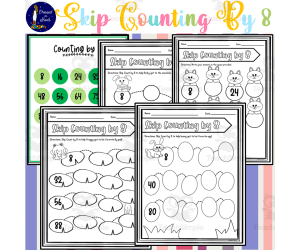
Skip Counting by 8 Worksheets
Math, Patterns, Kindergarten, Preschool, Grade 1, 2, Worksheets & Printables, Worksheets
Cute and fun skip counting by 8 worksheets . Includes: Counting by 8 posters in color Counting by 8 B&W poster Skip counting by 8 practice (8 to 56) Skip counting by 8 practice (8 to 80) Skip counting by 8 practice (8 to 112) Skip counting by 8 practice (56 to 120) Skip counting by 8 practice (8 to 112) Answer key ---------------------------------------------------------------------------------------------------
Author Soumara Siddiqui
Tags Skip Counting Posters, Skip Counting Worksheets, Skip Counting By 8, Skip Counting, Skip Counting By 8's

Beginning Sounds, Vowels, and Word Families Printable Workbook
ELA, Language Development, Phonics, Kindergarten, Preschool, Grade 1, Workbooks, Worksheets & Printables
Beginning Sounds, Vowels, and Word Families Printable Workbook helps young learners build critical early reading skills. This 28-page printable packet focuses on phonics development with tracing, spelling, and game activities to reinforce letter-sound relationships. Children learn to recognize the most common vowel sounds and consonant blends while spelling simple CVC words. The materials use engaging illustrations to model each activity . Educators can implement these materials in multiple ways - during whole group phonics lessons, small reading groups, independent work, or as supplemental homework. The scaffolded activities allow students to progress from basic letter recognition to decoding simple word families. This research-based phonics resource is well-suited for preschool, kindergarten, and first grade.
Author Twin Sisters Digital Media
Tags Phonics, Vowels, Beginning, Sounds, Word Families

Academic Citation Styles: A Comprehensive Guide for Students and Teach
Formal Writing, Writing, ELA, Adult Education, Rubrics, Teacher Tools, Outlines
This manual assists students and educators in understanding the most common academic citation formats in a clear and useful way. It explains how each style works and offers clear examples for instant application. It includes APA, MLA, Chicago, Harvard, IEEE, AMA, and Turabian formats. Each section contains succinct explanations, key features, and sample references. This enables students to readily recognize the distinctions and choose the suitable style for their tasks. This resource is available for educators to assist in creating lesson plans, research assignments, and scholarly articles. It reduces preparation time because of its structure and clarity. It can act as a fast guide for students when composing essays or completing tasks. The examples help them follow the rules correctly and avoid plagiarism. The language is simple, and the format is easy to follow. The guide can be used in class, during online lessons, or for independent study. It works well for writing at the levels of middle school, high school, and college. This resource acts as an effective tool that streamlines academic writing and enhances the confidence of each learner
Author Bright Classroom Ideas Marketplace
Rating
Tags Citation, Writing, Academic, College, University, Higher Education, Chicago, Mla
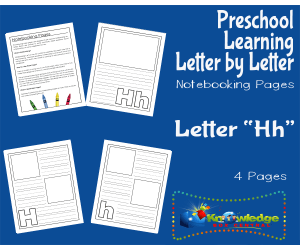
Preschool Letter by Letter: Letter H - Notebooking
ELA, Writing, Handwriting, Kindergarten, Preschool, Worksheets & Printables, Worksheets
Preschool Letter by Letter: Letter H - Notebooking This exceptionally designed tool is everything you need to help preschool aged children learn about the English alphabet with a keen focus on the letter 'H.' With seven pages of engaging, fun-filled activities, this digital resource centres around mastering letter recognition. The teaching guide includes: Explicit instructions for teachers or homeschooling parents on how to maximize outcomes using these materials. Three unique worksheets specifically designed for early learning needs at preschool and kindergarten levels. In these worksheets, learners will find a variety of exciting exercises constructed around tracing methodology and notebooking techniques—designed to enhance their language arts skills. These varied exercises can be integrated into group activities during in-class instruction or applied in smaller groups during centers time. They may also be sent home as part of homework assignments for further practice developing handwriting skills. Digital features include: A downloadable file for easy access at any time. A PDF file format that ensures no loss in picture or text quality when emailed or printed. The Preschool Letter by Letter: Letter H - Notebooking resource takes education beyond just literacy development; it ignites an interest in learning from an early age! Remember: Use this instrument wisely because every child deserves a fun-filled journey into literacy one step at a time!
Author Knowledge Box Central
Tags Preschool, Letter Recognition, Handwriting Skills, Language Arts, Notebooking
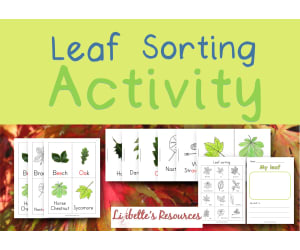
Leaf Sorting Activity: Kindergarten Science Projects
Science, Life Sciences, Nature & Plants, Biology, Grade 1, 2, Activities
Leaf Sorting Activity: Kindergarten Science Projects This Leaf Sorting lesson pack can help you to deliver the National Curriculum (or other Science curriculum for ages 5 to 6) for Science in Year 1. It is best carried out in autumn as the leaves fall, but can also be done in spring as new leaves emerge and children's interest in them can be excited. The Leaf Sorting Activity includes References to the relevant parts of the National Curriculum (but the activity does not have to be used in conjunction with the UK National Curriculum ). * 12 pictures of varying leaves, suitable for sorting according to vein pattern, formation and leaf properties (e.g. prickly/rounded edges, deep cut edges etc..) - in two sizes for whole class/group use or display. * a My Leaf recording worksheet * a sheet of 12 small pictures to sort, cut out and stick. How to sort leaves Leaves can be sorted according to several different factors. Sort by one property at a time. Edge - wavy, prickly, jagged, sharp etc… (let the children suggest ideas) Veins: One ‘spine’ vein with branches (many leaves) Like umbrella spokes (Nasturtium) Several main veins coming from base of leaf, with branches from each (Sycamore) Feel/look: soft, hairy, sharp, prickly, smooth, rough, tough, shiny etc… Colour: shade of green in spring/summer, or autumn colours (red, orange, brown, yellow etc…) Can the children find: All the prickly leaves? All the deeply notched leaves? All the leaves with leaflets? All the soft leaves? Etc… Children may dispute whether a leaf falls into a category or not. Use this as valuable discussion, always securing a good reason for their thinking. How to use the activity Class sorting: Let individual children hold up to 5 large leaf pictures. Can the children see two leaves that might match and say how they match? Now can they see if any other leaves fit that group - hold up the other leaf pictures one by one and see if they fit, passing the picture to another child to join the group, if that leaf fits. Does this leaf have …? Try sorting by various properties before letting the children take a leaf to sketch and describe on the ‘My leaf’ sheet. Group sorting: A small group of children can be challenged to find a way of sorting the leaves so that as many of them as possible are in a group. Or, more simply: Can you find the leaves that are pointed/sharp/have leaflets, are soft etc… Children can then be given the sheet of small leaves to sort in the way the teacher outlines. More! See our Autumn Leaves PowerPoint and All about Autumn PowerPoint What is included? 1 PDF with 13 pages: 12 small leaf pictures 12 large matching leaf pictures A sheet of 12 small pictures to sort, cut out and stick. A 'My Leaf' recording sheet
Author Lilibette's Resources
Rating
Tags Leaf Sorting, Sorting Leaves, Leaf ID, Trees, Leaves, Autumn, Spring, Autumn Leaves, New Leaves, Kindergarten Science Projects

Novel Study Worksheets - To the Future Ben Franklin - Magic Tree House
ELA, Reading, Reading Comprehension, Grade 3, 4, 5, 6, Worksheets, Worksheets & Printables
Novel Study Worksheets - To the Future, Ben Franklin - Magic Tree House This comprehensive English teaching resource offers a structured novel study activity centered on Mary Pope Osborne's beloved book, "To the Future, Ben Franklin" part of The Magic Tree House series. Spanning three printable PDF pages, this resource is perfect for enhancing students' understanding and engagement with the novel. Designed for primary and middle school students in grades 3 through 6, this resource is an excellent choice for post-reading activities that reinforce key elements of the story. The novel study includes a variety of exercises aimed at deepening comprehension and encouraging creative expression. Key components of this resource include: Setting Analysis: Students will answer two questions focusing on where and when the story takes place, helping them to grasp the importance of setting in the narrative. Vocabulary Development: A dedicated section prompts students to identify and explore new vocabulary words encountered in the text, enhancing their language skills. Chapter Summaries: Students are guided to summarize each chapter, reinforcing their understanding of the plot and key events. Creative Writing Activities: Two engaging writing exercises are included to spark imagination. The first invites students to imagine themselves alongside Jack and Annie, the book's protagonists, and write a postcard to a friend or family member describing their adventure. The second activity challenges them to create an alternative ending to the story, fostering critical thinking and narrative skills. This novel study resource not only aids in comprehension and vocabulary building but also encourages students to think critically and creatively about the story. It’s an ideal tool for teachers looking to enhance their English curriculum with interactive and thought-provoking activities related to The Magic Tree House series. This English Language Novel Study on "To the Future, Ben Franklin" PDF Printable Worksheets (3 slides) can be great for learners from 3rd grade to 6th grade to study this Magic Tree House Novel Learning with Alan is a Brand New Teaching Resource/Educational Material Store whose aim is to help Teachers, Educators and Tutors to achieve their teaching objectives while creating a fun and stimulating environment. Never Forget! If you want to browse more of my Teaching Resources, click here Learning with Alan!
Author Learning with Alan
Tags Novel Study, Magic Tree House, Books, Benjamin Franklin, American History, United States, Reading, Writing, Activity, Comprehension
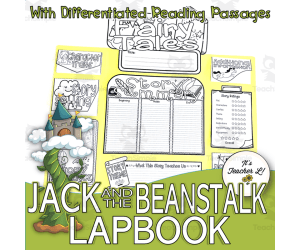
Jack and the Beanstalk Lapbook Project Reading & Writing Grade 3 4 5
Language Development, ELA, Children’s Literature, Literature, Literary Devices, Reading Comprehension, Reading, Grade 3, 4, 5, Activities, Centers, Crafts, Projects, Teacher Tools, Graphic Organizers, Assessments
Trek the trail of Jack in this fantastic Jack and the Beanstalk Lapbook Project designed for Grades 3, 4, 5, homeschool classrooms, and EFL/ESL learners. This perfect resource set is made for reading classes, reading centers, fairy tale units, sub plans, as well as a supplemental assessment tool for your reading comprehension activities. Contents: •3 Jack and the Beanstalk Lapbook Differentiated Reading Passages (Easy, Average, Hard) •6 Jack and the Beanstalk Lapbook Themed Lapbook Covers •2 Jack and the Beanstalk Lapbook Name Pages •1 Jack and the Beanstalk Lapbook Inner Overlap Page •3 Jack and the Beanstalk Lapbook Story Summary Page Options •2 Jack and the Beanstalk Lapbook Story Message Pages •2 Jack and the Beanstalk Lapbook Story Sequence Pockets •6 Jack and the Beanstalk Lapbook Story Sequence Photocards •3 Jack and the Beanstalk Lapbook Story Sequence Sets (6 cards each: Easy, Average, Hard) •6 Jack and the Beanstalk Lapbook Story Retell Cards •1 Jack and the Beanstalk Lapbook Character Traits Fold •1 Jack and the Beanstalk Lapbook Story Setting Fold •1 Jack and the Beanstalk Lapbook Additional Elements Fold •1 Jack and the Beanstalk Lapbook Story Ratings Page •1 Jack and the Beanstalk Lapbook Personal Reflection Fold
Author It's Teacher L
Rating
Tags Jack And The Beanstalk, Fairy Tale, Reading Comprehension, ELA Project

World War I: Major Battles Gr. 5-8
Social Studies, History, History: World, Grade 5, 6, 7, 8, Teacher Tools, Lesson Plans
World War I: Major Battles Gr. 5-8 A comprehensive teaching resource ideal for grade 5 to grade 8 educators. This educational tool provides critical insights into the global conflict of World War I, which lasted from 1914 to 1918. Main Concepts: Nationalism, imperialism, and militarism as causes of war during this historical period. The assassination of Archduke Franz Ferdinand leading up to major conflicts such as the one at Somme. Insignificant tensions in Europe culminating in a prominent Soviet conflict. Alliances: This resource includes lessons detailing alliances during this time-period - specifically, the roles of the Triple Alliance and Triple Entente. America's Participation: Students will be introduced to key events responsible for America's participation in war from Lusitania’s sinking to decoded plans involving mainland attacks. President Woodrow Wilson’s Peace Program: A critical aspect emphasized within this resource involves President Woodrow Wilson’s Fourteen Point peace program presented before Congress—an essential turning point towards peace after years of warfare. Influence by Industrial Era & Geographic Changes: The impact by industrial era on weaponry production and battling methodologies used during this period is explored extensively. Learners can understand how Europe changed geographically following Versailles Treaty implementation—an event directly shaping modern Europe today geographically.. Educational Flexibility & Alignments: The package is perfectly suited for various modes of teaching facilitation due its flexibility. It aligns with state standards and incorporates Bloom's Taxonomy. Additional Educational Elements: The resources also include engaging elements such as crosswords, word searches, a comprehension quiz, and an answer key for reinforcing knowledge retention among students. The teaching resource packet comes as a single accessible PDF file for efficient utilization by educators.
Author Classroom Complete Press
Tags PDF, World War 1 Famous Battles
Energy Around Us Gr. 4-7
Science, Physics, Grade 4, 5, Teacher Tools, Lesson Plans
Energy Around Us Gr. 4-7: A Comprehensive Teaching Resource The 'Energy Around Us Gr. 4-7' product is a comprehensive teaching resource for educators aiming to immerse students into the complex facets of energy. Whether public school teachers or homeschoolers, it offers engaging tie-in activities while introducing various forms of energy and exploring energy transformation. Centricity on Physical Science This unit is primarily focused on Physical Science, unveiling critical information through a series of student notes that emerge as lessons progress. The Science Challenge Format Promotes cooperative learning. Fosters problem-solving related to each lesson's theme. Serves as an active learning platform crucial for understanding complex scientific concepts like energy transformation. Beyond Interactive Sessions: Including exercises such as crosswords and word searches to reinforce knowledge in an enjoyable way, it ensures interactive sessions aren't limited only to student note discussions. Utilization across different teaching setups without disruption along with its applicability from grade 4 up-to grade 7 frameworks makes this resource a practical tool for teachers. A holistic approach: Educational reading passages, energy-themed activities, xpath management solutions- All these features bring together a balance between complexity and comprehensibility making 'Energy Around Us Gr. 4-7' the perfect choice in understanding physical science topics associated with energy attributions. Encased within easy access PDF files without having issues around software compatibility this resource effectively fuses fun with learning whilst understanding the omnipresent nature of energy!
Author Classroom Complete Press
Tags PDF

Gave Song (MP3)
ELA, Reading, Preschool, Kindergarten, Grade 1, 2, 3, Songs, Activities
This song will help students recognize the sight word GAVE. It is repeated, spelled, and used in sentences put to a catchy tune. This could help other teachers because it is a fun and easy way for students to learn.
Author Have Fun Teaching
Tags Counting

Literacy worksheets: Atmospheric conditions
ELA, Language Development, Vocabulary, Science, Earth and Environmental Sciences, Earth Sciences, Grade 3, 4, 5, Worksheets & Printables, Worksheets
Atmospheric Conditions Literacy Worksheets Dive into weather and climate with these engaging literacy worksheets for grades 3-5. Students will build vocabulary around atmospheric conditions through activities like bingo, word searches, anagrams, and more. Additional sections guide learners to make connections, write stories, conduct research, compare concepts, and illustrate scenes related to the topic. This self-paced resource can be used for independent practice, small groups, or whole class instruction in remote, hybrid, or traditional school settings. With over 25 standards-aligned activities, this packet offers versatile options to supplement science and language arts curriculum .
Author Learn it ANY way
Tags Atmospheric Conditions, Weather, Vocabulary, Reading, Writing, Grammar

Biology Binder Covers – Templates for Classroom Use
Life Sciences, Science, STEM, Basic Science, Special Resources, Montessori, Classroom Management, Resources for Teachers, Biology, Human Body, Homeschool Templates, Grade 7, 8, 9, 10, 11, 12, Worksheets, Worksheets & Printables, Teacher Tools, Projects, Activities, Workbooks, Drawing Templates & Outlines, Templates, Graphic Organizers, Experiments
Biology Binder Covers – Templates for Classroom Use Organize your biology handouts, notes, and units with visual clarity Simple and flexible templates to help organize your biology materials In my biology classes, it can be a challenge to keep things organized - especially when it comes to multiple units, lab notes, worksheets and review materials. To make it easier for my students and myself, I designed these simple binder sleeves. There are 12 different pages. The covers have a clean, colorful blob layout that is friendly but not distracting. I usually print them out and use them as cover sheets or as dividers in folders for students or teachers. They also work well for digital learning environments, e.g. as section covers in PDF files or on classroom platforms. I like that the color scheme allows students to quickly find what they are looking for, and it brings a little more structure to a subject that is often riddled with formulas and technical terms. When used as cover sheets, students can choose their favorite color for their cover sheet. This resource is handy - and has saved me a lot of time in lesson preparation and follow-up. What’s included: 12 biology-themed cover pages different colors zu choose as a cover sheet as a divider between the individual biology topics I've printed these on colored paper for my own binder and also used them digitally in student notebooks. Works well for both teacher organization and student-facing materials. 📍 Best wishes, Heike from Lernfitness Biology teacher (Chemistry teacher, Math teacher) in Germany Did You Know? I teach with a certified therapy dog, and together we create a positive and inspiring learning environment. 🐶✨
Author Lernfitness
Rating
Tags Science, Biology, STEM, Binder, Cover Sheet, Template, Organizer, Organize, GoodNotes, PDF

Unit 2 - Binder Divider, Review Activities, Test, and Recovery Quiz
Science, Chemistry, Physics, Grade 6, 7, 8, 9, 10, 11, 12, Tests, Quizzes and Tests, Teacher Tools
Unit 2 - Binder Divider, Review Activities, Test, and Recovery Quiz This resource is an essential toolkit for educators teaching Physics and Chemistry to grades 6 - 12. The package provides a structured approach for lesson delivery with several components included. The resource comes with: Unit 2 Binder Divider: A printable tool for students to remain organized by separating the binder into units making resources accessible. Metric Units Review Card Game: A two-sided card game reinforcing understanding of units such as acceleration measures in an engaging format that can be played under teacher supervision. Whiteboard Review: An all-embracing PowerPoint presentation designed for quick revision of all lessons within this unit ahead of assessments . Unit Test – Unit 2: Comprises varied question types like matching pairs, calculations ensuring comprehensive grasp over the unit. Recovery Quiz: Focused on areas where misconceptions are common providing reinforcement chances and opportunities for score enhancement. This material correlates with the Indiana State Standards for Integrated Chemistry & Physics , aiding students to master vital science skills including distinguishing speed from velocity or average speed versus average velocity. It also offers adjustability! You have the liberty to apply it as whole group instruction or small group activities or even homework based on what suits your classroom best. Get access to both .docx (editable) and .pdf (non-editable) versions enabling customization yet keeping ready-to-use copies close at hand as needed. All aspects of this set were built taking into consideration development of higher-order thinking skills while provoking curiosity about physical sciences smoothly navigating across major milestones through a constituted structure leading content exploration towards a successful closer of their educational pursuit. Note: Software capable of opening or editing .docx and .pdf files is required to use this resource effectively.
Author Integrated Chemistry and Physics
Tags Binder Divider, Review Activities, Test, Recovery Quiz, Physics And Chemistry

St. Augustine Research Organizer & Essay Assignment
Social Studies, ELA, Biographies, History, History: World, History: Ancient, Grade 7, 8, 9, 10, Activities, Projects, Worksheets & Printables, Worksheets
St. Augustine was theologian from the earlier period of Christianity whose writing greatly influenced medieval society. This resource provides your students with the opportunity to independently explore and write about the life of the "patron saint of theology" with this engaging research planner and essay assignment. This carefully scaffolded and easy-to-assign-AND-assess resource has been designed to guide student learning from St. Augustine fact-collection to the careful development of a five-paragraph research essay. Teaching this resource could not be easier! Start by handing out the background research and note-taking worksheet (you could also ONLY hand this out if you want a shorter lesson!). Once students have found their facts and sources, provide them with the essay outline activity, which guides them step-by-step through the requirements of a short research essay. From there, drafting their essay, using the provided peer review checklist, and submitting their final draft will be no problem at all. And then you can assess their work with the provided Common Core rubric! Use this entire resource as a complete research lesson or just part of it as a short research activity or sub plan! This TeachSimple download includes: - A St. Augustine essay writing assignment with directions, requirements, research essay writing tips, a peer review checklist, and Common Core-tied grading rubric - An editable rubric, provided as a link, that lets you make adjustments to the grade values and guidelines. This link is provided as as Google Sheet specifically built for integration into Google Classroom, although you can also modify it for use in other Learning Management Systems (LMSs) - A St. Augustine biography and note-taking worksheet that will guide your students through information gathering. This straightforward two-page handout includes instructions for background research, a fun drawing section, and an area to cite quality sources and organize conducted research - A research essay outlining worksheet, so students build on their St. Augustine notes in a clear and simple manner as they build their work towards a draft and final paper - All 6-pages of this lesson are provided in full-color and B&W versions Although this resource can be fitted for any secondary Language Arts classroom, it has been carefully designed to work best in grades 8 through 11. The included rubric is subtly but specifically tied to Common Core ELA Standards for Language (3) and Writing (2 and 7). This resource is provided as a print-ready, bookmarked, and adjustable PDF file. The rubric is also included as an editable Google Sheet. This resource contains 6 pages and 1 Google Sheet.
Author The Language of Educational Art, LLC
Tags Essay, Rubric, Research, Notetaking, Outlining

Qatar Reading Comprehension Passage - Cored Ed Encyclopedia
ELA, Language Development, Resources for Teachers, Reading Comprehension, Reading, Pre-Reading, Writing, Geography, Social Studies, History, Grade 2, 3, 4, 5, Worksheets & Printables, Worksheets, Teacher Tools, Centers, Activities, Writing Prompts, Assessments, Quizzes and Tests, Quizzes, Lesson Plans
This Qatar reading comprehension includes: Visualization (on the front cover) Start your lesson by taking a minute to think and share something about the topic. Read the script aloud (slowly), perhaps prepare some music or sound effects. Student close their eyes and let their imaginations wander. Students open their eyes, read the question aloud and give them a few minutes to complete. Ask a few students to share or keep answers until the end to compare with what they learn in the passage. Quick pause—thousands of Cored Education products are included with your TeachSimple membership. Download links and encyclopedia index available here. Pre-Reading Trivia Students will write down one thing they already know about the subject and then read five more facts and discuss. These facts are fun, and the students will enjoy learning about the subject before reading more. Give 1 minute for students to write what they already know (no pressure—best guess is fine). Read the five facts together. After each fact, do ask a student for their opinion, was it surprising? Set a purpose by asking students to highlight/underline one fact they want to learn more about during the reading. Reading Passage The text is a high-interest reading passage with set paragraphs, roughly three to four paragraphs long. It contains a variety of themes about the topic, anywhere from history to technology. The passage is between 250 and 350 words in length. First, ask students to look at the headings and see what they’ll learn about today. What do they know about the topic/heading? First read options: Teacher read-aloud (best for support). Partner reading (paragraph by paragraph). While reading, students underline important details, and vocabulary words they think may come up in the questions section. Mixed Questions The first question page contains four multiple-choice questions, each with a choice of four answers, and three written response questions that require a sentence or two from the student. Students complete the mcqs first independently, then review quickly as a class. For the 3 written responses, try to get students giving the answer with some form of evidence: “I think ___ because the text says ___.” If students get stuck, send them back to check the passage. Vocabulary Questions Practice seven key words from the text in this section across two activities. First section is scrambled words where students will unscramble three words given a clue for each. The second section is a word to meaning matching activity. Before starting, have some students read out words they underlined in the passage. Ask students to say the word and read aloud the sentence(s) around each word. Ask students to do scrambled words and the matching exercise in pairs then go through answers as a class. For the scrambled spelling task, get four pairs to come up to the board and write the words for extra practice with the other student reading out the clue. For the matching task, prompt students to give full sentences: “I matched ___ with ___ because ___.” Creative Writing In this question, the student will be required to write a five to eight sentence paragraph on a question related to the topic. Before starting, ask students write down 3 key ideas they are going to include in their piece. Ask students for ideas to share around the class to help those struggling. Pro writing expectations: 5–8 sentences At least 2 facts or details from the passage At least 2 vocabulary words from the previous page Students read their paragraphs while classmates listen for facts and vocabulary words. Extension Activities This page is optional for fast finishers or to take home. There are several activities, each one requiring a different skill. Do some, do none, do all, completely optional - but you will feel reassured knowing every possibility is planned for. Includes summary writting question. Answer Key There are answers for the multiple-choice questions, written response questions have sample answers, vocabulary answers and if there is a summary question then a sample summary will be provided as well. Lesson Plan Included Customized lesson plan for this lesson is included. Lesson Snapshot Title: Qatar Genre: Nonfiction (informational reading passage) Subject: Social Studies (Geography/History/Economics) Primary Topic: Qatar’s geography and change over time Estimated Guided Reading Level (A–Z): R What This Lesson Teaches Best How location and landforms shape a place (peninsula in the Persian Gulf; sea on three sides; sand dunes; an inlet called the Inland Sea). How a country’s economy can change over time (from pearling to oil and natural gas). Cause-and-effect in history (cultured pearls spread → pearling trade collapsed; oil/gas money → schools, hospitals, ports, neighborhoods). Connecting past and present in one place (pearl boats and tall towers sharing the same shoreline; Doha’s modern landmarks). Built-in comprehension practice (pre-reading trivia, mixed questions, vocabulary work, writing and extension activities align to passage details). Learning Goals I can describe Qatar’s location and what surrounds it using details from the passage. I can explain how pearl diving worked and why the pearling trade collapsed. I can identify how oil and natural gas changed Qatar and name what was built with that money. I can sequence key changes over time mentioned in the passage (pearling, oil discovery/exporting, independence, World Cup). I can use passage vocabulary (like peninsula, inlet, emirate) when talking about Qatar. Key Vocabulary From the Text peninsula — land with water on most sides inlet — water cutting into land from the sea seafloor — the bottom of the sea cultured — made or grown with human help emirate — a place led by an emir FULL CATALOG OF DOWNLOAD LINKS AND ENCYCLOPEDIA INDEX HERE
Author Cored Education
Rating
Tags Vocabulary, Reading Comprehension, Reading Passages, Reading, Creative Writing, Reading Strategies, Writing Prompts, Lesson Plans, Geography, Qatar

GCSE Poetry Lesson: ‘Love’s Philosophy’ by Percy Bysshe Shelley
ELA, Literature, Poetry, Grade 9, 10, 11, 12, Teacher Tools, Lesson Plans
GCSE Poetry Lesson on 'Love’s Philosophy' by Percy Bysshe Shelley This invaluable educational resource corresponds to an in-depth guide for educators teaching 'Love’s Philosophy' at grade 9 to 12. Primarily designed as a PowerPoint presentation, it amalgamates an array of elements into 18 engaging slides. Focal Points Covered: Poem Background: A brief biography about Percy Bysshe Shelley aids students in understanding his life and works. Thematic Exploration: Rich discussions around complex themes such as unrequited love. 'Content-Language-Structure': Vital components covered enhancing student comprehension skills while broadening their understanding and appreciation for poetry. Towards Interactive Learning: The resource fosters interactivity via features like starter activities, academic writing tasks engaging critical thinking skills, extension tasks for more advanced learners, and homework assignments fueling continuous practice. It culminates with a plenary that assists in summarizing the entire session meticulously. The GCSE Poetry Lesson on 'Love’s Philosophy', designed bearing teachers’ needs in mind, eliminates any additional work from your end making every minute worthwhile! Note: This versatile educational aid has been used effectively across multiple settings such as leading classroom instructions or remote learning using Google Meet lessons. Its adaptability also extends to act as an instrumental part of homework assignments or revision material.
Author Flynn's Educational
Tags GCSE Poetry, Love's Philosophy, Percy Bysshe Shelley, Unrequited Love, Comprehension Skills, Love's Philosophy Poem, Shelley Love Philosophy
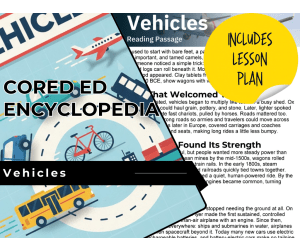
Vehicles Reading Comprehension Passage - Cored Ed Encyclopedia
ELA, Language Development, Reading Comprehension, Reading, Pre-Reading, Science, Technology, Engineering, History, Social Studies, Grade 2, 3, 4, 5, Worksheets & Printables, Worksheets, Teacher Tools, Centers, Activities, Writing Prompts, Assessments, Quizzes and Tests, Quizzes, Lesson Plans
This vehicles reading comprehension with lesson plan includes: Visualization (on the front cover) Start your lesson by taking a minute to think and share something about the topic. Read the script aloud (slowly), perhaps prepare some music or sound effects. Student close their eyes and let their imaginations wander. Students open their eyes, read the question aloud and give them a few minutes to complete. Ask a few students to share or keep answers until the end to compare with what they learn in the passage. Quick pause—thousands of Cored Education products are included with your TeachSimple membership. Download links and encyclopedia index available here. Pre-Reading Trivia Students will write down one thing they already know about the subject and then read five more facts and discuss. These facts are fun, and the students will enjoy learning about the subject before reading more. Give 1 minute for students to write what they already know (no pressure—best guess is fine). Read the five facts together. After each fact, do ask a student for their opinion, was it surprising? Set a purpose by asking students to highlight/underline one fact they want to learn more about during the reading. Reading Passage The text is a high-interest reading passage with set paragraphs, roughly three to four paragraphs long. It contains a variety of themes about the topic, anywhere from history to technology. The passage is between 250 and 350 words in length. First, ask students to look at the headings and see what they’ll learn about today. What do they know about the topic/heading? First read options: Teacher read-aloud (best for support). Partner reading (paragraph by paragraph). While reading, students underline important details, and vocabulary words they think may come up in the questions section. Mixed Questions The first question page contains four multiple-choice questions, each with a choice of four answers, and three written response questions that require a sentence or two from the student. Students complete the mcqs first independently, then review quickly as a class. For the 3 written responses, try to get students giving the answer with some form of evidence: “I think ___ because the text says ___.” If students get stuck, send them back to check the passage. Vocabulary Questions Practice seven key words from the text in this section across two activities. First section is scrambled words where students will unscramble three words given a clue for each. The second section is a word to meaning matching activity. Before starting, have some students read out words they underlined in the passage. Ask students to say the word and read aloud the sentence(s) around each word. Ask students to do scrambled words and the matching exercise in pairs then go through answers as a class. For the scrambled spelling task, get four pairs to come up to the board and write the words for extra practice with the other student reading out the clue. For the matching task, prompt students to give full sentences: “I matched ___ with ___ because ___.” Creative Writing In this question, the student will be required to write a five to eight sentence paragraph on a question related to the topic. Before starting, ask students write down 3 key ideas they are going to include in their piece. Ask students for ideas to share around the class to help those struggling. Pro writing expectations: 5–8 sentences At least 2 facts or details from the passage At least 2 vocabulary words from the previous page Students read their paragraphs while classmates listen for facts and vocabulary words. Extension Activities This page is optional for fast finishers or to take home. There are several activities, each one requiring a different skill. Do some, do none, do all, completely optional - but you will feel reassured knowing every possibility is planned for. Includes summary writting question. Answer Key There are answers for the multiple-choice questions, written response questions have sample answers, vocabulary answers and if there is a summary question then a sample summary will be provided as well. Lesson Plan Included Customized lesson plan for this lesson is included. Lesson Snapshot Title: Vehicles Genre: Nonfiction (Informational text) Subject: Social Studies / Science & Technology Primary Topic: How transportation changed from wheels to flight Estimated Guided Reading Level (A–Z): P Support pages: Pre-reading trivia, mixed questions, vocabulary practice, creative writing, extension activities, and an answer key. Support-page QA check: Some vocab items don’t match the exact word forms in the passage (e.g., chariot vs chariots , battery vs batteries , submarine vs submarines , locomotive vs locomotives ). What This Lesson Teaches Best Sequence of transportation changes over time: Moves from walking/animals, to logs/sledges, to wooden wheels and wagons, to roads and coaches, to steam locomotives, motor vehicles, and airplanes. How inventions improved travel and hauling: Explains how wheels, roads, tracks/railroads, and engines made travel smoother, faster, and able to carry heavier loads. Using headings to organize information: Section headings (“Roads…,” “When Steam…,” “A Lift Into the Air”) help readers track time periods and big shifts. Key historical details in an informational text: Includes dates and examples such as Uruk clay tablets (3700–3500 BCE) and the Wright Flyer flight (December 17, 1903). Modern tech and environmental impact: Notes electric motors, rechargeable batteries, and “no tailpipe exhaust,” ending with a question about helping the planet. Learning Goals Students will describe how people traveled and carried loads before wheels, using details from the passage. Students will identify how wheels changed what vehicles could do (hauling goods and moving more easily). Students will explain how roads and railroads affected travel and connected places, based on the text. Students will summarize the “biggest leap” in travel described in the passage and name the example given. Students will use headings and key details to retell the passage’s main changes in transportation in order. Key Vocabulary From the Text sledge — a sled that helps heavy things slide. Mesopotamia — an ancient region where Uruk was located. spoked — having thin supports connecting wheel center to rim. locomotives — train engines that pull cars on tracks. rechargeable — can be filled with power again. FULL CATALOG OF DOWNLOAD LINKS AND ENCYCLOPEDIA INDEX HERE
Author Cored Education
Rating
Tags Vocabulary, Reading Comprehension, Reading Passages, Lesson Plans, Ela Lesson Plans, Reading Comprehension Lesson Plans, Pre-reading, Science Lesson Plans, Technology, History Lesson Plans

Ending Sounds F G K Sentences Worksheet
ELA, Language Development, Phonics, Grade 1, 2, 3, Worksheets & Printables, Worksheets
Ending Sounds F G K Sentences Worksheet: This worksheet is perfect for students who are learning to identify and produce words with the ending sounds F, G, or K. By completing the sentences with the correct ending sound, students will practice their phonemic awareness and phonics skills. This is a great resource for teachers who are looking for extra practice materials for their students.
Author Have Fun Teaching
Tags Consonants, Ending Sounds

Sherpas in Nepal: Social Studies Reading Comprehension Passage (Docs)
ELA, Reading, Reading Comprehension, Strategies, Resources for Teachers, Social Studies, Sociology, Geography, Grade 6, 7, 8, 9, Writing Prompts, Worksheets & Printables, Centers, Activities, Teacher Tools, Assessments, Quizzes and Tests, Quizzes, Tests
Sherpas in Nepal: Social Studies Reading Comprehension Passage (Docs) This resource introduces a unique Social Studies reading comprehension passage with questions about The Sherpas in Nepal. The passage is carefully designed to bridge the gap between social studies and literacy through strengthening reading comprehension and sparking knowledge curiosity in middle school students. Each passage blends English Language Arts skills with accurate social studies content . Ideal for interdisciplinary learning in ELA and Social Studies. Suitable for Grade 9 review, too! Student Tasks throughout the passage: 5 multiple-choice questions targeting the following skills: main idea, key details, inference, vocabulary in context, and use of evidence 5 vocabulary matching items with clear, student-friendly definitions 5 text-based questions that require citing specific lines or facts 1 summary prompt that asks students to condense central ideas accurately Full answer key for every section Available Formats for this Resource: PDF Fillable PDF Word Docs FULL CATALOG OF DOWNLOADING LINKS HERE Social Studies Reading Comprehension Collection Links: 1. Ancient Civilizations PDF Fillable PDF Word Docs Google Docs 2. Early Empires and Trade Networks PDF Fillable PDF Word Docs Google Docs 3. The Founding of the United States PDF Fillable PDF Word Docs Google Docs 4. Language, Culture, and Meaning PDF Fillable PDF Word Docs Google Docs 5. Psychology and Society PDF Fillable PDF Word Docs Google Docs 6. Global Festivals and Traditions PDF Fillable PDF Word Docs Google Docs 7. Extreme Environments and People PDF Fillable PDF Word Docs Google Docs 8. Food, Culture, and Preservation PDF Fillable PDF Word Docs Google Docs 9. Global Food Customs PDF Fillable PDF Word Docs Google Docs 10. Media, Communication, and Popular Culture PDF Fillable PDF Word Docs Google Docs 11. Human Impact on the Environment PDF Fillable PDF Word Docs Google Docs 12. Civic Action and Social Change PDF Fillable PDF Word Docs Google Docs 13. Fashion, Society, and Power PDF Fillable PDF Word Docs Google Docs 14. People, Places, and Unusual Histories PDF Fillable PDF Word Docs Google Docs Product Details: Length: 5 pages Grades: 6–8, also suitable for Grade 9 review Use cases: close reading, stations, homework, intervention, test prep, and sub plans Why Teachers Choose This Passage: Authentic social studies content paired with rigorous literacy practice Consistent task structure for easier planning and smoother student routines Clear, age-appropriate writing that builds confidence without oversimplifying Use this passage to reinforce ELA skills in social studies, to add literacy to your lessons, and to support independent work. The passage strengthens main idea, evidence use, vocabulary in context, inference, cause and effect, and summary writing. With ready-to-use assessments and complete answer keys, you can provide focused practice that is simple to run and fast to review.
Author CORED Education - Middle & High School
Rating
Tags Middle School, Reading Comprehension, Reading Strategies, ELA, Centers, Reading Passage, Assessments, Vocabulary, Social Studies, Sociology
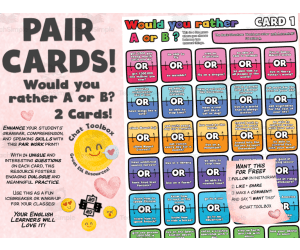
ESL Chat: Preferences, "Would you rather A or B?" Board Game
ELA, Language Development, ESL, Not Grade Specific, Activities, Games
Would you rather buy this print right now and solve all your problems or scroll a lot looking for something better? Stop scrolling here! This pair work activity will help your young learners increase their speaking skill in a super fun way! Enhance your learners' grammar, comprehension, and speaking skills with this activity ! With 30 interesting questions on each card, this resource provides engaging dialogue and meaningful speaking practice. Instructions Pair Work Activity : "Would you rather A or B?" Objective: Practice the grammar pattern "Would you rather A or B?" through interactive pair work. Materials Required: Pair Work cards with various "Would you rather A or B?" scenes. Timer First 1: Assign student pairs and provide each pair with a card. Second 2: Teach the Pattern: Briefly introduce the grammar pattern "Would you rather A or B?" to your students. Give examples and encourage students to form their own sentences using the pattern. Third 3: Work in Pairs: Sstudents take turns answering the question using "Would you rather A or B?" and provide a reason for their choice. Dependent upon level, support students to engage in a meaningful conversation and ask follow-up questions. Monitoring: Walk among the pairs to monitor their progress and provide help if necessary. Give feedback on grammar, pronunciation, and fluency. Activity End: Learners perform the activity until the end of allotted time or they finish their cards. Tips: Encourage learners to elaborate on their answers and provide reasons for their preferences. Tell the importance of active listening and encouraging their partner to speak. Provide positive feedback and praise correct usage of the grammar pattern.
Author Chat Toolbox
Tags Esl, Ell, English Language, Zoom, Literacy, Online Lesson, Handout, Pair Work, Grammar
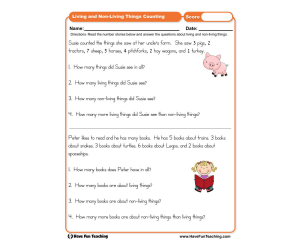
Living Things and Non Living Things Counting Worksheet
Math, Numbers, Science, Earth and Environmental Sciences, Earth Sciences, Preschool, Grade 1, 2, 3, 4, Worksheets & Printables, Worksheets
This Living Things and Non Living Things Counting Worksheet is a great way for students to practice reading number stories and answering questions about living and non-living things. This worksheet can help students learn to identify and count living and non-living things, and is a great way to practice early math skills.
Author Have Fun Teaching
Tags Statistics, Living And Non-Living Things
Algebra: Memory Match Game - PC Software
Math, Algebra, Common Core, Kindergarten, Preschool, Grade 1, 2, Activities, Games
Algebra: Memory Match Game - PC Software Algebra: Memory Match Game - PC Software is a unique teaching resource designed to break down the complexity of algebra for young learners from preschool to grade 2. With this interactive tool, instructors are equipped with a powerful way to engage students in the exploration and understanding of fundamental algebraic concepts. The Interactive Memory Match Game The product presents an intriguing memory match game embedded with carefully selected sets of algebra questions. Hidden as puzzle pieces across the interface, the game carries four matching pairs urging learners not only to memorize but also comprehend core elements. The engaging nature of this interactive memory match game encourages hands-on learning and facilitates strong retention span among young children. Designed in accordance with globally recognized academic standards: NCTM (National Council of Teachers Math) CCSFOM (Common Core State Standards for Mathematics). This ensures exposure applicable at both national and global levels in their early education phases. Simplicity And Educational Flexibility: The Algebra: Memory Match Game - PC Software comes packed into a zip file format making it easy for teachers or homeschoolers to download, install and run on any standard personal computer setup without needing additional hardware investment. This flexible teaching resource can be deployed in various educational settings whether it's traditional classroom-based learning or home-schooling environments; individual self-paced learning or group activities encouraging teamwork amongst student peers; as classwork during sessions or given as fun homework assignments boosting at-home engagement level. Innovative Approach towards Learning: With its unique approach towards conveying intricate abstract knowledge through gameplay interaction, the Algebra: Memory Match Game - PC Software exemplifies how modern resources can turn complex math subjects like Algebra into engaging academic journeys right from preschool level up till grade 2 while aligning with widely recognized academic standards.
Author Classroom Complete Press
Tags Math Games, Algebra Game, Memory Match, Simple Patterns, Subtraction

Astronomy & Space Science: SAMPLE Reading Comprehension Passage (PDF)
Science, Space, Earth and Environmental Sciences, ELA, Reading, Reading Comprehension, Strategies, Resources for Teachers, Grade 6, 7, 8, 9, Writing Prompts, Worksheets & Printables, Centers, Activities, Teacher Tools, Assessments, Quizzes and Tests, Quizzes, Tests
This is a ONE PASSAGE SAMPLE. The following is the description of the FULL resource and the downloading links: Astronomy & Space Science: Reading Comprehension Passages & Questions (PDF) This very engaging collection of science reading passages about Astronomy and Space Science is designed to bridge the gap between science and literacy through strengthening reading comprehension and sparking scientific curiosity in middle school students. Each passage blends English Language Arts skills with accurate science content that supports NGSS classroom practice. Ideal for interdisciplinary learning in ELA and Science. Suitable for Grade 9 review, too! What Is Included? There are (3) informational passages: The Solar System: A Neighborhood in Motion: Understand orbits, the Sun’s role, the differences between inner and outer planets, and where asteroids and comets fit in the system. The Story of Space Science: Trace the path from early skywatching to telescopes, satellites, exploration missions, and the ISS, with practical links to GPS, communications, and weather forecasting. Stars of Many Sizes: Dwarfs, Giants, and Neutrons: Explore stellar types and life cycles, including our Sun, red giants, supernovas, neutron stars, and pulsars. Student Tasks for Each Passage 5 multiple-choice questions targeting main idea, key details, inference, vocabulary in context, and use of evidence 5 vocabulary matching items with clear, student-friendly definitions 5 text-based questions that require citing specific lines or facts 1 summary prompt that asks students to condense central ideas accurately Full answer key for every section Available Formats for this Resource: Word Docs Google Docs FULL CATALOG OF DOWNLOADING LINKS HERE Reading Passage Links: Astronomy & Space Science PDF Fillable PDF Word Docs Google Docs Volcanoes, Rocks, & Mountains PDF Fillable PDF Word Docs Google Docs Rock Cycle, Soil, & Sinkholes PDF Fillable PDF Word Docs Google Docs Mars, Glaciers, & Antarctica PDF Fillable PDF Word Docs Google Docs Water Cycle, Acid Rain, & Wastewater PDF Fillable PDF Word Docs Google Docs Insects, Animals, & Ecosystems PDF Fillable PDF Word Docs Google Docs Bioluminescence & Insects PDF Fillable PDF Word Docs Google Docs Animal Skin, Cats, & T. Rex PDF Fillable PDF Word Docs Google Docs Human Body and Senses PDF Fillable PDF Word Docs Google Docs Health & Applied Bioscience PDF Fillable PDF Word Docs Google Docs Waves, Light, & Imaging PDF Fillable PDF Word Docs Google Docs Electricity & Energy PDF Word Docs Google Docs Motion & Materials PDF Word Docs Google Docs Chemistry and Materials Science PDF Fillable PDF Word Docs Google Docs Product Details Length: 14 pages total Grades: 6–8, also suitable for Grade 9 review Use cases: close reading, stations, homework, intervention, test prep, and sub plans Standards support: reinforces informational-text skills and supports NGSS-style sense making through observation, modeling, and clear use of claim, evidence, and reasoning Why Teachers Choose This Set Authentic science content paired with rigorous literacy practice Consistent task structure across all passages for easier planning and smoother student routines Clear, age-appropriate writing that builds confidence without oversimplifying Use this set to reinforce ELA skills in science, to add literacy to your lessons, or to support independent work. The passages strengthen main idea, evidence use, vocabulary in context, inference, cause and effect, and summary writing. With ready-to-use assessments and complete answer keys, you can provide focused practice that is simple to run and fast to review.
Author CORED Education - Middle & High School
Rating
Tags Middle School, Reading Comprehension, Reading Strategies, Reading Passages, ELA, Centers, Reading Passage, Assessments, Vocabulary, Earth Science
Crash Course Sociology Episode Worksheet | 20 - Crime
Social Studies, History, Psychology, Grade 10, 11, 12, Worksheets & Printables, Worksheets
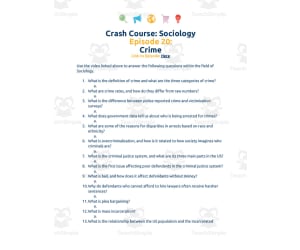
Crash Course Sociology Episode Worksheet on Crime This 2-page worksheet complements the Crash Course Sociology video on crime with 15 questions for students to answer. An answer key is included to allow students to check their work. The engaging 11-minute video explores concepts of crime through a sociological lens. Students will make connections to real-world issues. This resource can be used for whole group instruction with discussion or for independent study. Students can re-watch the relatable Crash Course video to fill in gaps and clarify understanding. Multiple viewings facilitate connections. Other sociology teaching resources from this educator are available spanning civil rights, constitutional clauses, ethnocentrism, team building, discrimination, election basics and more. Visit the storefront Active Social Studies for the full collection.
Author Ed Dynamic
Tags Crime Video, Sociology Course, Crash Course, Government Data, Victimization, Race, Ethnicity, Criminal Justice System, Mass Incarceration