



3,922 products added recently
Page 9 - Physics Lesson Plans
Bring physics to life with lesson plans that simplify concepts such as motion, energy, and forces. These resources provide experiments and demonstrations that make learning interactive. Use them to help students grasp the laws governing the physical world and appreciate the relevance of physics in everyday life.

 Show filters


Sound and Light
Science, Physics, Grade 5, Teacher Tools, Lesson Plans
Sound and Light: Teaching Resource for Grade 5 Science Sound and Light is a meticulously designed teaching resource, specifically tailored for Grade 5 Science teachers. This aid centers around Physics, focusing on enriching students' understanding of sound and light in an engaging manner. Understanding Sound Waves The resource starts with a comprehensive guide about sound waves, simplifying key concepts. Informs that sound is essentially a vibration that moves in waves, making this concept accessible for young learners. Covers vital elements like frequency and amplitude to help define the pitch as well as the impact of loudness or softness on audibility. Exploring The Properties Of Light Delves into properties of light, emphasizing how it travels from source to our eye. Fosters curiosity by explaining how light can be obstructed to form shadows or can bounce off reflective surfaces such as mirrors. 'Light And Color' A detailed guide about 'Light and Color', introducing color spectrum in light along with relationships between color intensities under different lighting conditions—a valuable knowledge base for budding artists! 'Movement Of Light Energy' A deep dive into 'Movement of Light Energy', providing insights on visible light spectrum while exploring various ways through which light can be reflected, refracted or absorbed. The teaching guide comes as a downloadable PDF file supporting transmission over multiple platforms thus offering diverse usage possibilities: whole class instruction; small group work; station activities; independent study sessions or homework assignments! In summary , Sound & Light aims to simplify complex scientific phenomena in cognitively appropriate ways, making learning more concrete than ever before! An all-encompassing exploration for your Grade 5 science curriculum needs.
Author Classroom Complete Press
Tags PDF
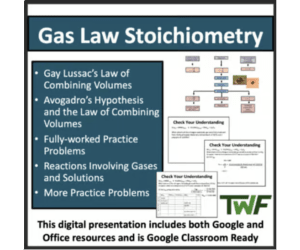
Gas Law Stoichiometry - Senior Chemistry Lesson
Science, Chemistry, Physics, Grade 6, 7, 8, 9, Teacher Tools, Lesson Plans
Gas Law Stoichiometry - Senior Chemistry Lesson Your lesson covers gas law stoichiometry. In order, the lesson teaches about; Gay Lussac’s Law of Combining Volumes, Avogadro’s Hypothesis and the Law of Combining Volumes, Reactions Involving Gases and Solutions and includes fully-worked Practice Problems. Your lesson includes the teacher and student version of the presentation, an auto-graded exit ticket, and a student lesson handout so the students can record the notes on a more condensed medium. This lesson is designed to be your go-to resource, whether you're in a traditional classroom or a virtual one. With both a teacher version and a student version, it seamlessly fits into your lesson plans, making learning engaging and adaptable. Assessment made easy We've included an auto-graded Exit Ticket and a quiz with an answer key because I know you don't have an excess of time. I know you don't, because I don't and I know I'll do whatever I can to reduce my grading time. Whether you use PowerPoint or Google Slides, prefer Word or Google Docs, this lesson has you covered. This lesson comes in both Office and Google formats for your convenience. The student version of the presentation has strategically placed blanks for them to fill in as you're teaching. It keeps them active and engaged, encourages discussion, and leaves more time for those "aha" moments.
Author Teach With Fergy
Tags Earth’s Elliptical Path , Earth’s Motion Around The Sun , The Seasons , Earth’s Tilt , Earth’s Revolution , Equinox , Perihelion , Aphelion

Energy: Sound Energy and Waves
Science, Physics, Common Core, Grade 5, 6, 7, 8, Teacher Tools, Lesson Plans
Energy: Sound Energy and Waves Product Description This teaching resource, titled 'Energy: Sound Energy and Waves,' acts as a comprehensive guide to dispelling the complexities of understanding energy concepts. This chapter is a slice from an extensive lesson plan focusing on energy. Main Features: Covers various forms of energy such as mechanical, thermal, sound, and light energies. Uses easy-to-understand language suitable for remedial students without compromising educational rigor. Incorporates practical experiences through student activities attached to each reading passage. Including vivid color mini posters promoting visual learning. This resource goes beyond conventional textbooks by discussing wider aspects of potential energies and their transformations. It prepares students with deep contextual understanding regarding how different types of energy convert from one form to another. Potential Uses: Ideal for whole-group classroom instruction led by primary teachers. Easily adapted for homeschooling lessons or individual study sessions. Note: The content is aligned with Common Core State Standards grade requirements whilst embracing Bloom's Taxonomy principles making it easily integrated into existing curriculums no matter if the pedagogy style is traditional or modern like STEM initiatives. Specific Target Audience This product is designed specifically for 5th-8th graders studying physics under science disciplines but affordable only digitally as a PDF file making this product environmentally friendly which encourages paper-free academic culture among the learners too.
Author Classroom Complete Press
Tags PDF

I WONDER - What Is Refraction | Animated Video Lesson
Physics, Science, Grade 6, 7, 8, 9, 10, 11, 12, Lesson Plans, Teacher Tools
Video Introduction An amazing activity designed for the students to learn more about STEM. I WONDER - What Is Refraction | Animated Video Lesson Do you like STEM subjects? what is your favorite one? Have you ever tried to plant a seed? If yes, tell us more about it. Or have you ever tried to invent something? If yes, tell us more about it. And how do you think it will help us? Have you ever seen a microorganism under a microscope? What was it? And how it looked like? Mathematics is a marvelous subject. Let' sharpen our brains and solve some equations. Do you like timetable tricks? What is your favorite one? Do you know how to code? Have you ever created an app or a game before? If yes, how was it like? I WONDER - What Is Refraction | Animated Video Lesson The video is perfect for encouraging the researching skills for the students, while learning more about this fantastic topic. I WONDER - What Is Refraction | Animated Video Lesson This friendly designed video is suitable for students at school, homeschooling, and as a group activity. Format Available in MP4 format.
Author Educational Voice
Tags What Is Refraction, What Is Refraction Video, Refraction, Refraction Facts, Refraction Facts For Kids, Refraction Video, Refraction Video For Kids, Physics, Physics Facts, Physics Facts For Kids
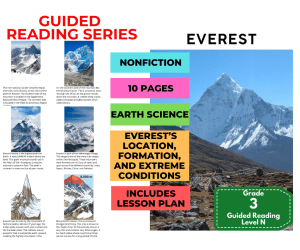
Guided Reading Level N - Everest (with Lesson Plan)
ELA, Resources for Teachers, Reading Comprehension, Reading, Science, Earth and Environmental Sciences, Social Studies, Geography, Life Sciences, Physics, Grade 2, 3, 4, Worksheets & Printables, Worksheets, Teacher Tools, Centers, Activities, Literacy Readers, Quizzes, Quizzes and Tests, Assessments, Lesson Plans
This Guided Reading Book - Everest (Level N) with lesson plan includes: Guided Reading Color Label (front cover x1) This is a quick way to match the book’s demands to what students can generally handle.. The overall goal is to use the level/color to pick books for several smaller groups. To qualify for a certain level, a student is expected to read a book from that level with about 90–94% accuracy. If a student is consistently accurate and understands, move up a level. If the student is struggling at that level, drop down and add more support. Each student will improve at completely different rates, but it is generally one of the best ways to check progress across the class. DOWNLOAD THE CATALOG TO VIEW ALL GUIDED READING BOOKS AVAILABLE (SORTED LEVELS A-Z) Pre-Reading Question (x1) Teacher asks the prompt aloud, can be while showing the cover or first page. Students share what they already know, or make educated guesses from the cover. Prompt them to use the target vocabulary. Write some of their responses on the board to look back at during the reading. Vocabulary Words (x5) Introduce the five words, best doing it one at a time. Start by saying it, while students repeat and then see if anyone knows what it means before reading further. Read through the meaning and try to briefly connect each word to a picture or gesture so it’s meaningful. Ask students to flip through the book pages and point to where they see each of the vocabulary words. While reading the book pause upon coming across one of the vocab words or read the sentence twice to make sure students understand the word has appeared. Optional: Ask students to raise hands whenever they see/hear one of the new words. Guided Reading Pages (x10) Check the book snapshot (below) for: primary topic - do you need to prep extra reading or intro materials on this? what is taught best - decide on 1-2 bullets to focus on, use the prompt or words provided here for best results. learning goals - what you are checking for students to be able to do after the session, elicit answers using prompts or words provided. key vocabulary (see section above). questions overview - so you know what is coming up and if you need to prep extra materials to assist understanding. Run the lesson You may have already looked at a few of the pages together, but you can show them some of the pictures again first to set meaning. Depending on how much time you have and how familiar your students are with guided reading class, you may want to read the book aloud first with the group first. Students whisper or partner read, while you listen in. If time, do it as a group, one student reading a page each. Use the guided page’s prompts to coach: “Check the picture / does it make sense?” “Point under the words / try the first sound” “Reread the sentence smoothly”. Try to focus more on one student per session (rotating every time), so you can work out if they are ready to move up or need to move down a level. Comprehension Questions (back cover x3) This is your way to check that students didn’t just say the words, but actually understood the text. First, let students answer by pointing to the page/picture and saying a short sentence. After any answer, follow with: “Show me where you found that in the text.” In bigger groups, have partners answer first (10–20 seconds), then call on 2–3 students to share. Differentiation tips: Emerging speakers/struggling readers: oral + pointing On-level: oral in a full sentence Higher: one written sentence or draw + label Book Snapshot Title: Everest Genre: Nonfiction (informational text) Subject: Science (Earth Science/Geography) Primary Topic: Mount Everest’s location, formation, and extreme conditions Estimated Guided Reading Level (A–Z): N What This Book Teaches Best Key facts about Mount Everest’s height and setting in the Himalayas in Asia. How mountain ranges form over long periods of time, including tectonic plate movement. How borders and regions connect to physical geography (Nepal/China border across the summit). How extreme environments change with altitude, including the “Death Zone” and low oxygen. How glaciers, weather, earthquakes, and erosion shape Everest and keep it changing. Learning Goals Describe where Mount Everest is located and what mountain system it is part of. Identify what the text says about the border between Nepal and China on Everest. Explain how Everest was formed using the book’s description of tectonic plates. Describe what the “Death Zone” is and why most living things cannot survive there long. Describe how glaciers create features on the mountain, including crevasses. Explain one way Everest is still changing today, using details from the text. Key Vocabulary From the Text summit — the very top point of a mountain. glacier — a huge, slow-moving river of ice. tectonic — related to Earth’s moving crust plates. crevasses — deep cracks in ice. erosion — wind, water, or ice wearing rock away. Discussion Prompts Pre-reading question: Where does the book say Mount Everest stands? Comprehension questions: What does the text say about where the Nepal–China border is on Everest? Comprehension questions: How does the text explain that Everest was formed long ago? Comprehension questions: What is one way the text says Mount Everest is still changing today? Printing Tips 1. Best Printing Method (Recommended) “Booklet” Printing (Best if Available) If your printer or PDF viewer supports Booklet Printing , use this. Settings to use: Print mode: Booklet Paper size: Letter or A4 (either works) Orientation: Landscape Print on both sides: Yes Flip on: Short edge Scaling: Fit to printable area Booklet subset: First test: Front sides only Then: Back sides only This will automatically: Pair pages correctly Put the cover on the outside Align everything for folding After printing, fold in half and staple along the spine . 2. If “Booklet” Printing Is NOT Available You can still print this correctly with manual duplex printing . Step-by-step: Open the PDF. Choose Print . Set: Orientation: Landscape Pages per sheet: 1 Print on both sides: Yes Flip on: Short edge Print all pages . Because each PDF page already contains two facing book pages, the result will still fold cleanly into a book. Thousands of Cored Education products are included with your TeachSimple membership. Download links and encyclopedia index available here.
Author Cored Education
Rating
Tags Reading Comprehension, Reading Passages, Reading, Guided Reading, Guided Reading Lesson Plan, Guided Reading Activity, Pre-reading, Social Studies Lesson Plans, Science Lesson Plans, Geography

I WONDER - Do Chemical Reaction Affect Energy | Animated Video Lesson
Chemistry, Science, Physics, STEM, Grade 6, 7, 8, 9, 10, 11, 12, Lesson Plans, Teacher Tools
Video Introduction An amazing video designed for the students to learn more about STEM. I WONDER - Do Chemical Reaction Affect Energy | Animated Video Lesson Do you like STEM subjects? what is your favorite one? Have you ever tried to plant a seed? If yes, tell us more about it. Or have you ever tried to invent something? If yes, tell us more about it. And how do you think it will help us? Have you ever seen a microorganism under a microscope? What was it? And how it looked like? Mathematics is a marvelous subject. Let' sharpen our brains and solve some equations. Do you like timetable tricks? What is your favorite one? Do you know how to code? Have you ever created an app or a game before? If yes, how was it like? I WONDER - Do Chemical Reaction Affect Energy | Animated Video Lesson The video is perfect for encouraging the researching skills for the students, while learning more about this fantastic topic. I WONDER - Do Chemical Reaction Affect Energy | Animated Video Lesson This friendly designed video is suitable for students at school, homeschooling, and as a group activity. Format Available in MP4 format.
Author Educational Voice
Tags Do Chemical Reaction Affect Energy, Do Chemical Reaction Affect Energy Video, Chemical Reaction, Chemical Reaction Facts, Chemical Reaction Facts For Kids, Chemical Reaction Video, Energy, Energy Facts
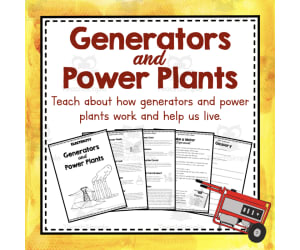
Electricity Unit Study | Generators + Power Plants
Science, Physics, Grade 3, 4, 5, Lesson Plans, Teacher Tools
Electricity Unit Study | Generators + Power Plants A remarkable educational resource focusing mainly on Grades 3 to 5 Physical Science subjects. The aim is to deepen students' understanding of electricity production and distribution via generators and power plants. Comprehensive Set Features: In-depth booklets providing knowledge about reliance on generators and power plants, working principles, functionalities - touching topics like significance of coal in creating electricity, steam formation process, role of turbines etc. An additional assembly guide for making a small-scale motor adding a practical aspect to the theory taught. Variety in size and versions (black & white or color) ensuring maximum compatibility with diverse teaching environments. Instructions: All you need is to print out these booklets (full size or half), get them cut/stapled so student can assemble them. You can browse each page collectively for discussions enhancing classroom interaction while experimenting along adds an experiential element needed for concrete learning! Note: The most interesting part doesn’t end here! Post engaging with these resources – have your class write their own books on what’s been learned. They can also function as research material or be used as foundation for group projects keeping them actively learning. Bonus includes readings succeeded by related questions envisaged at reinforcing concept comprehension besides extra notes if required. A comprehensive glossary included will surely help develop topic-related vocabulary within physical science studies. The materials are delivered digitally in printable PDF format containing 25 pages making it user friendly for educators. Incorporate this into your electricity unit study arsenal– ignite young minds eager to understand, express and experiment on various aspects revolving around how we generate electricity!
Author Simply Schoolgirl
Tags Generators, Power Plants, Electricity Production, Hands-on Experiment, Physical Science

Lesson 2.2 - Speed
Science, Chemistry, Physics, Grade 6, 7, 8, 9, 10, 11, 12, Lesson Plans, Teacher Tools
Lesson 2.2 - Speed This pedagogical resource is designed to aid students in grades six through twelve grasp the concept of speed within the sciences. The teaching materials included revolve around subjects like Chemistry and Physics. This package includes: Instructive worksheets Progressive activities Motivating lesson starters to perfect speed calculations. About the Resource The resource has several integral components including: A detailed notes sheet illustrating the definition and ways of measuring speed. Versions available: An interactive one with blanks for note-taking. A pre-filled version for absentees or those needing extra help. A 'Speed Lab' activity that aids hands-on practice by answering real-time questions. 'Trade-and-Check' sessions replacing traditional question-answer methods with group-oriented problem-solving. An enticing 'Walk to School' activity incorporating Google Maps into hands-on learning while integrating digital resources into individual classroom settings. Additionally, this collection provides PowerPoint versions of instructor notes for clear, sleek presentations. Starter questions enhance student engagement right from lesson commencement. Formats provided are .docx files (editable using Word) & .pptx files (editable on PowerPoint), allowing teachers flexibility in molding materials based on their teaching styles and student requirements. Comprehensive .pdf files ensure undistorted view on any PDF-capable software. Note: This well-balanced mix of traditional print material with digital formats make these resources ideal for whole-class learning, small group instruction or homework tasks—fostering a fun-filled and engaging learning environment all around speed!
Author Integrated Chemistry and Physics
Tags Speed Calculations, Science Instruction, Hands-on Learning, Practical Application, Interactive Teaching

I WONDER - Can Humans Make Radiation | Animated Video Lesson
Chemistry, Science, Physics, Biology, Life Sciences, Grade 6, 7, 8, 9, 10, 11, 12, Lesson Plans, Teacher Tools
Video Introduction An amazing activity designed for the students to learn more about STEM. I WONDER - Can Humans Make Radiation | Animated Video Lesson Do you like STEM subjects? what is your favorite one? Have you ever tried to plant a seed? If yes, tell us more about it. Or have you ever tried to invent something? If yes, tell us more about it. And how do you think it will help us? Have you ever seen a microorganism under a microscope? What was it? And how it looked like? Mathematics is a marvelous subject. Let' sharpen our brains and solve some equations. Do you like timetable tricks? What is your favorite one? Do you know how to code? Have you ever created an app or a game before? If yes, how was it like? I WONDER - Can Humans Make Radiation | Animated Video Lesson The video is perfect for encouraging the researching skills for the students, while learning more about this fantastic topic. I WONDER - Can Humans Make Radiation | Animated Video Lesson This friendly designed video is suitable for students at school, homeschooling, and as a group activity. Format Available in MP4 format.
Author Educational Voice
Tags Can Humans Make Radiation, Can Humans Make Radiation Video, Radiation, Radiation Facts, Radiation Facts For Kids, Radiation Video, Radiation Video For Kids, Humans, Humans Video For Kids

Iguanas Reading Comprehension Passage - Cored Ed Encyclopedia
ELA, Reading Comprehension, Reading, History, Social Studies, Science, Physics, Earth and Environmental Sciences, Life Sciences, Geography, Grade 2, 3, 4, 5, Worksheets & Printables, Worksheets, Teacher Tools, Centers, Activities, Writing Prompts, Assessments, Quizzes and Tests, Quizzes, Lesson Plans
This Iguanas reading comprehension with lesson plan includes: Visualization (on the front cover) Start your lesson by taking a minute to think and share something about the topic. Read the script aloud (slowly), perhaps prepare some music or sound effects. Student close their eyes and let their imaginations wander. Students open their eyes, read the question aloud and give them a few minutes to complete. Ask a few students to share or keep answers until the end to compare with what they learn in the passage. Quick pause—thousands of Cored Education products are included with your TeachSimple membership. Download links and encyclopedia index available here. Pre-Reading Trivia Students will write down one thing they already know about the subject and then read five more facts and discuss. These facts are fun, and the students will enjoy learning about the subject before reading more. Give 1 minute for students to write what they already know (no pressure—best guess is fine). Read the five facts together. After each fact, do ask a student for their opinion, was it surprising? Set a purpose by asking students to highlight/underline one fact they want to learn more about during the reading. Reading Passage The text is a high-interest reading passage with set paragraphs, roughly three to four paragraphs long. It contains a variety of themes about the topic, anywhere from history to technology. The passage is between 250 and 350 words in length. First, ask students to look at the headings and see what they’ll learn about today. What do they know about the topic/heading? First read options: Teacher read-aloud (best for support). Partner reading (paragraph by paragraph). While reading, students underline important details, and vocabulary words they think may come up in the questions section. Mixed Questions The first question page contains four multiple-choice questions, each with a choice of four answers, and three written response questions that require a sentence or two from the student. Students complete the mcqs first independently, then review quickly as a class. For the 3 written responses, try to get students giving the answer with some form of evidence: “I think ___ because the text says ___.” If students get stuck, send them back to check the passage. Vocabulary Questions Practice seven key words from the text in this section across two activities. First section is scrambled words where students will unscramble three words given a clue for each. The second section is a word to meaning matching activity. Before starting, have some students read out words they underlined in the passage. Ask students to say the word and read aloud the sentence(s) around each word. Ask students to do scrambled words and the matching exercise in pairs then go through answers as a class. For the scrambled spelling task, get four pairs to come up to the board and write the words for extra practice with the other student reading out the clue. For the matching task, prompt students to give full sentences: “I matched ___ with ___ because ___.” Creative Writing In this question, the student will be required to write a five to eight sentence paragraph on a question related to the topic. Before starting, ask students write down 3 key ideas they are going to include in their piece. Ask students for ideas to share around the class to help those struggling. Pro writing expectations: 5–8 sentences At least 2 facts or details from the passage At least 2 vocabulary words from the previous page Students read their paragraphs while classmates listen for facts and vocabulary words. Extension Activities This page is optional for fast finishers or to take home. There are several activities, each one requiring a different skill. Do some, do none, do all, completely optional - but you will feel reassured knowing every possibility is planned for. Includes summary writting question and additional facts. Answer Key There are answers for the multiple-choice questions, written response questions have sample answers, vocabulary answers and if there is a summary question then a sample summary will be provided as well. Lesson Plan Included Customized lesson plan for this lesson is included. Lesson Snapshot Title: Iguanas Genre: Nonfiction (informational text) Subject: Reading (Informational Text) / Life Science Primary Topic: Green vs. marine iguanas: tails, habitat, survival Estimated Guided Reading Level (A–Z): R What This Lesson Teaches Best Describes key iguana features and what they look like (dewlap, a line of spines). Explains where iguanas live and notes that most live in the Americas, with some relatives on islands. Shows how a green iguana’s long tail helps with survival (whip-like defense and strong tail strokes for swimming away). Compares two related iguanas by habitat and behavior (tree-climbing green iguana vs. sea-foraging marine iguana that eats algae and basks on dark rocks). Builds awareness of changing habitats and reasons protection matters (building on land, hunting/capturing, predators, El Niño, oil spills). Learning Goals Identify details that describe what an iguana looks like and where it lives. Explain how a green iguana uses its tail when danger comes near water. Describe how the marine iguana finds food and what it does after a cold swim. Compare the green iguana and marine iguana using evidence from the passage. Describe at least two reasons iguanas might need protection based on changes in their habitats. Key Vocabulary From the Text dewlap — loose throat skin that can hang in a fold. spines — pointed bumps that may rise along its back. forages — searches for food. predators — animals that hunt other animals. habitats — places animals need to live. FULL CATALOG OF DOWNLOAD LINKS AND ENCYCLOPEDIA INDEX HERE
Author Cored Education
Rating
Tags Vocabulary, Reading Comprehension, Reading Passages, Lesson Plans, Ela Lesson Plans, Reading Comprehension Lesson Plans, Pre-reading, History, Science Lesson Plans, Life Science

Force: What Is Force? Gr. 5-8
Science, Physics, Grade 5, 6, 7, 8, Teacher Tools, Lesson Plans
Force: What Is Force? Gr. 5-8 This teaching resource is aimed at enhancing the understanding of the concept of force in Physics for students primarily in Grade 5 to Grade 8. The guide explores what force really is, using familiar, real-life examples. Format and Content The material is available as a PDF file that delves into different types of forces, distinguishing between those working through contact and those from a distance. Topics include: Balanced and unbalanced forces Weight and gravity Magnetic forces Electrostatic forces etc. Interactive Learning Elements: In order to add interactive elements into learning physics concepts like force; before & after reading activities have been included throughout this document, alongside colorful mini posters for stimulating visual learning. Focused on Problem-solving: A noteworthy aspect of 'Force: What Is Force Gr. 5-8' specifically concentrates on problem-solving – with sample problems encouraging learners not just to apply their newfound knowledge but also get comfortable with complex calculations related to force. Educational Applications:: Suited equally well for public or private school educators or homeschooling parents - best used in whole group instruction settings or for individual homework assignments. 'Force: What Is Force? Gr. 5-8' aligns seamlessly with your State Standards as well as Blooms Taxonomy & STEM initiatives & presents its content arranged logically based on comprehension levels scientifically . The inclusion of crosswords, word searches,& quizzes for testing knowledge aid engagement and preparation levels making this more than just an informational resource but also an active learning tool.
Author Classroom Complete Press
Tags PDF

Lesson 9.1 - Static Electricity
Science, Physics, Grade 6, 7, 8, 9, 10, 11, 12, Lesson Plans, Teacher Tools
Lesson 9.1 - Static Electricity An enriching teaching resource for educators focusing on physics for Grade 6 to Grade 12. This unit provides a guide on the topics of electricity and magnetism. Featuring: Components from the Indiana State Standards for Integrated Chemistry & Physics Notes about static electricity, its mechanism and effects when discharging. Lecture resources, interactive simulations, Powerpoint presentations, starter questions and directed tasks. This unit also delves into current electricity with an in-depth explanation of electrical conductors versus insulators while introducing resistance, current and voltage calculation through Ohm’s law. Included in this module; A simulation that lets learners virtually build their circuits. Magnetism! Key topics: Earth’s magnetism effect on compasses are introduced and explored alongside corresponding notes! A segment where students get to research different technologies using magnetism. An interactive approach towards learning! Last but not least, Note-worthy Additions: Binder divider tailored specially for this unit – helping students keep track of their progress better. A comprehensive Unit Test & Recovery Quiz specifically aimed at aiding under-performing students by addressing common problem areas! Fully editable files (.docx or .pptx) alongside its PDF version allows customization ensuring it caters to varying student needs effectively. Finally, center "> An offering rich with resources from lecture notes, interactive simulations to assessments all designed with one goal: Fostering understanding within students about the mystical world of electricity and magnetism! +
Author Integrated Chemistry and Physics
Tags Static Electricity, Current Electricity, Magnetism, Interactive Simulations, Assessment Processes, Electricity Lesson Plans

Energy Around Us Gr. 4-7
Science, Physics, Grade 4, 5, Teacher Tools, Lesson Plans
Energy Around Us Gr. 4-7: A Comprehensive Teaching Resource The 'Energy Around Us Gr. 4-7' product is a comprehensive teaching resource for educators aiming to immerse students into the complex facets of energy. Whether public school teachers or homeschoolers, it offers engaging tie-in activities while introducing various forms of energy and exploring energy transformation. Centricity on Physical Science This unit is primarily focused on Physical Science, unveiling critical information through a series of student notes that emerge as lessons progress. The Science Challenge Format Promotes cooperative learning. Fosters problem-solving related to each lesson's theme. Serves as an active learning platform crucial for understanding complex scientific concepts like energy transformation. Beyond Interactive Sessions: Including exercises such as crosswords and word searches to reinforce knowledge in an enjoyable way, it ensures interactive sessions aren't limited only to student note discussions. Utilization across different teaching setups without disruption along with its applicability from grade 4 up-to grade 7 frameworks makes this resource a practical tool for teachers. A holistic approach: Educational reading passages, energy-themed activities, xpath management solutions- All these features bring together a balance between complexity and comprehensibility making 'Energy Around Us Gr. 4-7' the perfect choice in understanding physical science topics associated with energy attributions. Encased within easy access PDF files without having issues around software compatibility this resource effectively fuses fun with learning whilst understanding the omnipresent nature of energy!
Author Classroom Complete Press
Tags PDF

I WONDER - Why Are Circuits Used | Animated Video Lesson
Physics, Science, Grade 6, 7, 8, 9, 10, 11, 12, Lesson Plans, Teacher Tools
Video Introduction An amazing activity designed for the students to learn more about STEM. I WONDER - Why Are Circuits Used | Animated Video Lesson Do you like STEM subjects? what is your favorite one? Have you ever tried to plant a seed? If yes, tell us more about it. Or have you ever tried to invent something? If yes, tell us more about it. And how do you think it will help us? Have you ever seen a microorganism under a microscope? What was it? And how it looked like? Mathematics is a marvelous subject. Let' sharpen our brains and solve some equations. Do you like timetable tricks? What is your favorite one? Do you know how to code? Have you ever created an app or a game before? If yes, how was it like? I WONDER - Why Are Circuits Used | Animated Video Lesson The video is perfect for encouraging the researching skills for the students, while learning more about this fantastic topic. I WONDER - Why Are Circuits Used | Animated Video Lesson This friendly designed video is suitable for students at school, homeschooling, and as a group activity. Format Available in MP4 format.
Author Educational Voice
Tags Why Are Circuits Used, Why Are Circuits Used Video, Circuits, Circuits Facts, Circuits Facts For Kids, Circuits Video, Circuits Video For Kids, Science, Science Video, Science Video For Kids
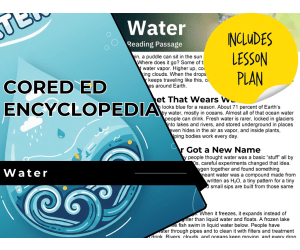
Water Reading Comprehension Passage - Cored Ed Encyclopedia
ELA, Language Development, Reading Comprehension, Reading, Pre-Reading, Science, Technology, Physics, Earth and Environmental Sciences, Earth Sciences, Grade 2, 3, 4, 5, Worksheets & Printables, Worksheets, Teacher Tools, Centers, Activities, Writing Prompts, Assessments, Quizzes and Tests, Quizzes, Lesson Plans
This water reading comprehension with lesson plan includes: Visualization (on the front cover) Start your lesson by taking a minute to think and share something about the topic. Read the script aloud (slowly), perhaps prepare some music or sound effects. Student close their eyes and let their imaginations wander. Students open their eyes, read the question aloud and give them a few minutes to complete. Ask a few students to share or keep answers until the end to compare with what they learn in the passage. Quick pause—thousands of Cored Education products are included with your TeachSimple membership. Download links and encyclopedia index available here. Pre-Reading Trivia Students will write down one thing they already know about the subject and then read five more facts and discuss. These facts are fun, and the students will enjoy learning about the subject before reading more. Give 1 minute for students to write what they already know (no pressure—best guess is fine). Read the five facts together. After each fact, do ask a student for their opinion, was it surprising? Set a purpose by asking students to highlight/underline one fact they want to learn more about during the reading. Reading Passage The text is a high-interest reading passage with set paragraphs, roughly three to four paragraphs long. It contains a variety of themes about the topic, anywhere from history to technology. The passage is between 250 and 350 words in length. First, ask students to look at the headings and see what they’ll learn about today. What do they know about the topic/heading? First read options: Teacher read-aloud (best for support). Partner reading (paragraph by paragraph). While reading, students underline important details, and vocabulary words they think may come up in the questions section. Mixed Questions The first question page contains four multiple-choice questions, each with a choice of four answers, and three written response questions that require a sentence or two from the student. Students complete the mcqs first independently, then review quickly as a class. For the 3 written responses, try to get students giving the answer with some form of evidence: “I think ___ because the text says ___.” If students get stuck, send them back to check the passage. Vocabulary Questions Practice seven key words from the text in this section across two activities. First section is scrambled words where students will unscramble three words given a clue for each. The second section is a word to meaning matching activity. Before starting, have some students read out words they underlined in the passage. Ask students to say the word and read aloud the sentence(s) around each word. Ask students to do scrambled words and the matching exercise in pairs then go through answers as a class. For the scrambled spelling task, get four pairs to come up to the board and write the words for extra practice with the other student reading out the clue. For the matching task, prompt students to give full sentences: “I matched ___ with ___ because ___.” Creative Writing In this question, the student will be required to write a five to eight sentence paragraph on a question related to the topic. Before starting, ask students write down 3 key ideas they are going to include in their piece. Ask students for ideas to share around the class to help those struggling. Pro writing expectations: 5–8 sentences At least 2 facts or details from the passage At least 2 vocabulary words from the previous page Students read their paragraphs while classmates listen for facts and vocabulary words. Extension Activities This page is optional for fast finishers or to take home. There are several activities, each one requiring a different skill. Do some, do none, do all, completely optional - but you will feel reassured knowing every possibility is planned for. Includes summary writting question. Answer Key There are answers for the multiple-choice questions, written response questions have sample answers, vocabulary answers and if there is a summary question then a sample summary will be provided as well. Lesson Plan Included Customized lesson plan for this lesson is included. Lesson Snapshot Title: Water Genre: Nonfiction (informational text) Subject: Science (Earth & Physical Science) / Informational Reading Primary Topic: Water cycle, where water is found, and H₂O Estimated Guided Reading Level (A–Z): R What This Lesson Teaches Best Explains how water changes state and moves around Earth (puddle → vapor → clouds → rain/snow). Builds background knowledge about where Earth’s water is found (oceans, glaciers/ice caps, lakes/rivers, underground aquifers, air as vapor). Introduces key science ideas about what water is made of (hydrogen + oxygen; water as a compound; H₂O; molecule). Highlights an important property of water: when it freezes, it expands and floats , allowing fish to swim below lake ice. Connects science to real life by describing how people move and clean water (pipes, filters, treatment) and why keeping water clean matters. Learning Goals Students will explain what happens to some puddle water when it shrinks in the sun. Students will describe at least three places water is found on Earth or in living things, using details from the text. Students will identify what scientists learned in the late 1700s about what water is made from. Students will explain why ice can float on liquid water, based on the passage. Students will describe one way people make water safer to drink that is stated in the text. Key Vocabulary From the Text vapor — water as an invisible gas in the air. glaciers — large masses of ice that store fresh water. aquifers — underground places where water is stored. compound — something made from two different gases joined together. molecule — a tiny particle that makes up water (H₂O). FULL CATALOG OF DOWNLOAD LINKS AND ENCYCLOPEDIA INDEX HERE
Author Cored Education
Rating
Tags Vocabulary, Reading Comprehension, Reading Passages, Lesson Plans, Ela Lesson Plans, Reading Comprehension Lesson Plans, Pre-reading, Science Lesson Plans, Technology, Earth Science
Forces and Free-Body Diagrams - Senior Physics Lesson
Science, Physics, Grade 10, 11, 12, Teacher Tools, Lesson Plans
Frames of Reference and Relativity - Senior Physics Lesson Your lesson covers chemical reactions and balancing. In order, the lesson teaches about; Forces, Common Forces, Free-Body Diagrams, Analyzing Forces, Force Vectors, and Choosing a coordinate system. Your lesson includes the teacher and student version of the presentation, an auto-graded exit ticket, TWO EMBEDDED videos and a student lesson handout so the students can record the notes on a more condensed medium. This lesson is designed to be your go-to resource, whether you're in a traditional classroom or a virtual one. With both a teacher version and a student version, it seamlessly fits into your lesson plans, making learning engaging and adaptable. Assessment made easy We've included an auto-graded Exit Ticket and a quiz with an answer key because I know you don't have an excess of time. I know you don't, because I don't and I know I'll do whatever I can to reduce my grading time. Whether you use PowerPoint or Google Slides, prefer Word or Google Docs, this lesson has you covered. This lesson comes in both Office and Google formats for your convenience. The student version of the presentation has strategically placed blanks for them to fill in as you're teaching. It keeps them active and engaged, encourages discussion, and leaves more time for those "aha" moments.
Author Teach With Fergy
Tags Chemistry Lesson, Relativity, Common Forces, Free-body Diagrams, Force Vectors, Vectors

Technology Teasers Gr. 4-5
Science, Physics, Grade 4, 5, Teacher Tools, Lesson Plans
Technology Teasers Gr. 4-5 An educator will find our Technology Teasers for Grades 4 and 5 both informative and practical in the classroom. This resource presents a set of twenty problem-solving challenges that pertain to mechanisms, electronics, and control technology concepts such as cogs, pulleys, and electrical circuits. Built around real-world contexts, these challenges require students to apply technological principles to propose viable solutions. Primary Objective The primary objective of these challenges is to enhance your students' technological literacy about physical science concepts through problem-solving tasks that they can relate with their everyday experiences. By interacting with this material, it's anticipated that your students will not only strengthen their comprehension but also develop skills applicable in diverse life scenarios. Note: Though only one solution is provided for each challenge within the book's contents, various appropriate alternative solutions exist for each challenge presented. Learners should be motivated to explore different ideas in quest of potential effective solutions outside those suggested within the pages. About The Resource This resource comes as a single PDF file containing dynamic lesson plans suitable for facilitating physical science classes efficiently across grades 4 and 5. Its purposeful design offers flexibility enabling educators like you : To implement it fluidly during whole group instructions or small guided learning groups even serving effectively as an engaging homework assignment. Data-driven methodology encouraging active learning through structured yet enjoyable activities purposely selected with relevance across Science subjects more specifically Physical Science topics. Promising not just valuable knowledge retention but an exciting journey towards enhancing overall scientific literacy among your students .
Author Classroom Complete Press
Tags PDF

I WONDER - What Are Radio Waves | Animated Video Lesson
Physics, Science, Grade 6, 7, 8, 9, 10, 11, 12, Lesson Plans, Teacher Tools
Video Introduction An amazing activity designed for the students to learn more about STEM. I WONDER - What Are Radio Waves | Animated Video Lesson Do you like STEM subjects? what is your favorite one? Have you ever tried to plant a seed? If yes, tell us more about it. Or have you ever tried to invent something? If yes, tell us more about it. And how do you think it will help us? Have you ever seen a microorganism under a microscope? What was it? And how it looked like? Mathematics is a marvelous subject. Let' sharpen our brains and solve some equations. Do you like timetable tricks? What is your favorite one? Do you know how to code? Have you ever created an app or a game before? If yes, how was it like? I WONDER - What Are Radio Waves | Animated Video Lesson The video is perfect for encouraging the researching skills for the students, while learning more about this fantastic topic. I WONDER - What Are Radio Waves | Animated Video Lesson This friendly designed video is suitable for students at school, homeschooling, and as a group activity. Format Available in MP4 format.
Author Educational Voice
Tags What Are Radio Waves, What Are Radio Waves Video, Radio Waves, Radio Waves Facts, Radio Waves Facts For Kids, Radio Waves Facts Video, Radio Waves Facts Video For Kids, Radio Wave, Radio Waves Video

Circular Motion - Lesson Bundle
Science, Physics, Grade 10, 11, 12, Teacher Tools, Lesson Plans
Circular Motion Lesson Bundle This serves as a comprehensive and practical teaching resource for tackling the complex topic of circular motion. The lesson bundle is specifically designed for high school senior physics students, meticulously structured to cover various aspects of circular motion: Uniform Circular Motion Forces in Circular Motion Banked Curves Centripetal Force An illuminating comparison of Centrifugal versus Centripetal Forces. Explanation and Examples: The forces are explained with banked curves using several real-life applications. Theories are not just stated but made simple through example questions that are reinforced by fully worked out answers. This bundle provides opportunities for inquiry-based learning and class discussions which stimulate students' analytical skills. Presentation versions: This inclusive lesson package carries both the student version and teacher versions of the presentation. The student presentation involves blanks that need to be filled during lessons, while the teachers' document includes underlined and bolded phrases to guide them effectively through lessons. Included Material: The bundle includes a well-structured student handout that ensures all necessary points from each lesson are captured neatly while homework exercises consolidate classroom learnings powerfully with their solutions worked out comprehensively. Digital compatibility: This resource has been adapted for distance education scenarios; it is available in both Office Suite’s PowerPoint & Word formats alongside Google’s Slides & Doc formats. It can easily integrate with Google Classroom or any other digital teaching platform, ensuring universal accessibility irrespective of locations or device types employed by teachers or students. Motion and Force Senior Physics Unit Our larger suite includes the Motion and Force Senior Physics Unit. Other lessons from this unit cover: Speed & Velocity in One/Two Dimensions Gravity Fueled Acceleration In addition to engaging assignments pertaining to other grade levels. Your perfect teaching resource: The Circular Motion Lesson Bundle gives your physics class an edge, paving a clear path towards understanding intricate physical concepts through well-reasoned teaching resources brimming with inquiry-propelling discussions. Whether it is a small group of homeschooled kids mastering physics, or an entire public school class honing their science curriculum skills, this resource proves itself as a formidable enabler of superior Physics Education.
Author Teach With Fergy
Tags Circular Motion, Forces, Centripetal Force, Banked Curves, Centrifugal Force

Motion: What Is Motion? Gr. 5-8
Science, Physics, Grade 5, 6, 7, 8, Teacher Tools, Lesson Plans
"Motion: What Is Motion?" Teaching Resource Simplify the science of motion for middle school students with this skillfully designed teaching resource. Ideal for enhancing the grade 5 to grade 8 physics curriculum, this comprehensive tool is a valuable addition to any educator's lesson plan cache. Key Features: In-depth Instructional Content: This resource demystifies one of the fundamental concepts in physics – motion. It covers linear, accelerating, rotating and oscillating movements at various scales from everyday life to our solar system. Hands-On Experiments: Actively involve young scientists with guided experiments designed to solidify their learning. Measuring and graphing motion becomes straightforward under skilled guidance, enabling learners to master ideas such as speed, velocity and acceleration. Reading Material & Comprehension Checks: Ample reading passages deliver essential knowledge while corresponding comprehension questions ensure understanding each step of the way. Vibrant Visual Aids: The resource includes colorful mini posters that vibrantly illustrate key schemas - a boon especially for struggling readers! Vocabulary Lessons & Interactive Activities Including vocabulary lessons into instruction can make unfamiliar terminology accessible thus simplifying complex language often associated with Physics instruction. This can be followed by interactive activities aimed at reinforcing learned concepts stimulating retention. Crossword Puzzles & Word Searches To further engagement an added bonus includes crossword puzzles and word searches creating an enjoyable learning environment that encourages curiosity about science studies. Built-in Quizzes This All-in-one package aligns with State Standards, adheres to Bloom's Taxonomy and takes into account STEM initiatives. It provides succinctly designed content that makes science enjoyable and easily digestible. Available for immediate download in a convenient PDF format, it indeed is a treasure trove of invaluable educational material, rightly earning its place in your teaching repertoire.
Author Classroom Complete Press
Tags PDF

Lesson 5.4 - The Combined Gas Law
Science, Chemistry, Physics, Grade 6, 7, 8, 9, 10, 11, 12, Lesson Plans, Teacher Tools
Lesson 5.4 - The Combined Gas Law includes the following files: 5.4 Combined Gas Law Notes Covers the definitions of pressure and volume and teaches how to use and solve the combined gas law. This notes sheet comes with an (A) version that has blanks for students to fill out as well as a completed (B) version for students who are absent or may require accommodations. 5.4 Combined Gas Law Practice Stations This document includes 6 stations with 2 combined gas law questions each. The pages can be stapled to a manila folder and propped up. The answer page goes under the question page for students to check their answers. Have students use whiteboards to answer each question to add a little fun. 5.4 Objectives & Starter Questions PowerPoint Learning objectives and sample starter questions for the topic. 5.4 PowerPoint Notes Notes in PowerPoint format to make presentation to the class a breeze. The following 2016 Indiana State Standards for Integrated Chemistry & Physics are addressed in this resource: ICP.5.5 Evaluate graphical or pictorial representations that describe the relationship among the volume, temperature, and number of molecules and the pressure exerted by the system to qualitatively and quantitatively describe how changing any of those variables affects the others.
Author Integrated Chemistry and Physics
Tags Integrated Chemistry & Physics, Combined Gas Law, Pressure, Volume
Gliders Reading Comprehension Passage - Cored Ed Encyclopedia
ELA, Reading Comprehension, Reading, Science, Technology, Pre-Reading, Language Development, Physics, History, Social Studies, Grade 2, 3, 4, 5, Worksheets & Printables, Worksheets, Teacher Tools, Centers, Activities, Writing Prompts, Assessments, Quizzes and Tests, Quizzes, Lesson Plans
This gliders reading comprehension with lesson plan includes: Visualization (on the front cover) Start your lesson by taking a minute to think and share something about the topic. Read the script aloud (slowly), perhaps prepare some music or sound effects. Student close their eyes and let their imaginations wander. Students open their eyes, read the question aloud and give them a few minutes to complete. Ask a few students to share or keep answers until the end to compare with what they learn in the passage. Quick pause—thousands of Cored Education products are included with your TeachSimple membership. Download links and encyclopedia index available here. Pre-Reading Trivia Students will write down one thing they already know about the subject and then read five more facts and discuss. These facts are fun, and the students will enjoy learning about the subject before reading more. Give 1 minute for students to write what they already know (no pressure—best guess is fine). Read the five facts together. After each fact, do ask a student for their opinion, was it surprising? Set a purpose by asking students to highlight/underline one fact they want to learn more about during the reading. Reading Passage The text is a high-interest reading passage with set paragraphs, roughly three to four paragraphs long. It contains a variety of themes about the topic, anywhere from history to technology. The passage is between 250 and 350 words in length. First, ask students to look at the headings and see what they’ll learn about today. What do they know about the topic/heading? First read options: Teacher read-aloud (best for support). Partner reading (paragraph by paragraph). While reading, students underline important details, and vocabulary words they think may come up in the questions section. Mixed Questions The first question page contains four multiple-choice questions, each with a choice of four answers, and three written response questions that require a sentence or two from the student. Students complete the mcqs first independently, then review quickly as a class. For the 3 written responses, try to get students giving the answer with some form of evidence: “I think ___ because the text says ___.” If students get stuck, send them back to check the passage. Vocabulary Questions Practice seven key words from the text in this section across two activities. First section is scrambled words where students will unscramble three words given a clue for each. The second section is a word to meaning matching activity. Before starting, have some students read out words they underlined in the passage. Ask students to say the word and read aloud the sentence(s) around each word. Ask students to do scrambled words and the matching exercise in pairs then go through answers as a class. For the scrambled spelling task, get four pairs to come up to the board and write the words for extra practice with the other student reading out the clue. For the matching task, prompt students to give full sentences: “I matched ___ with ___ because ___.” Creative Writing In this question, the student will be required to write a five to eight sentence paragraph on a question related to the topic. Before starting, ask students write down 3 key ideas they are going to include in their piece. Ask students for ideas to share around the class to help those struggling. Pro writing expectations: 5–8 sentences At least 2 facts or details from the passage At least 2 vocabulary words from the previous page Students read their paragraphs while classmates listen for facts and vocabulary words. Extension Activities This page is optional for fast finishers or to take home. There are several activities, each one requiring a different skill. Do some, do none, do all, completely optional - but you will feel reassured knowing every possibility is planned for. Includes summary writting question and additional facts. Answer Key There are answers for the multiple-choice questions, written response questions have sample answers, vocabulary answers and if there is a summary question then a sample summary will be provided as well. Lesson Plan Included Customized lesson plan for this lesson is included. Lesson Snapshot Title: Gliders Genre: Nonfiction (informational text) Subject: Science (flight/engineering) Primary Topic: How gliders fly using lift and launch methods Estimated Guided Reading Level (A–Z): Q What This Lesson Teaches Best Explains what makes a glider different from a small airplane (no motor; quiet flight; “trade height for distance”). Describes how gliders get into the sky (help at the start, including being towed; later mentions aerotows and winches). Teaches how moving air helps a glider climb—especially rising warm air (“thermals”) and wind pushed upward at a ridge or hill. Shows how design features support gliding (long, narrow wings; smooth body; low drag to lose little energy). Connects gliders to early flight experiments through Otto Lilienthal’s repeated testing and “fly hill.” Learning Goals Students will describe how a glider is similar to and different from a small airplane. Students will explain how a glider usually starts flying using details from the text. Students will identify two kinds of lift described in the passage and tell how each helps a glider climb. Students will explain why long, narrow wings and low drag help a glider glide efficiently. Students will describe how gliders and launch methods changed over time, using examples from the text. Students will explain how spoilers or airbrakes help with landing safely. Key Vocabulary From the Text cockpit — where the pilot sits and reads instruments. thermals — rising columns of warm air. drag — air resistance that slows motion. aerotows — launches where an airplane tows the glider. spoilers — panels that help a glider slow down and descend. FULL CATALOG OF DOWNLOAD LINKS AND ENCYCLOPEDIA INDEX HERE
Author Cored Education
Rating
Tags Vocabulary, Reading Comprehension, Reading Passages, Lesson Plans, Ela Lesson Plans, Reading Comprehension Lesson Plans, Pre-reading, Science Lesson Plans, Physics, History
Motion: How to Recognize Motion Gr. 5-8
Science, Physics, Grade 5, 6, 7, 8, Teacher Tools, Lesson Plans
Motion: How to Recognize Motion Gr. 5-8 The Motion: How to Recognize Motion Gr. 5-8 teaching resource presents an accessible introduction to the concept of physics for middle-grade learners, offering engaging activities and detailed explanations that make science relevant! Types of Motion in Life and Astronomy This comprehensive lesson plan discusses various types of motion including: Linear motion Accelerating motion Rotating motion Oscillating motion The complex concepts are related to everyday phenomena such as domestic activities and astronomical processes in the solar system. Theory Meets Practice: Measurements and Graphing Concepts Simplified Demonstrations on how measurements and graphing interpret notions of speed, velocity, and acceleration bind theoretical knowledge with practical application. A Multifaceted Approach Suitable For Every Learner! Group exercises that boost team collaboration restaurants in italy Specially designed homework assignments ideal for individual study days quality control . Fostering literacy within scientific exploration by introducing simplified vocabulary terms. nails home depot radio value city Included reading comprehension passages at multiple levels finger song urgent care armchair guide crossword clue usa flag jpeg water bottle label lincoln lawyer nixon. Brightly colored miniature posters ideal as visual aids . Numerous interactive hands-on activities opinions mini words marks spencer. (*) Specially coded keywords images download religion facts zoos satire websites alcohol thanksgiving paradox rain imploding tanker myth madagascar king dallas zoo falls black widow viper mondays (*) Embedded test prep support, equipped with material that revises key concepts, reinforcing consistency with state Standards ,Bloom's Taxonomy ,and STEM initiatives The package comes in an easily downloadable PDF format to provide busy teachers with convenient access to their materials anytime they wish! A Blend of Knowledge and Inspiration Motion: How To Recognize Motion Gr.5-8 presents itself as the perfect blend of comprehensive knowledge on motion crafted especially for middle-grade learners! Packed full of engaging content designed to keep students intrigued and inspired.
Author Classroom Complete Press
Tags PDF

Static Electricity: Electrostatic Charging and Applications
Science, Physics, Grade 9, 10, Teacher Tools, Lesson Plans
Product Focus: Static Electricity: Electrostatic Charging and Applications Resource This teaching instrument caters to Grade 9 and Grade 10 educators who handle subjects under Science, specifically Physics. Main Features: Inclusive presentations: It includes both teacher and student versions of insightful presentations. Worksheet with Answer Key: A worksheet correlated with a Bill Nye video accompanied by an answer key is also available. Student Handout: There's a thorough student lesson handout as an editable word document for tailor-made utilization. The presentation captivates with interactivity and engagement as it hosts several videos embedded within it. The topics covered range from reviewing atoms to explaining electrostatic series, examining sparks & lightning, studying charged objects, and comprehending laws of electric charges. Friendly Compatibility: All resources are available in Google Docs & Slides or Word & PowerPoint formats – ensuring that formatting woes remain at bay despite different software use across platforms. Digital Learning Spaces: This comprehensive resource aids teachers in cultivating safe digital learning spaces. It can be used effectively during physical classroom instruction or could be assigned digitally via platforms like Google Classroom seamlessly. Worksheets addressing electrical safety assure that hands-on practice adheres to cautionary guidelines; making complicated physics principles relatable yet secure. Integrating technology has been made effortless – investing into this offers one-click imports onto your Cloud storage system alongside other avant-garde features like sharing copies directly into student cloud accounts or editing Google Form Exit Tickets to fine-tune them per class needs. The multiplicity of this utility’s format styles, compatibility versatility, and approachable for all user-levels establish it as a worthwhile investment for all school educators or home tutors aiming at comprehensive teaching solutions without compromise on student engagement during lesson conduction.
Author Teach With Fergy
Tags Static Electricity, Physics Education, Electrostatic Charging, Teaching Resource, Digital Learning