3,567 products added recently
Graphing Worksheets
Enhance your math curriculum with graphing worksheets that help students interpret and create various types of graphs. These activities support data literacy and critical thinking. Use them to improve students' ability to analyze and present information visually.
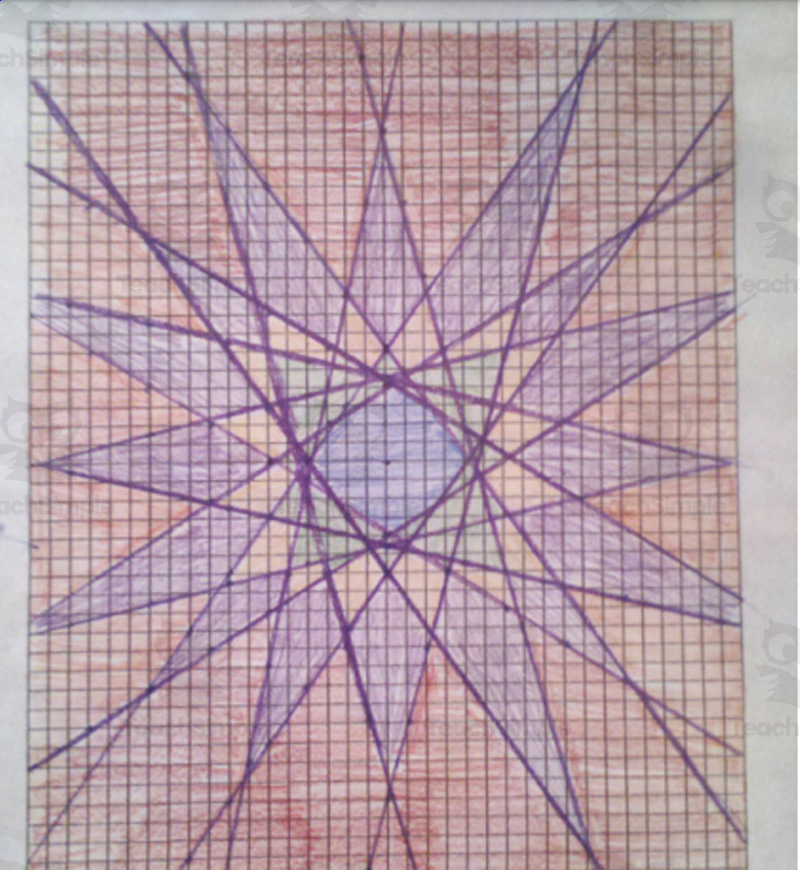
Math Writing Sheets with Decorative Grid Boxes
Seasons, Holiday & Seasonal, Summer, Spring, Common Core, Math, Early Math, Graphing, Basic Operations, Geometry, Homeschool Templates, Activities, Worksheets & Printables, Worksheets, Projects, Classroom Decor, Bulletin Boards, Posters, Teacher Tools, Templates, Diagrams
Math Writing Sheets with Decorative Grid Boxes Printable graph paper with a subtle design twist – for math tasks, creative problem solving, or structured writing 📐✏️ PNG + PDF These decorative math sheets combine practical structure with visual appeal. Designed especially for math lessons, they feature a box-style ruling (also known as graph or squared paper) and gentle decorative elements that frame the workspace without distracting from the task. The colors of the rulings match the surrounding design, giving each page a calm and balanced look. Whether you’re preparing math exercises, practicing place value, or creating space for geometry sketches – these sheets provide a flexible foundation. The structured grid supports clear number alignment and helps students organize their work, especially those who benefit from visual guidance. What’s included: A variety of printable decorative worksheets with math box rulings Rulings in colors matched to the design Subtle seasonal or subject-neutral decorations PDF format – for printing or use in digital notebooks (e.g. GoodNotes, Notability) PNG Format How I use them in class: I often reach for these sheets when I want to give a task a more finished or thoughtful appearance. Students use them for solving equations, drawing coordinate grids, or organizing data. They also work well for math journaling or scaffolded tasks, where a clear layout makes thinking visible. The design encourages careful work without being overwhelming – especially useful for students who struggle with messy layouts or find blank pages intimidating. Because the visuals are gentle and age-neutral, they’re suitable from upper elementary through secondary levels. They can also serve as project covers, learning logs, or a base for differentiated tasks. Sometimes, it’s these small details – like using a well-designed worksheet – that make students take their work a little more seriously. Best, Heike from Lernfitness Did You Know? I teach with a certified therapy dog, and together we create a positive and welcoming learning environment. 🐶
Author Lernfitness
Rating
Tags Activity Sheets, Spring, Summer, Decorative Pages, Writing, Drawing, Custom Classroom Materials, Seasonal, Worksheets, Math Writing Sheets
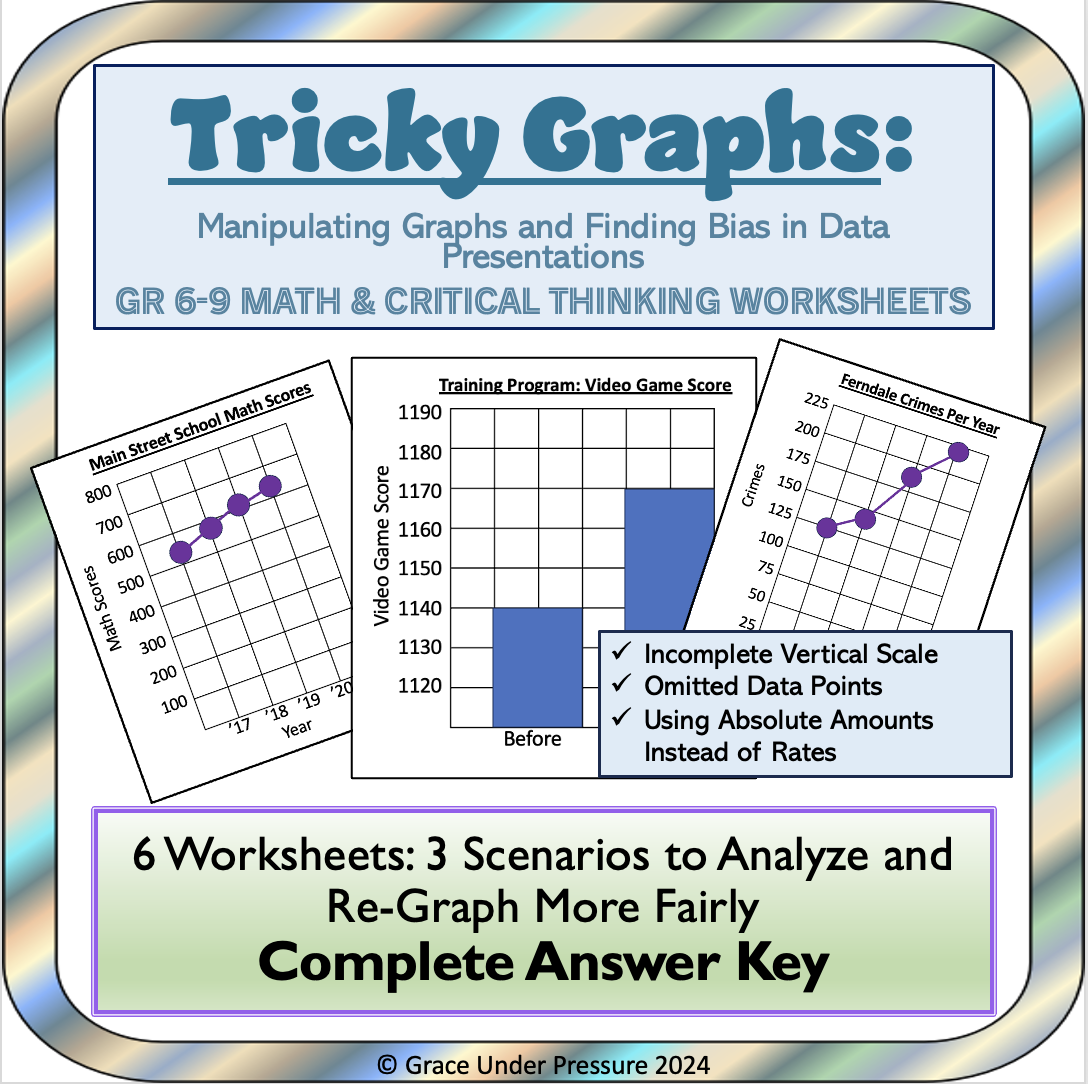
Tricky Graphs- Bias and Data: Bar Graph Worksheet Line Graph Worksheet
Math, Graphing, Life Skills, Special Resources, Grade 6, 7, 8, 9, Worksheets & Printables, Worksheets, Lesson Plans, Teacher Tools
Critical Thinking and Graphing and Media Literacy all in one! This middle grades math lesson for students in grades 6-9 helps teach your class about how graphs can be displayed in tricky and misleading ways. Your students will learn how to spot these biases and re-create the graphs in a more fair manner. This is real-life learning that will serve your students long past your graphing unit. It's a crucial life skill that is often not taught in school. Here’s a real-life math lesson that will be a great addition to your middle school graphing unit! Students are shown three unique and realistic graphs Each one presents information in a biased or misleading way. With step-by-step instructions, your students will be guided through the basics: 1) Carefully reading and interpreting each graph: the axes, the scales, the data that is included 2) Noticing any biases or manipulations that may be present 3) Determining what the author probably wanted to guide them to think when reading the initial graph On the second page for each situation, students are given extra information and tasked with re-creating the graph more fairly. Blank graphs (with scales and labels) are given to students; they will use the information provided in each table to create a new graph that displays the data in an accurate way. Reflection prompt questions are also included to stimulate discussion and students explaining their ideas in words. The misleading and biased scenarios include: Choosing a truncated vertical scale to overemphasize change Not plotting enough data points for the full picture Graphing an absolute amount when a rate would be more informative The three graphs include one bar graph and two line graphs. What's Included: 8 Page PDF Ready to Print and Use! Teacher Instructions 6 Worksheets: Two Pages each for Three Scenarios (including 15 questions and 3 graphs for students to create) Complete Answer Key
Author Grace Under Pressure
Tags Bar Graph Worksheet, Line Graph Worksheet, Bias, Data Collection, Data Presentation, Graphing, Graphing Worksheet, Critical Thinking, Life Skills, Media Literacy
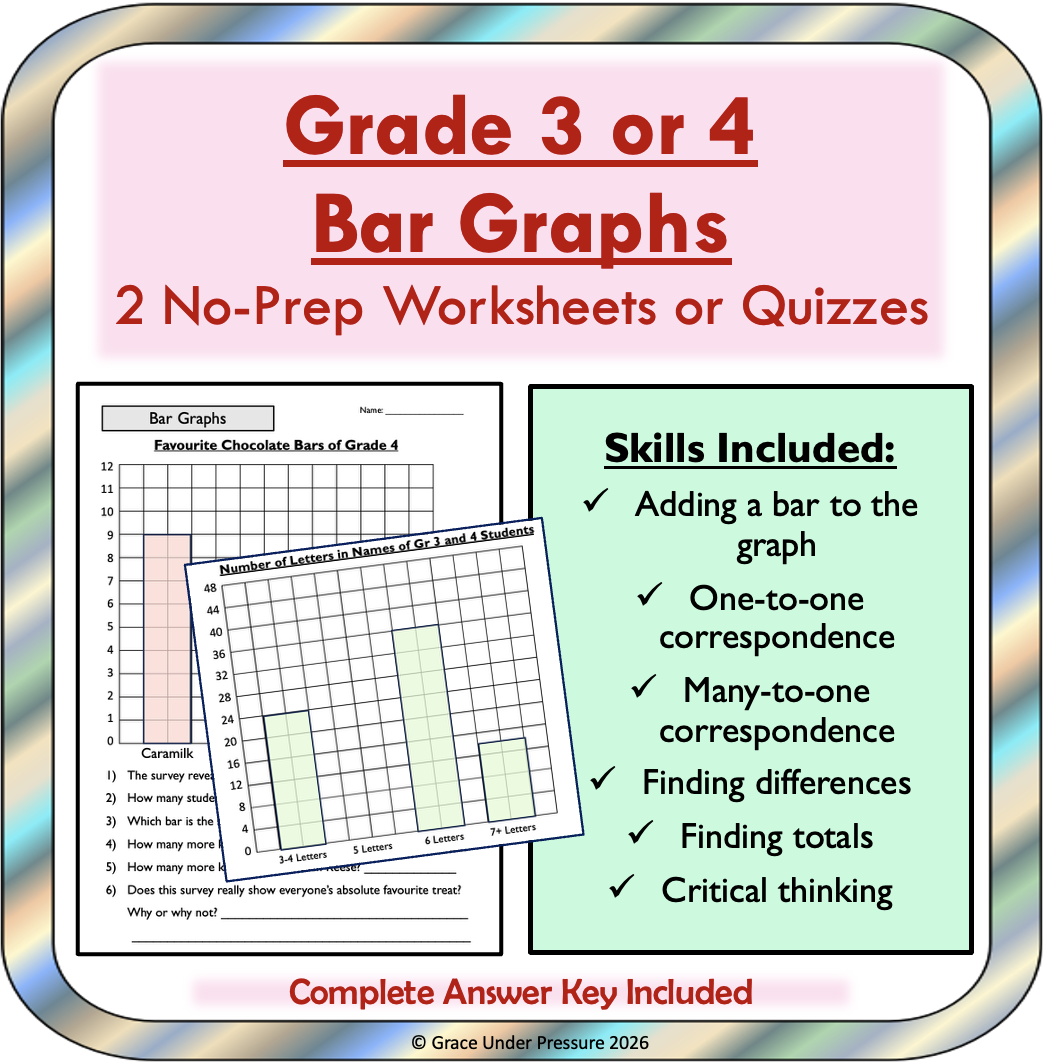
Bar Graph Worksheets or Quiz: 3rd and 4th Grade Math and Graphing
Math, Graphing, Statistics, Grade 3, 4, Quizzes, Quizzes and Tests, Teacher Tools, Worksheets & Printables, Worksheets
These ready-to-go quizzes or worksheets are perfect for a unit on bar graphs in 3rd or 4th grade. Simply print and use immediately! The first page contains a bar graph using one-to-one correspondence. Students will compare how many children like specific kinds of chocolate bars. The second page contains a bar graph using many-to-one correspondence (here one square represents four people). Students will compare how many children have names of different lengths. They will determine that half of a square represents 2 people, as a whole square represents 4 people. These two levels of worksheets or quizzes are great to use for differentiating, split grade classes, or at different times during your unit! Grades to Use With: This math assessment or worksheet is designed specifically for students in 3rd or 4th grade who are studying graphing, data collection, and early ideas about statistics in math class. This could also be used in a special education classes in 5th, 6th, or 7th grade where appropriate. What's Included: 3-Page PDF: Ready to Print and Use! Title Page with Answer Key One-Page Bar Graph Quiz with one-to-one correspondence One-Page Bar Graph Quiz with many-to-one correspondence If you find this math activity useful, please check out other real-world math ideas in my store! I love to create engaging math activities that show your students how the math skills they learn in the classroom are helpful in their daily lives. Math is everywhere! Dream Store Math Project: Decimal Calculations with Budgeting Financial Literacy: Plan a Vacation Math Project: Budgeting & Percentages with Time Zones and More! How to Create Circle Graphs and Pie Charts Math Project Financial Literacy My Party Budget: Real-World Decimals and Percentages Application Math in the Real World: Personal Math Research Project- Great for Early Finishers Park Design Geometry Project with Area, Perimeter, and Volume Canadian Cities: Real-World Place Value to Millions Activity Elapsed Time: My Perfect Day Applied Math Project with Time Intervals
Author Grace Under Pressure
Rating
Tags Bar Graph, One-to-one Correspondence, Many-to-one Correspondence, Graphing, Bar Graph Worksheets, Bar Graph Quiz, 3rd Grade Graphing, 4th Grade Graphing, Bar Graph Worksheet
Savings Goals: Middle School Financial Literacy, Graphing, Patterns
Finance, Life Studies, Home Economics, Math, Algebra, Graphing, Money, Life Skills, Special Resources, Grade 6, 7, 8, Worksheets & Printables, Word Problems, Worksheets
Teach your middle grades students in 6th, 7th, and 8th grade all about saving up money for large purchases and help them practice a variety of intermediate math skills: using ratio tables, graphing, completing operations with large numbers, using percentages , and more! This middle school financial literacy & budgeting lesson has six ready-to-use worksheets to teach your class how to develop savings goals and save their money for life's big-ticket items. How to Use: Print 5 or 6 worksheets for each student. Go through the information on the first page and give your students time to complete the vocabulary definitions (budget, credit card, loan, and interest). Students will then research an item of their choice (between $200 to $300). They will practice calculating the sales tax for it. On the second page, students will complete a simple ratio table and the included graph to calculate how many hours of work will be required to pay for their item. They will calculate how many weeks of work this will take based on how much they work each week. On the third and fourth pages, students will complete similar activities for even larger savings goals: a new car and a down payment for a home. Your students get a choice for how they will consolidate their learning: they can either create a cartoon or write a paragraph reflection to share what they learned about savings goals. Grades to Use With: This lesson is specifically designed for your middle grades students who are learning about ratios, graphs, tables, and financial literacy in math class. It's a great way to incorporate real-world math and budgeting into your 6th, 7th or 8th grade classroom! It could also be used in high school special education classes where appropriate. What's Included: 8-Page PDF: Ready to Print and Use! Teacher Instructions 4 Pages of Worksheets 2 Pages of Student Reflection Choices Complete Answer Key If you enjoy this financial literacy activity, check out others in my store! Grace Under Pressure
Author Grace Under Pressure
Rating
Tags Middle School Financial Literacy, Financial Literacy, Budget, Budgeting, Saving Money, Savings Goals, Patterns Tables, Graphs, Graphing, Tables Of Value
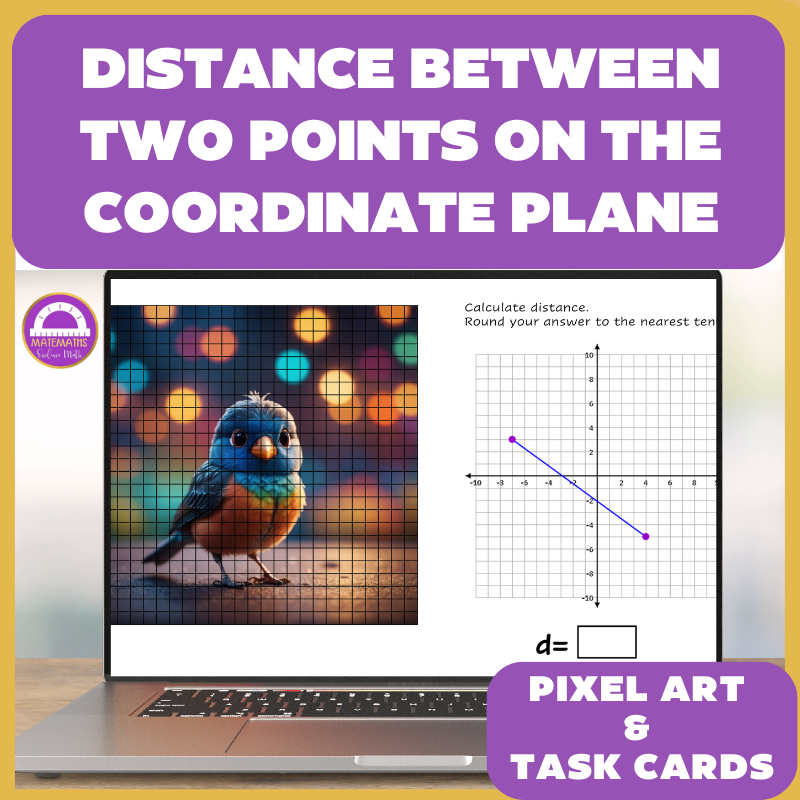
Algebra Vocabulary Crossword Puzzles
Math, Addition and Subtraction, Addition, Order Of Operations, Subtraction, Multiplication and Division, Division, Geometry, Graphing, Multiplication, Grade 8, 9, 10, Crosswords Puzzles, Worksheets, Worksheets & Printables
Introducing a dynamic resource designed to captivate Algebra 1 students: a collection of 50 crossword puzzles meticulously crafted to teach and reinforce essential algebraic vocabulary. This versatile collection of puzzles serves as an ideal: Addition to substitute lesson plans, ensuring a seamless educational experience. Tool for distance learning, delivering captivating content to virtual classrooms. Source of interactive homework, making after-class practice enjoyable. Solution for engaging early finishers, offering an enriching challenge. Each crossword puzzle comprehensively covers a wide array of algebraic topics, ensuring students build a strong foundation in key terms and concepts. The resource features an assortment of puzzle types, including: 7 Crosswords in both colored and black-and-white versions. 4 Circle Find a Word Puzzles. 4 Cartoon Jumble Puzzles. 5 Clue Jumble Puzzles. 2 Clueless Crosswords. 10 Code Words Challenges. 3 Communicative Crosswords Puzzles. 1 Anagram Puzzle. 3 Find a Word Puzzles. 3 No Peaky Puzzles. 4 Word Definition Puzzles. 4 Word Match Puzzles. Answer keys are thoughtfully included, making assessment a breeze and providing immediate feedback to students. Engaging in these puzzles not only entertains but also fosters critical thinking and problem-solving skills. The interactive nature of the puzzles encourages active participation, making the learning process enjoyable and effective. Say goodbye to mundane algebra vocabulary lessons. With these 50 captivating puzzles, students embark on an exciting journey of learning. By infusing an element of fun into the study of algebraic terms, this resource transforms education into an adventure. Whether you're navigating classroom dynamics, facilitating remote learning, assigning meaningful homework, or catering to varying learning paces, the "Algebraic Adventures: 50 Crossword Puzzles for Essential Vocabulary" resource is your versatile solution. Equip your students with a resource that not only enhances their algebraic knowledge but also instills a lasting appreciation for the subject. Elevate algebra education and make a positive impact on your students' mathematical journey.
Author Matemaths
Tags Matemaths, Puzzle, Crosswords, Math Vocabulary, Algebra
Double Bar Graph Worksheets – 2 Levels for Grades 3–5
Math, Graphing, Statistics, Grade 3, 4, 5, Quizzes, Quizzes and Tests, Teacher Tools, Worksheets & Printables, Worksheets
This ready-to-go quiz is perfect for a unit on double bar graphs in grades 3-5. The first page uses a double bar graph with one-to-one correspondence. Students compare how many boys and girls like specific kinds of chocolate bars. The second page uses a double bar graph with many-to-one correspondence (one square represents four people). Students compare how many kids in each grade have names of different lengths. Students have to determine that half a square represents two people since a whole square represents 4 people. These two levels are great for differentiating, split classes, or different times during your unit! Grades to Use With: This math assessment is designed for students in grades 3-5 who are learning about graphing, data, and statistics. In the USA, this is in Common Core Standards in the third grade and in British Columbia, Canada, it is addressed in Grade 5. It could also be used in middle school special education classrooms. What's Included: 4 Page PDF: Title Page One-Page Double Bar Graph Quiz with one-to-one correspondence One-Page Double Bar Graph Quiz with many-to-one correspondence Complete Answer Key If you enjoy this math activity, check out others in my store! I love to design engaging math printables that show students how the skills they learn in the classroom are actually extremely helpful in their everyday lives. Math is everywhere! Math Project: Create Your Dream Store: Decimal Calculations and Budgeting Financial Literacy: Vacation Math Project: Budgeting, Percentages, Time Zones and More! Math Project: Circle Graphs and Pie Charts Financial Literacy: My Party Budget: Decimals and Percentages Application Math in the Real World: Personal Math Research Project for STEM Education Geometry Project: Park Design with Area, Perimeter, and Volume Canadian Cities: Place Value to Millions Activity Elapsed Time: Perfect Day Math Project with Time Intervals
Author Grace Under Pressure
Rating
Tags Bar Graph, Double Bar Graph, One-to-one Correspondence, Many-to-one Correspondence, Graphing, Bar Graph Worksheets, Double Bar Graph Worksheet, Bar Graph Quiz
Lines of Symmetry Worksheets: Finding Symmetry in Polygons on Grids
Math, Graphing, Geometry, Grade 4, 5, 6, Worksheets & Printables, Worksheets
Line Symmetry Practice Worksheets Grades 4-6 Here are four worksheets of increasing difficulty to help your students in grades 4-6 practice the following skills: 1) Identifying and drawing lines of symmetry on polygons on a grid. 2) Creating interesting shapes and designs that are symmetrical either vertically or horizontally. How to Use: Choose which worksheets you will use with your students and print a class set. Practice 1: Students look at six shapes on a grid. They need to draw lines of symmetry on each shape (one has none, two have one line, two have two lines, and one has a diagonal line of symmetry). Practice 2: Students are shown half of a large, interesting shape on a grid. They need to recreate the other half over the given line of symmetry. Practice 3: Students are asked to draw a line of symmetry and make their own half shape. They will trade with a friend and finish their friend’s shape. Practice 4: Students are asked to create a colourful design on a grid. Parts of the design should be vertically and horizontally symmetrical. The finished products could be a beautiful bulletin board display! These worksheets could be used in many ways. They can become part of your unit as activities during class lessons. One or more could be a homework assignment. You could even use one for an assessment of your students' learning. Grades to Use With: These line symmetry worksheets are designed for students in grades 4-6 who are learning about symmetry or the reflection type of transformation. They could also be used in middle school special education classes. What's Included: 6 Page PDF: Ready to Print and Use! Teacher Instructions Draw Line of Symmetry Worksheet Finish a Symmetrical Shape Worksheet Create Half a Shape Worksheet Create a Design with Symmetrical Elements Worksheet ANSWER KEY INCLUDED © Grace Under Pressure 2025
Author Grace Under Pressure
Tags Line Symmetry, Line Symmetry Worksheet, Lines Of Symmetry, Lines Of Symmetry Worksheet, Symmetry, Symmetry Worksheet, Geometry Worksheet, Coordinate Plane, Reflections
BC Grade 4 Math: Full-Year 4th Grade Real World Math Worksheets
Math, Patterns, Time, Money, Addition and Subtraction, Decimals, Multiplication and Division, Geometry, Graphing, Place Value, Grade 3, 4, 5, Worksheets, Worksheets & Printables
Are you searching for some new lesson ideas to include in your fourth grade elementary math class? If you are wanting to refresh your grade 4 mathematics program, here is a complete, full-year printable resource ready for you! This 4th grade math full-year curriculum is designed to work alongside your school's math textbook. These modern, real-world math printable activities will add to your students' learning since they show how each of the math skills from the textbook can easily apply to real-life situations. Plus, this resource includes quick & easy math tasks for you to use for formative assessment. This 80-page printable PDF is full of real-world math scenarios (summer road trip, reading bar graphs, planning a camping trip), math stations, a variety of easy games, and creative math projects that address every curricular competency standard in the British Columbia Mathematics 4 curriculum. 18 Different Topics are Covered Including: Place Value to 10,000 including Addition and Subtraction Ordering & Comparing Fractions Decimals to the Hundredths including Addition and Subtraction Multiplication & Division Addition and Subtraction: Math Facts to 20 Multiplication & Division: Math Facts to 100 Algebraic Relationships and Increasing & Decreasing Patterns One-Step Equations Time (Digital and Analog) Regular & Irregular Polygons including Measuring the Perimeter Identifying Line Symmetry Reading and Creating Bar Graphs Probability Experiments Financial Literacy Grades to Use With: This full-year curriculum is designed for fourth grade math classes in the province of British Columbia, Canada. However, it is full of math activities that meet 3rd, 4th, and 5th grade US common core state standards, so it could easily be used in many classrooms! What's Included: 80-Page PDF with 20+ Different Activities Answer Keys (where applicable) If you enjoy this full-year math curriculum, check out my other ones: BC Grade 5 Math BC Grade 6 Math BC Grade 7 Math
Author Grace Under Pressure
Rating
Tags Math, Math Games, British Columbia, Math Text, Financial Literacy, 4th Grade Math, Grade 4 Math, Full Year 4th Grade Math, 4th Grade Math Worksheets, Grade 4 Math Worksheets
Increasing & Decreasing Patterns – Money Math Sheet
Math, Money, Algebra, Graphing, Grade 4, 5, Worksheets & Printables, Worksheets, Word Problems
Increasing and Decreasing Patterns: Money Math Tables and Simple Graphs Here’s a ready-to-go math lesson that helps your students apply what they are learning about pattern rules, increasing and decreasing patterns, tables, and graphs to simple, real-world financial situations. Each situation is a realistic financial scenario for a student in elementary school. Saving allowance money each week in a piggy bank. Selling cups of lemonade for a profit. Spending money from a fund for class birthday celebrations. Students will: Complete a table of values to explore each increasing or decreasing pattern. Graph the pattern on a simple grid that is already set up and labelled (two scenarios will be bar graphs and one will be a line graph). Write a pattern rule in words for the situation. Determine when the pattern will cross a certain threshold (for example, when the student has enough saved up for a big purchase, when the birthday fund runs out of money, etc. ). COMPLETE ANSWER KEY INCLUDED Grades to Use With: This lesson is designed for students in grades 4 or 5 who are learning about increasing and decreasing patterns, tables of value, bar graphs, line graphs, and early algebra ideas including pattern rules in words. It could also be used by middle school special education students or as a review in grade 6. If you enjoy this early algebra activity, check out several others in my store. I always try to show students how the math skills that they are learning in the classroom can be so helpful in everyday life! Pre-Algebra Problem: The Wave Pool: Expressions, Tables and Graphing Middle School Math Stations or Centers: Early Algebra: Patterns, Expressions, Tables, Graphing, and Equations Algebra: Modelling Equations: Visual Balance Scale Worksheet Independent and Dependent Variables in Grade 6 Math: Hockey Math Exponent Board Game: A Fun Way to Practice Math Skills Writing and Solving Two Step Equations from Real Life Situations
Author Grace Under Pressure
Rating
Tags Pattern Worksheets, Increasing Patterns, Decreasing Patterns, Early Algebra, Tables And Graphs, Tables And Graphs Worksheet, Graphing Patterns, Tables Of Value, Money Math, Financial Literacy
Grade 2 MATH Worksheets | Sports Theme
Math, Graphing, Place Value, Grade 2, Worksheets & Printables, Word Problems, Worksheets
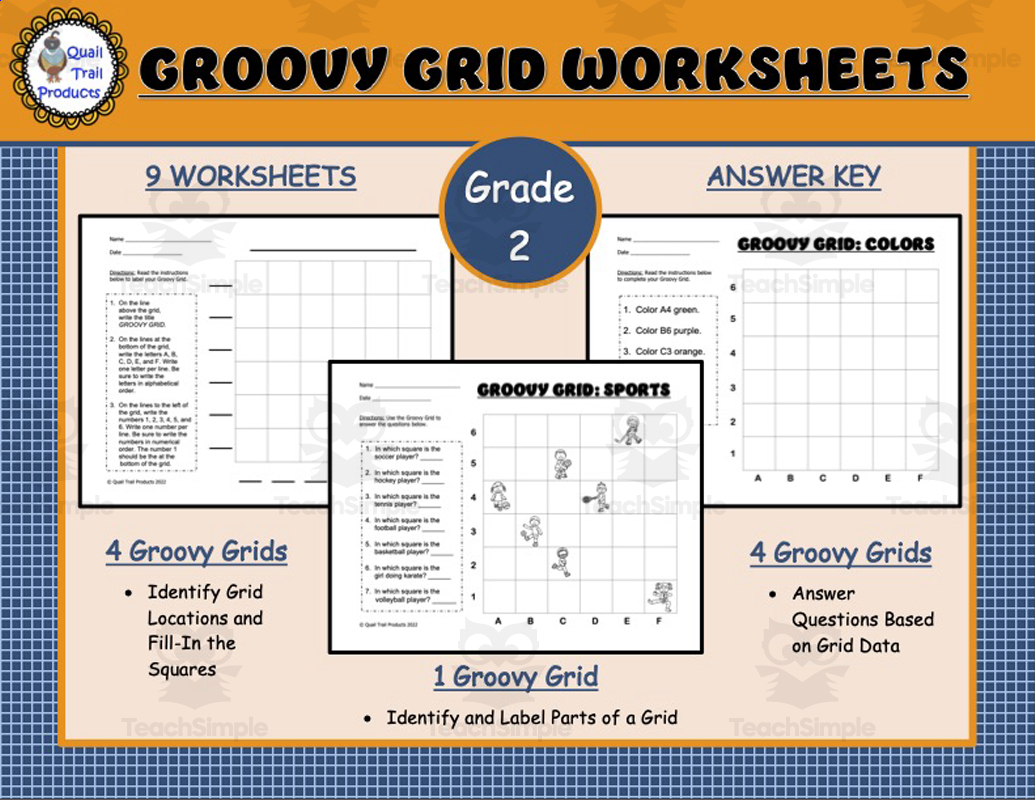
If you have 2nd graders who are sports fans, then this product is for you. These 12 math worksheets will add an element of fun to your math curriculum . As learners work their way through a variety of grade level concepts, they’ll be presented with sports themes including baseball, basketball, ice skating, and hockey, just to name a few. All worksheets are designed to meet current standards in mathematics, while also engaging your learners as they strengthen their skills. They will work on solving problems that include addition, subtraction, place value, greater than/less than, graphing, and geometry. Rounding out the set is a worksheet that contains 6 word problems, each focusing on real-world scenarios. There are a number of uses for these worksheets which is a great benefit to your teacher toolbox. Use them as a whole class activity or in small learning groups. If you’re looking for a way to help with the “summer slump”, look no further. With 12 different concepts presented across all math domains, these worksheets are a wonderful way for your grade 2 learners to review and practice their skills. They can also be used as a rainy-day activity, a homework assignment, or a last-minute activity when you have a substitute. One of the best parts is, they are PRINT and GO. You’ll also find an answer key is provided. Take a look below to see the details of each worksheet. WORKSHEET 1: learners will add 1-digit and 2-digit numbers, then color the putting green that shows the correct answer. (golf) WORKSHEET 2: learners will subtract 1-digit and 2-digit numbers and write their answers in the box being held by an athlete. WORKSHEET 3: learners will determine if the number on each soccer ball is odd or even and color the ball according to the key. WORKSHEET 4: learners will read a prompt next to each baseball or softball player and complete the pattern by skip counting. They’ll write their answers in the row of baseballs/softballs. WORKSHEET 5: learners will read the place value clues presented by each ice hockey player. They’ll color the hockey puck that shows the matching number. WORKSHEET 6: learners will compare two numbers shown on the pair of ice skates. They’ll complete the number sentence using the greater than or less than symbols. WORKSHEET 7: learners will complete the bar graph using the provided data. Then, they’ll answer questions about the graph. (basketball, gymnastics, karate, ice hockey, volleyball) WORKSHEET 8: learners will write numbers in word form, number form, and expanded form on the baseballs, footballs, and basketball hoops. WORKSHEET 9: learners will read prompts about times for sporting events and practice, then color theanalog clock that shows the matching time. WORKSHEET 10: learners will identify the correct cost of sporting equipment and count money (dollars and coins) to show the correct price of each item. WORKSHEET 11: learners will identify the 2-D shapes on each basketball hoop, write the name of the shape, and draw the shape in the provided box. WORKSHEET 12: learners will use addition and subtraction to solve the word problems about six different athletes (football, basketball, snowboarding, gymnastics, softball, and soccer). ANSWER KEY
Author Quail Trail Products
Tags Grade 2 Math, Sports, Addition, Subtraction, Odd And Even, Geometry, Time, Money, Skip Counting, Place Value
Dyscalculia Visual Fraction Manipulatives
Math, Fractions, Addition and Subtraction, Addition, Subtraction, Graphing, Money, Number Lines, Order Of Operations, Time, Homeschool Curriculum, Homeschool Templates, Grade 3, 4, 5, 6, 7, Worksheets & Printables, Workbooks, Worksheets, Word Searches, Teacher Tools, Assessments, Lesson Plans, Quizzes and Tests, Quizzes, Tests
Change the nature of instruction for fractions, and help all students by using this complete, evidence-based guide for teaching fractions to students who may have any or all of the following: Dyscalculia, Learning Disabilities in Mathematics, or Anxiety with regard to mathematics. Are you an educator or parent looking for an effective way to teach your students with prior difficulties with abstract mathematic concepts? If so, this is the resource for which you have been searching. This is NOT just another worksheet packet. This is a complete neuro-informed intervention system built to circumvent all cognitive barriers common to the students you teach, and create true and lasting understanding of fractions that will be retained for the remainder of the student's educational career. By following the Concrete-Pictorial-Abstract (CPA) framework along with the principles of cognitive science, this guide provides students with a means for teaching fractions in a way that they will finally be able to process and master from their neurodivergent brain perspective. Your students will no longer suffer from mathematics anxiety or the "Whole Number Bias", which results in students believing that 1/8 is greater than 1/3. We use Linear Fraction Bars as a visual aid and High Contrast Visual Mapping to make fractions tangible and explainable to students through the use of their neural systems, thus enabling students to understand fractions as Predictable and Intuitive. We deliberately avoid all of the Circular Fraction Models (i.e., Pizza) that confuse students with poor or absent spatial perception. THIS 37-PAGE COMPREHENSIVE GUIDELINE CONSISTS OF: The Educators Guide: This document consists of an in-depth look at the "why" behind the method in phase one. It will include definitions of the cognitive make-up behind dyscalculia, the incorrectness of standard methods, and the architectural guidelines for creating educational tools, including manipulatives that are compatible with how the brain works. This phase will also include case studies based on individual students that can be utilized in grade-level math classes. The Student Workbook: Phase Two will consist of a sequential ten part set of worksheets that will serve as step-by-step guides for students in grades three through five. In other words, the first page of the ten page guide will help students learn what a numerator and a denominator are before they then will be a part of the worksheet on determining whether two fractions are equal or comparable. The remainder of the pages will continue to follow the same sequence, with the last page covering mixed numbers. The Teacher Resources and Visual Aids Section: This section contains all the resources necessary for teacher's to correctly implement the above two guides. In addition to possessing high-resolution diagnostic diagrams that can be utilized in the classroom, this section also contains an answer key that has been developed with pedagogical notes included, and a clinical implementation guide that contains scripted interventions for how to address common errors made by students. PLEASE NOTE THE FOLLOWING Group: Individuals who provide direct instructional support to students with disabilities and other struggles in mathematics, such as: SE Teachers/Specialists Math Interventionists/ Specialists (Tier 2 & 3) Resource Room/Co-Teach Models Tutor and Educational Therapists Homeschool Parents General Ed Teachers who want to use effective differentiation strategies. Break the cycle of poor math performance. Get your students the tools they need to develop confidence and obtain true mastery of fractions through this master guide through the Math Anxiety. Key Terms: Dyscalculia, Math Intervention, Special Education Math, Fractions, Visual Math, Manipulatives, Math Anxiety, Learning Disabilities, Third, Fourth, Fifth, Grade, Homeschooling, RTI, Math Support, Number Sense, *CPA Framework (Concrete, Picture, Abstract) Teacher’s Guide. Reasons Why Parents/Schools Are Enthusiastic About This Resource: Evidence Based and Neuro-informed: This is truly not just a collection of activities but rather a structured program based on cognitive science; designed specifically to help students whom have dyscalculia. Eliminates Math Anxiety: The clear, visual, step-by-step approach removes uncertainty and abstract confusion which builds student confidence and creates a positive attitude ("I can do math") about math. Comprehensive All-In-One System: The complete package allows educators to save a tremendous amount of time in planning. It contains the theoretical document, the workbook (student-facing) as well as the full answer key that contains additional clinical cues. This resource is ready for immediate use as an intervention resource. Promotes True Understanding, Not Just Rote Memorization: By making fractions physical and visual, this program goes beyond mere memorization of rules and fosters true, deep conceptual understanding, which can be applied to future concepts. Highly Targeted for Intervention: This resource is an excellent Tier 2/3 resource for intervention, special education resource rooms, tutoring, and homeschooling. It provides very powerful and focused support, right where struggling learners require it most. An in-depth analysis of the content, research, and worksheets indicates the primary target audiences are: Special Education Teachers: This is a critical instructional support for teachers within this specialty since the resource was designed specifically for students diagnosed with learning disabilities. Math Interventionists: This resource meets the needs of small groups of students (Tier 2 and Tier 3) who are considerably below grade level in mathematics. Educational Therapists and Tutors: Qualified professionals who provide one-on-one support to students with dyscalculia. Homeschooling Parents: Especially for those children who have a diagnosis or possibly math deficits. Targeted Grade Levels: The component will specifically target grades three, four and five because all of the fractions address fundamental fractions through to adding fractions and mixed numbers, which are all taught at these grade levels. Rewriting Terms: All rights reserved. The author has copyright (Copyrighted by Syed Hammad Rizvi) on this work. A teacher may use this resource for his/her classroom and for private individual use. You may not modify this resource, distribute it, or sell it. You may not publish or make it available on the internet. If you would like to share this resource with your colleagues, please buy additional licenses from Teachsimple. Thank you for being honest and following my copyright terms. This product is made with love by Syed Hammad Rizvi.
Author Creative Book Store
Rating
Tags Dyscalculia, Dyscalculiaresources, Dyscalculiasupport, Mathintervention, Visualmath, Mathmanipulatives, Mathlearningdisability, Specialneedsmath, Neurodivergentlearning, Cpaframework
Line Graphs Activity Plotting and Interpreting Data on a Line Graph
Math, Graphing, Numbers, Grade 2, 3, 4, 5, Worksheets & Printables, Worksheets
Line Graphs Activity : Plotting and Interpreting Data on a Line Graph This comprehensive, fun-filled activity for grades 2 through 5 is a mathematics teaching resource designed to make learning engaging and enjoyable. The highlight of the session is understanding line graphs using data from pizza sales. The Activity Features: A hands-on experience catering to multiple learning styles. Visual data cards that depict the number of pizzas sold for first-hand statistical information. Task cards with instructions on how learners can plot this data onto provided large or smaller line graph sheets. Beyond just creating graphs, the resource focuses heavily on interpreting plotted data with response sheets included within the package facilitating efficient summarizing of findings. Included Organizational Tools: An optional file folder cover for organizing all necessary items at centers, boosting accessibility during classroom activities or homework tasks. Educational Support Material: , A sample response in the form an answer key. , A poster defining 'Line Graph'. , Mathematical terminology cards that explain basic vocabulary associated with graphing concepts. , Paper Saving Option: Offering either single large printing templates or two templates put together one sheet- helping save paper costs. In conclusion, this activity expertly bridges practical sales recording experience over time and academic knowledge specific to line graph analysis.
Author Teach2Tell
Tags Line Graph, Data Interpretation, Hands-on Activity, Pizza Sales, Visual Data, Interpreting Linear Graphs, Interpreting Graphs Worksheet Middle School
Linear Quadratic Systems Guided Notes + Homework Set
Math, Graphing, Grade 9, 10, 11, 12, Worksheets & Printables, Worksheets
Linear Quadratic Systems Guided Notes and Homework Set This math resource teaches students about linear quadratic systems. The informative guided notes allow learners to build understanding of this graphing concept step-by-step. As they progress through the material, they apply what they have learned by completing practice problems. A homework assignment is also included to reinforce and assess comprehension of linear quadratic systems. This versatile resource can be used individually or with groups of any size. The engaging guided notes cater to visual, auditory, and kinesthetic learning styles. Answer keys are provided for the practice sets and homework. This standards-aligned resource is an essential addition to any secondary math curriculum seeking to sharpen graphing abilities.
Author Eddie McCarthy
Tags Linear Quadratic Systems, Graphing, Algebra, Math Homework, Guided Notes
Math Practice Simplified K - Tables & Graphs
Math, Graphing, Grade 5, 6, 7, 8, Worksheets & Printables, Word Problems, Worksheets
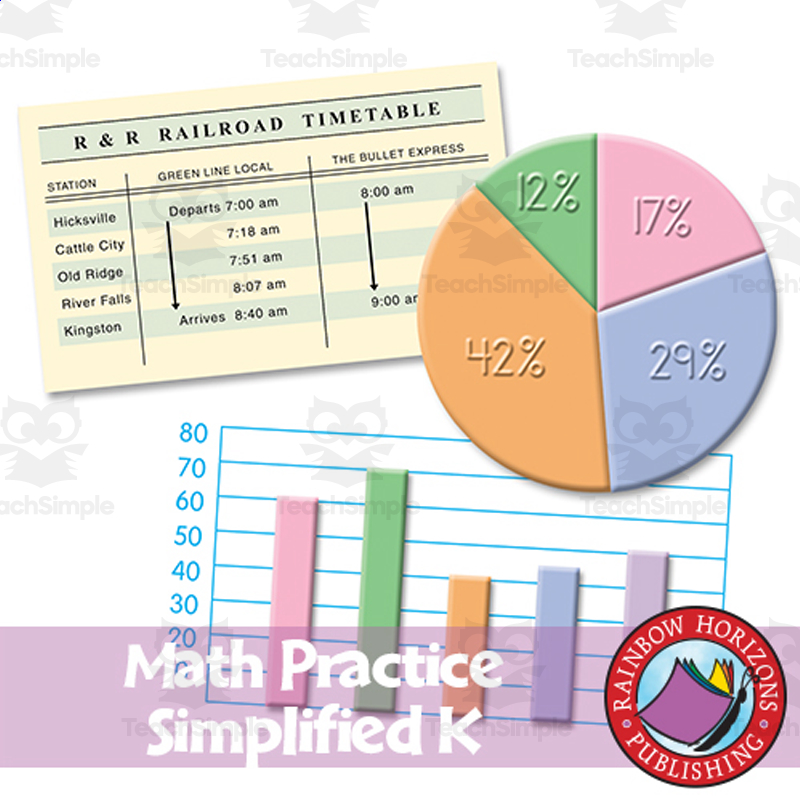
This mathematics-based resource is designed for grades 5-8. It’s imperative for students to have a strong foundation in basic math skills. This resource provides real-world activities to help students understand how to read and interpret data. Information from tables, charts and graphs are presented in this resource. Students will then present data in tables and graphs of their own making. Additional lessons on mean, median, mode and range are provided. Tables and graphs include: scattergrams, stem and leaf plots, line plots, box plots, histograms, among others. This resource is perfect to prepare students to succeed on standardized tests. An answer key is included. Aligned to National Council of Teachers of Mathematics (NCTM) Standards.
Author Classroom Complete Press
Tags Math, Mathematics, Tables, Graphs, Statistics, Probability, Data Analysis, Elementary, Middle, Answer Key
Coordinates in the 1st Quadrant – Plotting Practice
Math, Geometry, Graphing, Grade 5, Worksheets & Printables, Worksheets
This resource will enable your students practice plotting and reading coordinates in the first quadrant of a Cartesian plane where all the numbers are positive with a range of different graphic images leading up to points located on an x-y graph simply with letters. For each set of graphics (leaves, astronaut icons, geometric shapes, and letters)there are two separate activities: Finding the coordinates of points on an x-y Grid in the 1st Quadrant Given set of coordinates, locate their position on an x-y Grid in 1st Quadrant In addition, for a final set of worksheets, again there are the two activities, but this time the coordinates or points drawn on the axis form geometric shapes. This provides a good starting point for further questioning or investigation that could include: - naming the shapes - drawing lines of symmetry and labeling coordinates on the line - finding the coordinate of the centre of each shape - apply transformations and note the new coordinates .......... How many Worksheets in total ? Unlimited, because at the click of a button all the numbers or the location of the objects on the grid are randomized providing you with a new set of questions for classwork, homework, revision, assessments etc. Also as these worksheets require no preparation they are ideal worksheets to leave for a substitute teacher if needed. You will also have 2 sets of blank worksheets so that your students can create their own worksheets, or use them for the investigations suggested above Answers can be found on the second page of every worksheet, automatically generated when you create a new worksheet. Note These resources are PDF documents and work with the official Adobe Acrobat Reader on Windows or Mac computers with the randomising buttons also working via a touchscreen (PC or Mac)or on an Interactive Whiteboard. Common Core Standards - 5th Grade CCSS5.G.A.1 Use a pair of perpendicular number lines, called axes, to define a coordinate system, with the intersection of the lines (the origin) arranged to coincide with the 0 on each line and a given point in the plane located by using an ordered pair of numbers, called its coordinates. Understand that the first number indicates how far to travel from the origin in the direction of one axis, and the second number indicates how far to travel in the direction of the second axis, with the convention that the names of the two axes and the coordinates correspond (e.g., 𝘹-axis and 𝘹-coordinate, 𝘺-axis and 𝘺-coordinate). UK National Curriculum - Year 4 Programme of Study - Geometry - position and direction Describe positions on a 2-D grid as coordinates in the first quadrant. Here is a link to the next level on coordinates: Cartesian Coordinates in the Four Quadrants. Plotting and Locating points
Author Jeff's Notebooks
Rating
Tags Math, Coordinates, Plotting Points, Cartesian Coordinates, First Quadrant, 1st Quadrant, Positive Axes, Graphing Coordinates, Jeff's Notebooks, Interactive Whiteboard
Algebra Real World Math Problem: 5th 6th 7th Gr Patterns & Expressions
Math, Algebra, Graphing, Grade 5, 6, 7, Worksheets & Printables, Word Problems, Worksheets
This lesson is an excellent addition to a pre-algebra unit in grades 6 or 7 to help show students a real-world application of using expressions, tables of values, and graphing to solve a simple, everyday financial literacy decision. Students are tasked with deciding how to pay to visit a new wave pool in the neighbourhood. They can pay a flat monthly fee or pay a smaller fee and then pay a small amount each time they go. The trick will be determining how often they are likely to go each month. Students get to: Analyze a realistic scenario Complete two tables of values Write a pattern rule in words and turn it into an expression with a variable Create a simple line graph to compare the two options visually Explain their decision in words using evidence from their mathematical work This lesson can be used in various ways: it can be used during full-class instruction or smaller group activities. It could be regular classwork, a homework assignment, or even a summative assessment. I liked to have students complete it near the end of our algebra unit to assess skills before the unit test and to have as an artifact for parent-teacher conferences. An extension challenge is offered that is specifically designed for early finishers. A complete answer key is also included for easy marking out of twenty points. Grades to Use With: This lesson is designed for upper elementary or middle school students in grades 5-7. It could also be used in high school special education classrooms. What's Included: 7 Page PDF with three page student assignment, title page, and complete answer key. If you enjoy this algebra activity , check out others in my store: Modelling Equations: Visual Balance Scales Independent and Dependent Variables in Grade 6 Math: Hockey Math Solving Systems of Equations Using Substitution Inequality Matching Game Exponent Board Game Writing and Solving Two-Step Equations
Author Grace Under Pressure
Rating
Tags Pre-algebra, Expressions, Tables Of Values, Graphing, Graphs, Algebra, Variables, Real World Math, Word Problems, 6th Grade Algebra
Statistics Word Problems: Compare Two Data Sets of Annual Salaries
Math, Graphing, Measurements, Statistics, Grade 6, 7, 8, Worksheets & Printables, Worksheets, Word Problems
This middle school math lesson allows your students in grades 6-8 to apply the statistical skills they have been learning in class to a real-world financial literacy scenario: the annual salaries of workers who have a college degree compared to those who do not have one. It is a real world math activity that includes five worksheets all ready to go! Your students will: - Make two dot plots to display two data sets (that are included with the lesson): wages for people with a college degree and those without - Share observations about the distribution of data in each set - Calculate the mean, median and interquartile range for each data set - Draw inferences about whether there is an effect of a college education on someone's annual salary - Consider if the sample that was used is representative This lesson was designed to specifically address 7th Grade Common Core Math Standards for the Statistics and Probability strand: 7.SP.A.1 7.SP.B.3 7.SP.B.4 What's Included: 7 Page PDF- Ready to Print and Use! - Title Page with Teacher Instructions - Student Handout that has Two Data Sets (with 20 items each) - Dot Plot Worksheet (for students to graph and compare two dot plots) - 2-Page Measures of Central Tendency and Variation Worksheet - Reflection Worksheet - Answer Key If you enjoy this statistics lesson, check out other fun options in my store: Middle School Math Stations or Centers for Statistics and Probability: 5 Math Centers that are a great way to prepare for a unit test! Create Dot Plots and Histograms: 6th Grade Statistics and Graphing Practice: Students create and carry out their own survey and then graph it two ways! Identifying and Writing Statistical Questions for 6th Grade Math: Help your students learn ways to collect data and try it out!
Author Grace Under Pressure
Tags Statistics, Compare Data Sets, Financial Literacy, Dot Plots, Statistics Word Problems, Compare Data Distributions, Mean, Median, Interquartile Range, Graphing Data
5th Grade Summer Review or Practice Math Workbook
Math, Fractions, Graphing, Multiplication and Division, Order Of Operations, Addition and Subtraction, Algebra, Grade 4, 5, 6, Worksheets & Printables, Workbooks, Word Problems, Worksheets
Keep your students engaged and confident in math all summer long with this 5th Grade Summer Math Review Packet ! Designed to prevent the summer slide , this resource provides targeted practice on 20 essential 5th grade Common Core math skills —all identified as challenging concepts that lay the foundation for 6th-grade success . What’s Included? ✅ Teaching or note sheets for each skill ✅ Practice worksheets for reinforcement ✅ Detailed answer keys with step-by-step solutions ✅ Pre-review pages for select skills to refresh prior knowledge ✅ Teaching & tutoring tips for parents and educators Math Skills Covered: Multiply 2-digit numbers by 3-digit numbers Divide 4-digit numbers by 2-digit numbers Add, subtract, multiply, and divide whole numbers: word problems Evaluate numerical expressions with parentheses Convert decimals between standard and expanded form using fractions Compare decimal numbers (Ordering decimals included) Add and subtract decimals: word problems Multiply a decimal by a power of ten Multiply money amounts: multi-step word problems Divide by decimals Understand fractions as division: word problems Add and subtract fractions with unlike denominators: word problems Multiply two fractions Divide unit fractions and whole numbers: word problems Add, subtract, multiply, and divide mixed numbers Graph points from a table Multi-step problems with customary unit conversions Describe relationships among quadrilaterals Volume of compound figures Create and interpret line plots with fractions This packet is easily formatted to print and bind for a summer workbook or could be used individually in tutoring sessions or summer school lessons, as review worksheets. Practice could also help those that are skipping a grade in math, to ensure understanding of concepts that may be missed in the transition. Tags: 5th grade math review, summer math packet, prevent summer slide, 5th to 6th grade math transition, common core math worksheets, math tutoring resources, printable math workbook, summer school math activities, fractions and decimals practice, multiplication and division word problems
Author Kel's Klass
Tags 5th Grade Math Review, 5th Grade Summer Math Packet, Prevent Summer Slide, 5th To 6th Grade Math Transition, Common Core Math Worksheets, Math Tutoring Worksheets, Summer School Math Workbook, Adding And Subtracting Fractions, Multiplication And Division Practice
Spring Graphing
Math, Graphing, Kindergarten, Preschool, Grade 1, Worksheets & Printables, Worksheets
A Spring-themed set of worksheets to practice graphing. 1) April Showers Graphing - Color each item in the rainy pictures the same color. For each item color in one square of a box column. Answer the questions. 2) Sweet Graphing - Spin a paper clip and color one box below for each picture you get until you fill one of the columns. Write how many did you get from each picture. Answer the questions.
Author Cherry Workshop
Tags Graphing, Counting, Spring, Math, Graphing Spring
Solving Systems by Graphing Guided Notes + Homework Set
Math, Graphing, Grade 9, 10, 11, 12, Worksheets & Printables, Worksheets
Solving Systems by Graphing Guided Notes and Homework Set This 9-12th grade math resource teaches students to solve systems of equations by graphing. The informative guided notes scaffold the process of graphing two equations and finding their point of intersection. Students learn concepts such as dependent and independent variables while practicing graphing lines. After the instructional guided notes activity , a homework assignment gives students a chance to apply their new skills. Used for whole class, small group, or independent study, this resource builds graphing abilities. With answer keys included, the resource provides teaching materials to reinforce this vital Algebra skill. Students gain graphical comprehension and conceptual knowledge with these engaging Guided Notes and Homework.
Author Eddie McCarthy
Tags Solving Systems, Graphing, Algebra, Math Homework, Guided Notes
Tables and Graphs: Numerical Patterns
Math, Graphing, Grade 5, Worksheets & Printables, Worksheets
This product contains four practice sheets for the 5th grade Common Core standard: CCSS.MATH.CONTENT.5.OA.B.3 With this resource students will be asked to generate two numerical patterns using two given rules. Additionally, they will identify apparent relationships between corresponding terms and form ordered pairs consisting of corresponding terms from the two patterns, and graph the ordered pairs on a coordinate plane. For example, given the rule "Add 3" and the starting number 0, and given the rule "Add 6" and the starting number 0, generate terms in the resulting sequences, and observe that the terms in one sequence are twice the corresponding terms in the other sequence. Explain informally why this is so. There are five skills for which students will complete exercises. They are 1) when a pattern is described in words the student will find a specific term for that pattern, 2) when a pattern is described in words the student will choose the graph that illustrates that pattern, 3) when a pattern is described in words the student will graph the pattern 4) when a pattern is described the student will complete ordered pairs for that pattern and 5) when a pattern is shown the student will describe the pattern. All questions are multiple choice. The answer sheets are included. The file is in PDF format.
Author Math Resources With Rigor
Tags Numberical Patterns, Patterns In Graphs, Terms Of A Numberical Pattern, Describe Numerical Patterns
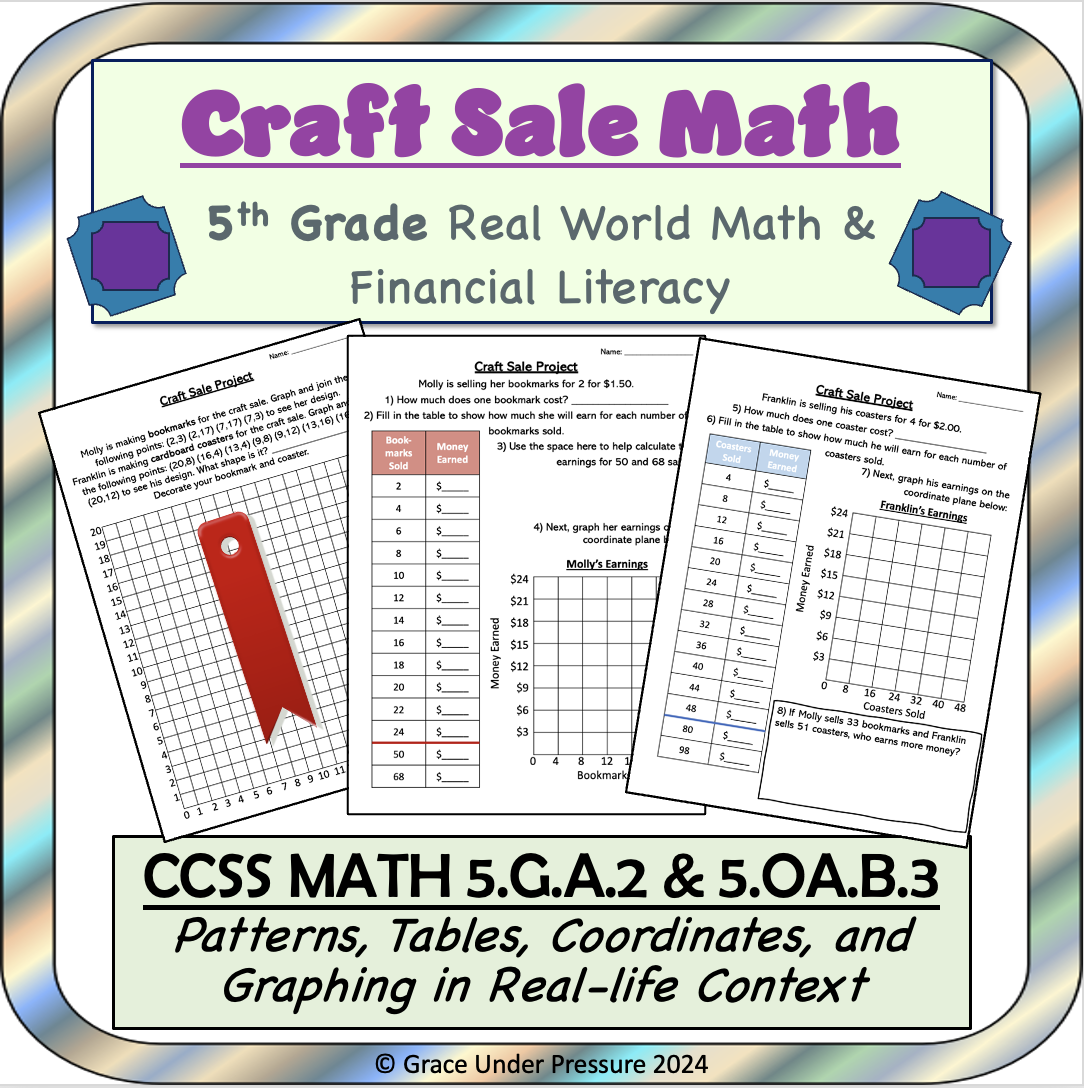
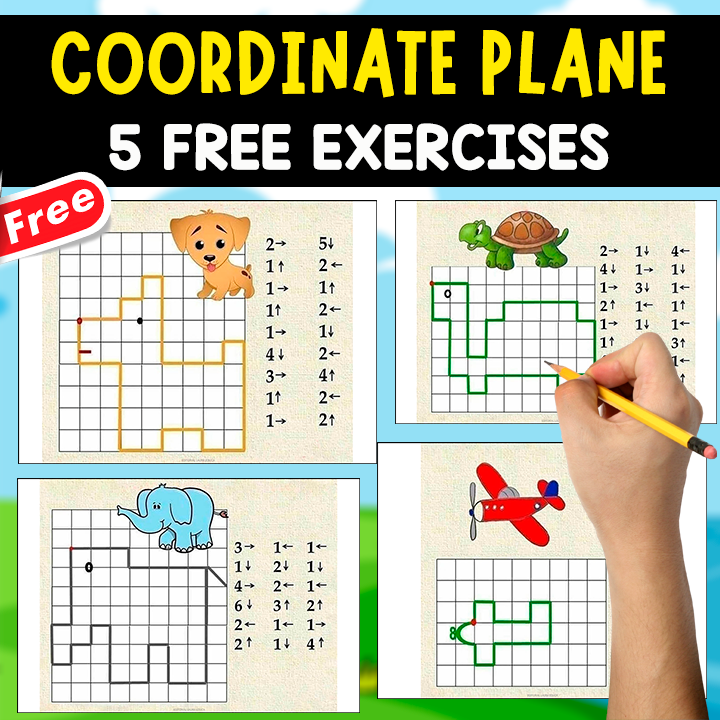
Coordinate Plane Worksheets: 5th Grade Patterns, Tables, Graphing
Math, Algebra, Graphing, Grade 5, 6, Worksheets & Printables, Worksheets, Word Problems
This engaging math project for students in grades 5 and 6 has several components, and it will help your students see how the math skills they learn in the classroom can be used in real-life situations! It is a great lesson to incorporate some simple financial literacy into your math curriculum too! How to Use: 1) Students will start by plotting ordered pairs on a coordinate plane to create the designs of two students who are making items for a craft sale. If graphed correctly, they will make a rectangle and an octagon. 2) Next, they will complete a worksheet that includes a table of values to show the profits of one of the craft sale participants. They will graph this data. 3) Then, students complete the same tasks (finishing a table of values and graphing the information) for the second seller. 4) Finally, students will compare the total sales of the two sellers to determine who made more money. There are a variety of ways students can find the final answer from multiplying with decimal amounts to using their tables or graphs. COMPLETE ANSWER KEY INCLUDED This lesson was created to target two specific 5th Grade Math Common Core Learning Standards: Geometry A.2: Represent real world and mathematical problems by graphing points in the first quadrant of the coordinate plane. Operations and Algebraic Thinking B.3: Generate two numerical patterns using two given rules. Form ordered pairs from the two patterns and graph the ordered pairs on a coordinate plane It could also be implemented in a 6th grade classroom during a Ratio and Proportional Relations unit or in a middle school special education classroom. What's Included: 7 Page PDF Ready to Print and Use! - Teacher instructions - Coordinate plane worksheet for students to plot shapes on - 2 pages of tables of values and graphs for students to complete - 3 page Answer Key
Author Grace Under Pressure
Tags 5th Grade Algebra, Patterns, Coordinate Plane Worksheet, Algebra Worksheet, Patterns And Tables, Graphing Workseheets, Real World Math, Financial Literacy, Math Project, Table Of Values
Measuring: Turkey Line
Holiday & Seasonal, Math, Graphing, Measurements, Grade 2, 3, Worksheets & Printables, Worksheets
Measuring: Turkey Line The Measuring: Turkey Line is a valuable teaching resource exclusively designed for 2nd and 3rd-grade educators, including public school teachers as well as homeschoolers. It creatively combines the basics of mathematics with holiday-themed fun, perfect to add to your lesson plan around Thanksgiving or any turkey-themed activity day. This interesting line plot activity involves students in practical learning by asking them to measure various feathers. The measurements are taken and then used to create a line plot, blending graphing and measurement principles within one task. Focusing particularly on key standards such as: 2MD1: Selecting an appropriate tool for a measurement task 2MD9: Creating a line graph using gathered data 3MD8: Putting together a line plot from scratch, this supportive resource presents opportunities for reinforcing basic skills in an enjoyable manner. Beyond being just about numbers, once the practical part is done, students can color, cut out, and assemble their turkeys. Many teachers have found success by having their pupils mount these artworks on construction paper for display purposes. This product isn't limited solely to math instruction; Measuring: Turkey Line incorporates seasonal festivities which make this educational activity relevant across other subject areas such as art or history related to the Thanksgiving Day celebration. The product comes as an effortless-to-download PDF file that can be printed directly for use in classrooms or home-teaching contexts without introducing unnecessary tech logistics into your teaching time. Further related resources like 'Winter Measurement'', 'Santa Math Maker'' can guide your holiday-linked lessons while still maintaining coordination with central mathematical concepts. In essence, Measuring: Turkey Line goes beyond being just another worksheet but rather tastefully integrates varied aspects of early education – numerical comprehension aligned with creative expression amid observing crucial cultural holidays. This additive enriches multifaceted classroom learning objectives affordably yet powerfully.
Author Teach With Baker
Tags Mathematics, Thanksgiving Education, Line Plot Activity, Measurement Learning, Creative Art
8th Grade Math Review Choice Board Activities Digital & Printable
Math, Algebra, Geometry, Graphing, Grade 8, 9, 10, Activities, Worksheets, Worksheets & Printables
Keep your 9th-grade students engaged and prepared for this school year with this interactive, comprehensive review of Pre-Algebra. This digital choice board is designed to master foundational math concepts they'll need in high school while keeping them motivated to learn. Perfect for back-to-school or as a review for key skills, this activity makes reviewing, practicing, and reinforcing Pre-Algebra concepts seamless, fun, and flexible in its format. What's Inside This choice board covers a wide array of essential Pre-Algebra topics, each with various activities and resources. Students can explore each topic at their own pace, choosing activities that best suit their learning needs. Each topic is equipped with pages that allow students to interactively practice material without requiring logins, Google Classroom, or Microsoft Teams. Covered Topics: Real Numbers Exponents Ratios and Proportions Equations Inequalities Linear Relationships Roots Functions Systems of Equations Pythagorean Theorem Transformations Scatter Plots Volume Probability Scientific Notation Whether your students are working with equations, exploring probability, or coming to understand functions, this choice board has them covered. The activities vary to let teachers easily reach all different learning styles and allow students to review what they've learned and further their newfound knowledge. Key Features: Digital: Just share the link and they're good to go! Nothing to set up, nothing to lock, no passwords to remember. Great for independent work or collaborative groups. Printable Resources: We know sometimes students learn best with hands-on tools. That's why this choice board includes printable reference sheets and problem sets, ideal for at-home practice or extra support. These printable resources help reinforce key theories and provide a helpful tool students can refer back to as they work through each activity. Why Teachers Love It No Prep Required: No hours of setup required. Just send the link and let your students be off learning. Self-Paced Learning: Learners decide on order and types of activities to work on. It's student-driven and huge for building confidence. Give your students this interactive no-prep Pre-Algebra review choice board and set them up for success in a fun way to begin the school year!
Author Matemaths
Tags Matemaths, Choice Board, Digital, Printable, Pre Algebra