Character Feelings Chart for Comprehension



About This Product
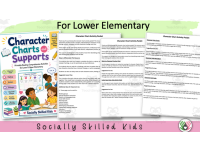
Character Chart Activity Packet | Character Traits, Feelings, Evidence & Reading Response
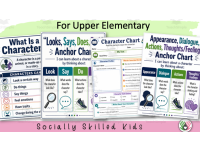
Help your students build stronger reading comprehension skills with this Character Chart Activity Packet! This resource gives elementary students structured, easy-to-use supports for identifying and describing characters in fiction texts. Students will practice noticing what characters look like, say, do, feel, and think, while also learning how to explain character traits with evidence from the story.
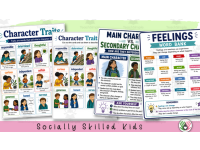
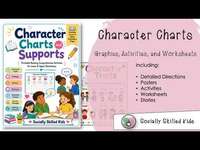
This packet includes anchor charts, word banks, character trait cards, feelings supports, graphic organizers, short practice passages, writing pages, and differentiated activities for both lower and upper elementary students.
Objective
The objective of this resource is to help students understand characters more deeply by identifying character traits, feelings, actions, dialogue, problems, changes, and text evidence. Students will move from simple character identification to more complete written and spoken explanations about characters.
Order, Outline, and Steps
This resource is organized to support clear instruction and gradual skill-building.
First, introduce character concepts using the included anchor charts and word banks. Next, teach students how readers learn about characters by looking at what they say, do, feel, and think. Then, use the character trait and feelings cards for vocabulary practice, discussion, sorting, and examples. After that, students can complete character charts using a read-aloud, short passage, independent book, or classroom text. Finally, students can use the extension writing page to turn their chart into a paragraph or written response.
Included sections support:
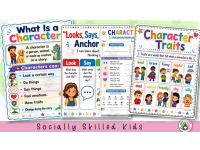
What is a character?
Looks, says, does, feels
Character traits
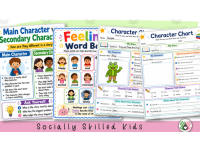
Character trait word bank
Character trait cards
Character trait cut-and-paste practice
Main character vs. secondary characters
Feelings word bank
Feelings cards
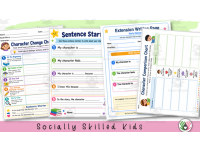
Character change chart
Character comparison chart
Sentence starters
Extension writing page
Lower elementary character pages
Upper elementary character pages
Lower elementary short practice passages
Upper elementary short practice passages
Character Focus sections for guided practice or answer support
Grades or Ages
This resource is designed for elementary students, with differentiated pages for:
Lower Elementary: Kindergarten, 1st Grade, and 2nd Grade
Upper Elementary: 3rd Grade, 4th Grade, and 5th Grade
It can also be used with older students who benefit from structured reading comprehension supports, visual references, sentence starters, or special education accommodations.
Implementation Format
This resource can be used in many instructional settings, including:
Whole-group reading lessons
Small-group instruction
Special education lessons
Reading intervention
Speech and language groups
Social skills lessons
Literacy centers
Partner work
Independent reading responses
Morning work
Homework
Sub plans
Progress monitoring
Teachers can use the pages with picture books, short stories, classroom read-alouds, independent reading books, or the included short practice passages.
Answer Keys
The included Character Focus sections can be used as answer keys, guided examples, or teacher modeling pages. These sections show students how to identify the character, problem, feeling, action, trait, meaningful quote, and evidence from the text. Because many character responses may vary depending on the story or student interpretation, these examples are designed to support discussion and flexible answers.
Tags
character traits, character chart, character feelings, reading comprehension, story elements, character analysis, character change, character comparison, text evidence, reading response, graphic organizers, fiction comprehension, elementary reading, special education reading, literacy centers, lower elementary reading, upper elementary reading, social emotional learning, SEL reading activities, character trait word bank
How to Use and Variations
Use the anchor charts at the beginning of a lesson to introduce or review key vocabulary. Read a short story or passage aloud and model how to complete one part of a chart. Then, allow students to complete a chart with teacher support, with a partner, or independently.
For students who need more support, teachers can provide choices, complete the chart together, allow drawing instead of writing, use the word banks as visual supports, or have students dictate their answers.
For students who are ready for more challenge, ask them to support their answers with text evidence, compare two characters, explain how a character changes, or use the extension page to write a complete paragraph.
Variation ideas include:
Use character trait cards for sorting activities.
Match feelings cards to characters in a story.
Use sticky notes while reading to mark character actions, feelings, or dialogue.
Have students compare a main character and a secondary character.
Use the upper elementary pages for written response or test-prep practice.
Use the lower elementary pages for guided practice, read-aloud responses, or visual-supported instruction.
Use the included passages for quick comprehension practice or social-emotional learning discussions.
Standards
This resource supports skills connected to Common Core reading and speaking/listening standards, including:
CCSS.ELA-LITERACY.RL.K.3 — Identify characters, settings, and major events in a story.
CCSS.ELA-LITERACY.RL.1.3 — Describe characters, settings, and major events in a story using key details.
CCSS.ELA-LITERACY.RL.2.3 — Describe how characters in a story respond to major events and challenges.
CCSS.ELA-LITERACY.RL.3.3 — Describe characters in a story and explain how their actions contribute to the sequence of events.
CCSS.ELA-LITERACY.RL.4.3 — Describe a character, setting, or event in depth using specific details in the text.
CCSS.ELA-LITERACY.RL.5.3 — Compare and contrast two or more characters, settings, or events in a story, drawing on specific details in the text.
This resource also supports speaking and listening skills, written response development, vocabulary development, social-emotional learning, and evidence-based comprehension instruction.
File Types
This resource is provided as a PowerPoint file, which can be used for printing, projecting, or editing as needed.
Number of Pages
This resource includes 63 pages/slides.
Resource Tags
0 Reviews
Check out these other great products