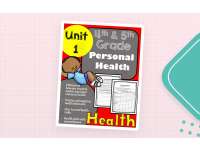
Personal Health – 4th & 5th Grade Unit 1



- Grades
- Grades 4–5, Elementary
- Pages
- 22
- File type
- Preparation
- Print ready


- Subject
- P.E. & Health, Life Studies, Health, Life Skills, Social Emotional Learning (SEL), Social Skills
- Topic
- health unit, personal health
- Resource types
- Worksheets & Printables, Worksheets, Assessments
- Preparation
- Print ready
About this resource
What's inside this resource
Personal Health: 4th and 5th Grade Unit 1
For 4th and 5th Grade Health, there are seven standards that students will practice and learn.
Through using this 4th and 5th Grade Health Unit 1: Personal Health students will explore and learn to identify daily healthy habits.
This unit is the perfect way to help 4th and 5th graders learn the importance of their personal health! This engaging unit is perfect to help your 4th and 5th grade students understand the four ways to be healthy which include: social, physical, mental, and emotional health. There are lessons that teach the steps to make good health decisions, plus there are lessons to help them to teach their family and friends with their health choices. Included in this unit are ways to help enhance their verbal and nonverbal communication skills, how to set reasonable goals to improve their eating habits, and students will set physical goals that will be beneficial to their health. All of these units meet Common Core Standards. Included at the end is an assessment to check for understanding with answer keys. This is a fun and engaging health unit that students are sure to enjoy.
There are 22 pages included!
Included in this 4th and 5th Grade Health Unit are the following:
Students will learn all the ways to be healthy which include physical, mental, emotional, and social.
Steps to help them make good health decisions. Students will practice those steps on their own with a given a scenario to solve.
A guide is given to teach these steps to help family and friends to make good health choices.
They will learn verbal and nonverbal communication skills and how to improve those skills.
Students will set goals to improve their healthy eating habits.
Setting physical goals to improve their health is also included.
Lastly, there is an assessment to check for understanding.
Answer keys are also provided.
There are seven units that cover all the health requirements for 4th and 5th grade. Here are the links to other health units:
Health | 4th and 5th Grade Unit 1: Personal Health
Health | 4th and 5th Grade Unit 2: Growth and Development
Health | 4th and 5th Grade Unit 3: Nutrition and Physical Activity
Health | 4th and 5th Grade Unit 4: Substance Use and Abuse
Health |4th and 5th Grade Unit 5: Injury and Violence Prevention
Health | 4th and 5th Grade Unit 6: Prevention and Control of Disease
Health |4th and 5th Grade Unit 7: Environmental Consumer Health
Related resources
More resources teachers may find useful
24 related resources were found using this product's title, contributor, categories and tags.

In the classroom
Teaching tips & learning objectives

Learning objectives
Distinguish among the four dimensions of health (physical, mental, emotional, social) and identify which one applies to a given scenario.
Apply a six-step decision-making process to resolve a personal-health-related problem, including a peer-pressure scenario.
Define key verbal and non-verbal communication terms and interpret non-verbal cues in example scenarios.

Teaching tips
Use the four scenario-identification examples as a whole-class warm-up before assigning the decision-making worksheets, since both build on the same physical/mental/emotional/social framework.
Note that the alcohol-refusal decision-making page is intentionally open-ended with no fixed answer key, so plan to discuss student responses as a class rather than grade against a key.
Skip or consolidate the nutrition food-pyramid tracker page, since it is duplicated verbatim in the file.

Skills covered
Health-dimension identification — students classify short scenarios as physical, mental, emotional, or social health situations.
Structured decision-making — students apply a six-step process to resolve both an academic-integrity scenario and a peer-pressure/substance scenario.
Communication vocabulary and inference — students define terms like misconstrued and gestures and interpret non-verbal cues from short scenarios.
Good to know
Questions teachers ask about this resource
The decision-making worksheet about being offered alcohol at a friend's house — does it come with a model answer like the other decision-making pages?
No — unlike the test-cheating scenario, this alcohol-refusal scenario has no separate answer-key version in the file; it's left fully open-ended for student and class discussion.
The 'Set goals to improve your health' nutrition page appears twice in a row with identical text — is that intentional?
It appears to be an unintentional duplicate: the food-group-pyramid page repeats verbatim before a third, differently-worded 'Setting goals' page about physical activity follows, so a teacher printing the file should check for the repeated page.

No reviews yet
Downloaded this resource? Tell other teachers how it went.
Resource details
Concepts & topics
Core concepts
 Core concepts
dimensions of health
decision-making process
verbal and non-verbal communication
nutrition and exercise tracking
 Topics
More to explore
You may also like