resources by type
resources by grade
resources by subject
other resources

2,473 products added recently

Health Lesson Plans

Educate your students on vital health topics with lesson plans covering nutrition, hygiene, mental health, and more. These activities encourage informed decision-making and self-care. Use these resources to support your students' overall well-being and healthy lifestyles.

Relevant
alt down
Any Time
alt down
filter by
alt down
All File Types
alt down
filter nav Show filters
Sort by: Relevant
CLEAR
resources by type
Activities
down arrow
Classroom Decor
down arrow
Teacher Tools
up arrow
Anchor Charts
Assessments
Charts
DBQ's
Diagrams
Graphic Organizers
Lesson Plans
Literacy Readers
Outlines
Presentations
Quizzes and Tests
down arrow
Rubrics
Templates
Worksheets & Printables
down arrow
resources by grade
Early Learning
down arrow
Pre-K
down arrow
Elementary
down arrow
Middle School
down arrow
High School
down arrow
Adult Education
Not Grade Specific
resources by subject
Creative Arts
down arrow
ELA
down arrow
Holiday & Seasonal
down arrow
Life Studies
down arrow
Math
down arrow
P.E. & Health
up arrow
Health
Mental Health
down arrow
Physical Education
Sports
Yoga
Social Studies
down arrow
Special Resources
down arrow
Science
down arrow
Foreign Languages
down arrow
Resources for Teachers
down arrow
other resources
Common Core
Homeschool Resources
down arrow
Montessori
Research
STEM
2nd grade Coronavirus / Covid-19 Facts

2nd grade Coronavirus / Covid-19 Facts
P.E. & Health, Health, Grade 2, Teacher Tools, Lesson Plans, Worksheets & Printables, Worksheets

For 2nd Grade Health there are seven standards that need to be taught. Unit 1 Personal Health Unit 2 Growth and Development Unit 3 Nutrition and Physical Activity Unit 4 Substance Use and Abuse Unit 5 Injury/ Violence Prevention Control and Safety Unit 6 Prevention/Control of Disease Unit 7 Environmental Consumer Health 2nd Grade Coronavirus / COVID-19 Facts is an informative packet that teaches second grade students about the coronavirus pandemic in a child-friendly way. This 20-page resource begins by defining what COVID-19 is and explaining how it originated and spreads from person to person. It then outlines safety precautions students can take, like washing hands, covering coughs, and social distancing. With simplified content and vocabulary, this packet helps increase student understanding of COVID-19. It can be used by classroom teachers or homeschooling parents in various ways, like independent reading, whole class instruction, or a science or health lesson. The engaging material is followed by a 1-page answer key. There are seven units that cover all the health requirements for second grade. Here are the links to other health units: Health 2nd Grade Unit 1: Personal Health Health 2nd Grade Unit 2: Growth and Development Health 1st Grade Unit 3: Nutrition and Physical Activity Health 2nd Grade Unit 4: Substance Use and Abuse Health 2nd Grade Unit 5: Injury / Violence Prevention and Safety Health 2nd Grade Unit 6: Prevention / Control of Disease Health 2nd Grade Unit 7: Environmental / Consumer Health 2nd grade Coronavirus / Covid-19 Facts This unit meets Common Core Standards.

Author K-5 Treasures

Tags Coronavirus, Covid-19 Facts, Pandemic, Spread Of Virus, 2nd Grade Health, Second Grade Health, Health Resources, Health Resources For 2nd Grade

Powered Phonics Rule Detectives Gamified Micro-Quests for K-2

Powered Phonics Rule Detectives Gamified Micro-Quests for K-2
Reading, ELA, Literature, Children’s Literature, Mental Health, P.E. & Health, Mindfulness, Health, Research, STEM, Homeschool Curriculum, Grade 1, 2, 3, 4, 5, Activities, Games, Projects, Experiments, Assessments, Teacher Tools, Lesson Plans, Literacy Readers, Presentations, Rubrics

Unleash the Potential of Literacy with this Full, AI-Supported Phonics Learning Program for Grade K-2 Students! "AIPowered Phonics Rule Detectives: Gamified Micro-Quests for K-2 Word Building - Phonics Rules Buildable Grade K-2nd Edition" features 45 pages of interactive digital lesson material that can turn conventional phonics lesson delivery into an incredibly fun and fascinating detective hunt mystery series for kids. A full range of interactive elements, digital AI advisory tools for adaptive content delivery, worksheets for kids, teacher support material, images, and solution keys have been included in this resource tools package for teachers and home schooling parents for effective decoding, reading, and spelling skill development for kids in Grade K-2. Based on a strong systematic and explicit phonics and synthetic background, the "buildable" sequence in the curriculum includes the following skills for each grade level: Kindergarten—basic CVC words and letter sounds, Grade 1—digraphs, blends, CVCE (or "magic e"), and long vowels, Grade 2—vowel teams, r-controlled vowels, diphthongs, syllables, soft C/G, and silent letters. Use the power of Artificial Intelligence to generate unlimited differentiated scenarios, sentences, and activities for remediation, on-grade, or enrichment purposes, and add gamification components such as role-playing, stories, points, badges, and feedback. Why Parents/Schools Love It: Engage Gamification Increases Motivation: Converts phonics lessons into enjoyable 'detective missions' involving stories, badges, & micro-quests, keeping children eager & preventing burnout, underpinning theories such as Self-Determination Theory & Behaviorism. AI-Enabled Personalization: Saves Time “Teachers use prompt cards to create endless differentiated learning material instantly, serving all children, from struggling to advanced learners, without consuming teaching hours.” Established Effectiveness with Data-Driven Insights: Comes with personalized student data indicating an 60-85% proficiency rate for essential rules, as well as assessment and tracking for literacy gains. Complete Ready-to-Use Resources: The all-inclusive resources are available as a single PDF that includes theory lessons, activity sheets, and answer keys and ethics guidelines related to AI that are suitable according to literacy best practices. It Helps Develop Lifelong Reading Confidence: This scaffolding approach leads children to gain a strong conceptual foundation regarding phonics rules, which results in their fluent reading skills, ability to master spelling concepts, as well as developing their lifelong love Target Classes/Students : On the basis of a comprehensive analysis of the PDF document, which includes the flow of the document, developmental phases, categories of rules, worksheets, as well as examples, the following groups of students can be targeted by it: Kindergarten (Emergent Readers): Emphasis on basic components including letter/sound association, vowel concepts, CVC words, and initial/final sounds. This is to promote cognitive balance in the content. Grade 1: Focuses on mastery of CVC words, introduction to digraphs (sh, ch, th, wh), blends (bl, fr, st), CVCE, magic 'e', Long Vowel teams - ai, ee, oa. Grade 2 (Developing Readers) Focuses on complex long vowel combinations, complex pairs of vowels in a word or syllable (ou, oy, ie), r-controlled combinations of letters and vowels (ar, er, ir, or, ur), diphthongs, inflectional suffixes, syllables, and silent letters Its K-2 continuum is "buildable," in that the rules ramp up cumulatively, and it is therefore ideal for mixed-age, intervention, or enrichment settings in the early grades of schooling. Copyright/Terms of Use : «This Book was copyrighted by Syed Hammad Rizvi.» You cannot modify it or give it or any part of it away or resell it. That means you cannot put it on the Internet where it might be downloaded by anyone who wants it. However, if you need to share this resource with colleagues, just purchase more licenses from Teachsimple. Thanks for following the terms of use! This product has been very proudly presented to you by Syed Hammad Rizvi

Author Creative Book Store

Rating

Tags AIPoweredPhonics, PhonicsRuleDetectives, GamifiedMicroQuests, K2WordBuilding, PhonicsRulesK2, BuildablePhonicsCurriculum, KindergartenPhonics, Grade1Phonics, Grade2Phonics, EarlyLiteracyDevelopment

Health 2nd Grade Unit 5: Injury / Violence Prevention and Safety

Health 2nd Grade Unit 5: Injury / Violence Prevention and Safety
P.E. & Health, Health, Physical Education, Special Resources, Life Skills, Social Emotional Learning (SEL), Social Skills, Common Core, Grade 2, Lesson Plans, Teacher Tools, Worksheets & Printables, Worksheets

For 2nd Grade Health there are seven standards that need to be taught. Unit 1 Personal Health Unit 2 Growth and Development Unit 3 Nutrition and Physical Activity Unit 4 Substance Use and Abuse Unit 5 Injury/ Violence Prevention Control and Safety Unit 6 Prevention/Control of Disease Unit 7 Environmental Consumer Health These units can be taught out of order. They are only numbered for your convenience. At the end of each unit, there is an assessment to test students’ understanding. Through using this Health 2nd Grade Unit 5: Injury / Violence Prevention and Safety students will learn to identify personal information, safety in their environment, trusted adults in their community, and how to identify bullying and ways to report it and stop bullying. Students will also learn the following concepts: * Know their address and phone number as they practice writing it and reciting it. * Understand safety in your environment. * Students will be able to identify trusted adults in community. * Students will learn safety procedures in home. * Students will understand what is bullying. At the end of the unit, there is an assessment to check for understanding. A total of 12 pages for this 2nd Grade Health unit on Injury / Violence Prevention and Safety. There are seven units that cover all the health requirements for second grade. Here are the links to other health units: Health 2nd Grade Unit 1: Personal Health Health 2nd Grade Unit 2: Growth and Development Health 1st Grade Unit 3: Nutrition and Physical Activity Health 2nd Grade Unit 4: Substance Use and Abuse Health 2nd Grade Unit 5: Injury / Violence Prevention and Safety Health 2nd Grade Unit 6: Prevention / Control of Disease Health 2nd Grade Unit 7: Environmental / Consumer Health 2nd grade Coronavirus / Covid-19 Facts This unit meets Common Core Standards.

Author K-5 Treasures

Tags Health Unit, Injury, Violence Prevention, Safety, 2nd Grade Health, Second Grade Health, Community Workers, Bully Prevention, Health Activities, 2nd Grade Health Resources

Health 1st Grade Unit 1:  Personal Health

Health 1st Grade Unit 1: Personal Health
P.E. & Health, Creative Arts, Art, Health, Physical Education, Social Skills, Special Resources, Life Skills, Social Emotional Learning (SEL), Grade 1, Lesson Plans, Teacher Tools, Worksheets & Printables, Worksheets

For 1st Grade Health there are seven standards that need to be taught. Unit 1 Personal Health Unit 2 Growth and Development Unit 3 Nutrition and Physical Activity Unit 4 Substance Use and Abuse Unit 5 Injury/ Violence Prevention Control and Safety Unit 6 Prevention/Control of Disease Unit 7 Environmental Consumer Health These units can be taught out of order. They are only numbered for your convenience. At the end of each unit, there is an assessment to test students’ understanding. Through using this Health 1st Grade Unit 1: Personal Health students will explore and learn to identify daily healthy habits. Included in this unit: * Understanding what active verses unactive movements and activities. * Being physically active and choosing which activity is healthy vs unhealthy. * Identifying healthy foods in a fun wordsearch. * How to understand your emotions and when to talk to someone to get help. At the end of the unit, there is an assessment to check for understanding. Included in this unit is an assessment with answer key. A total of 10 pages for Health 1st Grade Unit 1: Personal Health. There are seven units that cover all the health requirements for first grade. Here are the links to other health units: Health 1st Grade Unit 1: Personal Health Health 1st Grade Unit 2: Growth and Development Health 1st Grade Unit 3: Nutrition and Physical Activity Health 1st Grade Unit 4: Substance Use and Abuse Health 1st Grade Unit 5: Injury / Violence Prevention and Safety Health 1st Grade Unit 6: Prevention / Control of Disease Health 1st Grade Unit 7: Environmental / Consumer Health You can also teach your students about keeping yourself safe by studying about the Coronavirus, where and when it started and facts that plagued our world with this virus. 1st grade Coronavirus / Covid-19 Facts by Teach Simple This unit meets Common Core Standards.

Author K-5 Treasures

Tags Personal Health, Health Unit , Healthy Habits, Self-care, 1st Grade Health, First Grade Health, Healthy Foods, Healthy Eating, Physical Activity, Personal Development

Prevention and Control of Disease Health: 4th and 5th Grade Unit 6

Prevention and Control of Disease Health: 4th and 5th Grade Unit 6
P.E. & Health, Life Studies, Physical Education, Health, Life Skills, Special Resources, Social Emotional Learning (SEL), Social Skills, Grade 4, 5, Teacher Tools, Lesson Plans, Worksheets & Printables, Worksheets

Prevention and Control of Disease Health: 4th and 5th Grade Unit 6 For 4th and 5th Grade Health, there are seven standards that students will practice and learn. Through using this Prevention and Control of Disease Health: 4th and 5th Grade Unit 6 students will explore and learn to identify daily healthy habits. In this unit, students will learn how to prevent illness and diseases. There is a sorting activity where students will learn basics of communicable and non-communicable diseases and decipher which category they fall under. Students will learn how to promote good health, and they will understand how to identify reliable health sources. Included in this unit, students will study the Coronavirus, its origin, how it spreads, and how to keep communities and people safe. This unit is a perfect way for students to learn about diseases and how students can be healthy and stay informed! There are 44 pages included. This unit meets Common Core Standards. Included in this Prevention and Control of Disease Health: 4th and 5th Grade Unit 6 Worksheet on what is communicable and non-communicable diseases and sorting these diseases. An understanding of pathogens and how they spread in communities. Worksheets on four ways to promote good health and prevent illnesses. Learn to write healthy goals and learn how to accomplish these goals. There are harmful choices that could affect kids' health. Learning how to get enough sleep is good for their health. Students will also learn where to get reliable health information when needed such as a school nurse or counselor. Information about the Coronavirus is also included. Questions that will be answered include: What is Covid-19? How did Covid-19 start? How does it spread? Who is WHO and the CDC? What happens if you get Covid-19? What can you do to be safe? There is an assessment to check for understanding. An answer key is included. There are seven units that cover all the health requirements for 4th and 5th grade. Here are the links to other health units: Health | 4th and 5th Grade Unit 1: Personal Health Health | 4th and 5th Grade Unit 2: Growth and Development Health | 4th and 5th Grade Unit 3: Nutrition and Physical Activity Health | 4th and 5th Grade Unit 4: Substance Use and Abuse Health |4th and 5th Grade Unit 5: Injury and Violence Prevention Health | 4th and 5th Grade Unit 6: Prevention and Control of Disease Health |4th and 5th Grade Unit 7: Environmental Consumer Health

Author K-5 Treasures

Tags Health Unit, Personal Health, Healthy Goals, Health Activities, Physical Goals, Health Goals, Health And Wellness, 4th Grade Health, 5th Grade Heath, Heath Units

Kindergarten Health: Prevention and Control of Disease - Coronavirus / Covid-19 Facts

Kindergarten Health: Prevention and Control of Disease - Coronavirus / Covid-19 Facts
P.E. & Health, Health, Physical Education, Special Resources, Life Skills, Social Emotional Learning (SEL), Kindergarten, Teacher Tools, Lesson Plans, Worksheets & Printables, Worksheets

This resource, Kindergarten Health: Prevention and Control of Disease - Coronavirus / Covid-19 Facts, is a great tool to teach about the epic coronavirus that plagued the world in 2020. This unit is suited for first graders in a simple, yet accurate manner to increase understanding of this disease on what is the disease, how it started, how it spread throughout the world, and how society responded to this disease in keeping people safe. There are colored pages and pages in black and white. There are also opportunities for children to read some of the words, learn new vocabulary words, trace sentences, and they will even draw their own "novel" virus. Furthermore, students will gain a better understanding of how they can protect themselves, their families, and friends from other diseases that may affect them in the future. Last, there is a mask that students can decorate to show off their creativity. Topics that are covered for students to complete include the following: *What is Covid-19? *How did Covid-19 start? *How does it spread? *What can you do to be safe? Answers are included on some worksheets and some activities are differentiated for all young learners. A total of 12 worksheets are included in this packet. There are seven units that cover all the health requirements for Kindergarten. Here are the links to other health units: Kindergarten Health: Unit 1 Personal Health Kindergarten Health: Unit 2 Growth and Development Kindergarten Health: Unit 3 Nutrition and Physical Activity Kindergarten Health: Unit 4 Substance Use and Abuse Kindergarten Health: Unit 5 Injury / Violence Prevention Control and Safety Kindergarten Health: Unit 6 Prevention / Control of Disease Kindergarten Health: Unit 7 Enviromental Consumer Health You can also teach your students about keeping yourself safe by studying about the Coronavirus, where and when it started and facts that plagued our world with this virus. Kindergarten Health: Covid 19 / Coronavirus Facts This unit meets Common Core Standards.

Author K-5 Treasures

Tags Coronavirus, Covid-19 Facts, Pandemic, Virus Spread, Kindergarten Health, Health Resources, Health Resources For Kindergarten, Kindergarten Worksheets, Health Worksheets

Kindergarten Health: Unit 3

Kindergarten Health: Unit 3
P.E. & Health, Life Studies, Health, Physical Education, Special Resources, Life Skills, Social Emotional Learning (SEL), Social Skills, Kindergarten, Lesson Plans, Teacher Tools, Worksheets & Printables, Worksheets

For Kindergarten Health there are seven standards that need to be taught to achieve healthy habits! Unit 1 Personal Health Unit 2 Growth and Development Unit 3 Nutrition and Physical Activity Unit 4 Substance Use and Abuse Unit 5 Injury/ Violence Prevention Control and Safety Unit 6 Prevention/Control of Disease Unit 7 Environmental Consumer Health These units can be taught out of order. They are only numbered for your convenience. Through using this Kindergarten Health: Unit 3, students will explore and learn to identify daily healthy habits. Students will cut, paste, and sort healthy and unhealthy foods. Also included is a fun engaging story about an unhealthy cat who learns how to be healthy by eating the appropriate food and getting exercise. There are a total of 12 pages included in this unit for Kindergarten Health. Included in this unit: * Students will sort healthy foods by their color. Teachers will help students understand that fruits and vegetables are colorful and healthy for their bodies. * Students will cut and sort healthy foods verses unhealthy foods by pasting them into the correct column. * Students will read individually or as a group a story about an unhealthy cat who learns how to be healthy. At the end of the story, students will identify and draw healthy foods and a physical healthy habit that is good for their bodies. There are seven units that cover all the health requirements for Kindergarten. Here are the links to other health units: Kindergarten Health: Unit 1 Personal Health Kindergarten Health: Unit 2 Growth and Development Kindergarten Health: Unit 3 Nutrition and Physical Activity Kindergarten Health: Unit 4 Substance Use and Abuse Kindergarten Health: Unit 5 Injury / Violence Prevention Control and Safety Kindergarten Health: Unit 6 Prevention / Control of Disease Kindergarten Health: Unit 7 Enviromental Consumer Health You can also teach your students about keeping yourself safe by studying about the Coronavirus, where and when it started and facts that plagued our world with this virus. Kindergarten Health: Covid 19 / Coronavirus Facts This unit meets Common Core Standards.

Author K-5 Treasures

Tags Health, Health Units, Personal Health, Health Worksheets, Kindergarten Health, Kids Health, Elementary Health, Worksheets On Health, Healthy Habits, Healthy Foods

Kindergarten Health: Unit 1

Kindergarten Health: Unit 1
P.E. & Health, Life Studies, Health, Physical Education, Special Resources, Life Skills, Social Emotional Learning (SEL), Social Skills, Kindergarten, Teacher Tools, Lesson Plans, Worksheets & Printables, Worksheets

For Kindergarten Health there are seven standards that need to be taught to achieve healthy habits! Unit 1 Personal Health Unit 2 Growth and Development Unit 3 Nutrition and Physical Activity Unit 4 Substance Use and Abuse Unit 5 Injury/ Violence Prevention Control and Safety Unit 6 Prevention/Control of Disease Unit 7 Environmental Consumer Health These units can be taught out of order. They are only numbered for your convenience. This is a great health unit to help your students achieve healthy habits! Through using this Kindergarten Health: Unit 1, students will explore and learn to identify daily healthy habits. Included in this unit : * Students will understand the order of brushing their teeth as a daily habit. * Students will understand the importance of going to bed on time is a healthy habit. * Identifying healthy eating habits. * Understand what it means to be physically active. * Students will write a goal to brush teeth daily. * Understand that being clean and washing hands is a part of being healthy. There is a total of 14 pages included in this Unit 1 for Kindergarten Health. There are seven units that cover all the health requirements for Kindergarten. Here are the links to other health units: Kindergarten Health: Unit 1 Personal Health Kindergarten Health: Unit 2 Growth and Development Kindergarten Health: Unit 3 Nutrition and Physical Activity Kindergarten Health: Unit 4 Substance Use and Abuse Kindergarten Health: Unit 5 Injury / Violence Prevention Control and Safety Kindergarten Health: Unit 6 Prevention / Control of Disease Kindergarten Health: Unit 7 Enviromental Consumer Health You can also teach your students about keeping yourself safe by studying about the Coronavirus, where and when it started and facts that plagued our world with this virus. Kindergarten Health: Covid 19 / Coronavirus Facts This unit meets Common Core Standards.

Author K-5 Treasures

Tags Health, Health Units, Personal Health, Kindergarten Health, Health For Kindergarten, Healthy Foods, Healthy Habits, Personal Development For Kids, Elementary Health

Injury and Violence Prevention Health: 4th and 5th Grade Unit 5

Injury and Violence Prevention Health: 4th and 5th Grade Unit 5
P.E. & Health, Life Studies, Physical Education, Health, Special Resources, Life Skills, Social Emotional Learning (SEL), Social Skills, Grade 4, 5, Teacher Tools, Lesson Plans, Worksheets & Printables, Worksheets

Injury and Violence Prevention Health: 4th and 5th Grade Unit 5 For 4th and 5th Grade Health, there are seven standards that students will practice and learn. Through using this Injury and Violence Prevention Health: 4th and 5th Grade Unit 5 students will explore and learn to identify daily healthy habits. This is a wonderful unit to help students to stay safe and healthy. With this 4th and 5th Grade Health Unit 5: Injury / Violence Prevention, kids will learn to identify daily healthy habits along with how to treat minor cuts with basic first aid. Students will also learn how and when to call 911 and identify when there is an emergency to call. Furthermore, students will learn how to use the Heimlich maneuver. Other worksheets in this unit will teach students how to prevent common injuries at home, school, and in the community. In addition, there is an important paper on stranger danger and the tricks that strangers use on kids. Lastly, students will learn about bullying and how they can handle bullying situations along with how to deal with conflicts. This unit meets Common Core Standards. There are 16 pages included. Included in this Injury and Violence Prevention Health: 4th and 5th Grade Unit 5 Basic first aid will be taught for minor cuts. When and how to call 911 and know when it's an emergency. How to use the Heimlich maneuver. Understand the common injuries that happen at home, school, and in their community. Students will gain an understanding about stranger danger. Strategies to stop bullying and how to handle conflicts. There is also an activity about how words can break someone or build them up. There is an assessment included. An answer key is included. There are seven units that cover all the health requirements for 4th and 5th grade. Here are the links to other health units: Health | 4th and 5th Grade Unit 1: Personal Health Health | 4th and 5th Grade Unit 2: Growth and Development Health | 4th and 5th Grade Unit 3: Nutrition and Physical Activity Health | 4th and 5th Grade Unit 4: Substance Use and Abuse Health |4th and 5th Grade Unit 5: Injury and Violence Prevention Health | 4th and 5th Grade Unit 6: Prevention and Control of Disease Health |4th and 5th Grade Unit 7: Environmental Consumer Health

Author K-5 Treasures

Tags Health Unit, Personal Health, Healthy Goals, Health Activities, Physical Goals, Health Goals, Health And Wellness, 4th Grade Health, 5th Grade Heath, Heath Units

Growth and Development Health: 4th and 5th Grade Unit 2

Growth and Development Health: 4th and 5th Grade Unit 2
P.E. & Health, Life Studies, Physical Education, Health, Special Resources, Life Skills, Social Emotional Learning (SEL), Social Skills, Grade 4, 5, Teacher Tools, Lesson Plans, Worksheets & Printables, Worksheets

Growth and Development Health: 4th and 5th Grade Unit 2 For 4th and 5th Grade Health, there are seven standards that students will practice and learn. This unit is all about Growth and Development. Through using this Growth and Development Health: 4th and 5th Grade Unit 2 students will explore and learn to identify daily healthy habits. This unit is the perfect way to help 4th and 5th grade students learn and develop healthy habits. In this unit, students will understand and explain the six major body systems including the cardiovascular system, the digestive system, muscular system, the respiratory system, the nervous and skeletal systems, along and more. Also included in this unit, students will compare their emotional, physical, and academic differences with other classmates as they do activities with each other to build friendships and classroom unity with each other. Furthermore, students will have the opportunity to practice scenarios using different healthy methods. At the end of this unit, there is an assessment to check for understanding with answer keys included. This 24-page unit meets Common Core Standards and is filled with engaging activities that will help any student build a healthy foundation! Included in this 4th and 5th Grade Health Unit are the following: There are six major body systems that students will learn and be able to explain how they work and function together. The 6 major systems listed in this unit and include the following systems: Cardiovascular, Respiratory, Digestive, Skeletal, Nervous, and Muscular. Students will also compare their emotional, physical, and academic differences. There is an opportunity for students to healthy methods using different scenarios. Lastly, included there is an assessment to check for understanding with answers. There are 24 pages included! This 4th and 5th Grade Unit 2: Growth and Development meets the Common Core Standards. There are seven units that cover all the health requirements for 4th and 5th grade. Here are the links to other health units: Health | 4th and 5th Grade Unit 1: Personal Health Health | 4th and 5th Grade Unit 2: Growth and Development Health | 4th and 5th Grade Unit 3: Nutrition and Physical Activity Health | 4th and 5th Grade Unit 4: Substance Use and Abuse Health |4th and 5th Grade Unit 5: Injury and Violence Prevention Health | 4th and 5th Grade Unit 6: Prevention and Control of Disease Health |4th and 5th Grade Unit 7: Environmental Consumer Health

Author K-5 Treasures

Tags Health Unit, Personal Health, Healthy Goals, Health Activities, Physical Goals, Health Goals, Health And Wellness, 4th Grade Health, 5th Grade Heath, Heath Units

Teen Mental Resilience Strategies - Psychology Book

Teen Mental Resilience Strategies - Psychology Book
P.E. & Health, Health, Mental Health, Mindfulness, Physical Education, Sports, Yoga, Life Skills, Special Resources, Social Emotional Learning (SEL), Grade 6, 7, 8, 9, 10, 11, 12, Workbooks, Worksheets & Printables, Projects, Activities, Assessments, Teacher Tools, Lesson Plans, Literacy Readers, Outlines, Presentations

Find the best psychology book for teenager mental resilience in today's fast-paced world. "Teen Mental Resilience Strategies - Psychology" is an in-depth, entertainingly written book tailored specifically to help teenagers in high school overcome challenges of academic and social pressures, and changes in their emotions. Booked and penned by Syed Hammad Rizvi, this 382-page-long book incorporates the most crucial concepts of psychology, such as Growth Mindset, Neuroplasticity, and Emotional Intelligence (EQ), Stress management, Mindfulness, and Setting Goals. Consisting of 128 in-depth chapters, this book provides straightforward science-qualified advice on How to Decode Emotions, Break Self-Doubt, Build Healthy Relationships, Manage and Reduce Anxiety, and Achieve Sustainable Well-being in Life. Perfectly useful as a teenager mental health book, this book helps young readers to Switch Gears from Failures to Growth, Build Self-Compassion, and Stay Resilient under all circumstances. Search Keywords: Teen Mental Health Book, Resilience Strategies For Teens, Psychology For Teenagers, Emotional Intelligence Resource, Stress Relief For Teenagers, Mindfulness For Teens, Self-Esteem Building Workbook. Why Parents/Schools Love It: Empowers Teens with Skills for a Lifetime: Gives practical, psychology-based strategies to effectively deal with stress, emotions, and relations, enabling students to become independent and resilient. Comprehensive and Age-Appropriate: The book spans 128 chapters, starting with simple mind and body associations and progressing to more complex aspects such as grit and mindfulness, targeting students in grades 8 through 12. Encourages Positive Mental Health: Emphasizes self-awareness, thankfulness, and emotional resilience to avoid issues related to anxiety and depression and align with school counseling and wellness initiatives. Science-Backed and Engaging: Builds on established ideas from psychology such as EQ and neuroplasticity, making it a great resource to accompany a high school psychology curriculum. Fosters Family/School Discussions. Provides ways of communicating, limiting, and support networks, leading to discussions among teens, parents, and school personnel. Target Student Classes : After analyzing the book thoroughly, based on its content, its design, and the targeted group, it appears that it has been penned for students belonging to grades 8 through 12, roughly aged between 13 and 18 years. Starting off with middle-school education (grade 8) concepts such as understanding the teenage brain and mind, emotions, advancing through challenging ideas suited for high school students (grades 9 through 12) such as cognitive restructuring, post-traumatic growth, imposter syndrome, and self-determination theory, it appears that the language used has been advanced, targeting high school education related to science or general psychology, hence suited for students moving on from middle school or high school students undergoing pressures of college prep. Copyright/Terms of Use This book has been copyrighted by Syed Hammad Rizvi. This resource may only be used on an individual and personal level. For instance, you may not give it out to other classrooms. This also includes posting it on any website where it may be downloaded freely. If you like this resource, you can share it with other teachers by purchasing licenses to use it on Teachsimple. Thank you. This product is proud to be brought to you by Syed Hammad Rizvi

Author Creative Book Store

Rating

Tags TeenMentalHealth, ResilienceStrategies, PsychologyForTeens, HighSchoolWellBeing, EmotionalIntelligenceGuide, MentalHealthMatters, MentalHealthAwareness, MentalHealthRecovery, MentalHealthSupport, MentalHealthAdvocate

Biodesign & Bio-Art Unleash Creativity with Living Systems for Innovat

Biodesign & Bio-Art Unleash Creativity with Living Systems for Innovat
Health, P.E. & Health, Mental Health, Physical Education, Basic Science, Science, Biology, Life Sciences, Human Body, Physics, Homeschool Curriculum, Grade 9, 10, 11, 12, Lesson Plans, Teacher Tools, Assessments, Workbooks, Worksheets & Printables, Presentations

Unlock the creative power of biology! “Biodesign & Bio-Art: Unleash Creativity with Living Systems for Innovators” is the ultimate resource for the next generation of biological and creative minds. With this book, students will no longer be passive recipients of knowledge; they will instead take an active part in the process of innovation. Paddle into the world of 80 fascinating chapters where the basics of life, such as cells, DNA, and biotic systems, are first introduced, followed by the fascinating applications of such knowledge through biomimetics, biomaterials, or living art. The students will be able to learn design concepts from nature, materials developed out of fungus or bacteria, genetics, and ethics. Chock-full of smart insights, practical case studies, and visionary project ideas, this volume is more than an educational textbook - it is a springboard that launches young scholars into their future careers in biodesign, synthetic biology, and more. This textbook is suitable and ideal for STEM and STEAM education as it encourages critical thinking, practical application, and an deep appreciation and respect for natural intelligence. Empower young minds with all the knowledge and inspiration needed to create their beautiful and sustainable world. Technical Features: 80 Chapters of core biology and innovative applications. Interdisciplinary Fusion: It seamlessly integrates biology, art, design, and engineering. Future-Focused Skills Biomimicry/Biofabrication/ Genetic Engineering/ Project-Based Learning It encourages project-based learning with algae, fungi, and bacteria, among many others. Appropriate for STEM/STEAM: Aligns with current learning outcomes for critical thinking and creativity. Why Parents & Schools Will Love It: Prepares for the Future: Beyond book memorization, the university will provide knowledge of applicable, interdisciplinary skills essential for the job market in areas such as biotechnology, sustainable design, and ecological engineering. Fosters Critical & Ethical Thinking: It not only describes how to manipulate life, but also goes in-depth on why and whether they should, as it strives to promote ethical thinking. Interests Varied Students: Exquisitely designed for both scientifically inclined and creatively inclined students, highlighting the need for both qualities in order to truly innovate. This is perfect for getting students who would otherwise be uninterested in a systemized subject. Aligned with Modern STEM/STEAM Objectives: It wholly supports education schemes combined with Science, Technology, Engineering, Art, and Mathematics learning and applications. Comprehensive & All-in-One Resource: touches on a vast range of topics—from cell biology to bio-art, making it a helpful textbook or supplement for a variety of lessons and pursuits. Student Audience Primary: High School Students, Grades 10-12 (ages 15-18). The sophistication of material, chapter organization, and conceptual difficulty (such as central dogma, ethics of genetic engineering) are precisely suited to highly advanced high school programs for biology and art. Secondary Level: Honors/AP level grade 9 students and first year college or university-level introductory courses for biology, bio-design, or Arts courses. Audience Niche: Targeting aspiring scientists, artists, designers, and any student looking at STEM/STEAM, environmental science, sustainable designs, biotechnology, conceptual art, and more. Copyright/Terms of Use "This Book is copyrighted by Syed Hammad Rizvi." "You may only use this resource personally, and within one classroom." "You are not permitted to change, distribute, or sell copies of parts or whole of this resource." In other words, "You are not permitted to put it on the internet where it can be downloaded." If you would like to share the resource within your school, you can purchase additional licenses from Teachers Pay Teachers. I appreciate you following these terms of use. This product is proudly brought to you by Syed Hammad Rizvi

Author Creative Book Store

Rating

Tags Biodesign, BioArt, STEMeducation, STEAMlearning, BiologyBook, ScienceArt, Biomimicry, BioFabrication, HomeschoolScience, HighSchoolBiology

Health | 3rd Grade Unit 2: Growth and Development

Health | 3rd Grade Unit 2: Growth and Development
P.E. & Health, Life Studies, Physical Education, Health, Special Resources, Life Skills, Social Emotional Learning (SEL), Social Skills, Grade 3, Teacher Tools, Lesson Plans, Worksheets & Printables, Worksheets

This 3rd Grade Health Unit focuses on Growth and Development and is essential to help students with their health and wellness. There are seven units in all taught in 3rd grade that focus on health. These units include: Unit 1 that focuses on Personal Health and Wellness Unit 2 that focuses on Growth and Development Unit 3 teaches students about Nutrition and Physical Activity and how to eat right and stay active Unit 4 that helps students with Substance Use and Abuse and how to avoid bad substances Unit 5 that will teach students about Injury/ Violence Prevention Control and Safety Unit 6 that covers what happened during Covid and how to protect themselves while learning about Prevention/Control of Disease Unit 7 discusses our environment and how to help save our planet with Environmental Consumer Health These units all about health can be taught out of order. They are only numbered for your convenience. At the end of each unit, there is an assessment to test students’ understanding. Through using this Health 3rd Grade Unit 2: Growth and Development, students will be able to study and learn about body organs, our body systems, and their emotional and physical features. Included in this 3rd Grade Health Unit are the following: In this unit, students will learn about several different organs in the body including: brain, lungs, heart, liver, kidneys, and the small and large intestines. They will find a worksheet with a blank body and label all these parts after reading about these vital organs. Students will also learn about the many different body systems we have which include: skeletal and nervous systems, circulatory system, digestive system, respiratory system, muscular system, and learn about our skin and hair. They will assemble in order how these systems look in a body as they compile a book. They will also label each system after looking a drawings. They will explore the emotional and physical features of people when they are sad, surprised, happy, etc. Lastly, they will compare their physical features to other classmates and come to understand how our genes are all different. This unit meets Common Core Standards. It is 13 pages of fun engaging activities! At the end of the unit, there is an assessment to check for understanding. There are seven units that cover all the health requirements for 3rd grade. Here are the links to other health units:

Author K-5 Treasures

Rating

Tags Health Unit, Personal Health, Healthy Goals, Unhealthy Choices, Health Activities, Physical Goals, Health Goals, Health And Wellness, 3rd Grade Health, Third Grade Health

Kindergarten Health: Unit 5

Kindergarten Health: Unit 5
P.E. & Health, Life Studies, Physical Education, Health, Special Resources, Life Skills, Social Emotional Learning (SEL), Social Skills, Kindergarten, Lesson Plans, Teacher Tools, Worksheets & Printables, Worksheets

For Kindergarten Health there are seven standards that need to be taught to achieve healthy habits! Unit 1 Personal Health Unit 2 Growth and Development Unit 3 Nutrition and Physical Activity Unit 4 Substance Use and Abuse Unit 5 Injury/ Violence Prevention Control and Safety Unit 6 Prevention/Control of Disease Unit 7 Environmental Consumer Health These units can be taught out of order. They are only numbered for your convenience. Through using this Kindergarten Health: Unit 5, students will explore and learn to identify daily healthy habits. Included in this unit : Students will learn what to do if they are lost by learning their phone numbers of a parent or guardian. Students will also learn their address and full name, and guardian's names if lost. Students will complete a cut and paste activity for when to call 911 and when not to call 911. Students will learn about bike safety and the signals used when riding a bike. Playground safety is also taught in this unit . Learning about stranger danger is outlined in this unit with a cut and paste activity . Lastly, students will learn about bullying and what it means to be bullied and what to do. This excellent product comprises 11 pages chock-full of useful resources aimed at fostering critical life skills for the well-being of young learners. Embrace Kindergarten Health: Unit 5 in your classroom today! There are seven units that cover all the health requirements for Kindergarten. Here are the links to other health units: Kindergarten Health: Unit 1 Personal Health Kindergarten Health: Unit 2 Growth and Development Kindergarten Health: Unit 3 Nutrition and Physical Activity Kindergarten Health: Unit 4 Substance Use and Abuse Kindergarten Health: Unit 5 Injury / Violence Prevention Control and Safety Kindergarten Health: Unit 6 Prevention / Control of Disease Kindergarten Health: Unit 7 Enviromental Consumer Health You can also teach your students about keeping yourself safe by studying about the Coronavirus, where and when it started and facts that plagued our world with this virus. Kindergarten Health: Covid 19 / Coronavirus Facts This unit meets Common Core Standards.

Author K-5 Treasures

Tags Health Worksheets, Health, Kindergarten Health, Personal Health, Kids Health, Worksheets On Health, Elementary Health, Healthy Foods, Healthy Habits, Health Units

Daily Health & Hygiene Skills: Exercise and Fitness Gr. 6-12

Daily Health & Hygiene Skills: Exercise and Fitness Gr. 6-12
P.E. & Health, Health, Grade 6, 7, 8, 9, 10, 11, 12, Teacher Tools, Lesson Plans

Daily Health & Hygiene Skills: Exercise and Fitness Gr. 6-12 Designed as a comprehensive teaching tool, this resource focuses on promoting a healthy lifestyle among students from grade 6 to grade 12. Nutrition Planning The resource provides strategies and insights into creating healthy nutrition plans, demonstrating the crucial role of balanced diets. This section is designed for interactive group discussions on meal planning and its impact. Exercise Routine Creation In addition to diet information, resources for effective fitness routine creation are incorporated - giving teachers ways to encourage and instill regular exercise habits in students. Whether utilized as classroom instruction or homework assignments, these sections empower students to plan their personal fitness routines. Other Health & Hygiene Topics Covered: Personal grooming: Useful tips coupled with activities increase awareness about maintaining personal hygiene standards. Dental care: Every detail within dental care maintenance has been addressed meticulously ensuring educators leave no stone unturned when it comes this relevant aspect of daily hygiene practices. Household maintenance:This often overlooked component is included due to its importance in general cleanliness and hygiene principles. Safety Lessons: Community safety:Educators can use this section as a guiding light for producing responsible global citizens who exercise caution while actively contributing towards community cleanliness. Traveling safety measures :This part alludes to the indispensable need of awareness around travelling precautions easing out any potential anxieties yet developing alertness amongst young learners. Misuse of Drugs—Prescription-based & Non-prescription Extra emphasis is placed on educating students about potential dangers regarding drug misuse, a concerning issue amongst today's adolescents. Supportive Learning Tools The resource includes reading passages, real-world activities , and cross-word puzzles for active engagement and fun learning. Please note: The entire resource adheres to Bloom's Taxonomy and aligns with your State Standards. This makes it a standardized but impactful tool of knowledgeable dissemination. In Summary The Daily Health & Hygiene Skills: Exercise and Fitness Gr. 6-12 provides comprehensive health-related educational material: from nutrition to fitness; personal grooming to household hygiene; safety measures around travel and the community, along with responsible handling of drugs in society - all aimed at raising aware global citizens ready for future challenges.

Author Classroom Complete Press

Tags PDF

Environmental Consumer Health: 4th and 5th Grade Unit 7

Environmental Consumer Health: 4th and 5th Grade Unit 7
P.E. & Health, Life Studies, Physical Education, Health, Life Skills, Special Resources, Social Emotional Learning (SEL), Social Skills, Grade 4, 5, Teacher Tools, Lesson Plans, Worksheets & Printables, Worksheets

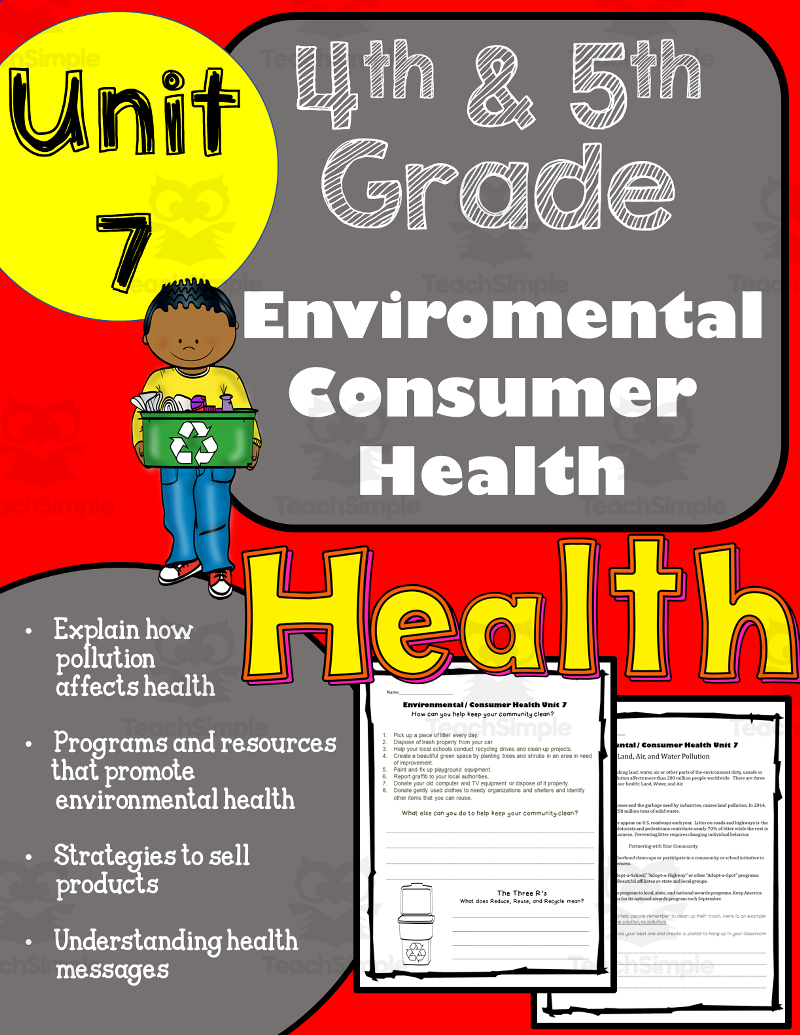
Environmental Consumer Health: 4th and 5th Grade Unit 7 For 4th and 5th Grade Health, there are seven standards that students will practice and learn. Through using this Environmental Consumer Health: 4th and 5th Grade Health Unit 7 students will explore and learn to identify daily healthy habits. This Environmental Consumer Health Unit 7, is full of engaging worksheets to help students learn about their environment in an educational way as it pertains to their own health and the health of others. In this unit, students will be educated on the pollution that effects the land, water, and air in their neighborhood and community. They will also identify solutions to stop the pollution. Along with that, they will discover ways to help the environment by reducing, recycling, and reusing products. Advertisers use tricky ways to convince consumers that unhealthy food is beneficial to them. Kids will learn about these tricky strategies and the messages that advertisers use that convince the public to use these unhealthy products. In addition, students will have the opportunity to draw their own advertisement to help stop the spread of a disease outbreak in a community. Lastly, there is an assessment to check for understanding. This Environmental Consumer Health unit is the perfect way for teachers and parents to help their students understand the importance of health in a community and teaches students a way to develop healthy habits for life! Included in this Environmental Consumer Health: 4th and 5th Grade Unit 7 are the following: How the land, water, and air pollution affect persona health and our community health. A worksheet is provided on solutions to stop the pollution. Learn ways to help a community with reducing, recycling, and reusing products. Students will learn about tricky strategies advertisers use on consumers to coerce them to purchase unhealthy products and the messages these advertisers are sending to kids. Understand what environmental health messages mean to a community. Draw your own health advertisement to help stop a disease outbreak in a community. Lastly, there is an assessment to check for understanding. There is an answer key included. There are 16 pages included! This unit meets Common Core Standards. There are seven units that cover all the health requirements for 4th and 5th grade. Here are the links to other health units: Health | 4th and 5th Grade Unit 1: Personal Health Health | 4th and 5th Grade Unit 2: Growth and Development Health | 4th and 5th Grade Unit 3: Nutrition and Physical Activity Health | 4th and 5th Grade Unit 4: Substance Use and Abuse Health |4th and 5th Grade Unit 5: Injury and Violence Prevention Health | 4th and 5th Grade Unit 6: Prevention and Control of Disease Health |4th and 5th Grade Unit 7: Environmental Consumer Health

Author K-5 Treasures

Tags Health Unit, Personal Health, Healthy Goals, Health Activities, Physical Goals, Health Goals, Health And Wellness, 4th Grade Health, 5th Grade Heath, Heath Units

VEGETABLES Gr. 3-4

VEGETABLES Gr. 3-4
P.E. & Health, Health, Grade 3, 4, Teacher Tools, Lesson Plans

VEGETABLES Gr. 3-4 Teaching Resource The VEGETABLES Gr. 3-4 resource is a comprehensive teaching packet designed for educators in Grade 3 and Grade 4 classrooms, as well as homeschooling parents. It provides engaging and relevant teaching materials centered on a vegetable theme for your students to enjoy. The packet is conveniently available as one printable PDF file. Main Focus Areas Brainstorming and Word Study: These activities are designed to help students expand their vocabulary while stimulating creative thinking skills. Phonics: Introducing sound patterns and pronunciation nuances associated with various vegetables aids language learning progression. P.E & Health - Research Activities: introduces basic research techniques related to health topics, fostering the development of critical research skills. Versatile Application The VEGETABLES Gr.3-4 resource pack can be easily adapted for different educational settings. Whether it's a group classroom lesson, homeschooling sessions or smaller after-school clubs—the lesson plans are flexible enough to fit your needs perfectly. Making Healthy Discussions Enjoyable! Incorporating a fun theme around vegetables makes discussions on healthy eating enjoyable! Who said broccoli couldn't be enthralling? In Summary, The VEGETABLES Gr 3-4 package stands out as it not only focuses on essential verbal skills but also emphasizes health-related knowledge within an approachable context—vegetables! Easy-to-print PDFs make preparation quick so that you spend less time planning lessons and more time actually teaching them—an ideal resource that makes learning about vegetables both entertaining and valuable.

Author Classroom Complete Press

Tags Chart Activity, Creative Writing, Book Creation, Cut And Paste, Vegetables

Kindergarten Health: Unit 7

Kindergarten Health: Unit 7
P.E. & Health, Life Studies, Physical Education, Health, Special Resources, Life Skills, Social Emotional Learning (SEL), Social Skills, Kindergarten, Teacher Tools, Lesson Plans, Worksheets & Printables, Worksheets

For Kindergarten Health there are seven standards that need to be taught to achieve healthy habits! Unit 1 Personal Health Unit 2 Growth and Development Unit 3 Nutrition and Physical Activity Unit 4 Substance Use and Abuse Unit 5 Injury/ Violence Prevention Control and Safety Unit 6 Prevention/Control of Disease Unit 7 Environmental Consumer Health These units can be taught out of order. They are only numbered for your convenience. Discover the comprehensive and engaging Kindergarten Health: Unit 7, a top-notch digital educational package designed to help you educate young minds about essential health concepts, habits, and practices. Focused on Environmental Consumer Health, this unit equips students with the knowledge to stay safe from sun exposure and appreciate the role healthcare workers play in their community. This fun-filled material offers interactive activities like cut-and-paste worksheets where children can learn about dressing appropriately for sun protection. They'll also get introduced to sunscreen usage for additional safety measures. With 12 insightful pages adhering to Common Core Standards, Kindergarten Health: Unit 7 is an indispensable resource for educators seeking high-quality content on environmental consumer health topics tailored towards kindergarten learners. Maximize your kindergarten instruction by exploring all seven units of the Kindergarten Health series by Teach Simple. Give your students a solid foundation in understanding personal wellbeing essentials while keeping them informed about current facts concerning Covid-19. Students will cut, paste, and decide how to best protect our bodies from the sun. They will also learn about health care workers in our community and how they keep us safe. There are a total of 12 pages included in this unit for Kindergarten Health. There are seven units that cover all the health requirements for Kindergarten. Here are the links to other health units: Kindergarten Health: Unit 1 Personal Health Kindergarten Health: Unit 2 Growth and Development Kindergarten Health: Unit 3 Nutrition and Physical Activity Kindergarten Health: Unit 4 Substance Use and Abuse Kindergarten Health: Unit 5 Injury / Violence Prevention Control and Safety Kindergarten Health: Unit 6 Prevention / Control of Disease Kindergarten Health: Unit 7 Enviromental Consumer Health You can also teach your students about keeping yourself safe by studying about the Coronavirus, where and when it started and facts that plagued our world with this virus. Kindergarten Health: Covid 19 / Coronavirus Facts This unit meets Common Core Standards.

Author K-5 Treasures

Tags Health Units, Health Worksheets, Worksheets On Health, Kindergarten Health, Personal Health, Healthy Habits, Healthy Foods, Healthy Kids, Elementary Health

FRUIT Gr. 3-4

FRUIT Gr. 3-4
P.E. & Health, Health, Grade 3, 4, Teacher Tools, Lesson Plans

Introduction Fruit Gr. 3-4 is an education resource designed with the primary goal of nurturing young minds in Grades 3 and 4. Aimed primarily at teachers and home-schooling parents, this product provides a unique learning opportunity that seamlessly integrates P.E. & Health subjects, focusing specifically on health. Product Overview By utilizing Fruit Gr. 3-4, children can engage in activities that revolve around developing a theme on fruit. These activities are systematically structured to encompass multiple study areas: Brainstorming, Word Study, Phonics, Creative tasks, and Research. Educational Benefits The engaging nature of these activities prompts students to dive deeper into health concepts while fostering an interesting learning environment compared to traditional teaching methods. Also worth mentioning is how easily these resources integrate into any existing lesson plan or curriculum for Grade 3 and Grade 4 class setups. For educators managing whole group instruction or facilitating small groups in class rotation lies the perfect use case scenario for Fruit Gr. 3-4. Rather than limiting use to classroom scenarios only; set it as homework assignment or independent learning task - encouraging student engagement beyond standard classroom horizons! Digital Accessibility – Convenience At Its Best! In addition to its versatile implementation potential, Fruit Gr. 3-4 also offers convenience when it comes to accessibility thanks due its availability as downloadable PDF file format—a practical solution for print outs whenever needed. A Unique Engagement Model – Co-exploration with Instructor & Peer Interaction..! This resource supports genuine teacher-to-student interaction without compromising educational value; personalized yet inclusive by means where educators play an instrumental role together with their pupils co-exploring this delightful fruit-themed universe while gaining insightful knowledge about the importance of health overall. To Wrap It Up.. In summary, whether you're an educator inspiring creative thinkers within the classroom or homeschooling parent providing personalized instruction at home - applying Fruit GRs' integration versatility could therefore serve beneficially optimizing students' comprehensive learning experience notably improving cultivation of skills sets involved - from Brainstorming & Word Study down intuitive Phonics enhancement enveloped unto Creative-based tasks plus fundamental Research leaps growth-wise.

Author Classroom Complete Press

Tags PDF

Health | 3rd Grade Unit 6: Prevention Control of Disease

Health | 3rd Grade Unit 6: Prevention Control of Disease
P.E. & Health, Life Studies, Physical Education, Health, Life Skills, Special Resources, Social Emotional Learning (SEL), Social Skills, Grade 3, Teacher Tools, Lesson Plans, Worksheets & Printables, Worksheets

This 3rd Grade Health Unit focuses on Prevention Control and Disease and is essential to help students with their health and wellness. There are seven units in all taught in 3rd grade that focus on health. These units include: Unit 1 that focuses on Personal Health and Wellness Unit 2 that focuses on Growth and Development Unit 3 teaches students about Nutrition and Physical Activity and how to eat right and stay active Unit 4 that helps students with Substance Use and Abuse and how to avoid bad substances Unit 5 that will teach students about Injury/ Violence Prevention Control and Safety Unit 6 that covers what happened during Covid and how to protect themselves while learning about Prevention/Control of Disease Unit 7 discusses our environment and how to help save our planet with Environmental Consumer Health Included in this 3rd Grade Health Unit are the following: These units can be taught out of order. They are only numbered for your convenience. At the end of each unit, there is an assessment to test students’ understanding. Through using this 3rd Grade Health Unit 6: Prevention Control of Disease, students will explore and learn to identify daily healthy habits. Included in this 3rd Grade Health Unit are the following: In this unit, students will learn new vocabulary and cut and paste illnesses as they sort and discover what illness are communicable and non-communicable diseases. Students will learn to take care of themselves as they learn about personal hygiene and the importance of how to stay clean with their bodies. They will learn about the importance of making and keeping goals and write three healthy goals and a way to accomplish these goals. Handwashing is another part of how to control disease. Students will review the importance of keeping their hands clean and how that will help them to stay healthy. For fun, there is a word search on dental hygiene included as they review these vocabulary words. Viruses can spread quickly in communities. In this unit, students will learn about the Coronavirus and measures on how to keep themselves and their family safe from spreadable diseases and viruses. Included is information on the Coronavirus for students to learn and then they will answer several questions as to its origin, how it started, how it spread, and what they can do to be safe for future viruses. Lastly, there is an assessment to check for understanding. This unit meets Common Core Standards. It is 30 pages of fun engaging activities! At the end of the unit, there is an assessment to check for understanding. There are seven units that cover all the health requirements for 3rd grade. Go to K-5 Treasures to check out the other 3rd Grade Health Units to help students complete the entire Health Standards for the year!

Author K-5 Treasures

Rating

Tags Health Unit, Personal Health, Healthy Goals, Unhealthy Choices, Health Activities, Physical Goals, Health Goals, Health And Wellness, 3rd Grade Health, Third Grade Health

Health 2nd Grade Unit 1: Personal Health

Health 2nd Grade Unit 1: Personal Health
P.E. & Health, Health, Physical Education, Common Core, Special Resources, Life Skills, Social Emotional Learning (SEL), Social Skills, Grade 2, Lesson Plans, Teacher Tools, Worksheets & Printables, Worksheets

For 2nd Grade Health there are seven standards that need to be taught. Unit 1 Personal Health Unit 2 Growth and Development Unit 3 Nutrition and Physical Activity Unit 4 Substance Use and Abuse Unit 5 Injury/ Violence Prevention Control and Safety Unit 6 Prevention/Control of Disease Unit 7 Environmental Consumer Health These units can be taught out of order. They are only numbered for your convenience. At the end of each unit, there is an assessment to test students’ understanding. Through using this Health 2nd Grade Unit 1: Personal Health students will explore and learn to identify daily healthy habits by knowing what foods are best to eat and how to set goals for physical activity. Habits included are: * Students will learn about healthy and unhealthy activities. These activities will include what is the difference between physical activities and sedimentary activities. * Students will learn how to make healthy choices that will benefit their nutritional goals. * They will learn about goals. Along with knowing the difference between long-term and short-term goals. And how to set both. * Students will come to understand their emotions and how to they can express those emotions as they learn to deal with their feelings. * Lastly, students will learn when and who they can rely on and who to talk to an adult about how they are feeling and how to get help when needed. At the end of the unit, there is an assessment to check for understanding. A total of 11 pages for this 2nd Grade Health Unit 1 on Personal Health There are seven units that cover all the health requirements for second grade. Here are the links to other health units: Health 2nd Grade Unit 1: Personal Health Health 2nd Grade Unit 2: Growth and Development Health 1st Grade Unit 3: Nutrition and Physical Activity Health 2nd Grade Unit 4: Substance Use and Abuse Health 2nd Grade Unit 5: Injury / Violence Prevention and Safety Health 2nd Grade Unit 6: Prevention / Control of Disease Health 2nd Grade Unit 7: Environmental / Consumer Health 2nd grade Coronavirus / Covid-19 Facts This unit meets Common Core Standards.

Author K-5 Treasures

Tags Health Unit, Personal Health, Healthy Goals, Unhealthy Choices, Health Activities, Physical Goals, Health Goals, Health And Wellness, 2nd Grade Health, Second Grade Health

Vegetables Reading Comprehension Passage - Cored Ed Encyclopedia

Vegetables Reading Comprehension Passage - Cored Ed Encyclopedia
ELA, Language Development, Reading Comprehension, Reading, Pre-Reading, Science, Life Sciences, Health, P.E. & Health, Nature & Plants, Grade 2, 3, 4, 5, Worksheets & Printables, Worksheets, Teacher Tools, Centers, Activities, Writing Prompts, Assessments, Quizzes and Tests, Quizzes, Lesson Plans

This vegetables reading comprehension with lesson plan includes: Visualization (on the front cover) Start your lesson by taking a minute to think and share something about the topic. Read the script aloud (slowly), perhaps prepare some music or sound effects. Student close their eyes and let their imaginations wander. Students open their eyes, read the question aloud and give them a few minutes to complete. Ask a few students to share or keep answers until the end to compare with what they learn in the passage. Quick pause—thousands of Cored Education products are included with your TeachSimple membership. Download links and encyclopedia index available here. Pre-Reading Trivia Students will write down one thing they already know about the subject and then read five more facts and discuss. These facts are fun, and the students will enjoy learning about the subject before reading more. Give 1 minute for students to write what they already know (no pressure—best guess is fine). Read the five facts together. After each fact, do ask a student for their opinion, was it surprising? Set a purpose by asking students to highlight/underline one fact they want to learn more about during the reading. Reading Passage The text is a high-interest reading passage with set paragraphs, roughly three to four paragraphs long. It contains a variety of themes about the topic, anywhere from history to technology. The passage is between 250 and 350 words in length. First, ask students to look at the headings and see what they’ll learn about today. What do they know about the topic/heading? First read options: Teacher read-aloud (best for support). Partner reading (paragraph by paragraph). While reading, students underline important details, and vocabulary words they think may come up in the questions section. Mixed Questions The first question page contains four multiple-choice questions, each with a choice of four answers, and three written response questions that require a sentence or two from the student. Students complete the mcqs first independently, then review quickly as a class. For the 3 written responses, try to get students giving the answer with some form of evidence: “I think ___ because the text says ___.” If students get stuck, send them back to check the passage. Vocabulary Questions Practice seven key words from the text in this section across two activities. First section is scrambled words where students will unscramble three words given a clue for each. The second section is a word to meaning matching activity. Before starting, have some students read out words they underlined in the passage. Ask students to say the word and read aloud the sentence(s) around each word. Ask students to do scrambled words and the matching exercise in pairs then go through answers as a class. For the scrambled spelling task, get four pairs to come up to the board and write the words for extra practice with the other student reading out the clue. For the matching task, prompt students to give full sentences: “I matched ___ with ___ because ___.” Creative Writing In this question, the student will be required to write a five to eight sentence paragraph on a question related to the topic. Before starting, ask students write down 3 key ideas they are going to include in their piece. Ask students for ideas to share around the class to help those struggling. Pro writing expectations: 5–8 sentences At least 2 facts or details from the passage At least 2 vocabulary words from the previous page Students read their paragraphs while classmates listen for facts and vocabulary words. Extension Activities This page is optional for fast finishers or to take home. There are several activities, each one requiring a different skill. Do some, do none, do all, completely optional - but you will feel reassured knowing every possibility is planned for. Includes summary writting question. Answer Key There are answers for the multiple-choice questions, written response questions have sample answers, vocabulary answers and if there is a summary question then a sample summary will be provided as well. Lesson Plan Included Customized lesson plan for this lesson is included. Lesson Snapshot Title: Vegetables Genre: Nonfiction (Informational text) Subject: Science (Life Science: plants, nutrition) / Reading (informational text) Primary Topic: What vegetables are and why they matter Estimated Guided Reading Level (A–Z): N What This Lesson Teaches Best What counts as a vegetable (in this text): Defines vegetables as edible parts of plants people choose to eat, including roots (carrot), leaves (spinach), and flower buds (broccoli). Plant parts and categories: Explains that many vegetables come from soft-stemmed, herbaceous plants rather than woody trees, and that vegetables come in many shapes because plants have many useful parts. Early farming and seed-saving: Describes how people once gathered edible plants from the wild, then began planting and saving seeds (about 10,000–7,000 BC), keeping and sharing plants that tasted better or grew bigger. Science vs. everyday language (tomato debate): Contrasts the botanical definition of “fruit” (seed-bearing part formed from a flower’s ovary) with how “vegetable” often means a savory plant food served with meals, noting a U.S. court decision in 1893 calling tomatoes vegetables for a tax rule. Nutrition and food preservation: States vegetables are usually low in fat and calories, filling because they bring water and fiber, and may contain vitamins/minerals (examples include vitamin A and vitamin C); also notes chilling, freezing, or canning to keep vegetables longer. Learning Goals Students will define a vegetable using examples from the text (root, leaf, bud). Students will describe where many vegetables come from (soft-stemmed, herbaceous plants) and explain what that means. Students will explain how seed-saving helped wild plants become “garden favorites,” using details from the passage. Students will compare the botanical meaning of fruit with the cooking meaning of vegetable, using the tomato example. Students will identify two reasons vegetables can be filling and healthy (water, fiber, vitamins/minerals) based on the text. Key Vocabulary From the Text edible — safe and good to eat. herbaceous — soft-stemmed; not woody. botanists — scientists who study plants. ovary — flower part that can form fruit. fiber — nutrient that helps you feel full. FULL CATALOG OF DOWNLOAD LINKS AND ENCYCLOPEDIA INDEX HERE

Author Cored Education

Rating

Tags Vocabulary, Reading Comprehension, Reading Passages, Lesson Plans, Ela Lesson Plans, Reading Comprehension Lesson Plans, Pre-reading, Science Lesson Plans, Nature And Plants, Health

Health | 3rd Grade Unit 7: Enviromental Consumer Health

Health | 3rd Grade Unit 7: Enviromental Consumer Health
P.E. & Health, Life Studies, Physical Education, Health, Life Skills, Special Resources, Social Emotional Learning (SEL), Social Skills, Grade 3, Teacher Tools, Lesson Plans, Worksheets & Printables, Worksheets

This 3rd Grade Health Unit focuses on Enviromental Consumer Health and is essential to help students with their health and wellness. There are seven units in all taught in 3rd grade that focus on health. These units include: Unit 1 that focuses on Personal Health and Wellness Unit 2 that focuses on Growth and Development Unit 3 teaches students about Nutrition and Physical Activity and how to eat right and stay active Unit 4 that helps students with Substance Use and Abuse and how to avoid bad substances Unit 5 that will teach students about Injury/ Violence Prevention Control and Safety Unit 6 that covers what happened during Covid and how to protect themselves while learning about Prevention/Control of Disease Unit 7 discusses our environment and how to help save our planet with Environmental Consumer Health These units can be taught out of order. They are only numbered for your convenience. At the end of each unit, there is an assessment to test students’ understanding. Through using this 3rd Grade Health Unit 7: Environmental Consumer Health, students will explore and learn to identify daily healthy habits. Included in this 3rd Grade Health Unit are the following: Students will learn about different types of pollution in the air, land, and sea and how the pollution affects community health. In this unit, students will read about how to keep the community in which they live in clean and the importance of being apart of a clean community. We've all heard of the terms: reuse, reduce, and recycle. Students will be able to understand the importance of these terms and how to recycle objects. There is a question about if kids today are healthier or less healthy and students will need to explain their reasoning. Many communities have a farmer's market with fresh fruits and vegetables. Students will discuss their thoughts on if this is beneficial for a community and how it can affect the environment and our health. Lastly, there is an assessment to check for understanding. This unit meets Common Core Standards. It is 11 pages of fun engaging activities! There are seven units that cover all the health requirements for 3rd grade. Go to K-5 Treasures to check out the other 3rd Grade Health Units to help students complete the entire Health Standards for the year!

Author K-5 Treasures

Rating

Tags Health Unit, Personal Health, Healthy Goals, Unhealthy Choices, Health Activities, Physical Goals, Health Goals, Health And Wellness, 3rd Grade Health, Third Grade Health

FRUIT AND VEGGIES Gr. 1-3

FRUIT AND VEGGIES Gr. 1-3
P.E. & Health, Health, Grade 1, 2, Teacher Tools, Lesson Plans

FRUIT AND VEGGIES Gr. 1-3: A Multi-Disciplinary Teaching Resource The FRUIT AND VEGGIES Gr. 1-3 teaching resource offers an array of engaging activities to effectively teach students in grades 1 through 3 about fruits and vegetables. This tool allows educators to seamlessly blend P.E. & Health subject matter into their regular curricula. The uniqueness of this product is its multidisciplinary approach which supports various learning styles, hence providing inclusive education for all students in the classroom. A Focus on Diverse Learning Areas: Creative writing Matching exercises Brainstorming sessions Word study activities (Plus art projects and cooking lessons!) Picturize a class day filled with learners enthusiastically writing about their favorite fruit or painting images of colorful vegetables! Even better - Think how cooking lessons can be leveraged to impart practical life skills along with awareness about healthy eating habits! This tool's adaptability allows teachers to facilitate intuitive learning experiences for both whole group instruction or small groups for more focused attention. Leveraging Research for Skill Development: An added bonus feature is the research element which contributes towards developing vital cognitive skills like critical thinking and problem solving among youngsters while they discover interesting facts related the fruits and veggies world! A Single Downloadable PDF Format: The entire material is provided in an easy-to-download format letting you instantaneously access the content while planning classes at school or home, paving way for applications ranging from classroom instruction to homework assignments or even homeschooling programs. Choosing FRUIT AND VEGGIES Gr. 1-3 as your go-to educational resource will enable you to incorporate creativity into health education, making learning an exciting journey for children. What's more, it will simplify the preparation process for educators too - thereby meeting curriculum goals in an efficient and effective manner!

Author Classroom Complete Press

Tags PDF