Inflation Lesson – High School Financial Literacy



- Grades
- Grades 8–12
- Pages
- 5
- File type
- Answer key
- Included


- Subject
- Finance, Math
- Topic
- Inflation, Financial Literacy
- Resource types
- Lesson Plans
- Answer key
- Included
- Standards
- 7.RP.A.3
Product description
From the author
This Inflation: High School Financial Literacy Lesson can help develop financial literacy skills in high school students and show them how the math they learn in the classroom can be useful in everyday life. The resource offers a complete introduction to inflation and its implications. It's perfect for classrooms including consumer math, applied math, or financial literacy.
The 2-page handout and worksheet incorporates real-world math scenarios enabling students to develop their financial understanding and strengthen their mathematical skills.
Key topics covered include:
Understanding inflation and why it may vary
Learning what amount of inflation is desirable and how it is calculated
Analyzing potential problems like decreased investment return when inflation is high or increased mortgage payments due to related interest rate hikes
Math Skills Required:
Calculating with percentages written in decimal form
Grades to Use With:
This lesson is designed for students in high school in grades 8-12 who have learned about calculating percentages using decimals.
It can help your students meet standard CCSSMP4 (Model with Mathematics), making math more than just an abstract concept but a real world applicable practice.
What's Included:
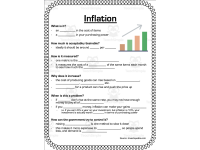
This lesson is a user-friendly 5-page PDF: ready to print and use immediately. It includes a one-page handout with two versions – note-taking or pre-filled, allowing you to choose which is best for your students' engagement. Then, there is a worksheet with four different real world inflation math problems accompanied by an answer key to make marking a breeze.
How to Use:
The product fits various teaching arrangements from whole class learning to individual seat work or partner work.
I would go through the handout with the whole class, do a sample problem on the board, and then allow my students to work in pairs or small groups to complete the worksheet.
If you enjoy this financial literacy activity, check out others in my store:
Related resources
More resources teachers may find useful
24 related resources were found using this product's title, contributor, categories and tags.



In the classroom
Teaching tips & learning objectives

Learning objectives
Calculate the new cost of an item after a stated inflation percentage, using decimal multiplication.
Compare a percent wage increase against a percent inflation rate to determine whether a budget still balances.
Evaluate whether an investment's return outpaces inflation-driven price increases on a specific purchase.

Teaching tips
Confirm students can multiply a percent as a decimal (e.g., 9% as 0.09) before assigning the four word problems, since the lesson states this skill is expected.
Assign the note-taking (fill-in-the-blank) version of the handout for guided instruction, and the complete version for independent review or absent students.
Walk through the mortgage interest problem (Question 4) as a class example. Compare its steps with the wage and investment problems.

Skills covered
Percent-of-a-number calculation — students find 9% of a grocery bill and add it to the original amount (Question 1).
Multi-step percent comparison — students compare a 2% wage raise against 5% inflation across income and expenses to judge affordability (Question 2).
Applied financial reasoning — students weigh a 4.5% investment return against 8% inflation to decide if a purchase stays affordable (Question 3).
Good to know
Questions teachers ask about this resource
Does the lesson explain inflation before assigning the calculation problems, or start directly with the math?
A six-question overview handout explains what inflation is, how it's measured, and how it's controlled before students move to the four calculation problems.
How are the two handout versions meant to be used differently?
One version presents the completed explanations for independent reading, while the second repeats the same content with key terms blanked out for guided note-taking.

No reviews yet
Downloaded this resource? Tell other teachers how it went.
Curriculum
Standards, concepts & topics
Standards
 Standards
- 7.RP.A.3 — Use proportional relationships to solve multistep ratio and percent problems. Examples: simple interest, tax, markups and markdowns, gratuities and commissions, fees, percent increase and decrease, percent error.
Core concepts
 Core concepts
Inflation
Consumer Price Index (CPI)
Percent increase
Personal finance
 Topics
Explore more
Categories this resource belongs to
Explore related searches
More to explore
You may also like