



2,806 products added recently
Page 27 - 7th Grade Activities
Enhance your seventh-grade curriculum with activities that stimulate curiosity and intellectual growth. These resources cover diverse subjects and include projects that promote inquiry and analysis. Incorporate them to keep students motivated and invested in their learning.

 Show filters


Synonyms and Antonyms Activities: The History of Hip Hop Dance | Nonfiction Passage with Questions
ELA, Language Development, Vocabulary, Grade 5, 6, 7, Activities
Hip Hop Synonyms and Antonyms Activities engage students with the history of hip hop dance told through rap lyrics. Students will practice identifying synonyms and antonyms in context using multiple choice questions. Answer keys are included. Teachers can use these printable PDF activities for independent practice, small groups, or whole class instruction. The rap lyrics walk through the origins of major hip hop dances like breaking, locking, and popping. Students will expand their vocabulary and reading comprehension in an engaging way. Educators looking for a break from traditional synonym and antonym worksheets will appreciate this creative resource that keeps kids attentive. Recommended for grades 5-7 language arts classes.
Author Rap Opera for Kids!
Tags Hip Hop Dance History, Hip Hop Dance Synonyms Activity, Hip Hop Dance Antonyms Activity, Reading Nonfiction, Dance Antonyms, Synonyms For Nonfiction

Subtracting Fractions - Problem Tickets
Math, Fractions, Montessori, Grade 4, 5, 6, 7, Activities
Product Title: Subtracting Fractions - Problem Tickets Subtracting Fractions - Problem Tickets is a comprehensive teaching aid designed to complement subtraction lessons for grades 4 to 7. This useful educational tool eliminates the tedium associated with learning fractions and turns it into an engaging practice session that students look forward to. The product is thoughtfully divided into different problem sets, each adding a layer of complexity as students gain confidence in their abilities. The simple green border that features on these Fraction Problem Tickets is symbolic of the subtraction operation found in standard Montessori math materials. Problems #1-9: Students start off with subtracting simple fractions having identical denominators, compatible with Montessori metal fraction insets or fraction circles. Answers are kept unreduced at this stage assuming that the concept of reducing fractions has not yet been introduced. Problems #10-18/19-27: They then progress onto practical applications involving subtracting fractions with differing denominators for either minuend or subtrahend and eventually both. Problems #28-36: Finally, they engage in more complex tasks requiring dedication towards subtracting mixed numbers requiring changes on both minuend as well as subtrahend. This resource includes an Answer Key, and Recording Sheets. To cater to different needs these materials can be printed then cut out individually or used whole after being laminated; whole sheets double up as problem sets offering differentiation possibilities. After delivering lessons teachers distribute selected tickets encouraging independent follow-ups thereby strengthening student's autonomous learning spirits. An interesting aspect of this resource lies its capacity to be used by casually tossing cut up tickets into a basket, this turns it into part of a math activity center where learners exercise choice determining which problems they want to tackle. Enriching the learning experience with decision-making challenges while encouraging more active participation in the process. Subtracting Fractions - Problem Tickets is an indispensable asset for all educators aiming at simplifying fraction subtraction teaching, and making learning an interactive and enjoyable experience for their students.
Author Virtually Montessori
Tags Subtracting Fractions, Math Education, Problem-solving, Fraction Subtraction, Interactive Learning
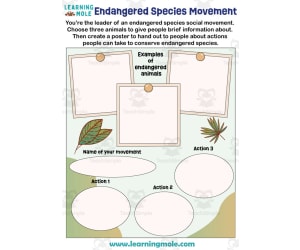
Endangered Species Movement Activity
Animals, Life Sciences, Science, Nature & Plants, Grade 3, 4, 5, 6, 7, 8, 9, 10, 11, 12, Activities
Activity Introduction An amazing activity designed for the students to learn more about animals in different countries. Endangered Species Movement Do you like animals? what is your favorite one? Do you own a pet? If yes, tell us more about it, like what its name? And what do you like most about it? What are the animal kingdoms? Can you write down the characteristics of each animal class like mammals, birds, reptiles, amphibian, fish and mollusks. Do you know that some animals can sing, can you name any of them? What is the largest and the smallest mammal in the world? What is the largest and the smallest bird in the world? What is the largest and the smallest fish in the world? Endangered Species Movement Activity The activity is perfect for encouraging the researching skills for the students, while learning more about this fantastic animal. Endangered Species Movement This friendly designed worksheet is suitable for students at school, homeschooling, and as a group activity. Instructions You're the leader of an endangered species social movement. Choose three animals to give people brief information about. Then create a poster to hand out to people about actions people can take to conserve endangered species. Format Available in a PDF format.
Author Educational Voice
Tags Endangered Species Movement Activity, Endangered Species, Endangered Species Activity, Endangered Species Facts, Endangered Species Facts For Kids, Endangered Animals, Endangered Plants
How to Write An Essay: Proofreading Spelling, Grammar and Punctuation - FLASH-MAC
ELA, Writing, Common Core, Grade 5, 6, 7, 8, Activities
How to Write An Essay: Proofreading Spelling, Grammar and Punctuation - FLASH-MAC FLASH-MAC is a dynamic teaching resource that provides educators with an engaging tool for enhancing students' proofreading skills. Ideal for students in grades 5 to 8, this resource can be used across a variety of educational settings including traditional classrooms or homeschooling environments. Focusing specifically on writing aspects of Language Arts, it will enhance the learners' understanding of vital proofreading tasks such as: Refining spelling proficiency Tightening grammar usage Adherence to appropriate punctuation rules. The interactive nature of the software promotes hands-on learning, allowing students to interact with an error-ridden essay about "the life cycle of frogs". By touching and correcting sentences directly on screen, pupils get direct involvement in rectifying composition errors. This flash-based teaching assistant aligns with the Common Core State Standards supporting educators in meeting key education benchmarks. It's designed considering Bloom's Taxonomy, ensuring comprehensive cognitive development while introducing learners to spelling correction exercises, grammar rules application, and accurate use of punctuation marks. The product file included in "How to Write An Essay: Proofreading Spelling Grammar and Punctuation - FLASH-MAC", is easily accessible through MAC operating systems ensuring seamless technology integration within your instruction process. It supports various instruction methods: Whole group lessons : Facilitate class discussions around identifying errors Serving as small group activities : Promoting peer-to-peer learning dynamics Serving as individual assignments : Elevate independent abilities if preferred by teachers or applicable based on lesson structure. In conclusion, How to Write An Essay: Proofreading Spelling Grammar and Punctuation - FLASH-MAC is an important tool that enriches learner interaction while nurturing future adept writers effectively.
Author Classroom Complete Press
Tags Software (Mac)

Apple Donuts Activity
Life Sciences, Science, Nature & Plants, Grade 1, 2, 3, 4, 5, 6, 7, 8, Activities
Activity Introduction An amazing activity /craft designed for the students to have fun learning about our daily activities or even to have fun doing some DIY crafts. Create Your Wardrobe Do you like group activities or crafts that you can enjoy with your friends and family? Or do you like individua activities and crafts that you can do on your own then show the world how creative you are? Have you ever tried to do a do it yourself craft? If yes tell us more about it, like has any one helped you, what was it about, what materials dd you use to create it and how much time did you suspend creating it? Do you like colouring? What is your favourite colour? Create Your Wardrobe Activity The activity is perfect for encouraging the creativity skills for the students, while having fun with our cool activities and crafts. Create Your Wardrobe This friendly designed worksheet is suitable for students at school, homeschooling, and as a group activity . Instructions Slice the top and bottom from each apple. Slice the apples into circles. Use a biscuit cutter & cut a hole in the center to make a donut shape. Top the apple rings with either chocolate spread, peanut butter or yogurt. Finally, garnish and decorate each donut with different topping. Format Available in a PDF format.
Author Educational Voice
Tags Apple Donuts Activity, Donuts Activity, Apple Donuts, Donuts Craft, Apple, Apples, Apples Activity, Apple Craft, Apples Facts, Apple Facts For Kids

Snapshot Book Report
ELA, Writing, Grade 4, 5, 6, 7, 8, Activities
Snapshot Book Report Step into the world of visual literature essence with the Snapshot Book Report. Crafted specifically for students in 4th to 8th grades, this resource encourages children to create a striking "snapshot" of their favorite reading books, leading to an engaging and informative book report. In today's digital age where visual content is king, the Snapshot Book Report serves as a unique teaching resource that integrates elements of Language Arts and Writing while bridging the gap between traditional book reports and modern educational trends. Towards Enhanced Reading Accountability & Engagement This teaching tool provides educators with content that is easily integrated into small groups or large classrooms. Implement these fun snapshots in various ways: they can be class assignments during reading comprehension lessons, weekend homework projects based around independent reading or exciting discussion starters within peer-led study groups. Fostering a Vibrant Classroom Reading Community The strength of this tool lies not just in its direct benefit - helping students delve deeper into understanding literature - but also in its indirect impact on fostering a vibrant reading community within your classroom walls. As these snapshots gradually fill-up your school corridors or classroom backdrops, they serve as windows showcasing beautiful entries from every student’s recent reads - creating a visually stimulating environment conducive to extensive book exploration by other curious minds. "Not simply pretty visuals, these displays are rich capsules holding novel insights about different books; making it harder for any student passing by not to feel excited about embarking on new literary adventures." The Snapshot Book Report Resource File: The Snapshot Book Report resource comes as an easy-to-access PDF file for teachers' convenience. In Conclusion All things considered, the Snapshot Book Report breathes life and color into conventional book report forms; encouraging creativity amongst pupils while propelling them towards independent critical thinking when it comes accessing literature. No frills or grand gestures needed – Just pure interactive learning at its best!
Author The Simplistic Teacher
Tags Visual Literature, Book Reports, Reading Comprehension, Independent Reading, Interactive Learning, Snapshot Book, Book Report 8th Grade, Book Report Template 8th Grade, Book Report Examples 8th Grade
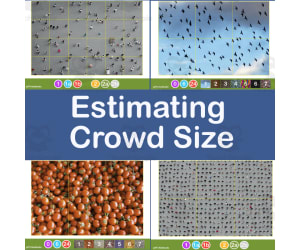
Estimating Crowd Sizes using Jacob's Method
Math, Statistics, Grade 7, Activities, Projects
This investigation focuses on estimating the size crowds or even large collections of objects using some very basic mathematics. Jacob's Method of counting large crowds involves creating a grid that divides a given area into equal size squares. An estimate is made by counting the number of people in a few squares, then multiply the average obtained by the number of squares in the grid. What would happen if you use different size grids ? How do the estimates compare between pupils ? Could you get a more accurate estimate if you took all the estimates in the class and calculated th average? These and many more questions are presented on the worksheet provided along with a number of pictures of multiple objects and crowds with & without prepared grids for printing or viewing on a computer screen. This activity encourages sharing and comparing of data, refining methods of collection of the data and discussion about the accuracy and limitations of the method used. The package includes: Teachers Guidance Notes An introduction into Jacob's Method and a guide to the Worksheets Estimation Worksheet A Worksheet for the students on how to use Jacob's Method and record the data. A list of questions for discussion. Estimation Crowds To be used as a starter with the student's Estimation Worksheet containing 2 crowds of different densities. Pupils begin by guessing the size of each crowd, then estimate with a 6 square grid & 24 square grid using Jacob's Method. Estimation Samples 1 and 2 14 pictures to choose from all of which have a fairly even distribution: crowds of people, tomatoes,stars, trees, bricks, flowers, balloons, birds and more. Pupils estimate with no grid, a 6 square grid & 24 square grid, and are encouraged to experiment further with other grid sizes of their own. Estimation Sample 3 7 more pictures to choose from, but this time the distribution of the populations are not so even or regular, so its more challenging and opens up more questions. They include a football crowd, bubbles, two other crowds, a shoal of fish and a herd of wildebeast. There is lots to practice with & an excellent topic for critical thinking without the need for advanced math and can be extended into investigating bias in crowd counting. Note: All the documents are printable. To view the sample populations with the grids on a computer you will need the Adobe Acrobat Reader on a PC or Mac. Common Core Links at 7th Grade CCSS7.SP.A.1 Understand that statistics can be used to gain information about a population by examining a sample of the population; generalizations about a population from a sample are valid only if the sample is representative of that population. Understand that random sampling tends to produce representative samples and support valid inferences. CCSS7.SP.A.2 Use data from a random sample to draw inferences about a population with an unknown characteristic of interest. Generate multiple samples (or simulated samples) of the same size to gauge the variation in estimates or predictions. For example, estimate the mean word length in a book by randomly sampling words from the book; predict the winner of a school election based on randomly sampled survey data. Gauge how far off the estimate or prediction might be.
Author Jeff's Notebooks
Tags Math, Statistic, Data Collection, Estimating, Estimating Crowds, Jacob's Method, Estimating Population Size, Math Investigation, Jeff's Notebooks, Data Handling, Estimating Crowd Size, Crowd Size Estimation

Main Idea and Details Activities: Molly Pitcher Biography | Nonfiction Passage with Questions
Social Studies, Biographies, Grade 5, 6, 7, Activities
Do your students need a break from traditional main idea and supporting details worksheets? Rap songs are your solution! Based on history and reading rap songs, these activities willkeep your students' attention using song lyrics as reading passageswhile they practice main idea and supporting details skills. Easily incorporate them intoindependent activitiesor complete them together as aclass lesson. The song lyrics for these activities are used as reading passages and have many content-vocabulary words from the song lyrics for students to practice main idea and supporting details. Teach reading skills to your students in a way that they will enjoy! Kids love music and will certainly enjoy main idea and supporting details in the song lyrics. These activities also feature simple explanations of how main idea and supporting details can guide students' comprehension. Multiple-choice questions with answer keys! All of these activities have multiple-choice questions with answer keys for easy grading. Everything included in this resource is listed below. - the song lyrics for use as a reading passage - What's the main idea? - Find the main idea practice - Details and graphic organizer practice - Organizing details to find the main idea - 4 Find the main idea - 1 Find the supporting detail - Main idea on beast mode - Main idea on beast mode graphic organizer ***Answer keys included.
Author Rap Opera for Kids!
Tags Main Ideas Reading Passage, Supporting Details Passage, Molly Pitcher Reading, Biography Reading Comprehension, What's The Big Idea Molly

Elect a President: Cooperative Work Activity
Social Studies, History, History: USA, Government, Grade 6, 7, 8, 9, Activities
Elect a President: Cooperative Work Activity An engaging teaching resource best suited for Grades 6-9, designed with a focus on Social Studies subjects, particularly History: USA and Government. The Concept This innovative activity introduces students to the fascinating world of elections. It creatively ties in aspects from WWII and leadership dynamics into an interactive learning session. Students work in pairs to assess potential presidential candidates based on defined attributes. Candidate Profiles Six anonymous presidential candidates' profiles are outlined – each presented with five positive attributes and one negative trait. These profiles are drawn from historical figures across different timelines, adding an additional layer of intrigue to the learning process. The Task Through a highly engaging exercise, students need to rank these figures according to who they believe would make ideal presidents based on the listed criteria. This module not only introduces them to election dynamics but also encourages critical thinking around leadership qualities and decision-making capabilities. Note: A simple click by tutors reveals each candidate's identity—an interesting twist that often surprises students about their primary or last-ranking choices. Potential Follow-Up Activities Discuss why certain candidates were selected over others; Analyze valuable traits according to student pairs; Delineate upon traits deemed insignificant; Etc... The Tools We Provide: Crafted using Microsoft PowerPoint making it easier for modification by educators as per their needs. *Can be used as part of whole class instruction, small group sessions or even individual homework assignments. Conclusion: The Elect a President: Cooperative Work Activity introduces a unique blend of history and government through interactive learning. It serves as an excellent introductory module for lessons on elections, WWII or leadership concepts.
Author EduPal Learning
Tags Elections, Cooperative Learning, Leadership, US History, Government
Google Earth Scavenger Hunt
Social Studies, Geography, Grade 5, 6, 7, 8, Activities
This resource is a Google Earth Scavenger Hunt. This is a 2-part webquest that will allow students to explore the world via Google Earth. Each part has 20 questions each and answer keys are included.
Author Hey Teacher Shoppe
Tags Google Earth, Geography, Scavenger Hunt, Webquest, Group Work, World Geography Scavenger Hunt, Geography Scavenger Hunt, Google Earth Activities

King George III and his Tax Collectors: Historical Simulation
Social Studies, History, History: USA, Grade 6, 7, 8, 9, Activities
King George III and his Tax Collectors: Historical Simulation A premier teaching resource designed for educators teaching American history. This versatile tool is ideal for Grades 6 through 9, making the complex historical events surrounding the American Revolution easily digestible. Interactive Experience This resource utilizes role-playing to help students actively engage with history. They can take on roles of colonists post-French and Indian War or play as King George III's tax collectors enforcing such acts as the Stamp Act. Versatility The simulation has a flexible structure, allowing educators to incorporate it into various aspects of classroom instruction - from whole group lessons to homework assignments. Promotes Critical Thinking The educational tool touches on vital themes like representation, taxation and self-determination, encouraging critical thinking amongst learners. PowerPoint Presentation: The package includes a presentation filled with information about significant historical occurrences leading up to the American Revolution, Tailored Instructions: Includes structured instructions for teachers to guide students effectively through complex narratives. Built-in Student Engagement: The student handout allows learners to engage directly with simulated tasks related to key periods and events. Inclusive Education Support: For our English Language Learners(Ells), it includes a writing frame offering regulated route support specific to these learners. Educational Technology Integration: Create seamless transitions between various tech-based settings due its compatibility with multiple file types hence supporting easier sharing between colleagues or parents. To add an artistic flair that captures attention, captivating clip art sourced from Prince Padania enhances engagement across all learning activities. Definitely King George III and his Tax Collectors: Historical Simulation is a requisite companion for educators desiring to make their American history lessons interactive, engaging and fun.
Author EduPal Learning
Tags Role-playing, American Revolution, Taxation, King George III, Stamp Act

Sort Clothing by Feature, Function and Class - Girl Version
Special Resources, Special Education Needs (SEN), Speech Therapy, Science, Basic Science, Kindergarten, Preschool, Grade 1, 2, 3, 4, 5, 6, 7, 8, 9, Activities
Girl version- The educational activity involves sorting clothing items based on their features, functions, and classes. The learners will be presented with a collection of various clothing items such as shirts, pants, jackets, sweaters, and so on. The objective of the activity is to categorize these items based on their unique features, functions, and classes. To begin the activity , the instructor will introduce the concept of feature, function, and class, providing examples and a brief description of each. The learners will then be given a set of clothing items and asked to sort them into categories based on these three criteria. For example, the learners could sort clothing items based on the feature of long sleeves, the function of keeping warm, or the class of pants. They could also be asked to sort clothes based on a combination of these criteria, such as sorting long sleeve shirts that are also suitable for cold weather. The instructor could also provide feedback and additional information about the clothing items and their features, functions, and classes. By completing this activity , the learners will improve their critical thinking and analytical skills as they learn to categorize and classify objects based on different criteria. They will also develop their knowledge and understanding of clothing items and their unique features, functions, and classes. The pages are clear of visual distractions which helps the learner focus on the task. This activity is easy to create - laminate all cards, cut out the individual sorting cards and velcro to the corresponding activity mat. You can hole punch the mats and put them in a binder or use binder clips for many years of teaching and learning. Enjoy, IFIO girl
Author IFIO girl - I'll Figure It Out
Tags Vocabulary, Clothes For Seasons, Visual Discrimination, Sorting, Features, Girl Clothes, Autism, Occupational Therapy, ABLLS-r, Feature Function Class, Sort Clothing

The story of Mother's Day (Reading Comprehension Activities)
ELA, Reading, Reading Comprehension, Grade 4, 5, 6, 7, Activities
This product concerns children from eight to twelve years old. The material includes an extensive text on the history of Mother's Day, i.e. how and why it was established. The text is accompanied by a worksheet with related comprehension tasks (multiple choice, answering questions, writing a paragraph). The material also includes a related picture to be shown to the whole class. This product can be used both at school and at home. It can also be an opportunity (at home) for mother and child to work together so that they can complete the worksheet together. Check out the follwing product's about Mother's Day For students of same age you can also use the follwing products Story Telling Poster Story Telling (6 A4 Posters) AWAKENING CREATIVITY in the English – Language Arts classroom Part 4 AWAKENING CREATIVITY in the English – Language Arts classroom Part 1 AWAKENING CREATIVITY in the English – Language Arts classroom Part 3 AWAKENING CREATIVITY in the English – Language Arts classroom Part 2 Sensory Language: Poster 2 (I describe using my 5 senses...) What is Sensory Language? It is the use of sensory details in description. Sensory Language: Descriptive Writing Activities 2 Sensory Language: Roll and tell! (A rolling die game with task cards) Sensory Language: Poster 1 (I read using my 5 senses...) Sensory Language: Poster 3 (What is sensory language?) Sensory Language: Descriptive Writing Activities 3 READING COMPREHENSION worksheets for INFORMATIONAL texts READING COMPREHENSION worksheets for ANY text Let’s READ about ZEBRAS Poster: I'm reading=I'm thinking Story Mountain Plot your story! (Story Mountan) Story Telling Poster Story Character (A4 poster) READING COMPREHENSION worksheets for ANY story Part 1 READING COMPREHENSION worksheets for ANY story Part 2 I offer the follwing products that you might find interesting Trace and colour 4 (farm animimals) Trace and colour 7 (school stuff) Trace and colour 6 (farm animals) Trace and colour 5 (farm animals) Trace and colour 8 (means of transportation) Trace and colour 3 Trace and colour 9 (football-soccer) Trace and colour 1 Trace and clolour 2 Summer Vocabulary Part 1 Summer Vocabulary Part 2 Fall/Autumn Vocabulary Part 1 Fall/Autumn Vocabulary Part 2 Spring Vocabulary Part 1 Spring Vocabulary Part 2 Winter: Vocabulary (word-wall) Seasons (4 A4 posters) The 4 seasons (A4 poster)
Author Teach To Heaven, Reoulita.com
Tags Mother's Day, Reading Comprehension, Multiple Choice, Question Answering, Paragraph Writing, Worksheet, Printout, Image
Superlatives Activity
ELA, Grammar, Grade 1, 2, 3, 4, 5, 6, 7, Activities
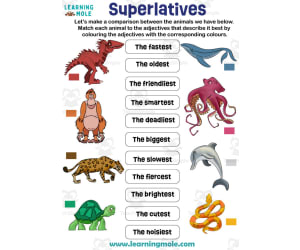
Activity Introduction An amazing activity designed for the students to learn more about languages. Superlatives Do you enjoy learning English? Which topic do you like the most Grammar, writing, reading, spelling, comprehension, vocabulary or phonics? Have you ever tried to learn any other language? If yes, tell us more about it? How many languages are spoken in the world? What do you think the most interesting one? Can you say Hello in Spanish, French or even Japanese? You can give it a try! Can you name the countries that speaks Portuguese? How many countries speaks Dutch? What is the less spoken language in the whole world? Would you like to learn a new language someday? If yes, which language will you choose? Superlatives Activity The activity is perfect for encouraging the researching skills for the students, while learning more about world languages. Superlatives This friendly designed worksheet is suitable for students at school, homeschooling, and as a group activity. Instructions Let's make a comparison between the animals we have below. Match each animal to the adjectives that describe it best by colouring the adjectives with the corresponding colours. Format Available in a PDF format.
Author Educational Voice
Tags Superlatives Activity, Superlative, Superlatives, Superlatives Facts For Kids, Superlative Facts, English, English Facts, English Facts For Kids, Grammar, Grammar Activity

Area of Parallelograms Digital Self-Checking Activity
Math, Geometry, Grade 6, 7, Activities
Area of Parallelograms Digital Self-Checking Activity 'Area of Parallelograms Digital Self-Checking Activity' is an innovative teaching tool designed for 6th and 7th-grade students. This engagement-driven activity merges education with technology, replacing traditional worksheets with dynamic exercises on Google Sheets. Key Features: An interactive mystery picture which unveils as students answer correctly A self-checking mechanism that provides immediate feedback, where correct answers turn green revealing the image while incorrect ones turn red. Focused instruction in Geometry serving to strengthen understanding related to parallelogram areas, word problems, missing dimensions and more. Inclusive learning approach promoting both procedural and conceptual comprehension. Inclusions: A set of 12 carefully framed questions furnished within a single Google Sheet An answer key for teachers' convenience An optional 'Show Your Work' page facilitating deeper understanding by allowing students to display their solution finding process Tutorial Usability: The game -based tutorial exercise can be flexibly deployed during classroom sessions or assigned as home-based reinforcement work. It's conveniently usable in various instructional formats like morning warm-up exercise, bell ringer activity, exit ticket or a re-teach document catering to different educational strategies. The resource can easily integrate into most Learning Management Systems upon uploading it into your Google Drive. The PDF file format ensures smooth downloadability avoiding technical interruptions often found in such resources thus saving precious time irrespective of where learning takes place - be it on school premises or at the student's home seamlessly connecting all through this exciting game -based adventure. With 'Area of Parallelograms Digital Self-Checking Activity', its more than just teaching, it's about cultivating a fun-filled learning atmosphere through a creatively designed digital platform.
Author Digitally Yours Shop
Tags Parallelograms, Area, Geometry, Math Activity, Self-checking

Science Action Labs Plant Science
Science, Life Sciences, Nature & Plants, Grade 4, 5, 6, 7, 8, Labs, Experiments, Activities
Science Action Labs Plant Science: Beyond Traditional Education The Science Action Labs Plant Science is a comprehensive and practical resource specifically designed to enhance teaching of botany to students from grades 4 to 8. As a meticulously curated catalog, it delivers hands-on activities which provides multi-faceted approach towards the study of plant science. Differentiated Learning with Hands-On Activities This product can be utilized for differentiated learning with varying levels of difficulty, addressing important scientific phenomena like photosynthesis and plant reproduction. These features make it an excellent educational foundation for young learners. An Extensive Resource: All Ready to Print! Sixty-four pages of ready-to-print worksheets are available at your disposal. Each page uncovers new opportunities for studious exploration. Tasks range from engaging experiments such as the seed corn Olympics, which instills knowledge about seed germination, to observational studies that let students delve into the fascinating world of pollen. With plants set in motion and experiments conducted using leaves, students gain first-hand exposure making science more tangible and interesting. Fostering Natural Curiosity in Children through Interactive Learning Kids are natural explorers; their inherent curiosity coupled with tangible showcases brought by these action labs will fuel their inquiry as well as understanding towards botanical science. It offers versatility whether delivered in full classrooms or small focussed groups or even assigned as homework tasks. Bridging Theory & Practice: Making Scientific Concepts Digestible This pack goes beyond providing all-encompassing knowledge about plant life at different growth stages but also cultivates an environment where students can learn at their own pace while handling real samples. By connecting theoretical knowledge with hands-on activities, scientific concepts become less abstract making it easier for students to comprehend. Revolutionizing Botany Education with Science Action Labs Plant Science In essence, the Science Action Labs Plant Science is an effective platform for teaching botany in a way that nurtures interest, sustains engagement, and breaks away from traditional models where rote memorization often overshadows actual comprehension. This resource is an invaluable addition to any curriculum aiming to foster budding scientists equipped not just with facts and figures, but also with the crucial skill of scientific inquiry.
Author Classroom Complete Press
Tags Plant Science, Crossword Puzzles, Science Writing, Dr. Newton, Seed Lab
Big Four Hydro powers Activity
Environmental Science, Earth and Environmental Sciences, Science, Grade 3, 4, 5, 6, 7, 8, 9, 10, 11, 12, Activities
Activity Introduction An amazing activity designed for the students to learn more about STEM. Big Four Hydro powers Do you like STEM subjects? what is your favorite one? Have you ever tried to plant a seed? If yes, tell us more about it. Or have you ever tried to invent something? If yes, tell us more about it. And how do you think it will help us? Have you ever seen a microorganism under a microscope? What was it? And how it looked like? Mathematics is a marvelous subject. Let' sharpen our brains and solve some equations. Do you like timetable tricks? What is your favorite one? Do you know how to code? Have you ever created an app or a game before? If yes, how was it like? Big Four Hydro powers Activity The activity is perfect for encouraging the researching skills for the students, while learning more about this fantastic topic. Big Four Hydro powers This friendly designed worksheet is suitable for students at school, homeschooling, and as a group activity. Instructions Research, write a brief description, and glue pictures of the current four largest hydroelectric power plants in the world according to their power generation capacity. Format Available in a PDF format.
Author Educational Voice
Tags Big Four Hydro Powers Activity, Four Hydro Powers Activity, Hydro Powers Activity, Hydro Powers, Hydropower, Hydropower Facts, Hydropower Facts For Kids, Water, Electricity, Renewable Energy

Distributive Property CUT & PASTE Activity
Math, Numbers, Grade 7, Activities
The Distributive Property CUT & PASTE Activity : An Engaging Tool for 7th-grade Mathematics This practical teaching resource focuses on enhancing comprehension of the distributive property, primarily featured in CCSS.MATH.CONTENT.7.NS.A.2.A. It revolves around understanding how multiplication extends from fractions to rational numbers. Uniquely Interactive Design Reinforces rules about operations, highlighted through results like (-1)(-1) = 1 and multiplication of signed numbers. Encourages interpretative analysis by applying products of rational numbers into real-world contexts. Inclusive design provides printable and Google Slides versions – apt for traditional classrooms or homeschool setups alike. The Distributive Property CUT & PASTE Activity is extensively useful in various learning scenarios – as a guide for structured lessons, small group activities, or even as individual homework assignments. A Comprehensive Resource Paired with Detailed Solutions An inclusive answer key allows teachers to evaluate student work confidently and ensures students’ adequate comprehension of the given problems. Constructed according to 7th-grade concepts this activity also proves beneficial when revising concepts with senior graders or challenging advanced learners on lower grade levels thanks to its adaptable nature. The ready-to-use PDF format ensures effortless integration into any lesson plan - making it an enriching addition whether it serves traditional classroom instruction or homeschool curriculums alike.
Author The Math Cafe
Tags Distributive Property, Hands-on Learning, Rational Numbers, Interactive Activity, Problem-solving
Megalosaurus Discovery Activity
Social Studies, History, History: World, History: Ancient, Grade 3, 4, 5, 6, 7, 8, 9, 10, 11, Activities
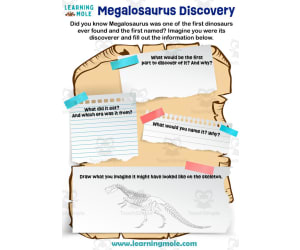
Activity Introduction An amazing activity designed for the students to learn more about animals in different countries. Megalosaurus Discovery Do you like dinosaurs? what is your favorite one? Do you own a pet? If yes, tell us more about it, like what its name? And what do you like most about it? Do you think that your pet has been evolved from a dinosaur? Can you write down the characteristics of your favourite dinosaur like it's shape, their rivals, where did it use to live and what was their favourite food? What is the largest and the smallest dinosaur that ever found? Why is the T-rex is so famous? Have you ever read any interesting facts about it? Can you name any of the carnivores or herbivores dinosaurs? Megalosaurus Discovery Activity The activity is perfect for encouraging the researching skills for the students, while learning more about this fantastic animal. Megalosaurus Discovery This friendly designed worksheet is suitable for students at school, homeschooling, and as a group activity. Instructions Did you know Megalosaurus was one of the first dinosaurs ever found and the first named? Imagine you were its discoverer and fill out the information below. Format Available in a PDF format.
Author Educational Voice
Tags Megalosaurus Discovery Activity, Megalosaurus Discovery, Megalosaurus, Megalosaurus Activity, Megalosaurus Facts, Megalosaurus Facts For Kids, Dinosaur

Word Relationships: Synonyms, Antonyms & Analogies: Expand Vocabulary
ELA, Language Development, Vocabulary, Grade 5, 6, 7, Activities
Teaching about synonyms, antonyms, and analogies has significantly accelerated progress in English Language Arts for my students. They are better equipped to not only answer the difficult state ELA test questions but it has also improved their daily reading and writing. It has especially helped those hard to reach learners on both sides of the spectrum from below grade level to enrichment. Enhancing my below grade level students' vocabulary was the key to propelling them towards success. Giving the proper skills to my higher level thinking students helped them to apply these skills so that they could read higher level books and understand the content vocabulary. If you're not already teaching about word relationships, here is your sign to start today! What are the benefits? aids in vocabulary development By understanding synonyms and antonyms, students can broaden their vocabulary. Knowing various words with similar or opposite meanings helps students to express themselves more precisely and diversely. improves my students’ comprehension skills Recognizing synonyms and antonyms allows students to infer the meanings of unknown words based on their knowledge of familiar ones, leading to a better overall understanding of texts. Students are better able to use context clues to figure out unknown words because their word bank has expanded. stimulates their critical thinking For analogies, students must identify relationships between word pairs, which helps them develop reasoning skills and grasp complex concepts more easily. Analogies also enhance problem-solving abilities by teaching students to make connections between ideas, a valuable skill both academically and in real-life situations. promotes more effective communication Knowing synonyms helps students avoid repetition and convey their thoughts more clearly. Understanding antonyms enables them to appreciate nuances and contrasts in language, making their communication more dynamic. improving writing skills. They allow students to vary their language, avoid redundancy, and create more engaging and sophisticated texts. Standardized tests always feature questions on synonyms, antonyms, and analogies. Mastery in these areas can significantly improve students' performance on these exams. For students learning English as a second language, grasping these concepts is fundamental. It facilitates quicker vocabulary acquisition and better overall language proficiency. Beyond this list, overall, teaching synonyms, antonyms, and analogies gives students the tools they need to be successful.
Author Big Apple Teaching
Tags Vocabulary, Antonym, Synonym, Analogy , Word Relationships

Culture Lesson: Cultural Norms and Avoiding Stereotypes Worksheets
Social Studies, Psychology, Life Studies, Grade 5, 6, 7, Worksheets & Printables, Worksheets, Activities, Experiments, Lesson Plans, Teacher Tools
Do you want your students in grades 5-7 to learn how to become global citizens who can respect a variety of cultural norms and comprehend cross-cultural differences? Are you looking for a fun way to bring all of these ideas to life? Check out this ready-to-go lesson for your class. This 5-Page PDF is ready to print for your social studies classroom. It includes clear teacher instructions for a fun class simulation where half of your students will act out a new "class norm" (five options are provided such as not raising your hand to ask a question) that the other half of your class won't be expecting. While the simulation is happening, everyone will be working on a three page reading comprehension task. Students will read about cultural norms from around the world (slurping noodles when eating in Japan or nodding one's head to say "no" in Bulgaria). They will imagine how not knowing about the cultural norms in a place where they are travelling could lead to accidental misunderstandings. Students are also taught a simple definition of the concept of stereotypes, and they will think of how they are different from cultural norms. Finally, there is a 1-page reflection with prompts- perfect for after a class discussion. Teacher Instructions: 1. Split your class in two and talk to only one half. 2. Tell them that they will have a new “class cultural norm.” Pick one from the provided ideas. 3. When the whole class is reunited, pass out the reading page & worksheets. Students read about cultural norms and answer the questions. 4. As they work, the selected half will enact their new norm, which will confuse the other half of the class. 5. Once the point has been made, let the other half in on the secret. 6. Have a discussion about cultural norms and give students time to write a reflection about this lesson.
Author Grace Under Pressure
Tags Culture, Stereotypes, Cultural, Culture Worksheets, Cross Culture, Travel, Norms, Cultural Norms, Class Simulation, Simulation

Making Inferences Activities: The History of Hip Hop | Nonfiction Passage with Questions
ELA, Strategies, Grade 5, 6, 7, Activities
Do your students need a break from traditional making inferences worksheets? Rap songs are your solution! Based on history and reading rap songs, these activities willkeep your students' attention using song lyrics as reading passageswhile they practice making inferences. Easily incorporate them intoindependent activitiesor complete them together as aclass lesson. The song lyrics for these activities are used as reading passages and have many content-vocabulary words from the song lyrics for students to practice making inferences. Teach reading skills to your students in a way that they will enjoy! Kids love music and will certainly enjoy syllables in the song lyrics. These activities also feature simple explanations of how making inferences can guide students' comprehension. Multiple-choice questions with answer keys! All of these activities have multiple-choice questions with answer keys for easy grading. Everything included in this resource is listed below. - the song lyrics for use as a reading passage - 6 hip hop and inferencing questions ***Answer keys included.
Author Rap Opera for Kids!
Tags Making Inferences, Hip Hop Inferences, Rap History Reading Activities, Nonfiction Passages, Hip Hop Question, Making Inferences Passages, Questions About Hip Hop, Hip Hop Lesson Plans, Hip Hop Worksheet Pdf
The Outsiders Character Card Comprehension Activity
ELA, Reading, Grade 7, 8, 9, 10, Activities
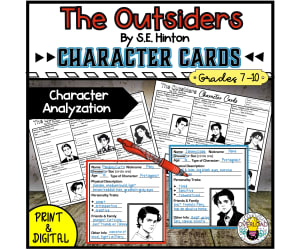
Grab this fun activity to test your students' knowledge of the characters in The Outsiders by S.E. Hinton! These CHARACTER CARDS offer a great analysis of each character, including age, social status, physical traits, personality traits, nicknames, and more. You'll also get a blank template to create your own traits for each character. Simply print and go, or use the digital version (Google Slides). Exemplar cards and answer keys are included. This activity can be used repeatedly and is a fun way to learn and assess students' understanding of the characters. Check out the thumbnails to see if this resource is for you. What's Included: Format: PDF Teacher Guide 12 Printable Character Cards: Pony, Johnny, Dally, Darry, Two-Bit, Steve, Soda, Sandy, Bob, Randy, Cherry, & Marcia Blank Character Card Template Digital Version: All 12 Character Cards & blank template (Google Slides) Exemplars: Completed cards for all 12 characters with usage ideas
Author Creativity Overload
Tags The Outsiders By S.E. Hinton, Characters In The Outsiders, The Outsider's Character Game

Life in Castle Activity
Social Studies, History, History: Ancient, History: World, History: Europe, Grade 3, 4, 5, 6, 7, 8, 9, Activities
Activity Introduction An amazing activity designed for the students to learn more about history. Life in Castle Do you like history? Which topic do you really enjoy about history? Have you ever read an interesting facts about the Vikings? If yes, can you mention them? What do you like most about the Victorian era? Can you name all the Tudors? Have you ever wondered how people used to live in ancient Japan and ancient China? Do you know any interesting facts about ancient Egyptians and the Pharaohs? Have you ever visited South America? What do you know about Incas and Aztecs? Celtic culture was really one of a kind, can you name any of the places that Celts used to live in? Imagine yourself living during the ancient Roman empire, how your life will look like? Ancient Greece was an amazing place to live in. What do you know about ancient Greek life? Life in Castle Activity The activity is perfect for encouraging the researching skills for the students, while learning more about history. Life in Castle This friendly designed worksheet is suitable for students at school, homeschooling, and as a group activity. Instructions What duties did each of the people below complete in the castle? Format Available in a PDF format.
Author Educational Voice
Tags Life In Castle Activity, Life In Castle, Castle, Castles, Castles Facts, Castles Facts For Kids, History, History Facts, History For Kids, History Facts For Kids