



2,646 products added recently
Page 22 - Reading Comprehension Activitites
Support your students in developing strong reading comprehension skills with a variety of engaging activities. This collection includes worksheets, graphic organizers, and discussion questions designed to help students understand and analyze texts. By integrating these resources into your teaching, you can enhance students' ability to interpret information and draw meaningful conclusions.

 Show filters


Reading Passages on Life Cycles of Organisms (Videos)
ELA, Reading, Reading Comprehension, Science, Life Sciences, Biology, Common Core, ESL, Language Development, Resources for Teachers, Grade 2, 3, 4, Teacher Tools, Activities
Accompanying Videos Based on Reading Passages on Life Cycles of Organisms for Life Science (Biology) These accompanying videos contain scripts extracted from the Science Reading Passages series. With stock footage, subtitles, voiceovers, animation and diagrams, they will help students understand the topic more. Ideal for starting or ending a lesson, each video runs at less than 5 minutes and is at least 95% identical to the passage itself. What's inside? Part 2 Videos - Life Cycles of Organisms Reading Passage 1: The Life Cycle of Plants Reading Passage 2: The Life Cycle of Animals Reading Passage 3: Heredity Science Reading Comprehension Outline: Targeted for students in 3rd and 4th grades, these reading passages are enhanced with illustrations and graphs to elucidate critical points. Each lesson aligns with the Common Core State Standards, allowing you to integrate science reading practice effortlessly, knowing that minimal preparation is needed on your part. Each passage comes with a variety of questions in different formats, including multiple-choice formats, data analysis, and fill-in-the-blanks. The topics covered strike a balance between engaging content and core curriculum -based science subjects. Versatile in application, these lessons are suitable for a variety of settings such as whole-class instruction, morning activities, independent desk work, small group discussions, contingency plans for substitute teachers, homework assignments, or even special holiday-themed tasks. Grade 3/4 Links: Physical Science Part 1 - Properties of Objects and Materials Google Docs/Slides/Forms PDF PPT Word Physical Science Part 2 - Position and Motion of Objects Google Docs/Slides/Forms PDF PPT Word Physical Science Part 3 - Light, Heat, Electricity, Magnetism Google Docs/Slides/Forms PDF PPT Word Life Science Part 1 - Characteristics of Organisms Google Docs/Slides/Forms PDF PPT Word Life Science Part 2 - Life Cycles of Organisms Google Docs/Slides/Forms PDF PPT Word Life Science Part 3 - Organisms and Environments Google Docs/Slides/Forms PDF PPT Word Earth Science Part 1 - Properties of Earth Materials Google Docs/Slides/Forms PDF PPT Word Earth Science Part 2 - Changes in the Earth and Sky Google Docs/Slides/Forms PDF PPT Word Earth Science Part 3 - Objects in the Sky Google Docs/Slides/Forms PDF PPT Word For similar products and other frees, do check out Cored Group on TeachSimple .
Author Cored Education
Rating
Tags Science, Elementary, Reading, Comprehension, Vocabulary, Life Science, Biology, Science Assessments, Reading Comprehension Assessments, Vocabulary Assessments
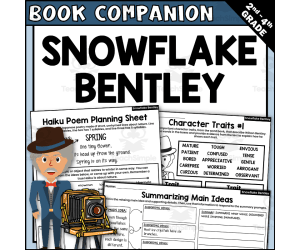
Snowflake Bentley Read Aloud Book Companion Activities for IRA
ELA, Reading, Reading Comprehension, Literature, Grade 2, 3, 4, Read Alouds, Activities
The Snowflake Bentley Read Aloud Book Companion Activities for IRA This inclusive teaching resource provides 47 print-and-go tools designed to encourage active learning in key areas such as comprehension, literature, and reading. This product encompasses a range of engaging activities intended to enrich students' understanding of the book Snowflake Bentley by Jacqueline Briggs Martin. TYPES OF RESOURCES INCLUDED: Comprehensive graphic organizers Diverse book companion content Interactive activities and worksheets IMPLEMENTATION: The application can vary depending on the needs or focus of each class: Whole group management: Teachers can assign tasks based on daily objectives. Small group discussions: These resources enable in-depth consideration of focused themes or concepts at a manageable pace. Homework assignments : Parents can reinforce what has been taught during school hours through these outsourced activities. SPECIFIC SKILLS TARGETED INCLUDE: Cause & effect determination Analyzing settings Note: this is not limited only Language Arts lessons but also extending towards other subjects such History or Science studies . The templates provided enables students to develop summary construction skills using the 'Somebody Wanted Because But So' method where children are tasked with identifying ideas within set categories. This encourages comprehensible and succinct statement formation covering pertinent incidents from their selected narratives. Heightsening creativity expressions, fostering research habits along with already incorporated educational prompts embodies an ideal academic-artistic alliance essential for holistic child development purposes. This set makes teaching easier while guaranteeing that objectives are met in an enjoyable and fulfilling manner. All resources are presented in an easy-to-use PDF format, allowing for effortless downloading, printing and integration into any teaching setting.
Author Creatively Gifted
Tags Snowflake Bentley, Read Aloud, Book Companion, Comprehension, Literacy
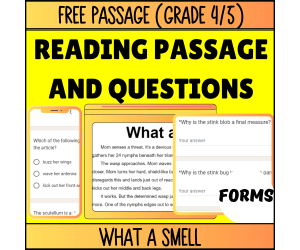
Reading Comprehension Nonfiction Set 2 Sample: What a Smell (Forms)
ELA, Reading, Language Development, Vocabulary, Common Core, ESL, Reading Comprehension, Writing, Literature, Children’s Literature, Grade 4, 5, Centers, Activities, Assessments, Teacher Tools, Tests, Quizzes and Tests
Reading Comprehension Passages Nonfiction Set 2 Sample Overview No prep reading comprehension lessons, with enjoyable articles and topics. Each lesson has a blend of post-reading activities. Mixed questions to check overall understanding. Vocabulary activities, plus a writing section. Lessons also contain a bonus extension exercise at the end. Some you may like, some you may not, either way they are there if you wish to use them. Full answer keys are provided. Passage Included 2.What a Smell: How does the stink bug protect its children? Find out in this lesson. Forms Version This is the Forms editable and fillable/self grading version. This download is available in GOOGLE Docs, GOOGLE Forms, GOOGLE Slides. PDF, PPT, WORD. FULL CATALOG OF DOWNLOAD LINKS HERE Grade 4/5 Links Fiction Set 1 - Animals Google Docs Google Forms Google Slides PDF PPT Word Guided Reading Materials Fiction Set 2 - Family Google Docs Google Forms Google Slides PDF PPT Word Guided Reading Materials Fiction Set 3 - Friends Google Docs Google Forms Google Slides PDF PPT Word Guided Reading Materials Fiction Set 4 - School Google Docs Google Forms Google Slides PDF PPT Word Guided Reading Materials Fiction Set 5 - Sports Google Docs Google Forms Google Slides PDF PPT Word Guided Reading Materials Nonfiction Set 1 - Birds Google Docs Google Forms Google Slides PDF PPT Word Guided Reading Materials Nonfiction Set 2 - Insects Google Docs Google Forms Google Slides PDF PPT Word Guided Reading Materials Nonfiction Set 3 - Mammals Google Docs Google Forms Google Slides PDF PPT Word Guided Reading Materials Nonfiction Set 4 - Nature Google Docs Google Forms Google Slides PDF PPT Word Guided Reading Materials Nonfiction Set 5 - Sea Animals Google Docs Google Forms Google Slides PDF PPT Word Guided Reading Materials Reading Passages Overview Each passage is especially written for Grade 4-5 students, including key vocabulary required for this age group. Topics are varied and are accompanied by colorful graphics. Topics are meant to educate, yet entertain the modern student. These passages are perfect for the modern classroom. Whereas textbooks can become outdated in no time, any changes to technology or the world will result in updates to this product. Mixed Questions The mixed questions section of each lesson includes a variation of five comprehension, vocabulary and math questions. In addition, key reading strategies are frequently covered including cause & effect, summarizing, compare & contrast and making conclusions. Two or three of the questions will be MCQs and other questions will require a written response of some kind. Full answers and example responses appear at the end of the lesson. Spelling & Vocab Each reading passage contains a variety of words and phrases designed for Grade 4-5 students. Spelling and vocab activities provide the opportunity to build fluency with these words. As it can become quite mundane doing the same activities over and over, each lesson in a set will contain a different spelling and vocab activity . Activities include: spelling games, sentence match-ups, mixed-up text and decoding words from the lesson. Writing Prompts Writing prompts are designed to continue the theme or lessons learned in the story. Students are persuaded to write in a variety of ways and each prompt includes several cues to help. As with the spelling/vocab section, writing prompts will vary. This includes research pieces, reading responses, poetry and creative writing prompts. Full Answer Keys Full answer keys and sample responses are provided so no matter how busy you are, you know you're covered! Mixed question answers provide evidence from the text, math questions contain the relevant workings. Answers are designed for use by the teacher, but also suitable as a handout to the student. Just for Fun Each lesson will have a bonus extension exercise. This is something fun to extend the lesson with. You can find these at the end of each lesson, titled Just for Fun. Just for Funs are optional. Some you may like, some you may not. Either way, they are there to do with as you wish. For similar downloads and other frees, do check out Cored Group on TeachSimple.
Author Cored Education
Tags Elementary, Reading, Comprehension, Vocabulary, Answers, Ccss, Common Core, Spelling, Writing, Passages

Social Studies SAMPLE Reading Passage: Food in South America (Docs)
ELA, Reading, Reading Comprehension, Strategies, Resources for Teachers, Social Studies, Sociology, Grade 6, 7, 8, 9, Writing Prompts, Worksheets & Printables, Centers, Activities, Teacher Tools, Assessments, Quizzes and Tests, Quizzes, Tests
This is a ONE PASSAGE SAMPLE. The following is the description of the FULL resource and the downloading links: Social Studies Reading Comprehension Passages and Questions: Food and Culture (Docs) This resource introduces a collection of Social Studies reading comprehension passages with questions about Food, Culture, and Preservation. The passages are carefully designed to bridge the gap between social studies and literacy through strengthening reading comprehension and sparking knowledge curiosity in middle school students. Each passage blends English Language Arts skills with accurate social studies content . Ideal for interdisciplinary learning in ELA and Social Studies. Suitable for Grade 9 review, too! What Is Included in this Collection? There are three informational passages (with full answer keys): Homemade Cottage Cheese: Food, Family, and Local Trade Salty Traditions: How Salami and Kimchi Stay Safe to Eat From Grasslands to Grill: The Foods of South America For Each Passage, students will have multiple tasks to complete as follow: 5 multiple-choice questions targeting main idea, key details, inference, vocabulary in context, and use of evidence 5 vocabulary matching items with clear, student-friendly definitions 5 text-based questions that require citing specific lines or facts 1 summary prompt that asks students to condense central ideas accurately Available Formats for this Resource PDF Fillable PDF Word Docs FULL CATALOG OF DOWNLOADING LINKS HERE For more Social Studies Reading Passages, check the following Links: Ancient Civilizations PDF Fillable PDF Word Docs Google Docs Early Empires and Trade Networks PDF Fillable PDF Word Docs Google Docs The Founding of the United States PDF Fillable PDF Word Docs Google Docs Language, Culture, and Meaning PDF Fillable PDF Word Docs Google Docs Psychology and Society PDF Fillable PDF Word Docs Google Docs Global Festivals and Traditions PDF Fillable PDF Word Docs Google Docs Extreme Environments and People PDF Fillable PDF Word Docs Google Docs Food, Culture, and Preservation PDF Fillable PDF Word Docs Google Docs Global Food Customs PDF Fillable PDF Word Docs Google Docs Media, Communication, and Popular Culture PDF Fillable PDF Word Docs Google Docs Human Impact on the Environment PDF Fillable PDF Word Docs Google Docs Civic Action and Social Change PDF Fillable PDF Word Docs Google Docs Fashion, Society, and Power PDF Fillable PDF Word Docs Google Docs People, Places, and Unusual Histories PDF Fillable PDF Word Docs Google Docs Product Details Length: 14 pages total Grades: 6–8, also suitable for Grade 9 review Use cases: close reading, stations, homework, intervention, test prep, and sub plans Why Teachers Choose This Set Authentic social studies content paired with rigorous literacy practice Consistent task structure across all passages for easier planning and smoother student routines Clear, age-appropriate writing that builds confidence without oversimplifying Use this set to reinforce ELA skills in social studies, to add literacy to your lessons, and to support independent work. The passages strengthen main idea, evidence use, vocabulary in context, inference, cause and effect, and summary writing. With ready-to-use assessments and complete answer keys, you can provide focused practice that is simple to run and fast to review.
Author CORED Education - Middle & High School
Rating
Tags Middle School, Reading Comprehension, Reading Strategies, ELA, Centers, Reading Passage, Assessments, Vocabulary, Social Studies, Food And Culture
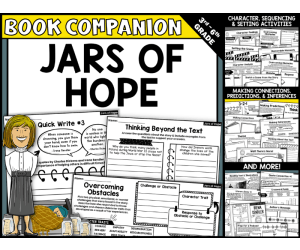
Jars of Hope by Jennifer Roy Interactive Read-Aloud Activities
ELA, Reading, Reading Comprehension, Grade 4, 5, 6, Read Alouds, Activities
Enhance your students' reading experience with this comprehensive companion for Jars of Hope, by Jennifer Roy. Featuring 55 ready-to-use activities, this resource is perfect for customizing learning to meet your students' needs and academic abilities. Designed to save you time and engage students effectively, these activities foster higher-level thinking skills and encourage textual evidence-based responses. Students will enjoy interactive and educational activities, while you appreciate having high-quality resources at your fingertips. INCLUDED IN THIS RESOURCE: Judging by the Cover Making Predictions Recalling events in Chronological Order Summary Story Plot Story Event Sort Problem & Solution Minor Problems & Solutions Cause & Effect Making Connections Making Inferences Notice & Note Character Feelings Character Traits (2 traits) Character Traits (4 traits) Character Inside & Out Character Development Character Change Overcoming Obstacles Overcoming Obstacles T- Chart Character Analysis Character Summary Acrostic Poem Sketch a Scene From the Story Setting the Scene Theme Thinking About the Text Thinking Beyond the Text Reading Text & Illustrations 3-2-1 Author's Message Jar of Keepsakes Dear Diary Prep for a Podcast Memorable Moments Crossword Puzzle Word Search Puzzle Wait... There's More! Design a Book Cover 3-Quote Connections 5-Literary Essay Prompts 5-Quick Write Prompts Irena Sendler Biography Brochure This resource is for extension read-aloud activities only. The book is not included.
Author Creatively Gifted
Tags Reading Comprehension, Reading, Upper Elementary Reading, Picture Book , Read-aloud Activities, Interactive Read-aloud Activities, Book Companion, Holocaust Remembrance, ELAR
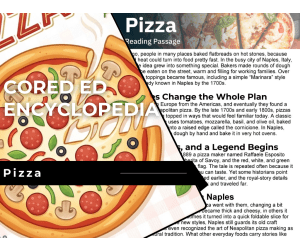
Pizza Reading Comprehension Passage - Cored Ed Encyclopedia
ELA, Language Development, Resources for Teachers, Reading Comprehension, Reading, Pre-Reading, Writing, Strategies, History, Social Studies, Grade 2, 3, 4, 5, Worksheets & Printables, Worksheets, Teacher Tools, Centers, Activities, Writing Prompts, Assessments, Tests, Quizzes and Tests, Quizzes
This pizza reading comprehension contains the following: Visualize on the Cover (Teacher Read Aloud Script) Start your lesson by taking a few moments to visualize the topic and share thoughts or feelings about it. Pre-Reading Trivia Students will write down one thing they already know about the subject and then read five more facts and discuss. These facts are fun, and the students will enjoy learning about the subject before reading more. Reading Passage The text is a high-interest reading passage with set paragraphs, roughly three to four paragraphs long. It contains a variety of themes about the topic, anywhere from history to technology. The passage is between 250 and 350 words in length. Mixed Questions The first question page contains four multiple-choice questions, each with a choice of four answers, and three written response questions that require a sentence or two from the student. Vocabulary Questions Practice seven key words from the text in this section across two activities. First section is scrambled words where students will unscramble three words given a clue for each. The second section is a word to meaning matching activity. Creative Writing In this question, the student will be required to write a five to eight sentence paragraph on a question related to the topic. Extension Activities This page is optional for fast finishers or to take home. There are several activities, each one requiring a different skill. Do some, do none, do all, completely optional - but you will feel reassured knowing every possibility is planned for. Includes summary writting question. Answer Key There are answers for the multiple-choice questions, written response questions have sample answers, vocabulary answers and if there is a summary question then a sample summary will be provided as well. FULL CATALOG OF DOWNLOAD LINKS AND ENCYCLOPEDIA INDEX HERE Lesson Snapshot Title: Pizza Genre: Nonfiction (informational text) Subject: Social Studies (culture/history of food) + Reading Informational Text Primary Topic: How pizza began in Naples and spread Estimated Guided Reading Level (A–Z): Q What This Lesson Teaches Best How pizza grew from simple flatbreads into popular street food in Naples, Italy , including a “Marinara” style known by the 1700s. How tomatoes arriving from the Americas changed pizza toppings, leading to styles that look familiar today. Key details of a classic Margherita-style pizza and a text-defined term: the raised crust edge called the cornicione . How a famous 1889 story about Queen Margherita is presented as a legend with details that are debated by historians. How foods change as people move: pizza “traveled,” becoming thick and cheesy in some places and thin, crisp, or foldable in others—while Naples guards its craft, recognized by UNESCO . Learning Goals Students will explain how the passage describes pizza starting from flatbreads and becoming special in Naples. Students will describe how tomatoes changed pizza in Naples using details from the text. Students will identify the toppings listed for a classic Margherita-style pizza in the passage. Students will explain what the passage says is debated about the Queen Margherita story. Students will describe how the passage says pizza changed as it traveled to new countries. Key Vocabulary From the Text Neapolitan — from Naples; connected to pizza made there. cornicione — the raised edge of the crust. Marinara — a simple pizza style known in Naples long ago. historians — people who study and write about the past. UNESCO — a group that recognizes important cultural traditions. Cored Ed Encyclopedia Overview The Cored Ed Encyclopedia is a weekly series of lessons that you can pick up and use right away. These short readings fit into whatever time you have available. Each one includes a warm-up, a reading, and a set of questions, but it’s flexible — you can do just the reading, the full lesson, or skip the writing section if you need to. Each lesson focuses on a single topic so students don’t get lost. The writing is clear but never childish, making it perfect for grades two through five. Topics range from animals and science to history, inventions, and everyday things. No matter the level of the student, everyone should take away at least one new idea or fact from each lesson. The materials are easy to print, easy to explain, and require no setup. They work well for whole-class teaching, partner work, or independent study.
Author Cored Education
Rating
Tags Vocabulary, Spelling, Reading Comprehension, Reading Passages, Reading, Creative Writing, Reading Strategies, Writing Prompts, Pizza, History

My 5 Senses Pop-Up Board Project Grade 1 2 3 ELA Science
ELA, Reading, Reading Comprehension, Science, Life Sciences, Human Body, Grade 1, 2, 3, Projects, Activities
Explore a fun and meaningful way of learning about our senses with this “My 5 Senses Pop-Up Board” and integrated ELA and Science project! Perfect for Grades 1, 2, 3, homeschoolers, and EFL / ESL learners, these pop-up boards are designed to let students have a hands-on practice with topics about 5 senses, body parts, practice writing / speaking sentences using “I can...” and other related lessons. This resource is made to help learners improve their vocabulary skills, reading and writing skills, creative skills and improve their comprehension skills about the topics. This set includes the following: -5 Senses Pop-Up Board with this contents: 5 senses: Touch smell sight hear taste -2 pop-up designs -2 genders choices -6 colored board design -6 black and white board design This “My 5 Senses Pop-Up Board” is a supplemental tool for teaching and learning about 5 senses and is an amazing integration of ELA and science subjects in any curriculum. This can also be used as an assessment tool as a project that can be used as an inclusion for students' portfolio and a cute addition to your classroom display!
Author It's Teacher L
Tags Body, Senses, Pop-up Board, ELA Project, Science Project
Reading Passages on Human Body Systems (Fillable PDF)
ELA, Reading, Reading Comprehension, Science, Life Sciences, Human Body, Biology, Common Core, ESL, Language Development, Grade 5, 6, 7, Worksheets & Printables, Worksheets, Assessments, Teacher Tools, Tests, Quizzes and Tests, Centers, Activities
Reading Passages on Human Body Systems for Life Science (Biology) Part 2 - Human Body Systems Reading Passage 1: Skeletal & Muscular Systems Reading Passage 2: Circulatory & Respiratory Systems Reading Passage 3: Nervous System Reading Passage 4: Digestive System Reading Passage 5: Reproductive System FILLABLE PDF VERSION Worksheet-style pages, but with type-in answer boxes so students can complete and save their work digitally. Other versions are available in the links list below or in the full catalog. Snapshot Title: Title not stated Genre: Nonfiction Subject: Science / Life Science / Human Body Primary Topic: Human body systems and how they function. Estimated Guided Reading Level (A–Z): V What This Teaches Best Explains how the skeletal and muscular systems work together for support and movement. Shows how the circulatory and respiratory systems work together to move oxygen and nutrients through the body. Teaches the major parts and jobs of the nervous system, including reflexes and brain functions. Traces the path of food through the digestive system and explains how nutrients are absorbed. Introduces reproduction, fertilization, zygote formation, and meiosis in clear body-systems language. Learning Goals Students will identify major structures and functions of several human body systems. Students will explain how body systems work together to keep the body alive and functioning. Students will describe how muscles move bones using tendons and joints. Students will trace the movement of oxygen, blood, or food through the body. Students will explain how reflexes, hormones, and nerve messages help control body actions. Students will describe the roles of fertilization, zygote formation, and meiosis in reproduction. FULL CATALOG OF DOWNLOAD LINKS HERE Grade 5/6 Links: Physical Science Part 1 - Physical and Chemical Properties Google Docs/Slides/Forms PDF PPT Word Free Supplementary Pack Accompanying Videos Physical Science Part 2 - Motion and Energy Google Docs/Slides/Forms PDF PPT Word Free Supplementary Pack Accompanying Videos Physical Science Part 3 - Electricity and Magnets Google Docs/Slides/Forms PDF PPT Word Free Supplementary Pack Accompanying Videos Life Science Part 1 - Cells, Reproduction and Genetics Google Docs/Slides/Forms PDF PPT Word Free Supplementary Pack Accompanying Videos Life Science Part 2 - Human Body Systems Google Docs/Slides/Forms PDF PPT Word Free Supplementary Pack Accompanying Videos Life Science Part 3 - Plant Parts and Ecosystems Google Docs/Slides/Forms PDF PPT Word Free Supplementary Pack Accompanying Videos Earth Science Part 1 - Plate Tectonics and Rock Cycle Google Docs/Slides/Forms PDF PPT Word Free Supplementary Pack Accompanying Videos Earth Science Part 2 - Ocean Exploration and Natural Resources Google Docs/Slides/Forms PDF PPT Word Free Supplementary Pack Accompanying Videos Earth Science Part 3 - Weather and Solar System Google Docs/Slides/Forms PDF PPT Word Free Supplementary Pack Accompanying Videos For similar products and other frees, do check out Cored Group on TeachSimple .
Author Cored Education
Rating
Tags Science, Elementary, Reading, Comprehension, Vocabulary, Worksheets, Printables, Reading Centers, Reading Comprehension Assessments, Science Assessments

Droughts Reading Comprehension Passage - Cored Ed Encyclopedia
ELA, Reading Comprehension, Reading, Science, Technology, Social Studies, History, Earth and Environmental Sciences, Life Sciences, Geography, Grade 2, 3, 4, 5, Worksheets & Printables, Worksheets, Teacher Tools, Centers, Activities, Writing Prompts, Assessments, Quizzes and Tests, Quizzes, Lesson Plans
This droughts reading comprehension with lesson plan includes: Visualization (on the front cover) Start your lesson by taking a minute to think and share something about the topic. Read the script aloud (slowly), perhaps prepare some music or sound effects. Student close their eyes and let their imaginations wander. Students open their eyes, read the question aloud and give them a few minutes to complete. Ask a few students to share or keep answers until the end to compare with what they learn in the passage. Quick pause—thousands of Cored Education products are included with your TeachSimple membership. Download links and encyclopedia index available here. Pre-Reading Trivia Students will write down one thing they already know about the subject and then read five more facts and discuss. These facts are fun, and the students will enjoy learning about the subject before reading more. Give 1 minute for students to write what they already know (no pressure—best guess is fine). Read the five facts together. After each fact, do ask a student for their opinion, was it surprising? Set a purpose by asking students to highlight/underline one fact they want to learn more about during the reading. Reading Passage The text is a high-interest reading passage with set paragraphs, roughly three to four paragraphs long. It contains a variety of themes about the topic, anywhere from history to technology. The passage is between 250 and 350 words in length. First, ask students to look at the headings and see what they’ll learn about today. What do they know about the topic/heading? First read options: Teacher read-aloud (best for support). Partner reading (paragraph by paragraph). While reading, students underline important details, and vocabulary words they think may come up in the questions section. Mixed Questions The first question page contains four multiple-choice questions, each with a choice of four answers, and three written response questions that require a sentence or two from the student. Students complete the mcqs first independently, then review quickly as a class. For the 3 written responses, try to get students giving the answer with some form of evidence: “I think ___ because the text says ___.” If students get stuck, send them back to check the passage. Vocabulary Questions Practice seven key words from the text in this section across two activities. First section is scrambled words where students will unscramble three words given a clue for each. The second section is a word to meaning matching activity. Before starting, have some students read out words they underlined in the passage. Ask students to say the word and read aloud the sentence(s) around each word. Ask students to do scrambled words and the matching exercise in pairs then go through answers as a class. For the scrambled spelling task, get four pairs to come up to the board and write the words for extra practice with the other student reading out the clue. For the matching task, prompt students to give full sentences: “I matched ___ with ___ because ___.” Creative Writing In this question, the student will be required to write a five to eight sentence paragraph on a question related to the topic. Before starting, ask students write down 3 key ideas they are going to include in their piece. Ask students for ideas to share around the class to help those struggling. Pro writing expectations: 5–8 sentences At least 2 facts or details from the passage At least 2 vocabulary words from the previous page Students read their paragraphs while classmates listen for facts and vocabulary words. Extension Activities This page is optional for fast finishers or to take home. There are several activities, each one requiring a different skill. Do some, do none, do all, completely optional - but you will feel reassured knowing every possibility is planned for. Includes summary writting question and additional facts. Answer Key There are answers for the multiple-choice questions, written response questions have sample answers, vocabulary answers and if there is a summary question then a sample summary will be provided as well. Lesson Plan Included Customized lesson plan for this lesson is included. Lesson Snapshot Title: Droughts Genre: Nonfiction (informational text with headings) Subject: Earth Science / Life Science / Reading (Informational Text) Primary Topic: What drought is, types, effects, and tracking Estimated Guided Reading Level (A–Z): Q What This Lesson Teaches Best Defines drought as a stretch of time when a region is drier than normal and can last from days to years. Explains types of drought (meteorological vs. hydrological) and describes what changes in streams, reservoirs, and groundwater. Uses concrete signs/evidence of drought (no puddles, dull grass, cracked ground, animals traveling farther, rivers showing more rocks). Connects history to learning: the Dust Bowl in the 1930s and how it led to soil-saving methods and drought indices. Introduces modern monitoring and responses (rain gauges, river sensors, satellites; fixing leaks, reusing water, collecting rain). Learning Goals Students will define drought using the book’s description and time frames. Students will identify signs of drought described in the passage (e.g., puddles, grass, cracked ground, rivers). Students will explain the difference between meteorological drought and hydrological drought using text evidence. Students will describe what happened during the Dust Bowl and why it mattered for tracking dryness. Students will describe ways droughts are monitored today and one way communities can respond. Key Vocabulary From the Text meteorological — related to weather and rainfall or snow. hydrological — related to water in rivers, reservoirs, and underground. groundwater — water stored under the ground. indices — numbers used to compare and track dryness. evapotranspiration — water moving from land and plants into air. FULL CATALOG OF DOWNLOAD LINKS AND ENCYCLOPEDIA INDEX HERE
Author Cored Education
Rating
Tags Vocabulary, Reading Comprehension, Reading Passages, Lesson Plans, Ela Lesson Plans, Reading Comprehension Lesson Plans, Pre-reading, Science Lesson Plans, Geography, Earth Science

Animal Skin, Cats, & T. Rex: SAMPLE Reading passage (Word)
Science, ELA, Reading, Reading Comprehension, Strategies, Resources for Teachers, Life Sciences, Animals, Insects, Nature & Plants, Grade 6, 7, 8, 9, Writing Prompts, Worksheets & Printables, Centers, Activities, Teacher Tools, Assessments, Quizzes and Tests, Quizzes, Tests
This is a ONE PASSAGE SAMPLE. The following is the description of the FULL resource and the downloading links: Animal Skin, Cats, & T. Rex: Reading Comprehension Passages (Word) This very engaging collection of life science reading passages about Animal Skin, Cats, & T. Rex is designed to bridge the gap between science and literacy through strengthening reading comprehension and sparking scientific curiosity in middle school students. Each passage blends English Language Arts skills with accurate science content that supports NGSS classroom practice. Ideal for interdisciplinary learning in ELA and Science. Suitable for Grade 9 review, too! What Is Included? There are (3) informational passages: Tyrannosaurus rex: The Tyrant Lizard King Step into the late Cretaceous and see T. rex up close, from its towering build and crushing bite to the clues fossils give about speed and feeding. CT scans, trackways, and healed injuries help scientists piece together how this predator lived. Cats and Sweetness: A Taste They Don’t Have A small change in a taste receptor means cats do not detect sugar. This trait fits a meat-first diet and helps explain why scent, texture, fats, and proteins matter more than sweetness. Animal Skin: A Tool for Survival Skin works as armor, thermostat, camouflage, warning, and display. Examples include the hippo’s natural sunscreen, zebra stripes that confuse attackers, and king snakes that copy coral snake colors to stay safe. Student Tasks for Each Passage: 5 multiple-choice questions targeting main idea, key details, inference, vocabulary in context, and use of evidence 5 vocabulary matching items with clear, student-friendly definitions 5 text-based questions that require citing specific lines or facts 1 summary prompt that asks students to condense central ideas accurately Full answer key for every section Available Formats for this Resource PDF Google Docs FULL CATALOG OF DOWNLOADING LINKS HERE Reading Passage Links: Astronomy & Space Science PDF Fillable PDF Word Docs Google Docs Volcanoes, Rocks, & Mountains PDF Fillable PDF Word Docs Google Docs Rock Cycle, Soil, & Sinkholes PDF Fillable PDF Word Docs Google Docs Mars, Glaciers, & Antarctica PDF Fillable PDF Word Docs Google Docs Water Cycle, Acid Rain, & Wastewater PDF Fillable PDF Word Docs Google Docs Insects, Animals, & Ecosystems PDF Fillable PDF Word Docs Google Docs Bioluminescence & Insects PDF Fillable PDF Word Docs Google Docs Animal Skin, Cats, & T. Rex PDF Fillable PDF Word Docs Google Docs Human Body and Senses PDF Fillable PDF Word Docs Google Docs Health & Applied Bioscience PDF Fillable PDF Word Docs Google Docs Waves, Light, & Imaging PDF Fillable PDF Word Docs Google Docs Electricity & Energy PDF Word Docs Google Docs Motion & Materials PDF Word Docs Google Docs Chemistry and Materials Science PDF Fillable PDF Word Docs Google Docs Product Details Length: 1e pages total Grades: 6–8, also suitable for Grade 9 review Use cases: close reading, stations, homework, intervention, test prep, and sub plans Standards support: reinforces informational-text skills and supports NGSS-style sense making through observation, modeling, and clear use of claim, evidence, and reasoning Why Teachers Choose This Set Authentic science content paired with rigorous literacy practice Consistent task structure across all passages for easier planning and smoother student routines Clear, age-appropriate writing that builds confidence without oversimplifying Use this set to reinforce ELA skills in science, to add literacy to your lessons, or to support independent work. The passages strengthen main idea, evidence use, vocabulary in context, inference, cause and effect, and summary writing. With ready-to-use assessments and complete answer keys, you can provide focused practice that is simple to run and fast to review.
Author CORED Education - Middle & High School
Rating 5
Tags Middle School, Reading Comprehension, Reading Strategies, ELA, Centers, Reading Passage, Assessments, Vocabulary, Life Science, Dinosaurs
Reading Comprehension Nonfiction Set 1 Sample: Elephant Seals (Docs)
ELA, Reading, Common Core, Reading Comprehension, Vocabulary, Language Development, ESL, Writing, Grade 6, 7, Worksheets & Printables, Worksheets, Assessments, Teacher Tools, Centers, Activities, Writing Prompts, Tests, Quizzes and Tests
Reading Comprehension Passages Nonfiction Set 1 Overview Reading comprehension lessons, especially written for Grade 6-7, providing the chance to read interesting and engaging passages. Each lesson has a mix of questions to check understanding, a vocabulary or spelling activity to help remember key language introduced, and a writing exercise. Full answer keys are provided. Passage Included 3.Elephant Seals: Fact: Elephant Seals spend 2 months a year on the beach! Google Docs Version This is the Docs editable and fillable version. This download is available in GOOGLE Docs, GOOGLE Forms, GOOGLE Slides. PDF, PPT, WORD. FULL CATALOG OF DOWNLOAD LINKS HERE Grade 6/7 Links Fiction Set 1 Google Docs Google Forms Google Slides PDF PPT Word Guided Reading Materials Fiction Set 2 Google Docs Google Forms Google Slides PDF PPT Word Guided Reading Materials Nonfiction Set 1 Google Docs Google Forms Google Slides PDF PPT Word Guided Reading Materials Nonfiction Set 2 Google Docs Google Forms Google Slides PDF PPT Word Guided Reading Materials Reading Passages Overview Each passage is especially written for Grade 6/7 students, including key vocabulary required for this age group. Topics are varied and are accompanied by colorful graphics. Topics are meant to educate, yet entertain the modern student. The majority of these short stories contain an important message - a way of developing these young learners further. Mixed Questions The mixed questions section of each lesson includes a variation of five to six comprehension, vocabulary and Math questions. In addition, key reading strategies are frequently covered including cause & effect, summarizing, compare & contrast and making conclusions. Mixed questions require a written response (no MCQ's), full answers and example responses appear at the end of the lesson. Spelling & Vocab Each reading passage contains a variety of words and phrases designed for Grade 6/7 students. Spelling and vocab activities provide the opportunity to build fluency with these words. Activities provide clues to help assist students. Vocabulary activities include extra questions where students must write a synonym, an antonym or a sentence using a certain word. Writing Prompts Writing prompts are designed to continue the theme or lessons learned in the story. Students are persuaded to write in a variety of ways and each prompt includes several cues to help. The main focus in this product, is the student. Prompts will require the student to relate to past experiences and encourage them to discuss feelings and ways to improve. Full Answer Keys Full answer keys and sample responses are provided so no matter how busy you are, you know you're covered! Mixed question answers provide evidence from the text, Math questions contain the relevant workings. Answers are designed for use by the teacher, but also suitable as a handout to the student. For similar downloads and other frees, do check out Cored Group on TeachSimple.
Author Cored Education
Tags Elementary, Reading, Comprehension, Vocabulary, Answers, Ccss, Common Core, Spelling, Writing, Digital Centers
Synonyms and Antonyms Aliens in Space Digital Escape Room
Special Resources, ELA, Special Education Needs (SEN), Speech Therapy, Reading, Reading Comprehension, Language Development, ESL, Vocabulary, Grade 2, 3, 4, Escape Room, Activities
Have you tried using gamification for teaching synonyms and antonyms? This is just what you need to keep students excited, engaged, and learning. Synonyms and Antonyms Aliens in Space Digital Escape Room will encourage student growth. I'm thrilled to introduce an interactive experience that goes beyond ordinary teaching methods. This escape room adventure is designed to enhance students' vocabulary, reading comprehension, and critical thinking skills, all while making learning an exciting journey. Imagine your students going on a space-themed adventure to solve challenges that boost their language skills. This escape room isn't just an activity; it elevates the way we approach speech therapy and language arts, creating a dynamic and successful learning environment. As you know, being flexible is crucial in education. This Synonyms and Antonyms Aliens in Space Escape Room easily fits into various teaching scenarios. Whether you need it for individual exploration, group collaboration, or whole-class engagement, the adventure seamlessly adapts to your teaching style. It's a versatile resource that builds language skills while igniting curiosity for learning. It is also great for homework practice and early finishers too! Join us on this journey, where students become explorers delving into synonyms and antonyms. I've seen firsthand the impact of interactive learning experiences on students' language proficiency and overall educational journey. The "Synonyms and Antonyms Aliens in Space" Digital Escape Room empowers students to confidently and effectively use language, going beyond word grasping. 🚀🌠📚Highlights: No logins required, ready-to-go adventure. Elevate vocabulary enrichment in a captivating way. Easy setup for individuals, small groups, or whole classes. Instant feedback with self-correcting features. Check out these other escape rooms: Analogies Space Adventure Digital Escape Room , Context Clues Night at the Museum Digital Escape Room , Idioms Dragon's Den Digital Escape Room , Multiple Meanings Homonyms Haunted House Digital Escape Room , and more to come!
Author Ivybee Speech
Tags Vocabulary, Receptive And Expressive Language, Reading, Writing

Water Cycle, Acid Rain, & Wastewater: Reading Passages (FILLABLE PDF)
Science, Earth and Environmental Sciences, ELA, Reading, Reading Comprehension, Strategies, Resources for Teachers, Environmental Science, Grade 6, 7, 8, 9, Writing Prompts, Worksheets & Printables, Centers, Activities, Teacher Tools, Assessments, Quizzes and Tests, Quizzes, Tests
Water Cycle, Acid Rain, and Wastewater: Reading Comprehension Passages and Questions (FILLABLE PDF) This very engaging and fillable collection of environmental science reading passages about Water Cycle, Acid Rain, and Wastewater is designed to bridge the gap between science and literacy through strengthening reading comprehension and sparking scientific curiosity in middle school students. Each passage blends English Language Arts skills with accurate science content that supports NGSS classroom practice. Ideal for interdisciplinary learning in ELA and Science. Suitable for Grade 9 review, too! These worksheets are designed as fillable PDFs , which means students can type their answers directly into the document on any computer or tablet . Each page includes highlighted text fields that show them exactly where to type! What Is Included? There are (3) informational passages: Wastewater: From Drain to Clean The Water Cycle: The Engine of Our Planet Acid Rain: Causes, Impacts, and Solutions Student Tasks for Each Passage: 5 multiple-choice questions targeting main idea, key details, inference, vocabulary in context, and use of evidence 5 vocabulary matching items with clear, student-friendly definitions 5 text-based questions that require citing specific lines or facts 1 summary prompt that asks students to condense central ideas accurately Full answer key for every section Available Formats for this Resource Word Docs Google Docs FULL CATALOG OF DOWNLOADING LINKS HERE Reading Passage Links: Astronomy & Space Science PDF Word Docs Google Docs Volcanoes, Rocks, & Mountains PDF Word Docs Google Docs Rock Cycle, Soil, & Sinkholes PDF Word Docs Google Docs Mars, Glaciers, & Antarctica PDF Word Docs Google Docs Water Cycle, Acid Rain, & Wastewater PDF Word Docs Google Docs Insects, Animals, & Ecosystems PDF Word Docs Google Docs Bioluminescence & Insects PDF Word Docs Google Docs Animal Skin, Cats, & T. Rex PDF Word Docs Google Docs Human Body and Senses PDF Word Docs Google Docs Health & Applied Bioscience PDF Word Docs Google Docs Waves, Light, & Imaging PDF Word Docs Google Docs Electricity & Energy PDF Word Docs Google Docs Motion & Materials PDF Word Docs Google Docs Chemistry and Materials Science PDF Word Docs Google Docs How to Use These PDFs Click on the highlighted area to start typing your answer. Move to the next question by clicking in the next highlighted box. When you are finished, close the document and select SAVE so your answers stay recorded. If you want to keep a blank copy for later, choose Save As and give your completed version a new name. Product Details Length: 15 pages total Grades: 6–8, also suitable for Grade 9 review Use cases: close reading, stations, homework, intervention, test prep, and sub plans Standards support: reinforces informational-text skills and supports NGSS-style sense making through observation, modeling, and clear use of claim, evidence, and reasoning Why Teachers Choose This Set Authentic science content paired with rigorous literacy practice Consistent task structure across all passages for easier planning and smoother student routines Clear, age-appropriate writing that builds confidence without oversimplifying Use this set to reinforce ELA skills in science, to add literacy to your lessons, or to support independent work. The passages strengthen main idea, evidence use, vocabulary in context, inference, cause and effect, and summary writing. With ready-to-use assessments and complete answer keys, you can provide focused practice that is simple to run and fast to review.
Author CORED Education - Middle & High School
Rating
Tags Middle School, Reading Comprehension, Reading Strategies, Reading Passages, ELA, Centers, Reading Passage, Assessments, Vocabulary, Environmental Science

Volcanoes, Rocks, & Mountains: Reading Comprehension Passages (Word)
Science, Earth and Environmental Sciences, ELA, Reading, Reading Comprehension, Strategies, Resources for Teachers, Geology, Earth Sciences, Grade 6, 7, 8, 9, Writing Prompts, Worksheets & Printables, Centers, Activities, Teacher Tools, Assessments, Quizzes and Tests, Quizzes, Tests
Volcanoes, Rocks, & Mountains: Reading Comprehension Passages (Word) This engaging collection of earth science reading passages about Mountains, Volcanoes, and Igneous Rocks is designed to bridge the gap between science and literacy through strengthening reading comprehension and sparking scientific curiosity in middle school students. Each passage blends English Language Arts skills with accurate science content that supports NGSS classroom practice. Ideal for interdisciplinary learning in ELA and Science. Suitable for Grade 9 review, too! What Is Included? There are (3) informational passages: Mountains: From Plates to Peaks See how plate collisions fold rock, faults lift blocks, and volcanism builds peaks. Learn how rivers, glaciers, and gravity continue to reshape ranges over time. How Volcanoes Shape Our World Examine hazards such as ash, gases, lahars, and pyroclastic flows, along with benefits like fertile soils, mineral resources, geothermal energy, and new land. Learn how monitoring and planning reduce risk. Igneous Rocks: From Fire to Everyday Life Compare intrusive and extrusive rocks, link cooling rates to crystal size and texture, and connect granite, basalt, pumice, and obsidian to everyday uses in buildings, roads, tools, and art. Student Tasks for Each Passage: 5 multiple-choice questions targeting main idea, key details, inference, vocabulary in context, and use of evidence 5 vocabulary matching items with clear, student-friendly definitions 5 text-based questions that require citing specific lines or facts 1 summary prompt that asks students to condense central ideas accurately Full answer key for every section Available Formats for this Resource PDF Google Docs FULL CATALOG OF DOWNLOADING LINKS HERE Reading Passage Links: Astronomy & Space Science PDF Word Docs Google Docs Volcanoes, Rocks, & Mountains PDF Word Docs Google Docs Rock Cycle, Soil, & Sinkholes PDF Word Docs Google Docs Mars, Glaciers, & Antarctica PDF Word Docs Google Docs Water Cycle, Acid Rain, & Wastewater PDF Word Docs Google Docs Insects, Animals, & Ecosystems PDF Word Docs Google Docs Bioluminescence & Insects PDF Word Docs Google Docs Animal Skin, Cats, & T. Rex PDF Word Docs Google Docs Product Details Length: 13 pages total Grades: 6–8, also suitable for Grade 9 review Use cases: close reading, stations, homework, intervention, test prep, and sub plans Standards support: reinforces informational-text skills and supports NGSS-style sense making through observation, modeling, and clear use of claim, evidence, and reasoning Why Teachers Choose This Set Authentic science content paired with rigorous literacy practice Consistent task structure across all passages for easier planning and smoother student routines Clear, age-appropriate writing that builds confidence without oversimplifying Use this set to reinforce ELA skills in science, to add literacy to your lessons, or to support independent work. The passages strengthen main idea, evidence use, vocabulary in context, inference, cause and effect, and summary writing. With ready-to-use assessments and complete answer keys, you can provide focused practice that is simple to run and fast to review.
Author CORED Education - Middle & High School
Rating
Tags Middle School, Reading Comprehension, Reading Strategies, Reading Passages, ELA, Centers, Reading Passage, Assessments, Vocabulary, Earth Science

Golf Reading Comprehension Passage - Cored Ed Encyclopedia
ELA, Language Development, Resources for Teachers, Reading Comprehension, Reading, Pre-Reading, Writing, Strategies, Sports, P.E. & Health, Grade 2, 3, 4, 5, Worksheets & Printables, Worksheets, Teacher Tools, Centers, Activities, Writing Prompts, Assessments, Tests, Quizzes and Tests, Quizzes
This golf reading comprehension contains the following: Pre-Reading Trivia Students will write down one thing they already know about the subject and then read five more facts and discuss. These facts are fun, and the students will enjoy learning about the subject before reading more. Reading Passage The text is a high-interest reading passage with set paragraphs, roughly three to four paragraphs long. It contains a variety of themes about the topic, anywhere from history to technology. The passage is between 250 and 350 words in length. Mixed Questions The first question page contains four multiple-choice questions, each with a choice of four answers, and three written response questions that require a sentence or two from the student. Creative Writing In this question, the student will be required to write a five to eight sentence paragraph on a question related to the topic. Extension Activities This page is optional for fast finishers. If there are five to ten minutes left at the end of the lesson, the student can choose one of three activities, each one requiring a different skill. Answer Key There are answers for the multiple-choice questions and three written response questions have sample answers. FULL CATALOG OF DOWNLOAD LINKS AND ENCYCLOPEDIA INDEX HERE Cored Ed Encyclopedia Overview The Cored Ed Encyclopedia is a weekly series of lessons that you can pick up and use right away. These short readings fit into whatever time you have available. Each one includes a warm-up, a reading, and a set of questions, but it’s flexible — you can do just the reading, the full lesson, or skip the writing section if you need to. Each lesson focuses on a single topic so students don’t get lost. The writing is clear but never childish, making it perfect for grades two through five. Topics range from animals and science to history, inventions, and everyday things. No matter the level of the student, everyone should take away at least one new idea or fact from each lesson. The materials are easy to print, easy to explain, and require no setup. They work well for whole-class teaching, partner work, or independent study.
Author Cored Education
Rating
Tags Vocabulary, Spelling, Reading Comprehension, Reading Passages, Cored Encyclopedia, Facts, Reading, Creative Writing, Sports, Golf

The Giant’s Causeway in Ireland: Social Studies Reading Passage (PDF)
ELA, Reading, Reading Comprehension, Strategies, Resources for Teachers, Social Studies, Geography, Grade 6, 7, 8, 9, Writing Prompts, Worksheets & Printables, Centers, Activities, Teacher Tools, Assessments, Quizzes and Tests, Quizzes, Tests
The Giant’s Causeway in Ireland: Social Studies Reading Comprehension Passage (PDF) This resource introduces a unique Social Studies reading comprehension passage with questions about The Giant’s Causeway in Ireland. The passage is carefully designed to bridge the gap between social studies and literacy through strengthening reading comprehension and sparking knowledge curiosity in middle school students. Each passage blends English Language Arts skills with accurate social studies content . Ideal for interdisciplinary learning in ELA and Social Studies. Suitable for Grade 9 review, too! Student Tasks throughout the passage: 5 multiple-choice questions targeting the following skills: main idea, key details, inference, vocabulary in context, and use of evidence 5 vocabulary matching items with clear, student-friendly definitions 5 text-based questions that require citing specific lines or facts 1 summary prompt that asks students to condense central ideas accurately Full answer key for every section Available Formats for this Resource: Fillable PDF Word Docs Google Docs FULL CATALOG OF DOWNLOADING LINKS HERE Social Studies Reading Comprehension Collection Links: 1. Ancient Civilizations PDF Fillable PDF Word Docs Google Docs 2. Early Empires and Trade Networks PDF Fillable PDF Word Docs Google Docs 3. The Founding of the United States PDF Fillable PDF Word Docs Google Docs 4. Language, Culture, and Meaning PDF Fillable PDF Word Docs Google Docs 5. Psychology and Society PDF Fillable PDF Word Docs Google Docs 6. Global Festivals and Traditions PDF Fillable PDF Word Docs Google Docs 7. Extreme Environments and People PDF Fillable PDF Word Docs Google Docs 8. Food, Culture, and Preservation PDF Fillable PDF Word Docs Google Docs 9. Global Food Customs PDF Fillable PDF Word Docs Google Docs 10. Media, Communication, and Popular Culture PDF Fillable PDF Word Docs Google Docs 11. Human Impact on the Environment PDF Fillable PDF Word Docs Google Docs 12. Civic Action and Social Change PDF Fillable PDF Word Docs Google Docs 13. Fashion, Society, and Power PDF Fillable PDF Word Docs Google Docs 14. People, Places, and Unusual Histories PDF Fillable PDF Word Docs Google Docs Product Details: Length: 5 pages Grades: 6–8, also suitable for Grade 9 review Use cases: close reading, stations, homework, intervention, test prep, and sub plans Why Teachers Choose This Passage: Authentic social studies content paired with rigorous literacy practice Consistent task structure for easier planning and smoother student routines Clear, age-appropriate writing that builds confidence without oversimplifying Use this passage to reinforce ELA skills in social studies, to add literacy to your lessons, and to support independent work. The passage strengthens main idea, evidence use, vocabulary in context, inference, cause and effect, and summary writing. With ready-to-use assessments and complete answer keys, you can provide focused practice that is simple to run and fast to review.
Author CORED Education - Middle & High School
Rating
Tags Middle School, Reading Comprehension, Reading Strategies, ELA, Centers, Reading Passage, Assessments, Vocabulary, Social Studies, Geography
Science Reading Comprehension on Objects in the Sky (Videos)
ELA, Reading, Reading Comprehension, Common Core, ESL, Language Development, Pre-Reading, Earth Sciences, Earth and Environmental Sciences, Science, Grade 2, 3, 4, Activities, Teacher Tools
Accompanying Videos Based on Reading Passages on Objects in the Sky for Earth Science These accompanying videos contain scripts extracted from the Science Reading Passages series. With stock footage, subtitles, voiceovers, animation and diagrams, they will help students understand the topic more. Ideal for starting or ending a lesson, each video runs at less than 5 minutes and is at least 95% identical to the passage itself. What's inside? Part 3 Videos - Objects in the Sky Reading Passage 1: Objects in the Sky Reading Passage 2: The Sun Science Reading Comprehension Outline: Targeted for students in 3rd and 4th grades, these reading passages are enhanced with illustrations and graphs to elucidate critical points. Each lesson aligns with the Common Core State Standards, allowing you to integrate science reading practice effortlessly, knowing that minimal preparation is needed on your part. Each passage comes with a variety of questions in different formats, including multiple-choice formats, data analysis, and fill-in-the-blanks. The topics covered strike a balance between engaging content and core curriculum-based science subjects. Versatile in application, these lessons are suitable for a variety of settings such as whole-class instruction, morning activities, independent desk work, small group discussions, contingency plans for substitute teachers, homework assignments, or even special holiday-themed tasks. FULL CATALOG OF DOWNLOAD LINKS HERE Grade 3/4 Links: Physical Science Part 1 - Properties of Objects and Materials Google Docs/Slides/Forms PDF PPT Word Free Supplementary Pack Accompanying Videos Physical Science Part 2 - Position and Motion of Objects Google Docs/Slides/Forms PDF PPT Word Free Supplementary Pack Accompanying Videos Physical Science Part 3 - Light, Heat, Electricity, Magnetism Google Docs/Slides/Forms PDF PPT Word Free Supplementary Pack Accompanying Videos Life Science Part 1 - Characteristics of Organisms Google Docs/Slides/Forms PDF PPT Word Free Supplementary Pack Accompanying Videos Life Science Part 2 - Life Cycles of Organisms Google Docs/Slides/Forms PDF PPT Word Free Supplementary Pack Accompanying Videos Life Science Part 3 - Organisms and Environments Google Docs/Slides/Forms PDF PPT Word Free Supplementary Pack Accompanying Videos Earth Science Part 1 - Properties of Earth Materials Google Docs/Slides/Forms PDF PPT Word Free Supplementary Pack Accompanying Videos Earth Science Part 2 - Changes in the Earth and Sky Google Docs/Slides/Forms PDF PPT Word Free Supplementary Pack Accompanying Videos Earth Science Part 3 - Objects in the Sky Google Docs/Slides/Forms PDF PPT Word Free Supplementary Pack Accompanying Videos For similar products and other frees, do check out Cored Group on TeachSimple .
Author Cored Education
Rating
Tags Science, Elementary, Reading, Comprehension, Vocabulary, Science Assessments, Reading Comprehension Assessments, Vocabulary Assessments, Earth Science
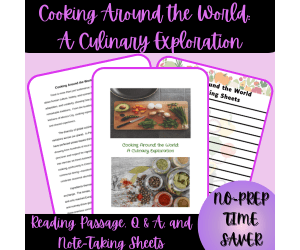
Cooking Around the World Reading Passage, Q & A, Note-Taking Sheets
ELA, Reading Comprehension, Reading, Research, Resources for Teachers, Social Studies, History, History: World, High School, Homeschool Resources, Middle School, Worksheets & Printables, Activities, Crosswords Puzzles, Worksheets, Teacher Tools, Assessments
Take your students on a mouthwatering journey around the globe with this resource - Cooking Around The World: A Culinary Exploration . I created this resource because I believe food isn't just about eating—it's about stories, heritage, and the beautiful ways people connect across cultures. Your students/homeschoolers will dive into rich descriptions of cooking traditions from Peru to Japan, discovering how each recipe tells a story of human creativity and adaptation. Through an engaging reading passage, thoughtful questions, and hands-on activities, they'll explore how something as everyday as cooking reveals our shared humanity. These materials do double duty: building essential reading skills while opening students'/homeschoolers' eyes to the diverse and delicious ways people around the world express their cultural identity through food. INCLUDED IN THIS RESOURCE: ✓High-quality reading passage about global cooking traditions and cultural significance ✓20 in-depth comprehension questions with complete answer key ✓Engaging crossword puzzle with solution key ✓10 versatile note-taking sheets for structured learning ✓Professionally formatted materials ready for immediate classroom use ✓Complete references list in MLA format for academic integrity TOPICS COVERED: ✓Cultural significance of food beyond basic nutrition ✓Unique cooking techniques from around the world ✓Historical food migrations and culinary exchanges ✓Indigenous food preparation methods ✓Mediterranean, Japanese, Indian, Chinese, and Peruvian culinary traditions ✓Relationship between geography and food development ✓Evolution of fusion cuisine in modern cooking ✓Cross-cultural food preservation techniques ✓Connection between cooking and human creativity What I love most about this Cooking Around The World: A Culinary Exploration resource is how it helps students/homeschoolers see beyond the classroom/homeschool walls. When kids discover why tandoor ovens create those distinctive smoky flavors in Indian breads or how Chinese wok cooking developed to conserve precious fuel, they're gaining insights that stick with them for life. The way food connects to geography, history, and cultural values becomes wonderfully clear. I have included a full set of academic references because I have found students/homeschoolers often want to dive deeper into specific cuisines that capture their imagination. fAt its heart, this resource turns something as familiar as food into a window through which students can better understand themselves and their place in our beautifully diverse world. If you and your students/homeschoolers enjoyed this resource, please leave a review. Thank you for your support! Tina - Big Easy Homeschooling Mom
Author Homeschool with Big Easy Homeschooling Mom
Rating
Tags Global Cooking Traditions, Cultural Food Significance, Culinary Exploration Teaching Resource, Cooking Techniques Around The World, Culinary History Lesson Plans, Culinary Diversity Lesson, Cultural Identity Through Food, Global Food Heritage Lesson, Food Cultural Reading Passage, Cultural Cooking Practices
Novel Study on Frankenstein by Mary Shelley - Research Project
ELA, Reading, Reading Comprehension, Writing, Literature, Library, Research, Grade 7, 8, 9, 10, 11, 12, Activities
Novel Study on Frankenstein by Mary Shelley - Research Project This English Language and Arts Literature Project on "Frankenstein; or, The Modern Prometheus" by Mary Shelley ( Novel Study ) aims to make learners discover this Classis Gothic Novel on a deeper level (Character's Description, Places' description, Chapter Reading Comprehension Questions, Novel Analysis + Writing Activity to engage with the novel read) Within this English Language Literature Novel Study Research on "Frankenstein" by Mary Shelley, it is offered: 2 worksheets to write research outcomes 40 Cards to fish for this Novel Study Project on "Frankenstein" How does this Novel Study on "Frankenstein; or, The Modern Prometheus" Teaching Resource work? learners (or groups) fish a Research Topic card of each color (black for characters, red for places, green for chapters comprehension questions, purple for novel analysis and orange for writing activity prompts) each student or group makes their personalized Research Project on "Frankenstein", by focusing on their fished topic cards (ex. fished black card on Characters on "Victor Frankensteim", Red card on places on "Geneva", green card on chapters on "Chapters 1-4", purple Cards on Novel analysis on the narrator and a orange card on Book Review Writing Prompt) Learners stick their fished cards on their research worksheet and write their Novel Study Project's outcomes Learners make a presentation on their personalized rersearch on "Frankenstein" teacher evaluates research given learner or group's research outcomes written on worksheets Why is this Teaching Resource worth using? By fishing topic cards, students have a chance to: make unique randomized research projects focus on specific topics only and discover more the research Novel in "non-superficial" ways Connect their own Research outcomes with their peers' This English Language Literature Novel Study on"Frankenstein; or, The Modern Prometheus" PDF Printable Research Project Teaching (7 slides) can be great for learners from 7th grade to 12th grade to study this Classis English Gothic Novel by Mary Shelley. Learning with Alan is a Brand New Teaching Resource/Educational Material Store whose aim is to help Teachers, Educators and Tutors to achieve their teaching objectives while creating a fun and stimulating environment. Never Forget! If you want to browse more of my Teaching Resources, click here Learning with Alan!
Author Learning with Alan
Tags Frankenstein, Mary Shelley, Author Study, Novel Study, Literature, English, Project, Research, Worksheet, Cards

Digital Escape Room: Idioms - Dragon's Dungeon
Special Resources, ELA, Speech Therapy, Reading, Reading Comprehension, Language Development, ESL, Grade 5, 6, 7, Escape Room, Activities
🌟 Step into an extraordinary linguistic adventure with the Idioms Dragon's Dungeon Digital Escape Room – a treasure trove designed to transform language learning! 📚🔍 As educators, we understand the profound impact of nurturing vital skills. This captivating resource is far beyond a mere game; it's a catalyst that ignites critical thinking, teamwork, and problem-solving. As students embark on this journey, each level they conquer by cracking idiom-related challenges earns them gems – the very keys that unlock the sword to defeat the dragon. 🗝️💎🐉 Why the emphasis on idioms, you ask? Think of them as intricate linguistic puzzles, each harboring hidden meanings that, when unraveled, amplify language comprehension and ignite creative expression. Idioms transcend mere phrases; they're like the vibrant threads that weave imagery, depth, and insight into communication. Teaching idioms arms students with a versatile toolbox, elevating conversations and written expression into a vivid tapestry. 🌈🗣️ But that's just the beginning of this immersive journey. The Idioms Dragon's Dungeon isn't just about learning; it's an exhilarating voyage. As students dive into each level, they encounter challenges that empower them to unveil the meanings of idioms – like unlocking the mysteries of a language riddle. 🧩🤔 Here's what adds an extra sparkle to this quest: No logins needed! Immerse yourself in this ready-to-go escapade. Immerse in vocabulary enhancement through an engaging experience. Hone critical thinking and problem-solving skills with every stage. Streamlined setup instructions for individual, small group, or whole class adventures. Unleash the potential of linguistic creativity and communication prowess with the Idioms Dragon's Dungeon Digital Escape Room . It's not just a game; it's an extraordinary voyage to the heart of language transformation. Check out this other fun escape room : Analogies Escape Room Look out for the new Context Clues Night at the Museum Escape Room and Multiple Meaning Words Escape the Haunted House.
Author Ivybee Speech
Tags Idioms, Figurative Language, Speech And Language Therapy, Language Arts, Reading Comprehension, Idioms Activities, Escape Room, ESL , Receptive And Expressive Language, Language Enrichment
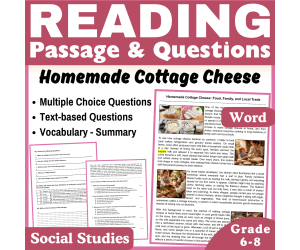
Cottage Cheese: Social Studies Reading Comprehension Passage (Word)
ELA, Reading, Reading Comprehension, Strategies, Resources for Teachers, Social Studies, Sociology, Grade 6, 7, 8, 9, Writing Prompts, Worksheets & Printables, Centers, Activities, Teacher Tools, Assessments, Quizzes and Tests, Quizzes, Tests
Cottage Cheese: Social Studies Reading Comprehension Passage (Word) This resource introduces a unique Social Studies reading comprehension passage with questions about Homemade Cottage Cheese. The passage is carefully designed to bridge the gap between social studies and literacy through strengthening reading comprehension and sparking knowledge curiosity in middle school students. Each passage blends English Language Arts skills with accurate social studies content . Ideal for interdisciplinary learning in ELA and Social Studies. Suitable for Grade 9 review, too! Student Tasks throughout the passage: 5 multiple-choice questions targeting the following skills: main idea, key details, inference, vocabulary in context, and use of evidence 5 vocabulary matching items with clear, student-friendly definitions 5 text-based questions that require citing specific lines or facts 1 summary prompt that asks students to condense central ideas accurately Full answer key for every section Available Formats for this Resource: PDF Fillable PDF Google Docs FULL CATALOG OF DOWNLOADING LINKS HERE Social Studies Reading Comprehension Collection Links: 1. Ancient Civilizations PDF Fillable PDF Word Docs Google Docs 2. Early Empires and Trade Networks PDF Fillable PDF Word Docs Google Docs 3. The Founding of the United States PDF Fillable PDF Word Docs Google Docs 4. Language, Culture, and Meaning PDF Fillable PDF Word Docs Google Docs 5. Psychology and Society PDF Fillable PDF Word Docs Google Docs 6. Global Festivals and Traditions PDF Fillable PDF Word Docs Google Docs 7. Extreme Environments and People PDF Fillable PDF Word Docs Google Docs 8. Food, Culture, and Preservation PDF Fillable PDF Word Docs Google Docs 9. Global Food Customs PDF Fillable PDF Word Docs Google Docs 10. Media, Communication, and Popular Culture PDF Fillable PDF Word Docs Google Docs 11. Human Impact on the Environment PDF Fillable PDF Word Docs Google Docs 12. Civic Action and Social Change PDF Fillable PDF Word Docs Google Docs 13. Fashion, Society, and Power PDF Fillable PDF Word Docs Google Docs 14. People, Places, and Unusual Histories PDF Fillable PDF Word Docs Google Docs Product Details: Length: 4 pages Grades: 6–8, also suitable for Grade 9 review Use cases: close reading, stations, homework, intervention, test prep, and sub plans Why Teachers Choose This Passage: Authentic social studies content paired with rigorous literacy practice Consistent task structure for easier planning and smoother student routines Clear, age-appropriate writing that builds confidence without oversimplifying Use this passage to reinforce ELA skills in social studies, to add literacy to your lessons, and to support independent work. The passage strengthens main idea, evidence use, vocabulary in context, inference, cause and effect, and summary writing. With ready-to-use assessments and complete answer keys, you can provide focused practice that is simple to run and fast to review.
Author CORED Education - Middle & High School
Rating
Tags Middle School, Reading Comprehension, Reading Strategies, ELA, Centers, Reading Passage, Assessments, Vocabulary, Social Studies, Sociology
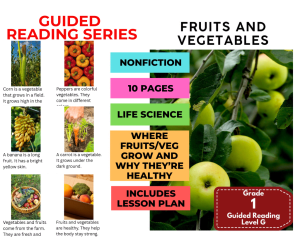
Fruits and Vegetables: Guided Reading Level G with Lesson Plan
ELA, Resources for Teachers, Reading Comprehension, Reading, Science, Language Development, Life Sciences, Health, P.E. & Health, Vocabulary, Kindergarten, Grade 1, 2, Worksheets & Printables, Worksheets, Teacher Tools, Centers, Activities, Literacy Readers, Quizzes, Quizzes and Tests, Assessments, Lesson Plans
This Fruits and Vegetables (level g) guided reading book with lesson plan includes: Guided Reading Color Label (front cover x1) This is a quick way to match the book’s demands to what students can generally handle.. The overall goal is to use the level/color to pick books for several smaller groups. To qualify for a certain level, a student is expected to read a book from that level with about 90–94% accuracy. If a student is consistently accurate and understands, move up a level. If the student is struggling at that level, drop down and add more support. Each student will improve at completely different rates, but it is generally one of the best ways to check progress across the class. DOWNLOAD THE CATALOG TO VIEW ALL GUIDED READING BOOKS AVAILABLE (SORTED LEVELS A-Z) Pre-Reading Question (x1) Teacher asks the prompt aloud, can be while showing the cover or first page. Students share what they already know, or make educated guesses from the cover. Prompt them to use the target vocabulary. Write some of their responses on the board to look back at during the reading. Vocabulary Words (x5) Introduce the five words, best doing it one at a time. Start by saying it, while students repeat and then see if anyone knows what it means before reading further. Read through the meaning and try to briefly connect each word to a picture or gesture so it’s meaningful. Ask students to flip through the book pages and point to where they see each of the vocabulary words. While reading the book pause upon coming across one of the vocab words or read the sentence twice to make sure students understand the word has appeared. Optional: Ask students to raise hands whenever they see/hear one of the new words. Guided Reading Pages (x10) Check the book snapshot (below) for: primary topic - do you need to prep extra reading or intro materials on this? what is taught best - decide on 1-2 bullets to focus on, use the prompt or words provided here for best results. learning goals - what you are checking for students to be able to do after the session, elicit answers using prompts or words provided. key vocabulary (see section above). questions overview - so you know what is coming up and if you need to prep extra materials to assist understanding. Run the lesson You may have already looked at a few of the pages together, but you can show them some of the pictures again first to set meaning. Depending on how much time you have and how familiar your students are with guided reading class, you may want to read the book aloud first with the group first. Students whisper or partner read, while you listen in. If time, do it as a group, one student reading a page each. Use the guided page’s prompts to coach: “Check the picture / does it make sense?” “Point under the words / try the first sound” “Reread the sentence smoothly”. Try to focus more on one student per session (rotating every time), so you can work out if they are ready to move up or need to move down a level. Comprehension Questions (back cover x3) This is your way to check that students didn’t just say the words, but actually understood the text. First, let students answer by pointing to the page/picture and saying a short sentence. After any answer, follow with: “Show me where you found that in the text.” In bigger groups, have partners answer first (10–20 seconds), then call on 2–3 students to share. Differentiation tips: Emerging speakers/struggling readers: oral + pointing On-level: oral in a full sentence Higher: one written sentence or draw + label Book Snapshot Title: Fruits and Vegetables Genre: Nonfiction Subject: Life Science (Plants and food) Primary Topic: Where fruits/vegetables grow and why they’re healthy Estimated Guided Reading Level (A–Z): G What This Book Teaches Best Many foods come from plants , and plants grow in the sun. Examples of fruits and where they grow (apple on a tall tree; banana with bright yellow skin). Examples of vegetables and where they grow (carrot under the ground; corn in a field; peppers in different colors; broccoli looks like a tiny tree). A simple fruit feature: most fruits have seeds inside (watermelon has many small seeds). Health connection: fruits and vegetables are healthy and help the body stay strong. Learning Goals Students will identify what the book says many foods come from. Students will describe where at least one fruit grows (example from the text). Students will describe where at least one vegetable grows (example from the text). Students will explain what the book says about seeds in fruits. Students will explain how fruits and vegetables help the body, using the book’s words. Key Vocabulary From the Text plants — living things that grow in the sun. fruit — food that can grow on a tree. vegetable — food that can grow in the ground. seeds — small parts inside fruits. healthy — good for your body. Discussion Prompts Pre-reading question: What fruits and vegetables do you already know, and where do you think they grow? Comprehension questions: What does the book say many foods come from? Comprehension questions: Where does the book say a carrot grows? Comprehension questions: How do fruits and vegetables help the body, according to the book? Printing Tips 1. Best Printing Method (Recommended) “Booklet” Printing (Best if Available) If your printer or PDF viewer supports Booklet Printing , use this. Settings to use: Print mode: Booklet Paper size: Letter or A4 (either works) Orientation: Landscape Print on both sides: Yes Flip on: Short edge Scaling: Fit to printable area Booklet subset: First test: Front sides only Then: Back sides only This will automatically: Pair pages correctly Put the cover on the outside Align everything for folding After printing, fold in half and staple along the spine . 2. If “Booklet” Printing Is NOT Available You can still print this correctly with manual duplex printing . Step-by-step: Open the PDF. Choose Print . Set: Orientation: Landscape Pages per sheet: 1 Print on both sides: Yes Flip on: Short edge Print all pages . Because each PDF page already contains two facing book pages, the result will still fold cleanly into a book. Thousands of Cored Education products are included with your TeachSimple membership. Download links and encyclopedia index available here.
Author Cored Education
Rating
Tags Reading Comprehension, Reading Passages, Reading, Guided Reading, Guided Reading Lesson Plan, Guided Reading Activity, Pre-reading, Science Lesson Plans, Life Science, Health

Milk Carton Program: Social Studies Reading Passage (Word)
ELA, Reading, Reading Comprehension, Strategies, Resources for Teachers, Social Studies, Sociology, Grade 6, 7, 8, 9, Writing Prompts, Worksheets & Printables, Centers, Activities, Teacher Tools, Assessments, Quizzes and Tests, Quizzes, Tests
Missing Children Milk Carton Program: Social Studies Reading Comprehension Passage (Word) This resource introduces a unique Social Studies reading comprehension passage with questions about The Missing Children Milk Carton Program. The passage is carefully designed to bridge the gap between social studies and literacy through strengthening reading comprehension and sparking knowledge curiosity in middle school students. Each passage blends English Language Arts skills with accurate social studies content . Ideal for interdisciplinary learning in ELA and Social Studies. Suitable for Grade 9 review, too! Student Tasks throughout the passage: 5 multiple-choice questions targeting the following skills: main idea, key details, inference, vocabulary in context, and use of evidence 5 vocabulary matching items with clear, student-friendly definitions 5 text-based questions that require citing specific lines or facts 1 summary prompt that asks students to condense central ideas accurately Full answer key for every section Available Formats for this Resource: PDF Fillable PDF Google Docs FULL CATALOG OF DOWNLOADING LINKS HERE Social Studies Reading Comprehension Collection Links: 1. Ancient Civilizations PDF Fillable PDF Word Docs Google Docs 2. Early Empires and Trade Networks PDF Fillable PDF Word Docs Google Docs 3. The Founding of the United States PDF Fillable PDF Word Docs Google Docs 4. Language, Culture, and Meaning PDF Fillable PDF Word Docs Google Docs 5. Psychology and Society PDF Fillable PDF Word Docs Google Docs 6. Global Festivals and Traditions PDF Fillable PDF Word Docs Google Docs 7. Extreme Environments and People PDF Fillable PDF Word Docs Google Docs 8. Food, Culture, and Preservation PDF Fillable PDF Word Docs Google Docs 9. Global Food Customs PDF Fillable PDF Word Docs Google Docs 10. Media, Communication, and Popular Culture PDF Fillable PDF Word Docs Google Docs 11. Human Impact on the Environment PDF Fillable PDF Word Docs Google Docs 12. Civic Action and Social Change PDF Fillable PDF Word Docs Google Docs 13. Fashion, Society, and Power PDF Fillable PDF Word Docs Google Docs 14. People, Places, and Unusual Histories PDF Fillable PDF Word Docs Google Docs Product Details: Length: 5 pages Grades: 6–8, also suitable for Grade 9 review Use cases: close reading, stations, homework, intervention, test prep, and sub plans Why Teachers Choose This Passage: Authentic social studies content paired with rigorous literacy practice Consistent task structure for easier planning and smoother student routines Clear, age-appropriate writing that builds confidence without oversimplifying Use this passage to reinforce ELA skills in social studies, to add literacy to your lessons, and to support independent work. The passage strengthens main idea, evidence use, vocabulary in context, inference, cause and effect, and summary writing. With ready-to-use assessments and complete answer keys, you can provide focused practice that is simple to run and fast to review.
Author CORED Education - Middle & High School
Rating
Tags Middle School, Reading Comprehension, Reading Strategies, ELA, Centers, Reading Passage, Assessments, Vocabulary, Social Studies, Sociology
Toothbrushes Reading Comprehension Passage - Cored Ed Encyclopedia
ELA, Language Development, Reading Comprehension, Reading, Science, Technology, Engineering, History, Social Studies, Life Sciences, Grade 2, 3, 4, 5, Worksheets & Printables, Worksheets, Teacher Tools, Centers, Activities, Writing Prompts, Assessments, Quizzes and Tests, Quizzes, Lesson Plans
This toothbrushes reading comprehension includes: Visualization (on the front cover) Start your lesson by taking a minute to think and share something about the topic. Read the script aloud (slowly), perhaps prepare some music or sound effects. Student close their eyes and let their imaginations wander. Students open their eyes, read the question aloud and give them a few minutes to complete. Ask a few students to share or keep answers until the end to compare with what they learn in the passage. Quick pause—thousands of Cored Education products are included with your TeachSimple membership. Download links and encyclopedia index available here. Pre-Reading Trivia Students will write down one thing they already know about the subject and then read five more facts and discuss. These facts are fun, and the students will enjoy learning about the subject before reading more. Give 1 minute for students to write what they already know (no pressure—best guess is fine). Read the five facts together. After each fact, do ask a student for their opinion, was it surprising? Set a purpose by asking students to highlight/underline one fact they want to learn more about during the reading. Reading Passage The text is a high-interest reading passage with set paragraphs, roughly three to four paragraphs long. It contains a variety of themes about the topic, anywhere from history to technology. The passage is between 250 and 350 words in length. First, ask students to look at the headings and see what they’ll learn about today. What do they know about the topic/heading? First read options: Teacher read-aloud (best for support). Partner reading (paragraph by paragraph). While reading, students underline important details, and vocabulary words they think may come up in the questions section. Mixed Questions The first question page contains four multiple-choice questions, each with a choice of four answers, and three written response questions that require a sentence or two from the student. Students complete the mcqs first independently, then review quickly as a class. For the 3 written responses, try to get students giving the answer with some form of evidence: “I think ___ because the text says ___.” If students get stuck, send them back to check the passage. Vocabulary Questions Practice seven key words from the text in this section across two activities. First section is scrambled words where students will unscramble three words given a clue for each. The second section is a word to meaning matching activity. Before starting, have some students read out words they underlined in the passage. Ask students to say the word and read aloud the sentence(s) around each word. Ask students to do scrambled words and the matching exercise in pairs then go through answers as a class. For the scrambled spelling task, get four pairs to come up to the board and write the words for extra practice with the other student reading out the clue. For the matching task, prompt students to give full sentences: “I matched ___ with ___ because ___.” Creative Writing In this question, the student will be required to write a five to eight sentence paragraph on a question related to the topic. Before starting, ask students write down 3 key ideas they are going to include in their piece. Ask students for ideas to share around the class to help those struggling. Pro writing expectations: 5–8 sentences At least 2 facts or details from the passage At least 2 vocabulary words from the previous page Students read their paragraphs while classmates listen for facts and vocabulary words. Extension Activities This page is optional for fast finishers or to take home. There are several activities, each one requiring a different skill. Do some, do none, do all, completely optional - but you will feel reassured knowing every possibility is planned for. Includes summary writting question. Answer Key There are answers for the multiple-choice questions, written response questions have sample answers, vocabulary answers and if there is a summary question then a sample summary will be provided as well. Lesson Plan Included Customized lesson plan for this lesson is included. Lesson Snapshot Title: Toothbrushes Genre: Nonfiction (informational text) Subject: Science (Health & Technology) Primary Topic: How toothbrushes changed over time Estimated Guided Reading Level (A–Z): R What This Lesson Teaches Best Explains how people cleaned teeth before store-bought toothbrushes by chewing a twig until it turned “fuzzy” and rubbing it on teeth. Shows how evidence from the past (archaeologists finding signs in places like Mesopotamia and Egypt) can tell us about tooth care long ago. Traces the history of the bristled brush from China’s Tang dynasty to Europe in the 1600s, highlighting how inventions travel. Describes how toothbrush designs changed to solve problems (for example, natural bristles staying damp and trapping bacteria). Summarizes key innovations—nylon bristles (1938) and the electric toothbrush (1954)—and connects them to the ongoing goal of protecting teeth. Learning Goals Students will describe how a “chew stick” was used to clean teeth long ago. Students will identify evidence in the text that people cared about clean mouths thousands of years ago. Students will explain how the bristled brush began in China and later spread to Europe. Students will summarize how toothbrush-making changed after 1780 using details about materials and design. Students will explain why inventors searched for new bristle materials and what nylon changed. Students will describe how an electric toothbrush helped brushing by adding steady motion. Key Vocabulary From the Text archaeologists — scientists who study the past using old remains. Mesopotamia — an ancient region where people lived long ago. miswak — a special stick used for cleaning teeth. patent — legal rights that protect an invention. bacteria — tiny germs that can cause problems. FULL CATALOG OF DOWNLOAD LINKS AND ENCYCLOPEDIA INDEX HERE
Author Cored Education
Rating
Tags Vocabulary, Reading Comprehension, Reading Passages, Lesson Plans, Ela Lesson Plans, Reading Comprehension Lesson Plans, Pre-reading, History, History Lesson Plans, Toothbrushes