



5,112 products added recently
Page 71 - Newest Teaching Resources

 Show filters
Physics Bell Ringers FULL YEAR - 180 Daily Warm-Ups (Grades 9-12)
Physics, Science, Grade 9, 10, 11, 12, Worksheets, Worksheets & Printables
This is a full year of physics bell-ringers - 180 short daily prompts that give high school students a steady, five-minute way to begin class. The set spans an entire course. It opens with the tools the rest of the year depends on: SI units and scientific notation, significant figures and unit conversion, the difference between a scalar and a vector, distance against displacement and speed against velocity, acceleration, the kinematic equations, reading position-time and velocity-time graphs, free fall, and projectile motion. It then turns to forces: free-body diagrams, Newton's three laws, mass and weight and the normal force, static and kinetic friction, uniform circular motion and centripetal force, universal gravitation and orbits, and momentum, impulse and collisions. The third unit covers work, energy and power: work and the joule, kinetic energy and why it depends on the square of the speed, gravitational and elastic potential energy, conservation of energy, power, simple machines and mechanical advantage, temperature against thermal energy, conduction and convection and radiation, specific heat and phase change, the gas laws, and the laws of thermodynamics. The final unit covers waves and fields: wave properties and the wave equation, reflection and refraction and diffraction and interference, sound and pitch and loudness and the Doppler effect, light and the electromagnetic spectrum, mirrors and lenses, electrostatics and Coulomb's law, current and voltage and resistance and circuits, magnetism and electromagnetism, and a first look at the wave and particle behaviour of light. Prompts are arranged into 36 weekly pages, each holding five days of work a teacher can hand out on Monday and collect on Friday. Every week rotates through the same five kinds of thinking: a term used rather than recited, a short reading with a question that requires reading it, an analysis problem, a quick multiple-choice check, and a question that asks students to state a claim and back it with evidence. On this subject the Wednesday analysis prompt is usually a calculation, and every calculation in the set resolves to a clean value - deliberately, so a warm-up stays a warm-up rather than becoming a problem set, and so a teacher can check a whole class at a glance. Correct answers on the multiple-choice day are distributed evenly across all four positions, so there is no pattern for students to guess. Every reading passage is original writing, so there is no third-party text to clear and no textbook is required. Everything is print-first: one clean PDF that copies well, uses little ink, prints two-sided so a full week fits on a single sheet, and needs no student accounts, devices or logins. A complete answer key covers all 180 prompts, and a standards page lists the NGSS high school physical science codes and the CCSS literacy in science and technical subjects codes the set actually addresses - each one earned by a recurring prompt slot or by a named block of weeks rather than claimed in general. Built for grades 9-12, and for conceptual physics as much as for the algebra-based first-year course, it works as a daily opener while attendance is taken, as an exit slip at the end of the period, as spiral review before an exam, or as ready-made work to leave for a substitute teacher on short notice.
Author Response Resources
Rating
Tags Physics Bell Ringers, Physics Warm Ups, Physics Do Now, Physics Bell Work, Physics Exit Slips, Physics Entry Ticket, High School Physics Bell Ringers, No Prep Physics, Physics Daily Starter, Physics Review
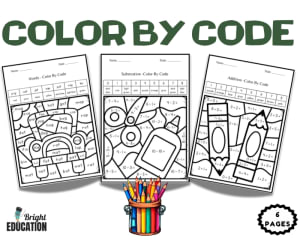
Color by Code Math Worksheets | Addition, Subtraction & Sight Words
Children’s Literature, Literature, ELA, Addition and Subtraction, Math, Grade 1, 2, Coloring Pages, Worksheets, Worksheets & Printables
Make math and literacy practice fun and engaging with this Color by Code Worksheets resource from Bright Education! This printable activity pack combines addition, subtraction, and word recognition with a motivating coloring activity that encourages students to solve problems and follow color codes carefully. With 6 pages of independent practice, students solve math equations or identify words, then use the provided color key to complete each picture. What's Included: Addition Color by Code worksheets Subtraction Color by Code worksheets Words Color by Code worksheets Clear color-code keys Addition facts within 10 Subtraction facts within 10 Word recognition and reading practice Fun mystery-picture coloring activities 6 printable pages Skills Covered: Addition fluency Subtraction fluency Number recognition Basic math facts Word recognition Early reading skills Following directions Fine motor and coloring skills Independent work habits Perfect For: Kindergarten 1st Grade Early elementary math Literacy centers Math centers Morning work Fast-finisher activities Homework Independent practice Review and reinforcement Small-group instruction Students will enjoy revealing the hidden pictures while practicing essential addition, subtraction, and word-recognition skills . This is a simple print-and-go resource that works well for classroom centers, review days, or extra practice. Format: Printable PDF Pages: 6 Subjects: Math & Literacy Grade Levels: Kindergarten–1st Grade
Author Bright Education
Rating
Tags Color By Code, Color By Number, Addition Color By Code, Subtraction Color By Code, Words Color By Code, Fine Motor Skills
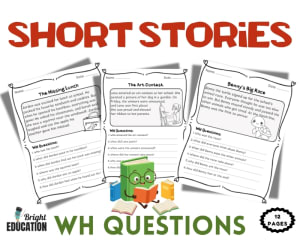
Short Stories Reading Comprehension | WH Questions Worksheets
Reading Comprehension, Reading, ELA, Children’s Literature, Literature, Grade 1, 2, Templates, Teacher Tools
Short Stories Reading Comprehension | WH Questions Worksheets – Fiction Passages Make reading practice fun and engaging with this Short Stories Reading Comprehension activity pack. Designed for elementary learners, this printable resource includes short fiction stories and WH questions that help students develop reading comprehension, understand story details, and practice answering questions using information from a text. Students will read a variety of short stories featuring interesting characters and everyday situations. The stories include The Missing Lunch, The Art Contest, and Benny’s Big Race , giving students opportunities to explore different events, characters, and story settings while building their reading skills. After reading each passage, students answer comprehension questions that focus on important details from the story. The WH questions encourage learners to identify who, what, when, where, why, and how information. These activities help students improve their understanding of fiction texts, locate answers in a passage, and develop confidence in written responses. This resource includes 12 printable pages of short stories and reading comprehension activities. The worksheets feature simple reading passages, engaging illustrations, and writing lines for students to complete their answers. The clear and organized format makes the activities easy to use during literacy lessons or independent reading practice. Ideal for elementary reading instruction, literacy centers, morning work, early finishers, or homework, this no-prep resource provides meaningful practice with short stories and WH questions. What’s Included: 12 printable reading comprehension pages Short fiction reading passages The Missing Lunch story The Art Contest story Benny’s Big Race story WH comprehension questions Who, what, when, where, why, and how questions Story detail identification practice Reading and written response activities Student-friendly printable layouts Ideal For: Reading comprehension practice Short stories and fiction passages WH questions Reading worksheets Story details and understanding Elementary literacy lessons Reading centers Independent reading practice Morning work Early finisher activities Homework assignments Classroom or homeschool use Help students strengthen their reading comprehension and develop confidence in answering questions with this engaging Short Stories Reading Comprehension worksheet pack.
Author Bright Education
Rating
Tags Short Stories, Reading Comprehension, WH Questions, Reading Passages, Fiction Reading, Elementary Reading, 1st Grade, Printable Worksheets, No Prep
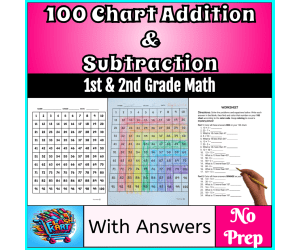
Hundreds (100s) Chart Addition & Subtraction Mystery Picture Reveal
Math, Addition and Subtraction, Addition, Subtraction, Basic Operations, Early Math, Numbers, Grade 1, 2, Worksheets & Printables, Worksheets
100 Chart Addition & Subtraction Mystery Picture | 1st & 2nd Grade Math Practicing addition and subtraction can sometimes feel repetitive for students. I designed this activity to make math practice fun! Students use a hundreds chart to solve math problems and reveal a colorful mystery picture . What's Inside? I created this printable 100 chart mystery picture activity with a mix of addition and subtraction questions connected to numbers on the 100 chart. Students will practice: Adding 10 Subtracting 10 Finding 10 more Finding 10 less Adding numbers such as +2 and +7 Subtracting numbers such as -3 and -5 Solving addition and subtraction problems within 100 After solving each question, students will find the answer on their hundreds chart and color it according to the color code. As they keep solving and coloring, a Rainbow Right Angles shape will appear! Best suited for: 1st and 2nd Grade Math Resource Features 100 chart addition and subtraction practice +10 and -10 practice 10 more and 10 less practice Addition and subtraction within 100 Color by answer activity Mystery picture reveal No-prep printable activity Answer key is included Simple format that is easy for students to follow Ways to Use It I designed this resource to be flexible, so you can use it in several ways: Independent math practice Math centers Morning work Small-group practice Addition and subtraction review 100 chart practice Early finisher activity Homework Homeschool math At-home practice Students can solve the problems and color the 100 chart independently, or you can have them work with a partner and check their answers before coloring. Why I Created This Resource I wanted to create a math activity that gives students a reason to keep solving instead of feeling like they are simply completing another worksheet. The mystery picture adds a little excitement while students practice important addition, subtraction, and 100 chart skills . I also kept the activity simple and easy to print, so it can be used without a lot of preparation. Common Core Connections This resource supports skills related to: CCSS 1.NBT.C.5: Given a two-digit number, mentally find 10 more or 10 less than the number. CCSS 2.NBT.B.5: Fluently add and subtract within 100 using strategies based on place value and properties of operations. CCSS 2.NBT.B.8: Mentally add and subtract 10 or 100 to a given number. 100 chart addition and subtraction Addition within 100 Subtraction within 100
Author FlashKart
Rating
Tags Hundreds Chart, Math, Color By Answer, Addition, Subtraction, Picture Reveal, Elementary Math, 1st Grade, 2nd Grade, Basic Operations

Emergency Translation Pocket Grids
Research, Resources for Teachers, Classroom Management, Community Building, Science, Life Sciences, Life Studies, Career, Leadership, STEM, Grade 6, 7, 8, 9, 10, 11, 12, Worksheets & Printables, Workbooks, Worksheets, Word Searches, Teacher Tools, Assessments, Lesson Plans, Quizzes and Tests, Quizzes, Tests
Empower your students to navigate any crisis abroad with confidence! This comprehensive pre-departure safety curriculum is the essential resource every study abroad student, parent, and university coordinator needs. What happens when a student faces a real emergency in a foreign country—a stolen passport, a sudden allergic reaction, a missed train—and their phone is dead, has no signal, or the translation app fails? Panic sets in, and crucial language skills disappear. Introducing the Emergency Translation Pocket Grids : a revolutionary, tech-proof communication system designed for high-stress situations. Based on cognitive load theory, this system bypasses digital failures and the memory collapse that occurs during a crisis. Instead of fumbling with a phone, students use a simple, foldable "point-and-communicate" grid to instantly and clearly state their needs in pharmacies, train stations, and police stations. This is more than just a phrasebook; it's a complete crisis-preparedness curriculum. WHAT'S INCLUDED (30-Page PDF): Part 1: The Theoretical Framework: A detailed introduction explaining the psychology of crisis communication and the "Tri-Sector Emergency Navigation Framework" (Pharmacy, Train Station, Police Station). Perfect for pre-departure seminars. Part 2: The Student Workbook: Ten meticulously designed worksheets that guide students through personalizing their own pocket grids. They'll research and translate critical phrases for medical needs, transit emergencies, and police interactions, turning theory into a life-saving, personalized tool. Part 3: Teacher Resources & Visuals: A complete instructor's guide with evaluation rubrics, pedagogical notes, and high-resolution visual aids (flowcharts and diagrams) to enhance pre-departure training and ensure students are truly prepared. IDEAL FOR: University & College Pre-Departure Orientations Study Abroad Program Coordinators High School Exchange Program Leaders Parents of students traveling abroad Independent students seeking robust safety preparation Don't just hope your students will be safe. Equip them with the skills and the tool to manage emergencies, de-escalate difficult situations, and turn a potential crisis into a manageable problem. Download today and provide the ultimate peace of mind! Keywords: Study Abroad Safety, Emergency Translation, Travel Safety Kit, Student Travel Guide, Pre-Departure Training, University Resource, College Safety, High School, College, Language Barrier, Crisis Communication, International Travel, Pharmacy Translation, Police Report Abroad. Why Parents/Schools Love It : Tech-Proof & Reliable: It works when phone batteries die, there’s no Wi-Fi in a subway, or a digital app fails. It’s a foolproof analog backup that provides true peace of mind. Reduces Panic & Empowers Students: In a crisis, memory fails. These grids replace fear and fumbling with a clear, simple, point-and-communicate method, giving students agency and control. Builds Real-World Skills: This is not just a vocabulary list. The workbook teaches students critical thinking, proactive research, situational awareness, and cross-cultural de-escalation tactics—skills that last a lifetime. Comprehensive & Proactive Preparation: It addresses the three most common and stressful emergency scenarios (medical, transit, security) with a structured, academic approach, moving students from a state of vulnerability to resilience. Target Student Audience : Based on the language, content, and structure, target the following audiences: Primary Target: University/College Students. The PDF explicitly mentions "university student," "study abroad program," "capstone project," and uses academic language (e.g., "cognitive load theory," "jurisprudence"). This is perfectly tailored for students (ages 18-22) preparing for or currently on a semester/year abroad. Secondary Target: University/School Administrators. The inclusion of "Part 3: Visuals & Teacher Resources" makes this a turnkey solution for Study Abroad Coordinators, International Program Directors, and Pre-Departure Orientation Leaders. They are a key purchasing audience as they can buy this for their entire cohort of students. Tertiary Target: Parents of Traveling Students. Parents are a highly motivated market for safety and peace-of-mind products. They will purchase this for their child. Niche Target: Advanced High School Students. While the language is advanced, this could be marketed to students in rigorous programs like the International Baccalaureate (IB) or those participating in high school exchange programs. Copyright/Terms of Use: This Book was copyrighted by Syed Hammad Rizvi. This resource is for personal and single classroom use only. You may not alter, redistribute, or sell any part of this resource. In other words, you may not put it on the Internet where it could be publicly found and downloaded. If you want to share this resource with colleagues, please purchase additional licenses from Teachsimple. Thank you for respecting these terms of use. This product is happily brought to you by Syed Hammad Rizvi
Author Creative Book Store
Rating
Tags EmergencyTranslation, TravelSafetyKit, StudyAbroadSafety, PrintableGuide, LanguageBarrier, CrisisCommunication, AnalogSolution, TechProofTravel, TravelPrep, PocketGrid

US State Presentation on Montana
Social Studies, Economics, First Peoples (Native), Geography, History: USA, History, Middle School, Not Grade Specific, High School, Adult Education, Presentations, Teacher Tools, Lesson Plans
US State Presentation on Minnesota Bring the United States to life in your classroom with this engaging US State Presentation on Montana , a ready-to-use digital resource designed for Geography, Social Studies, and US History classes from 7th grade through 12th grade . This presentation provides students with a clear, structured introduction to one US state while combining essential geographical, historical, economic, and cultural information in an accessible format. This US State Presentation on Montana , includes: The resource begins with a general introduction to the state , helping students understand its location, identity, and importance within the United States. Students then explore the state's borders and neighboring states , making it easier to place it within the broader geography of the country. A general data section introduces key facts such as population, area, population density, capital city, and other essential statistics , providing a useful foundation for further study. A paragraph that explores the history of this US state , highlighting important events, periods, people, and developments that have shaped its identity. This section is particularly useful for US History lessons because it allows students to connect state-level history with major events and themes in American history. A Geography section examines the state's physical characteristics, including its territory, landscapes, natural features, environment, and climate. Students can discover how mountains, rivers, plains, forests, coastlines, deserts, or other geographical characteristics have influenced settlement and human activity. A presentation also introduces the state's economy , explaining its major economic sectors, industries, natural resources, agricultural activities, and other economic strengths. This provides an excellent opportunity to connect geography with economics and understand why particular industries have developed in different parts of the United States. A dedicated section focuses on the capital city , introducing its importance as a political and administrative center. Students can also learn about other important cities , discovering major urban centers and their roles in business, transportation, education, culture, tourism, or industry. A paragraoh that explores culture , giving students an opportunity to learn about traditions, food, music, celebrations, landmarks, historical heritage, and other characteristics that contribute to the state's unique identity. This digital US State Presentation on Montana is ideal for classroom instruction, student research, geography units, US History lessons, Social Studies activities, state studies, homework, review activities, and independent learning. Its organized structure makes it suitable for middle school and high school students , while its broad range of topics encourages students to view a state from multiple perspectives. Whether you are teaching a unit on the United States, American Geography, US History, state studies, or regional culture , this resource offers a convenient and engaging way to help students explore the diversity and complexity of the United States. Perfect for: Geography Classes, Social Studies Classes, US History Classes, Middle School, High School, Grades 7–12, State Studies, American Studies, Homeschooling, Student Research, and Digital Learning. Learning with Alan is an educational resource store created to help teachers, educators, and tutors reach their teaching goals while building a fun, engaging, and stimulating learning environment . Because learning should always be meaningful—and fun! 🎓✨ If you want to browse more of my Teaching Resources, click here Learning with Alan!!
Author Learning with Alan
Rating
Tags Social Studies, Geography, USA, United States Of America, US History, US State, Montana, Yellowstone, Lesson, Introduction

Grade 5 Science Seasons & Adaptations Workbook | Printable activities
Science, Basic Science, Life Sciences, Earth and Environmental Sciences, Grade 5, 6, 7, 8, Worksheets & Printables, Worksheets, Dot To Dots
Help Grade 5 learners explore seasons, weather changes, plant and animal adaptations, predator and prey adaptations, and survival with this engaging printable science workbook. This 30-page Grade 5 Science resource is designed to support classroom teaching, revision, homework, homeschool learning, and independent practice. Learners are encouraged to observe, compare, investigate, apply scientific ideas, and explain how living things survive in different environments. 🔬 Topics covered: Earth, orbit and seasons Seasonal changes Plant and animal adaptations Adaptations to different environments Predator and prey adaptations Survival and scientific investigation Unit review and reflection ✨ Perfect for: Teachers • Homeschooling • Science Revision • Classroom Activities • Homework • Independent Learning 📚 Grade: 5 🧪 Subject: Science 📖 Topic: Seasons and Adaptations of Plants and Animals 📄 Format: Printable PDF 🎯 Use: Classroom, homework, revision, homeschool and science practice Give your learners meaningful activities that help them understand science rather than simply memorise facts .
Author Tracebloom Learning
Rating
Tags Grade 5 Science, Seasons And Weather, Season Worksheet, Weather Worksheet, Science Activities, Home School Resources, Tracebloom Learning
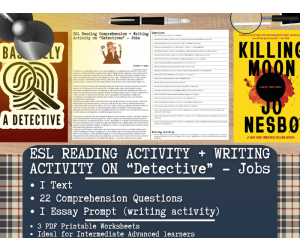
ESL Reading Comprehension + Writing Activity - Detective - Jobs
ELA, Language Development, ESL, Vocabulary, Reading Comprehension, Reading, Creative Writing, Writing, Formal Writing, Middle School, Not Grade Specific, High School, Adult Education, Worksheets & Printables, Worksheets, Writing Prompts
ESL Reading Comprehension + Writing Activity Worksheets - Detective - Jobs This ESL - EFL Teaching Resource on " Detective - Jobs " (3 PDF Worksheets Slides - Reading Comprehension + Writing Activity) can be ideal to improve Language skills in English. Ideal students for this ESL EFL TESOL Reading + Writing Activity are Foreign Students at middle and High School ( 7th - 12th Grade; teens ) . Newcomers or any ESL Learner is also more than suitable for this ESL - EFL - TESOL - TEFL (English as a Second or Foreign Language) Activity on " Detective - Jobs " ( Introduction + origins and history of this profession + experience and education needed + various types of this job + what it consists of + interviews ). This Teaching Educational Resource Product can also be ideal for ESL EFL TESOL Centers worldwide or any English second language tutor. Intermediate Advanced English as a Second or Foreign Language ( ESL - EFL - TESOL - TEFL ) learners are suitable for this ESL - EFL - TESOL - TEFL Teaching Resource on " Detective - Jobs " (Worksheet; 3 PDF Printable slides) In this English Second or Foreign Language ( ESL - EFL - TESOL - TEFL ) Reading Comprehension + Essay Writing Activity Worksheet on " Detective - Jobs " ( Introduction + origins and history of this profession + experience and education needed + various types of this job + what it consists of + interviews ), the following ESL - EFL - TESOL - TEFL ( English Second or Foreign Language ) activities are included: 1 text on " Detective - Jobs " ( Introduction + origins and history of this profession + experience and education needed + various types of this job + what it consists of + interviews ) 22 Comprehension Questions related to the previous text on " Detective - Jobs " ( with related space where students can answer to this text's comprehension questions ) 1 essay prompt for a writing activity on " Detective - Jobs " ( writing an essay on your own personal opinion on this job and whether you would ever like to become a Detective or not and why ) This ESL - EFL - TESOL - TEFL ( English Second or Foreign Language ) Teaching Resource Reading + Writing Activity ( essay prompts ) on " Detective - Jobs " ( Introduction + origins and history of this profession + experience and education needed + various types of this job + what it consists of + interviews ) is great for Intermediate Advanced English as a second or foreign language learners ( ESL- EFL - TESOL - TEFL ). This English Second Language Worksheet on " Detective - Jobs " ( Introduction + origins and history of this profession + experience and education needed + various types of this job + what it consists of + interviews ) aims to train and Reading Comprehension + Writing Skills. "Learning with Alan" is a teaching resources store that aims to provide high quality teaching resources and educational materials for ESL - EFL - TESOL ( English Second or Foreign Language ) teachers, tutors and educators. It aims to support teachers, educators, and tutors in both online and offline environments, helping them achieve their teaching goals while creating a fun, stimulating atmosphere for learning English. Always remember: learning is fun, and so is English! If you want to find more ESL - EFL - TESOL - TEFL ( English Second or Foreign Language ) Teaching Resources and Educational Material click here Learning with Alan!
Author Learning with Alan
Rating
Tags ESL, EFL, English Second Language, Reading Comprehension, Writing Activity, Detective, Jobs, Activity, Printable, Worksheets

Parts of Speech | Adjectives | High School Grammar Worksheet (Word)
Common Core, ELA, Language Development, ESL, Grammar, Spelling, Resources for Teachers, Grade 8, 9, 10, 11, 12, Centers, Activities, Teacher Tools, Assessments, Quizzes and Tests, Quizzes, Tests, Worksheets & Printables, Worksheets
Parts of Speech: Adjectives | High School Grammar Worksheet (Word Document) Help your students strengthen their grammar skills with this focused Parts of Speech: Adjectives worksheet designed for high school learners. This resource gives students meaningful practice identifying and using adjectives while also reviewing comparative, superlative, predicate, proper, and quantity forms. The worksheet includes 20 multiple-choice questions spread across 6 pages covering comparative and superlative adjectives, predicate adjectives, proper adjectives, quantity adjectives, irregular adjective forms, adjective identification, and correct adjective usage in context . Students also practice correcting common adjective errors and recognizing when words such as those, some, and each function as adjectives. Students will practice choosing correct comparative and superlative forms, identifying predicate and proper adjectives, distinguishing adjectives from other parts of speech, and applying adjective rules naturally in complete sentences rather than relying only on simple definitions. Other Formats: PDF Fillable PDF Google Docs This worksheet covers the following adjective skills: Identifying comparative and superlative adjectives Forming regular and irregular comparisons Correcting double comparisons such as more easier Choosing between comparative and superlative forms based on context Identifying predicate adjectives Recognizing proper adjectives Distinguishing adjectives from other parts of speech Identifying when words such as those, some, and each function as adjectives Using quantitative adjectives such as little and less Choosing the correct form of irregular adjectives such as good, better, best Correcting incorrect adjective forms such as more bad / worse Using farther correctly in comparisons Recognizing adjectives that describe nouns and pronouns Identifying adjectives in context Distinguishing adjective use from noun or verb use Applying adjective forms naturally in complete sentences Editing sentences for correct adjective usage Recognizing appropriate high-school-level adjective choices in context This resource includes: 20 multiple-choice questions Full answer key Suitable for Grades 8–12 This worksheet will help your students strengthen their grammar skills and build confidence in their writing. It works well for English Language Arts classes, grammar review, bell ringers, homework, substitute plans, independent work, and skill reinforcement . Looking for more? Explore the store for a growing collection of grammar resources and engaging reading comprehension passages designed to strengthen literacy skills across ELA and content-area learning. You’ll find practice activities, informational texts, comprehension questions, vocabulary work, and more resources created to make lesson planning easier and student practice more meaningful. ** Click here to check Middle and High School Resources ** You may also be interested in these resources from the store: Life Science Reading Comprehension Passages and Questions (6th, 7th, 8th Grade) Physical Science Reading Comprehension Passages and Questions (6th, 7th, 8th Grade) Earth Science Reading Comprehension Passages and Questions (6th, 7th, 8th Grade) Social Studies Reading Comprehension Passages and Questions (6th, 7th, 8th Grade)
Author EduNation Creative Store
Rating
Tags High School, Grammar, Worksheets, Common Core, ESL, Nouns, Middle School, Adjectives, Comparative Adjectives, Superlative Adjectives

Parts of Speech | Adjectives | HS Grammar Worksheet Fillable PDF
Common Core, ELA, Language Development, ESL, Grammar, Spelling, Resources for Teachers, Grade 8, 9, 10, 11, 12, Centers, Activities, Teacher Tools, Assessments, Quizzes and Tests, Quizzes, Tests, Worksheets & Printables, Worksheets
Parts of Speech: Adjectives | High School Grammar Worksheet (Fillable PDF) Help your students strengthen their grammar skills with this focused Parts of Speech: Adjectives worksheet designed for high school learners. This resource gives students meaningful practice identifying and using adjectives while also reviewing comparative, superlative, predicate, proper, and quantity forms. The worksheet includes 20 multiple-choice questions spread across 6 pages covering comparative and superlative adjectives, predicate adjectives, proper adjectives, quantity adjectives, irregular adjective forms, adjective identification, and correct adjective usage in context . Students also practice correcting common adjective errors and recognizing when words such as those, some, and each function as adjectives. Students will practice choosing correct comparative and superlative forms, identifying predicate and proper adjectives, distinguishing adjectives from other parts of speech, and applying adjective rules naturally in complete sentences rather than relying only on simple definitions. This worksheet is designed as a fillable PDF , which means students can type their answers directly into the document on any computer or tablet . Each page includes highlighted text fields that show them exactly where to type! Other Formats: PDF Word Docs Google Docs This worksheet covers the following adjective skills: Identifying comparative and superlative adjectives Forming regular and irregular comparisons Correcting double comparisons such as more easier Choosing between comparative and superlative forms based on context Identifying predicate adjectives Recognizing proper adjectives Distinguishing adjectives from other parts of speech Identifying when words such as those, some, and each function as adjectives Using quantitative adjectives such as little and less Choosing the correct form of irregular adjectives such as good, better, best Correcting incorrect adjective forms such as more bad / worse Using farther correctly in comparisons Recognizing adjectives that describe nouns and pronouns Identifying adjectives in context Distinguishing adjective use from noun or verb use Applying adjective forms naturally in complete sentences Editing sentences for correct adjective usage Recognizing appropriate high-school-level adjective choices in context This resource includes: 20 multiple-choice questions Full answer key Suitable for Grades 8–12 This worksheet will help your students strengthen their grammar skills and build confidence in their writing. It works well for English Language Arts classes, grammar review, bell ringers, homework, substitute plans, independent work, and skill reinforcement . Looking for more? Explore the store for a growing collection of grammar resources and engaging reading comprehension passages designed to strengthen literacy skills across ELA and content-area learning. You’ll find practice activities, informational texts, comprehension questions, vocabulary work, and more resources created to make lesson planning easier and student practice more meaningful. ** Click here to check Middle and High School Resources ** You may also be interested in these resources from the store: Life Science Reading Comprehension Passages and Questions (6th, 7th, 8th Grade) Physical Science Reading Comprehension Passages and Questions (6th, 7th, 8th Grade) Earth Science Reading Comprehension Passages and Questions (6th, 7th, 8th Grade) Social Studies Reading Comprehension Passages and Questions (6th, 7th, 8th Grade)
Author EduNation Creative Store
Rating
Tags High School, Grammar, Worksheets, Common Core, ESL, Nouns, Middle School, Adjectives, Comparative Adjectives, Superlative Adjectives
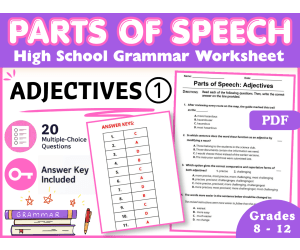
Parts of Speech | Adjectives | High School Grammar Worksheet (PDF)
Common Core, ELA, Language Development, ESL, Grammar, Spelling, Resources for Teachers, Grade 8, 9, 10, 11, 12, Centers, Activities, Teacher Tools, Assessments, Quizzes and Tests, Quizzes, Tests, Worksheets & Printables, Worksheets
Parts of Speech: Adjectives | High School Grammar Worksheet (PDF) Help your students strengthen their grammar skills with this focused Parts of Speech: Adjectives worksheet designed for high school learners. This resource gives students meaningful practice identifying and using adjectives while also reviewing comparative, superlative, predicate, proper, and quantity forms. The worksheet includes 20 multiple-choice questions spread across 6 pages covering comparative and superlative adjectives, predicate adjectives, proper adjectives, quantity adjectives, irregular adjective forms, adjective identification, and correct adjective usage in context . Students also practice correcting common adjective errors and recognizing when words such as those, some, and each function as adjectives. Students will practice choosing correct comparative and superlative forms, identifying predicate and proper adjectives, distinguishing adjectives from other parts of speech, and applying adjective rules naturally in complete sentences rather than relying only on simple definitions. Other Formats: Fillable PDF Word Docs Google Docs This worksheet covers the following adjective skills: Identifying comparative and superlative adjectives Forming regular and irregular comparisons Correcting double comparisons such as more easier Choosing between comparative and superlative forms based on context Identifying predicate adjectives Recognizing proper adjectives Distinguishing adjectives from other parts of speech Identifying when words such as those, some, and each function as adjectives Using quantitative adjectives such as little and less Choosing the correct form of irregular adjectives such as good, better, best Correcting incorrect adjective forms such as more bad / worse Using farther correctly in comparisons Recognizing adjectives that describe nouns and pronouns Identifying adjectives in context Distinguishing adjective use from noun or verb use Applying adjective forms naturally in complete sentences Editing sentences for correct adjective usage Recognizing appropriate high-school-level adjective choices in context This resource includes: 20 multiple-choice questions Full answer key Suitable for Grades 8–12 This worksheet will help your students strengthen their grammar skills and build confidence in their writing. It works well for English Language Arts classes, grammar review, bell ringers, homework, substitute plans, independent work, and skill reinforcement . Looking for more? Explore the store for a growing collection of grammar resources and engaging reading comprehension passages designed to strengthen literacy skills across ELA and content-area learning. You’ll find practice activities, informational texts, comprehension questions, vocabulary work, and more resources created to make lesson planning easier and student practice more meaningful. ** Click here to check Middle and High School Resources ** You may also be interested in these resources from the store: Life Science Reading Comprehension Passages and Questions (6th, 7th, 8th Grade) Physical Science Reading Comprehension Passages and Questions (6th, 7th, 8th Grade) Earth Science Reading Comprehension Passages and Questions (6th, 7th, 8th Grade) Social Studies Reading Comprehension Passages and Questions (6th, 7th, 8th Grade)
Author EduNation Creative Store
Rating
Tags High School, Grammar, Worksheets, Common Core, ESL, Nouns, Middle School, Adjectives, Comparative Adjectives, Superlative Adjectives

Addition & Subtraction Using Number Lines Worksheets | Math Practice
Addition and Subtraction, Math, Grade 1, 2, Templates, Teacher Tools
Help students build confidence with addition and subtraction using number lines with this engaging, print-and-go math worksheet resource! This 17-page activity pack provides focused practice with counting forward and backward on number lines, solving addition and subtraction problems, and filling in missing numbers. The activities are designed to strengthen number sense, counting skills, and basic addition and subtraction fluency . What's Included: Addition using number lines Subtraction using number lines Missing numbers on number lines Addition and subtraction within 10 Visual number-line practice Mixed addition and subtraction problems Printable student worksheets 17 pages of math practice Perfect For: Kindergarten Math 1st Grade Math Early elementary students Math centers Independent practice Morning work Homework Review and reinforcement Small-group instruction Math intervention Students can use the number lines as a visual strategy to count forward for addition and backward for subtraction , making abstract math concepts easier to understand. Skills Covered: Addition, subtraction, number lines, counting, number sense, missing numbers, and basic math facts.
Author Bright Education
Rating
Tags Number Lines, Addition, , Addition, Substraction, Math Worksheets, Kindergarten Math, First Grade Math, , Elementary Math, Missing Numbers
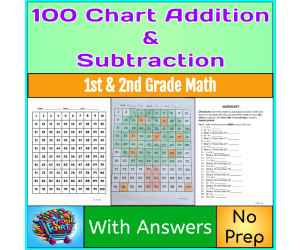
100 Chart Mystery Picture Reveal Math Worksheets | 10 More 10 Less
Math, Basic Operations, Early Math, Numbers, Grade 1, 2, Worksheets, Worksheets & Printables
Eliminating the boredom of repetitive math drills was my top priority when I designed this 100s chart mystery picture activity . I created this resource for first and second graders to make building mental math fluency fun, engaging, and rewarding. As students solve a mix of 10 more , 10 less , and mixed addition and subtraction equations, a vibrant leafy orange tree shape is revealed on their grid . This resource is suitable for 1st Grade and 2nd Grade (also works wonderfully for Kindergarten enrichment or 3rd Grade intervention). What's Inside? 1 Printable 100 Chart Grid Worksheet Color by code Math Task Page: A mix of mental math prompts I put together, including +10, -10, +4, -5, +9, and -8 questions (such as "What is 6 + 10? Color it Orange" and *"What is 10 more than 9? Color it Green"). Answer Key Resource Features: No-prep: Just print and go format Self-Checking Mystery Reveal: Students receive instant visual feedback-if their orange tree looks right at the end, they know their math is spot on! Multi-Skill Mental Math: This resource blends key place value practice (10 more / 10 less) with single-digit and multi-digit addition and subtraction . Fine Motor & Color Integration: These worksheets keep young learners focused and refreshed by combining number sense practice with coloring. How to Use This Resource in Various Ways: Math Centers / Station Activity: Set these worksheets in independent learning centers for self-paced practice. Morning Work: Start your morning with this fun yet brain-stimulating resource! Early Finisher Task: Keep fast finishers productively occupied while reinforcing 100 chart mental math. Sub Plans: I designed this set with a clear and simple layout, making it ideal to drop right into your substitute teacher folder. Homework: Straightforward instructions mean kids can work through it independently at home. How It Is Useful for Teachers, Homeschoolers, and Parents? For teachers: It saves their valuable Lesson Prep Time Teachers can use it as a no-prep math activity, while homeschoolers and parents can use it to provide extra practice with addition , subtraction , number patterns , and number sense within 100. High-Engagement Format of this set turns standard number sense drills into an exciting art discovery project your kids will ask to do again. Common Core Standards: CCSS 1.NBT.C.5: Given a two-digit number, mentally find 10 more or 10 less than the number. CCSS 2.NBT.B.5: Fluently add and subtract within 100 using strategies based on place value and properties of operations. CCSS 2.NBT.B.8: Mentally add and subtract 10 or 100 to a given number.
Author FlashKart
Rating
Tags Math, 100 Chart, Addition, Subtraction, 1st Grade Math, 2nd Grade Math, Color By Code, Add, Subtract, +10
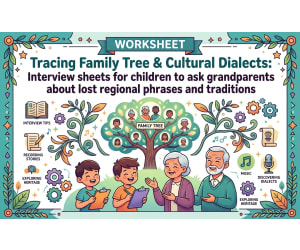
Tracing Family Tree & Cultural Dialects
Social Studies, History, History: World, Sociology, Resources for Teachers, Classroom Management, Community Building, Social Emotional Learning (SEL), Special Resources, Social Skills, Grade 4, 5, 6, 7, 8, 9, 10, Worksheets & Printables, Workbooks, Worksheets, Word Searches, Teacher Tools, Lesson Plans, Quizzes and Tests, Quizzes, Tests, Assessments
Transform your Social Studies, ELA, or History class with this profound and engaging Intergenerational Oral History Project . Go beyond the standard family tree and empower your students to become family archivists, preserving the priceless cultural and linguistic heritage hidden in their own families. This comprehensive curriculum guides students to interview their grandparents or elder relatives, uncovering the lost regional dialects, forgotten traditions, and unique family stories that are fading with time. It's not just a project; it's an act of cultural reclamation and a powerful bonding experience. Perfect for Middle School and High School students, this resource is also ideal for homeschooling families and heritage language learners seeking a deeper connection to their roots. What's Included in this 33-Page PDF? Part 1: The Educator's Guide (Introduction & Methodology): A robust 10-page guide for parents and teachers explaining the "why" and "how." It covers the pedagogy of cultural reclamation, the psychology of memory, and provides case studies for context. Part 2: The Student Workbook (13 Pages): The heart of the project! This section includes: 10 Themed Worksheets: With over 100 carefully crafted, sensory-based questions to guide the student interview. Topics include: Geography & Early Origins The Culinary Lexicon & Kitchen Traditions Playtime Terminology & Socialization Proverbs, Maxims, & Moral Linguistics And 6 more deeply researched themes! A Final Synthesis Worksheet: To encourage reflection and a collaborative summary between the student and their grandparent. Part 3: Teacher Implementation & Assessment (10 Pages): Everything you need to facilitate and grade this project with confidence. Conceptual Visuals: Three powerful diagrams to help students visualize abstract concepts like "Anatomy of a Regional Phrase." Teacher Implementation Guide: Practical, step-by-step advice on pre-interview scaffolding, handling sensitive topics (like cognitive decline), and leading a classroom synthesis. Comprehensive Assessment Rubrics: Detailed qualitative rubrics to assess student work on depth, reflection, and effort—not just right or wrong answers. This project is a perfect fit for units on Cultural Heritage, Family History, Primary Sources, Immigration, Linguistics, Social Studies, and English Language Arts (ELA). Give your students the tools to create a family artifact they will treasure for a lifetime. Why Parents/Schools Love It: Creates Powerful Family Connections: It provides a structured, meaningful reason for children to sit down and listen to their elders, bridging the generational gap and strengthening family bonds. Teaches Real-World Research Skills: Students learn authentic qualitative research skills, including how to conduct an interview, listen actively, take effective notes, and synthesize information from a primary source. Preserves Priceless Heritage: This project transforms fleeting memories and dying dialects into a permanent, tangible "Familial Lexicon" that the family can preserve and pass down for generations. Comprehensive and Turnkey: It is a complete, ready-to-use curriculum. The detailed teacher's guide, student worksheets, and assessment rubrics make it incredibly easy for educators and parents to implement effectively. Builds Empathy and Cultural Identity: By becoming the "expert" on their own family's history, students develop a profound sense of pride, identity, and empathy for the experiences of others. Target Audience (Student Classes) : Based on the academic language of the teacher's guide and the depth of the inquiry, target the following: Primary Target: Middle School (Grades 6-8) and High School (Grades 9-12) . Specific Subjects: Social Studies / History: Excellent for units on immigration, cultural studies, primary sources, and personal/family history. English Language Arts (ELA): Perfect for units on narrative writing, interviews, voice, and non-fiction. Sociology / Anthropology: An ideal introductory project for high school-level sociology or anthropology classes. World Languages / ESL (for Heritage Learners): Invaluable for students who speak a language at home but have lost touch with its regional dialects and cultural specifics. Secondary Target: Gifted and Talented Elementary (Grades 4-5) with significant teacher or parent guidance. It is also exceptionally well-suited for Homeschooling Co-ops and Families . Copyright/Terms of Use: This Book was copyrighted by Syed Hammad Rizvi. This resource is for personal and single classroom use only. You may not alter, redistribute, or sell any part of this resource. In other words, you may not put it on the Internet where it could be publicly found and downloaded. If you want to share this resource with colleagues, please purchase additional licenses from Teachsimple. Thank you for respecting these terms of use. This product is happily brought to you by Syed Hammad Rizvi
Author Creative Book Store
Rating
Tags IntergenerationalProject, OralHistoryProject, GrandparentInterview, FamilyHistoryProject, CulturalHeritage, FamilyDialects, PreservingHistory, FamilyStories, FamilyTraditions, HeritageLearner

Multiplying Decimals Worksheets | Decimal Multiplication Math Practice
Multiplication, Multiplication and Division, Math, Decimals, Grade 3, 4, Quizzes and Tests, Teacher Tools
Multiplying Decimals Worksheets | Decimal Multiplication Math Practice & Review Help students build confidence with decimal multiplication using this printable math practice activity pack. Designed for elementary and middle school learners, this resource provides focused practice with multiplying decimals by 10, 100, and 1,000, as well as solving decimal multiplication problems with whole numbers and other decimals. Students will work through a variety of multiplication exercises that help them understand how decimal values change when multiplied by powers of 10. The worksheets also include missing-number problems, encouraging learners to think carefully about place value, decimal points, and multiplication relationships. This activity pack includes 13 pages of printable worksheets with different levels of decimal multiplication practice. Students can begin with multiplying decimals by 10, 100, and 1,000, then move on to more challenging problems involving decimal factors such as 0.82, 2.08, 12.9, and other decimal values. The worksheets provide an organized way to reinforce multiplication skills and develop accuracy when working with decimals. They are useful for math lessons, independent practice, homework, small-group instruction, or review before an assessment. With clear layouts and plenty of practice questions, this resource gives students an opportunity to strengthen their understanding of decimal multiplication at their own pace. What's Included: 13 printable multiplying decimals worksheets Multiplying decimals by 10 practice Multiplying decimals by 100 practice Multiplying decimals by 1,000 practice Decimal multiplication with whole numbers Multiplying decimal numbers by decimal numbers Missing-number multiplication exercises Place value and decimal point practice Math review worksheets Student-friendly printable layouts Ideal For: Decimal multiplication lessons Multiplying by powers of 10 Decimal math review Place value practice Math fact reinforcement Independent math practice Small-group instruction Homework assignments Math centers Test preparation Classroom or homeschool use
Author Bright Education
Rating
Tags Multiplying Decimals, Decimal Worksheets, Math Worksheets, Decimal Math, Math Review, Place Value, Multiplication Practice, Elementary Math
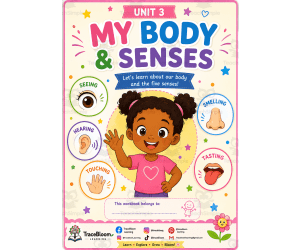
👀👂👃👅✋ How Do We Explore the World Around Us? | Grade 1 My Body & S
Science, Basic Science, Inventors, Theories, Grade 1, 2, 3, 4, Worksheets & Printables, Worksheets, Dot To Dots
Children discover the answer as they learn about their body parts and five senses with this engaging Grade 1 Science My Body & Senses printable workbook from TraceBloom Learning. 🌸🔬 Our bodies help us explore, understand and respond to the world around us every day. This activity-led workbook introduces young learners to important body parts and the five senses — sight, hearing, smell, taste and touch through familiar examples and simple, age-appropriate activities. 👀 Inside the workbook, learners explore: 🧍 Common body parts and their functions 👀 Sight — using our eyes to see colours, shapes, objects and the world around us 👂 Hearing — using our ears to hear sounds 👃 Smell — using our nose to notice different smells 👅 Taste — using our tongue to experience different tastes ✋ Touch — using our skin to feel different textures and sensations 🔎 How our senses help us observe and learn about our surroundings 🧠 Making connections between different body parts and the senses they help us use 📝 Simple activities involving identifying, matching, observing, drawing and thinking The activities encourage children to look carefully, listen closely, notice different smells, think about tastes and explore textures. Rather than simply memorising the five senses, learners are encouraged to connect science learning with real-life experiences . Young scientists can think about questions such as: What can I see? What sounds can I hear? What does something smell like? How does it taste? How does it feel? These simple questions help children develop their observation skills, scientific vocabulary, curiosity and ability to describe what they experience . This printable workbook is perfect for Grade 1 science lessons, homeschool learning, tutoring, homework, classroom activities, revision and independent practice . It can also be used as an engaging introduction to the human body and five senses . 🌟 Help children discover that science isn't only found in a laboratory — their own bodies are part of the amazing world they are learning to explore! ✨ Look. Listen. Smell. Taste. Touch. Discover! 🔬🌸 📚 Explore more TraceBloom Learning printable resources for Math • Science • English • Early Learning .
Author Tracebloom Learning
Rating
Tags Garde 1 Science, Five Senses, Human Body , Homeschool Resources, Teachers Resources, Sense Organs, Human Body For Kids, Science For Kids, Tracebloom Learning

What Are Everyday Objects Made Of? | Grade 1 Science Materials Work
Science, Basic Science, Inventors, Theories, Grade 1, 2, 3, 4, Worksheets & Printables, Workbooks, Worksheets, Coloring Pages, Dot To Dots
Let young scientists investigate the materials they see and use every day with this engaging Grade 1 Science Materials printable workbook from TraceBloom Learning ! 🌍🔬 Children interact with materials constantly, from the pencils they write with and the spoons they eat with to the bottles they drink from and the chairs they sit on. This workbook helps young learners begin to understand that everyday objects are made from different materials and that each material has properties that make it useful for particular purposes. Through simple, age-appropriate activities, learners explore common materials and compare their properties. 🧱 Inside the workbook, learners explore: 🌳 Wood and everyday wooden objects 🥄 Metal and objects made from metal 🧴 Plastic and familiar plastic objects 💪 Materials that are hard ☁️ Materials that are soft 🪨 Materials that feel rough ✨ Materials that feel smooth 🔎 Comparing the properties of different materials 💡 Understanding why different materials are suitable for different uses 🧪 Completing a simple materials investigation using familiar everyday objects 📝 Identifying, sorting, observing, comparing, and recording materials The activities encourage children to use their senses and observation skills while developing early scientific vocabulary. Learners can look closely at objects, think about how they feel, compare their properties, and consider why a particular material might have been chosen to make an object. For example, why might a spoon be made from metal? Why might a toy be made from plastic? Why could wood be useful for making a chair or pencil? These everyday connections help children understand that the properties of materials are linked to how and why they are used. This printable workbook is ideal for Grade 1 science classrooms, homeschool learning, tutoring, homework, revision, independent practice, early science centres, and hands-on observation activities . It provides a simple and engaging way to introduce young learners to materials and their properties while encouraging curiosity, observation, comparison, and scientific thinking. 🌟 ✨ Look closely. Feel, compare and investigate. Think like a scientist! 🔬 📚 Explore more TraceBloom Learning printable resources for Math • Science • English • Early Learning . #Grade1Science #MaterialsScience #ScienceActivities #TeachersResources #TraceBloomLearning
Author Tracebloom Learning
Rating
Tags Materials, Science Grade 1, Science Activities, Teachers Resources, Homeschool Resource

🌦️ Become a Little Weather Watcher! | Grade 1 Science Weather & Seaso
Science, Earth and Environmental Sciences, Grade 1, 2, 3, 4, Worksheets & Printables, Drawing Templates & Outlines, Worksheets, Coloring Pages, Crosswords Puzzles, Dot To Dots
Help young learners discover the world around them with this engaging Grade 1 Science Weather & Seasons printable workbook from TraceBloom Learning ! 🌍🔬 Weather is something children experience every day, making it a wonderful topic for introducing young learners to science through observation, discussion, matching, drawing, sorting, and simple investigations. This activity-led workbook helps Grade 1 learners explore weather, wind, temperature, changing weather, and the four seasons through simple, child-friendly activities designed to build scientific understanding step by step. ☀️ Inside the workbook, learners explore: 🌤️ What weather is and how we describe it ☀️ Sunny weather ☁️ Cloudy weather 🌧️ Rainy weather 💨 Wind and how we can observe it 🌡️ Hot and cold temperatures 🌦️ How weather can change 🌸 The four seasons ☀️ Summer 🍂 Autumn ❄️ Winter 🌷 Spring 👕 Choosing suitable clothing for different seasons 🔎 Simple weather observations and investigations 📝 Opportunities to draw, match, identify, sort, and record observations The activities are designed to help young scientists connect science concepts to everyday life . Instead of simply memorising facts, learners are encouraged to look at the weather around them, notice changes, think about what they observe, and communicate their ideas. This resource is ideal for Grade 1 teachers, homeschool families, tutors, parents, science centres, classroom revision, homework, independent practice, and early science learning . Whether you are introducing a new science unit, reinforcing classroom learning, preparing learners for assessment, or looking for meaningful printable activities, this workbook provides a practical and engaging way to explore Weather & Seasons . 🌦️📚 ✨ Observe the weather. Explore the seasons. Ask questions. Think like a scientist! 🔬 📚 Explore more TraceBloom Learning printable resources for Math • Science • English • Early Learning .
Author Tracebloom Learning
Rating
Tags Weather, Weather And Season, Science For Kids, Weather For Kids, Home Resources, Tracebloom Learning, Grade 1 Science, Grade 2 Science
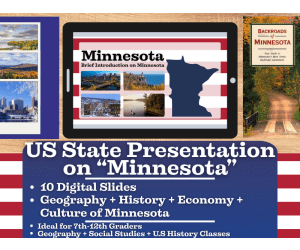
US State Presentation on Minnesota
Social Studies, Economics, First Peoples (Native), Geography, History: USA, History, Middle School, Not Grade Specific, High School, Teacher Tools, Presentations, Lesson Plans
US State Presentation on Minnesota Bring the United States to life in your classroom with this engaging US State Presentation on Minnesota , a ready-to-use digital resource designed for Geography, Social Studies, and US History classes from 7th grade through 12th grade . This presentation provides students with a clear, structured introduction to one US state while combining essential geographical, historical, economic, and cultural information in an accessible format. This US State Presentation on Minnesota , includes: The resource begins with a general introduction to the state , helping students understand its location, identity, and importance within the United States. Students then explore the state's borders and neighboring states , making it easier to place it within the broader geography of the country. A general data section introduces key facts such as population, area, population density, capital city, and other essential statistics , providing a useful foundation for further study. A paragraph that explores the history of this US state , highlighting important events, periods, people, and developments that have shaped its identity. This section is particularly useful for US History lessons because it allows students to connect state-level history with major events and themes in American history. A Geography section examines the state's physical characteristics, including its territory, landscapes, natural features, environment, and climate. Students can discover how mountains, rivers, plains, forests, coastlines, deserts, or other geographical characteristics have influenced settlement and human activity. A presentation also introduces the state's economy , explaining its major economic sectors, industries, natural resources, agricultural activities, and other economic strengths. This provides an excellent opportunity to connect geography with economics and understand why particular industries have developed in different parts of the United States. A dedicated section focuses on the capital city , introducing its importance as a political and administrative center. Students can also learn about other important cities , discovering major urban centers and their roles in business, transportation, education, culture, tourism, or industry. A paragraoh that explores culture , giving students an opportunity to learn about traditions, food, music, celebrations, landmarks, historical heritage, and other characteristics that contribute to the state's unique identity. This digital US State Presentation on Minnesota is ideal for classroom instruction, student research, geography units, US History lessons, Social Studies activities, state studies, homework, review activities, and independent learning. Its organized structure makes it suitable for middle school and high school students , while its broad range of topics encourages students to view a state from multiple perspectives. Whether you are teaching a unit on the United States, American Geography, US History, state studies, or regional culture , this resource offers a convenient and engaging way to help students explore the diversity and complexity of the United States. Perfect for: Geography Classes, Social Studies Classes, US History Classes, Middle School, High School, Grades 7–12, State Studies, American Studies, Homeschooling, Student Research, and Digital Learning. Learning with Alan is an educational resource store created to help teachers, educators, and tutors reach their teaching goals while building a fun, engaging, and stimulating learning environment . Because learning should always be meaningful—and fun! 🎓✨ If you want to browse more of my Teaching Resources, click here Learning with Alan!!
Author Learning with Alan
Rating
Tags Social Studies, Geography, USA, United States Of America, US History, US State, Minnesota, Lesson, Introduction, Presentation

Parts of Speech | Nouns 2 | High School Grammar Worksheet (Word)
Common Core, ELA, Language Development, ESL, Grammar, Spelling, Resources for Teachers, Grade 8, 9, 10, 11, 12, Centers, Activities, Teacher Tools, Assessments, Quizzes and Tests, Quizzes, Tests, Worksheets & Printables, Worksheets
Parts of Speech: Nouns (2) | High School Grammar Worksheet (Word Document) Help your students strengthen their grammar skills with this focused Parts of Speech: Nouns worksheet designed for high school learners. This resource gives students meaningful practice identifying and classifying different types of nouns while also reviewing plural and possessive forms. The worksheet includes 20 multiple-choice questions (spread across 6 pages ) covering common nouns, proper nouns, abstract nouns, concrete nouns, collective nouns, compound nouns, plural nouns, and possessive nouns . The questions use age-appropriate vocabulary and sentence contexts suitable for secondary students, making the activity useful for grammar review, independent practice, homework, intervention, or test preparation. Students will practice distinguishing noun types, recognizing correct plural forms, identifying possessive constructions, and applying grammar knowledge in context rather than relying only on simple definitions. Other Formats: PDF Fillable PDF Google Docs This resource includes: 20 multiple-choice questions Common and proper nouns Abstract and concrete nouns Collective and compound nouns Singular and plural noun forms Possessive nouns Irregular and compound plurals Full answer key Suitable for Grades 8–12 This worksheet will help your students strengthen their grammar skills and build confidence in their writing. It works well for English Language Arts classes, grammar review, bell ringers, homework, substitute plans, independent work, and skill reinforcement . Looking for more? Explore the store for a growing collection of grammar resources and engaging reading comprehension passages designed to strengthen literacy skills across ELA and content-area learning. You’ll find practice activities, informational texts, comprehension questions, vocabulary work, and more resources created to make lesson planning easier and student practice more meaningful. ** Click here to check Middle and High School Resources ** You may also be interested in these resources from the store: Life Science Reading Comprehension Passages and Questions (6th, 7th, 8th Grade) Physical Science Reading Comprehension Passages and Questions (6th, 7th, 8th Grade) Earth Science Reading Comprehension Passages and Questions (6th, 7th, 8th Grade) Social Studies Reading Comprehension Passages and Questions (6th, 7th, 8th Grade)
Author EduNation Creative Store
Rating
Tags High School, Grammar, Worksheets, Common Core, ESL, Nouns, Types Of Nouns, Common And Proper Nouns, Abstract And Concrete Nouns, Collectibe And Compound Nouns

Parts of Speech | Nouns 2 | High School Grammar Worksheet (PDF)
Common Core, ELA, Language Development, ESL, Grammar, Spelling, Resources for Teachers, Grade 8, 9, 10, 11, 12, Centers, Activities, Teacher Tools, Assessments, Quizzes and Tests, Quizzes, Tests, Worksheets & Printables, Worksheets
Parts of Speech: Nouns (2) | High School Grammar Worksheet (PDF) Help your students strengthen their grammar skills with this focused Parts of Speech: Nouns worksheet designed for high school learners. This resource gives students meaningful practice identifying and classifying different types of nouns while also reviewing plural and possessive forms. The worksheet includes 20 multiple-choice questions (spread across 6 pages ) covering common nouns, proper nouns, abstract nouns, concrete nouns, collective nouns, compound nouns, plural nouns, and possessive nouns . The questions use age-appropriate vocabulary and sentence contexts suitable for secondary students, making the activity useful for grammar review, independent practice, homework, intervention, or test preparation. Students will practice distinguishing noun types, recognizing correct plural forms, identifying possessive constructions, and applying grammar knowledge in context rather than relying only on simple definitions. Other Formats: Fillable PDF Word Docs Google Docs This resource includes: 20 multiple-choice questions Common and proper nouns Abstract and concrete nouns Collective and compound nouns Singular and plural noun forms Possessive nouns Irregular and compound plurals Full answer key Suitable for Grades 8–12 This worksheet will help your students strengthen their grammar skills and build confidence in their writing. It works well for English Language Arts classes, grammar review, bell ringers, homework, substitute plans, independent work, and skill reinforcement . Looking for more? Explore the store for a growing collection of grammar resources and engaging reading comprehension passages designed to strengthen literacy skills across ELA and content-area learning. You’ll find practice activities, informational texts, comprehension questions, vocabulary work, and more resources created to make lesson planning easier and student practice more meaningful. ** Click here to check Middle and High School Resources ** You may also be interested in these resources from the store: Life Science Reading Comprehension Passages and Questions (6th, 7th, 8th Grade) Physical Science Reading Comprehension Passages and Questions (6th, 7th, 8th Grade) Earth Science Reading Comprehension Passages and Questions (6th, 7th, 8th Grade) Social Studies Reading Comprehension Passages and Questions (6th, 7th, 8th Grade)
Author EduNation Creative Store
Rating
Tags High School, Grammar, Worksheets, Common Core, ESL, Nouns, Types Of Nouns, Common And Proper Nouns, Abstract And Concrete Nouns, Collectibe And Compound Nouns

New Grade 5 Science Resource | Forces & Magnetism
Science, Basic Science, Grade 5, 6, 7, 8, Worksheets & Printables, Worksheets
Make science more active, practical and meaningful with the new TraceBloom Learning Grade 5 Forces & Magnetism Activity-Led Workbook ! 🌸 This 30-page science resource is designed to help Grade 5 learners build strong scientific understanding while developing the skills they need to think and work like young scientists. The workbook explores important concepts related to forces and magnetism , including: • Gravity, normal force and applied force • Gravity and satellites • Friction and different types of resistance • Air resistance and other forces that oppose motion • Upthrust • Multiple forces acting on objects • Magnets and magnetic materials • Magnetic force and attraction • Fair testing and scientific investigations • Identifying variables • Force diagrams • Recording observations and data • Reading and representing data using graphs • Making predictions and observations • Analysing results • Drawing evidence-based conclusions Rather than functioning as a traditional learner textbook, this workbook follows an activity-led approach . Learners are encouraged to actively engage with science through prediction, investigation, observation, recording, comparison, analysis and application . Activities are designed to give learners opportunities to connect scientific ideas with situations they can observe in everyday life. They can explore how forces affect movement, investigate friction and resistance, think about how magnets interact with different materials, interpret simple scientific data and communicate their findings using appropriate scientific language. The workbook also introduces important scientific investigation skills , helping learners understand why fair tests are important, how variables can affect an investigation, how evidence can be recorded clearly, and how conclusions should be based on results rather than guesses. Whether you are a classroom teacher, homeschool educator, tutor or parent looking for additional Grade 5 science practice, this resource can be used for classroom activities, independent work, revision, science centres, homework or additional practice. 🌸 TraceBloom Learning — Explore • Investigate • Discover Created with a focus on clear explanations, purposeful activities and practical scientific thinking , TraceBloom Learning resources are designed to help learners move beyond simply remembering facts and begin using science to question, investigate, reason and explain . 📚 Explore more TraceBloom Learning resources and build your science collection today!
Author Tracebloom Learning
Rating
Tags FORCES AND MAGNETISM, FORCES, MAGNETS, SCIENCE, GRADE 5, MAGNETISM, GRADE 5 SCIENCE, GRADE 6 SCIENCE, GRADE 7 SCIENCE, HOMESHOOLING

102 Minutes Inside the Towers 9/11 Worksheet + Google Forms
History: USA, History, Social Studies, Grade 9, 10, 11, 12, Worksheets, Worksheets & Printables
Keep students watching and writing the whole way through with this fill-in-the-blank worksheet for 102 Minutes Inside the Towers (History Channel, 2026). The 35 questions follow the video in the order it plays, so students record each answer as that moment happens on screen instead of reconstructing it afterward — which holds their attention and leaves them with an organized set of notes to study from later. Built for US History, it is a natural fit for US History classes (grades 9-12) teaching September 11 and post-9/11 America -- the single most reliably taught calendar moment in the survey, amplified by the 25th anniversary, and Government and current-issues classes covering terrorism, emergency response and homeland security policy. The film runs about 102 minutes, so the sheet is built to carry a multi-day study or a longer viewing block rather than a single sitting. Use it as a full-period viewing activity, a guided companion when you hand the room to a substitute, or a focused review at the end of a unit. A complete answer key is printed on the final page, so whoever is covering the class can run it with no preparation and no background knowledge. The 3-pages layout is clean and low-ink, designed to print two-sided. One practical note before you plan the lesson: this is survivor testimony from inside the World Trade Center, and the film carries footage and firsthand accounts that some classes will find hard to watch. Screen it yourself first and decide what your own room needs set up in advance. The worksheet itself is anchored to the documented record — what happened and when, how the buildings and their exits worked, how the emergency response unfolded, and the decisions people made under pressure — so nothing on the page asks a student to write about injury or death. If it works well for your students, a quick rating wherever you downloaded it helps other teachers find it. Questions or a correction are always welcome at contact@responseresources.studio .
Author Response Resources
Rating
Tags 102 Minutes Inside The Towers, 9/11, September 11, 9/11 25th Anniversary, World Trade Center, Twin Towers, September 11 Documentary, US History, Documentary Worksheet, Movie Guide

Integrated Science Bell Ringers Unit 4 - 45 Daily Warm-Ups
Physics, Science, Grade 6, 7, 8, Worksheets, Worksheets & Printables
These integrated science bell-ringers give middle school students a calm, consistent way to begin class. Unit 4 gathers 45 short prompts on physical science core & year review, arranged as nine weekly pages a teacher can hand out each Monday and collect on Friday. The set is written for schools that teach one general science course a year rather than a separate life science year, Earth science year and physical science year, so the strands are sequenced to live together in a single course instead of being split apart. Each day asks something different. Monday introduces a term and asks students to use it, not just recite it. Tuesday supplies two or three sentences of real science and a question that can only be answered by reading them. Wednesday poses an analysis problem or a short calculation, worked the way a scientist would work it. Thursday is a quick multiple-choice check a teacher can scan in seconds. Friday asks for a claim supported by evidence, which is the reasoning skill the standards care most about and the one students get the least practice with. That variety keeps a daily routine from going stale while still reinforcing properties and states of matter, atoms, elements and the periodic table, chemical change and conservation of mass, motion, speed and acceleration, forces, gravity and Newton's laws, work, energy and energy transformations, waves, sound and light, heat, electricity and magnetism, and a closing cross-strand review that ties all three strands back together. The quantitative prompts were written deliberately so that every answer resolves to a whole number, which keeps a warm-up to five minutes and keeps the key beyond dispute. Everything is print-first: a clean PDF that copies well, uses little ink, prints two-sided so a full week fits on one sheet, and needs no student accounts, devices, or logins. A complete answer key covers all 45 prompts, and a standards page lists the NGSS middle school codes and the CCSS literacy in science codes the set actually addresses. Designed for grades 6-8, the prompts work as a daily opener while attendance is taken, as an exit slip at the end of the period, as spiral review before a test, or as ready-made work to leave for a substitute. Teachers who want the whole course can buy the full-year set of 180 prompts, of which this unit is one quarter.
Author Response Resources
Rating
Tags Integrated Science Bell Ringers, Middle School Science Warm Ups, Integrated Science Warm Ups, Daily Science Bell Ringers, Science Exit Slips, Science Do Now, Science Bell Work, Science Entry Ticket, No Prep Science, Science Daily Starter